REVIEW 4 major objections 5 minor 13 references
Precision Minimally-destructive detection of ultra-cold atomic ensembles
T0 review · 4 major / 5 minor · reviewed 2026-08-07 · deepseek-v4-flash
Pith's one-line read Demodulating the Faraday rotation of off-resonant light at the TOP trap's field rotation frequency yields a precise, minimally destructive atom-number measurement for ultra-cold ensembles.
desk verdict Clever modulation idea that is real and new, but the paper sells a precision measurement without the data to back it up. read the letter →
The pith
A machine-rendered reading of the paper's core claim, the machinery that carries it, and where it could break.
The reading
What carries the argument
The load-bearing element is the Time-Orbiting Potential (TOP) trap, a magnetic trap formed by a quadrupole field plus a bias field rotating in a plane, which confines atoms by time-averaging. In this design the rotating bias field also serves as a modulation carrier: the atomic spin vector is assumed to follow the field's direction, so the Faraday rotation of a probe beam traveling through the plane of rotation is sinusoidally modulated at the rotation frequency. A lock-in amplifier demodulates the normalized polarimetry signal at that frequency, converting the spin-aligned atom number into a DC amplitude that sits away from low-frequency technical noise. The same physical field that traps the atoms therefore supplies the modulation, so no separate phase modulator or interferometer is needed.
What would settle it
Compare the demodulated Faraday amplitude with the atom number measured by destructively imaging the same cloud afterwards, for clouds of different sizes: the central claim predicts a linear, zero-intercept proportionality whose slope does not change with probe power or TOP rotation frequency; a substantial nonlinearity or a power-dependent slope would falsify the spin-following assumption.
Extended reading notes
Core claim
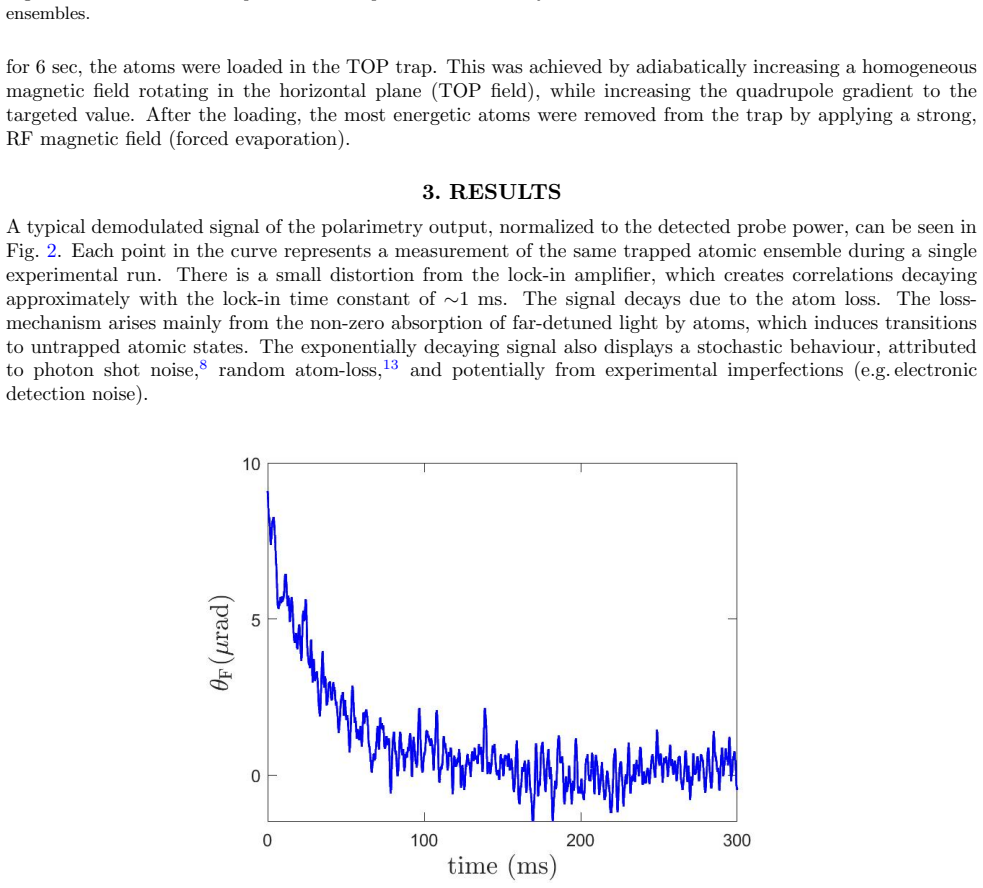
The central claim is that in a TOP-trapped, spin-polarized ensemble the Faraday rotation angle $\theta_F$ of a far-detuned probe is proportional to the total spin component $F_x$ along the probe direction, and hence to the atom number $N_{\rm at}$, and that the same rotating field that forms the trap modulates this signal so that $\theta_F \propto F_x \propto N_{\rm at}$ oscillates at the field-rotation frequency. Demodulating the balanced polarimetry output $S_2 \approx \Phi G F_x$ with a lock-in amplifier at that frequency moves the measurement from DC to audio frequencies, where technical noise is smaller, and yields a time-resolved trace of atom loss. The paper presents preliminary measurements of an exponentially decaying demodulated signal from a single trapped ensemble, with the decay attributed mainly to residual absorption of the probe light, and argues that the method can prepare ensembles of a desired atom number and support quantum-enhanced measurements.
Load-bearing premise
The atomic spins must follow the TOP trap's rotating magnetic field faithfully (adiabatically), so the Faraday signal is a clean sine wave at the rotation frequency whose amplitude is proportional to atom number.
Editorial extensions
If this is right
- An experimenter can monitor atom number during a single run with little heating, enabling feedback preparation of a cloud of a target size.
- Lock-in demodulation at the TOP rotation frequency moves the measurement away from low-frequency technical noise, improving precision over a DC Faraday readout.
- Because the trap itself provides the modulation, no extra optical modulators or interferometric reference arms are required in the detection path.
- The method is compatible with starting an interferometer sequence with a known atom number and with quantum-enhanced measurement protocols that need the quantum state preserved.
Reading between the lines
- A natural extension the paper does not demonstrate is a feedback loop that actively stabilizes atom number from run to run, using the demodulated signal as the error variable.
- The lock-in output could serve as a diagnostic of spin dynamics: unexpected harmonics or phase shifts as the TOP rotation frequency is varied would reveal incomplete adiabatic following.
- If the spin-following assumption holds generally, the same scheme should transfer to any time-averaged trap that imposes a known periodic field direction, not only to the TOP trap.
- Reaching the shot-noise-limited precision promised by the underlying method would require dealing with the ~1 ms temporal correlations the lock-in introduces; the paper does not show sub-shot-noise resolution on this system.
Editorial analysis
A structured set of objections, weighed in public.
Referee Report
Summary. The paper reports a technique for minimally destructive atom-number measurement of ultra-cold 87Rb ensembles, based on Faraday polarimetry with lock-in detection at the rotation frequency of a TOP magnetic trap. Section 2 models the measured Stokes component S2 as proportional to photon flux and the ensemble spin projection Fx (Eq. 1), assuming atoms are in a well-defined Zeeman state whose spin adiabatically follows the rotating TOP field. The only experimental evidence is a single demodulated signal decay trace in Section 3 (Fig. 2), attributed to probe-induced atom loss. The abstract claims a precise, minimally destructive measurement suitable for preparing atom-number states and for quantum-enhanced metrology.
Significance. If fully validated, the approach would be a technically simple addition to many cold-atom experiments: locking the detection to the TOP rotation frequency moves the Faraday signal out of the low-frequency noise band, and the method builds on well-established dispersive detection. The paper should be credited for recognizing this frequency-shifting opportunity and for framing the readout in the standard Faraday formalism. However, the presented results are preliminary to the point that the central claims are not yet supported: there is no atom-number calibration, no zero-atom background, no noise floor or precision quantification, and no demonstration of minimal destructiveness. The significance of the paper as it stands is therefore limited to a plausible proposal with an illustrative trace, not a demonstrated measurement technique.
major comments (4)
- [Section 3, Fig. 2] The only reported experimental evidence is a single demodulated decay trace, with no atom-number calibration, no independent destructive count, no zero-atom background, and no reproducibility data. The vertical axis is not linked to N_at, so the trace cannot distinguish an atomic Faraday signal from spurious polarization modulation at the TOP rotation frequency (e.g., magnetic pickup or fiber birefringence). This is the central unsupported step in the claim that the method yields a precise atom-number measurement.
- [Section 2, Eq. (1)] The proportionality θ_F ∝ N_at depends critically on the assumptions that atoms are in a well-defined Zeeman state and that the atomic spin adiabatically follows the rotating TOP field. Neither assumption is verified or bounded: no Larmor precession rate relative to the rotation frequency is given, and no measurement of spin dynamics or of the demodulated amplitude versus a known spin state is reported. Without this link, the demodulated amplitude cannot be interpreted as N_at.
- [Section 3, Fig. 2 and atom-loss discussion] The decay is attributed to probe-induced absorption loss, but the manuscript provides no measurement of the loss rate, no comparison of the ensemble temperature or coherence between probed and unprobed ensembles, and no demonstration on the timescale of an interferometer sequence. The abstract's claim of 'negligible effect on the ensemble temperature and ... minimal decoherence' is therefore an expectation, not a demonstrated result.
- [Title, abstract, and Section 4] The term 'precision' is never quantified. There is no single-shot noise assessment, no Allan deviation or variance of repeated measurements, no signal-to-noise ratio, and no comparison with an independent atom-counting method. The 'precise' claim cannot be evaluated from the presented data.
minor comments (5)
- [Section 2, Eq. (1)] G is not defined in the manuscript; please provide its explicit form or a precise pointer to the definition in Ref. [8].
- [Fig. 2] The axes and units are unspecified; state what is plotted (normalized lock-in output?) and give the probe parameters for the run.
- [Section 3 heading] The heading contains a typo, 'RESUL TS'. Also, the single trace is described as 'typical' without stating how many runs were recorded or how representative this trace is.
- [Abstract vs. Section 1] The abstract states 'we report on a precise ... technique' while Section 1 calls the results 'preliminary'. Please align the abstract with the actual level of validation presented.
- [References] Reference [1] is a citation to an online manifesto; please replace it with a citable scholarly source or remove it.
Circularity Check
No circularity: the lock-in Faraday readout follows from standard light-atom coupling and is not fitted to its own output.
full rationale
The derivation chain rests on Eq. (1), S2 = ΦGFx, which expresses the measured Stokes component in terms of the Faraday coupling constant G and the ensemble spin Fx. This is a standard result imported from the cited literature, not a fitted relation; the subsequent statement that θ_F ∝ N_at follows from the assumption of a well-defined Zeeman state and adiabatic spin following in the TOP trap, which is an external physical assumption rather than a consequence of the measured signal. The lock-in demodulation at the trap rotation frequency is an experimental technique that selects the signal component at that frequency; the claim that this component is proportional to N depends on the spin-tracking assumption, not on a parameter fit to the atom-number data. No parameter is fitted to a subset of the data and then used to predict a closely related quantity, and no load-bearing result is justified solely by self-citation. The paper's weaknesses are empirical: the single decay trace is not calibrated against an independent atom-number measurement, the zero-atom background is not shown, and the adiabatic-following assumption is not directly verified. These are correctness and evidence concerns, not circularity. The central claim has independent physical content, so the appropriate circularity score is 0.
Assumptions & free parameters
assumptions (3)
- domain assumption For a far-detuned probe, S2 ≈ Φ G Fx (Eq. 1).
- domain assumption Atomic spin follows the TOP rotating field.
- domain assumption Probe intensity is homogeneous over the cloud to within 1%.
Cite this review
Pith. "Pith review of Precision Minimally-destructive detection of ultra-cold atomic ensembles." pith.science (2026). https://pith.science/paper/4LI4WDNS
@misc{pith2026250605125,
  author       = {Pith},
  title        = {Pith review of: Precision Minimally-destructive detection of ultra-cold atomic ensembles},
  year         = {2026},
  howpublished = {\url{https://pith.science/paper/4LI4WDNS}},
  note         = {Machine review of arXiv:2506.05125}
}
read the original abstract
Over the last two decades the cold-atom physics has matured from proof-of-principle demonstrations to a versatile platform for precision measurements and study of quantum phenomena. Ultra-cold atomic ensembles have been used both for technological and fundamental science applications. To fully exploit their potential, a precise measurement and control of the atom number in the ensemble is crucial. We report on a precise, minimally-destructive measurement technique that can be used to prepare an atomic ensemble with a desired atom number. The measurement relies on the dispersive light-atom interaction, thus it is expected to have a negligible effect on the ensemble temperature and to induce minimal decoherence in the atomic quantum state. As a result, it can be used to perform quantum-enhanced measurements and prepare the atom-number state at the start of an interferometer sequence.
Figures

Reference graph
Works this paper leans on
-
[1]
Quantum manifesto, a new era of technology
A. de Touzalin, C. Marcus, F. H. I. C. R. M. . T. C., “Quantum manifesto, a new era of technology.” Retrieved from http://qurope.eu/manifesto
-
[2]
Quantum technology: the second quantum revolution,
MacFarlane, A. G. J., Dowling, J. P., and Milburn, G. J., “Quantum technology: the second quantum revolution,”Philosophical Transactions of the Royal Society of London. Series A: Mathematical, Physical and Engineering Sciences361(1809), 1655–1674 (2003)
work page 2003
-
[3]
Dispersive detection of atomic ensembles in the presence of strong lensing,
Deb, A. B., Chung, J., and Kjærgaard, N., “Dispersive detection of atomic ensembles in the presence of strong lensing,”New Journal of Physics22, 073017 (jul 2020)
work page 2020
-
[4]
Measurement noise 100 times lower than the quantum-projection limit using entangled atoms,
Hosten, O., Engelsen, N. J., Krishnakumar, R., and Kasevich, M. A., “Measurement noise 100 times lower than the quantum-projection limit using entangled atoms,”Nature529, 505–508 (Jan 2016)
work page 2016
-
[5]
Propagation of sound in a bose-einstein condensate,
Andrews, M. R., Kurn, D. M., Miesner, H.-J., Durfee, D. S., Townsend, C. G., Inouye, S., and Ketterle, W., “Propagation of sound in a bose-einstein condensate,”Phys. Rev. Lett.79, 553–556 (Jul 1997)
work page 1997
-
[6]
Direct, nondestructive observation of a bose condensate,
Andrews, M. R., Mewes, M.-O., van Druten, N. J., Durfee, D. S., Kurn, D. M., and Ketterle, W., “Direct, nondestructive observation of a bose condensate,”Science273(5271), 84–87 (1996)
work page 1996
-
[7]
Preparation of ultracold atom clouds at the shot noise level,
Gajdacz, M., Hilliard, A. J., Kristensen, M. A., Pedersen, P. L., Klempt, C., Arlt, J. J., and Sherson, J. F., “Preparation of ultracold atom clouds at the shot noise level,”Phys. Rev. Lett.117, 073604 (Aug 2016)
work page 2016
-
[8]
Quantum interface between light and atomic ensembles,
Hammerer, K., Sørensen, A. S., and Polzik, E. S., “Quantum interface between light and atomic ensembles,” Rev. Mod. Phys.82, 1041–1093 (Apr 2010)
work page 2010
Show all 13 references
-
[9]
Stable, tightly confining magnetic trap for evaporative cooling of neutral atoms,
Petrich, W., Anderson, M. H., Ensher, J. R., and Cornell, E. A., “Stable, tightly confining magnetic trap for evaporative cooling of neutral atoms,”Phys. Rev. Lett.74, 3352–3355 (Apr 1995)
1995
-
[10]
Aedge: Atomic experiment for dark matter and gravity exploration in space,
El-Neaj, Y. A., Alpigiani, C., and Amairi-Pyka, S. e. a., “Aedge: Atomic experiment for dark matter and gravity exploration in space,”EPJ Quantum Technology7, 6 (Mar 2020)
2020
-
[11]
Elgar—a european laboratory for gravitation and atom-interferometric re- search,
Canuel, B. and et al, S. A., “Elgar—a european laboratory for gravitation and atom-interferometric re- search,”Classical and Quantum Gravity37, 225017 (oct 2020)
2020
-
[12]
Rapid production of rb-87 bose-einstein condensates in a combined magnetic and optical potential,
Lin, Y., Perry, A., Compton, R., Spielman, I., and Porto, J., “Rapid production of rb-87 bose-einstein condensates in a combined magnetic and optical potential,”Physical Review A79(6) (2009)
2009
-
[13]
Generation and detection of a sub-poissonian atom number distribution in a one-dimensional optical lattice,
B´ eguin, J.-B., Bookjans, E. M., Christensen, S. L., Sørensen, H. L., M¨ uller, J. H., Polzik, E. S., and Appel, J., “Generation and detection of a sub-poissonian atom number distribution in a one-dimensional optical lattice,”Phys. Rev. Lett.113, 263603 (Dec 2014)
2014
Reviewed August 7, 2026 · model on record in the stance chip above.
Discussion (0). Continue with ORCID to comment.