REVIEW 5 major objections 6 minor 17 references
A Framework for Ethical Judgment of Smart City Applications
T0 review · 5 major / 6 minor · reviewed 2026-08-07 · deepseek-v4-flash
Pith's one-line read A logic-based framework aims to audit smart-city IoT applications for ethical violations before harm occurs.
desk verdict A real formalization attempt undermined by circular rules and a validation that credits human judgment for the automatic checker's misses. read the letter →
The pith
A machine-rendered reading of the paper's core claim, the machinery that carries it, and where it could break.
The reading
What carries the argument
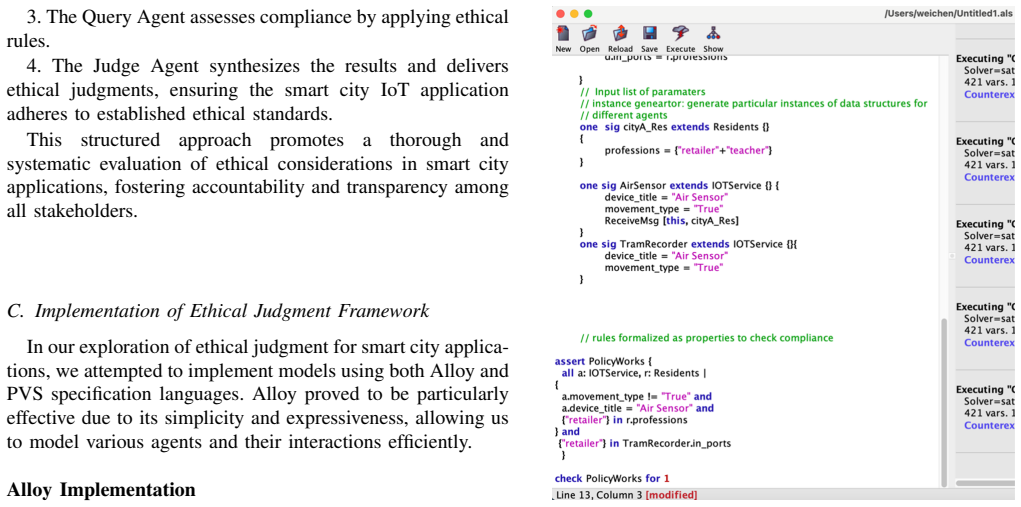
The machinery is a set of 13 ethical principles (P1–P13), each tied to one of six rights: safety and well-being, privacy, fairness, truth, what is agreed, and authority. Each principle is turned into a logical rule over attributes such as a device's movement type, interaction type, risk type, whether its usage agreement is violated, whether residents have legitimate authority, and whether government oversees safety and enforces standards. A multi-agent architecture supplies instances of these attributes—IoT service, residents, government, and business agents—while a query agent applies the rules and a judge agent reports counterexamples as violations. In the implementation, the rules are written as Alloy assertions and checked with the Alloy analyzer; PVS is used as an alternative specification language for the system. The case study shows one rule, P1, firing on the parking device because physical interaction with a payment kiosk carries a high-risk contact that the model encodes.
What would settle it
Run the framework on a real parking or transit deployment whose ethical violations have been independently verified, populate the agent attributes from actual device logs and consent records instead of hand-set mock values, and check whether every verified violation yields a counterexample; a verified violation that produces no counterexample would refute the claim that the framework effectively detects unethical outcomes.
Extended reading notes
Core claim
The central claim is that an ethical judgment framework can detect unethical outcomes in smart-city applications and can be extended for practical use. The paper argues that rights-based ethical principles, formalized as logical rules and evaluated in a multi-agent system, can reproduce the judgments a human reviewer would make. Concretely, the framework's Alloy assertions returned counterexamples for the physical-interaction safety risk in a simulated parking system, while human evaluation of the same agent instances found privacy violations in unauthorized data sharing and data collection without consent. The paper presents this alignment with ground truth as validation that the framework works.
Load-bearing premise
Everything the checker says depends on someone correctly writing down each device's risk level, interaction type, consent status, and authority, and in the case study those values are set by hand from simulated data rather than measured from a real deployment.
Editorial extensions
If this is right
- If the framework is right, a developer could run the 13 assertions before deployment and get a list of which rights a proposed IoT service threatens.
- Regulators could use the ruleset as an audit checklist across the six rights, with automated checks covering most mechanical violations and human review reserved for nuanced ones.
- Because the rules are expressed over agent properties, adding a new rule does not require reworking the models; a modeler can write an additional assertion.
- The case study suggests Alloy is the more practical specification language for this checking workflow when a human evaluator is in the loop.
- The framework positions itself as a decision aid rather than a substitute for ethical judgment, since the paper finds some communication-sensitive rules are better handled by people.
Reading between the lines
- The same agent-attribute schema could be lifted to other data-sharing urban services—transit occupancy, license-plate readers, public Wi-Fi—since the rules are generic over the four entity types rather than parking-specific.
- A measurable next step the paper does not take is to populate the attributes from real device logs, privacy policies, and consent records and compare the checker's precision and recall against independent human review; that would test whether the hand-set mock values are the real source of the detected violations.
- Because rule P11 reads a pre-set 'agreement violated' flag rather than deriving violation from consent records, the framework's practical power depends on an external consent-tracking mechanism that the paper leaves unspecified.
- If the framework were integrated into deployment tools, it could act as a continuous monitor: as device properties or government oversight flags change, the assertions could be re-run and violations reported in real time.
Editorial analysis
A structured set of objections, weighed in public.
Referee Report
Summary. The paper proposes a rights-based framework for ethical judgment of smart city IoT applications. It derives 13 ethical principles from six rights (safety, privacy, fairness, truth, agreement, authority), formalizes social entities (IoT service, residents, government, business) in PVS and Alloy, and sketches a multi-agent judgment architecture with communication, query, and judge agents. The evaluation is a single case study on FLASH parking technology, for which the paper lists ground-truth unethical outcomes, reports an Alloy-based automatic check, and reports a separate human assessment. The paper claims that the framework 'effectively detects unethical outcomes' and can be extended for practical use.
Significance. If the framework worked as claimed, it would offer a novel, partially automatable, logic-based audit tool for smart city deployments, and the comparison of PVS and Alloy would be of practical interest. The paper's strengths are its explicit rights-based derivation of principles, its concrete use of two formal specification languages, and its attempt to validate against a real-world use case with a declared ground truth. However, the formal rules as given do not faithfully encode several of the stated principles, and the reported validation exercises the automated checker for only one of the several detected violations. As a result, the central claim is not established by the presented evidence.
major comments (5)
- [Table I / Section V] The Table I formal rules for P4-P6 are of the form '¬collect_residents_data ∨ ¬receive_msg(...)', with no consent condition anywhere. The natural-language principles in Section V explicitly require 'without consent,' so the rules cannot distinguish consensual from non-consensual data collection or sharing; they either flag all data collection regardless of consent or are vacuously satisfied when the 'collect' input is absent. This is load-bearing because Section IX-E identifies privacy violations as the main findings, yet Section IX-D shows the Alloy-based check did not detect them.
- [Table I, P11-P12; Section IX-C] The formal rule for P11 is 'IoT usage agreement violated = FALSE' and for P12 is 'has right for protection = TRUE'. These are fields of the IoTService and Residents signatures in Section VI, and in Section IX-C they are set by hand to 'False' and 'True'. The rules therefore test the modeler's own assignment rather than deriving a violation from more basic facts; the verdict is an input to the framework, not a conclusion of it. This circularity undermines any claim that the framework independently judges the application with respect to the right to what is agreed or the right of authority.
- [Section IX-D to IX-F] The validation does not support the abstract claim. Section IX-D reports that the Alloy-based automatic judgment found a counterexample only for P1 (safety). The privacy violations (P4 and P6) and the fairness issue (P7) were found by 'human ethical judgment' in Section IX-E. Section IX-F states that the combined results match the ground truth, but the automated component contributed only the safety detection; the privacy detection is not performed by the formal rules. The simulation therefore demonstrates human judgment, not the automated rule-checking, for most of the ethical concerns claimed to be detected.
- [Section VII vs. Table I] The Alloy assertion for SafetyPrinciple in Section VII is 'device.movementType != "hazardous" => device.interactionType != "physical"', which flags any physical interaction regardless of hazard, whereas Table I's P1 requires ¬(M(d) ∨ H(d) ∨ T(d)). The case study's parking kiosk has movementType 'still' and interactionType 'physical', so the two formulations give different verdicts. The paper does not clarify which rule was actually checked in Section IX-D, leaving the reported automatic P1 result ambiguous.
- [Table I, P8-P9; Section X.A] The framework's own limitation statement in Section X.A acknowledges that the 13 rules 'may not capture every specific scenario,' yet the completeness of the ruleset is never demonstrated. In addition, P8's rule 'size(preference for IoT usage)=1' treats unanimous preference as a necessary condition for fairness, and P9's rule 'size(deploy neighborhood) ≥ #total num neighborhood*0.4' introduces an arbitrary threshold; no justification or sensitivity analysis is provided, and the FLASH case study does not exercise either rule.
minor comments (6)
- [Section VI-C] The Alloy specification for IoTService contains a typo in the comment: '// Set of neighborhoods where the device is deployed' is fine, but the Business agent in Section VI-F has 'SSet of neighborhoods', which should be 'Set'.
- [Table I] The table header 'Faireness' should be 'Fairness', and the formal rule for P13 misspells 'oversight IoT safety' as 'oversight IoT satefy'.
- [Section IX-C] The Business Agent signature uses the expression 'Old City"+"Fishtown' with string concatenation, which is not valid Alloy syntax and is not explained.
- [Section VIII-A] The architecture description references Figure 2, but the figure is not present in the manuscript, making the multi-agent design difficult to assess.
- [Section VII] The PVS RULESET example defines safety, privacy, and fairness functions with different signatures than the corresponding rules in Table I, and no mapping is given between the two formalizations.
- [Section IX-B] The data sources are described only qualitatively; it would help to state explicitly which facts in Section IX-C are drawn from the FLASH case study versus purely fabricated mock data.
Circularity Check
Several formal 'rules' are preset input flags, and the human-judgment validation is self-confirming, making the claimed 'effective detection' partially circular.
-
self definitional
[Table I (What's Agreed rule P11); Section VI-C and IX-C]
"P11 - The IoT device should not collect more data or perform actions beyond what has been consented by the residents ... IoT usage agreement violated = FALSE [...] one sig Parking device{ device title = "FLASH Parking", ... IoT usage agreement violated = "False", }"
The formal rule for P11 is just an equality test on the attribute 'IoT usage agreement violated', which is declared as an input field of the IoTService signature in Section VI-C and set by hand in the FLASH simulation to 'False'. The rule does not derive violation from device behavior, data collection, or consent records; a violation is reported only if the modeler pre-assigns 'True'. Thus the judgment is identical to the input by construction, and the Alloy check for P11 is vacuously satisfiable in the case study.
-
self definitional
[Table I (Authority rule P12); Section VI-D and IX-C]
"P12 - Residents should have the legitimate authority to request actions to avoid undesirable or unlawful outcomes caused by the IoT service ... has right for protection = TRUE [...] has legitimate authority = "True","
P12's formal rule checks a Boolean field ('has right for protection' in Table I, 'has legitimate authority' in the Alloy signature) that is supplied as input by the modeler, not inferred from any evidence. In the case study the Resident Agent is declared with 'has legitimate authority = True', so the rule holds by construction. The framework cannot discover whether residents actually possess authority, because the answer is already encoded in the hand-set attribute that the rule merely reads back.
1 more flagged steps
-
self definitional
[Section IX preamble, IX-D, IX-E, IX-F]
"In order to test our framework, for the application we first make comprehensive human-based judgment about all of their potential unethical outcomes to obtain ground truth, then we apply the proposed ethical framework to perform Alloy-based automatic ethical judgment and human judgment to see if the results match and validate if the proposed framework is applicable in real-world context."
The validation design uses the same human ethical judgment to create the ground truth and then counts the framework's own human-judgment arm as evidence that the framework 'effectively detects unethical outcomes'. The automatic Alloy pass found only P1, while the privacy findings used in Section IX-F come from the Section IX-E human assessment, not from the formal rules. Therefore the claimed validation for privacy reduces to human evaluators confirming their own prior classification, which is a self-comparison rather than an independent test of the automated judgment framework.
full rationale
The paper's automatic detection is not entirely circular: the Alloy counterexample for P1 is a genuine inference from the modeled attributes (high risk + physical interaction), and the rights-based principles are presented as externally motivated ethical content. However, the ruleset contains at least two rules that are tautological reads of modeler-supplied flags: P11 ('IoT usage agreement violated = FALSE') and P12 ('has right for protection = TRUE') are satisfied because the simulation hand-sets those exact values. Additionally, the validation loop for privacy and fairness is self-confirming: human ground truth is created first, and human judgment is then used as part of the framework to reproduce it; the automatic checker did not flag P4-P6 at all. A further correctness risk, noted in the paper's own discussion of completeness, is that the formal encodings of P4-P6 omit any consent condition, so they cannot express the 'without consent' clauses they are meant to enforce. Because part of the central detection claim is supported by an independent P1 inference but the remaining claimed detections reduce to preset flags and self-comparison, the appropriate circularity score is 6.
Assumptions & free parameters
free parameters (2)
- P9 neighborhood coverage threshold =
0.4
- P8 preference consensus size =
1
assumptions (4)
- domain assumption The six rights (truth, safety, privacy, fairness, agreement, authority) are the correct normative basis for smart city ethics.
- ad hoc to paper The 13 derived principles are sufficiently complete to prevent every relevant unethical outcome.
- domain assumption Agent attributes such as risk_type, interaction_type, and IoT_usage_agreement_violated faithfully represent real ethical states.
- ad hoc to paper The ground truth list of unethical outcomes for the FLASH parking case is correct and complete.
invented entities (1)
-
Judge Agent and Query Agent roles in the ethical judgment MAS
Cite this review
Pith. "Pith review of A Framework for Ethical Judgment of Smart City Applications." pith.science (2026). https://pith.science/paper/JLDZGSMX
@misc{pith2026250605172,
  author       = {Pith},
  title        = {Pith review of: A Framework for Ethical Judgment of Smart City Applications},
  year         = {2026},
  howpublished = {\url{https://pith.science/paper/JLDZGSMX}},
  note         = {Machine review of arXiv:2506.05172}
}
read the original abstract
As modern cities increasingly adopt a variety of sensors and Internet of Things (IoT) technologies to collect and analyze data about residents, environments, and public services, they are fostering greater interactions among smart city applications, residents, governments, and businesses. This trend makes it essential for regulators to focus on these interactions to manage smart city practices effectively and prevent unethical outcomes. To facilitate ethical analysis for smart city applications, this paper introduces a judgment framework that examines various scenarios where ethical issues may arise. Employing a multi-agent approach, the framework incorporates diverse social entities and applies logic-based ethical rules to identify potential violations. Through a rights-based analysis, we developed a set of 13 ethical principles and rules to guide ethical practices in smart cities. We utilized two specification languages, Prototype Verification System (PVS) and Alloy, to model our multi-agent system. Our analysis suggests that Alloy may be more efficient for formalizing smart cities and conducting ethical rule checks, particularly with the assistance of a human evaluator. Simulations of a real-world smart city application demonstrate that our ethical judgment framework effectively detects unethical outcomes and can be extended for practical use.
Figures


Reference graph
Works this paper leans on
-
[1]
Smart cities and communities: A key performance indicators framework,
M. Serrano, E. Griffor, D. A. Wollman, M. Dunaway, M. Burns, S. Rhee, and C. Greer, “Smart cities and communities: A key performance indicators framework,” NIST Special Publication, National Institute of Standards and Technology, Gaithersburg, Maryland , pp. 1900–206, 2022
work page 1900
-
[2]
Discover the 20 top smart city startups to watch in 2025,
S. Insights, “Discover the 20 top smart city startups to watch in 2025,” https://www.startus-insights.com/innovators-guide/smart-city- startups/#sc, 2024
work page 2025
-
[3]
Fostering the advancement of the internet of things,
NTIA, “Fostering the advancement of the internet of things,” Available at https://www.ntia.doc.gov/files/ntia/publications/iot green paper 01122017.pdf, 2017
work page 2017
-
[4]
Toward an ethical framework for smart cities and the internet of things,
M. P. Singh and P. K. Murukannaiah, “Toward an ethical framework for smart cities and the internet of things,” IEEE Internet Computing, 27(2): 51-56, 2023
work page 2023
-
[5]
The ethics of smart cities and urban science,
R. Kitchin, “The ethics of smart cities and urban science,” in Philosoph- ical transaction of the royal society , vol. A, 2016
work page 2016
-
[6]
K. Ahmad, M. Maabreh, and M. G. et al., “Developing future human- centered smart cities: Critical analysis of smart city security, data management, and ethical challenges,” in Computer Science Review 43 , 2022
work page 2022
-
[7]
An ethical framework for big data and smart cities,
V . Chang, “An ethical framework for big data and smart cities,” in Technological Forecasting & Social Change 165 , 2021
work page 2021
-
[8]
Ethical analyses of smart city applications,
S. Clever, T. Crago, and A. P. et al., “Ethical analyses of smart city applications,” in Urban Science, 2018, 2(4) , 2018, p. 96
work page 2018
Show all 17 references
-
[9]
The internet of things: Foundational ethical issues,
F. Allhoff and A. Henschke, “The internet of things: Foundational ethical issues,” Internet of Things, 1-2 (2018) 55-66 , 2018
2018
-
[10]
Computational ethics,
E. Awad, S. Levine, and M. A. et al., “Computational ethics,” Cell Press, 26(5):388-405, 2022
2022
-
[11]
Formalizing trust in artificial intelligence: Prerequisites, causes and goals of human trust in ai,
A. Jacovi, A. Marasovic, T. Miller, and Y . Goldberg, “Formalizing trust in artificial intelligence: Prerequisites, causes and goals of human trust in ai,” FAccT ’21, 2021
2021
-
[12]
Ethical system formalization using non-monotonic logics,
J.-G. Ganascia, “Ethical system formalization using non-monotonic logics,” Proceedings of the Annual Meeting of the Cognitive Science Society, 29(29), 2007
2007
-
[13]
Ethical judgment of agents’ behaviors in multi-agent systems,
N. Cointe, G. Bonnet, and O. Boissier, “Ethical judgment of agents’ behaviors in multi-agent systems,” AAMAS ‘16. Pages 1106-1114, 2016
2016
-
[14]
Pvs prover guide,
“Pvs prover guide,” Available at: https://pvs.csl.sri.com/doc/pvs-prover- guide.pdf
-
[15]
Prototype verification system,
“Prototype verification system,” Wikipedia. https://en.wikipedia.org/wiki/Prototype Verification System
-
[16]
Alloy (specification language),
“Alloy (specification language),” Wikipedia https://en.wikipedia.org/wiki/Alloy (specification language)
-
[17]
Parkway partners with flash for an enterprise-scale network of dynamic technology. case study,
“Parkway partners with flash for an enterprise-scale network of dynamic technology. case study,” https://www.flashparking.com/blog/case-study- parkway-corporation/
Reviewed August 7, 2026 · model on record in the stance chip above.
Discussion (0). Sign in to comment.