REVIEW 4 major objections 5 minor 85 references
Adiabatic dynamics in a V-type quantum system by oppositely chirped counterrotating circularly polarized laser pulses
T0 review · 4 major / 5 minor · reviewed 2026-08-07 · deepseek-v4-flash
Pith's one-line read Potassium atoms driven by intense oppositely chirped counterrotating circularly polarized pulses follow the field adiabatically, and this V-RAP mechanism explains the measured reshaping of the photoelectron vortices.
desk verdict Serious analytical core, honest about its own gaps, but the experimental confirmation lacks the adiabaticity check — deserves review with revisions. read the letter →
The pith
A machine-rendered reading of the paper's core claim, the machinery that carries it, and where it could break.
The reading
What carries the argument
The central object is the V-type three-level linkage, ground $|4s,m=0\rangle$ together with the degenerate excited states $|4p,\pm1\rangle$, coupled by an OC-CRCP pulse, i.e. a field that stays linearly polarized while its polarization angle rotates with a time-dependent angular velocity because the LCP component is up-chirped and the RCP component is down-chirped. In the rotating frame the dynamics is controlled by the instantaneous detuning $\Delta(t)=\dot{\zeta}(t)$ and the Rabi envelope $\Omega_0(t)$; adiabatic following holds when the dimensionless parameter $\alpha(t) = |\dot{\Omega}_0\Delta - \Omega_0\dot{\Delta}|/(2\Omega_0^2+\Delta^2)^{3/2}$ stays much smaller than one. The adiabatic solution (Eq. B18) has the structural identity $c_{+1}(t)=-c_{-1}^{*}(t)$, and that identity is what turns the two competing two-photon ionization amplitudes into exact opposites, yielding the adiabatic cancellation of Eqs. (16)\text{--}(17) that carries the explanation.
What would settle it
A decisive test would be an intensity series: measure the $c_2$, $c_4$, and $c_6$ SEV yields as the peak Rabi frequency is swept from the perturbative to the adiabatic regime. V-RAP predicts the relative $c_6$ yield should rise monotonically and saturate as $\alpha(t)$ falls below about 0.1; if instead the yield ratio passes through a maximum, oscillates, or rises with no saturation, or if a multistate simulation that includes the 3d and 4d resonances reproduces the measured enhancement while the V-RAP cancellation identity fails, the adiabatic-cancellation explanation is contradicted.
Extended reading notes
Core claim
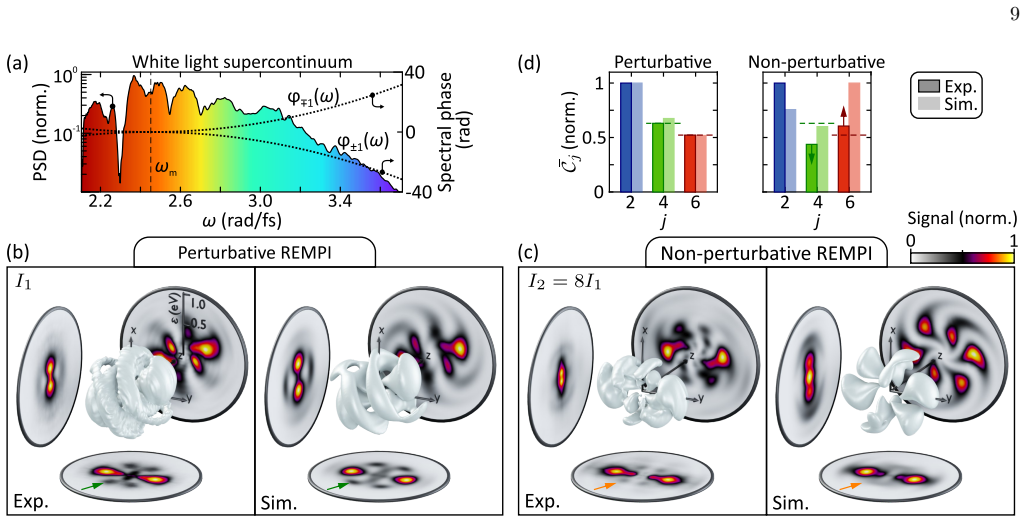
The central claim is that in the non-perturbative $(1+2)$ REMPI of potassium with OC-CRCP pulses the resonant $4s\text{--}4p$ V-system evolves adiabatically, so the excited-state amplitudes obey $c_{+1}(t) = -c_{-1}^{*}(t)$ (Eq. B18). Inserting that solution into second-order perturbation theory makes the pathway amplitudes $I_{+1}^{(-1,+1)}(t)$ and $I_{-1}^{(+1,+1)}(t)$ exactly opposite (Eqs. 16\text{--}17), so the associated ionization pathways cancel throughout the pulse. The $|\varepsilon_f,\pm1\rangle$ continua therefore lose most of their weight, suppressing the $c_2$ and $c_4$ vortices in the measured 3D PMD while the $c_6$ vortex, fed through the non-interfering $|\varepsilon_f,\pm3\rangle$ channels, becomes relatively stronger. The authors conclude that the pronounced changes observed in the PMD confirm the V-RAP scenario in the potassium $4s\text{--}4p$ system.
Load-bearing premise
The whole explanation rests on the assumption that the experimental laser pulses are strong and smooth enough that the atom stays in a single slowly changing light-coupled state for the entire pulse, and that the higher-lying 3d and 4d states the model leaves out do not redirect the ionization; if either condition fails, the predicted exact cancellation of two ionization pathways breaks down and the measured change in the vortex pattern would need another explanation.
Editorial extensions
If this is right
- At sufficiently high intensity and chirp, the two excited-state amplitudes lock in anti-phase, so the partial-wave continua $|\varepsilon_f,\pm1\rangle$ are suppressed and the $c_2$ and $c_4$ SEV yields drop relative to $c_6$.
- The $c_6$ SEV yield becomes a direct readout of the V-RAP mechanism: its relative enhancement in a decomposed PMD is the observable signature that adiabatic following occurred in the bound system.
- Because V-RAP is an adiabatic mechanism, increasing the peak Rabi frequency or chirp further strengthens the adiabatic following and cancellation (the paper's Fig. 5), so the effect should saturate rather than oscillate with intensity.
- The atom undergoes coherent population return and ends up back in the ground state, so the ionization signal is produced transiently during the pulse even though the excited states are strongly driven.
- Flipping the sign of the chirp reverses the rotational sense of the SEVs, and the paper shows this chirp control persists into the non-perturbative regime.
Reading between the lines
- We infer that V-RAP should transfer to other alkali atoms with a similar $s$\text{--}$p$ V-type linkage; because the mechanism depends on the linkage geometry and on satisfying the adiabatic condition rather than on potassium-specific details, rubidium or cesium under appropriately chirped OC-CRCP pulses should show the same relative enhancement of the $c_6$ vortex.
- A testable extension: the anti-phase relation $c_{+1} = -c_{-1}^{*}$ is a general consequence of the symmetric-spectrum Hamiltonian in any interaction regime, so the paper's distinctive claim is that adiabaticity makes it persist with the specific phase locking needed for exact cancellation; a shaper-based pump-probe measurement of the excited-state amplitudes would isolate that phase locking from
- If the cancellation is as clean as modeled, the same scheme could be used to produce nearly pure $c_6$ electron vortices, turning the suppression of $c_2$ and $c_4$ channels from an observed side effect into a resource for coherent control or photoelectron holography.
Editorial analysis
A structured set of objections, weighed in public.
Referee Report
Summary. The paper identifies and explains a new adiabatic mechanism in the (1+2) resonant multiphoton ionization of potassium by oppositely chirped counterrotating circularly polarized (OC-CRCP) pulses. In the non-perturbative regime, the degenerate 4s-4p V-system is claimed to follow the OC-CRCP field adiabatically ('V-RAP'), giving excited-state amplitudes c_{+1}(t) = -c*_{-1}(t) (Eqs. 10 and B18). Inserting this solution into the second-order ionization amplitudes (Eq. C5) yields an exact destructive interference between the pathways I_{+1}^{(-1,+1)} and I_{-1}^{(+1,+1)} (Eqs. 16-17), suppressing the |εf,±1⟩ continua and therefore the c2 and c4 symmetric free electron vortices, and relatively enhancing the c6 component in the measured 3D photoelectron momentum distribution. The authors support the mechanism with illustrative simulations (Fig. 2), with measured 3D PMDs at perturbative (I1 ≈ 5×10^11 W/cm^2) and non-perturbative (I2 ≈ 8 I1) intensities, and with decomposition of the PMDs into SEV yields via Eq. (20).
Significance. If the V-RAP scenario is confirmed, the paper offers a new and clean connection between adiabatic strong-field control and the angular composition of free electron vortices, and it gives an experimentally accessible signature (relative c6 enhancement) of an adiabatic mechanism in a V-type system. Among the paper's strengths are the parameter-free analytical derivation of the adiabatic solution and of the cancellation in Eq. (17), the explicit dimensionless adiabaticity parameter α(t) (Eq. 9) that makes the central condition quantitatively falsifiable, the numerical support from short-time-propagation TDSE simulations, and the high-quality experimental methodology (supercontinuum polarization shaping, VMI-based tomography, and 3D Fourier decomposition). The main reservations concern the documentation of adiabaticity for the experimental conditions and the quantification of the experimental comparison; they do not affect the internal consistency of the central algebraic result.
major comments (4)
- [Sec. IV and Sec. II.D, Eqs. (8)-(9)] The central claim that the measured PMD changes confirm V-RAP requires α(t) << 1 for the actual experimental conditions, but the manuscript never reports α(t) for the Fig. 4(c) parameters. The only quantitative demonstration of adiabaticity is Fig. 2, which uses a Gaussian input pulse with Δt = 5 fs, φ2 = 80 fs^2, and a peak Rabi frequency scaled to 50 Ω̂0 = 0.5 rad/fs. The non-perturbative experiment in Fig. 4(c) uses an asymmetric white-light spectrum, Δt ≈ 6 fs, |φ2| = 40 fs^2, and I2 ≈ 8 I1 ≈ 4×10^12 W/cm^2, but neither the corresponding peak Rabi frequency nor the α(t) of the simulation shown in Fig. 4(c) is stated. Since Eqs. (16)-(17) are obtained by inserting the adiabatic solution (B18) into Eq. (C5), the cancellation, and hence the attribution of the observed c6 enhancement to V-RAP, is not quantitatively established for the experimental conditions. The authors should report the peak Rabi frequency (and its calibration to the reported intensity), the chirp-stretched envelope (Eq. A5), and the resulting maximum of α(t) over the pulse for the non-perturbative data, including the effect of the asymmetric spectrum on the Hamiltonian (6) that underlies the derivation.
- [Eqs. (13), (C1), (C5), (15)-(17)] There is a sign inconsistency in the printed derivation of the adiabatic cancellation. With the field definition in Eq. (4), E_{-q}(t) = E_mod(t) e^{+iq ζ(t)}, so the product E_{-q1}(t) E_{-q2}(t) in Eqs. (13) and (C1) carries phase e^{+i(q1+q2)ζ}. Multiplied by c_{q0} ~ e^{-iq0ζ} from Eq. (B18), this yields the phase e^{-i(q0 - q1 - q2)ζ}, which agrees with Eq. (C5)'s e^{-i(q0+q1+q2)ζ} only when q1 + q2 = 0. For the crucial partner I_{-1}^{(+1,+1)} (q1 + q2 = +2) the literal reading gives e^{+3iζ}, so the exact cancellation in Eq. (17) would not follow; Eq. (15) likewise requires the two fields to be E_{+1} E_{+1}, not E_{-1} E_{-1}. The derivation becomes fully consistent if the subscripts in Eqs. (13) and (C1) read E_{q1}(t) E_{q2}(t); the authors should correct this (or explicitly redefine the field labeling) because Eq. (17) is the central mechanism of the paper.
- [Fig. 4(d) and Sec. IV] The quantitative experimental support lacks error bars and an error budget. The yield bars in Fig. 4(d) are shown without uncertainties, and the 'reasonable agreement' with the simulation in the non-perturbative case is not quantified. This matters because the authors themselves state (Sec. IV) that the asymmetric WLS spectrum makes the two pulse components not exact complex conjugates, so the excited-state anti-phase relation and hence the adiabatic cancellation are incomplete, and that the near-resonant 3d/4d states add extra phases along the 2PI pathways. These admissions modify precisely the quantitative content of Eq. (17) that the experiment is claimed to confirm. To make the comparison meaningful, the paper should (i) provide uncertainties for the Cj yields (from shot noise and tomographic reconstruction), and (ii) quantify the residual cancellation, e.g., by simulating with the measured asymmetric spectrum and reporting the ratio |I_{+1}^{(-1,+1)} + I_{-1}^{(+1,+1)}| relative to the remaining pathway amplitude, and by estimating the size of the 3d/4d corrections.
- [Fig. 4(b)-(c), Sec. IV] The perturbative and non-perturbative measurements differ in two experimental parameters simultaneously: the intensity is increased from I1 to 8 I1 while the chirp sign is flipped from φ2 = +40 fs^2 to -40 fs^2. The paper states the sign flip was made deliberately to demonstrate control of the rotational sense of the SEVs, but as a result the measured changes in the PMD shape cannot, by themselves, be assigned uniquely to the intensity-driven V-RAP mechanism; a chirp-sign-dependent change of the relative SEV yields in the non-perturbative regime would produce a similar-looking difference. The c6-enhancement claim would be cleanly supported by a non-perturbative measurement at φ2 = +40 fs^2 (or a perturbative measurement at -40 fs^2), or at minimum by an explicit argument, with data or simulation, that the relative yields C2, C4, C6 are invariant under the sign flip at fixed intensity.
minor comments (5)
- [Sec. II.D] The text refers to 'the second row of Fig. 3' when describing the intermediate-field dynamics; this should be Fig. 2.
- [Sec. II.C] The sentence 'This phenomenon, which occurs only when the V-RAP mechanism is realized in the bound state system.' is a sentence fragment and should be joined to the following sentence.
- [Sec. IV] The sentence 'The suppression of the ring lobes ... is, therefore, are direct accessible in the experiment.' contains a grammatical error ('are direct accessible' should be 'is directly accessible').
- [Eqs. (14)-(18)] The symbol E^2(t) in Eqs. (14)-(18) is used for the squared envelope E_mod^2(t); since E(t) denotes the cartesian field in Eq. (5), the notation should be defined explicitly to avoid confusion.
- [Sec. IV] The 'non-perturbative regime' label refers to the bound-state dynamics, while the ionization step is still treated by second-order perturbation theory (Eq. (12)); the authors should state explicitly that at I2 the total ionization probability remains small so that Eq. (12) is applicable, and should comment on the absence of focal-volume averaging in the simulated PMDs compared with the measured ones.
Circularity Check
No significant circularity: the V-RAP cancellation follows algebraically from the stated Hamiltonian and is then compared with independent experimental and numerical data.
full rationale
The paper's central derivation is self-contained and non-circular. Starting from the RWA Hamiltonian (Eq. B1), it derives the adiabatic condition (Eqs. B13-B15), solves the dressed-state TDSE to obtain the adiabatic bare-state solution with c_{+1}(t) = -c*_{-1}(t) (Eqs. B16-B18), and inserts this solution into the perturbative two-photon-ionization amplitude formula (Eqs. C1-C5) to obtain the exact cancellation I_{+1}^{(-1,+1)}(t) = -I_{-1}^{(+1,+1)}(t) (Eq. 17). The cancellation is a mathematical consequence of the assumed adiabatic following, not a fit to the measured PMD. The c6 enhancement is then compared with experimentally measured PMDs and with independent numerical TDSE simulations; no parameter is fitted to the c6/c4/c2 yield ratios. The citations to [60] and [61] supply the OC-CRCP pulse concept, the experimental apparatus, and the 3D Fourier retrieval method, but the V-RAP mechanism and adiabatic cancellation are derived from the stated Hamiltonian rather than imported from those references. The paper's own caveats (asymmetric WLS spectrum, omitted 3d/4d resonances, incomplete cancellation) limit the quantitative agreement but do not indicate that the prediction reduces to its inputs. The unverified experimental adiabaticity, i.e., whether alpha(t) << 1 holds for the conditions of Fig. 4, is a validation gap rather than a circularity.
Assumptions & free parameters
free parameters (2)
- Peak Rabi frequency scale for regime illustrations =
10 mrad/fs, then 10x and 50x in Fig. 2
- ROI for SEV yield integration (Eq. 20) =
epsilon0 = 0.5 eV, delta_epsilon = 0.3 eV, theta0 = 90 deg, delta_theta = 40 deg
assumptions (6)
- domain assumption Rotating wave approximation and exact resonance delta = 0
- domain assumption Symmetric input spectrum E_in(-omega) = E_in(omega)
- domain assumption Adiabatic following condition alpha(t) << 1
- domain assumption Truncation to the three-state 4s/4p(m=+/-1) manifold
- domain assumption Second-order perturbation theory for the ionization step
- domain assumption Atom initially in the ground state c(-infinity) = (1,0,0)
Cite this review
Pith. "Pith review of Adiabatic dynamics in a V-type quantum system by oppositely chirped counterrotating circularly polarized laser pulses." pith.science (2026). https://pith.science/paper/GDTOS73X
@misc{pith2026250605177,
  author       = {Pith},
  title        = {Pith review of: Adiabatic dynamics in a V-type quantum system by oppositely chirped counterrotating circularly polarized laser pulses},
  year         = {2026},
  howpublished = {\url{https://pith.science/paper/GDTOS73X}},
  note         = {Machine review of arXiv:2506.05177}
}
abstract
Shaped free electron vortices (SEVs) have recently been studied using atomic (1+2) resonance-enhanced multiphoton ionization (REMPI) by oppositely chirped counterrotating circularly polarized (OC-CRCP) femtosecond laser pulses. By transitioning from the perturbative to the non-perturbative REMPI regime, we identify an adiabatic excitation mechanism in a resonant V-type three-level system, termed V-RAP due to its similarities to rapid adiabatic passage (RAP). Experimentally, we observe a pronounced change in the shape of the measured three-dimensional photoelectron momentum distribution (3D PMD), which we trace back to this mechanism via analytical calculations and numerical simulations of the bound state and ionization dynamics. In V-RAP, the atom adiabatically follows the OC-CRCP field, with the two excited states driven in anti-phase, leading to an adiabatic cancellation of specific ionization pathways and explaining the observed changes in the PMD. In the experiment, we combine supercontinuum polarization pulse shaping to generate OC-CRCP femtosecond laser pulses with velocity map imaging-based photoelectron tomography to reconstruct the 3D PMD. The reconstructed PMDs are decomposed by 3D Fourier analysis into SEVs of different rotational symmetry, revealing a significant enhancement of the $c_6$-symmetric contribution, which is the signature of the V-RAP.
Figures


Figures from the paper (2 more)

Reference graph
Works this paper leans on
-
[60]
T. Bayer and M. Wollenhaupt, Molecular free electron vortices in photoionization by polarization-tailored ul- trashort laser pulses, Frontiers in Chemistry10, 899461 (2022)
work page 2022
-
[61]
K¨ ohnke, T
D. K¨ ohnke, T. Bayer, and M. Wollenhaupt, Shaped free- electron vortices, Phys. Rev. A110, 053109 (2024)
2024
-
[1]
Brumer and M
P. Brumer and M. Shapiro, Laser control of chemical re- actions, Scientific American3, 34 (1995)
1995
-
[2]
S. A. Rice and M. Zhao,Optical Control of Molecular Dynamics(Wiley, New York, 2000) p. 456
2000
-
[3]
Tannor,Introduction to Quantum Mechanics: A Time-Dependent Perspective(University Science Books, Sausalito, 2007) p
D. Tannor,Introduction to Quantum Mechanics: A Time-Dependent Perspective(University Science Books, Sausalito, 2007) p. 662
2007
-
[4]
A. M. Weiner, Femtosecond pulse shaping using spatial light modulators, Rev. Sci. Instrum.71, 1929 (2000)
work page 2000
- [5]
-
[6]
T. Brixner and G. Gerber, Femtosecond polarization pulse shaping, Opt. Lett.26, 557 (2001)
work page 2001
Show all 85 references
-
[7]
Wohlleben, T
W. Wohlleben, T. Buckup, J. L. Herek, and M. Motzkus, Coherent control for spectroscopy and manipulation of biological dynamics, Chem. Phys. Chem.6, 850 (2005)
2005
-
[8]
Silberberg, Quantum coherent control for nonlinear spectroscopy and microscopy, Annu
Y. Silberberg, Quantum coherent control for nonlinear spectroscopy and microscopy, Annu. Rev. Phys. Chem. 60, 277 (2009)
2009
-
[9]
Monmayrant, S
A. Monmayrant, S. Weber, and B. Chatel, A newcomer’s guide to ultrashort pulse shaping and characterization, J. Phys. B43, 103001 (2010)
2010
-
[10]
Wollenhaupt, A
M. Wollenhaupt, A. Assion, and T. Baumert,in: Springer Handbook of Lasers and Optics, Vol. 2 (Springer, 2012)
2012
-
[11]
Misawa, Applications of polarization-shaped fem- tosecond laser pulses, Adv
K. Misawa, Applications of polarization-shaped fem- tosecond laser pulses, Adv. Phys. X1, 544 (2016)
2016
-
[12]
Dantus,Femtosecond Laser Shaping: From Labora- tory to Industry(CRC Press, 2017)
M. Dantus,Femtosecond Laser Shaping: From Labora- tory to Industry(CRC Press, 2017)
2017
-
[13]
H. Qi, Z. Lian, D. Fei, Z. Chen, and Z. Hu, Manipulation of matter with shaped-pulse light field and its applica- tions, Advances in Physics: X6, 1949390 (2021)
2021
-
[14]
Strickland and G
D. Strickland and G. Mourou, Compression of amplified chirped optical pulses, Opt. Comm.56, 219 (1985)
1985
-
[15]
Strickland, Nobel lecture: Generating high-intensity ultrashort optical pulses, Rev
D. Strickland, Nobel lecture: Generating high-intensity ultrashort optical pulses, Rev. Mod. Phys.91, 030502 (2019)
2019
-
[16]
Baumert, T
T. Baumert, T. Brixner, V. Seyfried, M. Strehle, and G. Gerber, Femtosecond pulse shaping by an evolution- ary algorithm with feedback, Appl. Phys. B65, 779 (1997)
1997
-
[17]
Yelin, D
D. Yelin, D. Meshulach, and Y. Silberberg, Adaptive fem- tosecond pulse compression, Opt. Lett.22, 1793 (1997). 14
1997
-
[18]
Wollenhaupt, V
M. Wollenhaupt, V. Engel, and T. Baumert, Femtosec- ond laser photoelectron spectroscopy on atoms and small molecules: Prototype studies in quantum control, Annu. Rev. Phys. Chem.56, 25 (2005)
2005
-
[19]
Nuernberger, G
P. Nuernberger, G. Vogt, T. Brixner, and G. Gerber, Femtosecond quantum control of molecular dynamics in the condensed phase, Phys. Chem. Chem. Phys.9, 2470 (2007)
2007
-
[20]
Zamith, J
S. Zamith, J. Degert, S. Stock, B. de Beauvoir, V. Blanchet, M. A. Bouchene, and B. Girard, Observa- tion of coherent transients in ultrashort chirped excita- tion of an undamped two-level system, Phys. Rev. Lett. 87, 033001 (2001)
2001
-
[21]
Degert, W
J. Degert, W. Wohlleben, B. Chatel, M. Motzkus, and B. Girard, Realization of a time-domain fresnel lens with coherent control, Phys. Rev. Lett.89, 203003 (2002)
2002
-
[22]
Monmayrant, B
A. Monmayrant, B. Chatel, and B. Girard, Quantum state measurement using coherent transients, Phys. Rev. Lett.96, 103002 (2006)
2006
-
[23]
Bayer, M
T. Bayer, M. Wollenhaupt, and T. Baumert, Strong-field control landscapes of coherent electronic excitation, J. Phys. B41, 074007 (2008)
2008
-
[24]
Suchowski, A
H. Suchowski, A. Natan, B. D. Bruner, and Y. Silber- berg, Spatio-temporal coherent control of atomic sys- tems: weak to strong field transition and breaking of symmetry in 2d maps, J. Phys. B41, 074008 (2008)
2008
-
[25]
Bergmann, H
K. Bergmann, H. Theuer, and B. W. Shore, Coherent population transfer among quantum states of atoms and molecules, Rev. Mod. Phys.70, 1003 (1998)
1998
-
[26]
N. V. Vitanov, T. Halfmann, B. W. Shore, and K. Bergmann, Laser-induced population transfer by adi- abatic passage techniques, Annu. Rev. Phys. Chem.52, 763 (2001)
2001
-
[27]
B. W. Shore,Manipulating Quantum Structures Using Laser Pulses(Cambridge University Press, Cambridge,
-
[28]
Chatel, J
B. Chatel, J. Degert, and B. Girard, Role of quadratic and cubic spectral phases in ladder climbing with ultra- short pulses, Phys. Rev. A70, 053414 (2004)
2004
-
[29]
Broers, H
B. Broers, H. B. V. Vandenheuvell, and L. D. Noordam, Efficient population transfer in a 3-level ladder system by frequency-swept ultrashort laser-pulses, Phys. Rev. Lett. 69, 2062 (1992)
1992
-
[30]
Chatel, J
B. Chatel, J. Degert, S. Stock, and B. Girard, Competi- tion between sequential and direct paths in a two-photon transition, Phys. Rev. A68, 041402 (2003)
2003
-
[31]
D. J. Maas, D. I. Duncan, R. B. Vrijen, W. J. van der Zande, and L. D. Noordam, Vibrational ladder climbing in no by (sub)picosecond frequency-chirped infrared laser pulses, Chem. Phys. Lett.290, 75 (1998)
1998
-
[32]
J. S. Melinger, S. R. Gandhi, A. Hariharan, J. X. Tull, and W. S. Warren, Generation of narrow-band inversion with broad-band laser-pulses, Phys. Rev. Lett.68, 2000 (1992)
1992
-
[33]
M. Krug, T. Bayer, M. Wollenhaupt, C. Sarpe-Tudoran, T. Baumert, S. S. Ivanov, and N. V. Vitanov, Coherent strong-field control of multiple states by a single chirped femtosecond laser pulse, New J. Phys.11, 105051 (2009)
2009
-
[34]
J. S. Melinger, A. Hariharan, S. R. Gandhi, and W. S. Warren, Adiabatic population inversion in i2 vapor with picosecond laser pulses, J. Chem. Phys.95, 2210 (1991)
1991
-
[35]
C. J. Bardeen, Q. Wang, and C. V. Shank, Selective ex- citation of vibrational wave packet motion using chirped pulses, Phys. Rev. Lett.75, 3410 (1995)
1995
-
[36]
Assion, T
A. Assion, T. Baumert, J. Helbing, V. Seyfried, and G. Gerber, Coherent control by a single phase shaped femtosecond laser pulse, Chem. Phys. Lett.259, 488 (1996)
1996
-
[37]
S. H. Autler and C. H. Townes, Stark effect in rapidly varying fields, Phys. Rev.100, 703 (1955)
1955
-
[38]
Wollenhaupt, A
M. Wollenhaupt, A. Pr¨ akelt, C. Sarpe-Tudoran, D. Liese, and T. Baumert, Quantum control by selective popula- tion of dressed states using intense chirped femtosecond laser pulses, Appl. Phys. B82, 183 (2006)
2006
-
[39]
Calegari, G
F. Calegari, G. Sansone, S. Stagira, C. Vozzi, and M. Nisoli, Advances in attosecond science, J. Phys. B 49, 062001 (2016)
2016
-
[40]
Chang, P
Z. Chang, P. B. Corkum, and S. R. Leone, Attosec- ond optics and technology: progress to date and future prospects [invited], JOSA B33, 1081 (2016)
2016
-
[41]
Ilchen, E
M. Ilchen, E. Allaria, P. Rebernik Ribiˇ c, H.-D. Nuhn, A. Lutman, E. Schneidmiller, M. Tischer, M. Yurkov, M. Calvi, E. Prat, S. Reiche, T. Schmidt, G. A. Geloni, S. Karabekyan, J. Yan, S. Serkez, Z. Gao, B. Deng, C. Feng, H. Deng, W. Helml, L. Funke, M. Larsson, V. Zhaunerch...
2025
-
[42]
Richter, U
F. Richter, U. Saalmann, E. Allaria, M. Wollen- haupt, B. Ardini, A. Brynes, C. Callegari, G. Cerullo, M. Danailov, A. Demidovich, K. Dulitz, R. Feifel, M. D. Fraia, S. D. Ganeshamandiram, L. Giannessi, N. G¨ olz, S. Hartweg, B. von Issendorff, T. Laar- mann, F. Landmesser, Y....
2024
-
[43]
Brixner, G
T. Brixner, G. Krampert, T. Pfeifer, R. Selle, G. Ger- ber, M. Wollenhaupt, O. Graefe, C. Horn, D. Liese, and T. Baumert, Quantum control by ultrafast polarization shaping, Phys. Rev. Lett.92, 208301 (2004)
2004
-
[44]
J. M. Ngoko Djiokap, S. X. Hu, L. B. Madsen, N. L. Manakov, A. V. Meremianin, and A. F. Starace, Elec- tron vortices in photoionization by circularly polarized attosecond pulses, Phys. Rev. Lett.115, 113004 (2015)
2015
-
[45]
Pengel, S
D. Pengel, S. Kerbstadt, D. Johannmeyer, L. Englert, T. Bayer, and M. Wollenhaupt, Electron vortices in fem- tosecond multiphoton ionization, Phys. Rev. Lett.118, 053003 (2017)
2017
-
[46]
Pengel, S
D. Pengel, S. Kerbstadt, L. Englert, T. Bayer, and M. Wollenhaupt, Control of three-dimensional electron vortices from femtosecond multiphoton ionization, Phys. Rev. A96, 043426 (2017)
2017
-
[47]
J. M. Ngoko Djiokap, A. V. Meremianin, N. L. Manakov, S. X. Hu, L. B. Madsen, and A. F. Starace, Multistart spiral electron vortices in ionization by circularly polar- ized UV pulses, Phys. Rev. A94, 013408 (2016). 15
2016
-
[48]
M. Li, G. Zhang, T. Zhao, X. Ding, and J. Yao, Elec- tron vortices in photoionization by a pair of elliptically polarized attosecond pulses, Chin. Opt. Lett.15, 120202 (2017)
2017
-
[49]
X. Kong, G. Zhang, M. Li, T. Wang, X. Ding, and J. Yao, Odd-fold-symmetric spiral momentum distributions and their Stark distortions in hydrogen, JOSA B35, 2163 (2018)
2018
-
[50]
J. Jia, H. Cui, C. Zhang, J. Shao, J. Ma, and X. Miao, Investigation of the photoionization process of helium ion in bichromatic circularly xuv fields with different time delays, Chem. Phys. Lett.725, 119 (2019)
2019
-
[51]
Zhen, H.-D
Q. Zhen, H.-D. Zhang, S.-Q. Zhang, L. Ji, T. Han, and X.-S. Liu, Generation of electron vortices in photoioniza- tion by counter-rotating circularly polarized attosecond pulses, Chem. Phys. Lett.738, 136885 (2020)
2020
-
[52]
G. S. J. Armstrong, D. D. A. Clarke, J. Benda, J. Wragg, A. C. Brown, and H. W. van der Hart, Modeling to- mographic measurements of photoelectron vortices in counter-rotating circularly polarized laser pulses, Phys. Rev. A100, 063416 (2019)
2019
-
[53]
Eickhoff, L
K. Eickhoff, L. Englert, T. Bayer, and M. Wollenhaupt, Multichromatic polarization-controlled pulse sequences for coherent control of multiphoton ionization, Front. Phys.9, 444 (2021)
2021
-
[54]
In addition, we will carry out numerical quantum dynam- ics simulations employing our ab initio 2D TDSE model
to generate an additional ultrashort probe pulse of a different color to perform shaper-based polarization- sensitive pump-probe experiments for the time-resolved background-free imaging of the V-RAP dynamics. In addition, we will carry out numerical quantum dynam- ics simulat...
-
[55]
K. J. Yuan, H. Z. Lu, and A. D. Bandrauk, Photoioniza- tion of triatomic molecular ions H 2+ 3 by intense bichro- matic circularly polarized attosecond UV laser pulses, J. Phys. B50, 124004 (2017)
2017
-
[56]
K¨ ohnke, K
D. K¨ ohnke, K. Eickhoff, T. Bayer, and M. Wollenhaupt, Multichromatic supercontinuum polarization shaping ap- plied to photoelectron holography, New J. Phys.25, 123025 (2023)
2023
-
[57]
J. Guo, S. Q. Zhang, J. Zhang, S. P. Zhou, and P. F. Guan, Exploration of electron vortices in the photoion- ization of diatomic molecules in intense laser fields, Laser Physics31, 065301 (2021)
2021
-
[58]
J. M. N. Djiokap, A. V. Meremianin, N. L. Manakov, L. B. Madsen, S. X. Hu, and A. F. Starace, Dynamical electron vortices in attosecond double photoionization of H2, Phys. Rev. A98, 063407 (2018)
2018
-
[59]
Wang, M.-Y
R.-R. Wang, M.-Y. Ma, L.-C. Wen, Z. Guan, Z.-Q. Yang, Z.-H. Jiao, G.-L. Wang, and S.-F. Zhao, Comparative study of electron vortices in photoionization of molecules and atoms by counter-rotating circularly polarized laser pulses, J. Opt. Soc. Am. B40, 1749 (2023)
2023
-
[62]
N. J. Strandquist and J. M. Ngoko Djiokap, Reversible electron spirals by chirped attopulses at zero time delay, Phys. Rev. A106, 043110 (2022)
2022
-
[63]
Korobenko, Control of molecular rotation with an optical centrifuge, J
A. Korobenko, Control of molecular rotation with an optical centrifuge, J. Phys. B: At. Mol. Opt. Phys.51, 203001 (2018)
2018
-
[64]
Karczmarek, J
J. Karczmarek, J. Wright, P. Corkum, and M. Ivanov, Optical centrifuge for molecules, Phys. Rev. Lett.82, 3420 (1999)
1999
-
[65]
Bayer, M
T. Bayer, M. Wollenhaupt, H. Braun, and T. Baumert, Ultrafast and efficient control of coherent electron dy- namics via SPODS, Adv. Chem. Phys.159, 235 (2016)
2016
-
[66]
Wollenhaupt, A
M. Wollenhaupt, A. Pr¨ akelt, C. Sarpe-Tudoran, D. Liese, and T. Baumert, Strong field quantum control by se- lective population of dressed states, J. Opt. B7, S270 (2005)
2005
-
[67]
Vala and R
J. Vala and R. Kosloff, Coherent mechanism of robust population inversion, Opt. Express8, 238 (2001)
2001
-
[68]
Huang, B
W. Huang, B. W. Shore, A. Rangelov, and E. Kyoseva, Adiabatic following for a three-state quantum system, Opt. Comm.382, 196 (2017)
2017
-
[69]
Fano, Propensity rules – an analytical approach, Phys
U. Fano, Propensity rules – an analytical approach, Phys. Rev. A32, 617 (1985)
1985
-
[70]
N. V. Vitanov and P. L. Knight, Coherent excitation by asymmetric pulses, J. Phys. B28, 1905 (1995)
1995
-
[71]
Wollenhaupt, A
M. Wollenhaupt, A. Assion, O. Bazhan, C. Horn, D. Liese, C. Sarpe-Tudoran, M. Winter, and T. Baumert, Control of interferences in an Autler-Townes doublet: Symmetry of control parameters, Phys. Rev. A68, 015401 (2003)
2003
-
[72]
Meshulach and Y
D. Meshulach and Y. Silberberg, Coherent quantum con- trol of two-photon transitions by a femtosecond laser pulse, Nature396, 239 (1998)
1998
-
[73]
A. M. Weiner, Ultrafast optical pulse shaping: A tutorial review, Opt. Comm.284, 3669 (2011)
2011
-
[74]
Eickhoff, L
K. Eickhoff, L. Feld, D. K¨ ohnke, T. Bayer, and M. Wollenhaupt, Trichromatic shaper-based quantum state holography, Phys. Rev. A104, 052805 (2021)
2021
-
[75]
A. T. J. B. Eppink and D. H. Parker, Velocity map imag- ing of ions and electrons using electrostatic lenses: Appli- cation in photoelectron and photofragment ion imaging of molecular oxygen, Rev. Sci. Instrum.68, 3477 (1997)
1997
-
[76]
Kerbstadt, L
S. Kerbstadt, L. Englert, T. Bayer, and M. Wollenhaupt, Ultrashort polarization-tailored bichromatic fields, J. Mod. Opt.64, 1010 (2017)
2017
-
[77]
Smeenk, L
C. Smeenk, L. Arissian, A. Staude, D. M. Villeneuve, and P. B. Corkum, Momentum space tomographic imaging of photoelectrons, J. Phys. B42, 185402 (2009)
2009
-
[78]
Wollenhaupt, M
M. Wollenhaupt, M. Krug, J. K¨ ohler, T. Bayer, C. Sarpe- Tudoran, and T. Baumert, Three-dimensional tomo- graphic reconstruction of ultrashort free electron wave packets, Appl. Phys. B95, 647 (2009)
2009
-
[79]
M. D. Feit, J. A. Fleck Jr, and A. Steiger, Solution of the Schr¨ odinger equation by a spectral method, J. Comp. Phys.47, 412 (1982)
1982
-
[80]
A. C. Kak and M. Slaney,Principles of Computerized Tomographic Imaging(IEEE Press, New York, 1988) pp. 1–339
1988
-
[81]
Wollenhaupt, M
M. Wollenhaupt, M. Krug, J. K¨ ohler, T. Bayer, C. Sarpe- Tudoran, and T. Baumert, Photoelectron angular distri- butions from strong-field coherent electronic excitation, Appl. Phys. B95, 245 (2009)
2009
-
[82]
Karule, Multiphoton ionization of atomic hydrogen us- ing perturbation theory, inAdvances in atomic, molecu- lar, and optical physics, Vol
E. Karule, Multiphoton ionization of atomic hydrogen us- ing perturbation theory, inAdvances in atomic, molecu- lar, and optical physics, Vol. 27 (Elsevier, 1990) pp. 265– 299
1990
-
[83]
Dynamics on the Nanoscale
to shed light on the interaction between the induced vectorial dipole dynamics in the bound system and the shaped vectorial light field at the level of the wave func- tion. ACKNOWLEDGMENTS We gratefully acknowledge financial support from the collaborative research program “Dyn...
-
[84]
Kerbstadt, D
S. Kerbstadt, D. Pengel, D. Johannmeyer, L. Englert, T. Bayer, and M. Wollenhaupt, Control of photoelectron momentum distributions by bichromatic polarization- shaped laser fields, New J. Phys.19, 103017 (2017)
2017
-
[85]
Bayer, K
T. Bayer, K. Eickhoff, D. K¨ ohnke, and M. Wollenhaupt, Phase control of the autler-townes doublet in multistate systems, Phys. Rev. A108, 033111 (2023)
2023
Reviewed August 7, 2026 · model on record in the stance chip above.
Discussion (0). Sign in to comment.