REVIEW 3 major objections 5 minor 56 references
Robust Moment Identification for Nonlinear PDEs via a Neural ODE Approach
T0 review · 3 major / 5 minor · reviewed 2026-08-07 · deepseek-v4-flash
Pith's one-line read The paper claims that Neural ODEs, trained by matching whole moment trajectories rather than estimated derivatives, recover the governing ODEs of PDE moment systems from sparse and irregular data, and can learn the coordinate changes…
desk verdict A useful but narrow Neural-ODE adaptation of SINDy moment closure learning; Example 1 is clean, but the automated closure-discovery claim rests on favorable initialization and a post-hoc rotation. read the letter →
The pith
A machine-rendered reading of the paper's core claim, the machinery that carries it, and where it could break.
The reading
What carries the argument
The central machinery is the Neural ODE with a single linear layer over a prescribed feature dictionary: $\dot{x} = \Theta D(x)$, where the state $x$ collects moments and $D$ contains monomial terms such as $I_2$, $V_1$, $K$, $I_2^2$, $V_1^2$, and their products. The parameters $\Theta$ are trained by integrating forward from observed initial times and minimizing the difference between predicted and observed moment values, which removes the finite-difference derivative step. Sparse structure is enforced by iterative hard thresholding of $\Theta$ and, in the Fisher–KPP experiment, an $\ell^1$ penalty. To close unclosed systems, the paper pairs this with Riemannian optimization on the Stiefel manifold, minimizing the same trajectory loss over $A^\top A = I_{3\times 3}$ so that the new coordinates $y = A^\top x$ admit a sparse closed ODE. The Stiefel constraint is what prevents the trivial zero transformation and is the load-bearing device for discovering $E = K + J$ from the four unclosed NLS moments.
What would settle it
Generate NLS moment series from a known PDE, subsample them to a few dozen irregular time points with added noise, and run the same training; if the recovered coefficient matrix deviates from the exact closure $\mathrm{d}I_2/\mathrm{d}t = V_1$, $\mathrm{d}V_1/\mathrm{d}t = 4K - 2I_2$, $\mathrm{d}K/\mathrm{d}t = -V_1/2$ by more than the reported rounding error, the claim of exact recovery from sparse data is false. Conversely, a synthetic moment system that is provably unclosed under every linear map and yet passes the Stiefel closure test would refute the claim that the learned transformation has closed the system.
Extended reading notes
Core claim
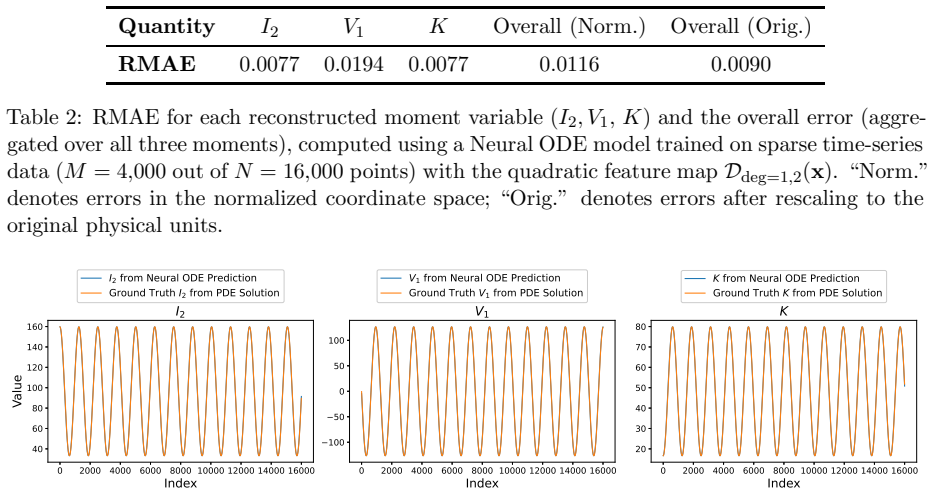
When the moments of a PDE solution are known to follow a low-dimensional ODE system, the paper shows that fitting the unknown right-hand side by integrating a linear dictionary-projection Neural ODE and comparing full trajectories to observed moments recovers the exact governing equations. With the nonlinear Schrödinger equation in a harmonic trap, the learned coefficient matrix matches the analytic closure $\mathrm{d}I_2/\mathrm{d}t = V_1$, $\mathrm{d}V_1/\mathrm{d}t = 4K - 2I_2$, $\mathrm{d}K/\mathrm{d}t = -V_1/2$ even when only $M=4000$ of $N=16000$ time steps are used. For the nonlinear NLS case where $(I_2, V_1, K, J)$ is not closed, the paper claims that minimizing the same trajectory loss over $A^\top A = I_{3\times 3}$ finds the hidden variable $E = K + J$ and the closed system that uses it. For Fisher–KPP, where only an approximate closure is known, the learned ODE approximates the moment data and, on the reported extrapolation test, gives lower overall relative error than the analytic approximate ODE model from the moment-closure literature. The paper presents this as evidence that fully trajectory-based learning can replace derivative-based identification in data-limited settings.
Load-bearing premise
The whole scheme assumes the true moment dynamics have a simple, sparse representation in the user-chosen feature library, and that any needed closure can be achieved by a linear coordinate transformation.
Editorial extensions
If this is right
- Under the sparse-dictionary assumption, any PDE whose chosen moments obey a closed polynomial ODE can have that ODE identified from far fewer observed time points than derivative-based SINDy requires.
- For systems that close only after a linear change of variables, the Stiefel method returns a valid transformation, up to an orthogonal rotation, and a companion sparse ODE in the new coordinates.
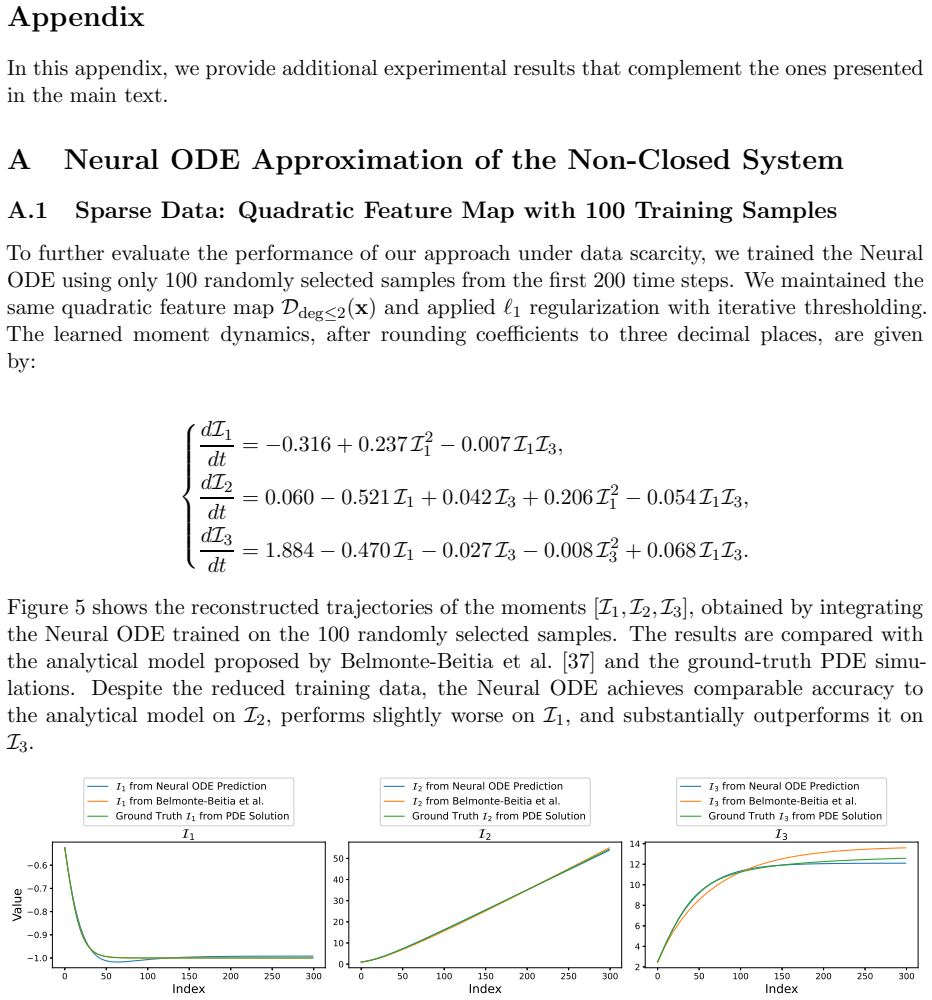
- The Fisher–KPP result implies that even without exact closure, a trajectory-trained Neural ODE can serve as a reduced-order model whose extrapolation accuracy beats the standard analytic approximation.
- Because the loss matches integrated trajectories rather than pointwise derivatives, the learned models in the demonstrated examples avoid the finite-time blow-up artifacts that can occur with local derivative fitting.
- The trained ODE can be analyzed with standard dynamical-systems tools, giving conserved quantities, stability, and long-time behavior for a low-dimensional description of the original PDE.
Reading between the lines
- Beyond the paper's demonstrations, the same trajectory-matching principle should tolerate measurement noise better than derivative-based methods, since the loss never differentiates the data; the paper does not run noise-corrupted experiments to confirm this.
- The authors only seek linear coordinate transformations, so systems whose closure manifold is genuinely nonlinear would likely require a separate extension; testing that is the natural next stress test of the approach.
- Applying the method to moment time series from other dispersive or reaction–diffusion models, such as higher-dimensional NLS or two-species fronts, is a direct extension that the paper's setup would support but does not perform.
Editorial analysis
A structured set of objections, weighed in public.
Referee Report
Summary. The paper proposes a Neural ODE framework for learning reduced-order moment dynamics from PDE simulations, applied to the nonlinear Schrödinger equation with a harmonic trap and to the Fisher–KPP equation. The method trains a linear-in-features ODE by matching integrated trajectories rather than estimated derivatives, which is intended to enable sparse and irregular time sampling. For the linear NLS closure (Example 1), it reports recovery of the exact coefficient matrix with low RMAE, including from a sparse subsample of M=4,000 out of N=16,000 points. For the unclosed NLS moments (Example 2), the paper formulates a Stiefel-manifold optimization (Algorithm 1) to learn a linear coordinate transformation that closes the system, and for FKPP it learns a quadratic surrogate that extrapolates better than the Belmonte-Beitia et al. analytical model. The paper claims robustness under sparse and irregular observations and positions the approach as a derivative-free alternative to SINDy.
Significance. If the central claims hold, the paper offers a practical extension of moment-closure identification: Neural ODE trajectory matching avoids finite-difference derivative errors and permits training on irregularly sampled time series. The clean recovery in Example 1 (Eq. 15) and the quantified FKPP extrapolation (Table 4) are valuable demonstrations, and the hyperparameter and coefficient tables make the experiments reproducible. However, the signature contribution—joint discovery of a coordinate transformation and sparse closed ODE via Stiefel optimization—is not currently supported by the evidence in Section 4.3, which limits the paper's stated scope. The result as presented is a useful proof-of-concept for a favorably initialized setting plus a post-hoc rotation, rather than an automated discovery algorithm.
major comments (3)
- [Section 4.3, Case 2 (Eqs. (20)–(21))] The random-initialization run does not demonstrate that Algorithm 1 discovers the closed-form coordinate transformation. The displayed orthogonal matrix O is introduced only after A_out and Θ_out are known and is chosen to align them with Agt and Θgt; no criterion, optimization, or algorithm is given for obtaining O from the output of Algorithm 1. Because the loss (13) is invariant under O(3) and no sparsity regularization is imposed on Θ in the outer A-loop, a dense Θ_out such as Eq. (20) is a valid solution of the optimization problem, and sparsity is not an emergent property of the method. To support the abstract's claim of discovering a sparse closed ODE system, the authors need to either add a sparsity-promoting term that acts on the equivalence class, provide an automatic post-processing step (e.g., minimize ||O^T Θ_out O||_1 over O(3)), or show that a random initialization with the existing thresholding converges to a sparse model without using the ground truth.
- [Section 4.3, final paragraph] The assertion that with M=4,000 of 16,000 samples the method 'accurately identified both the coordinate transformation and the corresponding closed ODE system' is unquantified. No matrices, trajectories, or error metrics are reported for this sparse-data run, despite the paper's central thesis being robustness under sparse and irregular observations. Please report the recovered A and Θ (or their equivalence-class representatives) and a quantitative error measure, such as the RMAE of trajectories reconstructed from the learned system or the coefficient error relative to Eq. (19).
- [Section 3.2 and Algorithm 1] The alternating optimization (13) is not designed to select a sparse representative from the O(3)-orbit of equivalent solutions. The iterative thresholding described in Section 3.1 is applied to Θ for a fixed A, but when A is updated on the Stiefel manifold the previously thresholded support can rotate into a different coordinate frame, and the outer loop has no sparsity objective. This explains why Case 2 of Section 4.3 converges to a dense Θ_out and why the post-hoc rotation is needed. The method description should be extended so that sparsity is part of the optimization, or the claims should be restricted to the favorably initialized setting.
minor comments (5)
- [Section 1, paragraph 4] The Introduction motivates the method by the noise sensitivity of derivative estimation, but no experiment in Section 4 injects noise into the moment observations. Please add noisy-data experiments, or explicitly scope the robustness claims to sparse and irregular sampling without noise.
- [Tables 2–6] All reported results appear to be single runs; the RMAE tables have no error bars or standard deviations over random subsampling or parameter initializations. Please report statistics over multiple seeds, especially for the sparse-data and Stiefel experiments.
- [Equation (16), dK/dt] The equation for dK/dt includes both '-0.003J' and '+0.240J'; please verify whether this is a typo and clarify the individual K and J equations, since the displayed K equation contains seemingly redundant J terms.
- [Section 3.1 and Remark 2] The key assumption that f admits a sparse representation in the predefined feature library, and the restriction to linear coordinate transformations, are stated as limitations only in passing; the abstract and conclusions present the framework as more general than these assumptions allow. Consider adding a sentence to the conclusions reiterating these scope conditions.
- [Section 4.4] The learned quadratic FKPP model includes a constant term and dependence on I1I3 that are absent from the analytical model (8); a brief discussion of how dictionary choice affects the extrapolation comparison would strengthen the claim that the improvement on I3 is not an artifact of the extra terms.
Circularity Check
No significant circularity: the moment-recovery and FKPP extrapolation results are checked against external analytic closures and held-out future time points; self-citations to [34] provide setup and an elementary equivariance remark, not load-bearing proof.
full rationale
The paper's central claims are not circular. In Section 4.1 the Neural ODE is trained by trajectory matching (loss (11)) and the recovered coefficients in Eq. (15) are compared with the independent analytic closure (4); the learned system is not an input to the loss. In Section 4.4 the FKPP model is trained on the first 200 time points and evaluated on the held-out 100, so the extrapolation superiority over the Belmonte-Beitia ODE is a genuine out-of-sample test. The Stiefel closure problem in Eq. (13) optimizes A and Theta without being given E=K+J; Case 1 initializes A near A_gt and demonstrates local recovery, which is a convergence check rather than a forced fit. The closest thing to a circular step is Section 4.3 Case 2: random initialization returns a dense Theta_out, and the sparse ground-truth-equivalent system appears only after applying an orthogonal matrix O. The paper explicitly labels this 'post-processing' and 'post hoc,' and the O(3) equivariance it cites from Remark 2 of [34] is elementary and stated in the present text, so the self-citation is not load-bearing. The first two columns of the displayed O coincide with the first two columns of A_out, so part of the agreement in Eq. (21) is by construction; this weakens the random-init demonstration and the immediately following unquantified 4,000-sample claim is missing supporting matrices and errors. Those are reproducible-evidence gaps, not a derivation that reduces to its own inputs. No fitted parameter is renamed as a prediction, no uniqueness theorem is imported from the authors, and no known result is repackaged as new. Hence the minor self-citation and the post-hoc verification concern warrant a score of 2 rather than 0, but the central recovery and extrapolation claims are self-contained.
Assumptions & free parameters
free parameters (4)
- Sparsity threshold cutoff and l1 regularization weight =
not reported
- Initial projection A(0) for Stiefel optimization =
ground-truth-inspired in Case 1; random in Case 2
- Moment normalization scaling =
per-moment min/max to [-1,1]
- Feature library choice =
Ddeg=1, Ddeg=1,2, Ddeg<=2, Dextended
assumptions (4)
- domain assumption Selected moments are well-defined and evolve according to a low-dimensional ODE system that can be represented sparsely in a prescribed feature dictionary.
- domain assumption For unclosed moment systems, a linear coordinate transformation y = A^T x with A^T A = I suffices to close the dynamics.
- standard math The FKPP moment system (Eq. (8)) derived from the traveling-wave ansatz (6) is the correct physical-expert baseline.
- domain assumption The simulated PDE solutions are treated as ground truth with no discretization or quadrature error accounted for.
Cite this review
Pith. "Pith review of Robust Moment Identification for Nonlinear PDEs via a Neural ODE Approach." pith.science (2026). https://pith.science/paper/EE2OPMRW
@misc{pith2026250605245,
  author       = {Pith},
  title        = {Pith review of: Robust Moment Identification for Nonlinear PDEs via a Neural ODE Approach},
  year         = {2026},
  howpublished = {\url{https://pith.science/paper/EE2OPMRW}},
  note         = {Machine review of arXiv:2506.05245}
}
read the original abstract
We propose a data-driven framework for learning reduced-order moment dynamics from PDE-governed systems using Neural ODEs. In contrast to derivative-based methods like SINDy, which necessitate densely sampled data and are sensitive to noise, our approach based on Neural ODEs directly models moment trajectories, enabling robust learning from sparse and potentially irregular time series. Using as an application platform the nonlinear Schr\"{o}dinger equation, the framework accurately recovers governing moment dynamics when closure is available, even with limited and irregular observations. For systems without analytical closure, we introduce a data-driven coordinate transformation strategy based on Stiefel manifold optimization, enabling the discovery of low-dimensional representations in which the moment dynamics become closed, facilitating interpretable and reliable modeling. We also explore cases where a closure model is not known, such as a Fisher-KPP reaction-diffusion system. Here we demonstrate that Neural ODEs can still effectively approximate the unclosed moment dynamics and achieve superior extrapolation accuracy compared to physical-expert-derived ODE models. This advantage remains robust even under sparse and irregular sampling, highlighting the method's robustness in data-limited settings. Our results highlight the Neural ODE framework as a powerful and flexible tool for learning interpretable, low-dimensional moment dynamics in complex PDE-governed systems.
Figures


Figures from the paper (3 more)


Reference graph
Works this paper leans on
-
[34]
Su Yang, Shaoxuan Chen, Wei Zhu, and P. G. Kevrekidis. Id entification of moment equations via data-driven approaches in nonlinear schr¨ odinger models. Frontiers in Photonics, Volume 5 - 2024, 2024
work page 2024
-
[1]
C. Sulem and P.L. Sulem. The nonlinear Schr¨ odinger equation: self-focusing and wav e collapse. Springer, New York, 1999
work page 1999
-
[2]
M.J. Ablowitz, B. Prinari, and A.D. Trubatch. Discrete and Continuous Nonlinear Schr¨ odinger Systems. Cambridge University Press, Cambridge, 2004
work page 2004
-
[3]
Y. S. Kivshar and G. P. Agrawal. Optical Solitons: From Fibers to Photonic Crystals . Academic Press, 2003
work page 2003
-
[4]
A. Hasegawa and Y. Kodama. Solitons in Optical Communications. Clarendon Press, Oxford, 1995
work page 1995
-
[5]
L. Pitaevskii and S. Stringari. Bose-Einstein condensation. Oxford University Press, Oxford, 2003
work page 2003
-
[6]
C. J. Pethick and H. Smith. Bose–Einstein Condensation in Dilute Gases . Cambridge University Press, Cambridge, United Kingdom, 2002
work page 2002
-
[7]
P. G. Kevrekidis, D. J. Frantzeskakis, and R. Carretero- Gonz´ alez.The Defocusing Nonlinear Schr¨ odinger Equation. SIAM, Philadelphia, 2015
work page 2015
Show all 56 references
-
[8]
Kono and M.M
M. Kono and M.M. Skori´ c. Nonlinear Physics of Plasmas . Springer-Verlag, Heidelberg, 2010
2010
-
[9]
Infeld and G
E. Infeld and G. Rowlands. Nonlinear waves, solitons and chaos . Cambridge University Press, Cambridge, 2000
2000
-
[10]
Ablowitz
M.J. Ablowitz. Nonlinear Dispersive Waves, Asymptotic Analysis and Solit ons. Cambridge University Press, Cambridge, 2011
2011
-
[11]
Peyrard and A
M. Peyrard and A. R. Bishop. Statistical mechanics of a n onlinear model for dna denatura- tion. Phys. Rev. Lett. , 62:2755–2758, Jun 1989
1989
-
[12]
M. Peyrard. Nonlinear dynamics and statistical physic s of DNA. Nonlinearity, 17:R1, 2004
2004
-
[13]
Existence and stabil ity of quasiperiodic breathers in the discrete nonlinear schr¨ odinger equation
Magnus Johansson and Serge Aubry. Existence and stabil ity of quasiperiodic breathers in the discrete nonlinear schr¨ odinger equation. Nonlinearity, 10(5):1151, sep 1997
1997
-
[14]
Growth and decay of di screte nonlinear schr¨ odinger breathers interacting with internal modes or standing-wav e phonons
Magnus Johansson and Serge Aubry. Growth and decay of di screte nonlinear schr¨ odinger breathers interacting with internal modes or standing-wav e phonons. Phys. Rev. E , 61:5864– 5879, May 2000
2000
-
[15]
S. Aubry. Discrete breathers: Localization and transf er of energy in discrete Hamiltonian nonlinear systems. Physica D , 216:1, 2006
2006
-
[16]
J. D. Murray. Mathematical Biology I: An Introduction , volume 17 of Interdisciplinary Applied Mathematics . Springer, 3rd edition, 2002
2002
-
[17]
Front propagation in heterogeneous media
Jack Xin. Front propagation in heterogeneous media. SIAM Review , 42(2):161–230, 2000. 23
2000
-
[18]
Simpson and Scott W
Matthew J. Simpson and Scott W. McCue. Fisher–kpp-type models of biological invasion: Open source computational tools, key concepts and analysis . Proceedings of the Royal Society A: Mathematical, Physical and Engineering Sciences , 480(2280):20240186, 2024
2024
-
[19]
Fisher–kpp equations and applicatio ns to a model in medical sciences
Benjamin Contri. Fisher–kpp equations and applicatio ns to a model in medical sciences. Networks and Heterogeneous Media , 13(1):119–153, 2018
2018
-
[20]
Raissi, P
M. Raissi, P. Perdikaris, and G. E. Karniadakis. Physic s-informed neural networks: A deep learning framework for solving forward and inverse problem s involving nonlinear partial differential equations. Journal of Computational Physics , 378:686–707, February 2019
2019
-
[21]
L. Lu, X. Meng, Z. Mao, and G.E. Karniadakis. DeepXDE: A d eep learning library for solving differential equations. SIAM Review , 63(1):208–228, 2021
2021
-
[22]
Brunton, Joshua L
Steven L. Brunton, Joshua L. Proctor, and J. Nathan Kutz . Discovering governing equations from data by sparse identification of nonlinear dynamical sy stems. page 3932–3937, 03 2016
2016
-
[23]
Schaeffer
H. Schaeffer. Learning partial differential equations via data discovery and sparse optimiza- tion. Proceedings of the Royal Society A: Mathematical, Physical and Engineering Sciences , 473(2197):20160446, 2017
2017
-
[24]
Feliu-Faba, Y
J. Feliu-Faba, Y. Fan, and L. Ying. Meta-learning pseud o-differential operators with deep neural networks. Journal of Computational Physics , 408:109309, 2020
2020
-
[25]
Z. Li, N.B. Kovachki, K. Azizzadenesheli, B. Liu, K. Bha ttacharya, A. Stuart, and A. Anand- kumar. Fourier neural operator for parametric partial differ ential equations. In International Conference on Learning Representations , 2021
2021
-
[26]
Karniadakis, I.G
G.E. Karniadakis, I.G. Kevrekidis, L. Lu, P. Perdikari s, S. Wang, and L. Yang. Physics- informed machine learning. Nature Reviews Physics , 3(6):422–440, 2021
2021
-
[27]
Machine learning conservat ion laws from trajectories
Ziming Liu and Max Tegmark. Machine learning conservat ion laws from trajectories. Phys. Rev. Lett., 126:180604, May 2021
2021
-
[28]
Machine learning hidden sym metries
Ziming Liu and Max Tegmark. Machine learning hidden sym metries. Phys. Rev. Lett. , 128:180201, May 2022
2022
-
[29]
Machine le arning conservation laws from differential equations
Ziming Liu, Varun Madhavan, and Max Tegmark. Machine le arning conservation laws from differential equations. Physical Review E , 106(4):045307, 2022
2022
-
[30]
Wei Zhu, Hong-Kun Zhang, and P. G. Kevrekidis. Machine l earning of independent conser- vation laws through neural deflation. Phys. Rev. E , 108:L022301, Aug 2023
2023
-
[31]
Inte grability ex machina
Sven Krippendorf, Dieter L¨ ust, and Marc Syvaeri. Inte grability ex machina. Fortschritte der Physik , 69(7):2100057, 2021
2021
-
[32]
Data-driven identifi cation of the spectral operator in akns lax pairs using conserved quantities
Pascal de Koster and Sander Wahls. Data-driven identifi cation of the spectral operator in akns lax pairs using conserved quantities. Wave Motion , 127:103273, 2024
2024
-
[33]
Computer assisted discovery of integrability via silo: Sparse identification of lax operators, 2025
Jimmie Adriazola, Wei Zhu, Panayotis Kevrekidis, and A lejandro Aceves. Computer assisted discovery of integrability via silo: Sparse identification of lax operators, 2025. 24
2025
-
[35]
The method of moments for nonlinear schr¨ odinger equations: Theory and application s
V ´ ıctor P´ erez-Garc ´ ıa, Pedro Torres, and Gaspar Montesinos. The method of moments for nonlinear schr¨ odinger equations: Theory and application s. SIAM Journal of Applied Math- ematics, 67:990–1015, 01 2007
2007
-
[36]
The moment method in general nonlinear schrodinger equations
Juan Garc ´ ıa-Ripoll and V ´ ıctor P´ erez-Garc ´ ıa. The moment method in general nonlinear schrodinger equations. 05 1999
1999
-
[37]
Calvo, and V ´ ıctor M
Juan Belmonte-Beitia, Gabriel F. Calvo, and V ´ ıctor M. P´ erez-Garc ´ ıa. Effective particle methods for fisher–kolmogorov equations: Theory and applic ations to brain tumor dynamics. Communications in Nonlinear Science and Numerical Simulati on, 19(9):3267–3283, 2014
2014
-
[38]
Weakident: Weak for- mulation for identifying differential equation using narrow -fit and trimming
Mengyi Tang, Wenjing Liao, Rachel Kuske, and Sung Ha Kan g. Weakident: Weak for- mulation for identifying differential equation using narrow -fit and trimming. Journal of Computational Physics , 483:112069, 2023
2023
-
[39]
Neural ordi- nary differential equations
Ricky TQ Chen, Yulia Rubanova, Jesse Bettencourt, and D avid K Duvenaud. Neural ordi- nary differential equations. Advances in neural information processing systems , 31, 2018
2018
-
[40]
Learning continu ous system dynamics from irregularly-sampled partial observations
Zijie Huang, Yizhou Sun, and Wei Wang. Learning continu ous system dynamics from irregularly-sampled partial observations. Advances in Neural Information Processing Sys- tems, 33:16177–16187, 2020
2020
-
[41]
Learning quantum dynamics with latent neural ordinary differential eq uations
Matthew Choi, Daniel Flam-Shepherd, Thi Ha Kyaw, and Al ´ an Aspuru-Guzik. Learning quantum dynamics with latent neural ordinary differential eq uations. Physical Review A , 105(4):042403, 2022
2022
-
[42]
Coupled graph ode for learning interacting system dynamics
Zijie Huang, Yizhou Sun, and Wei Wang. Coupled graph ode for learning interacting system dynamics. In Proceedings of the 27th ACM SIGKDD conference on knowledge dis covery & data mining , pages 705–715, 2021
2021
-
[43]
Neural ordinary differential equation control of dynamics on graphs
Thomas Asikis, Lucas B¨ ottcher, and Nino Antulov-Fant ulin. Neural ordinary differential equation control of dynamics on graphs. Physical Review Research, 4(1):013221, 2022
2022
-
[44]
Explainable deep learning for tumor dynamic modeling and overall survival prediction using neural-ode
Mark Laurie and James Lu. Explainable deep learning for tumor dynamic modeling and overall survival prediction using neural-ode. NPJ Systems Biology and Applications , 9(1):58, 2023
2023
-
[45]
Biologically informed neuralodes for genome-wide regulat ory dynamics
Intekhab Hossain, Viola Fanfani, Jonas Fischer, John Q uackenbush, and Rebekka Burkholz. Biologically informed neuralodes for genome-wide regulat ory dynamics. Genome Biology , 25(1):127, 2024
2024
-
[46]
Stiffness- reduced neural ode models for data-driven reduced-order modeling of combustion chemica l kinetics
Henry E Dikeman, Hongyuan Zhang, and Suo Yang. Stiffness- reduced neural ode models for data-driven reduced-order modeling of combustion chemica l kinetics. In AIAA SCITECH 2022 Forum, page 0226, 2022. 25
2022
-
[47]
Reduced-order model for fluid flows via neural ordinary differential equations
Carlos JG Rojas, Andreas Dengel, and Mateus Dias Ribeir o. Reduced-order model for fluid flows via neural ordinary differential equations. arXiv preprint arXiv:2102.02248 , 2021
2021 arXiv
-
[48]
Data-driven reduced- order modeling of spatiotemporal chaos with neural ordinary differential equations
Alec J Linot and Michael D Graham. Data-driven reduced- order modeling of spatiotemporal chaos with neural ordinary differential equations. Chaos: An Interdisciplinary Journal of Nonlinear Science, 32(7), 2022
2022
-
[49]
Biological invasions: theory and practice
Nanako Shigesada and Kohkichi Kawasaki. Biological invasions: theory and practice . Oxford University Press, UK, 1997
1997
-
[50]
Reaction–diffusi on waves in biology
Vitaly Volpert and Sergei Petrovskii. Reaction–diffusi on waves in biology. Physics of life reviews, 6(4):267–310, 2009
2009
-
[51]
The geo metry of algorithms with orthogonality constraints
Alan Edelman, Tom´ as A Arias, and Steven T Smith. The geo metry of algorithms with orthogonality constraints. SIAM journal on Matrix Analysis and Applications , 20(2):303– 353, 1998
1998
-
[52]
Optimization algorithms on matrix manifolds
P-A Absil, Robert Mahony, and Rodolphe Sepulchre. Optimization algorithms on matrix manifolds. Princeton University Press, 2008
2008
-
[53]
A scaled gradient projec tion method for minimization over the stiefel manifold
Harry Oviedo and Oscar Dalmau. A scaled gradient projec tion method for minimization over the stiefel manifold. In Lourdes Mart ´ ınez-Villase˜ nor, Ildar Batyrshin, and Antonio Mar ´ ın- Hern´ andez, editors, Advances in Soft Computing , pages 239–250, Cham, 2019. Springer In...
2019
-
[54]
A class of smooth e xact penalty function meth- ods for optimization problems with orthogonality constrai nts
Xin Liu Nachuan Xiao and Ya xiang Yuan. A class of smooth e xact penalty function meth- ods for optimization problems with orthogonality constrai nts. Optimization Methods and Software, 37(4):1205–1241, 2022
2022
-
[55]
A penalty-free infeasible approach for a class of nonsmooth optimization problems over the stiefel manifo ld
Xin Liu, Nachuan Xiao, and Ya xiang Yuan. A penalty-free infeasible approach for a class of nonsmooth optimization problems over the stiefel manifo ld. J. Sci. Comput. , 99:30, 2021
2021
-
[56]
Norm.” re fers to errors computed in normalized space; “Orig
Aly-Khan Kassam and Lloyd N. Trefethen. Fourth-order t ime-stepping for stiff pdes. SIAM J. Sci. Comput. , 26:1214–1233, 2005. 26 Appendix In this appendix, we provide additional experimental resul ts that complement the ones presented in the main text. A Neural ODE Approximati...
2005
Reviewed August 7, 2026 · model on record in the stance chip above.
Discussion (0). Sign in to comment.