REVIEW 3 major objections 4 minor 1 cited by
RaySt3R: Predicting Novel Depth Maps for Zero-Shot Object Completion
T0 review · 3 major / 4 minor · reviewed 2026-08-07 · deepseek-v4-flash
Pith's one-line read RaySt3R claims that 3D shape completion from a single RGB-D image can be solved by predicting depth, masks, and confidence for novel query rays and merging them, beating prior methods by 20–44% in chamfer distance.
desk verdict A solid and well-executed incremental advance: the ray-map view-synthesis formulation for object completion works, but the paper needs a depth-noise ablation and cleaner hyperparameter hygiene before the zero-shot claim is fully convincing. read the letter →
The pith
A machine-rendered reading of the paper's core claim, the machinery that carries it, and where it could break.
The reading
What carries the argument
The central object is the query ray map $R$, an $H \times W$ array of normalized ray directions that encodes a novel viewpoint. It is fed as queries in cross-attention to a transformer whose keys combine a point map of the input RGB-D and DINOv2 visual features. The argument is carried by a confidence-aware depth loss, which learns per-pixel confidence without explicit supervision, and by the view-merging rule that multiplies an occlusion mask, a thresholded predicted mask, and a confidence threshold to decide which predicted points enter the final shape.
What would settle it
Re-run the YCB-Video or HOPE evaluation with synthetic sensor noise added to the input depth (e.g., Gaussian noise whose standard deviation matches a consumer depth camera, alone and combined with dropout holes), and check whether the reported 20–44% chamfer-distance margins survive; the occlusion assumption in Eq. 6 would fail if performance collapses at realistic noise levels.
Extended reading notes
Core claim
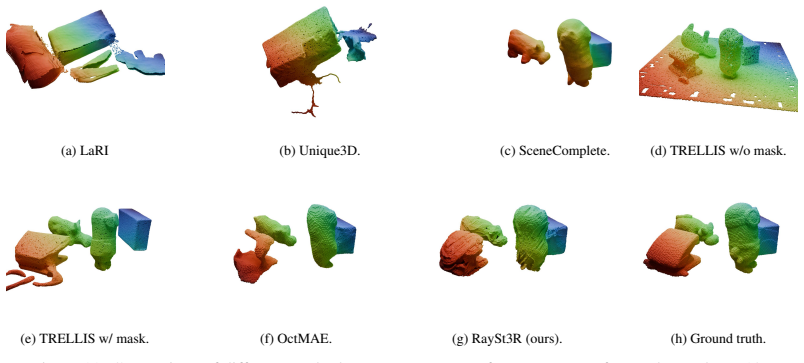
The central claim is that multi-object 3D shape completion reduces to predicting, for arbitrary query rays, the depth of the surface that first intersects the ray, together with a mask and a confidence score. The input is a masked RGB-D image plus a query ray map defining a novel viewpoint; the model uses a vision transformer with frozen DINOv2 features for the RGB, self-attention on the input point map and the ray map, cross-attention between the two, and DPT heads for depth, mask, and confidence. Predictions from 22 sampled views are fused by an occlusion test against the input depth and mask, a thresholded predicted object mask, and a thresholded confidence score. The paper reports state-of-the-art chamfer distance and F1@10mm on the OctMAE, YCB-Video, HOPE, and HomebrewedDB benchmarks, with the weakest standard deviation among methods, despite zero-shot transfer from synthetic training.
Load-bearing premise
The merging step assumes the input depth map and foreground mask are accurate enough to decide which novel-view points are occluded; real depth noise could remove true geometry or keep hallucinated points, and the paper tests mask noise but not input-depth noise.
Editorial extensions
If this is right
- Robots can obtain complete object geometry for grasping and manipulation from a single RGB-D frame, with inference under 1.2 seconds and no multi-view capture or volumetric grid.
- Shape completion no longer requires volumetric 3D supervision; training on pairs of RGB-D views plus query rays is enough, which makes data scaling substantially cheaper.
- A single confidence threshold trades accuracy against completeness, giving downstream systems a direct knob for outlier tolerance.
- Because predictions are per-view in camera coordinates, the output aligns naturally with pose-estimation and motion-planning pipelines, unlike canonical-space generators.
- The approach scales in compute via the number of queried views, so deployment can trade reconstruction density against latency.
Reading between the lines
- The ray-map query formulation is generic: the same network could be asked for depth along arbitrary rays outside the sampled view sphere, e.g., from an arbitrary camera pose, without retraining; the paper does not explicitly explore this.
- Adding realistic depth dropout and sensor noise to the input during training is a direct, untested extension that would target the weakest assumption of the merging step.
- The per-ray confidence scores could double as an active-view-selection signal: a system could query extra views precisely where confidence is low, reducing hallucination in unseen regions; the paper does not investigate this loop.
Editorial analysis
A structured set of objections, weighed in public.
Referee Report
Summary. RaySt3R recasts single-RGB-D multi-object 3D shape completion as novel-view depth prediction. Given a foreground-masked RGB-D image and a set of query rays, a DINOv2-conditioned ViT with cross-attention predicts per-pixel depth, object mask, and confidence for the novel views. Predictions from 22 views are fused using an occlusion test against the input depth (Eq. 6), predicted-mask thresholding, and a confidence threshold. The model is trained on 1.1M synthetic scenes from FoundationPose and OctMAE and evaluated zero-shot on the OctMAE test split and on YCB-Video, HOPE, and HomebrewedDB, reporting state-of-the-art chamfer distance and F1@10mm, with gains of 20-44% over OctMAE. The paper also provides ablations of training data, architecture components, and the merging procedure.
Significance. If the reported results hold, RaySt3R is a strong practical method for zero-shot multi-object shape completion: it is fast (1.2 s on a 4090), does not require per-object alignment or iterative refinement, and generalizes from synthetic data to real cluttered scenes. The paper's strengths include a large-scale synthetic training dataset, a systematic ablation of the view-merging pipeline (Table 3), standard-deviation reporting (Table 4), a mask-noise sensitivity analysis (Fig. 9), and the promise of open-sourcing the dataset. The central novelty—training a feedforward transformer to predict confidence-aware depth for arbitrary query rays and fusing them—is clearly presented and well-motivated.
major comments (3)
- [Section 4.4, Eq. (6); Table 3] The occlusion filter in Eq. (6) assumes the input depth map D_input is an accurate measurement of the visible foreground: every novel-view point projecting behind D_input is retained as newly revealed geometry, and every point in front is discarded. Table 3 shows that this component is load-bearing (removing it degrades OctMAE-test CD from 5.21 to 7.69), yet the paper only ablates noise in the input mask (Fig. 9), never noise or systematic bias in D_input. The real-world evaluation datasets contain noisy and incomplete depth, and the claimed 20-44% gains over OctMAE on those datasets could be sensitive to depth errors: if D_input reads too large, true novel-view surfaces are incorrectly discarded; if it reads too small, hallucinated points behind the measured surface survive. Please add a depth-noise ablation (e.g., Gaussian depth perturbation, holes, and a constant bias) on the real-world datasets, or otherwise provide evidence that the merging step is robust to realistic sensor noise.
- [Section 5.4 and Figure 4] Several hyperparameters are selected using the evaluation benchmarks themselves, which weakens the zero-shot claim. The confidence threshold τ=5 is justified by Figure 4, where the curve is averaged over 'all real-world datasets'—precisely the datasets used for the main evaluation—and the view-sampling parameters are set to λ_bb=1.3 and λ_cam=0.7 for all real-world datasets but λ_bb=2.5 and λ_cam=1.2 for OctMAE, i.e., adapted per evaluation dataset. Because the headline claim is zero-shot generalization, tuning on the test benchmarks gives the method an advantage that a truly zero-shot user would not have. Please either (a) select all hyperparameters on a held-out validation split disjoint from the test frames, or (b) provide a sensitivity analysis showing that the reported improvements hold over a wide range of τ, λ_bb, and λ_cam. The current presentation does not rule out that part of the 20-44% gain comes from per-dataset tuning.
- [Sections 5.1 and 5.2] The method is trained on synthetic data from the OctMAE dataset and evaluated on the 'evaluation split of the OctMAE dataset test split', but the paper does not state whether the test scenes or objects were excluded from training. If the OctMAE test split contains scenes or meshes that also appear in the training data, the synthetic benchmark would be optimistic and the reported 5.21 mm CD on this split would need to be re-interpreted. Please clarify the exact split protocol, including whether any object meshes from the test set are present in the training set, and if so, report results on a held-out split with unseen objects.
minor comments (4)
- [Section 4.3] The text says 'We don't include the input point map in our predictions as it likely contains noise and artifacts. Instead, query RaySt3R with the input view and include it in our predictions.' This appears contradictory and should be reworded to clarify whether the raw input point map is excluded from the final merged cloud while the predicted depth for the input view is included, or whether the input view is handled differently from other views.
- [Table 4] The table reports standard deviations as subscripts, but the caption says 'STD' without specifying the unit of aggregation; please state whether the standard deviation is computed over frames within each dataset, and over which number of samples, so the reader can interpret the ± values correctly.
- [Eq. (6)] The notation (p_n,i,j)_z is used for the z-component of the projected point; please define this explicitly in the text, and also clarify the handling of points whose projection falls outside the input image boundaries or exactly on the foreground-background boundary.
- [Acknowledgements and Supplement 8.3.2] There are minor typos: 'memebers' should be 'members' in the acknowledgements, and 'perfromance' should be 'performance' in Section 8.3.2. Please proofread; a few other small grammatical issues exist in the supplement.
Circularity Check
No derivation-level circularity: RaySt3R's central claim rests on held-out external benchmarks, not on a self-referential fit.
full rationale
The paper's derivation is an empirical pipeline, not a reduction of outputs to inputs. RaySt3R is trained with Eqs. (3)-(5) to predict novel-view depth, masks, and confidence from a masked RGB-D input and query ray map; those predictions are functions of learned weights, not algebraic consequences of the input depth. The occlusion filter in Eq. (6) uses the input depth and mask as geometric priors to decide which predicted points are newly visible, but it does not construct the predicted depth values, so it is not circular. The headline result is judged against the held-out OctMAE test split and the external real-world YCB-Video, HOPE, and HomebrewedDB benchmarks, with baseline numbers taken from prior work; no target metric is defined by RaySt3R's own output. Self-citations such as MASt3R-SFM [9] and FoundationPose [50] appear as architectural inspiration and training-data sources, but they are not used as unverified load-bearing premises or uniqueness theorems. The per-dataset view-sampling parameters and confidence threshold are chosen with some lookahead to the reported benchmarks, which is a test-set-tuning caveat rather than a circular derivation. Overall, no specific equation or fitted input is renamed as a prediction.
Assumptions & free parameters
free parameters (6)
- Confidence threshold tau =
5
- View sphere radius factor lambda_bb =
1.3 (real-world), 2.5 (OctMAE)
- Minimum camera distance factor lambda_cam =
0.7 (real-world), 1.2 (OctMAE)
- Confidence loss weight alpha =
0.2
- Mask loss weight lambda_mask =
0.1
- Number of query views =
22
assumptions (6)
- standard math Pinhole camera model: unprojection X = K^{-1}[iD, jD, D]^T and projection p = K P h(q) correctly relate image pixels to 3D points.
- domain assumption Synthetic training distribution (GSO/Objaverse objects in random scenes) is representative enough to generalize to real cluttered scenes.
- domain assumption Frozen DINOv2 features provide a useful visual prior for predicting depth and geometry from novel views.
- domain assumption The hand-crafted occlusion and mask merging (Eqs. 6 and 7) yields a complete and accurate surface when filtered by confidence and predicted masks.
- domain assumption Ground-truth meshes and depth values in the evaluation datasets are reliable references for Chamfer distance and F1.
- domain assumption The confidence scores learned without explicit supervision are a valid proxy for per-pixel depth error and can be thresholded to improve the final reconstruction.
Cite this review
Pith. "Pith review of RaySt3R: Predicting Novel Depth Maps for Zero-Shot Object Completion." pith.science (2026). https://pith.science/paper/LZYGWAXX
@misc{pith2026250605285,
  author       = {Pith},
  title        = {Pith review of: RaySt3R: Predicting Novel Depth Maps for Zero-Shot Object Completion},
  year         = {2026},
  howpublished = {\url{https://pith.science/paper/LZYGWAXX}},
  note         = {Machine review of arXiv:2506.05285}
}
read the original abstract
3D shape completion has broad applications in robotics, digital twin reconstruction, and extended reality (XR). Although recent advances in 3D object and scene completion have achieved impressive results, existing methods lack 3D consistency, are computationally expensive, and struggle to capture sharp object boundaries. Our work (RaySt3R) addresses these limitations by recasting 3D shape completion as a novel view synthesis problem. Specifically, given a single RGB-D image and a novel viewpoint (encoded as a collection of query rays), we train a feedforward transformer to predict depth maps, object masks, and per-pixel confidence scores for those query rays. RaySt3R fuses these predictions across multiple query views to reconstruct complete 3D shapes. We evaluate RaySt3R on synthetic and real-world datasets, and observe it achieves state-of-the-art performance, outperforming the baselines on all datasets by up to 44% in 3D chamfer distance. Project page: https://rayst3r.github.io
Figures


Figures from the paper (14 more)




Forward citations
Cited by 1 Pith paper
-
Learning Physics-Guided Residual Dynamics for Deformable Object Simulation
Physics-guided residual dynamics, a spring-mass simulator plus a network that predicts velocity corrections, yields the most accurate deformable-object simulation in the paper's real-world tests.
Reference graph
Works this paper leans on
-
[1]
A. Agarwal, G. Singh, B. Sen, T. Lozano-Pérez, and L. P. Kaelbling. Scenecomplete: Open- world 3d scene completion in complex real world environments for robot manipulation, 2024
work page 2024
-
[2]
J. T. Barron and J. Malik. Intrinsic scene properties from a single rgb-d image. In 2013 IEEE Conference on Computer Vision and Pattern Recognition, pages 17–24, 2013
work page 2013
-
[3]
A. Boulch and R. Marlet. Poco: Point convolution for surface reconstruction. In Proceedings of the IEEE/CVF Conference on Computer Vision and Pattern Recognition , pages 6302–6314, 2022
work page 2022
- [4]
-
[5]
C. Choy, J. Gwak, and S. Savarese. 4d spatio-temporal convnets: Minkowski convolutional neural networks. In CVPR, 2019
work page 2019
-
[6]
Dalal, M
M. Dalal, M. Liu, W. Talbott, C. Chen, D. Pathak, J. Zhang, and R. Salakhutdinov. Local policies enable zero-shot long-horizon manipulation. International Conference of Robotics and Automation, 2025
2025
- [7]
- [8]
Show all 57 references
-
[9]
Duisterhof, L
B. Duisterhof, L. Zust, P. Weinzaepfel, V . Leroy, Y . Cabon, and J. Revaud. Mast3r-sfm: a fully-integrated solution for unconstrained structure-from-motion, 2024
2024
-
[10]
El-Nouby, M
A. El-Nouby, M. Klein, S. Zhai, M. A. Bautista, V . Shankar, A. Toshev, J. M. Susskind, and A. Joulin. Scalable pre-training of large autoregressive image models. In Proceedings of the 41st International Conference on Machine Learning , ICML’24. JMLR.org, 2024
2024
-
[11]
H. Fan, H. Su, and L. J. Guibas. A point set generation network for 3d object reconstruction from a single image. In Proceedings of the IEEE conference on computer vision and pattern recognition, pages 605–613, 2017
2017
-
[12]
R. Gao*, A. Holynski*, P. Henzler, A. Brussee, R. Martin-Brualla, P. P. Srinivasan, J. T. Barron, and B. Poole*. Cat3d: Create anything in 3d with multi-view diffusion models. Advances in Neural Information Processing Systems, 2024
2024
-
[13]
K. He, X. Chen, S. Xie, Y . Li, P. Dollár, and R. Girshick. Masked autoencoders are scalable vision learners. CVPR, 2022
2022
-
[14]
J. Ho, A. Jain, and P. Abbeel. Denoising diffusion probabilistic models. Advances in neural information processing systems, 33:6840–6851, 2020
2020
-
[15]
J. Ho, T. Salimans, A. Gritsenko, W. Chan, M. Norouzi, and D. J. Fleet. Video diffusion models. Advances in Neural Information Processing Systems , 35:8633–8646, 2022
2022
-
[16]
J. Hou, A. Dai, and M. Nießner. Revealnet: Seeing behind objects in rgb-d scans. In CVPR, 2020
2020
-
[17]
Huang, L
H. Huang, L. Fu, M. Danielczuk, C. M. Kim, Z. Tam, J. Ichnowski, A. Angelova, B. Ichter, and K. Goldberg. Mechanical search on shelves with efficient stacking and destacking of objects. In Robotics Research, pages 205–221, Cham, 2023. Springer Nature Switzerland
2023
-
[18]
Iwase, K
S. Iwase, K. Liu, V . Guizilini, A. Gaidon, K. Kitani, R. Ambrus, and S. Zakharov. Zero-shot multi-object scene completion, 2024
2024
-
[19]
Kaskman, S
R. Kaskman, S. Zakharov, I. Shugurov, and S. Ilic. Homebreweddb: Rgb-d dataset for 6d pose estimation of 3d objects. ICCVW, 2019
2019
-
[20]
Kolesnikov, A
A. Kolesnikov, A. Dosovitskiy, D. Weissenborn, G. Heigold, J. Uszkoreit, L. Beyer, M. Minderer, M. Dehghani, N. Houlsby, S. Gelly, T. Unterthiner, and X. Zhai. An image is worth 16x16 words: Transformers for image recognition at scale. 2021
2021
-
[21]
Ladicky, O
L. Ladicky, O. Saurer, S. Jeong, F. Maninchedda, and M. Pollefeys. From point clouds to mesh using regression. In Proceedings of the IEEE International Conference on Computer Vision , pages 3893–3902, 2017
2017
-
[22]
J. Li, K. Han, P. Wang, Y . Liu, and X. Yuan. Anisotropic convolutional networks for 3d semantic scene completion. In Proceedings of the IEEE/CVF Conference on Computer Vision and Pattern Recognition, pages 3351–3359, 2020
2020
-
[23]
R. Li, B. Zhang, Z. Li, F. Tombari, and P. Wonka. Lari: Layered ray intersections for single-view 3d geometric reasoning. In arXiv preprint arXiv:2504.18424, 2025
2025 arXiv
-
[24]
Y . Li, Z. Yu, C. Choy, C. Xiao, J. M. Alvarez, S. Fidler, C. Feng, and A. Anandkumar. V oxformer: Sparse voxel transformer for camera-based 3d semantic scene completion. In CVPR, 2023
2023
-
[25]
R. Liu, R. Wu, B. Van Hoorick, P. Tokmakov, S. Zakharov, and C. V ondrick. Zero-1-to-3: Zero-shot one image to 3d object. In Proceedings of the IEEE/CVF international conference on computer vision, pages 9298–9309, 2023
2023
-
[26]
Loshchilov and F
I. Loshchilov and F. Hutter. Decoupled weight decay regularization. InInternational Conference on Learning Representations, 2019
2019
-
[27]
Mahler, M
J. Mahler, M. Matl, V . Satish, M. Danielczuk, B. DeRose, S. McKinley, and K. Goldberg. Learning ambidextrous robot grasping policies. Science Robotics, 4(26):eaau4984, 2019. 18
2019
-
[28]
Melas-Kyriazi, C
L. Melas-Kyriazi, C. Rupprecht, and A. Vedaldi. Pc2: Projection-conditioned point cloud diffusion for single-image 3d reconstruction. In Proceedings of the IEEE/CVF Conference on Computer Vision and Pattern Recognition, pages 12923–12932, 2023
2023
-
[29]
Mescheder, M
L. Mescheder, M. Oechsle, M. Niemeyer, S. Nowozin, and A. Geiger. Occupancy networks: Learning 3d reconstruction in function space. In Proceedings of the IEEE/CVF conference on computer vision and pattern recognition , pages 4460–4470, 2019
2019
-
[30]
Mishani, H
I. Mishani, H. Feddock, and M. Likhachev. Constant-time motion planning with anytime refine- ment for manipulation. In 2024 IEEE International Conference on Robotics and Automation (ICRA), page 10337–10343. IEEE, May 2024
2024
-
[31]
Oquab, T
M. Oquab, T. Darcet, T. Moutakanni, H. V . V o, M. Szafraniec, V . Khalidov, P. Fernandez, D. Haziza, F. Massa, A. El-Nouby, R. Howes, P.-Y . Huang, H. Xu, V . Sharma, S.-W. Li, W. Galuba, M. Rabbat, M. Assran, N. Ballas, G. Synnaeve, I. Misra, H. Jegou, J. Mairal, P. Labatut,...
2023
-
[32]
J. J. Park, P. Florence, J. Straub, R. Newcombe, and S. Lovegrove. Deepsdf: Learning continuous signed distance functions for shape representation. In Proceedings of the IEEE/CVF conference on computer vision and pattern recognition , pages 165–174, 2019
2019
-
[33]
S. Peng, M. Niemeyer, L. Mescheder, M. Pollefeys, and A. Geiger. Convolutional occupancy networks. In Computer Vision–ECCV 2020: 16th European Conference, Glasgow, UK, August 23–28, 2020, Proceedings, Part III 16, pages 523–540. Springer, 2020
2020
-
[34]
Ranftl, A
R. Ranftl, A. Bochkovskiy, and V . Koltun. Vision transformers for dense prediction. InICCV, 2021
2021
-
[35]
T. Ren, S. Liu, A. Zeng, J. Lin, K. Li, H. Cao, J. Chen, X. Huang, Y . Chen, F. Yan, Z. Zeng, H. Zhang, F. Li, J. Yang, H. Li, Q. Jiang, and L. Zhang. Grounded sam: Assembling open-world models for diverse visual tasks, 2024
2024
-
[36]
Rombach, A
R. Rombach, A. Blattmann, D. Lorenz, P. Esser, and B. Ommer. High-resolution image synthesis with latent diffusion models. In Proceedings of the IEEE/CVF conference on computer vision and pattern recognition, pages 10684–10695, 2022
2022
-
[37]
Saharia, W
C. Saharia, W. Chan, S. Saxena, L. Li, J. Whang, E. L. Denton, K. Ghasemipour, R. Gon- tijo Lopes, B. Karagol Ayan, T. Salimans, et al. Photorealistic text-to-image diffusion mod- els with deep language understanding. Advances in neural information processing systems , 35:3647...
2022
-
[38]
Somani, T
A. Somani, T. S. Huang, and S. D. Blostein. Least-squares fitting of two 3-D point sets. IEEE Transactions on Pattern Analysis and Machine Intelligence, pages 698–700, 1987
1987
-
[39]
Z. Tang, B. Sundaralingam, J. Tremblay, B. Wen, Y . Yuan, S. Tyree, C. Loop, A. Schwing, and S. Birchfield. Rgb-only reconstruction of tabletop scenes for collision-free manipulator control. In 2023 IEEE International Conference on Robotics and Automation (ICRA) , pages 1778–1...
2023
-
[40]
Tyree, J
S. Tyree, J. Tremblay, T. To, J. Cheng, T. Mosier, J. Smith, and S. Birchfield. 6-dof pose estimation of household objects for robotic manipulation: An accessible dataset and benchmark. In International Conference on Intelligent Robots and Systems (IROS) , 2022
2022
-
[41]
Vahdat, F
A. Vahdat, F. Williams, Z. Gojcic, O. Litany, S. Fidler, K. Kreis, et al. Lion: Latent point diffusion models for 3d shape generation. Advances in Neural Information Processing Systems , 35:10021–10039, 2022
2022
-
[42]
V oleti, C.-H
V . V oleti, C.-H. Yao, M. Boss, A. Letts, D. Pankratz, D. Tochilkin, C. Laforte, R. Rombach, and V . Jampani. Sv3d: Novel multi-view synthesis and 3d generation from a single image using latent video diffusion. In European Conference on Computer Vision, pages 439–457. Springe...
2024
-
[43]
J. Wang, M. Chen, N. Karaev, A. Vedaldi, C. Rupprecht, and D. Novotny. Vggt: Visual geometry grounded transformer. In Proceedings of the IEEE/CVF Conference on Computer Vision and Pattern Recognition, 2025
2025
-
[44]
P.-S. Wang, Y . Liu, and X. Tong. Deep octree-based cnns with output-guided skip connections for 3d shape and scene completion. In CVPRW, 2020
2020
-
[45]
Q. Wang, Y . Zhang, A. Holynski, A. A. Efros, and A. Kanazawa. Continuous 3d perception model with persistent state. arXiv preprint arXiv:2501.12387, 2025
2025 arXiv
-
[46]
S. Wang, V . Leroy, Y . Cabon, B. Chidlovskii, and J. Revaud. Dust3r: Geometric 3d vision made easy. In CVPR, 2024
2024
-
[47]
Weber, N
E. Weber, N. Müller, Y . Kant, V . Agrawal, M. Zollhöfer, A. Kanazawa, and C. Richardt. Fillerbuster: Multi-view scene completion for casual captures, 2025. arXiv:2502.05175
2025
-
[48]
B. Wen, W. Lian, K. Bekris, and S. Schaal. Catgrasp: Learning category-level task-relevant grasping in clutter from simulation. In 2022 International Conference on Robotics and Automa- tion (ICRA), pages 6401–6408. IEEE, 2022
2022
-
[49]
B. Wen, C. Mitash, B. Ren, and K. E. Bekris. se (3)-tracknet: Data-driven 6d pose tracking by calibrating image residuals in synthetic domains. In 2020 IEEE/RSJ International Conference on Intelligent Robots and Systems (IROS) , pages 10367–10373. IEEE, 2020
2020
-
[50]
B. Wen, W. Yang, J. Kautz, and S. Birchfield. Foundationpose: Unified 6d pose estimation and tracking of novel objects. In CVPR, 2024
2024
-
[51]
C.-Y . Wu, J. Johnson, J. Malik, C. Feichtenhofer, and G. Gkioxari. Multiview compressive coding for 3D reconstruction. In CVPR, 2023
2023
-
[52]
K. Wu, F. Liu, Z. Cai, R. Yan, H. Wang, Y . Hu, Y . Duan, and K. Ma. Unique3d: High-quality and efficient 3d mesh generation from a single image, 2024
2024
-
[53]
Xiang, Z
J. Xiang, Z. Lv, S. Xu, Y . Deng, R. Wang, B. Zhang, D. Chen, X. Tong, and J. Yang. Structured 3d latents for scalable and versatile 3d generation. arXiv preprint arXiv:2412.01506, 2024
2024 arXiv
-
[54]
Xiang, T
Y . Xiang, T. Schmidt, V . Narayanan, and D. Fox. Posecnn: A convolutional neural network for 6d object pose estimation in cluttered scenes. 2018
2018
-
[55]
X. Yan, L. Lin, N. J. Mitra, D. Lischinski, D. Cohen-Or, and H. Huang. Shapeformer: Transformer-based shape completion via sparse representation. InProceedings of the IEEE/CVF Conference on Computer Vision and Pattern Recognition, 2022
2022
-
[56]
K. Yao, L. Zhang, X. Yan, Y . Zeng, Q. Zhang, L. Xu, W. Yang, J. Gu, and J. Yu. CAST: Component-aligned 3d scene reconstruction from an RGB image. In arXiv:2502.12894, 2025
2025 arXiv
-
[57]
W. Yu, J. Xing, L. Yuan, W. Hu, X. Li, Z. Huang, X. Gao, T.-T. Wong, Y . Shan, and Y . Tian. Viewcrafter: Taming video diffusion models for high-fidelity novel view synthesis. arXiv preprint arXiv:2409.02048, 2024. 20
2024 arXiv
Reviewed August 7, 2026 · model on record in the stance chip above.
Discussion (0). Sign in to comment.