REVIEW 2 major objections 2 minor 28 references
Non-Perturbative Topological Gadgets for Many-Body Coupling
T0 review · 2 major / 2 minor · reviewed 2026-08-07 · deepseek-v4-flash
Pith's one-line read This paper claims a non-perturbative gadget built from a domain-wall chain and three- or five-body drivers implements the effective interaction αZ^{⊗nd} exactly in a gapped low-energy subspace.
desk verdict The factor-of-two eigenvalue error is real and breaks the central calibration, but the underlying non-perturbative gadget idea is novel enough to warrant a serious referee. read the letter →
The pith
A machine-rendered reading of the paper's core claim, the machinery that carries it, and where it could break.
The reading
What carries the argument
The central object is the domain-wall defect sector of a chain Hamiltonian built from overlapping three-body terms, ½(1 − Z_i Z^a_{i−1}Z^a_i), where ancilla qubits carry cumulative parity of the data qubits. When the data parity is unsatisfiable, exactly one term is broken and a topological defect sits at that position j; the single-defect subspace is a one-dimensional hopping model with a tridiagonal Toeplitz Hamiltonian whose eigenstates are sine vectors S_{kj}. The subspace driver (five-body in its clean form, three-body after a gauge transform) moves the defect along the chain, and the gauge unitary U_enc diagonalizes the defect sectors. What carries the argument is the combination: the chain sets the defect energy scale γ, the driver provides a spectrum that can be exactly cancelled by choosing β via Equation (21), and the ground-state overlap S0j between defect states of differing data configurations supplies the matrix elements for encoded logical operators.
What would settle it
Diagonalize the nd×nd tridiagonal matrix with off-diagonal entries 2 appearing in Equation (12) for small nd (say nd = 2, 3, 4). If its lowest eigenvalue is 4 cos(π/(nd+1)) rather than the stated −2 cos(π/(nd+1)), then the β in Equation (21) does not put the one-defect ground state at energy α, and the claimed identity H_eff = $αZ^{{⊗nd}}$ fails.
Extended reading notes
Core claim
The central claim is that the Hamiltonian H_Gadget = γH_Chain + βH_Subspace, with β = (γ − α)/(2 cos(π/(nd+1))), has a low-energy subspace on which it acts as H_eff = $αZ^{{⊗nd}}$: an nd-body interaction formed from only three-body chain terms plus five-body subspace drivers (or gauge-reduced three-body drivers). The chain term penalizes the number of defects, the subspace driver delocalizes a single defect like a particle in a box, and the chosen β cancels the defect kinetic energy so the one-defect ground state sits at energy α. The paper further shows that a physical X on a data qubit implements a logical X with a known amplitude correction 1/S0j, and that XiXi+1X^a_i implements adjacent logical XX. These operations let one flip a minor-embedded logical chain or drive it as a whole, with leakage suppressed by the O(γ) gap.
Load-bearing premise
Everything rests on one exact eigenvalue calculation: the energy of a single mobile domain wall must be exactly −2 cos(π/(nd+1)) for the chosen driver strength to cancel it; if that number is off, the gadget stops doing what is claimed.
Editorial extensions
If this is right
- If the construction is correct, an nd-body Z^{⊗nd} term for any nd can be implemented on a linear-connectivity device using three-body chain interactions and at most five-body drivers, with no perturbative expansion needed.
- The encoded single-qubit X operation, with correction 1/S0j, gives a way to flip a single data qubit inside a minor-embedding chain without breaking the chain constraints, directly addressing the tension between constraint enforcement and spin-flip dynamics on quasi-two-dimensional hardware.
- The three-body physical term XiXi+1X^a_i implements a logical XX interaction, enabling whole-chain driving and effective many-body X-catalysts in the Hadamard-rotated basis.
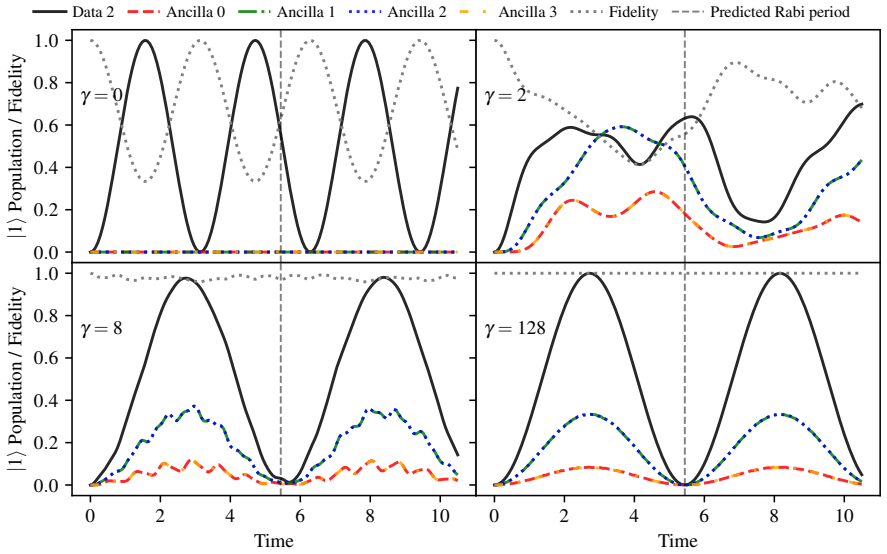
- The performance metrics (leakage, conditional fidelity, absolute fidelity) define an operating regime where high confinement γ makes the gadget act like the ideal logical Hamiltonian while suppressing single-qubit noise perturbations.
- The same defect-parity mechanism is proposed as a template for ice-like two-body systems, where boundary conditions alone determine whether an odd or even number of defects exist, potentially yielding approximate many-body couplings from purely two-body terms.
Reading between the lines
- Beyond the paper's explicit claims, this suggests that any product-of-Z diagonal Hamiltonian could be compiled from linear-connectivity three-body terms with an energy overhead set by γ rather than by perturbation order, a qualitative improvement over kth-order perturbative gadgets if the spectrum identity holds.
- The position-dependent overlap S0j implies logical driving is stronger at the chain ends than in the middle; the paper mentions heterogeneous subspace driving as a way to bias amplitude toward the ends, but does not numerically explore this tuning knob.
- A natural testable extension is to apply the same gadget in the Hadamard basis to build effective XX products (not just ZZ products) for catalyst terms in adiabatic computation; the authors list catalysts as an application but do not simulate them.
- If the ice-like two-body analogue works, it would beat the three-body chain gadget in locality, and the quasi-one-dimensional geometry suggests matrix-product-state simulations could verify it; this last point is an editorial extrapolation from the paper's outlook.
Editorial analysis
A structured set of objections, weighed in public.
Referee Report
Summary. The manuscript proposes a class of non-perturbative quantum gadgets based on domain-wall defects in a linear chain of three-body parity terms. A chain Hamiltonian penalizes unsatisfied clauses, while subspace drivers move a single defect along the chain, leading to an effective tight-binding model on the defect position. The authors claim that with a suitable driver strength beta (Eq. 21) the gadget realizes the exact effective interaction H_eff = alpha Z^{⊗nd} in a gapped low-energy subspace (Eq. 22), and they use this to construct encoded logical X and XX operations for minor-embedded chains. The paper includes numerical simulations of leakage, conditional fidelity, and a minor-embedding task.
Significance. If correct, the construction would be a useful alternative to perturbative gadgets, avoiding exponentially small energy scales and providing encoded logical operations with modest-weight physical terms. The paper is clearly written and the idea of exploiting the odd-even, boundary-dependent defect structure is appealing. The analytical diagonalization of the single-defect subspace via a sine transform is elegant, and the performance metrics in Sec. 6 are well defined. However, the central parameter-setting equation rests on an incorrect eigenvalue formula, so the headline result is not currently established. The authors also appropriately acknowledge limitations on composability and the approximate nature of the ice-like extension, which are not themselves problems.
major comments (2)
- [Sec. 3.1.2, Eqs. (12), (14), (21), (22)] The matrix in Eq. (12) is a tridiagonal Toeplitz matrix with off-diagonal matrix elements equal to 2. Its eigenvalues are 4 cos(pi (k+1)/(nd+1)) for k = 0,...,nd-1, not -2 cos(...) as stated in Eq. (14). Moreover, with the explicit +2 off-diagonal entries, the lowest eigenvalue occurs at k = nd-1 rather than k = 0, so Eq. (15) assigns the ground state to the wrong eigenvector. Because Eq. (21) is derived from this eigenvalue, the calibration does not place the one-defect subspace at the intended energy: with the authors' beta the one-defect ground-state energy is gamma - 4 beta cos(pi/(nd+1)) = 2 alpha - gamma in the large-nd limit, not alpha. Consequently Eq. (22) does not follow, and the numerical demonstrations in Figures 5-8 do not validate the claimed effective Hamiltonian. The eigenvalue formula and the calibration must be corrected before the central claim can be assessed.
- [Sec. 4, Eqs. (20)-(22)] Even if the eigenvalue formula is repaired, the stated calibration gives the zero-defect (satisfiable) sector energy 0 and the one-defect ground-state energy alpha, so the effective Hamiltonian on the two-dimensional parity subspace has eigenvalues {0, alpha}. For the unkinked chain this is (alpha/2)(I - Z^{⊗nd}), not alpha Z^{⊗nd}; the coefficient of the many-body term is alpha/2, and to realize exactly alpha Z^{⊗nd} one would need to place the odd-parity level at -alpha (up to an irrelevant constant), which corresponds to a different sign and magnitude of beta. The authors should either correct Eq. (22) or explicitly define alpha as the energy splitting rather than the coefficient of Z^{⊗nd}.
minor comments (2)
- [Sec. 5.1, Eq. (26)] The normalization constant S0j is given as sqrt(2/(nd-1)), but Eq. (13) and the simulation amplitudes in the Figure 6 caption (0.577, 0.5, 0.289 for nd=5) require sqrt(2/(nd+1)). This typo affects the correction factor 1/S0j for encoded single-qubit X operations and should be fixed.
- [Figure 5 caption] The statement that evolution from a logical |+> state under Z^{⊗n} for time t = pi/2 produces a GHZ state is not consistent with the standard identity e^{-i Z^{⊗n} t}|+>^n = cos(t)|+>^n - i sin(t)|->^n, which at t = pi/2 gives the product state -i|->^n. Please clarify what quantity labeled 'GHZ fidelity' is actually plotted, or correct the caption.
Circularity Check
No significant circularity: the gadget is an explicit construction whose parameter beta is a design equation, not a fitted value, and the cited self-work on domain-wall encoding is not load-bearing.
full rationale
The paper's central claim is that H_Gadget = gamma H_Chain + beta H_Subspace realizes H_eff = alpha Z^(⊗nd) in a gapped low-energy subspace. The parameter beta is set by Eq. 21 from the analytically derived single-defect spectrum in Eq. 14. This is a design or calibration equation, not a prediction extracted from data, and Eq. 22 follows by construction from diagonalizing the driver. The domain-wall encoding language is attributed to ref. [21] by one of the authors, but the chain Hamiltonian and defect subspace are derived within the paper itself (Eqs. 3-8); the self-citation only names an established concept and is not load-bearing. The apparent issue with Eq. 14's eigenvalue formula, if real, would be a mathematical correctness concern rather than circularity, because the derivation does not assume the desired conclusion; it attempts to prove it from a stated spectral lemma. Since no 'prediction' reduces to a fitted input and no load-bearing argument reduces to a self-citation, the derivation is self-contained for the purpose of this circularity analysis.
Assumptions & free parameters
free parameters (2)
- Confinement strength γ =
Values such as 1.05, 3, 8, 128, 1000 used in figures
- Target coupling strength α =
Set to 1 in numerical demonstrations
assumptions (4)
- standard math The one-defect effective Hamiltonian (Eq. 12) has eigenvalues λ_k = −2 cos(π(k+1)/(nd+1)) as stated in Eq. 14.
- domain assumption The one-defect subspace is invariant under the gadget Hamiltonian, and transitions between different defect-number sectors are suppressed by the confinement gap.
- domain assumption Physical hardware can realize the required three-body chain terms (Eq. 3) and five-body subspace drivers (Eq. 11), or the gauge-reduced three-body variant (Eq. 18).
- domain assumption The virtual ancilla qubits at the chain ends can be fixed to constant +1 or −1 values as boundary conditions.
Cite this review
Pith. "Pith review of Non-Perturbative Topological Gadgets for Many-Body Coupling." pith.science (2026). https://pith.science/paper/FPSCSQMU
@misc{pith2026250605323,
  author       = {Pith},
  title        = {Pith review of: Non-Perturbative Topological Gadgets for Many-Body Coupling},
  year         = {2026},
  howpublished = {\url{https://pith.science/paper/FPSCSQMU}},
  note         = {Machine review of arXiv:2506.05323}
}
read the original abstract
Continuous-time quantum hardware implementations generally lack the native capability to implement high-order terms that would facilitate efficient compilation of quantum algorithms. This limitation has, in part, motivated the development of perturbative gadgets -- multi-qubit constructions used to effect a desired Hamiltonian using engineered low-energy subspaces of a larger system constructed using simpler, usually two-body, primitives. In this work, we demonstrate how a class of non-perturbative gadgets can produce high-order multi-body interactions by taking advantage of the odd-even properties of topological defect subspaces. The simplest example is based on domain-wall defects forming an effective Ising spin-chain based on three-body coupling with linear connectivity, alongside three-, or five-body driving terms depending on the intended use. Although this will be the main focus of the paper due to conceptual simplicity, there exist systems constructed with only two-body couplings where the boundaries determine whether there are an odd or even number of defects, namely ice-like systems which may yield more complex gadget-like constructions.
Figures


Figures from the paper (5 more)




Reference graph
Works this paper leans on
-
[1]
Minor-embedding in adiabatic quantum computation: I
Vicky Choi. Minor-embedding in adiabatic quantum computation: I. The parameter set- ting problem. Quantum Information Process- ing, 7(5):193–209, 2008
work page 2008
-
[2]
Error-corrected quantum an- nealing with hundreds of qubits.Nature com- munications, 5(1):3243, 2014
Kristen L Pudenz, Tameem Albash, and Daniel A Lidar. Error-corrected quantum an- nealing with hundreds of qubits.Nature com- munications, 5(1):3243, 2014
work page 2014
-
[3]
Exponential speed-up of quantum anneal- ing via n-local catalysts
Roopayan Ghosh, Luca A Nutricati, Natasha Feinstein, PA Warburton, and Sougato Bose. Exponential speed-up of quantum anneal- ing via n-local catalysts. arXiv preprint arXiv:2409.13029, 2024
arXiv 2024
-
[4]
Kitaev, Alexander Shen, and Mikhail N
Alexei Yu. Kitaev, Alexander Shen, and Mikhail N. Vyalyi. Classical and Quantum Computation, volume 47 ofGraduate Studies in Mathematics. American Mathematical So- ciety, Providence, RI, 2002
work page 2002
-
[5]
3-local hamil- tonian is qma-complete, 2003
Julia Kempe and Oded Regev. 3-local hamil- tonian is qma-complete, 2003
work page 2003
-
[6]
The complexity of the local hamiltonian prob- lem
Julia Kempe, Alexei Kitaev, and Oded Regev. The complexity of the local hamiltonian prob- lem. Siam journal on computing, 35(5):1070– 1097, 2006
work page 2006
-
[7]
A quantum annealing architecture with all-to-all connectivity from local interactions
Wolfgang Lechner, Philipp Hauke, and Peter Zoller. A quantum annealing architecture with all-to-all connectivity from local interactions. Science advances, 1(9):e1500838, 2015
work page 2015
-
[8]
A transmon quantum annealer: Decom- posing many-body ising constraints into pair interactions
Martin Leib, Peter Zoller, and Wolfgang Lech- ner. A transmon quantum annealer: Decom- posing many-body ising constraints into pair interactions. Quantum Science and Technol- ogy, 1(1):015008, 2016
work page 2016
Show all 28 references
-
[9]
Estarellas
Ana Palacios, Artur Garcia-Saez, Bruno Juliá- Díaz, and Marta P. Estarellas. Scalable 2-local architecture for quantum annealing of ising models with arbitrary dimensions.Phys. Rev. Appl., 23:054070, May 2025
2025
-
[10]
King, and Jack Raymond
Kelly Boothby, Andrew D. King, and Jack Raymond. Zephyr topology of D-Wave quan- tum processors, 2021. D-Wave technical re- port: 14-1056A-A
2021
-
[11]
Lukin, Sheng-Tao Wang, and Hannes Pichler
Minh-Thi Nguyen, Jin-Guo Liu, Jonathan Wurtz, Mikhail D. Lukin, Sheng-Tao Wang, and Hannes Pichler. Quantum optimiza- tion with arbitrary connectivity using rydberg atom arrays. PRX Quantum, 4:010316, Feb 2023
2023
-
[12]
Daley, and Jonathan D
Johannes Kombe, Gerard Pelegrí, Andrew J. Daley, and Jonathan D. Pritchard. A quan- tum wire approach to weighted combina- torial graph optimisation problems, 2025. arXiv:2503.17115
2025 arXiv
-
[13]
Quantum simulation of one-dimensional fermionic systems with ising hamiltonians
Matthias Werner, Artur García-Sáez, and Marta P Estarellas. Quantum simulation of one-dimensional fermionic systems with ising hamiltonians. Physical Review B , 111(15):155441, 2025
2025
-
[14]
King, Cristiano Nisoli, Edward D
Andrew D. King, Cristiano Nisoli, Edward D. Dahl, Gabriel Poulin-Lamarre, and Alejandro Lopez-Bezanilla. Qubit spin ice. Science, 373(6554):576–580, July 2021
2021
-
[15]
Artificial ’spin ice’ in a geometrically frustrated lattice of nanoscale ferromagnetic islands
1 RF Wang, Cristiano Nisoli, Rafael Sá de Freitas, J Li, W McConville, BJ Cooley, MS Lund, N Samarth, C Leighton, VH Crespi, et al. Artificial ’spin ice’ in a geometrically frustrated lattice of nanoscale ferromagnetic islands. Nature, 439(7074):303–306, 2006
2006
-
[16]
A practical introduction to tensor networks: Matrix product states and projected entangled pair states
Román Orús. A practical introduction to tensor networks: Matrix product states and projected entangled pair states. Annals of Physics, 349:117–158, 2014
2014
-
[17]
Tensor net- works for quantum computing, 2025
Aleksandr Berezutskii et al. Tensor net- works for quantum computing, 2025. arXiv:2503.08626
2025
-
[18]
Relation betweentheandersonandkondohamiltonians
John R Schrieffer and Peter A Wolff. Relation betweentheandersonandkondohamiltonians. Physical Review, 149(2):491, 1966
1966
-
[19]
Per- turbative gadgets at arbitrary orders
Stephen P Jordan and Edward Farhi. Per- turbative gadgets at arbitrary orders. Phys- ical Review A–Atomic, Molecular, and Optical Physics, 77(6):062329, 2008
2008
-
[20]
Faehrmann, Sumeet Khatri, and Jens Eisert
Simon Cichy, Paul K. Faehrmann, Sumeet Khatri, and Jens Eisert. Perturbative gadgets for gate-based quantum computing: Nonre- cursive constructionswithout subspacerestric- tions. Physical Review A, 109(5), May 2024. 14
2024
-
[21]
Domain wall encoding of discrete variables for quantum annealing and QAOA
Nicholas Chancellor. Domain wall encoding of discrete variables for quantum annealing and QAOA. Quantum Science and Technol- ogy, 4(4):045004, aug 2019
2019
-
[22]
Quan- tum annealing correction with minor embed- ding
Walter Vinci, Tameem Albash, Gerardo Paz Silva, Itay Hen, and Daniel Lidar. Quan- tum annealing correction with minor embed- ding. Physical Review A, 92, 07 2015
2015
-
[23]
Effects of XX catalysts on quantum annealing spectra with perturbative crossings
Natasha Feinstein, Louis Fry-Bouriaux, Sougato Bose, and PA Warburton. Effects of XX catalysts on quantum annealing spectra with perturbative crossings. Physical Review A, 110(4):042609, 2024
2024
-
[24]
Gadgets for simulating a non-nativeXX inter- action in quantum annealing
Robert J Banks, Natasha Feinstein, Roopayan Ghosh, Sougato Bose, and PA Warburton. Gadgets for simulating a non-nativeXX inter- action in quantum annealing. arXiv preprint arXiv:2503.16663, 2025
2025 arXiv
-
[25]
Mohan Sarovar and G J. Milburn. Continuous quantum error correction by cooling.Physical Review A, 72, 07 2005
2005
-
[26]
Jordan, Edward Farhi, and Pe- ter W
Stephen P. Jordan, Edward Farhi, and Pe- ter W. Shor. Error-correcting codes for adi- abatic quantum computation. Phys. Rev. A, 74:052322, Nov 2006
2006
-
[27]
Young, Mohan Sarovar, and Robin Blume-Kohout
Kevin C. Young, Mohan Sarovar, and Robin Blume-Kohout. Error suppression and error correction in adiabatic quantum computation: Techniques and challenges.Physical Review X, 3, 07 2013
2013
-
[28]
Er- ror suppression and error correction in adiabatic quantum computation: non- equilibrium dynamics
Mohan Sarovar and Kevin C Young. Er- ror suppression and error correction in adiabatic quantum computation: non- equilibrium dynamics. New Journal of Physics, 15(12):125032, dec 2013. 15
2013
Reviewed August 7, 2026 · model on record in the stance chip above.
Discussion (0). Sign in to comment.