REVIEW 5 major objections 5 minor 52 references
Can Vision Transformers with ResNet's Global Features Fairly Authenticate Demographic Faces?
T0 review · 5 major / 5 minor · reviewed 2026-08-07 · deepseek-v4-flash
Pith's one-line read A few-shot prototype network that fuses frozen pre-trained ViT and ResNet-18 features and trains only two FC layers can authenticate demographic faces fairly, and Swin Transformer is the best of the three ViT backbones tested.
desk verdict Attribute classification dressed up as face authentication; the TAR/FAR metrics are tautological, so the fairness claim does not survive contact with the paper. read the letter →
The pith
A machine-rendered reading of the paper's core claim, the machinery that carries it, and where it could break.
The reading
What carries the argument
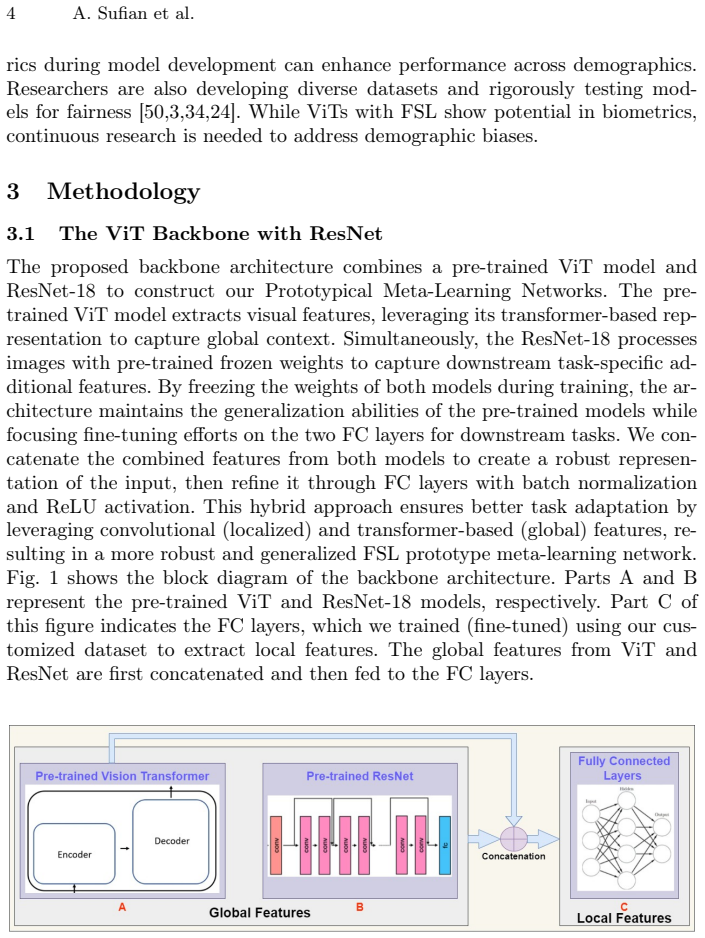
The central mechanism is the few-shot prototypical network with a ViT+ResNet-18 backbone: both encoders are kept frozen to preserve pre-trained global features, their output vectors are concatenated, and two trainable fully connected layers with batch normalization and ReLU adapt the representation. For each class, the mean of the support-set feature vectors forms a prototype, and a query image is assigned to the prototype with the smallest Euclidean distance. This design lets the system authenticate new demographic classes from a handful of examples while the only learned parameters are the two FC layers.
What would settle it
Take the same frozen-backbone prototype network and run it on an independently labeled demographic face dataset with verified labels and controlled image quality; if per-group accuracy gaps shrink, change order, or race accuracy drops far below 88%, the fairness conclusion does not generalize. A quicker check is to have independent annotators re-label the 13 classes in the authors' dataset and rerun the five-shot test to see whether the class accuracies and backbone ordering survive.
Extended reading notes
Core claim
On the authors' own terms, the discovery is that a few-shot prototypical network with a hybrid backbone—frozen pre-trained global features from a ViT, concatenated with frozen ResNet-18 features, then refined by two fine-tuned fully connected layers—authenticates demographic faces with small class-to-class differences across race/ethnicity, gender, and age. The network classifies each query by Euclidean distance to the mean support-set prototype. Among the three backbone families, the Swin Transformer outperforms the DeiT and Visual Transformer (VT) backbones in accuracy, precision, and recall in nearly every one-, three-, and five-shot setting, and it shows the smallest apparent bias in class-wise TAR/FAR. The ablation study, limited to the best backbone, shows ViT-alone accuracy is lower than ViT-plus-ResNet in all three demographic categories.
Load-bearing premise
The demographic dataset, assembled by web scraping, manual filtration, and OpenCV preprocessing with 20-50 images per class, must have correctly labeled race/ethnicity, gender, and age classes and representative query images, so that the reported accuracy and TAR/FAR differences reflect genuine model fairness rather than labeling noise or sampling artifacts.
Editorial extensions
If this is right
- At five support images per class, the Swin+ResNet prototype network reaches 88.29% accuracy on race/ethnicity, 98.00% on gender, and 99.33% on age, indicating that few-shot demographic face authentication is feasible with frozen pre-trained global features.
- The ablation shows that fusing ResNet-18 features with the ViT improves mean accuracy over the ViT alone across one-, three-, and five-shot settings in all three demographic categories.
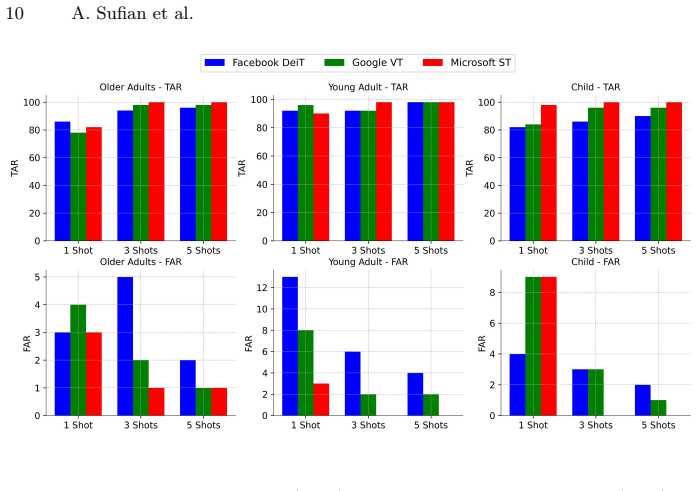
- Accuracy, precision, and recall all rise from one-shot to five-shot, and class-wise TAR increases while FAR decreases, so larger support sets reduce the apparent demographic gap.
- Among the three ViT families tested, the Swin Transformer is the recommended backbone for low-shot demographic face authentication, followed by the VT and then the DeiT.
Reading between the lines
- Because the demographic categories are coarse (seven races/ethnicities, three genders, three age groups) and images are few, the reported accuracies should be read as dataset-specific estimates; an independent, balanced benchmark would test whether Swin's lead persists outside this collection.
- The frozen-backbone-plus-light-projection recipe suggests a general low-resource pattern for biometric verification: keep massive encoders fixed and adapt a tiny head, which could carry over to other modalities such as voice or gait if the same prototype rule holds.
- The race/ethnicity accuracy (88.29%) is consistently the weakest category for all backbones, so the paper's fairness claim is stronger for gender and age than for race; a truly fair system would need to close that axis-specific gap.
- A direct test of the fairness claim would report per-group error rates rather than overall accuracy; the paper's TAR/FAR figures move in that direction but are still computed on a small static query set.
Editorial analysis
A structured set of objections, weighed in public.
Referee Report
Summary. The manuscript reports an empirical comparison of three pre-trained Vision Transformer backbones (Facebook DeiT, Google VT, Microsoft Swin Transformer) combined with frozen ResNet-18 and two trainable fully connected layers in a few-shot prototypical network for what it calls 'demographic face authentication'. A new dataset of 13 classes (7 race/ethnicity, 3 gender, 3 age) is assembled by web scraping and manual filtration; accuracy, precision, recall, TAR, and FAR are reported at 1-, 3-, and 5-shot settings. The authors conclude that Microsoft's Swin Transformer, especially when combined with ResNet, gives the best and fairest performance. Code and data are announced as available at a GitHub URL.
Significance. If the central claim were valid, the paper would offer useful evidence on backbone selection for low-shot face authentication and introduce a new demographic dataset. The manuscript has some constructive elements: it compares three backbones, reports repeated trials with standard deviations, includes an ablation study, and promises code and data release. However, the evaluation protocol does not measure face authentication or fairness as claimed: the classes are demographic groups rather than identities, the reported TAR/FAR definitions make TAR + FAR = 1 by construction, the statistical support is weak (tiny query sets, inconsistent trial counts, no significance tests or standard fairness metrics), and the only evaluation dataset is self-created with no external validation. These problems are load-bearing for the paper's stated contribution, so the significance of the reported accuracy numbers is not established.
major comments (5)
- [§4.4, Table 1, Abstract] The evaluation does not implement face authentication. Section 4.4 states that 'one static support sample image for each of the classes' is used, where the classes are the 7 race/ethnicity, 3 gender, and 3 age groups described in Section 4.1. Prototypes are therefore means over demographic groups, not over identities, and Table 1 reports demographic attribute classification accuracy. Accuracy on gender, age, or race groups cannot support the abstract's claim that the network can 'fairly authenticate demographic faces', because no identity-verification or identification protocol—same-person support/query pairs, impostor trials, or per-identity evaluation—is run. The conclusions in Sections 5 and 7 inherit this task mismatch.
- [§5, Eqs. (3)–(4), Figs. 3–5] Equations (3) and (4) define TAR = TN/(FP+TN) and FAR = FP/(FP+TN), so TAR + FAR = 1 identically. Consequently, the observation in Section 5 that 'as the support set increases, TAR improves, and FAR decreases' is a tautology, and Figs. 3–5 provide no independent evidence about authentication performance or fairness. The standard definitions (TAR = TP/(TP+FN), FAR = FP/(FP+TN)) would be required, together with a genuine verification protocol, before any authentic-rate conclusion can be drawn.
- [Table 1 caption vs. §4.4] The reported statistics are internally inconsistent and underpowered. Table 1's caption says each value is the mean of 10 independent trials, while Section 4.4 says 'Each data point in the performance table (Table 1) is derived from five different test assignments'. With only 10 static query images per class (70 race queries, 30 gender queries, 30 age queries per trial), the reported standard deviations such as ±0.03 in the 1-shot DeiT race row are not credible for multiclass decisions on 70 queries, and no confidence intervals or significance tests are provided. Differences between backbones, such as the 1-shot race accuracy gap between DeiT (52.29) and Swin (64.00), are not shown to be beyond sampling noise. Standard fairness metrics—for example, equalized odds, demographic parity, or per-group error rates—are absent, so the claim of reduced bias is not supported.
- [§4.3 and §4.2] The training protocol description is not coherent enough to reproduce. Section 4.3 first describes k-way n-shot episode training with k randomly chosen between 5 and 8, n between 1 and 5, and cross-entropy loss, but then states that the model learned on 'a dataset of 1036 classes' with image pairs labeled by dissimilarity scores and trained using binary cross-entropy loss as in Eq. (2). These are different learning problems, and the paper does not explain how the episodic prototype training and the pairwise binary classification are combined. Section 4.2 also says selection was limited to 40 images per class, while Section 4.1 reports 20–50 images per class. This ambiguity materially affects the reproducibility of the core experiment.
- [§4.1, §4.4] The newly created dataset is the sole evaluation instrument, and the manuscript provides no validation of its labels or representativeness. Images are obtained by a web-scraping API, manual filtration, and OpenCV preprocessing; class sizes vary from 20 to 50 images; there is no stated annotation protocol, no independent label check, and no comparison on an external benchmark such as LFW or a standard demographic face dataset. If the demographic labels contain noise or the 10 static query images per class are unrepresentative, the accuracy gaps in Table 1 and the fairness conclusions have no external validity.
minor comments (5)
- [Fig. 6 caption] The caption contains a typo: 'Microsft ST' should be 'Microsoft ST'.
- [§4.3] The learning rate is written as 'le-4'; this should be '1e-4'.
- [§4.1] The phrase 'and fliers to around 20 to 50 face images' should read 'and filtered to around 20 to 50 face images'.
- [§3.1, References [11], [47]] The paper refers to 'Google VT' as one of the three backbones, but the cited reference [47] is titled 'Visual transformers: Token-based image representation and processing for computer vision' and does not clearly correspond to a Google-published ViT model; the authors should identify the exact pretrained checkpoint and clarify the model name.
- [§6] The ablation study is limited to Microsoft ST 'due to page length constraints', as the paper itself notes; this limits the strength of the claim that adding ResNet improves performance for all three backbones.
Circularity Check
TAR/FAR trend is a definitional tautology and 'demographic face authentication' reduces to demographic attribute classification.
-
self definitional
[Section 5, Eqs. (3)-(4) and accompanying text]
"T AR= T rueN egative/(F alseP ostitive+ T rueN egative) (3) F AR= F alseP ostitive/(F alseP ostitive+ T rueN egative) (4) ... The class-wise mean True Authentication Rate (TAR) and False Authentication Rate (FAR) which are calculated in (3) and in (4) respectively, are displayed in graphs in Fig. 3, Fig. 4, and Fig. 5, show clear trends that as the support set increases, TAR improves, and FAR decreases across all backbone networks."
By the paper's own definitions, TAR = TN/(FP+TN) and FAR = FP/(FP+TN), so TAR + FAR = 1 identically: any increase in TAR automatically decreases FAR because they share the same denominator and complementary numerators. The claimed empirical trend, 'as the support set increases, TAR improves, and FAR decreases', is therefore not a discovery about the models but a consequence of the metric definitions. The paper presents this algebraic identity as evidence of fairness and of Microsoft ST's stability, so that portion of the fairness argument reduces to the equations by construction.
-
renaming known result
[Section 4.1, Section 4.4]
"The dataset includes three demographic categories: Race/Ethnicity, Gender, and Age Group. ... The Gender category consists of representative faces from male, female, and non-binary. ... with Race/Ethnicity demographic categories, there are a total of 7 distinct classes, so in a 1-shot test scenario, we choose one static support sample image for each of the classes."
The test classes are demographic attributes, not person identities: 7 race/ethnicity groups, 3 gender groups, and 3 age groups. A support prototype is the mean embedding of a demographic group, and Table 1 accuracy, precision, recall, TAR, and FAR all measure demographic attribute classification. Calling this 'face authentication' renames a standard demographic classification task as an identity-verification task; the central claim about fair authentication is, by the paper's own protocol, equivalent to demographic attribute classification and contains no identity-based authentication content.
full rationale
The paper is primarily an empirical comparison of frozen ViT backbones plus ResNet-18 under a few-shot prototypical network, and that backbone ranking is not itself derived from the paper's definitions; it is a measured outcome on the authors' scraped dataset. However, two load-bearing parts of the fairness narrative reduce by construction. First, the TAR/FAR 'trend' is forced by the definitions in Eqs. (3)-(4), since TAR and FAR are complementary by arithmetic. Second, the task labeled 'demographic face authentication' uses demographic groups as classes, so the reported accuracies are demographic attribute classification accuracies, not authentication rates; this is a renaming of a known classification task rather than a verification study. The only self-citation, FewFaceNet [37], is used incidentally in the literature review and is not load-bearing. Because the central fairness claim rests partly on these definitional reductions, the circularity score is 6 rather than 0-2.
Assumptions & free parameters
assumptions (3)
- domain assumption Frozen pre-trained ViT and ResNet-18 features, plus two trained FC layers, are sufficient to represent face identity for authentication across demographics.
- domain assumption The web-scraped, manually filtered images are correctly and consistently labeled by race/ethnicity, gender, and age.
- domain assumption Accuracy, precision, recall, and class-wise TAR/FAR on the custom dataset are sufficient to establish fairness.
Cite this review
Pith. "Pith review of Can Vision Transformers with ResNet's Global Features Fairly Authenticate Demographic Faces?." pith.science (2026). https://pith.science/paper/G3LO4SRQ
@misc{pith2026250605383,
  author       = {Pith},
  title        = {Pith review of: Can Vision Transformers with ResNet's Global Features Fairly Authenticate Demographic Faces?},
  year         = {2026},
  howpublished = {\url{https://pith.science/paper/G3LO4SRQ}},
  note         = {Machine review of arXiv:2506.05383}
}
read the original abstract
Biometric face authentication is crucial in computer vision, but ensuring fairness and generalization across demographic groups remains a big challenge. Therefore, we investigated whether Vision Transformer (ViT) and ResNet, leveraging pre-trained global features, can fairly authenticate different demographic faces while relying minimally on local features. In this investigation, we used three pre-trained state-of-the-art (SOTA) ViT foundation models from Facebook, Google, and Microsoft for global features as well as ResNet-18. We concatenated the features from ViT and ResNet, passed them through two fully connected layers, and trained on customized face image datasets to capture the local features. Then, we designed a novel few-shot prototype network with backbone features embedding. We also developed new demographic face image support and query datasets for this empirical study. The network's testing was conducted on this dataset in one-shot, three-shot, and five-shot scenarios to assess how performance improves as the size of the support set increases. We observed results across datasets with varying races/ethnicities, genders, and age groups. The Microsoft Swin Transformer backbone performed better among the three SOTA ViT for this task. The code and data are available at: https://github.com/Sufianlab/FairVitBio.
Figures


Figures from the paper (3 more)


Reference graph
Works this paper leans on
-
[1]
Abdrakhmanova, M., Yermekova, A., Barko, Y., Ryspayev, V., Jumadildayev, M., Varol, H.A.: One model to rule them all: A universal transformer for biometric matching. IEEE Access (2024)
work page 2024
-
[2]
Alasadi, J., Al Hilli, A., Singh, V.K.: Toward fairness in face matching algorithms. In: Proceedings of the 1st International Workshop on Fairness, Accountability, and Transparency in MultiMedia. pp. 19–25 (2019)
work page 2019
-
[3]
Advances in Neural Informa- tion Processing Systems36 (2024) 12 A
Andrews, J., Zhao, D., Thong, W., Modas, A., Papakyriakopoulos, O., Xiang, A.: Ethical considerations for responsible data curation. Advances in Neural Informa- tion Processing Systems36 (2024) 12 A. Sufian et al
work page 2024
-
[4]
arXiv preprint arXiv:2405.17247 (2024)
Bordes, F., Pang, R.Y., Ajay, A., Li, A.C., Bardes, A., Petryk, S., Mañas, O., Lin, Z., Mahmoud, A., Jayaraman, B., et al.: An introduction to vision-language modeling. arXiv preprint arXiv:2405.17247 (2024)
arXiv 2024
-
[5]
In: Proceedings of the IEEE/CVF conference on computer vision and pattern recognition
Browatzki, B., Wallraven, C.: 3fabrec: Fast few-shot face alignment by reconstruc- tion. In: Proceedings of the IEEE/CVF conference on computer vision and pattern recognition. pp. 6110–6120 (2020)
work page 2020
-
[6]
Towards Inclusive Face Recognition Through Synthetic Ethnicity Alteration
Chandaliya, P.K., Raja, K., Ramachandra, R., Akhtar, Z., Busch, C.: Towards inclusive face recognition through synthetic ethnicity alteration. arXiv preprint arXiv:2405.01273 (2024)
work page Pith review arXiv 2024
-
[7]
ACM Transactions on Intelligent Systems and Technology15(3), 1–45 (2024)
Chang, Y., Wang, X., Wang, J., Wu, Y., Yang, L., Zhu, K., Chen, H., Yi, X., Wang, C., Wang, Y., et al.: A survey on evaluation of large language models. ACM Transactions on Intelligent Systems and Technology15(3), 1–45 (2024)
2024
-
[8]
In: 2023 IEEE International Joint Conference on Biometrics (IJCB)
Das, A., Atreya, S., Mukherjee, A., Vitek, M., Li, H., Wang, C., Zhao, G., Boutros, F., Siebke, P., Kolf, J.N., et al.: Sclera segmentation and joint recognition bench- marking competition: Ssrbc 2023. In: 2023 IEEE International Joint Conference on Biometrics (IJCB). pp. 1–10. IEEE (2023)
work page 2023
Show all 52 references
-
[9]
Davis, J.P., Nichols, R., Robertson, D.J., Ibsen, M., Rathgeb, C., Jenkins, R., Løvåsdal, F., Raja, K.B., Babbs, M., Busch, C.: The super-recogniser advantage extends to the detection of digitally manipulated faces (2024)
2024
-
[10]
Springer (2018)
Deng, L., Liu, Y.: Deep learning in natural language processing. Springer (2018)
2018
-
[11]
CoRR abs/2010.11929 (2020), https://arxiv.org/abs/2010.11929
Dosovitskiy, A., Beyer, L., Kolesnikov, A., Weissenborn, D., Zhai, X., Unterthiner, T., Dehghani, M., Minderer, M., Heigold, G., Gelly, S., Uszkoreit, J., Houlsby, N.: An image is worth 16x16 words: Transformers for image recognition at scale. CoRR abs/2010.11929 (2020), https...
2020 arXiv
-
[12]
In: Proceedings of the IEEE/CVF International Conference on Computer Vision
Drozdowski,P.,Rathgeb,C.,Busch,C.:Thewatchlistimbalanceeffectinbiometric face identification: Comparing theoretical estimates and empiric measurements. In: Proceedings of the IEEE/CVF International Conference on Computer Vision. pp. 3757–3765 (2021)
2021
-
[13]
Pattern Recognition147, 110002 (2024)
Fang,M.,Yang,W.,Kuijper,A.,Struc,V.,Damer,N.:Fairnessinfacepresentation attack detection. Pattern Recognition147, 110002 (2024)
2024
-
[14]
In: International conference on machine learning
Finn, C., Abbeel, P., Levine, S.: Model-agnostic meta-learning for fast adaptation of deep networks. In: International conference on machine learning. pp. 1126–1135. PMLR (2017)
2017
-
[15]
IEEE Transactions on Biometrics, Behavior, and Identity Science4(1), 19–29 (2021)
de Freitas Pereira, T., Marcel, S.: Fairness in biometrics: a figure of merit to assess biometric verification systems. IEEE Transactions on Biometrics, Behavior, and Identity Science4(1), 19–29 (2021)
2021
-
[16]
Recent trends and advances in artificial intelli- gence and Internet of Things pp
Ghosh, A., Sufian, A., Sultana, F., Chakrabarti, A., De, D.: Fundamental concepts of convolutional neural network. Recent trends and advances in artificial intelli- gence and Internet of Things pp. 519–567 (2020)
2020
-
[17]
He,K.,Zhang,X.,Ren,S.,Sun,J.:Deepresiduallearningforimagerecognition.In: Proceedings of the IEEE conference on computer vision and pattern recognition. pp. 770–778 (2016)
2016
-
[18]
Image and Vision Computing 120, 104420 (2022)
Holkar, A., Walambe, R., Kotecha, K.: Few-shot learning for face recognition in the presence of image discrepancies for limited multi-class datasets. Image and Vision Computing 120, 104420 (2022)
2022
-
[19]
APSIPA transactions on signal and information pro- cessing 10, e9 (2021) Title Suppressed Due to Excessive Length 13
Imaoka, H., Hashimoto, H., Takahashi, K., Ebihara, A.F., Liu, J., Hayasaka, A., Morishita, Y., Sakurai, K.: The future of biometrics technology: from face recogni- tion to related applications. APSIPA transactions on signal and information pro- cessing 10, e9 (2021) Title Supp...
2021
-
[20]
Natural Language Processing Journal p
Khan, W., Daud, A., Khan, K., Muhammad, S., Haq, R.: Exploring the frontiers of deep learning and natural language processing: A comprehensive overview of key challenges and emerging trends. Natural Language Processing Journal p. 100026 (2023)
2023
-
[21]
In: Proceedings of the 38th ACM/SIGAPP Symposium on Applied Computing
Kim, G., Park, G., Kang, S., Woo, S.S.: S-vit: Sparse vision transformer for accu- rate face recognition. In: Proceedings of the 38th ACM/SIGAPP Symposium on Applied Computing. pp. 1130–1138 (2023)
2023
-
[22]
In: ICML deep learning workshop
Koch, G., Zemel, R., Salakhutdinov, R., et al.: Siamese neural networks for one- shot image recognition. In: ICML deep learning workshop. vol. 2, pp. 1–30. Lille (2015)
2015
-
[23]
nature 521(7553), 436–444 (2015)
LeCun, Y., Bengio, Y., Hinton, G.: Deep learning. nature 521(7553), 436–444 (2015)
2015
-
[24]
IEEE Transactions on Biometrics, Behavior, and Identity Science (2024)
Leschanowsky,A.,Rusti,C.,Quinlan,C.,Pnacek,M.,Gorce,L.,Hutiri,W.:Adata perspective on ethical challenges in voice biometrics research. IEEE Transactions on Biometrics, Behavior, and Identity Science (2024)
2024
-
[25]
IEEE Transactions on Neural Networks and Learning Systems (2023)
Liu, Y., Zhang, Y., Wang, Y., Hou, F., Yuan, J., Tian, J., Zhang, Y., Shi, Z., Fan, J., He, Z.: A survey of visual transformers. IEEE Transactions on Neural Networks and Learning Systems (2023)
2023
-
[26]
Liu, Z., Lin, Y., Cao, Y., Hu, H., Wei, Y., Zhang, Z., Lin, S., Guo, B.: Swin transformer:Hierarchical visiontransformerusingshiftedwindows.In:Proceedings of the IEEE/CVF international conference on computer vision. pp. 10012–10022 (2021)
2021
-
[27]
IEEE Transactions on Information Forensics and Security17, 2095–2109 (2022)
Luo, M., Wu, H., Huang, H., He, W., He, R.: Memory-modulated transformer network for heterogeneous face recognition. IEEE Transactions on Information Forensics and Security17, 2095–2109 (2022)
2022
-
[28]
Artificial Intelligence Review56(8), 8647– 8695 (2023)
Minaee, S., Abdolrashidi, A., Su, H., Bennamoun, M., Zhang, D.: Biometrics recog- nition using deep learning: A survey. Artificial Intelligence Review56(8), 8647– 8695 (2023)
2023
-
[29]
arXiv preprint arXiv:2402.06196 (2024)
Minaee, S., Mikolov, T., Nikzad, N., Chenaghlu, M., Socher, R., Amatriain, X., Gao, J.: Large language models: A survey. arXiv preprint arXiv:2402.06196 (2024)
2024 arXiv
-
[30]
PLOS Digital Health2(6), e0000278 (2023)
Nazer, L.H., Zatarah, R., Waldrip, S., Ke, J.X.C., Moukheiber, M., Khanna, A.K., Hicklen, R.S., Moukheiber, L., et al.: Bias in artificial intelligence algorithms and recommendations for mitigation. PLOS Digital Health2(6), e0000278 (2023)
2023
-
[31]
MIT press (2023)
Prince, S.J.: Understanding deep learning. MIT press (2023)
2023
-
[32]
OpenAI blog1(8), 9 (2019)
Radford,A.,Wu,J.,Child,R.,Luan,D.,Amodei,D.,Sutskever,I.,etal.:Language models are unsupervised multitask learners. OpenAI blog1(8), 9 (2019)
2019
-
[33]
In: 21st International Summer School for Advanced Studies on biometrics for Secure Authentification (2024)
Sanon, K.N., Di Manno, J., Gernot, T., Charrier, C., Rosenberger, C.: A study of bias estimation in biometric systems. In: 21st International Summer School for Advanced Studies on biometrics for Secure Authentification (2024)
2024
-
[34]
In: 2024 IEEE 18th International Conference on Automatic Face and Gesture Recognition (FG)
Shahreza, H.O., Ecabert, C., George, A., Unnervik, A., Marcel, S., Di Domenico, N., Borghi, G., Maltoni, D., Boutros, F., Vogel, J., et al.: Sdfr: Synthetic data for face recognition competition. In: 2024 IEEE 18th International Conference on Automatic Face and Gesture Recogni...
2024
-
[35]
Ad- vances in neural information processing systems30 (2017)
Snell, J., Swersky, K., Zemel, R.: Prototypical networks for few-shot learning. Ad- vances in neural information processing systems30 (2017)
2017
-
[36]
ACM Computing Surveys55(13s), 1–40 (2023)
Song, Y., Wang, T., Cai, P., Mondal, S.K., Sahoo, J.P.: A comprehensive survey of few-shot learning: Evolution, applications, challenges, and opportunities. ACM Computing Surveys55(13s), 1–40 (2023)
2023
-
[37]
Sufian et al
Sufian, A., Ghosh, A., Barman, D., Leo, M., Distante, C., Li, B.: Fewfacenet: A lightweight few-shot learning-based incremental face authentication for edge cam- 14 A. Sufian et al. eras. In: Proceedings of the IEEE/CVF International Conference on Computer Vision. pp. 2018–2027 (2023)
2023
-
[38]
In: Proceedings of the IEEE conference on computer vision and pattern recognition
Sung, F., Yang, Y., Zhang, L., Xiang, T., Torr, P.H., Hospedales, T.M.: Learning to compare: Relation network for few-shot learning. In: Proceedings of the IEEE conference on computer vision and pattern recognition. pp. 1199–1208 (2018)
2018
-
[39]
Nature medicine29(8), 1930–1940 (2023)
Thirunavukarasu, A.J., Ting, D.S.J., Elangovan, K., Gutierrez, L., Tan, T.F., Ting, D.S.W.: Large language models in medicine. Nature medicine29(8), 1930–1940 (2023)
2023
-
[40]
In: International conference on machine learning
Touvron, H., Cord, M., Douze, M., Massa, F., Sablayrolles, A., Jégou, H.: Training data-efficient image transformers & distillation through attention. In: International conference on machine learning. pp. 10347–10357. PMLR (2021)
2021
-
[41]
AI and Ethics3(4), 1407– 1422 (2023)
Valdivia, A., Serrajòrdia, J.C., Swianiewicz, A.: There is an elephant in the room: Towards a critique on the use of fairness in biometrics. AI and Ethics3(4), 1407– 1422 (2023)
2023
-
[42]
In: Guyon, I., Luxburg, U.V., Bengio, S., Wallach, H., Fergus, R., Vishwanathan, S., Garnett, R
Vaswani,A.,Shazeer,N.,Parmar,N.,Uszkoreit,J.,Jones,L.,Gomez,A.N.,Kaiser, L.u., Polosukhin, I.: Attention is all you need. In: Guyon, I., Luxburg, U.V., Bengio, S., Wallach, H., Fergus, R., Vishwanathan, S., Garnett, R. (eds.) Advances in Neural Information Processing Systems. ...
2017
-
[43]
Computational intelligence and neuroscience 2018(1), 7068349 (2018)
Voulodimos, A., Doulamis, N., Doulamis, A., Protopapadakis, E.: Deep learning for computer vision: A brief review. Computational intelligence and neuroscience 2018(1), 7068349 (2018)
2018
-
[44]
ACM Computing Sur- veys 56(3), 1–52 (2023)
Wang, B., Xie, Q., Pei, J., Chen, Z., Tiwari, P., Li, Z., Fu, J.: Pre-trained lan- guage models in biomedical domain: A systematic survey. ACM Computing Sur- veys 56(3), 1–52 (2023)
2023
-
[45]
In: Proceedings of the IEEE/CVF international conference on computer vision
Wang, W., Xie, E., Li, X., Fan, D.P., Song, K., Liang, D., Lu, T., Luo, P., Shao, L.: Pyramid vision transformer: A versatile backbone for dense prediction with- out convolutions. In: Proceedings of the IEEE/CVF international conference on computer vision. pp. 568–578 (2021)
2021
-
[46]
ACM computing surveys (csur)53(3), 1–34 (2020)
Wang, Y., Yao, Q., Kwok, J.T., Ni, L.M.: Generalizing from a few examples: A survey on few-shot learning. ACM computing surveys (csur)53(3), 1–34 (2020)
2020
-
[47]
arXiv preprint arXiv:2006.03677 (2020)
Wu, B., Xu, C., Dai, X., Wan, A., Zhang, P., Yan, Z., Tomizuka, M., Gonzalez, J., Keutzer, K., Vajda, P.: Visual transformers: Token-based image representation and processing for computer vision. arXiv preprint arXiv:2006.03677 (2020)
2020 arXiv
-
[48]
In: Proceedings of the IEEE/CVF international conference on computer vision
Wu, H., Xiao, B., Codella, N., Liu, M., Dai, X., Yuan, L., Zhang, L.: Cvt: In- troducing convolutions to vision transformers. In: Proceedings of the IEEE/CVF international conference on computer vision. pp. 22–31 (2021)
2021
-
[49]
IEEE Transactions on Multi- media 25, 1555–1563 (2023)
Yang, X., Han, M., Luo, Y., Hu, H., Wen, Y.: Two-stream prototype learning net- work for few-shot face recognition under occlusions. IEEE Transactions on Multi- media 25, 1555–1563 (2023)
2023
-
[50]
arXiv preprint arXiv:2402.14815 (2024)
Yang, Y., Liu, Y., Liu, X., Gulhane, A., Mastrodicasa, D., Wu, W., Wang, E.J., Sa- hani, D.W., Patel, S.: Demographic bias of expert-level vision-language foundation models in medical imaging. arXiv preprint arXiv:2402.14815 (2024)
2024 arXiv
-
[51]
The Visual Computer40(4), 2589–2598 (2024)
Yao, D., Shao, Y.: A data efficient transformer based on swin transformer. The Visual Computer40(4), 2589–2598 (2024)
2024
-
[52]
IEEE Transactions on Pattern Analysis and Machine Intelligence (2024)
Zhang, J., Huang, J., Jin, S., Lu, S.: Vision-language models for vision tasks: A survey. IEEE Transactions on Pattern Analysis and Machine Intelligence (2024)
2024
Reviewed August 7, 2026 · model on record in the stance chip above.
Discussion (0). Sign in to comment.