REVIEW 3 major objections 4 minor 3 cited by
Topological Freeze-out by Semi-Annihilation
T0 review · 3 major / 4 minor · reviewed 2026-08-07 · deepseek-v4-flash
Pith's one-line read Dark pions in a QCD-like sector can be all of the dark matter, freezing out by topological semi-annihilation over a mass range from 10 MeV to 1 TeV.
desk verdict Topological p-wave semi-annihilation is a genuinely nice mechanism, but the printed cross-section formulas contain internal inconsistencies and the subdominance of the s-wave annihilation channel rests on an uncomputed NDA coefficient. read the letter →
The pith
A machine-rendered reading of the paper's core claim, the machinery that carries it, and where it could break.
The reading
What carries the argument
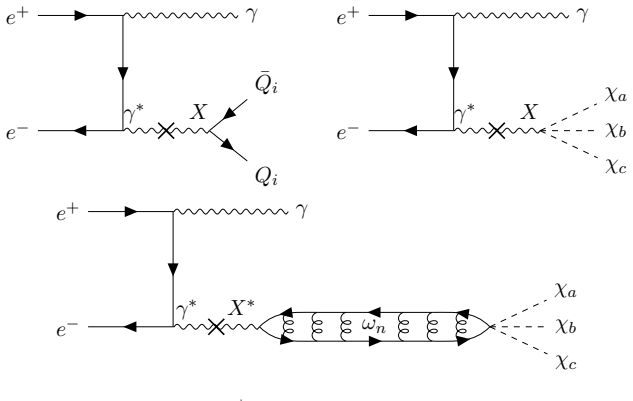
The load-bearing object is the Skyrme current $j_B^\mu=\frac{1}{24\pi^2}\epsilon^{\mu\nu\rho\sigma}\mathrm{tr}(U^{-1}\partial_\nu U\,U^{-1}\partial_\rho U\,U^{-1}\partial_\sigma U)$, which in the infrared measures the dark baryon number of the pion field $U=e^{2i\chi^a t^a/f_\chi}$. Gauging this current with a dark photon $X_\mu$ produces a vertex linear in $X_\mu$ and cubic in pions, so the elastic $\chi\chi\to XX$ channel is absent at tree level and the $2\to1$ semi-annihilation is the leading number-changing process. The machinery then consists of the thermal average of this $p$-wave cross-section, the NDA/IR/UV estimate of the one-loop $\chi\chi XX$ operators with order-one coefficients $\lambda_1,\lambda_2$, and the Boltzmann equation whose solution gives the relic-abundance contours.
What would settle it
Compute or measure the matching coefficient $|4\lambda_1+\lambda_2|$ for the loop-induced $\chi\chi\to XX$ process, for example by a lattice calculation of the dark-pion four-point function. If that coefficient is large enough to make $\langle\sigma v\rangle_{\chi\chi\to XX}/\langle\sigma v\rangle_{\chi\chi\to \chi X}\sim 1$ for $m_\chi<4\pi f_\chi$, the claim of $p$-wave dominance fails and $s$-wave annihilation signals, such as gamma rays from $\chi\chi\to XX\to\gamma\gamma$, should become observable.
Extended reading notes
Core claim
On its own terms, the paper's central discovery is that gauging the topological baryon-number (Skyrme) current of an $SU(N_c)$ dark QCD sector gives a technically natural, UV-complete realisation of semi-annihilation, with no ad hoc discrete symmetries. In the infrared the gauged current becomes the three-derivative topological interaction $\frac{e_B}{12\pi^2 f_\chi^3}\epsilon^{\mu\nu\rho\sigma}f^{abc}X_\mu\partial_\nu\chi_a\partial_\rho\chi_b\partial_\sigma\chi_c$, whose quantum numbers force the $2\to1$ process $\chi\chi\to\chi X$. Solving the coupled Boltzmann equations for this process together with a subdominant one-loop $\chi\chi\to XX$ annihilation, the paper finds that the dark pions reproduce the observed relic abundance while satisfying the EFT validity condition $m_\chi<4\pi f_\chi$; after imposing the BBN bound on the dark photon, the conservative allowed mass range is $10\,\mathrm{MeV}\lesssim m_\chi\lesssim 1\,\mathrm{TeV}$. The $p$-wave structure follows from angular momentum conservation and makes the channel insensitive to CMB and gamma-ray indirect searches, which is why such light dark matter is viable.
Load-bearing premise
The central assumption is that the two unknown Wilson coefficients $\lambda_1$ and $\lambda_2$ in the loop-induced $\chi\chi\to XX$ operator are of order one; if they are much larger, that $s$-wave annihilation channel could dominate over semi-annihilation and change both the relic abundance and the indirect-detection predictions.
Editorial extensions
If this is right
- Dark matter can be a composite dark pion with mass as low as about 10 MeV without violating CMB or gamma-ray bounds, because the semi-annihilation is $p$-wave and the elastic annihilation is loop-suppressed.
- The same topological vertex that sets the relic abundance also relates it to dark pion self-interactions: toward the light end of the allowed range, $\sigma/m_\chi$ can reach values relevant to small-scale structure puzzles.
- No ad hoc $Z_3$ or other discrete symmetry is needed to suppress $\chi\chi\to XX$; the abelian gauge structure automatically delays that channel to one loop.
- Because direct and indirect detection are suppressed, the dark photon portal becomes the main experimental handle, giving concrete collider targets such as mono-photon, mono-jet, exotic Higgs decays, and dark-photon spectroscopy.
- If the dark photon mass is not degenerate with the dark pion mass, with mass splitting above about 20%, the massless-dark-photon approximation changes the final yield by less than 20%.
- The leading-order $x^{-1}$ expansion of the semi-annihilation cross-section reproduces the full numerical freeze-out result to within about 10-15%, so the analytic relic-density formula is reliable.
Reading between the lines
- The same $2\to1$ vertex can also drive explosive freeze-in rather than freeze-out, which the paper notes as future work; mapping that history in detail would extend the model to heavier dark matter masses.
- For $N_f>2$ the WZW term reappears and induces $3\to2$ number-changing processes, so the thermal history could be a mixture of SIMP-like self-interaction and semi-annihilation, with the balance controlled by $e_B$ versus $f_\chi$.
- The order-one assumption on $\lambda_1,\lambda_2$ is the soft spot: if the true matching coefficients are parametrically larger, the $s$-wave $\chi\chi\to XX$ channel could dominate and revive indirect-detection constraints.
- Because the topological vertex coefficient is fixed by anomaly and 2-group matching rather than by free parameters, any clean deviation from the predicted relic-abundance contour would be a sharp probe of the underlying dark QCD parameters.
Editorial analysis
A structured set of objections, weighed in public.
Referee Report
Summary. The paper proposes a dark QCD model in which dark baryon number U(1)_B is gauged, so that in the infrared the baryon current becomes the topological Skyrme current and generates a χχχX interaction. This interaction drives the semi-annihilation process χχ→χX, which is shown to be p-wave and therefore free from the usual indirect-detection and CMB bounds. The authors compute the semi-annihilation cross-section, estimate the loop-induced χχ→XX annihilation channel using naive dimensional analysis with Wilson coefficients λ_1, λ_2 ∼ O(1), solve the Boltzmann equation for the dark-pion relic abundance, and identify viable parameter space with m_χ between roughly 10 MeV and 1 TeV. They also discuss self-interactions and a range of collider signatures.
Significance. The model-building idea is elegant and the topological interaction follows rigorously from symmetry matching; the p-wave property is a robust consequence of the three-derivative structure. If the quantitative dominance of semi-annihilation over annihilation holds, the paper provides a natural UV completion of semi-annihilation with a broad mass range and distinctive phenomenology. The Boltzmann analysis is standard, and the semi-analytic treatment in Appendix C is useful. However, the central quantitative claim rests on an uncomputed NDA estimate and on printed cross-section formulas that are dimensionally inconsistent, so the current version does not yet establish the claimed relic-density range.
major comments (3)
- [§3.2.4, Eqs. (3.11)–(3.13); §3.2.1, Eq. (3.5)] The printed annihilation rate is not internally consistent. Eq. (3.5) parametrizes the χχXX operator with prefactor (e_B/(16π^2 f_χ))^2, but Eqs. (3.11) and (3.12) use (e_B/(16π^2 f_χ^2))^4, which has different mass dimension and different powers of f_χ; as written, σ_{χχ→XX} in Eq. (3.11) has mass dimension M^{-5}, not M^{-2}. In addition, substituting the leading terms of Eqs. (3.4) and (3.12) into Eq. (3.13) gives a ratio of approximately 6×10^{-6} |4λ_1+λ_2|^2 e_B^2 (m_χ^2/f_χ^2) x / N_f, about a factor of 27 below the printed coefficient 1/(64π^4 N_f). Because the statement that annihilation remains subdominant for m_χ<4π f_χ and the numerical benchmarks in §4 rely directly on these expressions, the formulas must be corrected and the parameter scan re-run before the central claim can be assessed.
- [§3.2.1–§3.2.3] The estimate λ_{1,2}∼O(1) is an NDA assumption, not a computed result. The IR estimate of Sec. 3.2.2 and the UV estimate of Sec. 3.2.3 are cutoff-scale matching arguments (Λ^2/(4π)^2 and 1/Λ^2 matched at Λ=4π f_χ); they determine the overall size of the operator but not the finite parts encoded in λ_1 and λ_2. Since the annihilation cross-section is proportional to |4λ_1+λ_2|^2, a strong-dynamics enhancement by O(4π) would make the s-wave χχ→XX channel dominate over the p-wave semi-annihilation and would revive the CMB bounds quoted in §3.2.4. The paper should either compute the finite part of the one-loop amplitude in a controlled limit, or provide a quantitative bound on λ_1,λ_2 and state the resulting range of validity of the semi-annihilation-dominance claim.
- [§4 and Fig. 4] Because the ratio in Eq. (3.13) is used to justify neglecting χχ→XX in the Boltzmann analysis of §4.1 and to delimit the region where annihilations matter in §4.3, the factor-of-27 discrepancy and the NDA uncertainty propagate directly into the relic-density contours and the benchmarks in Eqs. (4.5)–(4.6). As printed, a reader cannot reproduce Y_χ(x) or the f_χ∝e_B^{1/3} m_χ^{2/3} scaling, and cannot verify that annihilation is subdominant on the e_B=0.1 contour. These numerical results should be regenerated after the cross-section normalization is fixed.
minor comments (4)
- [§4.3, Eq. (4.15)] Both partial-wave terms are labelled a_{L=0,I=2}; one should presumably be a_{L=0,I=0}. The final numerical coefficient is consistent with that correction, but as printed the formula is confusing.
- [§3.1, Eq. (3.1)] The Feynman rule uses "∼" rather than an equality; please replace it with a precise sign and overall factor.
- [§5.1] The word "sceanrios" should be "scenarios".
- [§6] The phrase "wide ray of rich phenomenology" should likely read "wide array of rich phenomenology".
Circularity Check
No significant circularity: the topological coupling is symmetry-fixed and the freeze-out analysis is self-contained; the O(1) annihilation estimate is an assumption, not a fitted prediction.
full rationale
The derivation chain is not circular. The semi-annihilation vertex in Eq. (2.4) is obtained by gauging the standard Skyrme-current identification (1.2)/(2.2), with the coefficient fixed by quantised topological/2-group matching; no parameter is fitted to the relic abundance. The thermally averaged semi-annihilation cross-section (3.3)-(3.4) follows from the Feynman rule (3.1) by explicit phase-space integration, and the relic-density calculation in Sec. 4 solves the Boltzmann equation (4.2) with these cross-sections; the result is a constraint on (m_chi, f_chi, e_B), not a renamed input. The self-citations [13,14] concern the generalised-symmetry interpretation and a related topological-portal model; the baryon-number-as-winding identification itself is supported by [7-10], so the self-citations are not load-bearing for the freeze-out calculation. The main caveats are physical/correctness risks rather than circularity: the O(1) assumption for lambda_1,2 in Eq. (3.5) is an NDA estimate, not a computed matching coefficient, and the printed ratio (3.13) is not reproduced by the leading terms of (3.4) and (3.12) (it is about a factor 27 smaller), which weakens the quantitative subdominance claim but does not make the derivation equivalent to its inputs.
Assumptions & free parameters
free parameters (6)
- m_chi (dark pion mass)
- f_chi (dark pion decay constant) =
2.8 GeV for benchmark 1, 27.2 GeV for benchmark 2
- e_B (dark gauge coupling) =
0.1, 0.13, 0.15 in Fig. 4
- lambda_1, lambda_2 (Wilson coefficients for chi chi -> XX) =
assumed O(1), set to 1 in benchmarks
- m_X (dark photon mass) =
set to 0 in most of the analysis
- m_Q (dark quark mass)
assumptions (4)
- domain assumption The dark SU(N_c) gauge theory with N_f light quarks confines and breaks chiral symmetry, yielding light pseudo-Goldstone pions chi.
- standard math Baryon number in the IR is carried by the topological winding number of the pion field (Goldstone-Wilczek/Balachandran/Witten).
- standard math The 2-group symmetry matching fixes the coefficient of the topological interaction to be quantized.
- ad hoc to paper Naive dimensional analysis provides a reliable estimate of the loop-induced chi chi XX coupling with O(1) coefficients.
invented entities (2)
-
Dark photon X_mu (U(1)_B gauge boson)
independent evidence
-
Dark pions chi^a (composite pseudo-Goldstone bosons)
independent evidence
Cite this review
Pith. "Pith review of Topological Freeze-out by Semi-Annihilation." pith.science (2026). https://pith.science/paper/FJTHYLZY
@misc{pith2026250605468,
  author       = {Pith},
  title        = {Pith review of: Topological Freeze-out by Semi-Annihilation},
  year         = {2026},
  howpublished = {\url{https://pith.science/paper/FJTHYLZY}},
  note         = {Machine review of arXiv:2506.05468}
}
abstract
We point out that a QCD-like dark sector can be coupled to the Standard Model by gauging the topological Skyrme current, which measures the dark baryon number in the infrared, to give a technically natural model for dark matter. This coupling allows for a semi-annihilation process $\chi \chi \rightarrow \chi X_\mu$, where $X_\mu$ is the gauge boson mediator and $\chi$ a dark pion field, which plays the dominant role in setting the dark matter relic abundance. The topological interaction is purely $p$-wave and so free from indirect detection constraints. We show that the dark matter pion mass needs to be in the range $10$ MeV $\lesssim m_\chi \lesssim$ $1$ TeV; towards the lighter end of this range, there can moreover be significant self-interactions. We discuss prospects for probing this scenario at collider experiments, ranging from the LHC to low-energy $e^+ e^-$ colliders, future Higgs factories, and beam-dump experiments.
Figures


Figures from the paper (2 more)

Forward citations
Cited by 3 Pith papers
-
Darkly Charged ALPs
Darkly charged ALPs (DALPs) forbid all d=5 ALP-SM operators and admit only two leading d=6 operators (Higgs portal and hypercharge portal), with distinct collider, cooling, and dark-matter phenomenology.
-
The Dark Side of a Tera-Z Factory
Future Tera-Z runs at FCC-ee/CEPC could indirectly probe TeV-scale t-channel dark matter portals through one-loop and two-loop electroweak precision shifts, and in leptophilic models would be the only planned experime...
-
Sub-GeV dark matter and multi-decay signatures from dark showers at beam-dump experiments
SHiP could observe multiple displaced vertices per event from dark rho mesons in dark showers, probing dark rho masses up to ~2 GeV and discriminating the model from dark photons.
Reference graph
Works this paper leans on
- [1]
-
[2]
Y. Bai and P. Schwaller, “Scale of dark QCD,” Phys. Rev. D89(2014) no. 6, 063522, arXiv:1306.4676
arXiv 2014
-
[3]
Review of strongly-coupled composite dark matter models and lattice simulations,
G. D. Kribs and E. T. Neil, “Review of strongly-coupled composite dark matter models and lattice simulations,” Int. J. Mod. Phys. A31(2016) no. 22, 1643004,arXiv:1604.04627
arXiv 2016
-
[4]
Two U(1)’s and Epsilon Charge Shifts,
B. Holdom, “Two U(1)’s and Epsilon Charge Shifts,” Phys. Lett. B166(1986) 196–198
1986
-
[5]
Higgs-field portal into hidden sectors,
B. Patt and F. Wilczek, “Higgs-field portal into hidden sectors,”arXiv:hep-ph/0605188
-
[6]
Dark Matter Through the Neutrino Portal,
A. Falkowski, J. Juknevich, and J. Shelton, “Dark Matter Through the Neutrino Portal,” arXiv:0908.1790
-
[7]
T. H. R. Skyrme, “A Nonlinear field theory,” Proc. Roy. Soc. Lond. A260(1961) 127–138
work page 1961
-
[8]
Fractional Quantum Numbers on Solitons,
J. Goldstone and F. Wilczek, “Fractional Quantum Numbers on Solitons,” Phys. Rev. Lett.47 (1981) 986–989
work page 1981
Show all 66 references
-
[9]
Exotic Levels from Topology in the QCD Effective Lagrangian,
A. P. Balachandran, V. P. Nair, S. G. Rajeev, and A. Stern, “Exotic Levels from Topology in the QCD Effective Lagrangian,” Phys. Rev. Lett.49(1982) 1124. [Erratum: Phys.Rev.Lett. 50, 1630 (1983)]
1982
-
[10]
Current Algebra, Baryons, and Quark Confinement,
E. Witten, “Current Algebra, Baryons, and Quark Confinement,” Nucl. Phys. B223(1983) 433–444
1983
-
[11]
Mechanism for Thermal Relic Dark Matter of Strongly Interacting Massive Particles,
Y. Hochberg, E. Kuflik, T. Volansky, and J. G. Wacker, “Mechanism for Thermal Relic Dark Matter of Strongly Interacting Massive Particles,” Phys. Rev. Lett.113(2014) 171301, arXiv:1402.5143
2014 arXiv
-
[12]
Model for Thermal Relic Dark Matter of Strongly Interacting Massive Particles,
Y. Hochberg, E. Kuflik, H. Murayama, T. Volansky, and J. G. Wacker, “Model for Thermal Relic Dark Matter of Strongly Interacting Massive Particles,” Phys. Rev. Lett.115(2015) no. 2, 021301,arXiv:1411.3727
2015 arXiv
-
[13]
Topological Portal to the Dark Sector,
J. Davighi, A. Greljo, and N. Selimovic, “Topological Portal to the Dark Sector,” Phys. Rev. Lett.134(2025) no. 11, 111804,arXiv:2401.09528
2025 arXiv
-
[14]
WZW terms without anomalies: Generalised symmetries in chiral Lagrangians,
J. Davighi and N. Lohitsiri, “WZW terms without anomalies: Generalised symmetries in chiral Lagrangians,” SciPost Phys.17(2024) no. 6, 168,arXiv:2407.20340. – 28 –
2024 arXiv
-
[15]
Consequences of anomalous Ward identities,
J. Wess and B. Zumino, “Consequences of anomalous Ward identities,” Phys. Lett. B37(1971) 95–97
1971
-
[16]
Global Aspects of Current Algebra,
E. Witten, “Global Aspects of Current Algebra,” Nucl. Phys. B223(1983) 422–432
1983
-
[17]
Semi-annihilation of Dark Matter,
F. D’Eramo and J. Thaler, “Semi-annihilation of Dark Matter,” JHEP06(2010) 109, arXiv:1003.5912
2010 arXiv
-
[18]
Hidden vector dark matter,
T. Hambye, “Hidden vector dark matter,” JHEP01(2009) 028,arXiv:0811.0172
2009 arXiv
-
[19]
Asymmetric dark matter from semi-annihilation,
A. Ghosh, D. Ghosh, and S. Mukhopadhyay, “Asymmetric dark matter from semi-annihilation,” JHEP08(2020) 149,arXiv:2004.07705
2020 arXiv
-
[20]
Heavy Thermal Dark Matter from a New Collision Mechanism,
E. D. Kramer, E. Kuflik, N. Levi, N. J. Outmezguine, and J. T. Ruderman, “Heavy Thermal Dark Matter from a New Collision Mechanism,” Phys. Rev. Lett.126(2021) no. 8, 081802, arXiv:2003.04900
2021 arXiv
-
[21]
How the Self-Interacting Dark Matter Model Explains the Diverse Galactic Rotation Curves,
A. Kamada, M. Kaplinghat, A. B. Pace, and H.-B. Yu, “How the Self-Interacting Dark Matter Model Explains the Diverse Galactic Rotation Curves,” Phys. Rev. Lett.119(2017) no. 11, 111102,arXiv:1611.02716
2017 arXiv
-
[22]
Cosmological Simulations with Self-Interacting Dark Matter I: Constant Density Cores and Substructure,
M. Rocha, A. H. G. Peter, J. S. Bullock, M. Kaplinghat, S. Garrison-Kimmel, J. Onorbe, and L. A. Moustakas, “Cosmological Simulations with Self-Interacting Dark Matter I: Constant Density Cores and Substructure,” Mon. Not. Roy. Astron. Soc.430(2013) 81–104, arXiv:1208.3025
2013 arXiv
-
[23]
Cosmological Simulations with Self-Interacting Dark Matter II: Halo Shapes vs. Observations,
A. H. G. Peter, M. Rocha, J. S. Bullock, and M. Kaplinghat, “Cosmological Simulations with Self-Interacting Dark Matter II: Halo Shapes vs. Observations,” Mon. Not. Roy. Astron. Soc. 430(2013) 105,arXiv:1208.3026
2013 arXiv
-
[24]
Observational and theoretical constraints on singular dark matter halos,
R. A. Flores and J. R. Primack, “Observational and theoretical constraints on singular dark matter halos,” Astrophys. J. Lett.427(1994) L1–4,arXiv:astro-ph/9402004
1994 arXiv
-
[25]
The Structure of cold dark matter halos,
J. F. Navarro, C. S. Frenk, and S. D. M. White, “The Structure of cold dark matter halos,” Astrophys. J.462(1996) 563–575,arXiv:astro-ph/9508025
1996 arXiv
-
[26]
Cold collapse and the core catastrophe,
B. Moore, T. R. Quinn, F. Governato, J. Stadel, and G. Lake, “Cold collapse and the core catastrophe,” Mon. Not. Roy. Astron. Soc.310(1999) 1147–1152,arXiv:astro-ph/9903164
1999 arXiv
-
[27]
Dark matter substructure within galactic halos,
B. Moore, S. Ghigna, F. Governato, G. Lake, T. R. Quinn, J. Stadel, and P. Tozzi, “Dark matter substructure within galactic halos,” Astrophys. J. Lett.524(1999) L19–L22, arXiv:astro-ph/9907411
1999 arXiv
-
[28]
Where are the missing Galactic satellites?,
A. A. Klypin, A. V. Kravtsov, O. Valenzuela, and F. Prada, “Where are the missing Galactic satellites?,” Astrophys. J.522(1999) 82–92,arXiv:astro-ph/9901240
1999 arXiv
-
[29]
Too big to fail? The puzzling darkness of massive Milky Way subhaloes,
M. Boylan-Kolchin, J. S. Bullock, and M. Kaplinghat, “Too big to fail? The puzzling darkness of massive Milky Way subhaloes,” Mon. Not. Roy. Astron. Soc.415(2011) L40, arXiv:1103.0007
2011 arXiv
-
[30]
The Milky Way’s bright satellites as an apparent failure of LCDM,
M. Boylan-Kolchin, J. S. Bullock, and M. Kaplinghat, “The Milky Way’s bright satellites as an apparent failure of LCDM,” Mon. Not. Roy. Astron. Soc.422(2012) 1203–1218, arXiv:1111.2048
2012 arXiv
-
[31]
The unexpected diversity of dwarf galaxy rotation curves,
K. A. Omanet al., “The unexpected diversity of dwarf galaxy rotation curves,” Mon. Not. Roy. Astron. Soc.452(2015) no. 4, 3650–3665,arXiv:1504.01437. – 29 –
2015 arXiv
-
[32]
Revisiting CMB constraints on dark matter annihilation,
M. Kawasaki, H. Nakatsuka, K. Nakayama, and T. Sekiguchi, “Revisiting CMB constraints on dark matter annihilation,” JCAP12(2021) no. 12, 015,arXiv:2105.08334
2021 arXiv
-
[33]
Strong constraints on thermal relic dark matter from Fermi-LAT observations of the Galactic Center,
K. N. Abazajian, S. Horiuchi, M. Kaplinghat, R. E. Keeley, and O. Macias, “Strong constraints on thermal relic dark matter from Fermi-LAT observations of the Galactic Center,” Phys. Rev. D102(2020) no. 4, 043012,arXiv:2003.10416
2020 arXiv
-
[34]
Naturalness, chiral symmetry, and spontaneous chiral symmetry breaking,
G. ’t Hooft, “Naturalness, chiral symmetry, and spontaneous chiral symmetry breaking,” NATO Sci. Ser. B59(1980) 135–157
1980
-
[35]
TASI Lectures: (No) Global Symmetries to Axion Physics,
M. Reece, “TASI Lectures: (No) Global Symmetries to Axion Physics,” PoST ASI2022(2024) 008,arXiv:2304.08512
2024 arXiv
-
[36]
A Geometry of the generations,
L. J. Hall and H. Murayama, “A Geometry of the generations,” Phys. Rev. Lett.75(1995) 3985–3988,arXiv:hep-ph/9508296
1995 arXiv
-
[37]
Generalized Global Symmetries,
D. Gaiotto, A. Kapustin, N. Seiberg, and B. Willett, “Generalized Global Symmetries,” JHEP 02(2015) 172,arXiv:1412.5148
2015 arXiv
-
[38]
Higher Symmetry and Gapped Phases of Gauge Theories,
A. Kapustin and R. Thorngren, “Higher Symmetry and Gapped Phases of Gauge Theories,” Prog. Math.324(2017) 177–202,arXiv:1309.4721
2017 arXiv
-
[39]
Exploring 2-Group Global Symmetries,
C. C´ ordova, T. T. Dumitrescu, and K. Intriligator, “Exploring 2-Group Global Symmetries,” JHEP02(2019) 184,arXiv:1802.04790
2019 arXiv
-
[40]
2-Group Global Symmetries and Anomalies in Six-Dimensional Quantum Field Theories,
C. C´ ordova, T. T. Dumitrescu, and K. Intriligator, “2-Group Global Symmetries and Anomalies in Six-Dimensional Quantum Field Theories,” JHEP04(2021) 252,arXiv:2009.00138
2021 arXiv
-
[41]
Cosmic abundances of stable particles: Improved analysis,
P. Gondolo and G. Gelmini, “Cosmic abundances of stable particles: Improved analysis,” Nucl. Phys. B360(1991) 145–179
1991
-
[42]
Neutralino relic density including coannihilations,
J. Edsj¨ o and P. Gondolo, “Neutralino relic density including coannihilations,” Phys. Rev. D56 (1997) 1879–1894,arXiv:hep-ph/9704361
1997 arXiv
-
[43]
The evaluation of integrals of Bessel functions via G-function identities,
V. Adamchik, “The evaluation of integrals of Bessel functions via G-function identities,” Journal of Computational and Applied Mathematics64(1995) no. 3, 283–290. https://www.sciencedirect.com/science/article/pii/0377042795001530. [44]Planck, N. Aghanimet al., “Planck 2018 res...
1995
-
[45]
Self-Heating Dark Matter via Semiannihilation,
A. Kamada, H. J. Kim, H. Kim, and T. Sekiguchi, “Self-Heating Dark Matter via Semiannihilation,” Phys. Rev. Lett.120(2018) no. 13, 131802,arXiv:1707.09238
2018 arXiv
-
[46]
Manifesting hidden dynamics of a sub-component dark matter,
A. Kamada, H. J. Kim, J.-C. Park, and S. Shin, “Manifesting hidden dynamics of a sub-component dark matter,” JCAP10(2022) 052,arXiv:2111.06808
2022 arXiv
-
[47]
Axion Portal to Scalar Dark Matter: Unveiling Stabilizing Symmetry Footprints,
F. D’Eramo and T. Sassi, “Axion Portal to Scalar Dark Matter: Unveiling Stabilizing Symmetry Footprints,”arXiv:2502.19491
-
[48]
BBN And The CMB Constrain Light, Electromagnetically Coupled WIMPs,
K. M. Nollett and G. Steigman, “BBN And The CMB Constrain Light, Electromagnetically Coupled WIMPs,” Phys. Rev. D89(2014) no. 8, 083508,arXiv:1312.5725
2014 arXiv
-
[49]
Velocity Dependence from Resonant Self-Interacting Dark Matter,
X. Chu, C. Garcia-Cely, and H. Murayama, “Velocity Dependence from Resonant Self-Interacting Dark Matter,” Phys. Rev. Lett.122(2019) no. 7, 071103,arXiv:1810.04709. – 30 –
2019 arXiv
-
[50]
Resonant Self-Interacting Dark Matter from Dark QCD,
Y.-D. Tsai, R. McGehee, and H. Murayama, “Resonant Self-Interacting Dark Matter from Dark QCD,” Phys. Rev. Lett.128(2022) no. 17, 172001,arXiv:2008.08608
2022 arXiv
-
[51]
Linear sigma dark matter,
D. Kondo, R. McGehee, T. Melia, and H. Murayama, “Linear sigma dark matter,” JHEP09 (2022) 041,arXiv:2205.08088
2022 arXiv
-
[52]
Stringent Constraints on Self-Interacting Dark Matter Using Milky-Way Satellite Galaxies Kinematics,
S. Ando, K. Hayashi, S. Horigome, M. Ibe, and S. Shirai, “Stringent Constraints on Self-Interacting Dark Matter Using Milky-Way Satellite Galaxies Kinematics,” arXiv:2503.13650
-
[53]
MeV gamma-ray constraints for light dark matter from semi-annihilation,
J. Guo, L. Wu, and B. Zhu, “MeV gamma-ray constraints for light dark matter from semi-annihilation,” Phys. Lett. B840(2023) 137853,arXiv:2302.06159
2023 arXiv
-
[54]
Dark photon limits: A handbook,
A. Caputo, A. J. Millar, C. A. J. O’Hare, and E. Vitagliano, “Dark photon limits: A handbook,” Phys. Rev. D104(2021) no. 9, 095029,arXiv:2105.04565. [55]A TLAS, G. Aadet al., “Search for dark matter in association with an energetic photon inpp collisions at √s= 13 TeV with the...
2021 arXiv
-
[58]
WIMPs at High Energy Muon Colliders,
T. Han, Z. Liu, L.-T. Wang, and X. Wang, “WIMPs at High Energy Muon Colliders,” Phys. Rev. D103(2021) no. 7, 075004,arXiv:2009.11287. [59]BaBar, J. P. Leeset al., “Search for Invisible Decays of a Dark Photon Produced ine +e− Collisions at BaBar,” Phys. Rev. Lett.119(2017) no....
2021 arXiv
-
[61]
SIMP Spectroscopy,
Y. Hochberg, E. Kuflik, and H. Murayama, “SIMP Spectroscopy,” JHEP05(2016) 090, arXiv:1512.07917
2016 arXiv
-
[62]
Dark spectroscopy at lepton colliders,
Y. Hochberg, E. Kuflik, and H. Murayama, “Dark spectroscopy at lepton colliders,” Phys. Rev. D97(2018) no. 5, 055030,arXiv:1706.05008. [63]CMS, A. M. Sirunyanet al., “Search for dark photons in Higgs boson production via vector boson fusion in proton-proton collisions at √s= 1...
2018 arXiv
-
[66]
Estimation of LHC and ILC Capabilities for Precision Higgs Boson Coupling Measurements,
M. E. Peskin, “Estimation of LHC and ILC Capabilities for Precision Higgs Boson Coupling Measurements,” inSnowmass 2013: Snowmass on the Mississippi. 12, 2013.arXiv:1312.4974
2013 arXiv
-
[67]
Exotic decays of the 125 GeV Higgs boson at futuree +e− lepton colliders,
Z. Liu, L.-T. Wang, and H. Zhang, “Exotic decays of the 125 GeV Higgs boson at futuree +e− lepton colliders,” Chin. Phys. C41(2017) no. 6, 063102,arXiv:1612.09284. – 31 –
2017 arXiv
-
[68]
Report of the Topical Group on Higgs Physics for Snowmass 2021: The Case for Precision Higgs Physics,
S. Dawsonet al., “Report of the Topical Group on Higgs Physics for Snowmass 2021: The Case for Precision Higgs Physics,” inSnowmass 2021. 9, 2022.arXiv:2209.07510. [69]A TLAS, M. Aaboudet al., “Search for new phenomena in final states with an energetic jet and large missing tr...
2016 arXiv
-
[71]
Summarizing experimental sensitivities of collider experiments to dark matter models and comparison to other experiments,
A. Boveiaet al., “Summarizing experimental sensitivities of collider experiments to dark matter models and comparison to other experiments,”arXiv:2206.03456. [72]CMS, A. M. Sirunyanet al., “Search for a Narrow Resonance Lighter than 200 GeV Decaying to a Pair of Muons in Proto...
2020 arXiv
-
[74]
Illuminating Dark Photons with High-Energy Colliders,
D. Curtin, R. Essig, S. Gori, and J. Shelton, “Illuminating Dark Photons with High-Energy Colliders,” JHEP02(2015) 157,arXiv:1412.0018
2015 arXiv
-
[75]
Search for a heavy dark photon at futuree +e− colliders,
M. He, X.-G. He, C.-K. Huang, and G. Li, “Search for a heavy dark photon at futuree +e− colliders,” JHEP03(2018) 139,arXiv:1712.09095
2018 arXiv
-
[76]
Semivisible Jets: Dark Matter Undercover at the LHC,
T. Cohen, M. Lisanti, and H. K. Lou, “Semivisible Jets: Dark Matter Undercover at the LHC,” Phys. Rev. Lett.115(2015) no. 17, 171804,arXiv:1503.00009
2015 arXiv
-
[77]
Lepton Jets from Radiating Dark Matter,
M. Buschmann, J. Kopp, J. Liu, and P. A. N. Machado, “Lepton Jets from Radiating Dark Matter,” JHEP07(2015) 045,arXiv:1505.07459
2015 arXiv
-
[78]
Dark Matter from Exponential Growth,
T. Bringmann, P. F. Depta, M. Hufnagel, J. T. Ruderman, and K. Schmidt-Hoberg, “Dark Matter from Exponential Growth,” Phys. Rev. Lett.127(2021) no. 19, 191802, arXiv:2103.16572
2021 arXiv
-
[79]
E. W. Kolb and M. S. Turner,The early universe. CRC Press, Taylor et Francis Group, 2018. – 32 –
2018
Reviewed August 7, 2026 · model on record in the stance chip above.
Discussion (0). Sign in to comment.