REVIEW 3 major objections 5 minor 80 references
Petrov-Galerkin model reduction for collisional-radiative argon plasma
T0 review · 3 major / 5 minor · reviewed 2026-08-07 · deepseek-v4-flash
Pith's one-line read A Petrov-Galerkin reduced-order model, trained on 0D relaxation runs, compresses the 36-state argon plasma model to 12 states and reproduces 1D and 2D ionizing shock-tube flows with sub-1% errors, where POD-based ROMs become unstable.
desk verdict Solid engineering extension of CoBRAS to multidimensional CR argon flows, but the general-capability claim outruns the validation: every 1D/2D test sits inside the 0D training box, and the paper's own low-temperature extrapolation tables show degradation. read the letter →
The pith
A machine-rendered reading of the paper's core claim, the machinery that carries it, and where it could break.
The reading
What carries the argument
The load-bearing object is the oblique projector $P = \Phi(\Psi^\top \Phi)^{-1}\Psi^\top$, produced by the CoBRAS (covariance-balancing) construction: state snapshots $X$ from nonlinear forward runs and gradient snapshots $Y$ from nonlinear adjoint runs over 0D constant-volume relaxation trajectories are combined through the leading singular triplets of $Y^\top X$, giving trial and test bases $\Phi = XV_r\Sigma_r^{-1/2}$ and $\Psi = YU_r\Sigma_r^{-1/2}$. Balancing the two covariances makes the reduced subspace hold both the energetically dominant modes and the directions along which the chosen output — the zeroth- and first-order moments of the argon atom and ion state distribution — responds to initial-state perturbations. Only the heavy-particle mass fractions are reduced; the electron mass fraction and the two temperatures are retained exactly, and each variable is rescaled by its own standard deviation before the basis is built. The projector is applied to the species-continuity equations of a second-order finite-volume, operator-split shock solver, with the full state reconstructed each step to evaluate chemistry source terms.
What would settle it
A decisive test is deployment outside the training band: a 1D shock whose post-shock states drive $T_{h0}$ toward or below 20,000 K, the regime where the paper's own 0D extrapolation errors grow (3.4% on Ar$^+$ internal energy at $r=9$). If the space-averaged relative errors of the electron molar fraction or Ar$^+$ internal energy climb well past the claimed 1% level, or the ROM destabilizes as POD does, the transfer claim fails. A second check is to integrate past the reported 0.25 ms window and track the induction-length oscillation period, which the ROM already matches to 0.5%.
Extended reading notes
Core claim
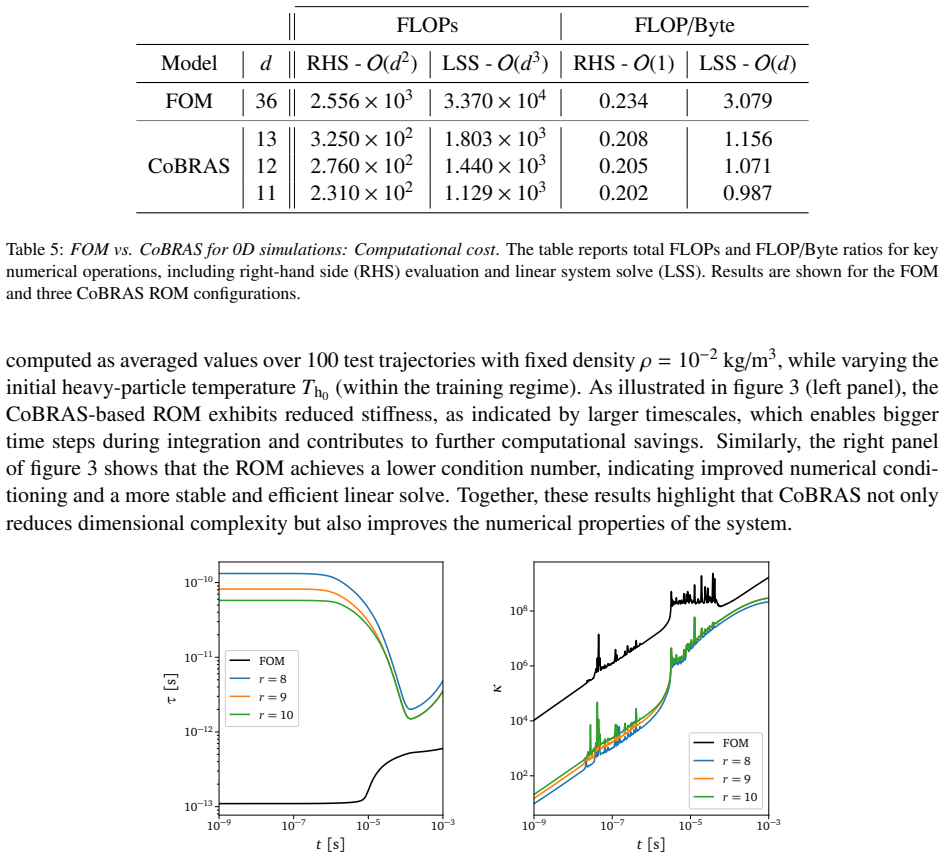
The paper's central claim is that a CoBRAS-based Petrov-Galerkin reduced-order model for collisional-radiative argon, constructed offline from nonlinear forward and adjoint 0D simulations, can be embedded in a finite-volume Euler solver and reproduce the full-order plasma dynamics in one- and two-dimensional ionizing shock-tube problems. With a latent dimension of $r=9$ (total reduced state dimension $d=12$ against 36 full-state variables), the ROM keeps space-averaged relative errors below 1% for most macroscopic quantities in 1D and below 10% — below 1% for most fields — in 2D, reproducing periodic shock-induced oscillations, electron avalanches, induction zones, triple points, and cellular ionization patterns with correct phase and amplitude. The paper reports theoretical FLOP reductions of more than an order of magnitude for right-hand-side evaluation and more than a factor of 30 for the implicit linear solves, together with reduced stiffness and improved conditioning of the reduced Jacobian. On the same test cases a standard POD-based ROM becomes unstable or inaccurate, which the paper attributes to POD's snapshot-only basis lacking the low-population, high-sensitivity directions that the covariance balance retains.
Load-bearing premise
The subspace learned from fixed-density 0D relaxation trajectories — a sudden temperature jump with no flow — must contain the chemistry needed in real 1D and 2D shock-tube flows, including strong shocks, induction zones, and electron avalanches.
Editorial extensions
If this is right
- A 3× reduction in transported state (12 vs 36 variables) cuts the number of species-continuity equations in multidimensional simulations, and implicit solves scale as $O(d^3)$ rather than $O(36^3)$.
- A subspace trained once on 320 zero-dimensional relaxation trajectories (plus subsampled adjoint runs) transfers to 1D and 2D flows, so detailed plasma chemistry no longer requires per-case empirical closure tuning.
- The ROM preserves physically observable quantities — shock Mach number, induction length, and the roughly 30.6 microsecond oscillation period — to within the full-order model's own agreement with experiment.
- For state-to-state kinetic models in general, the method offers a stability-preserving alternative to POD whenever the dynamics are stiff and dominated by low-population, high-sensitivity states.
Reading between the lines
- The paper's own 0D extrapolation data show that low-temperature cases ($T_{h0} < 20\,000$ K) push the Ar$^+$ internal-energy error to 3.4% at $r=9$, so a natural extension the authors do not test is a temperature-partitioned or adaptive basis that switches subspaces as post-shock conditions cool.
- Because the reduced state retains the electron mass fraction exactly and enforces quasi-neutrality, the timing of the electron avalanche is a sensitive, cheap observable of subspace quality; it could serve as an online error indicator or as a training signal for basis selection.
- The reported FLOP savings are theoretical in the present implementation, which reconstructs the full state at every step rather than assembling reduced operators offline; assembling those operators, combined with the observed conditioning improvement, is what would convert the >10× estimate into actual runtime gains.
- The paper leaves mass-fraction positivity unconstrained, producing small negative populations at early times; a positivity-preserving projection or constrained formulation is the direct next improvement and would also remove the main obstacle to longer extrapolative runs.
Editorial analysis
A structured set of objections, weighed in public.
Referee Report
Summary. The manuscript extends the CoBRAS Petrov-Galerkin reduced-order modeling framework, previously developed by Zanardi et al. for zero-dimensional state-to-state kinetics, to multidimensional collisional-radiative argon plasma flows. The authors train an oblique projection subspace on 0D constant-volume relaxation trajectories (Th0 in [20,000, 50,000] K, rho in [0.005, 0.1] kg/m^3), then embed the resulting ROM into a finite-volume solver through reduced species-continuity equations, retaining the electron mass fraction and the two temperatures as full variables. They report r=9 latent variables (reduced state dimension 12 vs. 36, a 3x reduction), theoretical FLOP reductions of more than an order of magnitude for RHS evaluation and roughly 30x for linear solves, and relative errors below 1% for most macroscopic quantities in 1D/2D ionizing shock-tube problems, including reproduction of periodic fluctuations, electron avalanches, triple points, and cellular ionization patterns, while a POD-based ROM is unstable. The paper also reports 0D interpolation and extrapolation error statistics, and explicitly notes that the FLOP savings are estimated rather than realized in the current implementation, which reconstructs the full-order state at each time step.
Significance. If the results hold, this is a meaningful step toward applying covariance-balancing projection-based ROMs to reactive plasma flows with state-to-state kinetics, a regime where POD-Galerkin models are known to be fragile. The strengths of the paper are its use of genuinely separate 0D training and 1D/2D testing configurations (no fitted test data), the systematic comparison against FOM and POD, the honest reporting of FLOP savings as theoretical rather than measured, the availability of the 0D ROM code on GitHub, and the explicit discussion of known limitations such as non-physical negative populations. The 1D and 2D error metrics and qualitative reproduction of complex unsteady features provide convincing evidence that the method works within the training regime. The main weaknesses are that the headline claims in the abstract and conclusions overstate the generality and the computational savings relative to what is actually demonstrated, and the multidimensional extrapolation performance is untested.
major comments (3)
- [Section 6 and Abstract] The statement in Section 6 that 'Relative errors remained consistently below 1% for macroscopic quantities' is contradicted by Table S7 (Dataset 3, low-temperature extrapolation): at r=9, the eAr+ error is 3.44% and the Te error is 3.69%. Since eAr+ and Te are among the macroscopic quantities defined in Section 4.1, the blanket claim in the abstract ('maintaining errors below 1% for macroscopic quantities') is not supported by the paper's own data. The accuracy claim should be restricted to the interpolation regime and to the specific 1D/2D configurations, or the authors should add a multidimensional extrapolation test that demonstrates sub-1% errors outside the training box.
- [Section 5.2.1 and Abstract] Table 5 reports FLOP reductions that are theoretical, not realized. Section 5.2.1 states 'these savings are estimated rather than fully realized, as we do not assemble reduced operators offline. Instead, the full-order state is reconstructed at each time step to evaluate the RHS of the FOM.' Hence the FLOP counts in Table 5 are for a hypothetical reduced-operator implementation, not for the code that was run. The abstract's unqualified claim of 'more than one order of magnitude savings in floating-point operations' is therefore misleading. Please either qualify the claim as 'estimated' or 'theoretical' in the abstract and conclusions, or report measured wall-clock times and show that the implementation actually attains these savings.
- [Sections 4.5, 5.3, 5.4] The generalization claim to multidimensional flows is demonstrated only within the training box of Table 1. The 1D/2D shock-tube cases have freestream density rho approximately 0.011 kg/m^3 and post-shock Th approximately 23,000 K, which lie inside the training ranges (rho in [0.005,0.1] kg/m^3, Th0 in [20,000,50,000] K). The paper's own 0D extrapolation tests (Tables S6 and S7) show that errors grow outside these ranges (e.g., eAr+ error 3.44% and Te error 3.69% at r=9 in Dataset 3). Thus the broad claim in the abstract that the method 'paves the way for fast, reliable simulation of high-speed plasma flows' and the Section 6 claim that it enables 'predictive, high-fidelity plasma simulations' are not supported by the demonstrated scope. The authors should either explicitly scope the conclusions to the tested regime or add a multidimensional test case whose post-shock thermodynamic states lie near or beyond the training boundaries.
minor comments (5)
- [Section 4.5, Eq. (28)] The notation in Eq. (28) is ambiguous: Phi_w is constructed for the heavy-particle species block, but the reconstruction D_w Phi_w z_hat + w_bar includes the electron mass fraction w_e in z_hat. Please clarify how w_e enters the reconstruction and the centering/scaling, and define the dimensions of Phi_w and D_w for the full mass-fraction vector w.
- [Section 5.2.1 and Appendix A] The term 'fastest timescale' defined as tau = 1/|lambda_min| appears inconsistent with the convention in Appendix A, where lambda_min denotes the eigenvalue of smallest magnitude. With that convention, 1/|lambda_min| is the slowest timescale, not the fastest. Please clarify the convention or correct the terminology.
- [Section 5.3] The statement that u_infinity = 4,535 m/s 'reproduce[s] a Mach 15.9 shock in the laboratory frame' seems inconsistent with the argon sound speed at T_infinity = 293.6 K (approximately 319 m/s, giving Ma approximately 14.2). Please clarify whether this is a shock-relative Mach number or whether a different reference state is intended.
- [Section 5.2.1 and Section 6] The paper states that in multidimensional simulations 'the reduced number of state variables translates directly into fewer scalar quantities to be transported.' While fewer transported scalars is true, the source term is still evaluated at full order because of the reconstruction step noted in Section 4.5, so the statement could be misread as an overall speedup. Consider adding a sentence quantifying the source-term share of the cost.
- [Section 5] The GitHub link for the 0D ROM should include a version, commit hash, or DOI to enable reproducibility of the exact results presented, rather than a pointer to a mutable repository.
Circularity Check
No significant circularity: the oblique-projection subspace is trained on 0D relaxation data and then deployed on separate 1D/2D shock cases without refitting; the group's prior work supplies the method, not the claimed results.
full rationale
The paper's central derivation chain (Sections 4.3-4.5 and 5.3-5.4) is a standard Petrov-Galerkin construction. The projector is computed from state snapshots X and adjoint gradient snapshots Y generated from 320 0D constant-volume trajectories (Table 1), and the 1D/2D shock deployments use this fixed projector without retraining on the test outputs; the reported errors are measured against FOM solutions on cases not used in the basis construction, so the predictions are not fitted to the test data. The method is inherited from Zanardi et al. [54] and Otto et al. [52], but those citations supply the projection formalism and previously documented limitations (e.g., non-positive mass fractions), not the 1D/2D accuracy results; CoBRAS is a peer-reviewed, parameter-free construction with stated assumptions, so citing it is independent support rather than a circularity. The abstract's FLOP savings are explicitly acknowledged in Section 5.2.1 as estimated rather than fully realized in the current implementation, and the low-temperature extrapolation degradation is disclosed in Tables S6-S7, so the reasoning chain does not conceal its own inputs. No equation is defined in terms of the quantity it is used to predict, and no fitted parameter is renamed as a prediction.
Assumptions & free parameters
free parameters (5)
- Reduced dimension r =
r = 9 for 1D/2D (also tested r = 8, 10)
- Training bounds for T_h0 =
20,000 to 50,000 K
- Training bounds for density rho =
0.005 to 0.1 kg/m^3
- Subsampling fraction for adjoint =
10% of t0 values
- Shock-sensing blending parameter eta (numerical scheme) =
0 to 1 via Gaussian smoothing
assumptions (5)
- domain assumption Two-temperature single-fluid Euler equations with neglected viscosity and diffusion
- domain assumption CR mechanism of Vlcek/Bultel/Kapper-Cambier with optical thinness except ground-state reabsorption
- domain assumption Superelastic collisions are negligible
- domain assumption Initial ASDFs follow Boltzmann distributions at Te0
- standard math CoBRAS approximation error bound (Zahm et al., Otto et al.)
Cite this review
Pith. "Pith review of Petrov-Galerkin model reduction for collisional-radiative argon plasma." pith.science (2026). https://pith.science/paper/TL7ONBJX
@misc{pith2026250605483,
  author       = {Pith},
  title        = {Pith review of: Petrov-Galerkin model reduction for collisional-radiative argon plasma},
  year         = {2026},
  howpublished = {\url{https://pith.science/paper/TL7ONBJX}},
  note         = {Machine review of arXiv:2506.05483}
}
abstract
High-fidelity simulation of nonequilibrium plasmas -- crucial to applications in electric propulsion, hypersonic re-entry, and astrophysical flows -- requires state-specific collisional-radiative (CR) kinetic models, but these come at a prohibitive computational cost. Traditionally, this cost has been mitigated through empirical or physics-based simplifications of the governing equations. However, such approaches often fail to retain the essential features of the original dynamics, particularly under strong nonequilibrium conditions. To address these limitations, we develop a Petrov-Galerkin reduced-order model (ROM) for CR argon plasma based on oblique projections that optimally balance the covariance of full-order state trajectories with that of the system's output sensitivities. This construction ensures that the ROM captures both the dominant energetic modes and the directions most relevant to input-output behavior. After offline training in a zero-dimensional setting using nonlinear forward and adjoint simulations, the ROM is coupled to a finite-volume solver and applied to one- (1D) and two-dimensional (2D) ionizing shock-tube problems. The ROM achieves a 3$\times$ reduction in state dimension and more than one order of magnitude savings in floating-point operations, while maintaining errors below 1% for macroscopic quantities. In both 1D and 2D, it robustly reproduces complex unsteady plasma features -- such as periodic fluctuations, electron avalanches, triple points, and cellular ionization patterns -- in contrast to standard ROM strategies, which become unstable or inaccurate under these challenging conditions. These results demonstrate that the proposed projection-based ROM enables substantial model compression while preserving key physical mechanisms in nonequilibrium plasma physics, paving the way for fast, reliable simulation of high-speed plasma flows.
Figures


Figures from the paper (6 more)


Reference graph
Works this paper leans on
-
[1]
D. M. Goebel, I. Katz, Fundamentals of Electric Propulsion: Ion and Hall Thrusters, John Wiley and Sons, 2008. URL:https://onlinelibrary.wiley.com/doi/book/10.1002/9780470436448. doi:10.1002/9780470436448
-
[2]
S. V . Pancheshnyi, D. A. Lacoste, A. Bourdon, C. O. Laux, Ignition of propane-air mixtures by a repetitively pulsed nanosecond discharge, IEEE Transactions on Plasma Science 34 (2006) 2478–
work page 2006
-
[3]
Park, Nonequilibrium Hypersonic Aerothermodynamics, Wiley, New York, 1990
C. Park, Nonequilibrium Hypersonic Aerothermodynamics, Wiley, New York, 1990
work page 1990
-
[4]
B. Helber, A. Turchi, J. B. Scoggins, A. Hubin, T. E. Magin, Experimental investigation of ablation and pyrolysis processes of carbon-phenolic ablators in atmospheric entry plasmas, International Journal of Heat and Mass Transfer 100 (2016) 810–824. doi:10.1016/J.IJHEATMASSTRANSFER.2016.04.072
-
[5]
J. P. H. Goedbloed, S. Poedts, Principles of Magnetohydrodynamics: With Applica- tions to Laboratory and Astrophysical Plasmas, Cambridge University Press, 2004. URL: https://www.cambridge.org/core/books/principles-of-magnetohydrodynamics/ 847AF12C94451B41D8F71C1F11EB308A. doi:10.1017/CBO9780511616945
-
[6]
Vlcek, A collisional-radiative model applicable to argon discharges over a wide range of conditions
J. Vlcek, A collisional-radiative model applicable to argon discharges over a wide range of conditions. I. Formulation and basic data, Journal of Physics D: Applied Physics 22 (1989) 623. URL:https://iopscience.iop.org/article/10.1088/0022-3727/22/ 5/009https://iopscience.iop.org/article/10.1088/0022-3727/22/5/009/meta. doi:10.1088/0022-3727/22/5/009. 22
-
[7]
A. Bultel, B. van Ootegem, A. Bourdon, P. Vervisch, Influence of Ar$_2ˆ+$ in an argon collisional- radiative model, Physical Review E 65 (2002) 046406. URL:https://journals.aps.org/pre/ abstract/10.1103/PhysRevE.65.046406. doi:10.1103/PhysRevE.65.046406
-
[8]
M. G. Kapper, J. L. Cambier, Ionizing shocks in argon. Part I: Collisional-radiative model and steady-state structure, Journal of Applied Physics 109 (2011). URL:https://doi.org/10.1063/ 1.3585688. doi:10.1063/1.3585688
Show all 80 references
-
[9]
M. G. Kapper, J. L. Cambier, Ionizing shocks in argon. Part II: Transient and multi-dimensional effects, Journal of Applied Physics 109 (2011). URL:https://doi.org/10.1063/1.3585694. doi:10.1063/1.3585694
2011 doi
-
[11]
Bultel, J
A. Bultel, J. Annaloro, Elaboration of collisional–radiative models for flows related to plan- etary entries into the Earth and Mars atmospheres, Plasma Sources Science and Technology 22 (2013) 025008. URL:https://iopscience.iop.org/article/10.1088/0963-0252/22/2/ 025008. doi:...
2013 doi
-
[12]
Panesi, A
M. Panesi, A. Lani, Collisional radiative coarse-grain model for ionization in air, Physics of Fluids 25 (2013) 057101. URL:http://aip.scitation.org/doi/10.1063/1.4804388. doi:10.1063/ 1.4804388
2013 doi
-
[13]
Capitelli, G
M. Capitelli, G. Colonna, G. D’Ammando, K. Hassouni, A. Laricchiuta, L. D. Pietanza, Coupling of Plasma Chemistry, Vibrational Kinetics, Collisional-Radiative Models and Electron Energy Dis- tribution Function Under Non-Equilibrium Conditions, Plasma Processes and Polymers 14 ...
2017 doi
-
[14]
E. A. Nagnibeda, E. Kustova, Non-Equilibrium Reacting Gas Flows, Heat and Mass Transfer, Springer Berlin Heidelberg, Berlin, Heidelberg, 2009. URL:http://link.springer.com/10. 1007/978-3-642-01390-4. doi:10.1007/978-3-642-01390-4
2009 doi
-
[15]
Panesi, T
M. Panesi, T. E. Magin, A. Bourdon, A. Bultel, O. Chazot, Electronic Excitation of Atoms and Molecules for the FIRE II Flight Experiment, Journal of Thermophysics and Heat Transfer 25 (2011) 361–374. URL:https://arc.aiaa.org/doi/10.2514/1.50033. doi:10.2514/1.50033
2011 doi
-
[16]
Panesi, R
M. Panesi, R. L. Jaffe, D. W. Schwenke, T. E. Magin, Rovibrational internal energy transfer and dissociation of N 2(1Σ+ g )-N(4S u) system in hypersonic flows, The Journal of Chemical Physics 138 (2013) 044312. URL:http://aip.scitation.org/doi/10.1063/1.4774412. doi:10.1063/1. 4774412
2013 doi
-
[17]
Panesi, A
M. Panesi, A. Munafò, T. E. Magin, R. L. Jaffe, Nonequilibrium shock-heated nitrogen flows using a rovibrational state-to-state method, Physical Review E 90 (2014) 013009. URL:https://link. aps.org/doi/10.1103/PhysRevE.90.013009. doi:10.1103/PhysRevE.90.013009
2014 doi
-
[18]
R. L. Macdonald, A. Munafò, C. O. Johnston, M. Panesi, Nonequilibrium radiation and dissociation of CO molecules in shock-heated flows, Physical Review Fluids 1 (2016) 043401. URL:https://link. aps.org/doi/10.1103/PhysRevFluids.1.043401. doi:10.1103/PhysRevFluids.1.043401. 23
2016 doi
-
[19]
Capitelli, R
M. Capitelli, R. Celiberto, G. Colonna, F. Esposito, C. Gorse, K. Hassouni, A. Laricchiuta, S. Longo, Fundamental Aspects of Plasma Chemical Physics, volume 85 ofSpringer Series on Atomic, Optical, and Plasma Physics, Springer New York, New York, NY , 2016. URL:http://link.spr...
2016 doi
-
[20]
R. L. Macdonald, E. Torres, T. E. Schwartzentruber, M. Panesi, State-to-State Master Equation and Direct Molecular Simulation Study of Energy Transfer and Dissociation for the N 2-N System, The Journal of Physical Chemistry A 124 (2020) 6986–7000. URL:https://pubs.acs.org/doi/...
2020 doi
-
[21]
Hammerling, J
P. Hammerling, J. D. Teare, B. Kivel, Theory of Radiation from Luminous Shock Waves in Ni- trogen, The Physics of Fluids 2 (1959) 422–426. URL:/aip/pfl/article/2/4/422/823460/ Theory-of-Radiation-from-Luminous-Shock-Waves-in. doi:10.1063/1.1724413
1959 doi
-
[22]
S. P. Heims, Moment Equations for Vibrational Relaxation Coupled with Dissociation, The Journal of Chemical Physics 38 (1963) 603–606. URL:/aip/jcp/article/38/3/603/205798/ Moment-Equations-for-Vibrational-Relaxation. doi:10.1063/1.1733712
1963 doi
-
[24]
C. E. Treanor, P. V . Marrone, Effect of Dissociation on the Rate of Vibrational Relax- ation, The Physics of Fluids 5 (1962) 1022–1026. URL:/aip/pfl/article/5/9/1022/966710/ Effect-of-Dissociation-on-the-Rate-of-Vibrational. doi:10.1063/1.1724467
1962 doi
-
[25]
Park, Assessment of two-temperature kinetic model for ionizing air, Journal of Thermophysics and Heat Transfer 3 (1989) 233–244
C. Park, Assessment of two-temperature kinetic model for ionizing air, Journal of Thermophysics and Heat Transfer 3 (1989) 233–244. URL:https://arc.aiaa.org/doi/10.2514/3.28771. doi:10. 2514/3.28771
1989 doi
-
[26]
Park, Review of chemical-kinetic problems of future NASA missions
C. Park, Review of chemical-kinetic problems of future NASA missions. I - Earth entries, Journal of Thermophysics and Heat Transfer 7 (1993) 385–398. URL:https://arc.aiaa.org/doi/10. 2514/3.431. doi:10.2514/3.431
1993 doi
-
[27]
C. Park, J. T. Howe, R. L. Jaffe, G. V . Candler, Review of chemical-kinetic problems of future NASA missions. II - Mars entries, Journal of Thermophysics and Heat Transfer 8 (1994) 9–23. URL:https: //arc.aiaa.org/doi/10.2514/3.496. doi:10.2514/3.496
1994 doi
-
[28]
C. Park, R. L. Jaffe, H. Partridge, Chemical-Kinetic Parameters of Hyperbolic Earth Entry, Journal of Thermophysics and Heat Transfer 15 (2001) 76–90. URL:https://arc.aiaa.org/doi/10.2514/ 2.6582. doi:10.2514/2.6582
2001 doi
-
[29]
K. L. Heritier, R. L. Jaffe, V . Laporta, M. Panesi, Energy transfer models in nitrogen plasmas: Analysis of N2(1Σ+ g )-N(4S u)-e− interaction, The Journal of Chemical Physics 141 (2014) 184302. URL:http: //aip.scitation.org/doi/10.1063/1.4900508. doi:10.1063/1.4900508
2014 doi
-
[30]
T. E. Magin, M. Panesi, A. Bourdon, R. L. Jaffe, D. W. Schwenke, Coarse-grain model for internal energy excitation and dissociation of molecular nitrogen, Chemical Physics 398 (2012) 90–95. doi:10. 1016/J.CHEMPHYS.2011.10.009. 24
2012
-
[31]
Munafò, M
A. Munafò, M. Panesi, T. E. Magin, Boltzmann rovibrational collisional coarse-grained model for internal energy excitation and dissociation in hypersonic flows, Physical Review E 89 (2014) 023001. URL:https://link.aps.org/doi/10.1103/PhysRevE.89.023001. doi:10. 1103/PhysRevE.89.023001
2014 doi
-
[32]
Munafò, Y
A. Munafò, Y . Liu, M. Panesi, Modeling of dissociation and energy transfer in shock-heated nitrogen flows, Physics of Fluids 27 (2015) 127101. URL:http://aip.scitation.org/doi/10.1063/1. 4935929. doi:10.1063/1.4935929
2015 doi
-
[33]
Y . Liu, M. Panesi, A. Sahai, M. Vinokur, General multi-group macroscopic modeling for thermo- chemical non-equilibrium gas mixtures, The Journal of Chemical Physics 142 (2015) 134109. URL: http://aip.scitation.org/doi/10.1063/1.4915926. doi:10.1063/1.4915926
2015 doi
-
[34]
R. L. Macdonald, R. L. Jaffe, D. W. Schwenke, M. Panesi, Construction of a coarse-grain quasi- classical trajectory method. I. Theory and application to N 2-N2 system, The Journal of Chem- ical Physics 148 (2018) 054309. URL:http://aip.scitation.org/doi/10.1063/1.5011331. doi:...
2018 doi
-
[35]
R. L. Macdonald, M. S. Grover, T. E. Schwartzentruber, M. Panesi, Construction of a coarse-grain quasi-classical trajectory method. II. Comparison against the direct molecular simulation method, The Journal of Chemical Physics 148 (2018) 054310. URL:http://aip.scitation.org/do...
2018 doi
-
[36]
Sahai, B
A. Sahai, B. Lopez, C. O. Johnston, M. Panesi, Adaptive coarse graining method for energy transfer and dissociation kinetics of polyatomic species, The Journal of Chemical Physics 147 (2017) 054107. URL:http://aip.scitation.org/doi/10.1063/1.4996654. doi:10.1063/1.4996654
2017 doi
-
[37]
Venturi, M
S. Venturi, M. Sharma Priyadarshini, B. Lopez, M. Panesi, Data-Inspired and Physics-Driven Model Reduction for Dissociation: Application to the O 2+O System, The Journal of Physical Chem- istry A 124 (2020) 8359–8372. URL:https://pubs.acs.org/doi/10.1021/acs.jpca.0c04516. doi:...
2020 doi
-
[38]
Sharma Priyadarshini, Y
M. Sharma Priyadarshini, Y . Liu, M. Panesi, Coarse-grained modeling of thermochemical nonequi- librium using the multigroup maximum entropy quadratic formulation, Physical Review E 101 (2020) 013307. URL:https://link.aps.org/doi/10.1103/PhysRevE.101.013307. doi:10. 1103/PhysR...
2020 doi
-
[39]
Zanardi, S
I. Zanardi, S. Venturi, M. Panesi, Adaptive physics-informed neural operator for coarse-grained non- equilibrium flows, Scientific Reports 13 (2023) 1–22. URL:https://www.nature.com/articles/ s41598-023-41039-y. doi:10.1038/s41598-023-41039-y
2023 doi
-
[40]
Jacobsen, I
C. Jacobsen, I. Zanardi, S. Bhola, K. Duraisamy, M. Panesi, Information theoretic clustering for coarse-grained modeling of non-equilibrium gas dynamics, Journal of Computational Physics 507 (2024) 112977. doi:10.1016/J.JCP.2024.112977
2024
-
[41]
Zanardi, S
I. Zanardi, S. Venturi, M. Panesi, Towards Efficient Simulations of Non-Equilibrium Chemistry in Hypersonic Flows: A Physics-Informed Neural Network Framework, in: AIAA SciTech Forum and Exposition, American Institute of Aeronautics and Astronautics Inc, AIAA, 2022. URL:https:...
2022 doi
-
[42]
Zanardi, S
I. Zanardi, S. Venturi, M. Panesi, Towards Efficient Simulations of Non-Equilibrium Chemistry in Hypersonic Flows: Neural Operator-Enhanced 1-D Shock Simulations, in: AIAA SciTech Forum and Exposition, American Institute of Aeronautics and Astronautics (AIAA), 2023. URL:https:...
2023 doi
-
[43]
Zanardi, S
I. Zanardi, S. Venturi, M. Panesi, Towards Efficient Simulations of Non-Equilibrium Chemistry in Hypersonic Flows: Application of Neural Operators in Multidimensional CFD Simulations, 2024. URL:https://arc.aiaa.org/doi/10.2514/6.2024-0773. doi:10.2514/6.2024-0773
2024 doi
-
[44]
C. W. Rowley, T. Colonius, R. M. Murray, Model reduction for compressible flows using POD and Galerkin projection, Physica D: Nonlinear Phenomena 189 (2004) 115–129. doi:10.1016/J.PHYSD. 2003.03.001
2004 doi
-
[45]
M. F. Barone, I. Kalashnikova, D. J. Segalman, H. K. Thornquist, Stable Galerkin reduced order models for linearized compressible flow, Journal of Computational Physics 228 (2009) 1932–1946. doi:10.1016/J.JCP.2008.11.015
2009 doi
-
[46]
J. C. Sutherland, A. Parente, Combustion modeling using principal component analysis, Proceedings of the Combustion Institute 32 (2009) 1563–1570. doi:10.1016/J.PROCI.2008.06.147
2009 doi
-
[47]
Parente, J
A. Parente, J. C. Sutherland, Principal component analysis of turbulent combustion data: Data pre- processing and manifold sensitivity, Combustion and Flame 160 (2013) 340–350. doi:10.1016/J. COMBUSTFLAME.2012.09.016
2013 doi
-
[48]
Bellemans, A
A. Bellemans, A. Munafò, T. E. Magin, G. Degrez, A. Parente, Reduction of a collisional-radiative mechanism for argon plasma based on principal component analysis, Physics of Plasmas 22 (2015). URL:https://doi.org/10.1063/1.4922077. doi:10.1063/1.4922077
2015 doi
-
[49]
Bellemans, T
A. Bellemans, T. Magin, A. Coussement, A. Parente, Reduced-order kinetic plasma mod- els using principal component analysis: Model formulation and manifold sensitivity, Physical Review Fluids 2 (2017) 073201. URL:https://journals.aps.org/prfluids/abstract/10. 1103/PhysRevFluid...
2017 doi
-
[50]
C. W. Rowley, S. T. Dawson, Model Reduction for Flow Analysis and Con- trol, Annual Review of Fluid Mechanics 49 (2017) 387–417. URL:https://www. annualreviews.org/content/journals/10.1146/annurev-fluid-010816-060042. doi:10.1146/annurev-fluid-010816-060042
2017 doi
-
[51]
S. E. Otto, A. Padovan, C. W. Rowley, Optimizing Oblique Projections for Nonlinear Systems us- ing Trajectories, SIAM Journal on Scientific Computing 44 (2022) A1681–A1702. URL:https: //epubs.siam.org/doi/10.1137/21M1425815. doi:10.1137/21M1425815
2022 doi
-
[52]
S. E. Otto, A. Padovan, C. W. Rowley, Model Reduction for Nonlinear Systems by Balanced Trun- cation of State and Gradient Covariance, SIAM Journal on Scientific Computing 45 (2023) A2325– A2355. URL:https://epubs.siam.org/doi/10.1137/22M1513228. doi:10.1137/22M1513228
2023 doi
-
[53]
Padovan, B
A. Padovan, B. V ollmer, D. J. Bodony, Data-Driven Model Reduction via Non-intrusive Optimization of Projection Operators and Reduced-Order Dynamics, SIAM Journal on Applied Dynamical Systems 23 (2024) 3052–3076. URL:https://doi.org/10.1137/24M1628414. doi:10.1137/24M1628414. 26
2024 doi
-
[54]
Zanardi, A
I. Zanardi, A. Padovan, D. J. Bodony, M. Panesi, Petrov-Galerkin model reduction for ther- mochemical nonequilibrium gas mixtures, Journal of Computational Physics 533 (2025) 113999. URL:https://linkinghub.elsevier.com/retrieve/pii/S0021999125002827. doi:10.1016/J.JCP.2025.113999
2025
-
[55]
Zanardi, A
I. Zanardi, A. Padovan, D. J. Bodony, M. Panesi, Petrov-Galerkin model reduction for thermo- chemical nonequilibrium gas mixtures: Application to the N2+N system, in: AIAA SciTech Fo- rum and Exposition, American Institute of Aeronautics and Astronautics Inc, AIAA, 2025. URL: ...
2025 doi
-
[56]
B. C. Moore, Principal Component Analysis in Linear Systems: Controllability, Observability, and Model Reduction, IEEE Transactions on Automatic Control 26 (1981) 17–32. doi:10.1109/TAC. 1981.1102568
1981
-
[57]
G. E. Dullerud, F. Paganini, A Course in Robust Control Theory, volume 36 ofTexts in Applied Mathematics, Springer New York, New York, NY , 2000. URL:http://link.springer.com/10. 1007/978-1-4757-3290-0. doi:10.1007/978-1-4757-3290-0
-
[58]
C. W. Rowley, Model reduction for fluids using balanced proper orthogonal decomposition, Inter- national Journal of Bifurcation and Chaos 15 (2005) 997–1013. URL:https://doi.org/10.1142/ S0218127405012429. doi:10.1142/S0218127405012429
2005 doi
-
[59]
Varga, Balanced truncation model reduction of periodic systems, Proceedings of the IEEE Confer- ence on Decision and Control 3 (2000) 2379–2384
A. Varga, Balanced truncation model reduction of periodic systems, Proceedings of the IEEE Confer- ence on Decision and Control 3 (2000) 2379–2384. doi:10.1109/CDC.2000.914155
2000
-
[60]
Padovan, C
A. Padovan, C. W. Rowley, Continuous-time balanced truncation for time-periodic fluid flows using frequential Gramians, Journal of Computational Physics 496 (2024) 112597. doi:10.1016/J.JCP. 2023.112597
2024
-
[61]
I. I. Glass, Over forty years of continuous research at UTIAS on nonstationary flows and shock waves, Shock Waves 1 (1991) 75–86. URL:https://link.springer.com/article/10.1007/ BF01414870. doi:10.1007/BF01414870
1991 doi
-
[62]
Y . B. Zel’dovich, Y . P. Raizer, W. D. Hayes, R. F. Probstein, Physics of Shock Waves and High- Temperature Hydrodynamic Phenomena, Academic Press, 1967. URL:https://doi.org/10. 1016/B978-0-12-395672-9.X5001-2. doi:10.1016/B978-0-12-395672-9.X5001-2
1967 doi
-
[63]
Hirsch, Numerical Computation of Internal and External Flows, 1 ed., Elsevier, 2007
C. Hirsch, Numerical Computation of Internal and External Flows, 1 ed., Elsevier, 2007. URL:https://linkinghub.elsevier.com/retrieve/pii/B9780750665940X50371. doi:10. 1016/B978-0-7506-6594-0.X5037-1
2007
-
[64]
van Leer, Flux-vector splitting for the Euler equations, Lecture Notes in Physics 170 (1982) 507–512
B. van Leer, Flux-vector splitting for the Euler equations, Lecture Notes in Physics 170 (1982) 507–512. URL:https://link.springer.com/chapter/10.1007/3-540-11948-5_66. doi:10. 1007/3-540-11948-5_66
1982 doi
-
[65]
van Leer, Towards the ultimate conservative difference scheme
B. van Leer, Towards the ultimate conservative difference scheme. V . A second-order sequel to Godunov’s method, Journal of Computational Physics 32 (1979) 101–136. URL:https:// linkinghub.elsevier.com/retrieve/pii/0021999179901451. doi:10.1016/0021-9991(79) 90145-1. 27
1979
-
[66]
G. D. van Albada, B. van Leer, W. W. Roberts, A Comparative Study of Computational Methods in Cosmic Gas Dynamics, Upwind and High-Resolution Schemes (1997) 95–103. URL:https://link.springer.com/chapter/10.1007/978-3-642-60543-7_6. doi:10.1007/ 978-3-642-60543-7_6
1997 doi
-
[67]
J. J. Quirk, A contribution to the great Riemann solver debate, International Journal for Numerical Methods in Fluids 18 (1994) 555–574. URL:https://onlinelibrary.wiley.com/doi/10.1002/ fld.1650180603. doi:10.1002/FLD.1650180603
1994 doi
-
[68]
Strang, On the Construction and Comparison of Difference Schemes, SIAM Journal on Numerical Analysis 5 (1968) 506–517
G. Strang, On the Construction and Comparison of Difference Schemes, SIAM Journal on Numerical Analysis 5 (1968) 506–517. URL:http://epubs.siam.org/doi/10.1137/0705041. doi:10.1137/0705041
1968 doi
-
[69]
O. M. Knio, H. N. Najm, P. S. Wyckoff, A Semi-implicit Numerical Scheme for Reacting Flow, Journal of Computational Physics 154 (1999) 428–467. URL:https://linkinghub.elsevier. com/retrieve/pii/S0021999199963222. doi:10.1006/jcph.1999.6322
1999
-
[70]
M. A. Singer, S. B. Pope, H. N. Najm, Operator-splitting with ISAT to model reacting flow with detailed chemistry, Combustion Theory and Modelling 10 (2006) 199–217. URL:http://www. tandfonline.com/doi/abs/10.1080/13647830500307501. doi:10.1080/13647830500307501
2006 doi
-
[71]
Z. Ren, C. Xu, T. Lu, M. A. Singer, Dynamic adaptive chemistry with operator split- ting schemes for reactive flow simulations, Journal of Computational Physics 263 (2014) 19–
2014
-
[72]
H. Wu, P. C. Ma, M. Ihme, Efficient time-stepping techniques for simulating turbu- lent reactive flows with stiffchemistry, Computer Physics Communications 243 (2019) 81–
2019
-
[73]
URL:https://linkinghub.elsevier.com/retrieve/pii/S0021999114000436. doi:10. 1016/j.jcp.2014.01.016
2014
-
[74]
Radhakrishnan, A
K. Radhakrishnan, A. C. Hindmarsh, Description and use of LSODE, the Livemore Solver for Or- dinary Differential Equations, Technical Report, Lawrence Livermore National Laboratory (LLNL), Livermore, CA, 1993. URL:https://ntrs.nasa.gov/citations/19940030753
1993
-
[75]
Noda, Scaling techniques to enhance two-dimensional correlation spectra, Journal of Molecular Structure 883-884 (2008) 216–227
I. Noda, Scaling techniques to enhance two-dimensional correlation spectra, Journal of Molecular Structure 883-884 (2008) 216–227. doi:10.1016/J.MOLSTRUC.2007.12.026
2008 doi
-
[76]
D. R. Durran, Numerical Methods for Fluid Dynamics, volume 32 ofTexts in Applied Mathematics, 2 ed., Springer New York, New York, NY , 2010. URL:http://link.springer.com/10.1007/ 978-1-4419-6412-0. doi:10.1007/978-1-4419-6412-0
2010 doi
-
[77]
O. Zahm, P. G. Constantine, C. Prieur, Y . M. Marzouk, Gradient-Based Dimension Reduction of Multivariate Vector-Valued Functions, SIAM Journal on Scientific Computing 42 (2020) A534–A558. URL:https://epubs.siam.org/doi/10.1137/18M1221837. doi:10.1137/18M1221837. 28
2020 doi
-
[78]
Munafò, S
A. Munafò, S. Kumar, S. M. Jo, M. Panesi, HEGEL: a high-fidelity flexible software for hypersonics and plasma simulations, in: AIAA SciTech Forum and Exposition, American Institute of Aeronautics and Astronautics Inc, AIAA, 2024. URL:https://arc.aiaa.org/doi/10.2514/6.2024-044...
2024 doi
-
[79]
B. J. Isaac, Reduced-order modeling for reacting flows based on principal component analysis, Ph.D. thesis, University of Utah, Salt Lake City, 2014
2014
-
[82]
Petrov-Galerkin model reduction for collisional-radiative argon plasma
A. Munafò, M. Panesi, Plato : A High-Fidelity Library for Multicomponent Gases and Plasmas, Journal of Thermophysics and Heat Transfer (2025) 1–21. URL:https://arc.aiaa.org/doi/10. 2514/1.T7097. doi:10.2514/1.T7097. 29 Supplementary Material to “Petrov-Galerkin model reduction...
2025 doi
-
[96]
URL:https://linkinghub.elsevier.com/retrieve/pii/S001046551930133X. doi:10. 1016/j.cpc.2019.04.016
2019
-
[2487]
doi:10.1109/TPS.2006.876421
2006
Reviewed August 7, 2026 · model on record in the stance chip above.
Discussion (0). Sign in to comment.