REVIEW 2 major objections 4 minor 1 cited by
Theory of plasmon spectroscopy with the quantum twisting microscope
T0 review · 2 major / 4 minor · reviewed 2026-08-07 · deepseek-v4-flash
Pith's one-line read Plasmon-assisted tunneling in a quantum twisting microscope can map a sample's plasmon spectrum and electron-plasmon coupling strength.
desk verdict A careful and honest extension of QTM inelastic-tunneling theory to plasmons; the general framework is solid and useful, while the magic-angle TBG predictions rest on one-shot GW in a regime the paper itself acknowledges is beyond it. read the letter →
The pith
A machine-rendered reading of the paper's core claim, the machinery that carries it, and where it could break.
The reading
What carries the argument
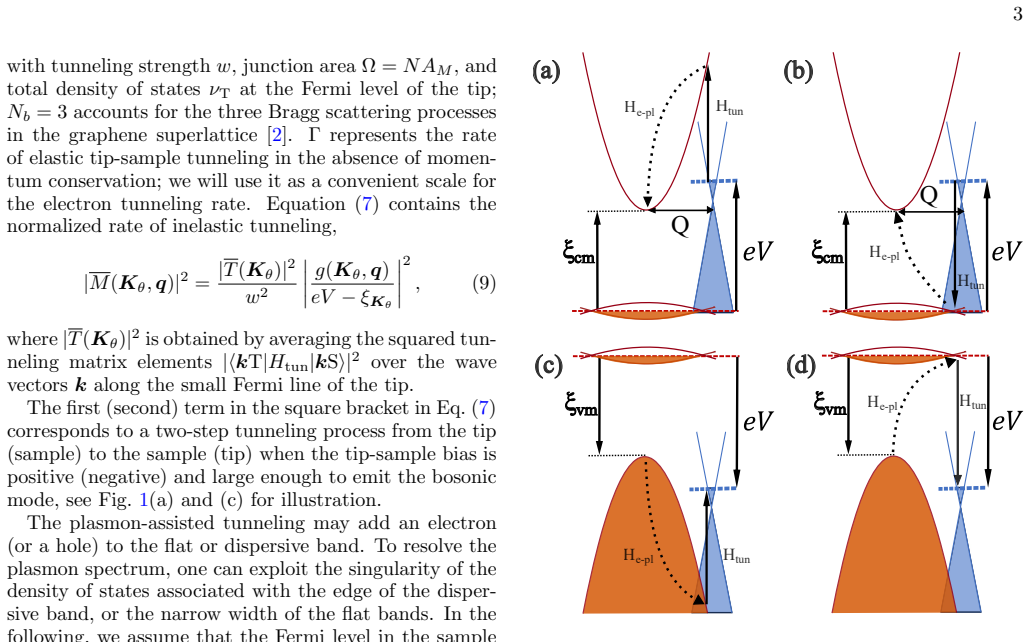
The load-bearing object is the dynamically screened Coulomb interaction $\hat{W}(q,\omega)$ and its dissipative part $\hat{W}''(q,\omega)$, computed at the random-phase-approximation level. Its plasmon pole, $\hat{W}''_{g_1,g_2}(q,\nu) = -\pi \phi_{q+g_1}\phi^*_{q+g_2}\delta(\nu-\hbar\omega_q)$, defines both the plasmon dispersion and the electrostatic potential $\phi_q$ of the zero-point motion, from which the microscopic electron-plasmon coupling $g_{\lambda\rho}(k,q) = A_M^{-1/2}\sum_g \langle u^\lambda_k | u^\rho_{k-q-g}\rangle \phi_{q+g}$ is constructed. The second ingredient is momentum-conserving interlayer tunneling in the QTM geometry, which pins the incoming electron to the tip Dirac point $K_\theta$ and converts twist angle into transferred momentum. Together these ingredients let the off-shell self-energy in the GW approximation map the plasmon spectral weight onto specific features of $G(V,\theta)$.
What would settle it
A direct falsifier would be a cryogenic QTM measurement of a charge-neutral TBG device with a lightly doped tip: if sweeping the twist angle does not produce a $d^2I/dV^2$ peak at $eV^*(\theta) \approx \xi_{cm} + \hbar\omega_{Q_\theta}$ tracking the predicted plasmon dispersion, or if the low-bias satellites are absent when the tip Dirac point is at $\kappa'$ and $m$, the central mechanism is not operating as claimed. A cleaner numerical falsifier would be to compute $dI/dV$ with a nonperturbative method for the same parameters and check whether the satellite and kink positions survive when GW fails.
Extended reading notes
Core claim
On its own terms, the central result is that the QTM differential conductance directly measures the momentum-resolved spectral function of the sample along the trajectory of the tip Dirac point: $dI/dV \propto \sum_{\lambda\rho} \Lambda_\rho(K_\theta)^* \Lambda_\lambda(K_\theta) A^S_{\lambda\rho}(K_\theta, eV)$, with $\Lambda_\lambda$ a tunneling form factor. Away from the quasiparticle peaks, the spectral function is controlled by the off-shell self-energy, which in turn is controlled by the dissipative part of the dynamically screened Coulomb interaction $\hat{W}''$. When $\hat{W}''$ has a plasmon pole, the inelastic conductance reduces to a sum over final bands of a normalized inelastic tunneling rate $|M^\lambda(K_\theta,q)|^2$ times energy-conserving delta functions, so the twist angle selects the plasmon wave vector $q = K_\theta - K_{\theta_{\rm TBG}}$. For charge-neutral twisted bilayer graphene, the calculation predicts that tunneling into the flat bands produces almost bias-independent plasmon satellites set by the plasmon density of states, while tunneling into the dispersive remote bands produces a step in $dI/dV$ at $eV^*(\theta) \approx \xi_{cm} + \hbar\omega_{Q_\theta}$, whose $d^2I/dV^2$ peak traces the plasmon dispersion.
Load-bearing premise
The argument assumes the electrons in magic-angle twisted bilayer graphene stay weakly interacting enough that the noninteracting flat bands plus a one-shot GW correction describe the spectrum; if the Coulomb repulsion is stronger than the flat-band width, the system becomes a correlated insulator and the predicted tunneling features would differ.
Editorial extensions
If this is right
- For twisted bilayer graphene near the magic angle, $dI/dV$ should show two nearly dispersionless satellites at $eV \approx \pm(\hbar\omega_0 + \xi_{\rm VH})$ when the tip Dirac point is parked near the $\kappa'$ or $m$ points, with intensity strongly suppressed near $\gamma$.
- A $d^2I/dV^2$ peak at $eV^*(\theta) \approx \xi_{cm} + \hbar\omega_{Q_\theta}$ should trace the momentum-resolved plasmon dispersion as the twist angle is swept, on both positive and negative bias sides.
- The predicted onset kink in $dI/dV$ is weak, roughly $\Delta(dI/dV) \sim 4\times10^{-3} G_{\rm incoh}$ for the parameters studied, so the feature is best resolved in $d^2I/dV^2$ and near $\kappa'$, where elastic tunneling into the lowest remote band is suppressed.
- Strong gate screening with a sample-gate distance $d_g=1$ nm does not destroy the predicted signatures; it shifts the plasmon and satellite energies to about 10 meV, leaving undamped plasmons near the moiré Brillouin zone boundary.
- Tip-induced screening and interlayer electron-plasmon scattering are weak for a charge-neutral or lightly doped tip, so the predicted features survive in a realistic junction.
Reading between the lines
- Going beyond the paper's explicit scope, the same off-shell self-energy formalism should apply to other bosonic collective modes in moiré systems, including magnons, phasons, and Goldstone-mode-like excitations, with the particle-hole vertex replaced by the appropriate susceptibility.
- If magic-angle twisted bilayer graphene at charge neutrality is actually a correlated insulator or hosts Hubbard bands, the GW-based spectral function and its satellites would not be the final word; the paper itself notes that satellite features would then appear above the Hubbard-band elastic peaks, an observation that could be used to distinguish weak- and strong-coupling regimes.
- A direct experimental test would be to measure $d^2I/dV^2$ maps on charge-neutral TBG devices with dual gates and a low-doped tip; the predicted twist-angle dependence of $eV^*(\theta)$ is sharp enough to confirm or rule out the plasmon origin of the kinks.
- Extracting the electron-plasmon coupling $\phi_q$ from satellite intensities would provide a microscopic estimate of the plasmon contribution to pairing in magic-angle twisted bilayer graphene, offering a route to test the plasmon-glue scenario without relying on superconducting transition temperatures.
Editorial analysis
A structured set of objections, weighed in public.
Referee Report
Summary. The paper develops a theory for plasmon-assisted inelastic tunneling spectroscopy with the quantum twisting microscope (QTM). It derives the differential conductance in terms of the sample's momentum-resolved spectral function, expresses the off-shell electron self-energy through the dynamically screened Coulomb interaction, and isolates the plasmon contribution. The formalism is applied to twisted bilayer graphene (TBG) at 1.20° and 1.07° (near the magic angle) using RPA screening and a one-shot GW self-energy. The authors predict two signatures: nearly dispersionless low-bias plasmon satellites in dI/dV due to tunneling into the flat bands, and high-bias d2I/dV2 kinks whose threshold voltage tracks the momentum-resolved plasmon dispersion. They also analyze the effects of tip-induced screening and interlayer electron-plasmon scattering, showing these give small quantitative corrections.
Significance. If the predictions are robust, this work would establish a new spectroscopic probe of collective excitations in moiré materials, extending previous QTM phonon spectroscopy to plasmons. The general formalism in Sec. IV is clean and goes beyond earlier single-band treatments, and the paper provides a microscopic, parameter-light calculation with no fitting of the target signatures. The detailed treatment of tip screening effects in Appendix B is a particular strength, as is the explicit derivation of the inelastic tunneling current from both diagrammatic and golden-rule approaches. However, the quantitative predictions for 1.07° MATBG are built on one-shot GW in a regime where the paper itself states that GW fails to describe the correlated Mott/Hubbard physics. This leaves the headline magic-angle predictions unsecured, although the general framework and the 1.20° results remain valuable.
major comments (2)
- [Sec. V.B, Sec. VI, Figs. 9-10] The quantitative predictions for 1.07° TBG rely on one-shot GW starting from noninteracting Bistritzer-MacDonald bands, in a regime where U ≈ B ≈ 10 meV (stated in Sec. V.B). The paper explicitly acknowledges in Sec. VI that GW fails to describe the Mott/Hubbard states expected in MATBG, and the cited QMC/DMFT literature predicts Hubbard bands rather than a symmetric metal. Because perturbation theory is not controlled when U ≈ B, the predicted quasiparticle peaks, plasmon satellites at eV ≈ ω0 + ξVH ≈ 10 meV, and the high-bias kinks tracing ℏω(Qθ) are not robust: a correlated insulating ground state would replace the quasiparticle peaks with Hubbard bands and could shift or destroy the predicted inelastic features. This does not invalidate the general formalism in Sec. IV or the 1.20° results, but it undermines the headline MATBG claims. The authors should either provide a more controlled treatment (e.g., using a Hubbard-band spectral function or a nonperturbative method) or explicitly reframe the 1.07° results as an uncontrolled illustration rather than a quantitative prediction.
- [Sec. IV.B, Eq. (37) and the condition above it] The off-shell self-energy expansion is justified by the condition |ϵ − ξλ_k| ≫ v_q/A_M for all λ. In the 1.20° calculation, the plasmon satellites appear at an energy ~40 meV away from the quasiparticle peaks, while the averaged interaction scale for the dual-gate-screened Coulomb potential in that geometry (dg = 40 nm) is comparable to the flat-band bandwidth (~50 meV). For such a moderate separation, the neglect of higher-order diagrams in the self-energy may affect the quantitative line shapes and intensities of the satellites, which the paper acknowledges in Sec. V.B for GW (overestimation of satellites). The qualitative existence of the two signatures is robust, but the quantitative spectral weights and peak positions should be interpreted with this caveat. Please state more explicitly the estimated value of v_q/A_M for the parameters used and discuss the extent to which the off-shell condition is satisfied.
minor comments (4)
- [Sec. II, Eqs. (7)-(9)] In the simplified derivation, the notation M(Kθ, q) in Eq. (9) uses ξ_{Kθ} for a single band, whereas the general expression in Eq. (47) sums over intermediate bands with ξ^ρ_{Kθ}. This change of notation is a bit abrupt; a short sentence connecting the two would improve clarity.
- [Sec. V.B, Fig. 9(b)] The red dashed line in Fig. 9(b) plots the rescaled tunneling conductance (eV)^2 dI/dV, but the units of this quantity are not stated. Since (eV)^2 has dimensions of energy squared, the rescaled conductance has unusual units; please specify or normalize the curve in a dimensionally clear way.
- [Fig. 5(b) and Fig. 8(a)] The color scale in these plots is labeled "-Tr(W'')" with units meV·A_M, but the caption refers to "spectral weight" without defining how the trace is normalized. A brief explanation of the normalization and the meaning of the trace over reciprocal-lattice indices would aid the reader.
- [Appendix B, Eqs. (B9)-(B10)] The analytic continuation of the graphene response function involves branch cuts on the real axis; the notation "ω approaches the real axis from above" is terse. Adding a sentence specifying the sign convention for the square roots would remove ambiguity.
Circularity Check
No significant circularity: the predicted tunneling signatures are computed from a stated microscopic model (BM bands, RPA screening, GW self-energy) without fitting the target conductance features.
full rationale
The paper's derivation chain is self-contained rather than circular. The input is the interacting Bistritzer-MacDonald Hamiltonian (Sec. III); the plasmon response is computed in RPA from the density-density response function (Eqs. 48-49); the screened interaction W is used in the off-shell self-energy (Eqs. 37-38); the spectral function follows from the Dyson equation (Eq. 50); and the QTM conductance is obtained from that spectral function (Eq. 33). The predicted signatures—low-bias plasmon satellites and high-bias d2I/dV2 kinks—follow from the delta-function pole structure of W at the plasmon frequency (Eq. 43) inserted through the self-energy; no parameter is fitted to the conductance data. The comparison in Fig. 9(b) between (eV)^2 dI/dV, Sigma'', and D(omega) is an internal consistency check, since all three quantities derive from the same RPA screening potential, not an independent prediction extracted from data. Self-citations to the authors' earlier phonon-QTM and Dirac-point-spectroscopy work appear (e.g., Eq. 8 and Sec. V.B), but they provide only normalization factors and interpretive context; the central claim does not reduce to those citations. Sec. VI explicitly concedes that one-shot GW cannot describe the Mott/Hubbard states expected in MATBG; that is a validity and robustness caveat for the quantitative MATBG predictions, not a circularity in the derivation. The general framework and the moderately screened 1.20-degree results remain independent of that caveat.
Assumptions & free parameters
free parameters (8)
- w1 = 117 meV =
117 meV from prior TBG fits
- w0/w1 = 0.7 =
0.7
- v_D = 10^6 m/s =
10^6 m/s
- epsilon_r (relative permittivity) =
10 (main text), 6.6 (Appendix B)
- sample-gate distance d_g =
1 nm for 1.07 deg, 40 nm for 1.20 deg
- tip-sample distance d_T =
0.5 nm
- broadening eta =
0.4 meV (0.8 meV in Appendix B)
- tip chemical potential mu_T =
0 in main text, 20 meV in Appendix B
assumptions (8)
- domain assumption Bistritzer-MacDonald continuum model with literature parameters captures TBG single-particle bands in the twist-angle range studied.
- domain assumption RPA describes the screened Coulomb interaction and the plasmon poles.
- domain assumption One-shot GW gives a reliable spectral function in the studied regimes.
- domain assumption The tip is a noninteracting low-density Dirac metal; tip screening and interlayer electron-plasmon scattering can be neglected.
- domain assumption Momentum-conserving tunneling Hamiltonian with equal tunneling amplitudes w0 = w1 = w and no interface relaxation/corrugation.
- domain assumption Applied bias shifts the tip chemical potential while the sample chemical potential stays fixed relative to its Dirac point.
- domain assumption Plasmons away from the particle-hole continuum are undamped and represented by Dirac-delta poles in W''.
- domain assumption The counterterm H_c = -H_HF^{nu=0} from Ref. [53] regularizes the Dirac-sea self-energy.
Cite this review
Pith. "Pith review of Theory of plasmon spectroscopy with the quantum twisting microscope." pith.science (2026). https://pith.science/paper/X5O5ZBWX
@misc{pith2026250605485,
  author       = {Pith},
  title        = {Pith review of: Theory of plasmon spectroscopy with the quantum twisting microscope},
  year         = {2026},
  howpublished = {\url{https://pith.science/paper/X5O5ZBWX}},
  note         = {Machine review of arXiv:2506.05485}
}
read the original abstract
We consider plasmon-assisted electron tunneling in a quantum twisting microscope (QTM). The dependence of the differential conductance on the two control parameters of the QTM -- the twist angle and bias -- reveals the plasmon spectrum as well as the strength of plasmon-electron interactions in the sample. We perform microscopic calculations for twisted bilayer graphene (TBG), to predict the plasmon features in the tunneling spectra of TBG close to the magic angle for different screening environments. Our work establishes a general framework for inelastic tunneling spectroscopy of collective electronic excitations using the quantum twisting microscope.
Figures


Figures from the paper (8 more)


Forward citations
Cited by 1 Pith paper
-
Revealing electron-electron interactions in graphene at room temperature with the quantum twisting microscope
Room-temperature quantum twisting microscopy of graphene/hBN/graphene shows split nesting and nonlinear onset features consistent with electron-electron renormalization of the Dirac dispersion with fitted α=0.32.
Reference graph
Works this paper leans on
-
[1]
These charges are separated from the monolayer graphene tip by a vertical distance dT
Dynamical screening from the tip For simplicity, we neglect the finite thickness of TBG by assuming that its charges reside in the center of two graphene layers due to strong layer hybridization of the flat-band wave functions. These charges are separated from the monolayer graphene tip by a vertical distance dT. It will be convenient to introduce a layer...
-
[2]
Interlayer electron-plasmon scattering The plasmons in the sample generate an electric field that extends out of the sample plane ( z = 0) and interact with the electrons in the tip. In this section, we compute the corrections to the inelastic tunneling conductance due to the interlayer electron-plasmon coupling. The full electron-plasmon coupling Hamilto...
-
[3]
Inbar, J
A. Inbar, J. Birkbeck, J. Xiao, T. Taniguchi, K. Watan- abe, B. Yan, Y. Oreg, A. Stern, E. Berg, and S. Ilani, The quantum twisting microscope, Nature 614, 682 (2023)
2023
-
[4]
J. Birkbeck, J. Xiao, A. Inbar, T. Taniguchi, K. Watan- abe, E. Berg, L. Glazman, F. Guinea, F. von Op- pen, and S. Ilani, Measuring Phonon Dispersion and Electron-Phason Coupling in Twisted Bilayer Graphene with a Cryogenic Quantum Twisting Microscope (2024), arXiv:2407.13404 [cond-mat]
arXiv 2024
- [5]
-
[6]
V. Peri, S. Ilani, P. A. Lee, and G. Refael, Probing quan- tum spin liquids with a quantum twisting microscope, Physical Review B 109, 035127 (2024)
work page 2024
-
[7]
F. Pichler, W. Kadow, C. Kuhlenkamp, and M. Knap, Probing magnetism in moir´ e heterostructures with quan- tum twisting microscopes, Physical Review B 110, 045116 (2024)
work page 2024
-
[8]
M. Carrega, I. J. Vera-Marun, and A. Principi, Tun- neling spectroscopy as a probe of fractionalization in two-dimensional magnetic heterostructures, Phys. Rev. B 102, 085412 (2020)
work page 2020
Show all 56 references
-
[9]
Lewandowski and L
C. Lewandowski and L. Levitov, Intrinsically undamped plasmon modes in narrow electron bands, Proceedings of the National Academy of Sciences 116, 20869 (2019)
2019
-
[10]
Papaj and C
M. Papaj and C. Lewandowski, Probing correlated states with plasmons, Science Advances 9, eadg3262 (2023)
2023
-
[11]
Lewandowski, D
C. Lewandowski, D. Chowdhury, and J. Ruhman, Pairing in magic-angle twisted bilayer graphene: Role of phonon and plasmon umklapp, Physical Review B 103, 235401 (2021)
2021
-
[12]
Cea and F
T. Cea and F. Guinea, Coulomb interaction, phonons, and superconductivity in twisted bilayer graphene, Pro- ceedings of the National Academy of Sciences 118, e2107874118 (2021)
2021
-
[13]
Sharma, M
G. Sharma, M. Trushin, O. P. Sushkov, G. Vignale, and S. Adam, Superconductivity from collective excitations in magic-angle twisted bilayer graphene, Phys. Rev. Res. 2, 022040 (2020)
2020
-
[14]
L. Peng, I. Yudhistira, G. Vignale, and S. Adam, The- oretical determination of the effect of a screening gate on plasmon-induced superconductivity in twisted bilayer graphene, Phys. Rev. B 109, 045404 (2024)
2024
-
[15]
N. Wei, F. von Oppen, and L. I. Glazman, Dirac-point spectroscopy of flat-band systems with the quantum twisting microscope, Phys. Rev. B 111, 085128 (2025)
2025
-
[16]
Stauber and H
T. Stauber and H. Kohler, Quasi-flat plasmonic bands in twisted bilayer graphene, Nano letters 16, 6844 (2016)
2016
-
[17]
Cavicchi, I
L. Cavicchi, I. Torre, P. Jarillo-Herrero, F. H. L. Kop- pens, and M. Polini, Theory of intrinsic acoustic plas- mons in twisted bilayer graphene, Physical Review B 110, 045431 (2024)
2024
-
[18]
Pines and J
D. Pines and J. R. Schrieffer, Approach to equilibrium of electrons, plasmons, and phonons in quantum and clas- sical plasmas, Phys. Rev. 125, 804 (1962)
1962
-
[19]
G. D. Mahan, Many-particle physics (Springer Science & Business Media, 2013)
2013
-
[20]
Bistritzer and A
R. Bistritzer and A. H. MacDonald, Moir´ e bands in twisted double-layer graphene, Proceedings of the Na- tional Academy of Sciences 108, 12233 (2011)
2011
-
[21]
J. M. B. Lopes dos Santos, N. M. R. Peres, and A. H. Castro Neto, Graphene Bilayer with a Twist: Electronic Structure, Physical Review Letters 99, 256802 (2007)
2007
-
[22]
Vafek and J
O. Vafek and J. Kang, Renormalization group study of hidden symmetry in twisted bilayer graphene with coulomb interactions, Phys. Rev. Lett. 125, 257602 (2020)
2020
-
[23]
In our notation, ˆW does not include the first order Coulomb interaction and is different from the conven- tional notation in the GW approximation
-
[24]
Note that Gincoh is the scale for the features in dI/dV re- sulting from elastic, momentum-conserving tunneling [3]
-
[25]
X. Gao, A. Jimeno-Pozo, P. A. Pantaleon, E. Code- cido, D. L. Sharifi, Z. Zhang, Y. Liu, K. Watanabe, T. Taniguchi, M. W. Bockrath, F. Guinea, and C. N. Lau, Double-edged role of interactions in superconduct- ing twisted bilayer graphene (2024), arXiv:2412.01578 [cond-mat.mes-hall]
2024 arXiv
-
[26]
Y. Wang, J. Zhu, G. W. Burg, A. Swain, K. Watanabe, T. Taniguchi, Y. Zheng, A. H. MacDonald, and E. Tu- tuc, Independently tunable flat bands and correlations in a graphene double moir´ e system, Phys. Rev. Lett. 134, 096204 (2025)
2025
-
[27]
Barrier, L
J. Barrier, L. Peng, S. Xu, V. I. Fal’ko, K. Watanabe, T. Tanigushi, A. K. Geim, S. Adam, and A. I. Berdyugin, Coulomb screening of superconductivity in magic-angle twisted bilayer graphene (2024), arXiv:2412.01577 [cond- mat]
2024 arXiv
-
[28]
C˘ alug˘ aru, M
D. C˘ alug˘ aru, M. Borovkov, L. L. Lau, P. Coleman, Z.-D. Song, and B. A. Bernevig, Twisted bilayer graphene as topological heavy fermion: Ii. analytical approximations of the model parameters, Low Temperature Physics 49, 640 (2023)
2023
-
[29]
R. M. Martin, L. Reining, and D. M. Ceperley, Interact- ing electrons (Cambridge University Press, 2016)
2016
-
[30]
Caruso and F
F. Caruso and F. Giustino, The gw plus cumulant method and plasmonic polarons: application to the ho- mogeneous electron gas, The European Physical Journal B 89, 1 (2016)
2016
-
[31]
P. J. Ledwith, J. Dong, A. Vishwanath, and E. Khalaf, Nonlocal Moments in the Chern Bands of Twisted Bilayer Graphene (2025), arXiv:2408.16761 [cond-mat]
2025 arXiv
-
[32]
Guinea and N
F. Guinea and N. R. Walet, Electrostatic effects, band distortions, and superconductivity in twisted graphene 21 bilayers, Proceedings of the National Academy of Sci- ences 115, 13174 (2018)
2018
-
[33]
Novelli, I
P. Novelli, I. Torre, F. H. L. Koppens, F. Taddei, and M. Polini, Optical and plasmonic properties of twisted bi- layer graphene: Impact of interlayer tunneling asymme- try and ground-state charge inhomogeneity, Phys. Rev. B 102, 125403 (2020)
2020
-
[34]
J. Zhu, I. Torre, M. Polini, and A. H. MacDonald, Weak- coupling theory of magic-angle twisted bilayer graphene, Phys. Rev. B 110, L121117 (2024)
2024
-
[35]
L. Peng, G. Vignale, and S. Adam, Many-body perturba- tion theory for moir´ e systems (2025), arXiv:2502.06968 [cond-mat.str-el]
2025 arXiv
-
[36]
J. S. Hofmann, E. Khalaf, A. Vishwanath, E. Berg, and J. Y. Lee, Fermionic monte carlo study of a realistic model of twisted bilayer graphene, Phys. Rev. X 12, 011061 (2022)
2022
-
[37]
Huang, N
C. Huang, N. Parthenios, M. Ulybyshev, X. Zhang, F. F. Assaad, L. Classen, and Z. Y. Meng, Angle-tuned gross- neveu quantum criticality in twisted bilayer graphene: A quantum monte carlo study (2025), arXiv:2412.11382 [cond-mat.str-el]
2025 arXiv
-
[38]
Datta, M
A. Datta, M. J. Calder´ on, A. Camjayi, and E. Bas- cones, Heavy quasiparticles and cascades without sym- metry breaking in twisted bilayer graphene, Nature Com- munications 14, 5036 (2023)
2023
-
[39]
G. Rai, L. Crippa, D. C˘ alug˘ aru, H. Hu, F. Paoletti, L. De’ Medici, A. Georges, B. A. Bernevig, R. Valent ´ ı, G. Sangiovanni, and T. Wehling, Dynamical Correlations and Order in Magic-Angle Twisted Bilayer Graphene, Physical Review X 14, 031045 (2024)
2024
-
[40]
Zhou, Y.-J
G.-D. Zhou, Y.-J. Wang, N. Tong, and Z.-D. Song, Kondo phase in twisted bilayer graphene, Phys. Rev. B 109, 045419 (2024)
2024
-
[41]
M. J. Calder´ on, A. Camjayi, A. Datta, and E. Bascones, Cascades in transport and optical conductivity of twisted bilayer graphene (2025), arXiv:2412.20855 [cond-mat.str- el]
2025 arXiv
-
[42]
Georges, G
A. Georges, G. Kotliar, W. Krauth, and M. J. Rozen- berg, Dynamical mean-field theory of strongly correlated fermion systems and the limit of infinite dimensions, Re- views of Modern Physics 68, 13 (1996)
1996
-
[43]
Hu, Z.-D
H. Hu, Z.-D. Song, and B. A. Bernevig, Projected and Solvable Topological Heavy Fermion Model of Twisted Bilayer Graphene (2025), arXiv:2502.14039 [cond-mat]
2025
-
[44]
P. J. Ledwith, A. Vishwanath, and E. Khalaf, Exotic car- riers from concentrated topology: Dirac trions as the origin of the missing spectral weight in twisted bilayer graphene (2025), arXiv:2505.08779 [cond-mat.str-el]
2025 arXiv
-
[45]
Song and B
Z.-D. Song and B. A. Bernevig, Magic-Angle Twisted Bi- layer Graphene as a Topological Heavy Fermion Problem, Physical Review Letters 129, 047601 (2022)
2022
-
[46]
E. G. C. P. van Loon, H. Hafermann, A. I. Lichten- stein, A. N. Rubtsov, and M. I. Katsnelson, Plasmons in strongly correlated systems: Spectral weight trans- fer and renormalized dispersion, Phys. Rev. Lett. 113, 246407 (2014)
2014
-
[47]
Wu and S
F. Wu and S. Das Sarma, Collective excitations of quantum anomalous hall ferromagnets in twisted bilayer graphene, Phys. Rev. Lett. 124, 046403 (2020)
2020
-
[48]
Kumar, M
A. Kumar, M. Xie, and A. H. MacDonald, Lattice col- lective modes from a continuum model of magic-angle twisted bilayer graphene, Phys. Rev. B 104, 035119 (2021)
2021
-
[49]
B. A. Bernevig, B. Lian, A. Cowsik, F. Xie, N. Reg- nault, and Z.-D. Song, Twisted bilayer graphene. v. ex- act analytic many-body excitations in coulomb hamil- tonians: Charge gap, goldstone modes, and absence of cooper pairing, Phys. Rev. B 103, 205415 (2021)
2021
-
[50]
Khalaf, N
E. Khalaf, N. Bultinck, A. Vishwanath, and M. P. Zale- tel, Soft modes in magic angle twisted bilayer graphene (2020), arXiv:2009.14827 [cond-mat.str-el]
2020 arXiv
-
[51]
Bultinck, E
N. Bultinck, E. Khalaf, S. Liu, S. Chatterjee, A. Vish- wanath, and M. P. Zaletel, Ground state and hidden symmetry of magic-angle graphene at even integer fill- ing, Phys. Rev. X 10, 031034 (2020)
2020
-
[52]
Xie and A
M. Xie and A. H. MacDonald, Nature of the correlated insulator states in twisted bilayer graphene, Phys. Rev. Lett. 124, 097601 (2020)
2020
-
[53]
Wunsch, T
B. Wunsch, T. Stauber, F. Sols, and F. Guinea, Dynami- cal polarization of graphene at finite doping, New Journal of Physics 8, 318 (2006)
2006
-
[54]
Bistritzer and A
R. Bistritzer and A. H. MacDonald, Transport between twisted graphene layers, Phys. Rev. B 81, 245412 (2010)
2010
-
[55]
S. Liu, E. Khalaf, J. Y. Lee, and A. Vishwanath, Ne- matic topological semimetal and insulator in magic-angle bilayer graphene at charge neutrality, Phys. Rev. Res. 3, 013033 (2021)
2021
-
[56]
B. A. Bernevig, Z.-D. Song, N. Regnault, and B. Lian, Twisted bilayer graphene. iii. interacting hamiltonian and exact symmetries, Phys. Rev. B 103, 205413 (2021)
2021
Reviewed August 7, 2026 · model on record in the stance chip above.
Discussion (0). Sign in to comment.