REVIEW 3 major objections 6 minor 124 references
The TOI-1117 Multi-planetary System: 3 sub-Neptunes, 1 in both the Neptunian Desert and Radius Valley
T0 review · 3 major / 6 minor · reviewed 2026-08-07 · deepseek-v4-flash
Pith's one-line read The paper establishes that TOI-1117 hosts three sub-Neptune planets, the innermost of which occupies both the Neptunian Desert and the Radius Valley, and argues from photoevaporation modeling that this hot Neptune is water-rich rather…
desk verdict Solid three-planet discovery with a real but fixable overstatement in the abstract's water-rich claim. read the letter →
The pith
A machine-rendered reading of the paper's core claim, the machinery that carries it, and where it could break.
The reading
What carries the argument
The argument runs on three coupled pieces of machinery. A joint fit in the exoplanet framework combines TESS and LCOGT light curves with HARPS radial velocities to derive the stellar and planetary parameters, with stability calculations from rebound and spock (instability times) and MEGNO (chaos indicator) ruling out non-circular orbits. A resonance analysis tracks four critical resonant angles of the 2:1 mean-motion resonance over 4,000 N-body integrations to test whether b/c and c/d librate. For the interior, a four-layer model (iron core, rocky mantle, water layer, H/He envelope) is sampled with nested sampling, and the photoevolver code couples stellar X-ray evolution, envelope structure, and atmospheric escape to simulate the photoevaporation history from 10 Myr to 10 Gyr. The photoevaporation simulations are the decisive step: they strip every H/He envelope within 100 Myr, leaving water-rich interiors as the surviving explanation for the planet's low density.
What would settle it
A transmission spectrum of TOI-1117b that shows a clear hydrogen-helium atmosphere—for example strong H-alpha absorption or Rayleigh scattering extending to small scale heights—would contradict the water-rich no-H/He conclusion, since the photoevaporation simulations only strip H/He under the in-situ assumption. Conversely, a spectrum showing strong steam absorption with no hydrogen features would confirm it.
Extended reading notes
Core claim
TOI-1117 hosts three sub-Neptune planets. Planet b transits with a period of 2.228 days, a mass of 8.90 Earth masses and a radius of 2.46 Earth radii, making it a hot Neptune that falls in both the Neptunian Desert and the Radius Valley. Planets c and d are detected in HARPS radial velocities with minimum masses of about 7.5 and 9.1 Earth masses and periods of 4.58 and 8.67 days. The eccentricities are consistent with zero; N-body integrations show that eccentricities above roughly 0.2–0.27 would destabilize the system within 1 Gyr. The b/c period ratio lies close to 2:1, with about 70 percent of simulated initial conditions showing libration of a critical resonant angle. Photoevaporation simulations find that any hydrogen-helium envelope on an in-situ planet b is lost within the first 100 Myr, contradicting the observed radius; a structure with a water-rich layer and no H/He envelope instead matches the data. The paper therefore argues for a water-rich interior for TOI-1117b and a quiescent, low-eccentricity migration origin for the system.
Load-bearing premise
The conclusion that TOI-1117b is water-rich depends on the assumption that the planet formed in situ at its present distance of 0.033 AU, because the photoevaporation simulations assume the planet started there with a primordial H/He envelope; if the planet formed beyond the snow line and migrated inward, its initial envelope mass, accretion history, and X-ray exposure would differ, and the rocky-with-envelope scenario would not be ruled out.
Editorial extensions
If this is right
- TOI-1117b becomes a rare benchmark hot Neptune with precisely measured mass and radius at the intersection of the Neptunian Desert and the Radius Valley, and it is bright enough for JWST atmospheric characterization (ESM = 11.7).
- The stability analysis shows the three orbits must be nearly circular, so the eccentricity upper limits from the radial velocities are physically meaningful rather than unconstrained.
- A near 2:1 resonance between b and c (70 percent of stable solutions librate) supports convergent disk migration rather than violent high-eccentricity migration.
- Photoevaporation modeling implies TOI-1117b has a water-rich layer of about 33 percent of its mass with no H/He envelope, making it a steam- or ocean-world candidate.
- The system's peas-in-a-pod uniformity (Q = 0.004, C = 0.005) indicates a quiescent formation pathway, linking hot Neptunes in the desert to the low-eccentricity migration channel proposed for ultra-short-period rocky planets.
Reading between the lines
- If the water-rich interpretation survives, TOI-1117b's atmosphere should be metal-enriched; a transmission spectrum searching for water steam rather than hydrogen features would discriminate between the water-rich and rocky-plus-envelope scenarios.
- The discovery implies that the Neptunian Desert may hide a population of multi-planet systems produced by gentle migration; future surveys should search desert planets for companions rather than treating them as isolated objects.
- The MEGNO inclination analysis favors near-coplanar orbits for c and d, which means precise transit timing or future astrometry could measure their true masses and test whether the system is genuinely peas-in-a-pod in a stronger sense.
- The in-situ versus ex-situ ambiguity for planet b could be probed with a Rossiter–McLaughlin measurement of the stellar obliquity; a low obliquity would support quiescent disk migration, while a high obliquity would suggest a more chaotic past.
Editorial analysis
A structured set of objections, weighed in public.
Referee Report
Summary. The paper presents the discovery of three sub-Neptune planets around the Sun-like star TOI-1117. The inner planet b is transiting, with period 2.228 d, mass 8.90+0.95-0.96 M⊕ and radius 2.46+0.13-0.12 R⊕, placing it in the Neptunian Desert and Radius Valley. Two additional non-transiting signals are identified in HARPS radial velocities at 4.579 d and 8.665 d. The authors validate the transiting planet with TESS and LCOGT photometry, speckle imaging, and centroid analysis, and justify the two outer planets via periodogram significance, WAIC model comparison, and the absence of activity-indicator correlations. The paper further presents N-body stability simulations (SPOCK and MEGNO), a resonant-angle analysis, interior structure retrieval, and photoevaporation simulations with the photoevolver code. The authors conclude that the system must be nearly circular for long-term stability, that b and c may be near a 2:1 resonance, and that photoevaporation favors a water-rich composition for b if it formed in situ.
Significance. If the three-planet system is confirmed, TOI-1117 is a valuable addition to the small sample of Neptunian Desert planets in multi-planet architectures. The combination of a precisely characterized transiting planet and two stable RV companions makes the system a useful test bed for formation models of hot Neptunes, including high-eccentricity migration versus disk migration. The paper's strengths include the thorough false-positive checks for the transit (ground-based LCOGT detection, speckle imaging, TESS-cont contamination analysis), the use of WAIC for model comparison, and the explicit dynamical stability analysis that constrains eccentricities and mutual inclinations. The photoevaporation modeling addresses a relevant question, although the compositional conclusion is conditional and, in its current form, partially circular; the discovery itself is not affected by this issue. The use of publicly available TESS, LCOGT, and HARPS data and open-source tools (exoplanet, rebound, spock, photoevolver) enhances reproducibility, though the custom analysis code is only available on request.
major comments (3)
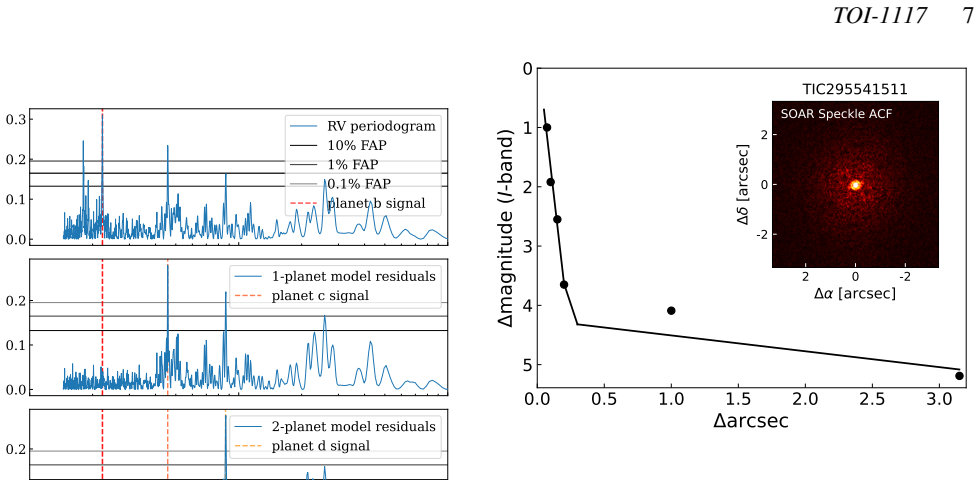
- [Abstract; Table 4] The masses quoted for TOI-1117c and TOI-1117d in the Abstract (M_c=7.46+1.43-1.62 M⊕ and M_d=9.06+2.07-1.78 M⊕) disagree with Table 4, which reports M_p sin i = 8.78+1.19-1.21 M⊕ and 10.71+1.59-1.58 M⊕ for these planets. Furthermore, the 'Mass (See Section 4.1.2)' rows in Table 4 list lower bounds of 7.57 and 9.19 M⊕, which are below the corresponding minimum masses implied by the RV semi-amplitudes; a true mass cannot be smaller than M_p sin i. These inconsistencies are central to the discovery claim and must be reconciled before publication.
- [Section 4.4; Section 5; Abstract] The photoevaporation conclusion is explicitly conditional on in-situ formation in Section 4.4 ('providing that TOI-1117b formed in-situ, rules out the rocky scenario and instead favours the water scenario'). The Abstract omits this caveat and states that rocky core and H/He atmosphere models are 'inconsistent with observations' while water-rich scenarios are 'favoured'. Section 5 then argues that in-situ formation is unlikely because 'photoevaporation analysis (Section 4.4) shows TOI-1117b is likely to host water', using the water-rich inference to reject the very assumption on which it depends. This is circular. If TOI-1117b formed beyond the snow line and migrated inward, its initial envelope mass, accretion history, and X-ray exposure time could differ, so the rocky/H-He scenario is not robustly ruled out. The Abstract and Discussion should present the water-rich preference only as a conditional result.
- [Section 4.4, Figure 15] The description of the 'water scenario' is internally inconsistent. The text defines the water scenario as a rocky core and water-rich layer 'with no H/He atmosphere', but the following paragraph says 'We evolved both the rocky and water scenarios with a number of starting H/He mass fractions ranging from 1% to 10%', and Figure 15 shows the evolution of the H/He envelope mass fraction for both panels. Either the water scenario simulation actually includes an initial H/He envelope, contradicting the definition, or the figure and text are mislabeled. This ambiguity affects the interpretation of the photoevaporation results and should be clarified.
minor comments (6)
- [Abstract; Section 3.2] The eccentricity 'upper limits' quoted in the Abstract (e_b=0.11, e_c=0.29, e_d=0.24) are not defined as confidence intervals; please specify whether these are 1σ, 95%, or other limits.
- [Section 4.2] The claim that TOI-1117b and c are 'likely to be in a near 2:1 resonance' is stronger than the analysis supports: only about 70% of the initial conditions have libration amplitude <180° for one of the two critical angles, with a minimum libration amplitude of about 23°, and the <180° criterion admits very wide librations. Please soften the wording or provide the full distribution of libration amplitudes.
- [Figure 13] The labels 'EV' and 'NU' in Figure 13 are not defined in the caption or text; please explain these abbreviations or remove them.
- [Section 6] In the final paragraph of Section 6, 'The circular eccentricities support disk migration' should be reworded, for example 'The near-circular orbits support disk migration', since eccentricities are not themselves circular.
- [Table 4] The longitude of ascending node Ω for TOI-1117b is completely unconstrained (−0.003±2.135 rad) and has no effect on the other parameters; consider removing this row or marking it as unconstrained.
- [Section 8] The Data Availability statement says the analysis code 'can be made available upon reasonable request to the author'; for reproducibility, please consider depositing the code in a public repository.
Circularity Check
The three-planet discovery is independent and well supported; only the photoevaporation/water-rich argument is circular because it rejects the in-situ assumption on which it depends.
-
other
[Section 4.4 (Photoevaporation history) and Section 5 (Discussion)]
"Our simulations therefore suggest the planet should not host a H/He envelope in the present day, which, providing that TOI-1117b formed in-situ, rules out the rocky scenario and instead favours the water scenario for TOI-1117b. ... However, it is unlikely that TOI-1117b formed in situ at 0.033AU because photoevaporation analysis (Section 4.4) shows TOI-1117b is likely to host water and water accretion is expected to occur beyond the snow line."
The photoevaporation conclusion that the water-rich scenario is favoured is explicitly conditional on the assumption that TOI-1117b formed in-situ. Section 5 then uses that same conditional conclusion as evidence against in-situ formation, arguing that in-situ formation is unlikely because the photoevaporation analysis shows the planet is likely to host water. The water-rich inference is therefore used to reject the very premise on which it depends. The abstract omits the caveat and presents the conditional result as an unconditional finding, which strengthens the circularity in the paper's interpretive chain. The planet detection itself is not affected by this step.
full rationale
The discovery of the three sub-Neptunes is self-contained and not circular. The transit and RV signals are jointly fitted with independent photometric and spectroscopic data; model selection uses WAIC; eccentricity, inclination, and resonance analyses use N-body simulations with codes such as rebound and spock, and the photoevaporation modelling uses forward models (photoevolver, Johnstone et al. X-ray histories, Chen & Rogers envelopes, Kubyshkina et al. escape rates) rather than refitting the observed mass and radius. The one genuine circular step is the water-rich/in-situ argument: Section 4.4 states the water-rich preference holds only 'providing that TOI-1117b formed in-situ', and Section 5 then uses that same preference to reject in-situ formation. This is a logical circle in a secondary interpretive claim, not in the central detection claim, so the overall circularity score is modest.
Assumptions & free parameters
free parameters (6)
- RV jitter =
ln(jitter) = 1.50 (+0.41, -0.53), corresponding to about 4.5 m/s
- Planet orbital eccentricities =
e = 0 for all planets (fixed)
- Limb darkening coefficients =
u1 = 0.61 (+0.25, -0.26), u2 = 0.64 (+0.24, -0.32)
- Initial H/He envelope mass fraction in photoevaporation simulations =
1%, 2%, 5%, and 10% starting mass fractions
- Interior water mass fraction =
0.20 ± 0.12 (free model), 0.35 ± 0.09 (no-atmosphere model)
- Stellar age =
4.42 ± 1.50 Gyr
assumptions (5)
- domain assumption The three HARPS periodic signals are planetary and not caused by stellar activity or instrumental artifacts.
- domain assumption The stability and resonance simulations assume coplanar, near-circular orbits.
- domain assumption TOI-1117b formed in situ at 0.033 AU for the photoevaporation interpretation.
- domain assumption The interior is a differentiated four-layer structure (iron core, rocky mantle, water layer, H/He atmosphere) with the adopted equations of state.
- domain assumption The adopted stellar mass, radius, and age are accurate enough for the orbital and evolution modeling.
Cite this review
Pith. "Pith review of The TOI-1117 Multi-planetary System: 3 sub-Neptunes, 1 in both the Neptunian Desert and Radius Valley." pith.science (2026). https://pith.science/paper/GXN2ALCZ
@misc{pith2026250605521,
  author       = {Pith},
  title        = {Pith review of: The TOI-1117 Multi-planetary System: 3 sub-Neptunes, 1 in both the Neptunian Desert and Radius Valley},
  year         = {2026},
  howpublished = {\url{https://pith.science/paper/GXN2ALCZ}},
  note         = {Machine review of arXiv:2506.05521}
}
abstract
We present the discovery of three sub-Neptune planets around TOI-1117, a Sun-like star with mass $0.97\pm0.02M_{\odot}$, radius $1.05\pm0.03R_{\odot}$, age $4.42\pm1.50$ Gyr and effective temperature $5635\pm62$ K. Light curves from TESS and LCOGT show a transiting sub-Neptune with a $2.23$ day period, mass $M_b=8.90_{-0.96}^{+0.95}M_{\oplus}$ and radius $R_b=2.46_{-0.12}^{+0.13}R_{\oplus}$. This is a rare 'hot Neptune' that falls within the parameter spaces known as the 'Neptunian Desert' and the 'Radius Valley'. Two more planetary signals are detected in HARPS radial velocities, revealing two non-transiting planets with minimum masses $M_c=7.46_{-1.62}^{+1.43}M_{\oplus}$ and $M_d=9.06_{-1.78}^{+2.07}M_{\oplus}$, and periods of $4.579\pm0.004$ and $8.67\pm0.01$ days. The eccentricities were poorly constrained by the HARPS data, with upper limits $e_b=0.11$, $e_c=0.29$, and $e_d=0.24$. However, dynamical simulations of the TOI-1117 system, suggest that the orbits must be nearly circular to be stable. The simulations also show that TOI-1117b and c are likely to be in a near 2:1 resonance. The multi-planet nature of TOI-1117 makes it a more complex case for formation theories of the Neptunian Desert and Radius Valley, as current theories such as high-eccentricity migration are too turbulent to produce a stable, non-eccentric, multi-planet system. Moreover, analysis of TOI-1117b's photoevaporation history found rocky core and H/He atmosphere models to be inconsistent with observations, whilst water-rich scenarios were favoured.
Figures


Figures from the paper (12 more)




Reference graph
Works this paper leans on
-
[1]
Adibekyan V. Z., Sousa S. G., Santos N. C., Delgado Mena E., Gonz \'a lez Hern \'a ndez J. I., Israelian G., Mayor M., Khachatryan G., 2012, @doi [ ] 10.1051/0004-6361/201219401 , http://adsabs.harvard.edu/abs/2012A
-
[2]
Adibekyan V., et al., 2015, @doi [ ] 10.1051/0004-6361/201527120 , http://adsabs.harvard.edu/abs/2015A
-
[3]
Adibekyan V., et al., 2021, @doi [Science] 10.1126/science.abg8794 , 374, 330–332
-
[4]
F., Barceló Forteza S., 2020, @doi [A&A] 10.1051/0004-6361/201937118 , 635, A128
Aller A., Lillo-Box J., Jones D., Miranda L. F., Barceló Forteza S., 2020, @doi [A&A] 10.1051/0004-6361/201937118 , 635, A128
-
[5]
J., et al., 2020, @doi [Nature] 10.1038/s41586-020-2421-7 , 583, 39–42
Armstrong D. J., et al., 2020, @doi [Nature] 10.1038/s41586-020-2421-7 , 583, 39–42
-
[6]
Baluev R. V., 2008, @doi [ ] 10.1111/j.1365-2966.2008.12689.x , https://ui.adsabs.harvard.edu/abs/2008MNRAS.385.1279B 385, 1279
arXiv 2008
-
[7]
Barragán O., et al., 2019, @doi [Monthly Notices of the Royal Astronomical Society] 10.1093/mnras/stz2569 , 490, 698
-
[8]
Baruteau C., et al., 2014, in Beuther H., Klessen R. S., Dullemond C. P., Henning T., eds, Protostars and Planets VI. pp 667--689 ( @eprint arXiv 1312.4293 ), @doi 10.2458/azu_uapress_9780816531240-ch029
arXiv 2014
Show all 124 references
-
[9]
J., Higgins M
Bell K. J., Higgins M. E., 2022, TESS\_PRF: Display the TESS pixel response function , Astrophysics Source Code Library, record ascl:2207.008
2022
-
[10]
Z., Santos N
Bertran de Lis S., Delgado Mena E., Adibekyan V. Z., Santos N. C., Sousa S. G., 2015, @doi [ ] 10.1051/0004-6361/201424633 , https://ui.adsabs.harvard.edu/abs/2015A&A...576A..89B 576, A89
2015 doi
-
[11]
J., Lissauer J
Bodenheimer P., Stevenson D. J., Lissauer J. J., D’Angelo G., 2018, @doi [The Astrophysical Journal] 10.3847/1538-4357/aae928 , 868, 138
2018 doi
-
[12]
J., et al., 2010, @doi [Science] 10.1126/science.1185402 , 327, 977
Borucki W. J., et al., 2010, @doi [Science] 10.1126/science.1185402 , 327, 977
2010 doi
-
[13]
M., et al., 2013, @doi [ ] 10.1086/673168 , https://ui.adsabs.harvard.edu/abs/2013PASP..125.1031B 125, 1031
Brown T. M., et al., 2013, @doi [ ] 10.1086/673168 , https://ui.adsabs.harvard.edu/abs/2013PASP..125.1031B 125, 1031
2013 doi
-
[14]
Buchner J., et al., 2014, @doi [ ] 10.1051/0004-6361/201322971 , https://ui.adsabs.harvard.edu/abs/2014A&A...564A.125B 564, A125
2014 doi
-
[15]
A., et al., 2020, @doi [Research Notes of the American Astronomical Society] 10.3847/2515-5172/abc9b3 , https://ui.adsabs.harvard.edu/abs/2020RNAAS...4..201C 4, 201
Caldwell D. A., et al., 2020, @doi [Research Notes of the American Astronomical Society] 10.3847/2515-5172/abc9b3 , https://ui.adsabs.harvard.edu/abs/2020RNAAS...4..201C 4, 201
2020 doi
-
[16]
Castro-Gonz \'a lez A., et al., 2022, @doi [ ] 10.1093/mnras/stab2669 , https://ui.adsabs.harvard.edu/abs/2022MNRAS.509.1075C 509, 1075
2022 doi
-
[17]
B., Armstrong D
Castro-Gonz \'a lez A., Bourrier V., Lillo-Box J., Delisle J. B., Armstrong D. J., Barrado D., Correia A. C. M., 2024a, @doi [ ] 10.1051/0004-6361/202450957 , https://ui.adsabs.harvard.edu/abs/2024A&A...689A.250C 689, A250
-
[18]
Castro-Gonz \'a lez A., et al., 2024b, @doi [ ] 10.1051/0004-6361/202451656 , https://ui.adsabs.harvard.edu/abs/2024A&A...691A.233C 691, A233
-
[19]
Chabrier G., Mazevet S., Soubiran F., 2019, @doi [ ] 10.3847/1538-4357/aaf99f , https://ui.adsabs.harvard.edu/abs/2019ApJ...872...51C 872, 51
2019 doi
-
[20]
A., 2016, @doi [ ] 10.3847/0004-637X/831/2/180 , https://ui.adsabs.harvard.edu/abs/2016ApJ...831..180C 831, 180
Chen H., Rogers L. A., 2016, @doi [ ] 10.3847/0004-637X/831/2/180 , https://ui.adsabs.harvard.edu/abs/2016ApJ...831..180C 831, 180
2016 doi
-
[21]
R., Beichman C
Ciardi D. R., Beichman C. A., Horch E. P., Howell S. B., 2015, @doi [The Astrophysical Journal] 10.1088/0004-637X/805/1/16 , 805, 16
2015 doi
-
[22]
M., Sim \'o C., 2000, @doi [ ] 10.1051/aas:2000108 , https://ui.adsabs.harvard.edu/abs/2000A&AS..147..205C 147, 205
Cincotta P. M., Sim \'o C., 2000, @doi [ ] 10.1051/aas:2000108 , https://ui.adsabs.harvard.edu/abs/2000A&AS..147..205C 147, 205
2000 doi
-
[23]
Collins K., 2019, in American Astronomical Society Meeting Abstracts \#233. p. 140.05
2019
-
[24]
A., Kielkopf J
Collins K. A., Kielkopf J. F., Stassun K. G., Hessman F. V., 2017, @doi [ ] 10.3847/1538-3881/153/2/77 , http://adsabs.harvard.edu/abs/2017AJ....153...77C 153, 77
2017 doi
-
[25]
I., Johnson J
Dawson R. I., Johnson J. A., 2018, @doi [Annual Review of Astronomy and Astrophysics] https://doi.org/10.1146/annurev-astro-081817-051853 , 56, 175
2018 doi
-
[26]
J., et al., 2023, @doi [Astronomy & Astrophysics] 10.1051/0004-6361/202346370 , 677, A12
Deeg H. J., et al., 2023, @doi [Astronomy & Astrophysics] 10.1051/0004-6361/202346370 , 677, A12
2023 doi
-
[27]
Delgado Mena E., et al., 2014, @doi [ ] 10.1051/0004-6361/201321493 , http://adsabs.harvard.edu/abs/2014A
2014 doi
-
[28]
Z., Sousa S
Delgado Mena E., Tsantaki M., Adibekyan V. Z., Sousa S. G., Santos N. C., Gonz \'a lez Hern \'a ndez J. I., Israelian G., 2017, @doi [ ] 10.1051/0004-6361/201730535 , http://adsabs.harvard.edu/abs/2017A
2017 doi
-
[29]
Delgado Mena E., et al., 2019, @doi [ ] 10.1051/0004-6361/201834783 , https://ui.adsabs.harvard.edu/abs/2019A&A...624A..78D 624, A78
2019 doi
-
[30]
C., Tsantaki M., Gonz \'a lez Hern \'a ndez J
Delgado Mena E., Adibekyan V., Santos N. C., Tsantaki M., Gonz \'a lez Hern \'a ndez J. I., Sousa S. G., Bertr \'a n de Lis S., 2021, @doi [ ] 10.1051/0004-6361/202141588 , https://ui.adsabs.harvard.edu/abs/2021A&A...655A..99D 655, A99
2021 doi
-
[31]
Dong S., Xie J.-W., Zhou J.-L., Zheng Z., Luo A., 2017, @doi [Proceedings of the National Academy of Sciences] 10.1073/pnas.1711406115 , 115, 266–271
2017 doi
-
[32]
Dorn C., Lichtenberg T., 2021, The Astrophysical Journal Letters, 922, L4
2021
-
[33]
Dorn C., Venturini J., Khan A., Heng K., Alibert Y., Helled R., Rivoldini A., Benz W., 2017, @doi [ ] 10.1051/0004-6361/201628708 , https://ui.adsabs.harvard.edu/abs/2017A&A...597A..37D 597, A37
2017 doi
-
[34]
P., Davies G
Doyle A. P., Davies G. R., Smalley B., Chaplin W. J., Elsworth Y., 2014, @doi [ ] 10.1093/mnras/stu1692 , https://ui.adsabs.harvard.edu/abs/2014MNRAS.444.3592D 444, 3592
2014 doi
-
[35]
J., King G
Fern \'a ndez Fern \'a ndez J., Wheatley P. J., King G. W., 2023, @doi [ ] 10.1093/mnras/stad1257 , https://ui.adsabs.harvard.edu/abs/2023MNRAS.522.4251F 522, 4251
2023 doi
-
[36]
B., Rasio F
Ford E. B., Rasio F. A., 2008, @doi [ ] 10.1086/590926 , https://ui.adsabs.harvard.edu/abs/2008ApJ...686..621F 686, 621
2008 doi
-
[37]
Foreman-Mackey D., 2018, @doi [] 10.3847/2515-5172/aaaf6c , http://adsabs.harvard.edu/abs/2018RNAAS...2a..31F 2, 31
2018 doi
-
[38]
Foreman-Mackey D., et al., 2021, @doi [Journal of Open Source Software] 10.21105/joss.03285 , 6, 3285
2021 doi
-
[39]
J., et al., 2017, @doi [ ] 10.3847/1538-3881/aa80eb , https://ui.adsabs.harvard.edu/abs/2017AJ....154..109F 154, 109
Fulton B. J., et al., 2017, @doi [ ] 10.3847/1538-3881/aa80eb , https://ui.adsabs.harvard.edu/abs/2017AJ....154..109F 154, 109
2017 doi
-
[40]
Gaia Collaboration et al., 2018, @doi [A&A] 10.1051/0004-6361/201833051 , 616, A1
2018 doi
-
[41]
J., Fabrycky D
Gilbert G. J., Fabrycky D. C., 2020, @doi [The Astronomical Journal] 10.3847/1538-3881/ab8e3c , 159, 281
2020 doi
-
[42]
Goldreich P., Tremaine S., 1979, @doi [ ] 10.1086/157448 , https://ui.adsabs.harvard.edu/abs/1979ApJ...233..857G 233, 857
1979 doi
-
[43]
Gomes Da Silva J., 2019, pyrhk, https://github.com/gomesdasilva/pyrhk
2019
-
[44]
E., 2020, @doi [Monthly Notices of the Royal Astronomical Society] 10.1093/mnras/staa315 , 493
Gupta A., Schlichting H. E., 2020, @doi [Monthly Notices of the Royal Astronomical Society] 10.1093/mnras/staa315 , 493
2020 doi
-
[45]
Hakim K., Rivoldini A., Van Hoolst T., Cottenier S., Jaeken J., Chust T., Steinle-Neumann G., 2018, @doi [ ] 10.1016/j.icarus.2018.05.005 , https://ui.adsabs.harvard.edu/abs/2018Icar..313...61H 313, 61
2018 doi
-
[46]
Haldemann J., Alibert Y., Mordasini C., Benz W., 2020, @doi [ ] 10.1051/0004-6361/202038367 , https://ui.adsabs.harvard.edu/abs/2020A&A...643A.105H 643, A105
2020 doi
-
[47]
Helled R., Stevenson D., 2017, @doi [ ] 10.3847/2041-8213/aa6d08 , https://ui.adsabs.harvard.edu/abs/2017ApJ...840L...4H 840, L4
2017 doi
-
[48]
Ho C. S. K., Van Eylen V., 2023, @doi [Monthly Notices of the Royal Astronomical Society] 10.1093/mnras/stac3802 , 519, 4056
2023 doi
-
[49]
B., Everett M
Howell S. B., Everett M. E., Sherry W., Horch E., Ciardi D. R., 2011, @doi [The Astronomical Journal] 10.1088/0004-6256/142/1/19 , 142, 19
2011 doi
-
[50]
B., Matson R
Howell S. B., Matson R. A., Ciardi D. R., Everett M. E., Livingston J. H., Scott N. J., Horch E. P., Winn J. N., 2021, @doi [The Astronomical Journal] 10.3847/1538-3881/abdec6 , 161, 164
2021 doi
-
[51]
X., et al., 2020, @doi [Research Notes of the AAS] 10.3847/2515-5172/abca2e , 4, 204
Huang C. X., et al., 2020, @doi [Research Notes of the AAS] 10.3847/2515-5172/abca2e , 4, 204
2020 doi
-
[52]
Irwin J., Irwin M., Aigrain S., Hodgkin S., Hebb L., Moraux E., 2007, @doi [ ] 10.1111/j.1365-2966.2006.11408.x , https://ui.adsabs.harvard.edu/abs/2007MNRAS.375.1449I 375, 1449
2007
-
[53]
M., et al., 2016, in Chiozzi G., Guzman J
Jenkins J. M., et al., 2016, in Chiozzi G., Guzman J. C., eds, Society of Photo-Optical Instrumentation Engineers (SPIE) Conference Series Vol. 9913, Software and Cyberinfrastructure for Astronomy IV. p. 99133E, @doi 10.1117/12.2233418
2016 doi
-
[54]
S., et al., 2020, @doi [Nature Astronomy] 10.1038/s41550-020-1142-z , https://ui.adsabs.harvard.edu/abs/2020NatAs...4.1148J 4, 1148
Jenkins J. S., et al., 2020, @doi [Nature Astronomy] 10.1038/s41550-020-1142-z , https://ui.adsabs.harvard.edu/abs/2020NatAs...4.1148J 4, 1148
2020 doi
-
[55]
Jensen E., 2013, Tapir: A web interface for transit/eclipse observability , Astrophysics Source Code Library ( @eprint ascl 1306.007 )
2013
-
[56]
P., Bartel M., G \"u del M., 2021, @doi [ ] 10.1051/0004-6361/202038407 , https://ui.adsabs.harvard.edu/abs/2021A&A...649A..96J 649, A96
Johnstone C. P., Bartel M., G \"u del M., 2021, @doi [ ] 10.1051/0004-6361/202038407 , https://ui.adsabs.harvard.edu/abs/2021A&A...649A..96J 649, A96
2021 doi
-
[57]
Kempton E. M. R., et al., 2018, @doi [ ] 10.1088/1538-3873/aadf6f , https://ui.adsabs.harvard.edu/abs/2018PASP..130k4401K 130, 114401
2018 doi
-
[58]
M., 2013, @doi [mnras] 10.1093/mnras/stt1435 , http://adsabs.harvard.edu/abs/2013MNRAS.435.2152K 435, 2152
Kipping D. M., 2013, @doi [mnras] 10.1093/mnras/stt1435 , http://adsabs.harvard.edu/abs/2013MNRAS.435.2152K 435, 2152
2013 doi
-
[59]
Knierim H., Helled R., 2024, @doi [ ] 10.3847/1538-4357/ad8dd0 , https://ui.adsabs.harvard.edu/abs/2024ApJ...977..227K 977, 227
2024 doi
-
[60]
arXiv:2504.12118
Knierim H., Helled R., 2025, arXiv e-prints, https://ui.adsabs.harvard.edu/abs/2025arXiv250412118K p. arXiv:2504.12118
2025 arXiv
-
[61]
Kubyshkina D., et al., 2018, @doi [ ] 10.1051/0004-6361/201833737 , https://ui.adsabs.harvard.edu/abs/2018A&A...619A.151K 619, A151
2018 doi
-
[62]
L., 1993, SYNTHE spectrum synthesis programs and line data
Kurucz R. L., 1993, SYNTHE spectrum synthesis programs and line data
1993
-
[63]
V., et al., 2021, @doi [The Astronomical Journal] 10.3847/1538-3881/ac0d06 , 162, 75
Lester K. V., et al., 2021, @doi [The Astronomical Journal] 10.3847/1538-3881/ac0d06 , 162, 75
2021 doi
-
[64]
Lin D. N. C., Bodenheimer P., Richardson D. C., 1996, @doi [ ] 10.1038/380606a0 , https://ui.adsabs.harvard.edu/abs/1996Natur.380..606L 380, 606
1996 doi
-
[65]
H., et al., 2018, @doi [The Astronomical Journal] 10.3847/1538-3881/aae778 , 156, 277
Livingston J. H., et al., 2018, @doi [The Astronomical Journal] 10.3847/1538-3881/aae778 , 156, 277
2018 doi
-
[66]
Lozovsky M., Helled R., Dorn C., Venturini J., 2018, @doi [ ] 10.3847/1538-4357/aadd09 , https://ui.adsabs.harvard.edu/abs/2018ApJ...866...49L 866, 49
2018 doi
-
[67]
P., Lustig-Yaeger J., Deitrick R., 2019, @doi [ ] 10.3847/1538-3881/aae8e5 , https://ui.adsabs.harvard.edu/abs/2019AJ....157...64L 157, 64
Luger R., Agol E., Foreman-Mackey D., Fleming D. P., Lustig-Yaeger J., Deitrick R., 2019, @doi [ ] 10.3847/1538-3881/aae8e5 , https://ui.adsabs.harvard.edu/abs/2019AJ....157...64L 157, 64
2019 doi
-
[68]
Maffione N., Giordano C., Cincotta P., 2011, @doi [International Journal of Non-Linear Mechanics] 10.1016/j.ijnonlinmec.2010.06.008 , 46, 23–34
2011 doi
-
[69]
E., Hillenbrand L
Mamajek E. E., Hillenbrand L. A., 2008, @doi [ ] 10.1086/591785 , https://ui.adsabs.harvard.edu/abs/2008ApJ...687.1264M 687, 1264
2008 doi
-
[70]
Matsakos T., K \"o nigl A., 2016, @doi [ ] 10.3847/2041-8205/820/1/L8 , https://ui.adsabs.harvard.edu/abs/2016ApJ...820L...8M 820, L8
2016 doi
-
[71]
A., Howell S
Matson R. A., Howell S. B., Horch E. P., Everett M. E., 2018, @doi [ ] 10.3847/1538-3881/aac778 , https://ui.adsabs.harvard.edu/abs/2018AJ....156...31M 156, 31
2018 doi
-
[72]
2003, Msngr, 114, 200
Mayor M., Pepe F., Queloz D., et al. 2003, Msngr, 114, 200
2003
-
[73]
Mazeh T., Holczer T., Faigler S., 2016, @doi [A&A] 10.1051/0004-6361/201528065 , 589, A75
2016 doi
-
[74]
H., Harbeck D.-R., Lister T
McCully C., Volgenau N. H., Harbeck D.-R., Lister T. A., Saunders E. S., Turner M. L., Siiverd R. J., Bowman M., 2018, in . p. 107070K ( @eprint arXiv 1811.04163 ), @doi 10.1117/12.2314340
2018 arXiv
-
[75]
Mol Lous M., Helled R., Mordasini C., 2022, @doi [Nature Astronomy] 10.1038/s41550-022-01699-8 , https://ui.adsabs.harvard.edu/abs/2022NatAs...6..819M 6, 819
2022 doi
-
[76]
D., Bryson S
Morton T. D., Bryson S. T., Coughlin J. L., Rowe J. F., Ravichandran G., Petigura E. A., Haas M. R., Batalha N. M., 2016, @doi [The Astrophysical Journal] 10.3847/0004-637X/822/2/86 , 822, 86
2016 doi
-
[77]
M \"u ller S., Helled R., 2023, @doi [ ] 10.1051/0004-6361/202244827 , https://ui.adsabs.harvard.edu/abs/2023A&A...669A..24M 669, A24
2023 doi
-
[78]
Naponiello L., et al., 2023, @doi [Nature] 10.1038/s41586-023-06499-2 , 622, 255–260
2023 doi
-
[79]
Ogihara M., Morbidelli A., Guillot T., 2015, @doi [A&A] 10.1051/0004-6361/201525884 , 578, A36
2015 doi
-
[80]
Osborn A., et al., 2023, @doi [Monthly Notices of the Royal Astronomical Society] 10.1093/mnras/stad2575 , 526, 548
2023 doi
-
[81]
F., Dorn C., Helled R., Bouchy F., Haldemann J., Alibert Y., 2020, @doi [ ] 10.1051/0004-6361/202038006 , https://ui.adsabs.harvard.edu/abs/2020A&A...640A.135O 640, A135
Otegi J. F., Dorn C., Helled R., Bouchy F., Haldemann J., Alibert Y., 2020, @doi [ ] 10.1051/0004-6361/202038006 , https://ui.adsabs.harvard.edu/abs/2020A&A...640A.135O 640, A135
2020 doi
-
[82]
F., et al., 2021, @doi [ ] 10.1051/0004-6361/202040247 , https://ui.adsabs.harvard.edu/abs/2021A&A...653A.105O 653, A105
Otegi J. F., et al., 2021, @doi [ ] 10.1051/0004-6361/202040247 , https://ui.adsabs.harvard.edu/abs/2021A&A...653A.105O 653, A105
2021 doi
-
[83]
E., Jackson A
Owen J. E., Jackson A. P., 2012, @doi [ ] 10.1111/j.1365-2966.2012.21481.x , https://ui.adsabs.harvard.edu/abs/2012MNRAS.425.2931O 425, 2931
2012
-
[84]
E., Lai D., 2018, @doi [Monthly Notices of the Royal Astronomical Society] 10.1093/mnras/sty1760 , 479, 5012
Owen J. E., Lai D., 2018, @doi [Monthly Notices of the Royal Astronomical Society] 10.1093/mnras/sty1760 , 479, 5012
2018 doi
-
[85]
E., Wu Y., 2017, @doi [ ] 10.3847/1538-4357/aa890a , https://ui.adsabs.harvard.edu/abs/2017ApJ...847...29O 847, 29
Owen J. E., Wu Y., 2017, @doi [ ] 10.3847/1538-4357/aa890a , https://ui.adsabs.harvard.edu/abs/2017ApJ...847...29O 847, 29
2017 doi
-
[86]
G., Collins K
Paegert M., Stassun K. G., Collins K. A., Pepper J., Torres G., Jenkins J., Twicken J. D., Latham D. W., 2021, VizieR On-line Data Catalog: IV/39 ( @eprint arXiv 2108.04778 ), https://arxiv.org/abs/2108.04778
2021 arXiv
-
[87]
Paxton B., Bildsten L., Dotter A., Herwig F., Lesaffre P., Timmes F., 2011, @doi [ ] 10.1088/0067-0049/192/1/3 , https://ui.adsabs.harvard.edu/abs/2011ApJS..192....3P 192, 3
2011 doi
-
[88]
et al., 2022, @doi [A&A] 10.1051/0004-6361/202244118 , 666, A184
Persson, Carina M. et al., 2022, @doi [A&A] 10.1051/0004-6361/202244118 , 666, A184
2022 doi
-
[89]
Pu B., Lai D., 2019, @doi [Monthly Notices of the Royal Astronomical Society] 10.1093/mnras/stz1817 , 488, 3568–3587
2019 doi
-
[90]
F., 2012, @doi [ ] 10.1051/0004-6361/201118085 , https://ui.adsabs.harvard.edu/abs/2012A&A...537A.128R 537, A128
Rein H., Liu S. F., 2012, @doi [ ] 10.1051/0004-6361/201118085 , https://ui.adsabs.harvard.edu/abs/2012A&A...537A.128R 537, A128
2012 doi
-
[91]
Rein H., Tamayo D., 2015, @doi [ ] 10.1093/mnras/stv1257 , https://ui.adsabs.harvard.edu/abs/2015MNRAS.452..376R 452, 376
2015 doi
-
[92]
R., Steffen J
Rice D. R., Steffen J. H., Vazan A., 2024, The Distribution of Planet Radius in Kepler Multiplanet Systems Depends on Gap Complexity ( @eprint arXiv 2406.12239 ), https://arxiv.org/abs/2406.12239
2024 arXiv
-
[93]
R., et al., 2014, @doi [Journal of Astronomical Telescopes, Instruments, and Systems] 10.1117/1.JATIS.1.1.014003 , 1, 014003
Ricker G. R., et al., 2014, @doi [Journal of Astronomical Telescopes, Instruments, and Systems] 10.1117/1.JATIS.1.1.014003 , 1, 014003
2014 doi
-
[94]
Salvatier J., Wiecki T., Fonnesbeck C., 2015, Probabilistic Programming in Python using PyMC ( @eprint arXiv 1507.08050 )
2015 arXiv
-
[95]
N., Kotson M
Sanchis-Ojeda R., Rappaport S., Winn J. N., Kotson M. C., Levine A., El Mellah I., 2014, @doi [ ] 10.1088/0004-637X/787/1/47 , https://ui.adsabs.harvard.edu/abs/2014ApJ...787...47S 787, 47
2014 doi
-
[96]
C., et al., 2013, @doi [ ] 10.1051/0004-6361/201321286 , http://adsabs.harvard.edu/abs/2013A
Santos N. C., et al., 2013, @doi [ ] 10.1051/0004-6361/201321286 , http://adsabs.harvard.edu/abs/2013A
2013 doi
-
[97]
J., et al., 2021, @doi [Frontiers in Astronomy and Space Sciences] 10.3389/fspas.2021.716560 , https://ui.adsabs.harvard.edu/abs/2021FrASS...8..138S 8, 138
Scott N. J., et al., 2021, @doi [Frontiers in Astronomy and Space Sciences] 10.3389/fspas.2021.716560 , https://ui.adsabs.harvard.edu/abs/2021FrASS...8..138S 8, 138
2021
-
[98]
F., 1986, Mathematics of Computation, 46, 135
Shampine L. F., 1986, Mathematics of Computation, 46, 135
1986
-
[99]
F., et al., 2006, @doi [The Astronomical Journal] 10.1086/498708 , 131, 1163
Skrutskie M. F., et al., 2006, @doi [The Astronomical Journal] 10.1086/498708 , 131, 1163
2006 doi
-
[100]
C., et al., 2012, @doi [PASP] 10.1086/667697 , 124, 1000–1014
Smith J. C., et al., 2012, @doi [PASP] 10.1086/667697 , 124, 1000–1014
2012 doi
-
[101]
A., 1973, PhD thesis, THE UNIVERSITY OF TEXAS AT AUSTIN
Sneden C. A., 1973, PhD thesis, THE UNIVERSITY OF TEXAS AT AUSTIN
1973
-
[102]
Sotin C., Grasset O., Mocquet A., 2007, @doi [ ] 10.1016/j.icarus.2007.04.006 , https://ui.adsabs.harvard.edu/abs/2007Icar..191..337S 191, 337
2007 doi
-
[103]
G., 2014, [arXiv:1407.5817], http://adsabs.harvard.edu/abs/2014arXiv1407.5817S
Sousa S. G., 2014, [arXiv:1407.5817], http://adsabs.harvard.edu/abs/2014arXiv1407.5817S
2014 arXiv
-
[104]
G., Santos N
Sousa S. G., Santos N. C., Israelian G., Mayor M., Monteiro M. J. P. F. G., 2007, @doi [A&A] 10.1051/0004-6361:20077288 , http://adsabs.harvard.edu/abs/2007A
2007 doi
-
[105]
G., et al., 2008, @doi [ ] 10.1051/0004-6361:200809698 , https://ui.adsabs.harvard.edu/abs/2008A&A...487..373S 487, 373
Sousa S. G., et al., 2008, @doi [ ] 10.1051/0004-6361:200809698 , https://ui.adsabs.harvard.edu/abs/2008A&A...487..373S 487, 373
2008 doi
-
[106]
G., Santos N
Sousa S. G., Santos N. C., Adibekyan V., Delgado-Mena E., Israelian G., 2015, @doi [ ] 10.1051/0004-6361/201425463 , http://adsabs.harvard.edu/abs/2015A
2015 doi
-
[107]
G., et al., 2021, arXiv e-prints, https://ui.adsabs.harvard.edu/abs/2021arXiv210904781S p
Sousa S. G., et al., 2021, arXiv e-prints, https://ui.adsabs.harvard.edu/abs/2021arXiv210904781S p. arXiv:2109.04781
2021
-
[108]
C., et al., 2012, @doi [PASP] 10.1086/667698 , 124, 985–999
Stumpe M. C., et al., 2012, @doi [PASP] 10.1086/667698 , 124, 985–999
2012 doi
-
[109]
C., Smith J
Stumpe M. C., Smith J. C., Catanzarite J. H., Van Cleve J. E., Jenkins J. M., Twicken J. D., Girouard F. R., 2014, @doi [ ] 10.1086/674989 , http://adsabs.harvard.edu/abs/2014PASP..126..100S 126, 100
2014 doi
-
[110]
M., Kiss L
Szabó G. M., Kiss L. L., 2011, @doi [The Astrophysical Journal Letters] 10.1088/2041-8205/727/2/L44 , 727, L44
2011 doi
-
[111]
Tamayo D., et al., 2020, @doi [Proceedings of the National Academy of Sciences] 10.1073/pnas.2001258117 , 117, 18194–18205
2020 doi
-
[112]
Tokovinin A., 2018, @doi [PASP] 10.1088/1538-3873/aaa7d9 , 130, 035002
2018 doi
-
[113]
Torres G., Andersen J., Gim \'e nez A., 2010, @doi [ ] 10.1007/s00159-009-0025-1 , https://ui.adsabs.harvard.edu/abs/2010A&ARv..18...67T 18, 67
2010 doi
-
[114]
D., et al., 2018, @doi [ ] 10.1088/1538-3873/aab694 , http://adsabs.harvard.edu/abs/2018PASP..130f4502T 130, 064502
Twicken J. D., et al., 2018, @doi [ ] 10.1088/1538-3873/aab694 , http://adsabs.harvard.edu/abs/2018PASP..130f4502T 130, 064502
2018 doi
-
[115]
M., Haldemann J., Ronco M
Venturini J., Guilera O. M., Haldemann J., Ronco M. P., Mordasini C., 2020, @doi [ ] 10.1051/0004-6361/202039141 , https://ui.adsabs.harvard.edu/abs/2020A&A...643L...1V 643, L1
2020 doi
-
[116]
P., Guilera O
Venturini J., Ronco M. P., Guilera O. M., Haldemann J., Mordasini C., Miller Bertolami M., 2024, @doi [A&A] 10.1051/0004-6361/202349088 , 686, L9
2024 doi
-
[117]
Watanabe S., 2010, Asymptotic Equivalence of Bayes Cross Validation and Widely Applicable Information Criterion in Singular Learning Theory ( @eprint arXiv 1004.2316 ), https://arxiv.org/abs/1004.2316
2010 arXiv
-
[118]
M., et al., 2018, @doi [ ] 10.3847/1538-3881/aa9ff6 , https://ui.adsabs.harvard.edu/abs/2018AJ....155...48W 155, 48
Weiss L. M., et al., 2018, @doi [ ] 10.3847/1538-3881/aa9ff6 , https://ui.adsabs.harvard.edu/abs/2018AJ....155...48W 155, 48
2018 doi
-
[119]
G., et al., 2019, @doi [Monthly Notices of the Royal Astronomical Society] 10.1093/mnras/stz1084 , 486, 5094
West R. G., et al., 2019, @doi [Monthly Notices of the Royal Astronomical Society] 10.1093/mnras/stz1084 , 486, 5094
2019 doi
-
[120]
Wisdom J., Holman M., 1991, @doi [ ] 10.1086/115978 , https://ui.adsabs.harvard.edu/abs/1991AJ....102.1528W 102, 1528
1991 doi
-
[121]
L., et al., 2010, @doi [The Astronomical Journal] 10.1088/0004-6256/140/6/1868 , 140, 1868–1881
Wright E. L., et al., 2010, @doi [The Astronomical Journal] 10.1088/0004-6256/140/6/1868 , 140, 1868–1881
2010 doi
-
[122]
Wu Y., Murray N., 2003, @doi [ ] 10.1086/374598 , https://ui.adsabs.harvard.edu/abs/2003ApJ...589..605W 589, 605
2003 doi
-
[123]
Zeng L., et al., 2019, @doi [Proceedings of the National Academy of Sciences] 10.1073/pnas.1812905116 , 116, 9723–9728
2019 doi
-
[124]
W., 2019, @doi [The Astronomical Journal] 10.3847/1538-3881/ab55e9 , 159, 19
Ziegler C., Tokovinin A., Briceño C., Mang J., Law N., Mann A. W., 2019, @doi [The Astronomical Journal] 10.3847/1538-3881/ab55e9 , 159, 19
2019 doi
Reviewed August 7, 2026 · model on record in the stance chip above.
Discussion (0). Sign in to comment.