REVIEW 3 major objections 4 minor 77 references
Path-integral Monte Carlo simulations of solid parahydrogen using two-body, three-body, and four-body ab initio interaction potential energy surfaces
T0 review · 3 major / 4 minor · reviewed 2026-08-07 · deepseek-v4-flash
Pith's one-line read Adding the four-body ab initio interaction to path-integral Monte Carlo simulations predicts solid parahydrogen's equilibrium density at 0.02608 Å$^{-3}$, matching the experimental 0.0261 Å$^{-3}$, and reproduces the pressure-density…
desk verdict Four-body ab initio PES in the estimator fixes the para-H2 EOS up to 0.065 A^-3; the pressure curves, however, rest on a derivative of a six-parameter fit with no uncertainty propagation. read the letter →
The pith
A machine-rendered reading of the paper's core claim, the machinery that carries it, and where it could break.
The reading
What carries the argument
The central machinery is a hierarchy of isotropic ab initio potential energy surfaces: the two-body FSH surface built with an adiabatic hindered-rotor treatment, a three-body surface spherically averaged by six-point Lebedev quadrature and implemented by trilinear interpolation, and a four-body surface implemented as a feed-forward neural network. These are combined with path-integral Monte Carlo sampling in which each PES can be used either during sampling (strategies $S[2]$, $S[2,3]$, $S[2,3,4]$) or only during estimation, so expensive higher-order terms can be included in the estimator without slowing the random walk. Trotter factorization errors are removed by $\tau$-extrapolation near equilibrium and by small imaginary-time steps elsewhere, finite-size errors are corrected by two- and three-body tail corrections, and the energy-density results are fitted to a modified Birch equation of state whose derivative gives the pressure.
What would settle it
Run the same path-integral framework with five- and six-body non-additive potentials at densities above $0.065$ Å$^{-3}$; if the pressure overestimate and the hcp symmetry breaking persist once the many-body expansion is effectively converged, the isotropic point-particle model is at fault. A complementary test is to repeat the equilibrium-density simulation with an anisotropic potential that keeps rotational degrees of freedom explicit and check whether the kinetic energy moves from about $53$ cm$^{-1}$ toward the experimental $49.3(8)$ cm$^{-1}$.
Extended reading notes
Core claim
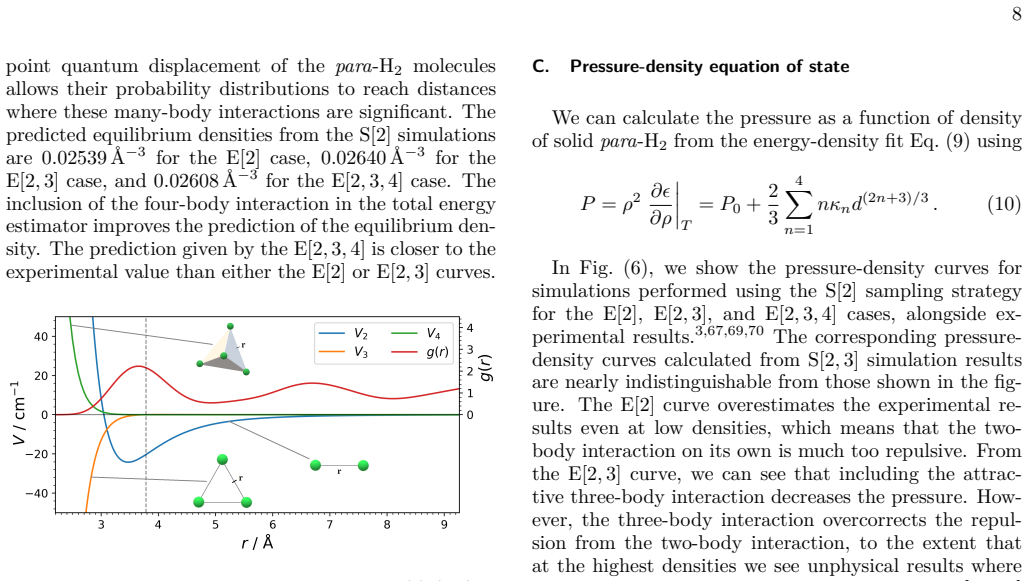
The paper establishes that the four-body non-additive interaction, not the three-body term, is the many-body contribution that brings the equation of state of solid parahydrogen into line with experiment at low and moderate densities. Simulations using only the two-body potential are too repulsive; adding the attractive three-body term overcorrects so badly that the pressure eventually decreases with density. When the four-body interaction energy is included in the estimator, the predicted equilibrium density is $0.02608$ Å$^{-3}$, essentially matching the experimental $0.0261$ Å$^{-3}$, and the simulated pressure-density curve agrees with experiment up to about $0.065$ Å$^{-3}$, beyond which the pressure is overestimated. The authors attribute the high-density deviation to five-body and higher-order many-body interactions, and report that using the four-body PES during sampling at $0.1$ Å$^{-3}$ artificially breaks the hcp lattice symmetry.
Load-bearing premise
The load-bearing premise is that solid parahydrogen can be treated as a collection of point particles interacting through isotropic potentials, with rotation and vibration folded out of the two-body term and omitted from the three- and four-body terms; the paper itself concludes that the remaining 7% kinetic-energy overestimate cannot come from five-body terms, pointing instead to this isotropic approximation.
Editorial extensions
If this is right
- The predicted equilibrium density of solid parahydrogen at 4.2 K becomes $0.02608$ Å$^{-3}$ with the four-body interaction in the estimator, essentially matching the experimental value.
- The simulated pressure-density curve agrees with experiment up to about $0.065$ Å$^{-3}$, replacing the qualitative mismatch that appears when only two-body or two-plus-three-body terms are used.
- Beyond $0.065$ Å$^{-3}$, the pressure is overestimated, which the paper takes as evidence that five-body and higher-order many-body interactions are required.
- Using the four-body potential during sampling at $0.1$ Å$^{-3}$ produces an artificial translational symmetry breaking in the hcp lattice, so high-order PESs should be used for estimation, not sampling, at densities where neglected terms are large.
- The average kinetic energy at equilibrium is overestimated by about 7%, a discrepancy the paper attributes to the isotropic-potential approximation rather than missing many-body terms.
Reading between the lines
- A natural testable extension is to add five- and six-body non-additive potentials for parahydrogen, as has been done for helium; by analogy, even-order terms are repulsive and odd-order terms attractive, so the high-density pressure overestimate should shrink as the series is extended.
- The 7% kinetic-energy overestimate at equilibrium, which the paper cannot attribute to higher many-body terms, suggests that anisotropic rotational degrees of freedom are already relevant at low density; a PIMC simulation with explicit rotational states would settle this.
- The artificial hcp symmetry breaking from the four-body PES in sampling implies that truncated many-body expansions can mimic structural phase transitions; similar artifacts should be checked in machine-learned many-body force fields applied at compressed densities.
- Since the S[2] and S[2,3] sampling strategies gave nearly identical total energies, the estimation-only inclusion of expensive many-body PESs seems broadly valid at low and moderate densities, which could let cheaper simulations of other quantum solids include high-order terms without paying the sampling cost.
Editorial analysis
A structured set of objections, weighed in public.
Referee Report
Summary. The paper reports path-integral Monte Carlo (PIMC) simulations of hcp solid parahydrogen at T = 4.2 K over densities from 0.024 to 0.1 Å^-3, using isotropic ab initio two-body (FSH), three-body, and four-body PESs. The authors distinguish sampling from estimation strategies, apply Trotter extrapolation near equilibrium and a small-τ method at higher densities, apply two- and three-body tail corrections, and fit the energy-density data to a modified Birch form. The headline results are that including the four-body energy in the estimator yields an equilibrium density of 0.02608 Å^-3 (experiment: 0.0261 Å^-3) and reproduces the experimental pressure-density curve up to roughly 0.065 Å^-3, overestimating the pressure beyond that density; at 0.1 Å^-3, using the four-body PES during sampling leads to an hcp symmetry-breaking artifact that the authors identify as likely unphysical. The authors conclude that five-body and higher-order interactions are needed at high densities, while the residual 7% kinetic-energy overestimate at equilibrium cannot be explained by missing higher-body terms.
Significance. If correct, the work provides strong evidence that four-body non-additive interactions are the dominant missing many-body contribution to the low-to-moderate-density equation of state of solid parahydrogen. The paper's strengths include the use of ab initio PESs trained on coupled-cluster energies, careful treatment of Trotter extrapolation (Eq. 7) and finite-size tail corrections, an earlier N = 180 vs N = 448 finite-size check, explicit supplementary energy-density data, and transparent discussion of the symmetry-breaking artifact. The near-quantitative agreement with the experimental equilibrium density and pressure below 0.065 Å^-3 is a meaningful step beyond pairwise models. The significance is tempered, however, by the fact that the pressure curve is obtained by differentiating a six-parameter fit without propagated uncertainties, and by the acknowledged isotropic-PES limitation that leaves a 7% kinetic-energy discrepancy at equilibrium.
major comments (3)
- [Sec. IV C, Eq. (10), Supplementary Tables I-II] The pressure-density curve that supports the central claim is obtained as the density derivative of the six-parameter modified Birch fit, Eq. (9), evaluated through Eq. (10). The supplementary material reports only point estimates of the fit parameters; no covariance matrix or uncertainty propagation is given, so the statistical significance of the agreement with experiment up to 0.065 Å^-3 is not established. The cancellation is severe: for the S[2] E[2,3,4] fit, P(rho0) = P0 + (2/3) sum(n kappa_n) is a near-zero difference of about +15.17 and -15.16 cm^-1 Å^-3. The same derivative formalism already produces a nonphysical decreasing pressure at high density for the E[2,3] curve in Fig. 6, showing that the fitted derivative is not robust in cancellation regions. The quoted chi-squared values are weighted residuals of the energy fit, not a test of the derivative, and no direct pressure (virial) estimator is provided. I recommend adding a direct pressure estimator, constraining the fit to yield physical pressure behavior, or reporting propagated derivative uncertainties; without one of these, the headline pressure agreement is not quantitatively established.
- [Sec. II A-B, Eq. (1); Sec. V] The Hamiltonian Eq. (1) treats molecules as point particles with isotropic PESs: the two-body FSH PES includes rotational and vibrational degrees of freedom only through an adiabatic hindered-rotor average, and the three- and four-body PESs are spherically averaged via six-point Lebedev quadrature. The authors themselves state in Sec. V that the 7% overestimate of the kinetic energy per molecule at equilibrium density cannot be explained by missing five-body and higher interactions, which points to the isotropic PES approximation as a likely source of systematic error. This acknowledged limitation means the reported EOS is specific to the isotropic model, and the conclusion that the four-body term is the dominant missing many-body interaction should be tempered or supported by a comparison with anisotropic PES simulations or with experimental kinetic-energy data.
- [Sec. II C, Table I, Sec. IV D] The E[2,3,4] pressure curve in Fig. 6 is computed from four-body energies estimated on configurations sampled with the S[2] (or S[2,3]) strategy; the four-body PES is included during sampling only at 0.1 Å^-3. The paper's own S[2,3,4] simulation at that density shows a roughly 1% change in total energy (Table I) and a symmetry-breaking artifact (Sec. IV D). No test is provided that the perturbative sampling assumption remains valid up to 0.065 Å^-3, the stated limit of pressure agreement. The overestimation above 0.065 Å^-3 could therefore be attributable, at least in part, to the breakdown of the S[2]-based sampling rather than exclusively to missing five-body and higher-order terms. A density scan with S[2,3,4] sampling in the 0.06-0.08 Å^-3 range, or a direct comparison of pressures from different sampling strategies, would strengthen the attribution of the high-density deviation to missing many-body interactions.
minor comments (4)
- [Eq. (5)] The partition function immediately after Eq. (5) is written as Z = Tr{A exp(-beta H)}, but it should be Tr{exp(-beta H)}; this is a formal error in a defining equation, although it does not affect the numerical results.
- [Throughout] There are several typographical errors: 'equlibrium' (Sec. IV B), 'straties' (Sec. II C), 'approxation' (Sec. II B), 'valnce' (Sec. II B), 'appoximation' (Sec. II B), and 'systemic' appears where 'systematic' is intended (Secs. III B and III C).
- [Eq. (10) and Fig. 6] Equation (10) yields pressure in units of cm^-1 Å^-3, while the text and Fig. 6 quote pressure in GPa; the conversion factor should be stated explicitly so readers can reproduce the plotted curves.
- [Supplementary Material, Sec. I] The goodness-of-fit measure chi^2 defined in the supplementary material is a weighted mean-square residual, not the standard chi-square per degree of freedom; labeling it as a weighted residual (or reporting a reduced chi-square) would avoid confusion.
Circularity Check
No significant circularity: the simulated EOS predictions are benchmarked against external experimental data, and the ab initio PES inputs were not fitted to those benchmarks.
full rationale
The central predictions—equilibrium density and the pressure-density curve—are tested against external experimental values (rho0 = 0.0261 Angstrom^-3; Refs. [3,67,69,70]), so the comparison is not self-referential. The input PESs are ab initio surfaces trained on CCSD(T) electronic-structure energies (Sec. II B), with no experimental EOS data in the training set. The paper states this explicitly: 'Unlike phenomenological PESs, ab initio PESs have no dependence on the results of any specific experiment, and can be constructed to contain the different many-body contributions explicitly' (Sec. I). The same-group PESs (Refs. [16,42,43]) are legitimate prior work whose reliability rests on electronic-structure calculations, not on the solid parahydrogen EOS being predicted. The modified Birch fit, Eq. (9), is used only as an interpolation of simulation energies; its normalization by the experimental rho0 is a rescaling and does not force the fitted minimum or the pressure derivative to match experiment. The paper's own limitation statement in Sec. V—that the kinetic-energy overestimate cannot be explained by missing higher-order many-body terms and may instead implicate the isotropic-PES approximation—shows that the agreement with experiment is treated as a genuine, falsifiable result rather than a consequence of the model assumptions. The skeptic's concern about the pressure being a small residual of large fit parameters is a legitimate uncertainty/robustness issue, but it is not circularity: no experimental pressure was used to determine the fit parameters. Accordingly, no circular step can be identified, and the derivation chain is self-contained with respect to the experimental benchmarks.
Assumptions & free parameters
free parameters (2)
- Birch EOS parameters ϵ0, P0, κ1..κ4 =
Reported in supplementary Tables I and II for S[2] and S[2,3] strategies
- Trotter extrapolation coefficients c2 and c4 =
Not reported in text
assumptions (6)
- domain assumption The three- and four-body PESs are isotropic, spherically averaged with six-point Lebedev quadrature over rotational degrees of freedom; the two-body FSH PES treats rotations adiabatically.
- domain assumption CCSD(T) energies with AVQZ/AVTZ/AVDZ basis sets and midbond functions are accurate enough for the PES training data.
- domain assumption Bosonic exchange is negligible in solid para-H2, so distinguishable-particle PIMC is valid.
- standard math The Trotter error scales as τ² + τ⁴ (Eq. 7), enabling extrapolation.
- domain assumption Tail corrections for the two-body and three-body energies are computed with g(r)=1 outside the cutoff or product of pair distributions, and the four-body tail is neglected.
- domain assumption The modified Birch EOS (Eq. 9) is a valid functional form for the energy-density curve over the simulated density range.
Cite this review
Pith. "Pith review of Path-integral Monte Carlo simulations of solid parahydrogen using two-body, three-body, and four-body ab initio interaction potential energy surfaces." pith.science (2026). https://pith.science/paper/YTIQPGSP
@misc{pith2026250605557,
  author       = {Pith},
  title        = {Pith review of: Path-integral Monte Carlo simulations of solid parahydrogen using two-body, three-body, and four-body ab initio interaction potential energy surfaces},
  year         = {2026},
  howpublished = {\url{https://pith.science/paper/YTIQPGSP}},
  note         = {Machine review of arXiv:2506.05557}
}
abstract
We present path integral Monte Carlo simulation results for the equation of state of solid parahydrogen between $ 0.024 \, {\r{A}}^{-3} $ and $ 0.1 \, {\r{A}}^{-3} $ at $ T = 4.2 \, $ K. The simulations are performed using non-additive isotropic ab initio two-body, three-body, and four-body potential energy surfaces (PES). We apply corrections to account for both the finite size simulation errors and the Trotter factorization errors. Simulations that use only the two-body PES during sampling yield an equation of state similar to that of simulations that use both the two-body and three-body PESs during sampling. With the four-body interaction energy, we predict an equilibrium density of $ 0.02608 \, {\r{A}}^{-3} $, very close to the experimental result of $ 0.0261 \, {\r{A}}^{-3} $. The inclusion of the four-body interaction energy also brings the simulation results in excellent agreement with the experimental pressure-density data until around $ 0.065 \, {\r{A}}^{-3} $, beyond which the simulation results overestimate the pressure. These PESs overestimate the average kinetic energy per molecule at the equilibrium density by about $ 7 \% $ compared to the experimental result. Our findings suggest that, at higher densities, we require five-body and higher-order many-body interactions to quantitatively improve the agreement between the pressure-density curve produced by simulations, and that of experiment. Using the four-body PES during sampling at excessively high densities, where such higher-order many-body interactions are likely to be significant, causes an artificial symmetry breaking in the hcp lattice structure of the solid.
Figures


Figures from the paper (5 more)


Reference graph
Works this paper leans on
-
[2]
L. H. Nosanow, ``Theory of quantum crystals,'' Phys.\ Rev. , vol. 146, p. 120, 1966
work page 1966
-
[1]
H. P. Gush, W. F. J. Hare, E. J. Allin, and H. L. Welsh, ``The infrared fundamental band of liquid and solid hydrogen,'' Can.\ J.\ Phys. , vol. 38, p. 176, 1960
work page 1960
-
[3]
I. F. Silvera, ``The solid molecular hydrogens in the condensed phase: F undamentals and static properties,'' Rev.\ Mod.\ Phys. , vol. 52, p. 393, 1980
work page 1980
-
[4]
A. Bhandari, A. P. Rollings, L. Ratto, and J. D. Weinstein, ``High-purity solid parahydrogen,'' Rev.\ Sci.\ Instr. , vol. 92, p. 073202, 2021
work page 2021
-
[5]
C. S. Barrett, L. Meyer, and J. Wasserman, ``Crystal structure of solid hydrogen and deuterium, and of neon--hydrogen and neon--deuterium mixtures,'' J.\ Chem.\ Phys. , vol. 45, p. 834, 1966
work page 1966
-
[6]
O. Schnepp, ``One-phonon excited states of solid H _2 and D _2 in the ordered phase,'' Phys.\ Rev.\ A , vol. 2, no. 6, p. 2574, 1970
work page 1970
-
[7]
M. Dusseault and M. Boninsegni, ``Atomic displacements in quantum crystals,'' Phys.\ Rev.\ B , vol. 95, p. 104518, 2017
work page 2017
-
[8]
T. R. Prisk, R. T. Azuah, D. L. Abernathy, G. E. Granroth, T. E. Sherline, P. E. Sokol, J. Hu, and M. Boninsegni, ``Zero-point motion of liquid and solid hydrogen,'' Phys.\ Rev.\ B , vol. 107, p. 094511, 2023
work page 2023
Show all 77 references
-
[9]
Fernandez-Alonso, C
F. Fernandez-Alonso, C. Cabrillo, R. Fern\' a ndez-Perea, F. J. Bermejo, M. A. Gonz\' a lez, C. Mondelli, and E. Farhi, ``Solid para-hydrogen as the paradigmatic quantum crystal: T hree observables probed by ultrahigh-resolution neutron spectroscopy,'' Phys.\ Rev.\ B , vol. 86...
2012
-
[10]
U. Buck, F. Huisken, A. Kohlhase, D. Otten, and J. Schaefer, ``State resolved rotational excitation in D _2 + H _2 collisions,'' J.\ Chem.\ Phys. , vol. 78, p. 4439, 1978
1978
-
[11]
I. F. Silvera and V. V. Goldman, ``The isotropic intermolecular potential for H _2 and D _2 in the solid and gas phases,'' J.\ Chem.\ Phys. , vol. 69, p. 4209, 1978
1978
-
[12]
M. J. Norman, R. O. Watts, and U. Buck, ``A spherical potential for hydrogen from solid state and scattering data,'' J.\ Chem.\ Phys. , vol. 81, p. 3500, 1984
1984
-
[13]
Diep and J
P. Diep and J. K. Johnson, ``An accurate H _2 -- H _2 interaction potential from first principles,'' J.\ Chem.\ Phys. , vol. 112, no. 10, p. 4465, 2000
2000
-
[14]
R. J. Hinde, ``A six-dimensional H _2 -- H _2 potential energy surface for bound state spectroscopy,'' J.\ Chem.\ Phys. , vol. 128, p. 154308, 2008
2008
-
[15]
Patkowski, W
K. Patkowski, W. Cencek, P. Jankowski, K. Szalewicz, J. B. Mehl, G. Garberoglio, and A. H. Harvey, ``Potential energy surface for interactions between two hydrogen molecules,'' J.\ Chem.\ Phys. , vol. 129, p. 094304, 2008
2008
-
[16]
Faruk, M
N. Faruk, M. Schmidt, H. Li, R. J. Le Roy, and P.-N. Roy, ``First-principles prediction of the R aman shifts in parahydrogen clusters,'' J.\ Chem.\ Phys. , vol. 141, p. 014310, 2014
2014
-
[17]
Omiyinka and M
T. Omiyinka and M. Boninsegni, ``Pair potentials and equation of state of solid para-hydrogen to megabar pressure,'' Phys.\ Rev.\ B , vol. 88, p. 024112, 2013
2013
-
[18]
Operetto and F
F. Operetto and F. Pederiva, ``Diffusion M onte C arlo study of the equation of state of solid para- H _2 ,'' Phys.\ Rev.\ B , vol. 73, p. 184124, 2006
2006
-
[19]
M. J. Elrod and R. J. Saykally, ``Many-body effects in intermolecular forces,'' Chem.\ Rev. , vol. 94, p. 1975, 1994
1975
-
[20]
A. O. de-la Roza, L. M. LeBlanc, and E. R. Johnson, ``What is ``many-body'' dispersion and should I worry about it?,'' Phys.\ Chem.\ Chem.\ Phys. , vol. 22, pp. 8266--8276, 2020
2020
-
[21]
Wind and I
P. Wind and I. R eggen, ``Ab initio calculation of three-body interaction in the ( H _2 ) _3 trimer,'' Chem.\ Phys. , vol. 211, pp. 179--189, 1996
1996
-
[22]
R. J. Hinde, ``Three-body interactions in solid parahydrogen,'' Chem.\ Phys.\ Lett. , vol. 460, pp. 141--145, 2008
2008
-
[23]
Manzhos, K
S. Manzhos, K. Nakai, and K. Yamashita, ``Three-body interactions in clusters C O --(p H _2 ) _n ,'' Chem.\ Phys.\ Lett. , vol. 493, pp. 229--233, 2010
2010
-
[24]
Ibrahim and P.-N
A. Ibrahim and P.-N. Roy, ``Equation of state of solid parahydrogen using ab initio two-body and three-body interaction potentials,'' J.\ Chem.\ Phys. , vol. 157, p. 174503, 2022
2022
-
[25]
Cencek, G
W. Cencek, G. Garberoglio, A. H. Harvey, M. O. McLinden, and K.Szalewicz, ``Three-body nonadditive potential for argon with estimated uncertainties and third virial coefficient,'' J.\ Phys.\ Chem.\ A , vol. 117, pp. 7542--7552, 2013
2013
-
[26]
Ro\' s ciszewski, B
K. Ro\' s ciszewski, B. Paulus, P. Fulde, and H. Stoll, ``Ab initio coupled-cluster calculations for the fcc and hcp structures of rare-gas solids,'' Phys.\ Rev.\ B , vol. 62, no. 9, p. 5482, 2000
2000
-
[27]
Tian, F.-S
C.-L. Tian, F.-S. Liu, F.-Q. Jing, and L.-C. Cai, ``Five- and six-body effects on equation of state of solid ^4 H e,'' J.\ Phys.\ Condens.\ Matter , vol. 18, pp. 8103--8112, 2006
2006
-
[28]
A. L. Barnes and R. J. Hinde, ``Effect of three-body interactions on the zero-temperature equation of state of H C P solid ^4 H e,'' J.\ Chem.\ Phys. , vol. 146, p. 094510, 2017
2017
-
[29]
Garberoglio, A
G. Garberoglio, A. H. Harvey, J. Lang, M. Przybytek, M. Lesiuk, and B. Jeziorski, ``Path-integral calculation of the third dielectric virial coefficient of helium based on ab initio three-body polarizability and dipole surfaces,'' J.\ Chem.\ Phys. , vol. 161, p. 144111, 2024
2024
-
[30]
Binosi, G
D. Binosi, G. Garberoglio, and A. H. Harvey, ``Third density and acoustic virial coefficients of helium isotopologues from ab initio calculations,'' J.\ Chem.\ Phys. , vol. 160, p. 244305, 2024
2024
-
[31]
Marienhagen and K
P. Marienhagen and K. Meier, ``Calculation of thermodynamic properties of helium using path integral M onte C arlo simulations in the N p T ensemble and ab initio potentials,'' J.\ Chem.\ Phys. , vol. 161, p. 224110, 2024
2024
-
[32]
Schwerdtfeger and A
P. Schwerdtfeger and A. Hermann, ``Equation of state for solid neon from quantum theory,'' Phys.\ Rev.\ B , vol. 80, p. 064106, 2009
2009
-
[33]
Garberoglio, ``On the contribution of non-additive three-body interactions to the third virial coefficient of para-hydrogen,'' Chem.\ Phys.\ Lett
G. Garberoglio, ``On the contribution of non-additive three-body interactions to the third virial coefficient of para-hydrogen,'' Chem.\ Phys.\ Lett. , vol. 557, p. 26, 2013
2013
-
[34]
T. W. Maltby, M. Hammer, and . Wilhelmsen, ``Equation of state for solid argon valid for temperatures up to 300 K and pressures up to 16 G P a,'' J.\ Phys.\ Chem.\ Ref.\ Data , vol. 53, p. 043102, 2024
2024
-
[35]
C.-L. Tian, N. Wu, F. Liu, S. K. Saxena, and X. Zheng, ``Four-body interaction energy for compressed solid krypton from quantum theory,'' J.\ Chem.\ Phys. , vol. 137, p. 044108, 2012
2012
-
[36]
R. J. Wheatley, G. Garberoglio, and A. H. Harvey, ``Four-body nonadditive potential energy surface and the fourth virial coefficient of helium,'' J.\ Chem.\ Eng.\ Data. , vol. 68, pp. 3257--3264, 2023
2023
-
[37]
Morresi and G
T. Morresi and G. Garberoglio, ``Revisiting the properties of superfluid and normal liquid ^4 H e using ab initio potentials,'' J.\ Low Temp.\ Phys. , 2025
2025
-
[38]
Paszke, S
A. Paszke, S. Gross, F. Massa, A. Lerer, J. Bradbury, G. Chanan, T. Killeen, Z. Lin, N. Gimelshein, L. Antiga, A. Desmaison, A. Kopf, E. Yang, Z. DeVito, M. Raison, A. Tejani, S. Chilamkurthy, B. Steiner, L. Fang, J. Bai, and S. Chintala, ``Pytorch: an imperative style, high-p...
2019
-
[39]
Abadi, A
M. Abadi, A. Agarwal, P. Barham, E. Brevdo, Z. Chen, C. Citro, G. S. Corrado, A. Davis, J. Dean, M. Devin, S. Ghemawat, I. Goodfellow, A. Harp, G. Irving, M. Isard, Y. Jia, R. Jozefowicz, L. Kaiser, M. Kudlur, J. Levenberg, D. Man \'e , R. Monga, S. Moore, D. Murray, C. Olah, ...
2015
-
[40]
R. S. Graham and R. J. Wheatley, ``Machine learning for non-additive intermolecular potentials: Q uantum chemistry to first-principles predictions,'' Chem.\ Commun. , vol. 58, p. 6898, 2022
2022
-
[41]
Broad, S
J. Broad, S. Preston, R. J. Wheatley, and R. S. Graham, ``Gaussian process models of potential energy surfaces with boundary optimization,'' J.\ Chem.\ Phys. , vol. 155, p. 144106, 2021
2021
-
[42]
Ibrahim and P.-N
A. Ibrahim and P.-N. Roy, ``Three-body potential energy surface for para-hydrogen,'' J.\ Chem.\ Phys. , vol. 156, p. 044301, 2022
2022
-
[43]
Ibrahim and P.-N
A. Ibrahim and P.-N. Roy, ``A neural network-based four-body potential energy surface for parahydrogen,'' J.\ Chem.\ Phys. , vol. 160, p. 244308, 2024
2024
-
[44]
Gregoryanz, C
E. Gregoryanz, C. Ji, P. Dalladay-Simpson, B. Li, R. T. Howie, and H.-K. Mao, ``Everything you always wanted to know about metallic hydrogen but were afraid to ask,'' Matter\ Radiat.\ Extremes , vol. 5, p. 038101, 2020
2020
-
[45]
Marx and M
D. Marx and M. H. M \"u ser, ``Path integral simulations of rotors: T heory and applications,'' J.\ Phys.\ Condens.\ Matter , vol. 11, p. R117, 1999
1999
-
[46]
Goncharenko and P
I. Goncharenko and P. Loubeyre, ``Neutron and X -ray diffraction study of the broken symmetry phase transition in solid deuterium,'' Nature , vol. 435, pp. 1206--1209, 2005
2005
-
[47]
D. M. Ceperley and B. J. Alder, ``Ground state of solid hydrogen at high pressures,'' Phys.\ Rev.\ B , vol. 36, pp. 2092--2106, 1987
1987
-
[48]
Schmidt, J
M. Schmidt, J. M. Fern\' a ndez, N. Faruk, M. Nooijen, R. J. Le Roy , J. H. Morilla, G. Tejeda, S. Montero, and P.-N. Roy, ``Raman vibrational shifts of small clusters of hydrogen isotopologues,'' J.\ Phys.\ Chem.\ A , vol. 119, p. 12551, 2015
2015
-
[49]
Li, P.-N
H. Li, P.-N. Roy, and R. J. Le Roy , ``An ``adiabatic-hindered-rotor'' treatment allows para- H _2 to be treated as if it were spherical,'' J.\ Chem.\ Phys. , vol. 133, p. 104305, 2010
2010
-
[50]
Li, P.-N
H. Li, P.-N. Roy, and R. J. Le Roy, ``Analytic M orse/long-range potential energy surfaces and predicted infrared spectra for C O _2 -- H _2 ,'' J. Chem. Phys. , vol. 132, no. 21, p. 214309, 2010
2010
-
[51]
L. Wang, D. Xie, R. J. Le Roy, and P.-N. Roy, ``A new four-dimensional ab initio potential energy surface for N _2 O -- H e and vibrational band origin shifts for the N _2 O -- H e _ N clusters with N = 1-40 ,'' J.\ Chem.\ Phys. , vol. 137, p. 104311, 2012
2012
-
[52]
L. Wang, D. Xie, R. J. Le Roy , and P.-N. Roy, ``A new six-dimensional potential energy surface for H _2 -- N _2 O and its adiabatic-hindered-rotor treatment,'' J.\ Chem.\ Phys. , vol. 139, p. 034312, 2013
2013
-
[53]
Li, X.-L
H. Li, X.-L. Zhang, R. J. Le Roy, and P.-N. Roy, ``Analytic M orse/long-range potential energy surfaces and predicted infrared spectra for C O -- H _2 dimer and frequency shifts of C O in (para- H _2 ) _ N N =1-20 clusters,'' J.\ Chem.\ Phys. , vol. 139, p. 164315, 2013
2013
-
[54]
A. Marr, T. Halverson, A. Tripp, and P.-N. Roy, ``Vibrational R aman shifts of spin isomer combinations of hydrogen dimers and isotopologues,'' J.\ Phys.\ Chem.\ A , vol. 124, no. 34, pp. 6877--6888, 2020
2020
-
[55]
Schmidt and P.-N
M. Schmidt and P.-N. Roy, ``On the accuracy and efficiency of different methods to calculate raman vibrational shifts of parahydrogen clusters,'' J.\ Chem.\ Phys. , vol. 156, p. 084102, 2022
2022
-
[56]
K \'a llay and P
M R C C , a quantum chemical program suite written by M. K \'a llay and P. R. Nagy and D. Mester and L. Gyevi-Nagy and J. Cs \'o ka and P. B. Szab \'o and Z. Rolik and G. Samu and J. Csontos and B. H \'e gely and \'A . Ganyecz and I. Ladj \'a nszki and L. Szegedy and B. Lad \'...
-
[57]
K \'a llay, P
M. K \'a llay, P. R. Nagy, D. Mester, Z. Rolik, G. Samu, J. Csontos, J. Cs \'o ka, P. B. Szab \'o , L. Gyevi-Nagy, B. H \'e gely, I. Ladj \'a nszki, L. Szegedy, B. Lad \'o czki, K. Petrov, M. Farkas, P. D. Mezei, and \'A . Ganyecz, ``The M R C C program system: Accurate quantu...
2020
-
[58]
u tt, A. Tkatchenko, and K.-R. M \
O. T. Unke, S. Chmiela, H. E. Sauceda, M. Gastegger, I. Poltavsky, K. T. Sch \"u tt, A. Tkatchenko, and K.-R. M \"u ller, ``Machine learning force fields,'' Chem.\ Rev. , vol. 121, pp. 10142--10186, 2021
2021
-
[59]
D. M. Ceperley, ``Path integrals in the theory of condensed helium,'' Rev.\ Mod.\ Phys. , vol. 67, p. 279, 1995
1995
-
[60]
Boninsegni, N
M. Boninsegni, N. V. Prokof'ev, and B. V. Svistunov, ``Worm algorithms for continuous-space path integral M onte C arlo simulations,'' Phys.\ Rev.\ Lett. , vol. 96, p. 070601, 2006
2006
-
[61]
Boninsegni, N
M. Boninsegni, N. V. Prokof'ev, and B. V. Svistunov, ``Worm algorithm and diagrammatic M onte C arlo: A new approach to continuous-space path integral M onte C arlo simulations,'' Phys.\ Rev.\ E , vol. 74, p. 036701, 2006
2006
-
[62]
Boninsegni, ``Search for superfluidity in supercooled liquid parahydrogen,'' Phys.\ Rev.\ B , vol
M. Boninsegni, ``Search for superfluidity in supercooled liquid parahydrogen,'' Phys.\ Rev.\ B , vol. 97, p. 054517, 2018
2018
-
[63]
Ibrahim, L
A. Ibrahim, L. Wang, T. Halverson, R. J. Le Roy , and P.-N. Roy, ``Equation of state and first principles prediction of the vibrational matrix shift of solid parahydrogen,'' J.\ Chem.\ Phys. , vol. 151, p. 244501, 2019
2019
-
[64]
Yan and D
Y. Yan and D. Blume, ``Path integral M onte C arlo ground state approach: F ormalism, implementation, and applications,'' J.\ Phys.\ B , vol. 50, p. 223001, 2017
2017
-
[65]
Attard, ``Pair-hypernetted-chain closure for three-body potentials: R esults for argon with the A xilrod- T eller triple-dipole potential,'' Phys.\ Rev.\ A , vol
P. Attard, ``Pair-hypernetted-chain closure for three-body potentials: R esults for argon with the A xilrod- T eller triple-dipole potential,'' Phys.\ Rev.\ A , vol. 45, no. 6, pp. 3659--3669, 1991
1991
-
[66]
M. P. Allen and D. J. Tildesley, Computer simulation of liquids . Oxford University Press, 2 ed., 2017
2017
-
[67]
Driessen, J
A. Driessen, J. A. de Waal, and I. F. Silvera, ``Experimental determination of the equation of state of solid hydrogen and deuterium at high pressures,'' J.\ Low Temp.\ Phys. , vol. 34, p. 255, 1979
1979
-
[68]
R. E. Cohen, O. G \"u lseren, and R. J. Hemley, ``Accuracy of equation-of-state formulations,'' Am.\ Mineral. , vol. 85, pp. 338--344, 2000
2000
-
[69]
S. N. Ishmaev, I. P. Sadikov, A. A. Chernyshov, B. A. Vindryaevski i , V. A. Sukhoparov, A. S. Telepnev, and G. V. Kobelev, ``Neutron structural investigations of solid parahydrogen at pressures up to 24 kbar,'' Zh.\ Eksp.\ Teor.\ Fiz. , vol. 84, pp. 394--403, 1983
1983
-
[70]
Mao and R
H. Mao and R. J. Hemley, ``Ultrahigh-pressure transitions in solid hydrogen,'' Rev.\ Mod.\ Phys. , vol. 66, pp. 671--692, 1994
1994
-
[71]
R. A. Aziz, F. R. W. McCourt, and C. C. K. Wong, ``A new determination of the ground state interatomic potential for H e _2 ,'' Mol.\ Phys. , vol. 61, pp. 1487--1511, 1987
1987
-
[72]
Cencek, K
W. Cencek, K. Patkowski, and K. Szalewicz, ``Full-configuration interaction calculation of three-body nonadditive contribution to helium interaction potential,'' J.\ Chem.\ Phys. , vol. 131, p. 064105, 2009
2009
-
[73]
R. A. Aziz, V. P. S. Nain, J. S. Carley, W. L. Taylor, and G. T. McConville, ``An accurate intermolecular potential for helium,'' J.\ Chem.\ Phys. , vol. 70, pp. 4330--4342, 1979
1979
-
[74]
L. W. Bruch and I. J. McGee, ``Calculations and estimates of the ground state energy of helium trimers,'' J.\ Chem.\ Phys. , vol. 59, pp. 409--413, 1973
1973
-
[75]
A. R. Janzen and R. A. Aziz, ``An accurate potential energy curve for helium based on ab initio calculations,'' J.\ Chem.\ Phys. , vol. 107, pp. 914--919, 1997
1997
-
[76]
M. J. Cohen and J. N. Murrell, ``An analytic function for the three-body potential of H e _3 ,'' Chem.\ Phys.\ Lett. , vol. 260, pp. 371--376, 1996
1996
-
[77]
Chang and M
S.-Y. Chang and M. Boninsegni, ``Ab initio potentials and the equation of state of condensed helium at high pressure,'' J.\ Chem.\ Phys. , vol. 115, pp. 2629--2633, 2001
2001
Reviewed August 7, 2026 · model on record in the stance chip above.
Discussion (0). Sign in to comment.