REVIEW 3 major objections 5 minor 48 references
Cavity-mediated exciton hopping in a dielectrically engineered polariton system
T0 review · 3 major / 5 minor · reviewed 2026-08-07 · deepseek-v4-flash
Pith's one-line read Patterned dielectric layers define mesoscopic exciton domains in a molybdenum diselenide monolayer, and the dispersive regime of a shared microcavity makes those domains interact through a beam-splitter hopping $J_{ij}$.
desk verdict A credible fabrication advance and a convincing local-potential result, but the intersite hopping claim is only robust for one of the two demonstrated pairs; the P2 coupling is essentially consistent with zero. read the letter →
The pith
A machine-rendered reading of the paper's core claim, the machinery that carries it, and where it could break.
The reading
What carries the argument
The load-bearing object is the effective Hamiltonian obtained by a Schrieffer-Wolff transformation of many exciton modes coupled to a single cavity mode, Eq. 1 of the paper: $$\tilde H\simeq\left(E_C-\sum_i \frac{$g_i^{2}$}{\Delta_i}\right)a^\dagger a + \sum_i\left(E_i+\frac{$g_i^{2}$}{\Delta_i}\right)b_i^\dagger b_i + \sum_{i\neq j}\frac{g_i g_j}{2}\left(\frac{1}{\Delta_i}+\frac{1}{\Delta_j}\right)b_i^\dagger b_j.$$ The second-order term turns virtual photon exchange into a beam-splitter hopping $J_{ij}$ between exciton sites. The analysis is carried by a dissipative input-output transmission model, Eq. 2 of the Supplementary Information, which fits the measured cavity spectra to extract each domain's energy $E_i$ and coupling strength $g_i$, from which $J_{ij}$ is computed.
What would settle it
Time-resolve the dynamics: prepare an exciton in one disk and measure whether it coherently oscillates into the other disk at frequency $2J_{LR}/\hbar$. Alternatively, tune the cavity energy across a wide range and check whether the inferred $J_{LR}$ follows $(g_L g_R/2)(1/\Delta_L+1/\Delta_R)$ with independently measured $g$ and $\Delta$; a deviation would show the dispersive-hopping interpretation is incomplete.
Extended reading notes
Core claim
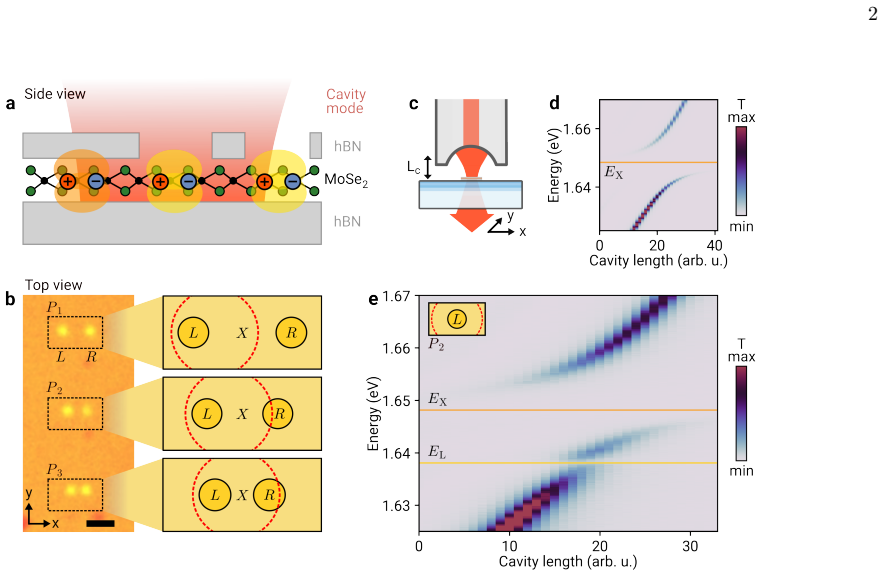
The central claim is that in the dispersive regime of cavity coupling, the photon mode can be nearly eliminated and re-emerge as an effective interaction between exciton resonances. Expanding to second order in $g_i/\Delta_i$ yields an effective Hamiltonian whose off-diagonal term gives a beam-splitter hopping $J_{ij}$ between any two exciton domains $i$ and $j$. The paper reports direct spectral evidence: with the cavity mode at the edge of a disk, the dressed exciton states show an avoided crossing with $2J_{LX}=1.5$ meV, and when the mode samples both disks of a pair, the hybrid eigenstates imply intersite couplings $2J_{LR}$ of about 0.1 meV for pair P2 and 1 meV for pair P3. The coupling falls off as the cavity mode is moved away from the sites, as the formula predicts. The exciton landscape itself is made by lithographically defined holes in the top hBN layer, which change the dielectric environment and shift the local exciton energy by up to 10 meV, with light-matter coupling strengths set by domain size.
Load-bearing premise
The measured spectra are assumed to be described by a few discrete, homogeneous bosonic modes—one for the monolayer reservoir and one for each etched disk—coupled to a single cavity mode, with all spatial and spectral disorder folded into linewidths; if a continuum of exciton modes or higher-order transverse cavity modes participates differently at different detunings, the fitted $J$ would not be a genuine intersite hopping matrix element.
Editorial extensions
If this is right
- Dielectric patterning of hBN creates mesoscopic exciton domains with redshifts up to 10 meV and light-matter couplings around 2.5 meV, producing lower-polariton energy landscapes with local potential depths of about 2 meV.
- In the dispersive regime, the cavity mode generates an effective beam-splitter hopping $J_{ij}=(g_i g_j/2)(1/\Delta_i+1/\Delta_j)$ between spatially separated exciton domains, with observed splittings $2J_{LX}=1.5$ meV and $2J_{LR}\sim0.1$ meV (P2) and $\sim1$ meV (P3).
- The hopping is tunable in situ: changing the cavity energy changes the detunings $\Delta_i$, and laterally moving the cavity mode changes the effective $J$, with the coupling vanishing as the mode moves away from the sites.
- This establishes a bosonic analogue of cavity-mediated qubit coupling, opening a route to polaritonic lattices and quantum simulators based on dielectrically engineered two-dimensional semiconductors.
Reading between the lines
- A direct test the paper does not report is time-resolved dynamics: an exciton initially placed in one disk should coherently oscillate into the other disk at frequency $2J_{LR}/\hbar$, whereas the present evidence is spectral only.
- Because $J_{ij}$ depends on detunings and domain sizes, one could engineer programmable lattices by tuning the cavity energy or placing disks at chosen positions, making the hopping strength a design parameter rather than a fixed material property.
- The paper's minimal model treats the surrounding monolayer exciton $X$ as a third discrete mode; a continuum treatment of that spatially extended reservoir could modify the inferred $J$ values, since part of the effective L-R coupling may proceed through virtual exchange with $X$ rather than purely through the photon mode.
Editorial analysis
A structured set of objections, weighed in public.
Referee Report
Summary. The paper reports a MoSe2 monolayer encapsulated in patterned hBN, with through-holes creating disk-shaped exciton domains of reduced dielectric screening, coupled to a tunable fiber microcavity. Transmission spectroscopy reveals local lower-polariton energy shifts that depend on cavity detuning, and the authors interpret avoided-crossing-like features as evidence for dispersive cavity-mediated hopping between the disk domains and the surrounding monolayer reservoir. The effective hopping is described by a Schrieffer-Wolff-derived expression, J_ij = (g_i g_j / 2)(1/Delta_i + 1/Delta_j), and the paper reports maximal values 2J_LX = 1.5 meV for a domain-to-reservoir pair and 2J_LR ~ 0.1 meV and ~1 meV for the P2 and P3 site pairs. The central claim is that the cavity mediates long-range coherent exciton hopping in the dispersive regime.
Significance. If fully substantiated, the work would demonstrate a scalable dielectric-engineering route to mesoscopic polariton domains in TMD monolayers and a cavity-mediated coupling mechanism relevant for polaritonic lattices and quantum simulation proposals. Strengths of the manuscript include the parameter-free Schrieffer-Wolff derivation of the effective hopping within the few-mode model, detailed dissipative-model fits to transmission spectra, and quantitative comparisons of local energy shifts with the model. The local energy-shift measurements and the scaling of the disk coupling strength with cavity-mode overlap provide independent supporting evidence for the domain picture. However, the evidence for intersite hopping is weakened by the statistical significance of the P2 result and by the model dependence of the extracted couplings, as detailed in the major comments.
major comments (3)
- [Main text Fig. 4c; Supplementary Note V] The claimed intersite hopping for the P2 pair is not statistically significant under the reported fit parameters. Supplementary Note V lists g_L = 0.4 +/- 0.4 meV and g_R = 1.2 +/- 0.4 meV, with detunings Delta_L ~ -21.5 meV and Delta_R ~ -23.2 meV at the Fig. 4b cavity energy. Substituting these into J_LR = (g_L g_R / 2)(1/Delta_L + 1/Delta_R) gives a central 2|J_LR| of only about 0.04 meV, and even the one-sigma upper edge is only about 0.1 meV. The text states a maximal 2J_LR ~ 0.1 meV for P2, which is therefore indistinguishable from zero at the quoted precision. A full covariance propagation should be reported, and at minimum the P2 result should be presented as an upper limit rather than as a demonstrated hopping strength.
- [Main text Eq. (1); Supplementary Notes II and III] The central hopping claim rests on a few-mode dissipative model in which the extended monolayer reservoir is collapsed into a single X mode and only selected cavity positions with negligible higher-order transverse modes are analyzed. The eigenstates overlaid on the data in Fig. 3b are computed from the same model parameters with which the transmission spectra were fitted, making the comparison a consistency check rather than an independent test. Because the continuum of exciton states in the surrounding monolayer is not treated explicitly, the extracted J_LR values may absorb systematic effects that are not captured by the discrete three-mode ansatz. The authors should provide a quantitative estimate of this model uncertainty, for example by testing sensitivity to the inclusion of additional reservoir modes or by comparing fits with different mode decompositions.
- [Supplementary Note V] The stated validity condition for the Schrieffer-Wolff expansion, |g_i^2/Delta_i|^2 << 1, is dimensionally inconsistent and should read (g_i/Delta_i)^2 << 1. Even with this correction, the condition is not deeply satisfied for the X reservoir: with g_X ~ 9.5 meV and Delta_X ~ 15 meV, (g_X/Delta_X)^2 ~ 0.4. The numerical validation described in the Note only requires deviations 'well within typical linewidths,' which is not stringent enough for the claimed effect sizes: for P2 the effect to be measured is 0.04-0.1 meV, more than an order of magnitude below the ~2.5 meV linewidth. The effective Hamiltonian may thus be adequate for qualitative branch positions but not for quantitative extraction of sub-linewidth hopping strengths.
minor comments (5)
- [Main text, Fig. 4b/c captions] The main text states that the Fig. 4b spectrum was taken at a cavity energy of 1.659 eV, but Fig. 4c is computed at 1.670 eV; the relationship between these two energies and the reported maximal 2J_LR values should be clarified.
- [Supplementary Note II] The phrase 'Suplementary Note II' appears in the main text (Fig. 2a caption); the correct spelling is 'Supplementary.'
- [Supplementary Note III] In the text following Supplementary Fig. 4, 'exction domains' is a typo for 'exciton domains.'
- [Methods] In the cryogenic cavity system description, 'croystat' should be 'cryostat,' and the abbreviation 'ICP-REI' likely should be 'ICP-RIE.'
- [Fig. 3b] The caption states that the dashed lines are eigenstates of Eq. (1), but these are model eigenstates computed with parameters fitted from the same data; the caption should state this explicitly to avoid implying an independent measurement.
Circularity Check
Minor consistency-based circularity in the experimental J extraction; the underlying Schrieffer-Wolff derivation is independent.
-
fitted input called prediction
[Main text Fig. 3b and Fig. 4c; Supplementary Note V (parameters from fits of Eq. 2)]
"The theoretical eigenstates of the effective Hamiltonian shown in Fig. 3b of the main text were computed for two cavity-coupled exciton resonances X and L using the following set of parameters: EX = 1.6436 eV, gX = 9.5 meV, EL = 1.6399 eV, gL = 1.6 meV. These values are in excellent agreement with the results obtained from fits of Eq. 2 to the transmission spectra for different cavity lengths measured at the same cavity mode position."
The dashed eigenstates used to exhibit the effective coupling are not an independent prediction: the E and g inputs were obtained by fitting Eq. 2 to the very transmission spectra against which the eigenstates are displayed. Similarly, Supplementary Note V states that the JLR values in Fig. 4c 'were computed from the measured values of EL/R and gL/R' fitted from the same spectra, and the main text presents the decrease of this computed quantity as 'expected from Eq. 1 and evidenced in Fig. 4c.' The agreement is therefore a model-consistency check: J is constructed from the fitted parameters through Eq. 1 rather than measured independently. This is a mild circularity for the experimental demonstration; the Schrieffer-Wolff expansion itself is parameter-free and not circular.
full rationale
The central theoretical result, Eq. (1) of the main text, is a standard second-order Schrieffer-Wolff expansion of the coupled-oscillator Hamiltonian: no parameter is fitted to the target J, and the form J_ij = (g_i g_j/2)(1/Delta_i + 1/Delta_j) follows algebraically from the stated model. The cited dispersive-coupling framework (Blais et al., Majer et al.) is external and standard, and the self-citations in the paper are used for apparatus, platform, or context rather than to justify the hopping formula. The only mild circularity is that the theoretical eigenstates and J values used to visualize the effect are computed from E_i and g_i fitted to the same transmission spectra, so the agreement is a consistency check rather than an independent test. The fitted parameters are externally benchmarked as physically plausible (g_X = 9.6 meV, g_L = 2.65 meV versus a sqrt-area estimate), and the derivation itself does not reduce to its inputs. This is a minor, non-load-bearing circularity for the experimental demonstration, not a tautology in the claimed theory.
Assumptions & free parameters
free parameters (5)
- Light-matter coupling strengths g_X, g_L, g_R =
gX = 9.6 meV; gL = 2.65 +/- 0.04 meV; gR ~ 1.2 +/- 0.4 meV (values vary by pair and position)
- Exciton resonance energies E_X, E_L, E_R =
EX ~ 1.643 to 1.644 eV, EL ~ 1.637 to 1.640 eV, ER ~ 1.636 to 1.640 eV depending on pair and position
- Cavity linewidth kappa =
1.52 meV with Lorentzian 1.15 meV and Gaussian 0.70 meV contributions
- Exciton linewidths Gamma_i =
Not listed individually; typical polariton branch linewidths ~ 2.5 meV
- Gaussian well depths a_L, a_R for lower-polariton energy profiles =
About 2 meV for P1; several meV for P2 depending on cavity energy
assumptions (5)
- domain assumption The optical response is described by a Tavis-Cummings Hamiltonian for one cavity mode and discrete bosonic exciton modes, with transmission given by the input-output formula Eq. 2.
- standard math The effective hopping Hamiltonian follows from a second-order Schrieffer-Wolff expansion in g_i / Delta_i, requiring |(g_i / Delta_i)^2| << 1.
- domain assumption The energy shift of the disk-localized excitons is dominated by the change in dielectric screening, while strain-induced shifts are irrelevant to the claims.
- ad hoc to paper Higher-order transverse cavity modes have negligible influence at the selected measurement positions.
- domain assumption Each spatially extended exciton population (X, L, R) can be represented by one homogeneous resonance energy and one coupling strength at each cavity position.
Cite this review
Pith. "Pith review of Cavity-mediated exciton hopping in a dielectrically engineered polariton system." pith.science (2026). https://pith.science/paper/PIRFNXXA
@misc{pith2026250605561,
  author       = {Pith},
  title        = {Pith review of: Cavity-mediated exciton hopping in a dielectrically engineered polariton system},
  year         = {2026},
  howpublished = {\url{https://pith.science/paper/PIRFNXXA}},
  note         = {Machine review of arXiv:2506.05561}
}
read the original abstract
Exciton-polaritons - coherently hybridized states of excitons and photons - are instrumental for solid-state nonlinear optics and quantum simulations. To enable engineered polariton energy landscapes and interactions, local control over the particle-like states can be achieved by tuning the properties of the exciton constituent. Monolayer transition metal dichalcogenides stand out in this respect, as they readily allow for a deterministic, flexible and scalable control of excitons, and thus of hybrid exciton-polaritons, via environmental dielectric engineering. Here, we demonstrate the realization of mesoscopic exciton-polariton domains in a structured dielectric exciton environment, and establish an effective long-range exciton hopping in the dispersive regime of cavity-coupling. Our results represent a crucial step toward interacting polaritonic networks and quantum simulations in exciton-polariton lattices based on dielectrically tailored two-dimensional semiconductors.
Figures


Figures from the paper (1 more)

Reference graph
Works this paper leans on
-
[1]
Deng, H., Haug, H. & Yamamoto, Y. Exciton-polariton Bose-Einstein condensation. Reviews of Modern Physics 82, 1489–1537 (2010)
work page 2010
-
[2]
Carusotto, I. & Ciuti, C. Quantum fluids of light. Re- views of Modern Physics 85, 299–366 (2013)
work page 2013
-
[3]
N., Asenjo-Garcia, A., Schuck, P
Basov, D. N., Asenjo-Garcia, A., Schuck, P. J., Zhu, X. & Rubio, A. Polariton panorama. Nanophotonics 10, 549–577 (2021). 7
work page 2021
-
[4]
Schneider, C., Glazov, M. M., Korn, T., Höfling, S. & Urbaszek, B. Two-dimensional semiconductors in the regime of strong light-matter coupling. Nature Commu- nications 9, 2695 (2018)
work page 2018
-
[5]
Anton-Solanas, C. et al. Bosonic condensation of exciton- polaritons in an atomically thin crystal. Nature Materials 20, 1233–1239 (2021)
work page 2021
-
[6]
Qiu, L., Chakraborty, C., Dhara, S. & Vamivakas, A. N. Room-temperature valley coherence in a polaritonic sys- tem. Nature Communications 10, 1513 (2019)
work page 2019
-
[7]
Lundt, N. et al. Optical valley Hall effect for highly valley-coherent exciton-polaritons in an atomically thin semiconductor. Nature Nanotechnology 14, 770–775 (2019)
work page 2019
-
[8]
Tan, L. B. et al. Interacting Polaron-Polaritons. Physical Review X 10, 021011 (2020)
work page 2020
Show all 48 references
-
[9]
Zhang, L. et al. Van der Waals heterostructure polari- tons with moiré-induced nonlinearity. Nature 591, 61–65 (2021)
2021
-
[10]
Scherzer, J. et al. Correlated magnetism of moiré exciton- polaritons on a triangular electron-spin lattice. arXiv.org, 2405.12698 (2024)
2024 arXiv
-
[11]
Schneider, C. et al. Exciton-polariton trapping and po- tential landscape engineering. Reports on Progress in Physics 80, 016503 (2016)
2016
-
[12]
Klembt, S. et al. Exciton-polariton topological insulator. Nature 562, 552–556 (2018)
2018
-
[13]
Fontaine, Q. et al. Kardar-Parisi-Zhang universality in a one-dimensional polariton condensate. Nature 608, 687– 691 (2022)
2022
-
[15]
Raja, A. et al. Coulomb engineering of the bandgap and excitons in two-dimensional materials. Nature Commu- nications 8, 15251 (2017)
2017
-
[17]
Ben Mhenni, A. et al. Breakdown of the Static Dielec- tric Screening Approximation of Coulomb Interactions in Atomically Thin Semiconductors. ACS Nano 19, 4269– 4278 (2025)
2025
-
[18]
Wurdack, M. et al. Motional narrowing, ballistic trans- port, and trapping of room-temperature exciton polari- tons in an atomically-thin semiconductor. Nature Com- munications 12, 5366 (2021)
2021
-
[19]
Rupprecht, C. et al. Demonstration of a polariton step potential by local variation of light-matter coupling in a van-der-Waals heterostructure. Optics Express 28, 18649–18657 (2020)
2020
-
[20]
Wurdack, M. et al. Enhancing Ground-State Popula- tion and Macroscopic Coherence of Room-Temperature WS2 Polaritons through Engineered Confinement. Phys- ical Review Letters 129, 147402 (2022)
2022
-
[21]
Li, D. et al. Trapping-induced quantum beats in a van- der-Waals heterostructure microcavity observed by two- dimensional micro-spectroscopy. Optical Materials Ex- press 13, 2798–2807 (2023)
2023
-
[22]
Zhao, J. et al. Ultralow Threshold Polariton Conden- sate in a Monolayer Semiconductor Microcavity at Room Temperature. Nano Letters 21, 3331–3339 (2021)
2021
-
[23]
Blais, A., Huang, R.-S., Wallraff, A., Girvin, S. M. & Schoelkopf, R. J. Cavity quantum electrodynamics for superconducting electrical circuits: An architecture for quantum computation. Physical Review A 69, 062320 (2004)
2004
-
[25]
& Esslinger, T
Ritsch, H., Domokos, P., Brennecke, F. & Esslinger, T. Cold atoms in cavity-generated dynamical optical poten- tials. Reviews of Modern Physics 85, 553–601 (2013)
2013
-
[27]
Vijayan, J. et al. Cavity-mediated long-range interactions in levitated optomechanics. Nature Physics 20, 859–864 (2024)
2024
-
[28]
Vadia, S. et al. Open-Cavity in Closed-Cycle Cryostat as a Quantum Optics Platform. PRX Quantum 2, 040318 (2021)
2021
-
[29]
Tan, L. B. et al. Bose Polaron Interactions in a Cavity- Coupled Monolayer Semiconductor. Physical Review X 13, 031036 (2023)
2023
-
[30]
& Quat- tropani, A
Savona, V., Andreani, L., Schwendimann, P. & Quat- tropani, A. Quantum well excitons in semiconductor mi- crocavities: Unified treatment of weak and strong cou- pling regimes. Solid State Communications 93, 733–739 (1995)
1995
-
[31]
Rupprecht, C. et al. Micro-mechanical assembly and characterization of high-quality Fabry-Pérot microcavi- ties for the integration of two-dimensional materials. Ap- plied Physics Letters 118 (2021)
2021
-
[32]
Thureja, D. et al. Electrically tunable quantum confine- ment of neutral excitons. Nature 606, 298–304 (2022)
2022
-
[33]
Hu, J. et al. Quantum control of exciton wave functions in 2D semiconductors. Science Advances 10, eadk6369 (2024)
2024
-
[34]
Gu, J. et al. Enhanced nonlinear interaction of polaritons via excitonic Rydberg states in monolayer WSe 2. Nature Communications 12, 2269 (2021)
2021
-
[35]
Gu, L. et al. Giant optical nonlinearity of Fermi polarons in atomically thin semiconductors. Nature Photonics 18, 816–822 (2024)
2024
-
[36]
Polovnikov, B. et al. Field-Induced Hybridization of Moiré Excitons in MoSe 2/WS2 Heterobilayers. Physical Review Letters 132, 076902 (2024)
2024
-
[37]
Boulier, T. et al. Microcavity Polaritons for Quantum Simulation. Advanced Quantum Technologies 3, 2000052 (2020)
2020
-
[38]
Son, S. et al. Strongly adhesive dry transfer technique for van der Waals heterostructure. 2D Materials 7, 041005 (2020)
2020
-
[39]
Shin, M. J. & Shin, Y. J. Stacking of 2D materials con- taining a thin layer of hexagonal boron nitride using poly- caprolactone. Journal of the Korean Physical Society 78, 1089–1094 (2021)
2021
-
[40]
Tabataba-Vakili, F. et al. Metasurface of Strongly Cou- pled Excitons and Nanoplasmonic Arrays. Nano Letters 24, 10090–10097 (2024)
2024
-
[41]
Mader, M., Benedikter, J., Husel, L., Hänsch, T. W. & Hunger, D. Quantitative determination of the complex polarizability of individual nanoparticles by scanning cavity microscopy. ACS Photonics 9, 466–473 (2022). Supplementary Information: Cavity-mediated exciton hopping in a...
2022
-
[42]
Khestanova, E. et al. Electrostatic control of nonlinear photonic-crystal polaritons in a monolayer semiconductor. Nano Letters 24, 7350–7357 (2024)
2024
-
[43]
Raja, A. et al. Coulomb engineering of the bandgap and excitons in two-dimensional materials. Nature Communications 8, 15251 (2017)
2017
-
[44]
Peimyoo, N. et al. Engineering Dielectric Screening for Potential-well Arrays of Excitons in 2D Materials. ACS Applied Materials & Interfaces 12, 55134–55140 (2020)
2020
-
[45]
Borghardt, S. et al. Engineering of optical and electronic band gaps in transition metal dichalcogenide monolayers through external dielectric screening. Physical Review Materials 1, 054001 (2017)
2017
-
[46]
Ben Mhenni, A. et al. Breakdown of the Static Dielectric Screening Approximation of Coulomb Interactions in Atomically Thin Semiconductors. ACS Nano 19, 4269–4278 (2025)
2025
-
[47]
Schmidt, R. et al. Reversible uniaxial strain tuning in atomically thin WSe 2. 2D Materials 3, 021011 (2016)
2016
-
[48]
Evans, R. E. et al. Photon-mediated interactions between quantum emitters in a diamond nanocavity. Science 362, 662–665 (2018)
2018
-
[49]
Benedikter, J. et al. Transverse-mode coupling and diffraction loss in tunable Fabry-Pérot microcavities. New Journal of Physics 17, 053051 (2015)
2015
-
[50]
Electrically tunable quantum confinement of neutral excitons
Thureja, D. Electrically tunable quantum confinement of neutral excitons . Doctoral Thesis, ETH Zurich (2023)
2023
-
[51]
Gebhardt, C. et al. Polariton hyperspectral imaging of two-dimensional semiconductor crystals. Scientific Reports 9, 13756 (2019)
2019
-
[52]
Majer, J. et al. Coupling superconducting qubits via a cavity bus. Nature 449, 443–447 (2007)
2007
Reviewed August 7, 2026 · model on record in the stance chip above.
Discussion (0). Sign in to comment.