REVIEW 3 major objections 5 minor 1 cited by
UniRes: Universal Image Restoration for Complex Degradations
T0 review · 3 major / 5 minor · reviewed 2026-08-07 · deepseek-v4-flash
Pith's one-line read One diffusion model restores mixed real degradations by blending specialist latent predictions at sampling time with per-image weights.
desk verdict A neat inference-time combination idea whose headline superiority rests on per-image test-metric search on an unreleased benchmark. read the letter →
The pith
A machine-rendered reading of the paper's core claim, the machinery that carries it, and where it could break.
The reading
What carries the argument
The load-bearing object is Eq. (2), the weighted combination of latent diffusion predictions. A pre-trained text-to-image latent diffusion model is fine-tuned on four tasks -- super-resolution, motion deblurring, defocus deblurring, and denoising -- with a constant text prompt identifying each task, and a blind-restoration mode is obtained by randomly dropping conditions, enabling classifier-free guidance. At inference, each task's noise prediction $\epsilon_\theta(z_t, z_{LQ}, s_k)$ is computed on the same noisy and low-quality latents, and the sampling uses the weighted sum. The weights are selected per image by grid search in $[-0.2, 1.2]$ maximizing MUSIQ, which is what adapts the model to the particular mixture of degradations in the input. A fifth DownLQ expert, a super-resolution prediction conditioned on a downsampled and bicubic-upscaled input, acts as a fidelity-quality dial.
What would settle it
Take an independent set of real photographs with paired high-quality references whose degradations are mixtures of the four training types, run the per-image grid-search weight optimization on each, and compare the best weighted result against the best single-task expert on the same images. The central claim fails if the optimal weighted combination is not, on average, better on both a no-reference quality metric and a fidelity metric such as PSNR or SSIM.
Extended reading notes
Core claim
On the paper's own terms, the central discovery is that the knowledge from several well-isolated restoration tasks can be transferred to arbitrarily mixed real-world degradations by taking a weighted sum of the per-task latent diffusion predictions at every sampling step: $\tilde{\epsilon}_\theta(z_t, z_{LQ}; w) = \sum_k w_k \epsilon_\theta(z_t, z_{LQ}, s_k)$, with $\sum_k w_k = 1$ and each $s_k$ a fixed text prompt identifying one task. The weights are not learned; they are optimized per image by grid search in $[-0.2, 1.2]$ against the no-reference quality metric MUSIQ. On the authors' curated benchmark DiversePhotos, which selects real photographs containing at least two co-occurring degradations, this combined prediction outperforms four strong published restoration baselines on every reported metric, and the framework adds a DownLQ prediction that controls how much detail is generated at the cost of fidelity. The paper concludes that a mixture of specialists in one model is more reliable against complex real degradations than the compared models.
Load-bearing premise
The load-bearing premise is that a real degradation mixing several known types can be represented as a weighted linear combination of the latent predictions of models trained separately on each type, and the paper validates this premise only on its own not-yet-released DiversePhotos set.
Editorial extensions
If this is right
- If the central claim holds, arbitrary mixtures of known degradations can be restored end-to-end without iterating through separate restoration steps, because the weighted sum handles all tasks simultaneously.
- Per-image weight optimization means the same model adapts to the dominant degradation of each photo, shifting emphasis toward, for instance, motion deblur or denoising as needed.
- The framework extends to new restoration or manipulation tasks simply by adding another expert prediction to Eq. (2), so long as training data for the isolated task exists.
- The DownLQ term provides a controllable fidelity-versus-detail trade-off: larger downsampling factors produce more generated detail, with the ×4 factor chosen as the balance point.
- The paper's DiversePhotos benchmark, with 160 real images in four dominant degradation categories, offers a new test bed for complex-degradation restoration.
- Weights can be delivered by a learned regressor on image features, so the expensive per-image grid search can be bypassed with only a modest drop in quality.
Reading between the lines
- The paper leaves implicit that Eq. (2) presupposes approximate linearity in latent prediction space, which, if it holds, would make the framework a general composition mechanism rather than a fixed four-task method.
- If the optimizer metric were replaced by one better aligned with human preference, the optimal weights would shift; the paper's average negative weight for denoising already shows the current objective favors sharpness over fidelity.
- A testable extension suggested by the formulation is applying UniRes to camera-related degradations outside the original four, such as JPEG compression artifacts or color fading, by training one more isolated expert and adding its prediction to the weighted sum.
- Because grid search is driven by a no-reference metric, the framework could in principle be coupled to any differentiable quality scorer, making the choice of scorer part of the restoration objective itself.
Editorial analysis
A structured set of objections, weighed in public.
Referee Report
Summary. The paper proposes UniRes, a diffusion-based framework for restoring images with complex, arbitrary mixtures of degradations. The authors fine-tune a single latent diffusion model on four well-isolated restoration tasks (super-resolution, motion deblur, defocus deblur, and denoising) using per-task text prompts, then at inference combine the latent noise predictions from the different tasks with learned or searched weights (Eq. 2). The combination weights are chosen per test image by grid search that maximizes the MUSIQ quality metric (Eq. 3). The paper introduces a self-curated test set, DiversePhotos, assembled from SPAQ, KONIQ, and LIVE, and reports that UniRes outperforms all baselines on every metric on DiversePhotos×1. The central claim is that this weighted combination of task-specific latent predictions yields robust restoration of arbitrary complex real-world degradations.
Significance. The core idea of transferring knowledge from isolated restoration tasks to complex mixtures through latent-space interpolation is appealing and the multi-task training formulation is clearly presented. The paper also includes honest failure cases, a discussion of the non-reference metric's limitations, and detailed training and dataset construction notes. The DownLQ mechanism for fidelity-quality trade-off is interesting. However, the headline evaluation is undermined by a circular protocol: the per-image grid search maximizes MUSIQ, which is also one of the three reported metrics, and no baseline gets a comparable per-image optimization. The authors' own Table 5 shows that with a Random Forest weight predictor or with average optimal weights, the claimed advantage on ClipIQA and ManIQA disappears. Because the DiversePhotos benchmark is not released and the calibration set for the alternative protocol is undisclosed, the central empirical claim cannot be independently verified.
major comments (3)
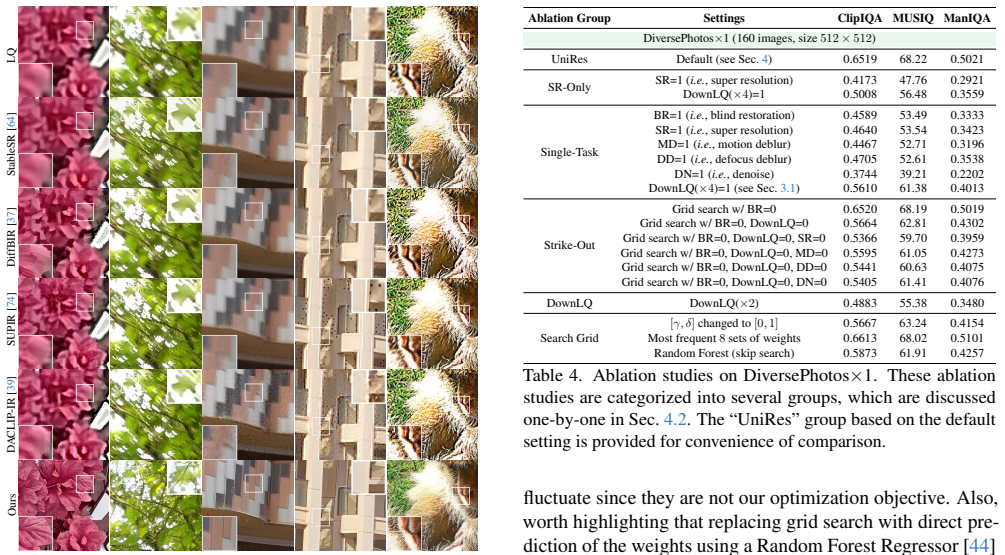
- [§4.1, Tab. 2, Eq. (3)] The claim that UniRes 'outperforms all other methods on every metric on DiversePhotos×1' is based on a protocol where the combination weights are selected per test image by grid search that maximizes MUSIQ (Eq. (3), Sec. 3.3), and MUSIQ is one of the three metrics reported in Tab. 2. The reported MUSIQ score is therefore, by construction, the maximum over the weight grid for each image, and no baseline is given an analogous per-image optimization. The paper's own Tab. 5 shows how dependent the result is on this protocol: with the Random Forest weight predictor (no search), UniRes scores ClipIQA 0.5873 and ManIQA 0.4257, below DiffBIR's 0.6453 and 0.4922; with the average optimal weights (App. A.5), the corresponding values are 0.5941 and 0.4266. Thus the 'every metric' claim is not supported by any protocol other than the one that optimizes one of the reported metrics at test time.
- [§4.2, Tab. 4, App. B.1] The alternative weight-selection protocol that preserves high scores, 'Most frequent 8 sets of weights,' relies on 120 extra images 'collected similar to DiversePhotos' whose source, selection criteria, and disjointness from the 160 test images are not described, and those images and the DiversePhotos test set itself are not released (App. B.1: 'We will provide public download links ... in the future'). This makes the central benchmark unverifiable and raises the risk that the calibration set overlaps with or is not representative of the test set. As it stands, the only fully described protocol is the per-image MUSIQ oracle search, which is the circular one described above.
- [§3.2, Eq. (2)] The core assumption of the method, that the restoration of an arbitrary complex degradation equals a weighted linear combination of the per-task latent noise predictions (Eq. (2)), is asserted without derivation and is not validated on any controlled mixture with known degradation strengths. The paper provides no experiment showing that the optimal weights correlate with the actual mixing coefficients of the degradations, and the negative average weight for the denoise task (App. A.5) suggests that the optimization is exploiting the quality metric's preference for sharpness rather than recovering the true degradation composition. The linear-additivity assumption is therefore untested, and the evidence for it consists solely of scores on the self-curated, unreleased DiversePhotos benchmark.
minor comments (5)
- [Throughout] There are several typos, including 'focux' in §3.2, 'occasionaly' in §4.2, 'resotration' in App. A.3, 'advertized' in App. A.3, 'denoing' in App. A.5, and 'casued' in §1.
- [Tab. 2, Tab. 3] The table captions mention that the top-3 results are highlighted with different color transparency, but the tables in the manuscript are monochrome, so this visual encoding is not reproducible in the current version.
- [§4.2, Tab. 4] The Random Forest regressor row in Tab. 4 is not described in the main text: the MT-A features, the training split, and the number of trees are not given, which prevents replication of even the non-oracle variant.
- [App. A.3, Tab. 5] The computational cost of the default protocol is substantial: about 3677 seconds per image on TPUv5, versus single-digit seconds for the baselines on A100; this practical gap should be acknowledged in the main text when presenting the method as a practical state-of-the-art solution.
- [§3.2, Fig. 3] The interaction between the DownLQ factor and the upscaling condition is unclear: the paper states that a ×4 DownLQ factor is used, but it does not clarify whether the DownLQ input is downsampled relative to the LQ input or relative to the output resolution in the ×1 and ×4 experiments.
Circularity Check
MUSIQ 'superiority' is the value of the optimized objective: per-image weights are chosen to maximize MUSIQ (Eq. 3), so the 68.22 score in Tab. 2 is a grid-search maximum, not an independent measurement.
-
fitted input called prediction
[Sec. 3.3, Eq. (3); reported in Sec. 4.1 and Tab. 2]
"Then, the optimization is done by grid search within a pre-defined range [γ,δ]^K, where γ⩽δ and γ,δ∈R: w∗ = arg max w∈Ω Q(g(x,w)) (3)... In this paper, we empirically adopt MUSIQ [27] as the Q(·) function."
Eq. (3) chooses w* per image by maximizing Q(g(x,w)) with Q=MUSIQ, so the Tab. 2 MUSIQ value 68.22 is the value of the maximized objective over the 1512-point grid, not an independent score; baselines get no such per-image search. Sec. 4.1 uses this margin ('MUSIQ score of 68.22 significantly surpasses that of the second-place method, StableSR, which scored 61.39') to assert it 'outperforms all other methods on every metric.' Tab. 5 shows the claim is protocol-dependent: with Random Forest weights (no MUSIQ search) UniRes gets 0.5873/61.91/0.4257 vs DiffBIR 0.6453/59.97/0.4922, so the per-image fit is what produces the reported superiority on the optimized metric.
full rationale
This is the one load-bearing circular step. The per-image grid search in Sec. 3.3 optimizes MUSIQ, which is also one of the three headline metrics, so the headline MUSIQ superiority on DiversePhotos×1 is forced by construction. The ClipIQA and ManIQA columns are not directly optimized, but Tab. 5 shows they do not support the 'every metric' claim when the search is replaced by a weight predictor; the paper's strongest statement therefore rests on the fitted quantity. The paper's own 'Average optimal combination weights' row (0.5941/62.10/0.4266) likewise drops below DiffBIR on ClipIQA and ManIQA. Eq. (2)'s linear combination of expert latents is an asserted modeling choice rather than a derived result, but it is not circular — it is an independent ansatz testable on the external single-degradation tasks. The unreleased DiversePhotos benchmark and the unspecified origin of the calibration images for the 'most frequent 8 weights' variant are reproducibility and validation weaknesses, not formal circularity. MUSIQ itself is a published IQA method co-authored by one of the present authors; using it as a criterion is not self-citation circularity in itself, but optimizing it per test image turns the reported score into the optimum of the selection rule, and Sec. A.8 concedes MUSIQ is 'not fully aligned with human.'
Assumptions & free parameters
free parameters (4)
- per-image combination weights w =
Mean (BR=0.07, SR=0.12, MD=0.07, DD=0.06, DN=-0.15, DownLQ=0.83); most frequent (DN=-0.2, DownLQ=1.20)
- search grid range [gamma, delta] and interval =
[-0.2, 1.2], step 0.2, at most one negative weight
- DownLQ downscaling factor =
4
- task sampling probabilities =
SR 0.32, MD 0.28, DD 0.18, DN 0.22
assumptions (5)
- standard math Standard latent diffusion forward/reverse process and DDIM sampling.
- domain assumption Complex real-world degradations are arbitrary mixtures of four types: low resolution, motion blur, defocus blur, and real noise.
- ad hoc to paper The restoration of a complex degradation equals a weighted linear combination of the per-task latent predictions in Eq. (2).
- domain assumption Conditioning by latent concatenation preserves input structure better than adapter-based conditioning.
- domain assumption MUSIQ approximates human perceptual preference well enough to guide weight selection.
invented entities (2)
-
DownLQ pseudo-task
-
DiversePhotos benchmark
Cite this review
Pith. "Pith review of UniRes: Universal Image Restoration for Complex Degradations." pith.science (2026). https://pith.science/paper/TH4GI7RB
@misc{pith2026250605599,
  author       = {Pith},
  title        = {Pith review of: UniRes: Universal Image Restoration for Complex Degradations},
  year         = {2026},
  howpublished = {\url{https://pith.science/paper/TH4GI7RB}},
  note         = {Machine review of arXiv:2506.05599}
}
read the original abstract
Real-world image restoration is hampered by diverse degradations stemming from varying capture conditions, capture devices and post-processing pipelines. Existing works make improvements through simulating those degradations and leveraging image generative priors, however generalization to in-the-wild data remains an unresolved problem. In this paper, we focus on complex degradations, i.e., arbitrary mixtures of multiple types of known degradations, which is frequently seen in the wild. A simple yet flexible diffusionbased framework, named UniRes, is proposed to address such degradations in an end-to-end manner. It combines several specialized models during the diffusion sampling steps, hence transferring the knowledge from several well-isolated restoration tasks to the restoration of complex in-the-wild degradations. This only requires well-isolated training data for several degradation types. The framework is flexible as extensions can be added through a unified formulation, and the fidelity-quality trade-off can be adjusted through a new paradigm. Our proposed method is evaluated on both complex-degradation and single-degradation image restoration datasets. Extensive qualitative and quantitative experimental results show consistent performance gain especially for images with complex degradations.
Figures


Figures from the paper (10 more)



Forward citations
Cited by 1 Pith paper
-
Degradation-Aware Metric Prompting for Hyperspectral Image Restoration
A single hyperspectral-restoration model that computes six interpretable input statistics (frequency, texture, spectral-curvature metrics) and uses them as prompts to route Mixture-of-Experts modules achieves state-of...
Reference graph
Works this paper leans on
-
[1]
Abdelrahman Abdelhamed, Stephen Lin, and Michael S. Brown. A high-quality denoising dataset for smartphone cameras. InIEEE Conference on Computer Vision and Pat- tern Recognition (CVPR), 2018. 1, 2, 4, 6, 12
2018
-
[2]
Defocus deblur- ring using dual-pixel data
Abdullah Abuolaim and Michael S Brown. Defocus deblur- ring using dual-pixel data. InEuropean Conference on Com- puter Vision, pages 111–126. Springer, 2020. 1, 2, 4, 12
2020
-
[3]
Ntire 2017 challenge on single image super-resolution: Dataset and study
Eirikur Agustsson and Radu Timofte. Ntire 2017 challenge on single image super-resolution: Dataset and study. InThe IEEE Conference on Computer Vision and Pattern Recogni- tion (CVPR) Workshops, 2017. 4, 6, 12
2017
-
[4]
Diffusion soup: Model merging for text-to-image diffusion models, 2024
Benjamin Biggs, Arjun Seshadri, Yang Zou, Achin Jain, Aditya Golatkar, Yusheng Xie, Alessandro Achille, Ashwin Swaminathan, and Stefano Soatto. Diffusion soup: Model merging for text-to-image diffusion models, 2024. 3
2024
-
[5]
JAX: composable transformations of Python+NumPy programs, 2018
James Bradbury, Roy Frostig, Peter Hawkins, Matthew James Johnson, Chris Leary, Dougal Maclaurin, George Necula, Adam Paszke, Jake VanderPlas, Skye Wanderman-Milne, and Qiao Zhang. JAX: composable transformations of Python+NumPy programs, 2018. 5
2018
-
[6]
Tim Brooks, Aleksander Holynski, and Alexei A. Efros. In- structpix2pix: Learning to follow image editing instructions,
-
[7]
Toward real-world single image super-resolution: A new benchmark and a new model
Jianrui Cai, Hui Zeng, Hongwei Yong, Zisheng Cao, and Lei Zhang. Toward real-world single image super-resolution: A new benchmark and a new model. InProceedings of the IEEE International Conference on Computer Vision, 2019. 2, 6
work page 2019
-
[8]
Freeman, Michael Rubinstein, Yuanzhen Li, and Dilip Krishnan
Huiwen Chang, Han Zhang, Jarred Barber, AJ Maschinot, Jose Lezama, Lu Jiang, Ming-Hsuan Yang, Kevin Murphy, William T. Freeman, Michael Rubinstein, Yuanzhen Li, and Dilip Krishnan. Muse: Text-to-image generation via masked generative transformers, 2023. 2
work page 2023
Show all 86 references
-
[9]
Pre-trained image processing transformer
Hanting Chen, Yunhe Wang, Tianyu Guo, Chang Xu, Yiping Deng, Zhenhua Liu, Siwei Ma, Chunjing Xu, Chao Xu, and Wen Gao. Pre-trained image processing transformer. InPro- ceedings of the IEEE/CVF Conference on Computer Vision and Pattern Recognition (CVPR), pages 12299–12310, 2021. 3
2021
-
[10]
Restoreagent: Autonomous image restoration agent via multimodal large language models, 2024
Haoyu Chen, Wenbo Li, Jinjin Gu, Jingjing Ren, Sixiang Chen, Tian Ye, Renjing Pei, Kaiwen Zhou, Fenglong Song, and Lei Zhu. Restoreagent: Autonomous image restoration agent via multimodal large language models, 2024. 2, 3, 6
2024
-
[11]
Simple baselines for image restoration.arXiv preprint arXiv:2204.04676, 2022
Liangyu Chen, Xiaojie Chu, Xiangyu Zhang, and Jian Sun. Simple baselines for image restoration.arXiv preprint arXiv:2204.04676, 2022. 13
2022 arXiv
-
[12]
Pali: A jointly-scaled multilingual language-image model, 2023
Xi Chen, Xiao Wang, Soravit Changpinyo, AJ Piergiovanni, Piotr Padlewski, Daniel Salz, Sebastian Goodman, Adam Grycner, Basil Mustafa, Lucas Beyer, Alexander Kolesnikov, Joan Puigcerver, Nan Ding, Keran Rong, Hassan Akbari, Gaurav Mishra, Linting Xue, Ashish Thapliyal, James B...
2023
-
[13]
Inversion by direct iteration: An alternative to denoising diffusion for image restoration.Transactions on Machine Learning Research,
Mauricio Delbracio and Peyman Milanfar. Inversion by direct iteration: An alternative to denoising diffusion for image restoration.Transactions on Machine Learning Research,
-
[14]
Burst deblurring: Removing camera shake through fourier burst accumulation
Mauricio Delbracio and Guillermo Sapiro. Burst deblurring: Removing camera shake through fourier burst accumulation. InIEEE Conference on Computer Vision and Pattern Recog- nition, pages 2385–2393, 2015. 1, 4, 5, 18, 20
2015
-
[15]
Perceptual quality assessment of smartphone photog- raphy
Yuming Fang, Hanwei Zhu, Yan Zeng, Kede Ma, and Zhou Wang. Perceptual quality assessment of smartphone photog- raphy. InIEEE Conference on Computer Vision and Pattern Recognition, pages 3677–3686, 2020. 1, 2, 6, 8, 13, 14, 18
2020
-
[16]
Abolfazl Farahani, Sahar V oghoei, Khaled Rasheed, and Hamid R. Arabnia. A brief review of domain adaptation,
-
[17]
Model- agnostic meta-learning for fast adaptation of deep networks,
Chelsea Finn, Pieter Abbeel, and Sergey Levine. Model- agnostic meta-learning for fast adaptation of deep networks,
-
[18]
Deepti Ghadiyaram and Alan C. Bovik. Massive online crowdsourced study of subjective and objective picture qual- ity.IEEE Transactions on Image Processing, 25(1):372–387,
-
[19]
Referring flexible image restoration, 2024
Runwei Guan, Rongsheng Hu, Zhuhao Zhou, Tianlang Xue, Ka Lok Man, Jeremy Smith, Eng Gee Lim, Weiping Ding, and Yutao Yue. Referring flexible image restoration, 2024. 3
2024
-
[20]
Classifier-free diffusion guidance, 2022
Jonathan Ho and Tim Salimans. Classifier-free diffusion guidance, 2022. 4, 8, 12
2022
-
[21]
Denoising diffu- sion probabilistic models, 2020
Jonathan Ho, Ajay Jain, and Pieter Abbeel. Denoising diffu- sion probabilistic models, 2020. 2, 3, 4
2020
-
[22]
V . Hosu, H. Lin, T. Sziranyi, and D. Saupe. Koniq-10k: An ecologically valid database for deep learning of blind image quality assessment.IEEE Transactions on Image Processing, 29:4041–4056, 2020. 1, 2, 6, 13, 14, 18
2020
-
[23]
Semi-cycled generative adversarial networks for real-world face super-resolution.IEEE Transac- tions on Image Processing, 32:1184–1199, 2023
Hao Hou, Jun Xu, Yingkun Hou, Xiaotao Hu, Benzheng Wei, and Dinggang Shen. Semi-cycled generative adversarial networks for real-world face super-resolution.IEEE Transac- tions on Image Processing, 32:1184–1199, 2023. 2
2023
-
[24]
Meta-sr: A magnification-arbitrary network for super-resolution, 2019
Xuecai Hu, Haoyuan Mu, Xiangyu Zhang, Zilei Wang, Tie- niu Tan, and Jian Sun. Meta-sr: A magnification-arbitrary network for super-resolution, 2019. 2, 3
2019
-
[25]
Autodir: Automatic all-in-one image restoration with latent diffusion, 2024
Yitong Jiang, Zhaoyang Zhang, Tianfan Xue, and Jinwei Gu. Autodir: Automatic all-in-one image restoration with latent diffusion, 2024. 2, 3, 8, 12, 13
2024
-
[26]
A style-based generator architecture for generative adversarial networks,
Tero Karras, Samuli Laine, and Timo Aila. A style-based generator architecture for generative adversarial networks,
-
[27]
Musiq: Multi-scale image quality transformer,
Junjie Ke, Qifei Wang, Yilin Wang, Peyman Milanfar, and Feng Yang. Musiq: Multi-scale image quality transformer,
-
[28]
Vila: Learning image aesthetics from user comments with vision-language pretraining, 2023
Junjie Ke, Keren Ye, Jiahui Yu, Yonghui Wu, Peyman Milan- far, and Feng Yang. Vila: Learning image aesthetics from user comments with vision-language pretraining, 2023. 5
2023
-
[29]
Auto-encoding varia- tional bayes, 2022
Diederik P Kingma and Max Welling. Auto-encoding varia- tional bayes, 2022. 2 9
2022
-
[30]
Alina Kuznetsova, Hassan Rom, Neil Alldrin, Jasper Uijlings, Ivan Krasin, Jordi Pont-Tuset, Shahab Kamali, Stefan Popov, Matteo Malloci, Alexander Kolesnikov, Tom Duerig, and Vit- torio Ferrari. The open images dataset v4: Unified image classification, object detection, and vi...
1956
-
[31]
All-In-One Image Restoration for Unknown Corruption
Boyun Li, Xiao Liu, Peng Hu, Zhongqin Wu, Jiancheng Lv, and Xi Peng. All-In-One Image Restoration for Unknown Corruption. InIEEE Conference on Computer Vision and Pattern Recognition, New Orleans, LA, 2022. 2, 3, 6, 13
2022
-
[32]
Lsdir: A large scale dataset for image restoration
Yawei Li, Kai Zhang, Jingyun Liang, Jiezhang Cao, Ce Liu, Rui Gong, Yulun Zhang, Hao Tang, Yun Liu, Denis Deman- dolx, Rakesh Ranjan, Radu Timofte, and Luc Van Gool. Lsdir: A large scale dataset for image restoration. In2023 IEEE/CVF Conference on Computer Vision and Pattern R...
2023
-
[33]
Swinir: Image restoration using swin transformer, 2021
Jingyun Liang, Jiezhang Cao, Guolei Sun, Kai Zhang, Luc Van Gool, and Radu Timofte. Swinir: Image restoration using swin transformer, 2021. 13
2021
-
[34]
A comprehensive survey on test-time adaptation under distribution shifts, 2023
Jian Liang, Ran He, and Tieniu Tan. A comprehensive survey on test-time adaptation under distribution shifts, 2023. 3
2023
-
[35]
Rich hu- man feedback for text-to-image generation, 2024
Youwei Liang, Junfeng He, Gang Li, Peizhao Li, Arseniy Klimovskiy, Nicholas Carolan, Jiao Sun, Jordi Pont-Tuset, Sarah Young, Feng Yang, Junjie Ke, Krishnamurthy Dj Dvi- jotham, Katie Collins, Yiwen Luo, Yang Li, Kai J Kohlhoff, Deepak Ramachandran, and Vidhya Navalpakkam. Ric...
2024
-
[36]
Enhanced deep residual networks for single image super-resolution
Bee Lim, Sanghyun Son, Heewon Kim, Seungjun Nah, and Kyoung Mu Lee. Enhanced deep residual networks for single image super-resolution. InThe IEEE Conference on Com- puter Vision and Pattern Recognition (CVPR) Workshops,
-
[37]
Diffbir: Towards blind image restoration with generative diffusion prior, 2024
Xinqi Lin, Jingwen He, Ziyan Chen, Zhaoyang Lyu, Bo Dai, Fanghua Yu, Wanli Ouyang, Yu Qiao, and Chao Dong. Diffbir: Towards blind image restoration with generative diffusion prior, 2024. 1, 2, 3, 4, 5, 6, 7, 8, 12, 13
2024
-
[38]
Visual instruction tuning, 2023
Haotian Liu, Chunyuan Li, Qingyang Wu, and Yong Jae Lee. Visual instruction tuning, 2023. 2, 3
2023
-
[39]
Photo-realistic image restoration in the wild with controlled vision-language models.arXiv preprint arXiv:2404.09732, 2024
Ziwei Luo, Fredrik K Gustafsson, Zheng Zhao, Jens Sj¨olund, and Thomas B Sch¨on. Photo-realistic image restoration in the wild with controlled vision-language models.arXiv preprint arXiv:2404.09732, 2024. 1, 2, 3, 6, 7, 8, 13
2024 arXiv
-
[40]
Gustafsson, Zheng Zhao, Jens Sj¨olund, and Thomas B
Ziwei Luo, Fredrik K. Gustafsson, Zheng Zhao, Jens Sj¨olund, and Thomas B. Sch¨on. Controlling vision-language models for multi-task image restoration, 2024. 3
2024
-
[41]
Patel, and Peyman Milan- far
Kangfu Mei, Mauricio Delbracio, Hossein Talebi, Zhengzhong Tu, Vishal M. Patel, and Peyman Milan- far. Codi: Conditional diffusion distillation for higher-fidelity and faster image generation. InProceedings of the IEEE/CVF Conference on Computer Vision and Pattern Recognition ...
2024
-
[42]
Deep multi-scale convolutional neural network for dynamic scene deblurring
Seungjun Nah, Tae Hyun Kim, and Kyoung Mu Lee. Deep multi-scale convolutional neural network for dynamic scene deblurring. InCVPR, 2017. 1, 2, 4, 5, 6, 12
2017
-
[43]
Long Ouyang, Jeff Wu, Xu Jiang, Diogo Almeida, Carroll L. Wainwright, Pamela Mishkin, Chong Zhang, Sandhini Agar- wal, Katarina Slama, Alex Ray, John Schulman, Jacob Hilton, Fraser Kelton, Luke Miller, Maddie Simens, Amanda Askell, Peter Welinder, Paul Christiano, Jan Leike, a...
2022
-
[44]
Pedregosa, G
F. Pedregosa, G. Varoquaux, A. Gramfort, V . Michel, B. Thirion, O. Grisel, M. Blondel, P. Prettenhofer, R. Weiss, V . Dubourg, J. Vanderplas, A. Passos, D. Cournapeau, M. Brucher, M. Perrot, and E. Duchesnay. Scikit-learn: Machine learning in Python.Journal of Machine Learnin...
2011
-
[45]
Scalable diffusion models with transformers, 2023
William Peebles and Saining Xie. Scalable diffusion models with transformers, 2023. 2, 4
2023
-
[46]
Sdxl: Improving latent diffusion models for high-resolution image synthesis, 2023
Dustin Podell, Zion English, Kyle Lacey, Andreas Blattmann, Tim Dockhorn, Jonas M¨uller, Joe Penna, and Robin Rombach. Sdxl: Improving latent diffusion models for high-resolution image synthesis, 2023. 2
2023
-
[47]
Promptir: Prompting for all-in-one image restoration
Vaishnav Potlapalli, Syed Waqas Zamir, Salman Khan, and Fahad Khan. Promptir: Prompting for all-in-one image restoration. InThirty-seventh Conference on Neural Informa- tion Processing Systems, 2023. 3, 12, 13
2023
-
[48]
Spire: Semantic prompt-driven image restoration, 2024
Chenyang Qi, Zhengzhong Tu, Keren Ye, Mauricio Delbracio, Peyman Milanfar, Qifeng Chen, and Hossein Talebi. Spire: Semantic prompt-driven image restoration, 2024. 2, 3
2024
-
[49]
Xpsr: Cross-modal priors for diffusion-based image super-resolution, 2024
Yunpeng Qu, Kun Yuan, Kai Zhao, Qizhi Xie, Jinhua Hao, Ming Sun, and Chao Zhou. Xpsr: Cross-modal priors for diffusion-based image super-resolution, 2024. 3
2024
-
[50]
Multiscale structure guided diffusion for image deblurring, 2023
Mengwei Ren, Mauricio Delbracio, Hossein Talebi, Guido Gerig, and Peyman Milanfar. Multiscale structure guided diffusion for image deblurring, 2023. 5
2023
-
[51]
Realistic blur synthesis for learning image deblurring
Jaesung Rim, Geonung Kim, Jungeon Kim, Junyong Lee, Seungyong Lee, and Sunghyun Cho. Realistic blur synthesis for learning image deblurring. InProceedings of the European Conference on Computer Vision (ECCV), 2022. 2
2022
-
[52]
High-resolution image synthesis with latent diffusion models, 2022
Robin Rombach, Andreas Blattmann, Dominik Lorenz, Patrick Esser, and Bj ¨orn Ommer. High-resolution image synthesis with latent diffusion models, 2022. 2, 3, 4, 5
2022
-
[53]
U-net: Convolutional networks for biomedical image segmentation,
Olaf Ronneberger, Philipp Fischer, and Thomas Brox. U-net: Convolutional networks for biomedical image segmentation,
-
[54]
Sara Mahdavi, Rapha Gontijo Lopes, Tim Salimans, Jonathan Ho, David J Fleet, and Mohammad Norouzi
Chitwan Saharia, William Chan, Saurabh Saxena, Lala Li, Jay Whang, Emily Denton, Seyed Kamyar Seyed Ghasemipour, Burcu Karagol Ayan, S. Sara Mahdavi, Rapha Gontijo Lopes, Tim Salimans, Jonathan Ho, David J Fleet, and Mohammad Norouzi. Photorealistic text-to-image diffusion mod...
2022
-
[55]
Image super- resolution via iterative refinement.IEEE transactions on pattern analysis and machine intelligence, 45(4):4713–4726,
Chitwan Saharia, Jonathan Ho, William Chan, Tim Sali- mans, David J Fleet, and Mohammad Norouzi. Image super- resolution via iterative refinement.IEEE transactions on pattern analysis and machine intelligence, 45(4):4713–4726,
-
[56]
Progressive distillation for fast sampling of diffusion models, 2022
Tim Salimans and Jonathan Ho. Progressive distillation for fast sampling of diffusion models, 2022. 2, 3
2022
-
[57]
Adversarial diffusion distillation, 2023
Axel Sauer, Dominik Lorenz, Andreas Blattmann, and Robin Rombach. Adversarial diffusion distillation, 2023. 2
2023
-
[58]
Outra- geously large neural networks: The sparsely-gated mixture- of-experts layer, 2017
Noam Shazeer, Azalia Mirhoseini, Krzysztof Maziarz, Andy Davis, Quoc Le, Geoffrey Hinton, and Jeff Dean. Outra- geously large neural networks: The sparsely-gated mixture- of-experts layer, 2017. 3 10
2017
-
[59]
Denoising diffusion implicit models, 2022
Jiaming Song, Chenlin Meng, and Stefano Ermon. Denoising diffusion implicit models, 2022. 2, 3, 4, 5
2022
-
[60]
Deep video deblurring for hand-held cameras
Shuochen Su, Mauricio Delbracio, Jue Wang, Guillermo Sapiro, Wolfgang Heidrich, and Oliver Wang. Deep video deblurring for hand-held cameras. InProceedings of the IEEE conference on computer vision and pattern recognition, pages 1279–1288, 2017. 2
2017
-
[61]
Nima: Neural image assessment.IEEE Transactions on Image Processing, 27(8): 3998–4011, 2018
Hossein Talebi and Peyman Milanfar. Nima: Neural image assessment.IEEE Transactions on Image Processing, 27(8): 3998–4011, 2018. 5
2018
-
[62]
Maxim: Multi- axis mlp for image processing.CVPR, 2022
Zhengzhong Tu, Hossein Talebi, Han Zhang, Feng Yang, Peyman Milanfar, Alan Bovik, and Yinxiao Li. Maxim: Multi- axis mlp for image processing.CVPR, 2022. 2, 3
2022
-
[63]
Ex- ploring clip for assessing the look and feel of images
Jianyi Wang, Kelvin CK Chan, and Chen Change Loy. Ex- ploring clip for assessing the look and feel of images. In AAAI, 2023. 5, 6
2023
-
[64]
Chan, and Chen Change Loy
Jianyi Wang, Zongsheng Yue, Shangchen Zhou, Kelvin C.K. Chan, and Chen Change Loy. Exploiting diffusion prior for real-world image super-resolution.International Journal of Computer Vision, 2024. 1, 2, 3, 4, 5, 6, 7, 8, 13
2024
-
[65]
Esrgan: Enhanced super-resolution generative adversarial networks, 2018
Xintao Wang, Ke Yu, Shixiang Wu, Jinjin Gu, Yihao Liu, Chao Dong, Chen Change Loy, Yu Qiao, and Xiaoou Tang. Esrgan: Enhanced super-resolution generative adversarial networks, 2018. 2, 3, 4
2018
-
[66]
Real-esrgan: Training real-world blind super-resolution with pure synthetic data
Xintao Wang, Liangbin Xie, Chao Dong, and Ying Shan. Real-esrgan: Training real-world blind super-resolution with pure synthetic data. InInternational Conference on Computer Vision Workshops (ICCVW), 2021. 1, 2, 4, 5
2021
-
[67]
Component divide-and- conquer for real-world image super-resolution, 2020
Pengxu Wei, Ziwei Xie, Hannan Lu, Zongyuan Zhan, Qixiang Ye, Wangmeng Zuo, and Liang Lin. Component divide-and- conquer for real-world image super-resolution, 2020. 2, 6
2020
-
[68]
Towards real-world burst image super-resolution: Benchmark and method, 2023
Pengxu Wei, Yujing Sun, Xingbei Guo, Chang Liu, Jie Chen, Xiangyang Ji, and Liang Lin. Towards real-world burst image super-resolution: Benchmark and method, 2023. 2
2023
-
[69]
De- blurring via stochastic refinement
Jay Whang, Mauricio Delbracio, Hossein Talebi, Chitwan Saharia, Alexandros G Dimakis, and Peyman Milanfar. De- blurring via stochastic refinement. InProceedings of the IEEE/CVF Conference on Computer Vision and Pattern Recognition, pages 16293–16303, 2022. 2
2022
-
[70]
Seesr: Towards semantics-aware real-world image super-resolution, 2024
Rongyuan Wu, Tao Yang, Lingchen Sun, Zhengqiang Zhang, Shuai Li, and Lei Zhang. Seesr: Towards semantics-aware real-world image super-resolution, 2024. 2, 3, 5
2024
-
[71]
Hq-50k: A large-scale, high-quality dataset for image restoration, 2023
Qinhong Yang, Dongdong Chen, Zhentao Tan, Qiankun Liu, Qi Chu, Jianmin Bao, Lu Yuan, Gang Hua, and Nenghai Yu. Hq-50k: A large-scale, high-quality dataset for image restoration, 2023. 2
2023
-
[72]
Maniqa: Multi-dimension attention network for no-reference image quality assessment
Sidi Yang, Tianhe Wu, Shuwei Shi, Shanshan Lao, Yuan Gong, Mingdeng Cao, Jiahao Wang, and Yujiu Yang. Maniqa: Multi-dimension attention network for no-reference image quality assessment. InProceedings of the IEEE/CVF Con- ference on Computer Vision and Pattern Recognition, pag...
2022
-
[73]
Pixel-aware stable diffusion for realistic image super-resolution and personalized stylization
Tao Yang, Rongyuan Wu, Peiran Ren, Xuansong Xie, , and Lei Zhang. Pixel-aware stable diffusion for realistic image super-resolution and personalized stylization. InThe Euro- pean Conference on Computer Vision (ECCV) 2024, 2023. 2, 3, 4
2024
-
[74]
Scaling up to excellence: Practicing model scaling for photo- realistic image restoration in the wild, 2024
Fanghua Yu, Jinjin Gu, Zheyuan Li, Jinfan Hu, Xiangtao Kong, Xintao Wang, Jingwen He, Yu Qiao, and Chao Dong. Scaling up to excellence: Practicing model scaling for photo- realistic image restoration in the wild, 2024. 1, 2, 3, 4, 5, 6, 7, 8, 12, 13
2024
-
[75]
Promptfix: You prompt and we fix the photo,
Yongsheng Yu, Ziyun Zeng, Hang Hua, Jianlong Fu, and Jiebo Luo. Promptfix: You prompt and we fix the photo,
-
[76]
Restormer: Efficient transformer for high-resolution image restoration, 2022
Syed Waqas Zamir, Aditya Arora, Salman Khan, Mu- nawar Hayat, Fahad Shahbaz Khan, and Ming-Hsuan Yang. Restormer: Efficient transformer for high-resolution image restoration, 2022. 13
2022
-
[77]
The emergence of reproducibility and generalizability in diffusion models, 2024
Huijie Zhang, Jinfan Zhou, Yifu Lu, Minzhe Guo, Peng Wang, Liyue Shen, and Qing Qu. The emergence of reproducibility and generalizability in diffusion models, 2024. 2
2024
-
[78]
Deblurring by realistic blurring, 2020
Kaihao Zhang, Wenhan Luo, Yiran Zhong, Lin Ma, Bjorn Stenger, Wei Liu, and Hongdong Li. Deblurring by realistic blurring, 2020. 2, 3
2020
-
[79]
Adding conditional control to text-to-image diffusion models, 2023
Lvmin Zhang, Anyi Rao, and Maneesh Agrawala. Adding conditional control to text-to-image diffusion models, 2023. 2, 3
2023
-
[80]
Patel, and Gang Hua
Mo Zhou, Yiding Yang, Haoxiang Li, Vishal M. Patel, and Gang Hua. Deployment prior injection for run-time calibrat- able object detection, 2024. 3 A. More Experiments and Discussions A.1. Why Specifically Four Degradation Types? In this paper, we particularly focus on complex ...
2024
-
[82]
"" 11Find all valid possible combination weights. 12
-> List[List[float]]: 10""" 11Find all valid possible combination weights. 12""" 13values = np.arange(vmin, vmax + 1e-3, interval) 14allcombs = it.product( *([values] * nvars)) 15allcombs = [np.array(x)forxinallcombs] 16# figure out valid combinations 17validcombs = [] 18forxi...
1950
-
[83]
Download SPAQ [ 15], KONIQ [ 22], and LIVE [ 18] datasets
-
[84]
Gather images whose file names are mentioned in the following 12 listings
-
[85]
Center-crop all images from SPAQ and KONIQ datasets to512×512resolution
-
[86]
Resize (bicubic) all images from LIVE dataset (from 500×500) to512×512resolution. (SPAQ,low resolution as dominating degradation, with other degra- dations): 00019, 00025, 00033, 00109, 00192, 00226, 00251, 00381, 00414, 00559, 00561, 00585, 00743, 03973, 04085, 04136, 04270, ...
-
[2023]
Featured Certification. 2
Reviewed August 7, 2026 · model on record in the stance chip above.
Discussion (0). Sign in to comment.