REVIEW 4 major objections 5 minor 33 references
Network Hexagons Under Attack: Secure Crowdsourcing of Geo-Referenced Data
T0 review · 4 major / 5 minor · reviewed 2026-08-07 · deepseek-v4-flash
Pith's one-line read The paper claims a PKI with ephemeral pseudonym certificates and rotating keys guarantees anonymity for geo-data reporters.
desk verdict First systematic threat analysis of Nexagon with a real prototype and measured overhead, but the anonymity guarantee is overstated and the k-anonymity mitigation does not work as claimed; deserves peer review with heavy revision. read the letter →
The pith
A machine-rendered reading of the paper's core claim, the machinery that carries it, and where it could break.
The reading
What carries the argument
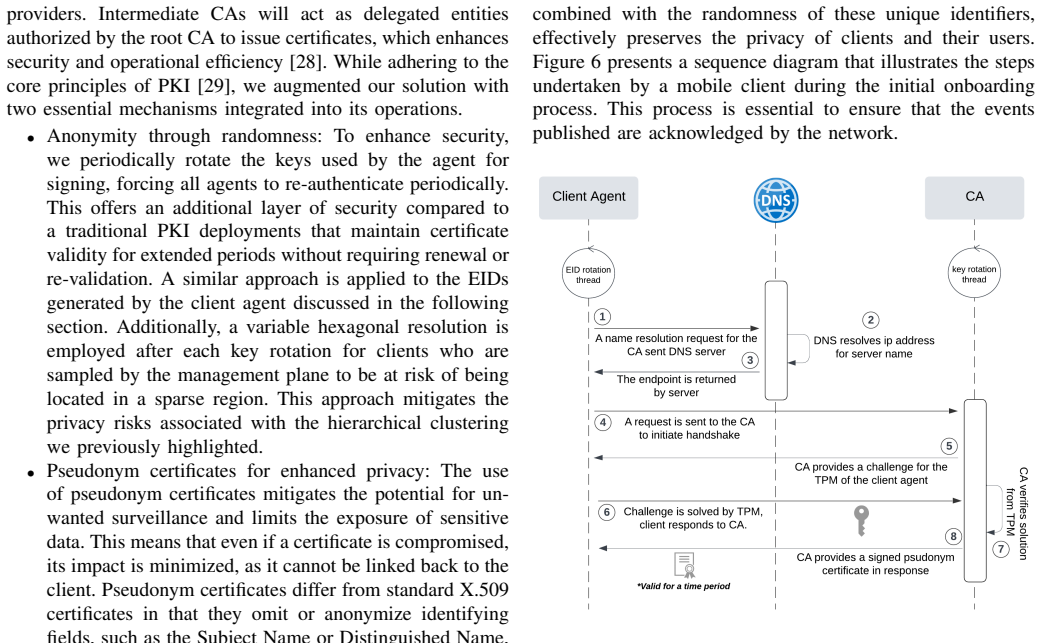
The load-bearing mechanism is the ephemeral pseudonym certificate workflow, carried by three interacting pieces: a root certificate authority as the single source of truth, a trusted platform module on each client that attests to a fresh key pair and signs a certificate request, and an H3 spatial index whose resolution parameter can be raised or lowered. Pseudonym certificates omit identifying subject fields; periodic key rotation makes each certificate usable for a limited window; and adaptive resolution coarsens the grid where clients are sparse, mimicking k-anonymity by keeping a plausible crowd inside each reported hexagon. Together these pieces convert the clients' persistent identifiers into frequently changing, unlinkable short-term credentials.
What would settle it
Compromise the certificate authority so it logs the long-term identity with each issued pseudonym, then observe one client's published events: if the log links a pseudonym back to the identity, the anonymity claim fails. A simpler check is to place one client in a sparse H3 tile and record event timing across endpoint identifier rotations; if timing gaps correlate with the client's movement, session linkage is still possible despite key rotation.
Extended reading notes
Core claim
The paper's central claim is that the vulnerabilities in the current Nexagon specification can be mitigated by an architecture that separates long-term identity from network identity: a root certificate authority issues pseudonym certificates to TPM-equipped clients, clients rotate keys and endpoint identifiers on a schedule, and the H3 hexagonal grid resolution expands adaptively in sparse regions so no client is the sole occupant of a tile. The authors state that this combination guarantees user and device anonymity and effectively mitigates re-identification and surveillance risks, with the measured overhead kept within their stated bounds. The guarantee is architectural: at any time, what the network sees is a short-lived pseudonym whose identifying fields have been omitted and whose link to the long-term identity exists only inside the trusted management plane.
Load-bearing premise
The privacy guarantee depends on the certificate authority staying honest and uncracked and on every client device carrying a working trusted platform module; if either fails, rotating pseudonyms no longer hide users from the authority or from an attacker who corrupts it.
Editorial extensions
If this is right
- If the architecture works as claimed, a compromised short-lived pseudonym certificate reveals little about the user because it carries no identifying fields and expires before meaningful profiling.
- Adaptive H3 resolution in sparse regions would make isolated vehicles harder to single out, at the cost of coarser location data in exactly the areas where the protocol is weakest.
- The reported overhead bounds (latency up to 25% higher, throughput up to 7% lower) suggest the anonymity layer is deployable on ordinary infrastructure rather than requiring new radio or vehicle hardware.
- Deploying the protocol as an overlay would let operators adopt these protections without rewriting the underlying locator/identifier routing or changing existing network configuration.
Reading between the lines
- Beyond the paper's claims, the privacy guarantee is only as strong as the certificate authority: a malicious or compromised CA that logs the long-term identity next to each issued pseudonym can re-identify every client, so the guarantee should be read as conditional on CA trust and TPM integrity.
- Beyond the paper's claims, key rotation alone does not defeat correlation attacks based on timing or movement; the paper lists dummy traffic as a mitigation, but the prototype evaluation does not appear to test whether timing patterns across rotations still link sessions.
- Beyond the paper's claims, adaptive resolution trades utility for privacy: in sparse regions the data becomes coarser, which could reduce the precision of traffic and hazard reports, so a real deployment would need a policy on how much resolution to sacrifice.
- A natural extension is a small field trial with real vehicles and an adversarial observer who knows the rotation schedule; if the observer can guess which pseudonym belongs to which vehicle after a rotation, the mechanism needs stronger unlinkability, such as mix-network delays.
Editorial analysis
A structured set of objections, weighed in public.
Referee Report
Summary. This paper applies STRIDE and LINDDUN threat modeling to the IETF Nexagon protocol and identifies several threats, including session linkage, request profiling, sparse-region attacks, user re-identification, and spoofed agents. It proposes a PKI-based security architecture with a root CA, TPM-backed attestation, ephemeral pseudonym certificates, randomized key rotation, and adaptive H3 resolution to mitigate these threats. A microservice prototype running on two VMs is used to measure overhead; the reported average latency increases by about 25% and throughput drops by about 4%. The paper claims that the architecture "guarantees user and device anonymity" and "effectively mitigates re-identification and surveillance risks in sparse environments."
Significance. If the privacy guarantee were established, the paper would be a useful practical contribution: it provides a systematic threat analysis of a protocol under standardization and a reproducible prototype with confidence intervals. The threat analysis is a reasonable use of standard frameworks, and the performance measurement is a useful preliminary datapoint. However, the central privacy claim is not supported by the presented evidence, and the paper currently overstates both the privacy guarantees and the deployment readiness.
major comments (4)
- [Abstract; Section V.A.1] The claim that the scheme "guarantees user and device anonymity" is not supported by the protocol as described. During onboarding, the CA verifies the client's TPM attestation and receives "an encrypted representation of its long-term identity" (Section V.A.1), so the CA can permanently link that identity to every pseudonym certificate it issues. With the CA placed in the Trusted Management Plane and no analysis of CA compromise or honest-but-curious behavior, pseudonym rotation cannot prevent re-identification by the CA. The paper should either make the trust assumptions explicit and weaken the "guarantee" language, or add a mechanism such as blind certificate issuance and a formal unlinkability argument.
- [Section IV.C.1; Table II] The sparse-region mitigation cannot deliver the claimed k-anonymity-like guarantee. Increasing the H3 resolution coarsens the geographic area but does not increase the number of distinct clients in the anonymity set; if fewer than k clients are present, no resolution produces k indistinguishable clients. The "Ensure at least k clients are indistinguishable in any region" row in Table II is therefore not achievable by dynamic resolution alone. The prototype implements only dynamic resolution and key rotation; dummy traffic and mix networks are listed in Table II but not realized. Consequently, the abstract's claim that the solution "effectively mitigates re-identification and surveillance risks in sparse environments" is not established, and no privacy metric is measured.
- [Section V; Table II] Several listed mitigations are not implemented or evaluated. The prototype includes key rotation and variable H3 resolution, but dummy traffic, mix networks, and request-pattern noise from Table II are absent from Section V. Since session linkage and request profiling are high- or medium-risk threats, the claim that these threats are "addressed" by the implementation is not supported by the evidence. The evaluation measures only latency and throughput; it does not measure anonymity set size, unlinkability, or resistance to the identified attacks.
- [Section V.B] The performance claim is based on a two-VM testbed with 2 CPU cores and 4 GB RAM per VM and roughly 260 requests/second. This is a useful microbenchmark, but it is insufficient to support the statement that the approach is "ready for real-world deployment" in intelligent transportation systems. The reported confidence intervals are helpful, but the scale and network conditions are far from a vehicular deployment. The paper should either limit the claim to a feasibility study or extend the evaluation.
minor comments (5)
- [Section II] In Section II, the sentence "For instance, [10] used k-anonymity to obscure the actual location..." cites [10], which is Dwork's differential privacy paper; this should be corrected to a k-anonymity or location-based services reference.
- [Section V] There are multiple typos and inconsistencies: "reqests" in Section V.B.1, "it's development" in the Section V opener, and inconsistent capitalization of "Nexagons" and "Nexagon." A careful proofread is needed.
- [Section V.A.1] The statement that "even if a certificate is compromised, its impact is minimized, as it cannot be linked back to the client" is misleading, because the root CA can link the pseudonym certificate to the long-term identity established during onboarding, as noted in the major comments.
- [Section V.A.1; reference [32]] The repository [32] is described both as available at a URL and "upon request"; the paper should provide a public, working link and include setup instructions to support reproducibility.
- [Section IV.B; Table I] The mapping table would benefit from explaining why "Repudiation" and "Information Disclosure" are excluded from STRIDE while "Non-repudiation" and "Disclosure" are listed under LINDDUN; as written, the table appears to cover similar concepts under different names.
Circularity Check
No significant circularity: the paper's security claims are unsupported by measurement but are not derived from their own inputs; the only self-citation is a non-load-bearing GitHub repository link.
full rationale
The claimed derivation chain is not circular. The threat analysis uses external frameworks (STRIDE [18] and LINDDUN [19]) applied to the IETF Nexagon specification [6], and the proposed mitigations (PKI, pseudonym certificates, key rotation, adaptive H3 resolution) are presented as design decisions rather than as consequences of fitted data. The performance results in Section V.B are direct measurements of the prototype against a pre-shared-key baseline, not predictions derived from the security parameters. No equation or parameter in the paper reduces to another by construction. The sole self-citation is the authors' GitHub repository [32], which provides prototype code but carries no logical weight in the security argument, so it does not constitute load-bearing self-citation. The paper does contain validation gaps that should be weighed as correctness risks rather than circularity: the abstract's 'guarantees user and device anonymity' is not supported by any anonymity or privacy metric (Section V.B measures only latency and throughput), and the sparse-region mitigation in Section IV.C.1 ('achieve an effect similar to k anonymity') is weaker than the k-anonymity definition given in Section II, which requires at least k-1 other indistinguishable individuals. These gaps mean the central claim is overbroad, but the derivation is not circular.
Assumptions & free parameters
free parameters (1)
- k-anonymity threshold (k)
assumptions (5)
- domain assumption The Nexagon protocol as specified in IETF draft [6] lacks an authentication mechanism and uses static EIDs, making the identified threats applicable.
- domain assumption Every mobile client has access to a functional TPM for attestation during onboarding.
- domain assumption The Certificate Authority is trusted and cannot be compromised, despite being able to link the long-term identity to pseudonyms during onboarding.
- domain assumption Adaptive H3 resolution can provide at least k indistinguishable clients in sparse regions without destroying the utility of the geo-referenced data.
- domain assumption The two-VM test environment with 4 GB RAM and 2 cores each yields latency and throughput results representative of real-world vehicular deployments.
Cite this review
Pith. "Pith review of Network Hexagons Under Attack: Secure Crowdsourcing of Geo-Referenced Data." pith.science (2026). https://pith.science/paper/YEOVTRMR
@misc{pith2026250605601,
  author       = {Pith},
  title        = {Pith review of: Network Hexagons Under Attack: Secure Crowdsourcing of Geo-Referenced Data},
  year         = {2026},
  howpublished = {\url{https://pith.science/paper/YEOVTRMR}},
  note         = {Machine review of arXiv:2506.05601}
}
read the original abstract
A critical requirement for modern-day Intelligent Transportation Systems (ITS) is the ability to collect geo-referenced data from connected vehicles and mobile devices in a safe, secure and anonymous way. The Nexagon protocol, which builds on the IETF Locator/ID Separation Protocol (LISP) and the Hierarchical Hexagonal Clustering (H3) geo-spatial indexing system, offers a promising framework for dynamic, privacy-preserving data aggregation. Seeking to address the critical security and privacy vulnerabilities that persist in its current specification, we apply the STRIDE and LINDDUN threat modelling frameworks and prove among other that the Nexagon protocol is susceptible to user re-identification, session linkage, and sparse-region attacks. To address these challenges, we propose an enhanced security architecture that combines public key infrastructure (PKI) with ephemeral pseudonym certificates. Our solution guarantees user and device anonymity through randomized key rotation and adaptive geospatial resolution, thereby effectively mitigating re-identification and surveillance risks in sparse environments. A prototype implementation over a microservice-based overlay network validates the approach and underscores its readiness for real-world deployment. Our results show that it is possible to achieve the required level of security without increasing latency by more than 25% or reducing the throughput by more than 7%.
Figures


Figures from the paper (2 more)

Reference graph
Works this paper leans on
-
[1]
Big data an- alytics in intelligent transportation systems: A survey,
L. Zhu, F. R. Yu, Y . Wang, B. Ning, and T. Tang, “Big data an- alytics in intelligent transportation systems: A survey,” IEEE Transactions on Intelligent Transportation Systems , vol. 20, no. 1, pp. 383–398, 2019
work page 2019
-
[2]
A survey of mobile crowdsensing techniques: A critical component for the internet of things,
J. Liu, H. Shen, H. S. Narman, W. Chung, and Z. Lin, “A survey of mobile crowdsensing techniques: A critical component for the internet of things,” ACM Trans. Cyber- Phys. Syst., vol. 2, no. 2, Jun. 2018
work page 2018
-
[3]
The future of geospatial intel- ligence,
J. Dold and J. Groopman, “The future of geospatial intel- ligence,” Geo-spatial Information Science , vol. 20, no. 4, pp. 151–162, 2017
work page 2017
-
[4]
Connected vehicles: Technology review, state of the art, challenges and opportunities,
G. Abdelkader, K. Elgazzar, and A. Khamis, “Connected vehicles: Technology review, state of the art, challenges and opportunities,” Sensors, vol. 21, no. 22, 2021
work page 2021
-
[5]
Security and privacy issues in intelligent transportation systems: Classification and challenges,
D. Hahn, A. Munir, and V . Behzadan, “Security and privacy issues in intelligent transportation systems: Classification and challenges,” IEEE Intelligent Transportation Systems Maga- zine, vol. 13, no. 1, pp. 181–196, 2021
work page 2021
-
[6]
IETF Working Group, draft-ietf-lisp-nexagon-54, Internet En- gineering Task Force, Sep. 2024
work page 2024
-
[7]
Lisp: A southbound sdn protocol?
A. Rodriguez-Natal, M. Portoles-Comeras, V . Ermagan, et al., “Lisp: A southbound sdn protocol?” IEEE Communications Magazine, vol. 53, no. 7, pp. 201–207, 2015
work page 2015
-
[8]
Optimizing noise level for perturb- ing geo-location data,
A. Palia and R. Tandon, “Optimizing noise level for perturb- ing geo-location data,” Advances in Intelligent Systems and Computing, pp. 63–73, 2018
work page 2018
Show all 33 references
-
[9]
K-anonimity: A model for protecting pri- vacy,
L. Sweeney, “K-anonimity: A model for protecting pri- vacy,” International Journal of Uncertainty, Fuzziness and Knowledge-Based Systems, vol. 10, no. 05, pp. 557–570, 2002
2002
-
[10]
Differential privacy,
C. Dwork, “Differential privacy,” in Proceedings of the 33rd International Conference on Automata, Languages and Pro- gramming - Volume Part II , ser. ICALP’06, Venice, Italy: Springer-Verlag, 2006, pp. 1–12, ISBN : 3540359079. DOI: 10.1007/11787006 1. [Online]. Available: htt...
2006 doi
-
[11]
Differential privacy in the wild: A tutorial on current practices & open challenges,
A. Machanavajjhala, X. He, and M. Hay, “Differential privacy in the wild: A tutorial on current practices & open challenges,” Proceedings of the VLDB Endowment , vol. 9, pp. 1611–1614, Sep. 2016
2016
-
[12]
Secure mobile crowdsensing based on deep learning,
L. Xiao, D. Jiang, D. Xu, W. Su, N. An, and D. Wang, “Secure mobile crowdsensing based on deep learning,” China Communications, vol. 15, no. 10, pp. 1–11, 2018
2018
-
[13]
Enabling strong privacy preservation and accurate task allocation for mobile crowdsensing,
J. Ni, K. Zhang, Q. Xia, X. Lin, and X. S. Shen, “Enabling strong privacy preservation and accurate task allocation for mobile crowdsensing,” IEEE Transactions on Mobile Com- puting, vol. 19, no. 6, pp. 1317–1331, 2020
2020
-
[14]
Secure and privacy-preserving crowdsensing using smart contracts: Issues and solutions,
A. J. Perez and S. Zeadally, “Secure and privacy-preserving crowdsensing using smart contracts: Issues and solutions,” Computer Science Review , vol. 43, p. 100 450, 2022
2022
-
[15]
Achieving incentive, security, and scalable privacy protection in mobile crowdsensing services,
J. Xiong, R. Ma, L. Chen, Y . Tian, L. Lin, and B. Jin, “Achieving incentive, security, and scalable privacy protection in mobile crowdsensing services,” Wireless Communications and Mobile Computing , vol. 2018, no. 1, p. 8 959 635, 2018
2018
-
[16]
Hierarchical hexagonal clustering and indexing,
V . Uher, P. Gajdo ˇs, V . Sn´aˇsel, Y .-C. Lai, and M. Radeck ´y, “Hierarchical hexagonal clustering and indexing,” Symmetry, vol. 11, no. 6, 2019
2019
-
[17]
H3 documentation
H. Documentation. “H3 documentation.” Accessed: 2024-08-
2024
-
[18]
A descriptive study of microsoft’s threat modeling technique,
R. Scandariato, K. Wuyts, and W. Joosen, “A descriptive study of microsoft’s threat modeling technique,” Requirements Engineering, vol. 20, Jun. 2013
2013
-
[19]
A privacy threat analysis framework: Supporting the elicitation and fulfillment of privacy requirements,
M. Deng, K. Wuyts, R. Scandariato, B. Preneel, and W. Joosen, “A privacy threat analysis framework: Supporting the elicitation and fulfillment of privacy requirements,” Re- quirements Engineering , vol. 16, pp. 3–32, 2011. [Online]. Available: https://api.semanticscholar.org/C...
2011
-
[20]
Tarzan: A peer-to-peer anonymizing network layer,
M. J. Freedman and R. Morris, “Tarzan: A peer-to-peer anonymizing network layer,” in Proceedings of the 9th ACM Conference on Computer and Communications Security, ser. CCS ’02, Washington, DC, USA: Association for Com- puting Machinery, 2002, pp. 193–206, ISBN : 1581136129. D...
2002
-
[21]
Chakravarty, Traffic analysis attacks and defenses in low la- tency anonymous communication
S. Chakravarty, Traffic analysis attacks and defenses in low la- tency anonymous communication. Columbia University, 2014
2014
-
[22]
Spatial cloaking algorithms for location pri- vacy,
C.-Y . Chow, “Spatial cloaking algorithms for location pri- vacy,” Encyclopedia of Geographical Information Science, Springer, USA, 2008
2008
-
[23]
Zero- touch mutual authentication scheme for 6tisch industrial iot networks,
A. Haj-Hassan, Y . Imine, A. Gallais, and B. Quoitin, “Zero- touch mutual authentication scheme for 6tisch industrial iot networks,” in 2022 International Wireless Communications and Mobile Computing (IWCMC) , 2022, pp. 354–359. DOI: 10.1109/IWCMC55113.2022.9824568
2022
-
[24]
Trusted platform module as an enabler for security in cloud computing,
M. Achemlal, S. Gharout, and C. Gaber, “Trusted platform module as an enabler for security in cloud computing,” pp. 1– 6, 2011
2011
-
[25]
{Ftpm}: A {software- only} implementation of a {tpm} chip,
H. Raj, S. Saroiu, A. Wolman, et al., “{Ftpm}: A {software- only} implementation of a {tpm} chip,” in 25th USENIX Se- curity Symposium (USENIX Security 16) , 2016, pp. 841–856
2016
-
[26]
Overlay network technologies in sdn: Eval- uating performance and scalability of vxlan and geneve,
T. Muhammad, “Overlay network technologies in sdn: Eval- uating performance and scalability of vxlan and geneve,” International Journal of Computer Science and Technology (IJCST), vol. 5, no. 1, pp. 39–75, 2021
2021
-
[27]
Available: https://h3geo.org/docs/
(2024), [Online]. Available: https://h3geo.org/docs/
2024
-
[28]
Characterizing overlay multicast networks and their costs,
S. Fahmy and M. Kwon, “Characterizing overlay multicast networks and their costs,” IEEE/ACM Transactions on Net- working (TON), vol. 15, pp. 373–386, 2007
2007
-
[29]
Verification of certificate authorities (cas) and integration with cloud providers for enhanced security,
K. Jeziorski, D. McFadden, and R. Lennon, “Verification of certificate authorities (cas) and integration with cloud providers for enhanced security,” in 2023 Cyber Research Conference - Ireland (Cyber-RCI) , 2023, pp. 1–8. DOI: 10. 1109/Cyber-RCI59474.2023.10671564
2023
-
[30]
Public key infrastructures and digital certificates for the internet of things,
M. Schukat and P. Cortijo, “Public key infrastructures and digital certificates for the internet of things,” pp. 1–5, 2015
2015
-
[31]
Experimentation and assessment of pseudonym certificate management and misbehavior detection in c-its,
F. Haidar, M. Makassikis, M. Sall, H. Bakhti, A. Kaiser, and B. Lonc, “Experimentation and assessment of pseudonym certificate management and misbehavior detection in c-its,” IEEE Open Journal of Intelligent Transportation Systems , vol. 2, pp. 128–139, 2021. DOI: 10 . 1109 / ...
2021
-
[32]
An efficient secure group signature scheme,
S. Rong-Hua, “An efficient secure group signature scheme,” in 2002 IEEE Region 10 Conference on Computers, Com- munications, Control and Power Engineering. TENCOM ’02. Proceedings., vol. 1, 2002, 109–112 vol.1. DOI: 10 . 1109 / TENCON.2002.1181226
2002 arXiv
-
[33]
O. A. Obadofin, Nexagon, https : / / github . com / okemawo / Nexagon, GitHub repository, 2024
2024
Reviewed August 7, 2026 · model on record in the stance chip above.
Discussion (0). Sign in to comment.