REVIEW 4 major objections 5 minor 46 references
Controlled Data Rebalancing in Multi-Task Learning for Real-World Image Super-Resolution
T0 review · 4 major / 5 minor · reviewed 2026-08-07 · deepseek-v4-flash
Pith's one-line read A single shared super-resolution network can beat dedicated per-task models on every degradation task it defines, by converting measured task imbalance into controlled per-task training data volumes.
desk verdict A useful data-rebalancing trick for multi-task real-SR with honest experiments, but the task partition is weakly validated and the headline benchmark is self-constructed. read the letter →
The pith
A machine-rendered reading of the paper's core claim, the machinery that carries it, and where it could break.
The reading
What carries the argument
The load-bearing identity is Eq. (12): $N_i = N \cdot w_{\tau_i}^k$, which converts the normalized task weight $w_{\tau_i}^k$ (computed from PSNR distance between a task's single-task network and the shared multi-task network, fed through an exponential) into the number of training samples allotted to task $\tau_i$ in interval $T_k$. The supporting machinery is the degradation-subspace task definition: the degradation space is partitioned by parameter ranges of blur kernel size and noise injection rate into four subspaces (mild, blur, noise, severe), and each subspace is treated as a task.
What would settle it
Run the Section 3.1 fine-tuning probe on a degradation pipeline in which the down-sampling scale or JPEG quality is varied across the same range as the noise and blur levels; if the PSNR variance across those configurations becomes comparable to that of noise and blur, the four-subspace partition omits a discriminative axis and the reported balanced-training gains would be expected to shrink or vanish. A direct check is retraining with five or six subspaces that include down-sampling and JPEG and comparing the per-task gains to Table 1.
Extended reading notes
Core claim
The paper's central claim is that the optimal way to train one shared super-resolution network on heterogeneous real-world degradations is to quantify how much each degradation task lags behind its own single-task model and then rebalance the training data itself: within each training interval, task $\tau$ is assigned $N \cdot w_\tau^k$ training samples, where $w_\tau^k$ is an exponential function of the PSNR distance between the single-task and multi-task networks. The argument proceeds in three steps: first, only blur and noise operators meaningfully differentiate tasks (down-sampling and JPEG compression are redundant for task definition); second, a focal-loss-style exponential weighting measures task imbalance dynamically at interval boundaries; third, algebraic rearrangement of the weighted multi-task loss shows that sample re-weighting with a uniform per-sample weight is equivalent to proportional sample-volume adjustment, eliminating outlier-driven loss spikes while preserving imbalance compensation. The paper reports consistent best or second-best PSNR, SSIM, and LPIPS results across its DIV2K4Level subsets and on RealSR, DRealSR, and DIV2K-Val, and shows the rebalancing scheme can be grafted onto existing base models.
Load-bearing premise
The load-bearing premise is that the relative difficulty ranking of degradation operators is stable, so that blur and noise alone define the tasks and down-sampling and JPEG compression can be dropped from task definition without losing anything important.
Editorial extensions
If this is right
- If the claim holds, any Real-SR training pipeline can improve within a fixed degradation space by replacing random degradation sampling with the authors' task definition and per-interval data-volume rebalancing.
- The algebraic equivalence (Eqs. 5-12) means that measured imbalance can be regulated without changing the loss function, so the method integrates with existing architectures (demonstrated on RealSRGAN, RealESRGAN, SwinIR, and HAT).
- Dynamic re-evaluation of weights at interval boundaries captures the fact that task imbalance shifts during training, unlike static task grouping used in prior multi-task SR.
- Per-task volume control prevents outlier samples with large weights from dominating gradients, stabilizing training compared to naive loss weighting.
Reading between the lines
- The task-definition step implies a testable hierarchy of degradation operators: the discriminative-power ranking (noise and blur above down-sampling and JPEG compression) could be reused to choose which operators to partition in other restoration problems, such as deblurring or denoising, where the same cost-geometry reasoning may apply.
- The sample-volume equivalence suggests that the same rebalancing could be implemented via importance sampling with replacement, decoupling effective volume from storage and allowing finer-grained control without additional disk cost.
- The paper's reported upper-bound comparison (multi-task matching or beating single-task networks) hints that benefits may extend beyond balancing to positive transfer, but the paper does not isolate transfer from rebalancing; a follow-up could ablate by reweighting without re-prioritizing tasks.
- A concrete extension is to apply the interval-based rebalancing to a diffusion-based SR backbone, since the ablation only covers GAN- and transformer-based architectures.
Editorial analysis
A structured set of objections, weighed in public.
Referee Report
Summary. The paper treats real-world image super-resolution as a multi-task learning problem over degradation subspaces. It proposes (1) a task-definition scheme that partitions the degradation space into four subspaces (mild, blur, noise, severe) using blur-kernel size and noise-injection rate as the discriminative axes, (2) a dynamic, difficulty-aware loss weighting mechanism based on PSNR distances between single-task and multi-task networks, and (3) a conversion of those loss weights into per-task training-data volumes, formally derived in Eqs. (5)-(12). Experiments on the authors' DIV2K4Level benchmark and on standard real-world sets (RealSR, DRealSR) report consistent gains over prior methods, and an integration study shows improvements when the proposed framework is applied to several existing SR backbones.
Significance. If the central claim holds, the paper offers a simple and potentially portable training-time recipe: quantify task imbalance via single-task references, then resample each degradation subspace proportionally to its learned weight, rather than using ad hoc loss weighting that can amplify outliers. The algebraic equivalence in Eqs. (5)-(12) is a genuine strength and is correctly derived under the stated assumptions of normalized weights and equal initial per-task sample sizes. The ablation across four base architectures and the comparison with RLW, DWA, and GLS are useful and give the work practical value. However, the significance is contingent on two empirically load-bearing assumptions: that the operator-difficulty ranking in Fig. 1 is stable under realistic joint degradation variations, and that the DIV2K4Level benchmark, constructed from the same four-way task partition the method assumes, does not create a circular evaluation. These issues require additional experiments before the claimed 'consistent superiority' can be fully accepted.
major comments (4)
- [Section 3.1, Fig. 1] The task-discrimination analysis in Section 3.1 varies only one degradation operator at a time (e.g., noise severity while keeping blur, down-sampling, and JPEG fixed). This does not establish that down-sampling and JPEG parameters are redundant when blur and noise are varied jointly. If the discriminative power of down-sampling or JPEG changes with blur/noise severity, then the four-subspace partition omits a relevant degradation axis, and Eq. (12) is balancing a misspecified task set. Since DIV2K4Level is constructed from exactly those four subspaces, the reported gains in Table 1 would be partly an artifact of the chosen partition. Please provide a joint-variation experiment (e.g., a grid over blur size and noise level while also varying down-sampling scale and JPEG quality) and additionally evaluate on a hold-out test set partitioned by all four operators, not only by the two used in the task definition.
- [Section 4, Tables 1 and 2] Tables 1 and 2 report no error bars, confidence intervals, or multiple-seed statistics, and the comparison methods are used with their official pretrained checkpoints rather than retrained under matched task splitting and training budgets. The reported margins over strong baselines are often only 0.05-0.2 dB on 100-image subsets, which is within the range where run-to-run variation and checkpoint selection can matter. Please report per-subset standard deviations or confidence intervals across at least three training runs, and ideally retrain a leading baseline under the same data-rebalancing and training schedule to separate the benefit of the method from the benefit of the extra training procedure.
- [Section 3.2, Eq. (4)] The text states that weights are normalized ('After the final weight normalization'), but Eq. (4) defines w_k^tau = exp(DP(...)) without an explicit normalization step, while the derivation of Eq. (12) in Section 3.3 uses the assumption sum_i w_k^tau_i = 1. Please make the normalization explicit in Eq. (4) (e.g., define w_k^tau as the normalized exponential weights) so that the substitution in Eq. (11) follows directly and the reader can verify the algebra without an implicit convention.
- [Section 3.3, Eqs. (10)-(12)] The derivation of Eq. (12) assumes that all tasks initially have an identical sample size N_i = N/n and that N is a fixed total sample count within an interval. In the actual training pipeline, data are generated online via random degradation sampling, and the interval length is described in iterations. Please clarify how N_i is operationalized (e.g., number of LR-HR pairs generated per task per interval) and how the adjusted sample sizes in Eq. (12) are realized during training. Without this implementation detail, the method is not fully reproducible and the claim that this is 'controlled data rebalancing' rather than a purely notational change is difficult to assess.
minor comments (5)
- [Section 3.2, Eq. (4)] The sentence 'recomputing the exponential weighting formula given by Equ. 3' appears to refer to Eq. (4), since Eq. (3) defines the PSNR distance and Eq. (4) defines the exponential weighting; please correct the equation reference.
- [Section 4, Implementation details] The implementation details state that blur kernel size and noise injection rate define the four subspaces, but the actual boundary values are deferred to the supplementary material. For a self-contained submission, please list the parameter ranges for the mild, blur, noise, and severe subspaces in the main paper or in an appendix that is included with the submission.
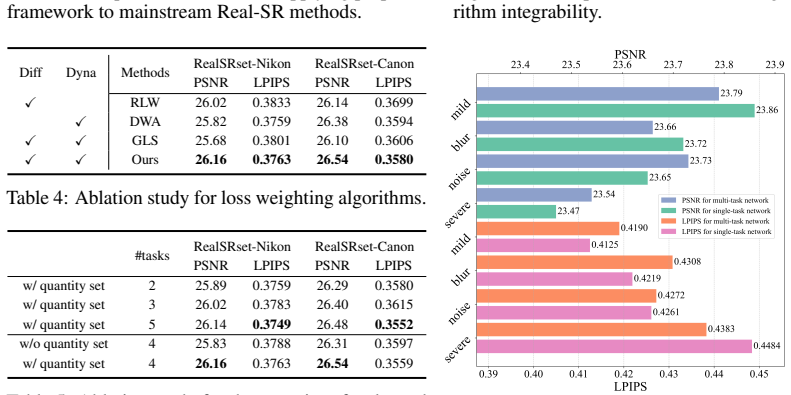
- [Table 4] The column headings 'Diff' and 'Dyna' for the loss-weighting ablation are not defined in the caption or text; please spell out what these conditions mean (e.g., difficulty-aware weighting and dynamic weight updating).
- [Section 4.2, Fig. 5] The sentence 'In specific experiments, we set parameter t to 40, corresponding to half of the complete training procedure' is unclear: t is not defined in the figure or in Section 3.2, where the interval notation is T_k. Please define t and explain how the interval length is chosen.
- [Throughout] There are several typos and notation inconsistencies, including 'Redefination' in the Section 3.1 title, the use of 'Equ.' versus 'Eq.', and the undefined notation N_single^tau and N_multi^tau in Eq. (3); a careful proofread would improve clarity.
Circularity Check
No significant circularity: the loss-weight-to-data-volume conversion is an algebraic identity, weights are measured from external single-task/multi-task comparisons, and the main gains are supported by ablations and independent real-world benchmarks.
full rationale
The paper's central derivation, Eqs. 5-12, is a closed-form algebraic equivalence: starting from a per-task loss definition and a uniform per-sample weight, it derives N_i = N·w_i. This is not circular because the task weights w_i are measured quantities—PSNR distances between a separately trained single-task network and the current multi-task network—not quantities constructed from the reported evaluation metrics. The empirical claims are further supported by ablation studies (Tables 4 and 5) and by consistent gains on real-world datasets (RealSR, DRealSR) that are not synthesized from the paper's four-subspace task partition, which would not be expected if the result reduced to a design tautology. The only mild concern, that the DIV2K4Level test set is aligned with the same degradation subspaces used in task definition, is an evaluation-design issue rather than a circular derivation, and it does not affect the independent real-world benchmark results. No load-bearing self-citations or imported uniqueness theorems are present.
Assumptions & free parameters
free parameters (2)
- Number of degradation subspaces and their boundaries =
4 tasks (mild, blur, noise, severe); exact blur and noise boundaries deferred to supplementary
- Weight update interval t =
40
assumptions (4)
- domain assumption Degradation operators' discriminative power is stable and can be ranked by fine-tuning variance, allowing down-sampling and JPEG parameters to be excluded from task definition.
- domain assumption Unbiased random degradation sampling gives all tasks equal optimization priority.
- domain assumption PSNR distance between the shared network and single-task networks is a valid, monotonic proxy for task imbalance.
- standard math Standard arithmetic in the loss-to-sample equivalence of Eqs. 5 through 12.
Cite this review
Pith. "Pith review of Controlled Data Rebalancing in Multi-Task Learning for Real-World Image Super-Resolution." pith.science (2026). https://pith.science/paper/BDOHZL2E
@misc{pith2026250605607,
  author       = {Pith},
  title        = {Pith review of: Controlled Data Rebalancing in Multi-Task Learning for Real-World Image Super-Resolution},
  year         = {2026},
  howpublished = {\url{https://pith.science/paper/BDOHZL2E}},
  note         = {Machine review of arXiv:2506.05607}
}
read the original abstract
Real-world image super-resolution (Real-SR) is a challenging problem due to the complex degradation patterns in low-resolution images. Unlike approaches that assume a broadly encompassing degradation space, we focus specifically on achieving an optimal balance in how SR networks handle different degradation patterns within a fixed degradation space. We propose an improved paradigm that frames Real-SR as a data-heterogeneous multi-task learning problem, our work addresses task imbalance in the paradigm through coordinated advancements in task definition, imbalance quantification, and adaptive data rebalancing. Specifically, we introduce a novel task definition framework that segments the degradation space by setting parameter-specific boundaries for degradation operators, effectively reducing the task quantity while maintaining task discrimination. We then develop a focal loss based multi-task weighting mechanism that precisely quantifies task imbalance dynamics during model training. Furthermore, to prevent sporadic outlier samples from dominating the gradient optimization of the shared multi-task SR model, we strategically convert the quantified task imbalance into controlled data rebalancing through deliberate regulation of task-specific training volumes. Extensive quantitative and qualitative experiments demonstrate that our method achieves consistent superiority across all degradation tasks.
Figures


Figures from the paper (4 more)


Reference graph
Works this paper leans on
-
[1]
Ntire 2017 challenge on single image super-resolution: Dataset and study
Eirikur Agustsson and Radu Timofte. Ntire 2017 challenge on single image super-resolution: Dataset and study. InProceedings of the IEEE conference on computer vision and pattern recognition workshops, pages 126–135, 2017
2017
-
[2]
Marta Bistro´n and Zbigniew Piotrowski. Optimization of imaging reconnaissance systems using super- resolution: Efficiency analysis in interference conditions.Sensors (Basel, Switzerland), 24(24):7977, 2024
work page 2024
-
[3]
Toward real-world single image super-resolution: A new benchmark and a new model
Jianrui Cai, Hui Zeng, Hongwei Yong, Zisheng Cao, and Lei Zhang. Toward real-world single image super-resolution: A new benchmark and a new model. InProceedings of the IEEE/CVF international conference on computer vision, pages 3086–3095, 2019
2019
-
[4]
Adversarial diffusion compression for real-world image super-resolution
Bin Chen, Gehui Li, Rongyuan Wu, Xindong Zhang, Jie Chen, Jian Zhang, and Lei Zhang. Adversarial diffusion compression for real-world image super-resolution. InProceedings of the IEEE/CVF conference on computer vision and pattern recognition, 2025
work page 2025
-
[5]
Hat: Hybrid attention transformer for image restoration.arXiv preprint arXiv:2309.05239, 2023
Xiangyu Chen, Xintao Wang, Wenlong Zhang, Xiangtao Kong, Yu Qiao, Jiantao Zhou, and Chao Dong. Hat: Hybrid attention transformer for image restoration.arXiv preprint arXiv:2309.05239, 2023
arXiv 2023
-
[6]
Multinet++: Multi-stream feature aggregation and geometric loss strategy for multi-task learning
Sumanth Chennupati, Ganesh Sistu, Senthil Yogamani, and Samir A Rawashdeh. Multinet++: Multi-stream feature aggregation and geometric loss strategy for multi-task learning. InProceedings of the IEEE/CVF conference on computer vision and pattern recognition workshops, pages 0–0, 2019
work page 2019
-
[7]
Learning a deep convolutional network for image super-resolution
Chao Dong, Chen Change Loy, Kaiming He, and Xiaoou Tang. Learning a deep convolutional network for image super-resolution. InComputer Vision–ECCV 2014: 13th European Conference, Zurich, Switzerland, September 6-12, 2014, Proceedings, Part IV 13, pages 184–199. Springer, 2014
2014
-
[8]
Tsd-sr: One-step diffusion with target score distillation for real-world image super- resolution
Linwei Dong, Qingnan Fan, Yihong Guo, Zhonghao Wang, Qi Zhang, Jinwei Chen, Yawei Luo, and Changqing Zou. Tsd-sr: One-step diffusion with target score distillation for real-world image super- resolution. InProceedings of the IEEE/CVF conference on computer vision and pattern recognition, 2025
work page 2025
Show all 46 references
-
[9]
Adadiffsr: Adaptive region-aware dynamic acceleration diffusion model for real-world image super-resolution
Yuanting Fan, Chengxu Liu, Nengzhong Yin, Changlong Gao, and Xueming Qian. Adadiffsr: Adaptive region-aware dynamic acceleration diffusion model for real-world image super-resolution. InEuropean Conference on Computer Vision, pages 396–413. Springer, 2024
2024
-
[10]
Efficiently identifying task groupings for multi-task learning.Advances in Neural Information Processing Systems, 34:27503–27516, 2021
Chris Fifty, Ehsan Amid, Zhe Zhao, Tianhe Yu, Rohan Anil, and Chelsea Finn. Efficiently identifying task groupings for multi-task learning.Advances in Neural Information Processing Systems, 34:27503–27516, 2021
2021
-
[11]
Sample-level weighting for multi-task learning with auxiliary tasks.Applied Intelligence, 54(4):3482–3501, 2024
Emilie Grégoire, Muhammad Hafeez Chaudhary, and Sam Verboven. Sample-level weighting for multi-task learning with auxiliary tasks.Applied Intelligence, 54(4):3482–3501, 2024
2024
-
[12]
Blind super-resolution with iterative kernel correction
Jinjin Gu, Hannan Lu, Wangmeng Zuo, and Chao Dong. Blind super-resolution with iterative kernel correction. InProceedings of the IEEE/CVF conference on computer vision and pattern recognition, pages 1604–1613, 2019
2019
-
[13]
Dynamic task prioritization for multitask learning
Michelle Guo, Albert Haque, De-An Huang, Serena Yeung, and Li Fei-Fei. Dynamic task prioritization for multitask learning. InProceedings of the European conference on computer vision (ECCV), pages 270–287, 2018
2018
-
[14]
Unfolding the alternating optimization for blind super resolution.Advances in Neural Information Processing Systems, 33:5632–5643, 2020
Yan Huang, Shang Li, Liang Wang, Tieniu Tan, et al. Unfolding the alternating optimization for blind super resolution.Advances in Neural Information Processing Systems, 33:5632–5643, 2020. 10
2020
-
[15]
Multi-task learning using uncertainty to weigh losses for scene geometry and semantics
Alex Kendall, Yarin Gal, and Roberto Cipolla. Multi-task learning using uncertainty to weigh losses for scene geometry and semantics. InProceedings of the IEEE conference on computer vision and pattern recognition, pages 7482–7491, 2018
2018
-
[16]
Accurate image super-resolution using very deep convolutional networks
Jiwon Kim, Jung Kwon Lee, and Kyoung Mu Lee. Accurate image super-resolution using very deep convolutional networks. InProceedings of the IEEE conference on computer vision and pattern recognition, pages 1646–1654, 2016
2016
-
[17]
Ubernet: Training a universal convolutional neural network for low-, mid-, and high- level vision using diverse datasets and limited memory
Iasonas Kokkinos. Ubernet: Training a universal convolutional neural network for low-, mid-, and high- level vision using diverse datasets and limited memory. InProceedings of the IEEE conference on computer vision and pattern recognition, pages 6129–6138, 2017
2017
-
[18]
Photo-realistic single image super- resolution using a generative adversarial network
Christian Ledig, Lucas Theis, Ferenc Huszár, Jose Caballero, Andrew Cunningham, Alejandro Acosta, Andrew Aitken, Alykhan Tejani, Johannes Totz, Zehan Wang, et al. Photo-realistic single image super- resolution using a generative adversarial network. InProceedings of the IEEE c...
2017
-
[19]
Efficient and degradation-adaptive network for real-world image super-resolution
Jie Liang, Hui Zeng, and Lei Zhang. Efficient and degradation-adaptive network for real-world image super-resolution. InEuropean Conference on Computer Vision, pages 574–591. Springer, 2022
2022
-
[20]
Swinir: Image restoration using swin transformer
Jingyun Liang, Jiezhang Cao, Guolei Sun, Kai Zhang, Luc Van Gool, and Radu Timofte. Swinir: Image restoration using swin transformer. InProceedings of the IEEE/CVF international conference on computer vision, pages 1833–1844, 2021
2021
-
[21]
Lukas Liebel and Marco Körner. Single-image super resolution for multispectral remote sensing data using convolutional neural networks.The International Archives of the Photogrammetry, Remote Sensing and Spatial Information Sciences, 41:883–890, 2016
2016
-
[22]
Reasonable effectiveness of random weighting: A litmus test for multi-task learning.arXiv preprint arXiv:2111.10603, 2021
Baijiong Lin, Feiyang Ye, Yu Zhang, and Ivor W Tsang. Reasonable effectiveness of random weighting: A litmus test for multi-task learning.arXiv preprint arXiv:2111.10603, 2021
2021 arXiv
-
[23]
End-to-end multi-task learning with attention
Shikun Liu, Edward Johns, and Andrew J Davison. End-to-end multi-task learning with attention. In Proceedings of the IEEE/CVF conference on computer vision and pattern recognition, pages 1871–1880, 2019
2019
-
[24]
Cross-stitch networks for multi- task learning
Ishan Misra, Abhinav Shrivastava, Abhinav Gupta, and Martial Hebert. Cross-stitch networks for multi- task learning. InProceedings of the IEEE conference on computer vision and pattern recognition, pages 3994–4003, 2016
2016
-
[25]
Metric learning based interactive modulation for real-world super-resolution
Chong Mou, Yanze Wu, Xintao Wang, Chao Dong, Jian Zhang, and Ying Shan. Metric learning based interactive modulation for real-world super-resolution. InEuropean Conference on Computer Vision, pages 723–740. Springer, 2022
2022
-
[26]
Deep learning based autonomous vehicle super resolution doa estimation for safety driving.IEEE Transactions on Intelligent Transportation Systems, 22(7):4301–4315, 2020
Liangtian Wan, Yuchen Sun, Lu Sun, Zhaolong Ning, and Joel JPC Rodrigues. Deep learning based autonomous vehicle super resolution doa estimation for safety driving.IEEE Transactions on Intelligent Transportation Systems, 22(7):4301–4315, 2020
2020
-
[27]
Vcisr: Blind single image super-resolution with video compression synthetic data
Boyang Wang, Bowen Liu, Shiyu Liu, and Fengyu Yang. Vcisr: Blind single image super-resolution with video compression synthetic data. InProceedings of the IEEE/CVF Winter Conference on Applications of Computer Vision, pages 4302–4312, 2024
2024
-
[28]
Unsupervised degradation representation learning for blind super-resolution
Longguang Wang, Yingqian Wang, Xiaoyu Dong, Qingyu Xu, Jungang Yang, Wei An, and Yulan Guo. Unsupervised degradation representation learning for blind super-resolution. InProceedings of the IEEE/CVF conference on computer vision and pattern recognition, pages 10581–10590, 2021
2021
-
[29]
Real-esrgan: Training real-world blind super- resolution with pure synthetic data
Xintao Wang, Liangbin Xie, Chao Dong, and Ying Shan. Real-esrgan: Training real-world blind super- resolution with pure synthetic data. InProceedings of the IEEE/CVF international conference on computer vision, pages 1905–1914, 2021
1905
-
[30]
Recovering realistic texture in image super- resolution by deep spatial feature transform
Xintao Wang, Ke Yu, Chao Dong, and Chen Change Loy. Recovering realistic texture in image super- resolution by deep spatial feature transform. InProceedings of the IEEE conference on computer vision and pattern recognition, pages 606–615, 2018
2018
-
[31]
Sinsr: diffusion-based image super-resolution in a single step
Yufei Wang, Wenhan Yang, Xinyuan Chen, Yaohui Wang, Lanqing Guo, Lap-Pui Chau, Ziwei Liu, Yu Qiao, Alex C Kot, and Bihan Wen. Sinsr: diffusion-based image super-resolution in a single step. InProceedings of the IEEE/CVF conference on computer vision and pattern recognition, pa...
2024
-
[32]
Image quality assessment: from error visibility to structural similarity.IEEE transactions on image processing, 13(4):600–612, 2004
Zhou Wang, Alan C Bovik, Hamid R Sheikh, and Eero P Simoncelli. Image quality assessment: from error visibility to structural similarity.IEEE transactions on image processing, 13(4):600–612, 2004. 11
2004
-
[33]
Component divide-and-conquer for real-world image super-resolution
Pengxu Wei, Ziwei Xie, Hannan Lu, Zongyuan Zhan, Qixiang Ye, Wangmeng Zuo, and Liang Lin. Component divide-and-conquer for real-world image super-resolution. InComputer Vision–ECCV 2020: 16th European Conference, Glasgow, UK, August 23–28, 2020, Proceedings, Part VIII 16, page...
2020
-
[34]
One-step effective diffusion network for real-world image super-resolution.Advances in Neural Information Processing Systems, 37:92529–92553, 2024
Rongyuan Wu, Lingchen Sun, Zhiyuan Ma, and Lei Zhang. One-step effective diffusion network for real-world image super-resolution.Advances in Neural Information Processing Systems, 37:92529–92553, 2024
2024
-
[35]
Seesr: Towards semantics-aware real-world image super-resolution
Rongyuan Wu, Tao Yang, Lingchen Sun, Zhengqiang Zhang, Shuai Li, and Lei Zhang. Seesr: Towards semantics-aware real-world image super-resolution. InProceedings of the IEEE/CVF conference on computer vision and pattern recognition, pages 25456–25467, 2024
2024
-
[36]
Gradient surgery for multi-task learning.Advances in neural information processing systems, 33:5824–5836, 2020
Tianhe Yu, Saurabh Kumar, Abhishek Gupta, Sergey Levine, Karol Hausman, and Chelsea Finn. Gradient surgery for multi-task learning.Advances in neural information processing systems, 33:5824–5836, 2020
2020
-
[37]
Resshift: Efficient diffusion model for image super- resolution by residual shifting.Advances in Neural Information Processing Systems, 36:13294–13307, 2023
Zongsheng Yue, Jianyi Wang, and Chen Change Loy. Resshift: Efficient diffusion model for image super- resolution by residual shifting.Advances in Neural Information Processing Systems, 36:13294–13307, 2023
2023
-
[38]
Achievement-based training progress balancing for multi-task learning
Hayoung Yun and Hanjoo Cho. Achievement-based training progress balancing for multi-task learning. In Proceedings of the IEEE/CVF International Conference on Computer Vision, pages 16935–16944, 2023
2023
-
[39]
Taskonomy: Disentangling task transfer learning
Amir R Zamir, Alexander Sax, William Shen, Leonidas J Guibas, Jitendra Malik, and Silvio Savarese. Taskonomy: Disentangling task transfer learning. InProceedings of the IEEE conference on computer vision and pattern recognition, pages 3712–3722, 2018
2018
-
[40]
Designing a practical degradation model for deep blind image super-resolution
Kai Zhang, Jingyun Liang, Luc Van Gool, and Radu Timofte. Designing a practical degradation model for deep blind image super-resolution. InProceedings of the IEEE/CVF international conference on computer vision, pages 4791–4800, 2021
2021
-
[41]
Learning a single convolutional super-resolution network for multiple degradations
Kai Zhang, Wangmeng Zuo, and Lei Zhang. Learning a single convolutional super-resolution network for multiple degradations. InProceedings of the IEEE conference on computer vision and pattern recognition, pages 3262–3271, 2018
2018
-
[42]
The unreasonable effectiveness of deep features as a perceptual metric
Richard Zhang, Phillip Isola, Alexei A Efros, Eli Shechtman, and Oliver Wang. The unreasonable effectiveness of deep features as a perceptual metric. InProceedings of the IEEE conference on computer vision and pattern recognition, pages 586–595, 2018
2018
-
[43]
Real-world image super-resolution as multi-task learning.Advances in Neural Information Processing Systems, 36:21003–21022, 2023
Wenlong Zhang, Xiaohui Li, Guangyuan Shi, Xiangyu Chen, Yu Qiao, Xiaoyun Zhang, Xiao-Ming Wu, and Chao Dong. Real-world image super-resolution as multi-task learning.Advances in Neural Information Processing Systems, 36:21003–21022, 2023
2023
-
[44]
Image super-resolution using very deep residual channel attention networks
Yulun Zhang, Kunpeng Li, Kai Li, Lichen Wang, Bineng Zhong, and Yun Fu. Image super-resolution using very deep residual channel attention networks. InProceedings of the European conference on computer vision (ECCV), pages 286–301, 2018
2018
-
[45]
Residual dense network for image super-resolution
Yulun Zhang, Yapeng Tian, Yu Kong, Bineng Zhong, and Yun Fu. Residual dense network for image super-resolution. InProceedings of the IEEE conference on computer vision and pattern recognition, pages 2472–2481, 2018
2018
-
[46]
Csrgan: medical image super-resolution using a generative adversarial network
Yongpei Zhu, Zicong Zhou, Guojun Liao, and Kehong Yuan. Csrgan: medical image super-resolution using a generative adversarial network. In2020 IEEE 17th international symposium on biomedical imaging workshops (ISBI Workshops), pages 1–4. IEEE, 2020. 12
2020
Reviewed August 7, 2026 · model on record in the stance chip above.
Discussion (0). Sign in to comment.