How Tough Is Location Anonymization? Re-identifying 100K Real-User Trajectories in Japan
Pith reviewed 2026-05-19 10:21 UTC · model grok-4.3
The pith
Re-identification succeeds on anonymized mobility data from 100,000 users in Japan by recovering hidden locations and times.
A machine-rendered reading of the paper's core claim, the machinery that carries it, and where it could break.
Core claim
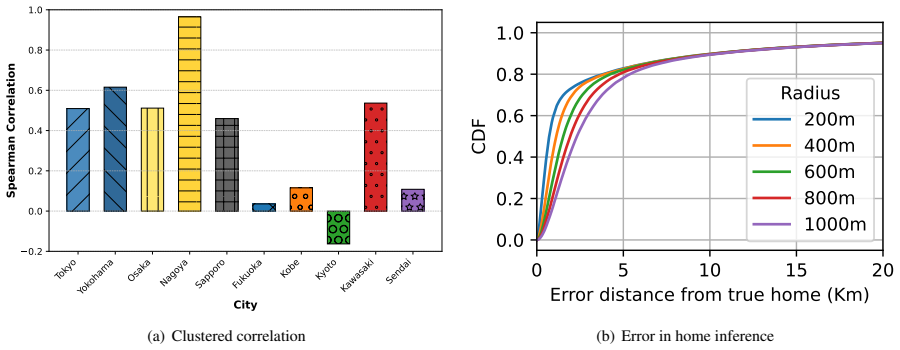
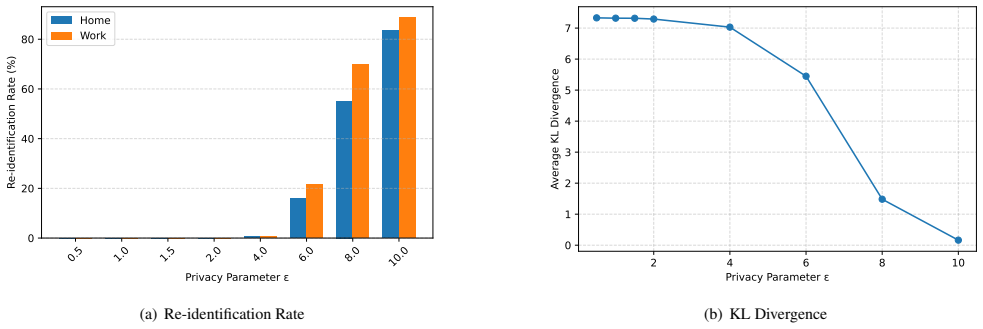
The sanitization applied to the YJMob100K dataset leaves enough spatial and temporal structure to recover both the real-world geographic frame and the actual calendar timeline by exploiting density signatures, urban correlations, and temporal activity profiles. On top of this reconstruction, metrics capturing spatio-temporal k-anonymity, point unicity, home-work uniqueness, and exposure to sensitive locations reveal extensive re-identification surfaces. Representative sanitization strategies like geo-indistinguishability and local differential privacy either destroy utility at strong privacy levels or leave structural leakage intact at utility-preserving levels.
What carries the argument
Reconstruction of geographic and temporal context from density signatures, urban correlations, and temporal activity profiles, followed by trajectory-level privacy metrics such as k-anonymity and anchor uniqueness.
If this is right
- Strong privacy parameters in sanitization methods destroy the data's utility for downstream analysis.
- Utility-preserving parameter settings leave the structural leakage largely intact.
- A small number of observations or visits to sensitive venues often suffices to uniquely identify users.
- Current sanitization techniques prove insufficient for protecting large-scale mobility data.
- Trajectory-aware privacy mechanisms and stronger publication standards are needed.
Where Pith is reading between the lines
- Similar re-identification risks likely apply to mobility datasets released in other countries with comparable urban structures.
- Organizations publishing trajectory data may need to adopt more sophisticated de-identification that accounts for spatio-temporal correlations.
- Policy makers could develop guidelines requiring validation against re-identification attacks before release.
- Researchers might explore hybrid methods combining differential privacy with trajectory-specific noise.
Load-bearing premise
The anonymized data still contains enough recognizable patterns from movement density and timing to map it back to real places and dates.
What would settle it
A successful falsification would occur if the reconstructed geographic frame from density signatures does not align with actual locations in Japan when verified against public geographic data.
Figures



read the original abstract
Mobility traces are among the most revealing forms of personal data, yet trajectory releases are often protected only by ad hoc transformations. We stress-test such practices on recently-released YJMob100K, an anonymized dataset of 100,000 user trajectories in Japan. First, we show that the applied protection leaves enough spatial and temporal structure to recover both the real-world geographic frame and the actual calendar timeline by exploiting density signatures, urban correlations, and temporal activity profiles. On top of this reconstruction, we quantify privacy risks through trajectory-level metrics that capture spatio-temporal k-anonymity, -point unicity, home-work and multi-anchor uniqueness, and exposure to secluded and sensitive locations. These metrics reveal extensive re-identification surfaces: a small number of observations, anchors, or sensitive venues often suffices to uniquely pinpoint users or their social neighborhoods. Finally, we evaluate representative sanitization strategies: geo-indistinguishability, local differential privacy, and aggressive spatial de-structuring; and observe a consistent pattern: strong privacy parameters destroy downstream utility, while utility-preserving settings leave structural leakage largely intact. Overall, our findings show that current sanitization techniques are insufficient for large-scale mobility data, and they highlight the urgent need for trajectory-aware privacy mechanisms and stronger publication standards.
Editorial analysis
A structured set of objections, weighed in public.
Referee Report
Summary. The paper stress-tests ad hoc anonymization on the YJMob100K dataset of 100,000 real-user trajectories in Japan. It claims that the released data retains sufficient spatial and temporal structure to reconstruct the true geographic frame and calendar timeline via density signatures, urban correlations, and activity profiles. Building on this, it applies trajectory-level metrics (spatio-temporal k-anonymity, point unicity, home-work and multi-anchor uniqueness, exposure to sensitive locations) to quantify re-identification surfaces, then evaluates sanitization strategies (geo-indistinguishability, local differential privacy, spatial de-structuring) and reports that strong privacy parameters destroy utility while utility-preserving parameters leave structural leakage largely intact.
Significance. If the reconstruction accuracy and metric results hold, the work is significant as a large-scale empirical demonstration on a recently released real-user mobility dataset. It uses standard privacy metrics without circularity or invented parameters and provides concrete trade-off evidence between privacy and utility, supporting calls for trajectory-aware mechanisms and improved publication standards in location privacy.
major comments (3)
- [Abstract / Reconstruction section] Reconstruction pipeline (described in the abstract and presumably §3): the central claim that density signatures, urban correlations, and temporal profiles suffice to recover both the real-world geographic frame and actual calendar timeline lacks reported quantitative accuracy metrics, error rates, or validation against ground truth; without these, the extent of recoverable structure cannot be assessed.
- [Metrics and results] Privacy risk quantification (abstract and presumably §4): the metrics for spatio-temporal k-anonymity, point unicity, home-work uniqueness, and sensitive-location exposure are introduced, but the manuscript provides no tables or distributions showing the fraction of users with low k or high unicity; this is load-bearing for the claim of 'extensive re-identification surfaces'.
- [Sanitization experiments] Sanitization evaluation (abstract and presumably §5): the reported pattern that 'strong privacy parameters destroy downstream utility, while utility-preserving settings leave structural leakage largely intact' requires explicit before/after comparisons (e.g., metric values or utility scores at specific ε for geo-indistinguishability); the current high-level statement is insufficient to support the insufficiency conclusion.
minor comments (2)
- [Metrics definitions] Define or cite the exact formulas used for 'multi-anchor uniqueness' and 'exposure to secluded locations' to ensure reproducibility.
- [Dataset description] Add a table summarizing the dataset statistics (number of points per trajectory, spatial/temporal granularity) early in the paper.
Simulated Author's Rebuttal
We thank the referee for the constructive feedback and for recognizing the significance of our empirical analysis on the YJMob100K dataset. We address each major comment below and will incorporate the suggested additions in the revised manuscript.
read point-by-point responses
-
Referee: [Abstract / Reconstruction section] Reconstruction pipeline (described in the abstract and presumably §3): the central claim that density signatures, urban correlations, and temporal profiles suffice to recover both the real-world geographic frame and actual calendar timeline lacks reported quantitative accuracy metrics, error rates, or validation against ground truth; without these, the extent of recoverable structure cannot be assessed.
Authors: We agree that the reconstruction claims would be strengthened by explicit quantitative validation. In the revision we will expand §3 with a new subsection reporting accuracy metrics, error rates, and ground-truth validation results for both geographic frame recovery and calendar timeline alignment. revision: yes
-
Referee: [Metrics and results] Privacy risk quantification (abstract and presumably §4): the metrics for spatio-temporal k-anonymity, point unicity, home-work uniqueness, and sensitive-location exposure are introduced, but the manuscript provides no tables or distributions showing the fraction of users with low k or high unicity; this is load-bearing for the claim of 'extensive re-identification surfaces'.
Authors: The current version describes the metrics but does not include the requested aggregate statistics. We will add summary tables and distributions in the revised §4 that report the fraction of users below given k thresholds and above given unicity levels, directly supporting the extent of re-identification surfaces. revision: yes
-
Referee: [Sanitization experiments] Sanitization evaluation (abstract and presumably §5): the reported pattern that 'strong privacy parameters destroy downstream utility, while utility-preserving settings leave structural leakage largely intact' requires explicit before/after comparisons (e.g., metric values or utility scores at specific ε for geo-indistinguishability); the current high-level statement is insufficient to support the insufficiency conclusion.
Authors: We accept that concrete parameter-level comparisons are needed. The revised §5 will include tables and figures with before/after values of the privacy metrics and utility scores at specific ε (and equivalent parameters for the other mechanisms), making the trade-off evidence explicit. revision: yes
Circularity Check
No significant circularity
full rationale
This paper is an empirical analysis of an externally released dataset (YJMob100K) using standard privacy metrics including spatio-temporal k-anonymity, point unicity, and anchor uniqueness. The central claims rest on direct reconstruction of geographic and temporal frames from density signatures and quantitative evaluation of sanitization strategies, with no equations, fitted parameters, or self-citations that reduce results to inputs by construction. The argument is self-contained against external benchmarks.
Axiom & Free-Parameter Ledger
axioms (1)
- domain assumption The YJMob100K dataset was protected only by ad hoc transformations that leave spatial and temporal structure intact.
Lean theorems connected to this paper
-
IndisputableMonolith/Foundation/RealityFromDistinction.leanreality_from_one_distinction unclear?
unclearRelation between the paper passage and the cited Recognition theorem.
We leverage population density patterns, structural correlations, and temporal activity profiles to re-identify the dataset’s real-world location and timing.
What do these tags mean?
- matches
- The paper's claim is directly supported by a theorem in the formal canon.
- supports
- The theorem supports part of the paper's argument, but the paper may add assumptions or extra steps.
- extends
- The paper goes beyond the formal theorem; the theorem is a base layer rather than the whole result.
- uses
- The paper appears to rely on the theorem as machinery.
- contradicts
- The paper's claim conflicts with a theorem or certificate in the canon.
- unclear
- Pith found a possible connection, but the passage is too broad, indirect, or ambiguous to say the theorem truly supports the claim.
Reference graph
Works this paper leans on
-
[1]
Gonzalez, M. C., Hidalgo, C. A. & Barabasi, A.-L. Understanding individual human mobility patterns. nature 453, 779–782 (2008)
work page 2008
-
[2]
Montjoye, Y .-A. d., Hidalgo, C. A., Verleysen, M. & Blondel, V . D. Unique in the Crowd: The privacy bounds of human mobility. Sci. Reports 3, 1376, DOI: 10.1038/srep01376 (2013)
-
[3]
Yjmob100k: City-scale and longitudinal dataset of anonymized human mobility trajectories
Yabe, T.et al. Yjmob100k: City-scale and longitudinal dataset of anonymized human mobility trajectories. Sci. Data 11, 397 (2024)
work page 2024
-
[4]
Douriez, M., Doraiswamy, H., Freire, J. & Silva, C. T. Anonymizing NYC Taxi Data: Does It Matter? In Data Science and Advanced Analytics (DSAA), 2016 IEEE International Conference on , 140–148 (IEEE, 2016)
work page 2016
-
[5]
Revealing urban area from mobile positioning data
Pint´er, G. Revealing urban area from mobile positioning data. Sci. Reports 14, DOI: 10.1038/s41598-024-82006-5 (2024). 10/11
-
[6]
Zhong, Y ., Yuan, N. J., Zhong, W., Zhang, F. & Xie, X. You Are Where You Go: Inferring Demographic Attributes from Location Check-ins. In ACM WSDM, 295–304, DOI: 10.1145/2684822.2685287 (ACM, Shanghai China, 2015)
-
[7]
Please Forget Where I Was Last Summer: The Privacy Risks of Public Location (Meta)Data
Drakonakis, K., Ilia, P., Ioannidis, S. & Polakis, J. Please Forget Where I Was Last Summer: The Privacy Risks of Public Location (Meta)Data, DOI: 10.48550/arXiv.1901.00897 (2019). ArXiv:1901.00897 [cs]
work page internal anchor Pith review Pith/arXiv arXiv doi:10.48550/arxiv.1901.00897 1901
-
[8]
Fung, B. C., Wang, K., Chen, R. & Yu, P. S. Privacy-preserving data publishing: A survey of recent developments.ACM Comput. Surv. (Csur) 42, 1–53 (2010)
work page 2010
-
[9]
Acs, G. & Castelluccia, C. A Case Study: Privacy Preserving Release of Spatio-temporal Density in Paris. In ACM SIGKDD, KDD ’14, 1679–1688, DOI: 10.1145/2623330.2623361 (ACM, New York, NY , USA, 2014)
- [10]
-
[11]
Available online: https://data.humdata
Japan: High resolution population density maps + demographic estimates (2018). Available online: https://data.humdata. org/dataset/japan-high-resolution-population-density-maps-demographic-estimates (accessed on 3 June 2025)
work page 2018
-
[12]
Time and Date AS. Japanese holidays calendar. https://www.timeanddate.com/calendar/custom.html?year=2021&country= 26&cols=3&hol=9&df=1 (2021). Accessed: 2025-06-03
work page 2021
-
[13]
Typhoon hagibis: Japan suffers deadly floods and landslides from storm
BBC News. Typhoon hagibis: Japan suffers deadly floods and landslides from storm. https://www.bbc.com/news/ world-asia-50020108 (2019). Accessed: 2025-06-03
work page 2019
-
[14]
Gramaglia, M., Fiore, M., Furno, A. & Stanica, R. Glove: Towards privacy-preserving publishing of record-level-truthful mobile phone trajectories. ACM/IMS Trans. Data Sci. 2, DOI: 10.1145/3451178 (2021)
-
[15]
Chatzikokolakis, K., Andr´es, M. E., Bordenabe, N. E. & Palamidessi, C. Broadening the scope of differential privacy using metrics. In PETS, 82–102, DOI: 10.1007/978-3-642-39077-7 5 (Springer, 2013)
-
[16]
Kairouz, P., Bonawitz, K. & Ramage, D. Discrete distribution estimation under local privacy. In International Conference on Machine Learning, 2436–2444 (PMLR, 2016)
work page 2016
-
[17]
Wang, H. et al. PrivTrace: Differentially private trajectory synthesis by adaptive markov models. In 32nd USENIX Security Symposium (USENIX Security 23) , 1649–1666 (2023)
work page 2023
-
[18]
Andr´es, M. E., Bordenabe, N. E., Chatzikokolakis, K. & Palamidessi, C. Geo-indistinguishability: differential privacy for location-based systems. In ACM CCS, CCS ’13, 901–914, DOI: 10.1145/2508859.2516735 (2013)
-
[19]
CNIL – French Data Protection Authority
Commission Nationale de l’Informatique et des Libert´es. CNIL – French Data Protection Authority. https://www.cnil.fr (2025). Accessed: 2025-06-03
work page 2025
-
[20]
Personal Information Protection Commission (PPC)
Personal Information Protection Commission Japan. Personal Information Protection Commission (PPC). https://www. ppc.go.jp/en/ (2025). Accessed: 2025-06-03
work page 2025
-
[21]
Yabe, T. et al. YJMob100K: City-Scale and Longitudinal Dataset of Anonymized Human Mobility Trajectories, DOI: 10.5281/zenodo.10836269 (2024). A Additional data A.1 Top 10 residential grids We identify the top 10 residential grid cells by user count as follows: (82.0, 135.0), (77.0, 135.0), (81.0, 135.0), (82.0, 149.0), (77.0, 134.0), (87.0, 141.0), (80.0...
discussion (0)
Sign in with ORCID, Apple, or X to comment. Anyone can read and Pith papers without signing in.