REVIEW 4 major objections 7 minor 29 references
Heterogeneous Sequel-Aware Graph Neural Networks for Sequential Learning
T0 review · 4 major / 7 minor · reviewed 2026-08-07 · deepseek-v4-flash
Pith's one-line read Explicitly modeling item-sequel links in a heterogeneous GNN improves next-item recommendation when enough items belong to series, with gains scaling with sequel density.
desk verdict A novel sequel-edge construction, but the evaluation leaks future information and the ML-100K results contradict the abstract. read the letter →
The pith
A machine-rendered reading of the paper's core claim, the machinery that carries it, and where it could break.
The reading
What carries the argument
The load-bearing mechanism is sequel-aware message propagation. For each item $i$, the model computes $h^{\mathrm{seq}}_i = \frac{1}{|N_s(i)|} \sum_{j \in N_s(i)} h^{(l-1)}_j \cdot P(j)$, where $N_s(i)$ is the set of items that follow $i$ in its series and $P(j)$ is a sinusoidal positional encoding of $j$'s position in the series. This term is what injects ordered series structure into item embeddings; it is fused with long-term and short-term interaction embeddings and the fused representation updates the item node. When this term is removed or the sequel edges are noisy, the model's advantage over a user-item GCN shrinks.
What would settle it
Run HSAL-GNN and the strongest graph baseline on a dataset with publisher-verified series metadata, holding the user-item graph fixed. If the sequel-aware model does not beat the baseline on series-rich item slices, or if randomly shuffling sequel links does not degrade its scores, then the claimed benefit of sequel information is not real.
Extended reading notes
Core claim
The central claim is that temporal item-sequence structure is a usable signal for next-item recommendation. HSAL-GNN represents each item as either standalone or sequel; for sequel items it aggregates messages from the items that come later in the same series, weighted by a sinusoidal positional embedding, and then fuses this sequel-aware representation with long-term and short-term user-item signals before predicting the next item as a link in a sampled subgraph. The paper's empirical thesis is that this fusion improves ranking quality over graph-based recommendation without sequel information. The improvement concentrates in sequel-rich data: NDCG@10 rises by 6.46% over the strongest baseline on Goodreads, by a small margin on ML-1m, and not at all on ML-100K, where the model underperforms a graph baseline.
Load-bearing premise
The whole advantage depends on the sequel edges in the data being accurate and complete; MovieLens sequels are inferred by matching titles like 'Part 1' and 'Part 2', which can miss or mislabel series entries, and the Goodreads sample is described without reporting how it was drawn.
Editorial extensions
If this is right
- On platforms where items naturally form ordered series (books, films, games, courses), adding sequel edges to a recommender GNN should improve next-item ranking, with gains proportional to series density.
- Below a certain fraction of series items \u2014 around 4\u20138% in the paper's data \u2014 sequel-aware modeling stops helping and can lose to a plain graph model, so metadata coverage should be checked before adopting it.
- Fusion strategy matters: simple sum-based fusion of sequel and interaction signals outperformed mean, concatenation, and a more complex heterogeneous transformation on the tested datasets.
- The method extends to any directed, ordered item relation, not only entertainment sequels; prerequisite chains in education and versioned products are natural candidates for the same graph construction.
Reading between the lines
- The paper's pattern of results implies a practical decision rule the authors do not state: estimate the share of sequel items and the reliability of series metadata before adopting sequel-aware modeling; if either is low, a standard user-item GCN is likely the safer choice.
- A stronger test of the mechanism would use verified series metadata on MovieLens; the title-matching inference used here may understate the potential benefit of clean sequel edges.
- Because the paper reports only leave-one-out evaluation on sampled data, a live deployment would reveal whether the NDCG gains translate into user-facing recommendation quality.
Editorial analysis
A structured set of objections, weighed in public.
Referee Report
Summary. The paper proposes HSAL-GNN, a heterogeneous graph neural network for sequential recommendation that augments the user-item bipartite graph with item-item edges representing sequel relationships. The architecture combines long-term, short-term, and sequel-aware item embeddings through several fusion strategies and uses sinusoidal positional encodings. The authors evaluate on three synthetic and three real-world datasets against GRU4Rec, SASRec, BERT4Rec, SVAE, ACVAE, DiffuRec, STOSA, and DGSR, using a leave-one-out protocol. The central claim is that explicitly modeling sequel relations improves or matches state-of-the-art graph-based sequential recommenders, especially when sequel information is abundant. The paper also includes an ablation study and a sensitivity analysis of hyperparameters.
Significance. The problem of exploiting item-series structure is timely and under-explored, and the idea of encoding such structure in a heterogeneous GNN is reasonable. The paper offers a broad empirical comparison and a detailed ablation, and it makes code available. If the claimed improvements were established with a sound evaluation protocol, the contribution would be useful to the recommender-systems community. However, the current evaluation suffers from a serious temporal-leakage issue that casts doubt on the reported gains, several reported results contradict the text, and internal inconsistencies appear in the ablation table. As a result, the significance of the contribution is not established by the experiments as reported.
major comments (4)
- [§4.1, §4.2, §4.3.2] The sequel-edge construction in §4.1 and the subgraph sampling in Algorithm 1 create item-item edges without any timestamp restriction. Section 4.3.2 defines hseq_i by aggregating over 'subsequent items in the sequel series.' In the leave-one-out protocol (§5.4), the held-out next item is frequently a direct successor of an item already in the user's history; because the graph contains all user interactions and sequel edges are formed over the full series, the candidate item's embedding can incorporate information from interactions that occur after the prediction time, including the target item itself. This gives HSAL-GNN access to future information that DGSR and other baselines do not have, so the reported gains in Tables 2 and 3 do not measure the value of sequel-aware representation. The authors should restrict sequel edges to pairs whose interaction timestamps are both before the prediction time, or re-run the evaluation under a strict temporal split (e.g., training only on edges with t < t_k for each user). Without such a correction, the central claim in the abstract is not supported.
- [§5.5, Table 3, Table 2] Section 5.5 states that ML-100K 'sees little to no improvement' and that the Non-Sequential synthetic dataset shows 'minimal improvements.' Table 3 shows that on ML-100K HSAL-GNN is worse than DGSR on every metric, with NDCG@10 0.4347 vs 0.4439 and Hit@10 0.7241 vs 0.7288. Table 2 shows that on the Non-Sequential dataset HSAL-GNN is worse than DGSR on all metrics, including NDCG@10 0.0432 vs 0.0476. Also on the Sequential dataset, HSAL-GNN is slightly worse than DGSR on most metrics (e.g., NDCG@10 0.9529 vs 0.9553). These results contradict the text and weaken the abstract's claim of 'better (or comparable)' performance. The report should be corrected and the negative results discussed honestly.
- [Table 4] In Table 4, the 'Sinusoidal' positional-embedding row reports ML-1m NDCG@10 = 0.4347, while the 'Sum' fusion row (which uses the default sinusoidal embedding) reports 0.4795 and the corresponding HSAL-GNN result in Table 3 is 0.4796. The value 0.4347 is identical to the ML-100K NDCG@10 in Table 3, suggesting a copy-paste error. This inconsistency undermines the ablation claim that sinusoidal embeddings outperform rotary embeddings on ML-1m. The ablation table should be verified and corrected.
- [§5.2] Section 5.2 states that experiments are run five times and mean performance is reported, but no standard deviations or significance tests are provided. Many of the claimed improvements are small, for example ML-1m NDCG@10 0.4796 vs 0.4764, Goodreads NDCG@10 0.2074 vs 0.1948, and Mixed NDCG@10 0.4539 vs 0.4290. Without variance reporting, these differences may be due to random seed variation. The authors should report mean ± std over the five seeds and perform paired significance tests for the main comparisons.
minor comments (7)
- [§5.1, Table 1] The density formula is unclear and the values appear inconsistent: for Goodreads, 200k interactions / (2000 users × 6474 items) is about 1.5%, not 0.01%, and for ML-1m, 1.0M / (6040 × 3900) is about 4.2%, not 4.79%. Please clarify the formula and correct the numbers.
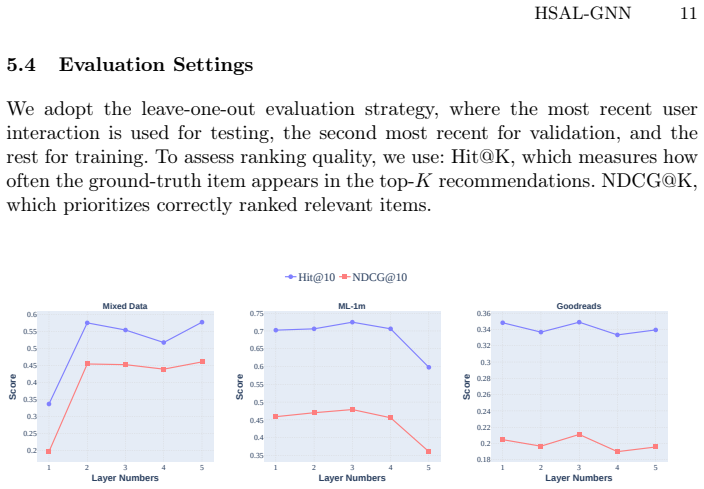
- [§5.7] The text says 'as illustrated in Figure 4' when discussing the effect of the number of layers, but the layer experiments are shown in Figure 3; Figure 4 is the bar-chart comparison. Please correct the cross-reference.
- [§1] The abbreviation 'LTSM' is a typo and should be 'LSTM'.
- [§4.1] The definition of ia and ib in Eq. (3) is confusing; please clarify that ia is the immediate predecessor and ib the immediate successor of ip in the series, and define the edge-tuple notation consistently.
- [§4.3.4] The 'SeHGNN-based transformation' is described only by name; please provide the exact equation or a precise reference to the specific layer so that the fusion strategy is reproducible.
- [§3.1] There are footnote markers 3 and 4 with no accompanying footnote text in the submission; please either supply the footnotes or remove the markers.
- [§5.2] The maximum sequence length is set to 50, while the average sequence length in Goodreads is 260.9 (Table 1); please explain how longer sequences are truncated and whether this affects the comparison.
Circularity Check
No significant circularity: HSAL-GNN's sequel-aware design is an empirical architectural contribution evaluated against external baselines, not a derivation that reduces to its own inputs.
full rationale
The paper does not claim to derive a result from first principles; it proposes a heterogeneous GNN architecture that incorporates sequel-aware item-item edges and evaluates it against standard baselines on synthetic and real-world datasets. The sequel-aware message propagation hseq_i = (1/|Ns(i)|) sum_{j in Ns(i)} (h_j * P(j)) is a modeling choice, not a fitted parameter that is later renamed as a prediction. The evaluation uses a leave-one-out protocol with training, validation, and test splits, and the reported Hit/NDCG gains are measured against external baselines such as DGSR, SASRec, and BERT4Rec. The ablation study tests fusion strategies and positional embeddings, but none of these variants is fitted to the test labels and then reported as an independent prediction. The paper contains no load-bearing self-citations: all references are to external prior work. A reader might worry that sequel edges built without timestamp constraints could leak future interactions, and that the gains on Goodreads and the losses on ML-100K are consistent with such leakage; however, that is a correctness or validity concern about the experimental setup, not a circularity in which the claimed result is equivalent to the input by construction. No equation in the paper defines the predicted next item in terms of the evaluation labels, and no fitted constant is passed off as an architectural result. Therefore the appropriate circularity score is 0.
Assumptions & free parameters
free parameters (7)
- Embedding dimension d =
50
- Sub-graph sampling order m =
4
- Number of GNN layers L =
tuned per dataset (final values not listed)
- Maximum sequence length =
50
- Learning rate =
0.01
- Batch size =
50
- Weight decay lambda =
1e-4
assumptions (4)
- domain assumption Sequel relationships are static and known a priori from series metadata or title matching.
- domain assumption Items in a sequel series have an ordered progression that users tend to consume in order.
- standard math Standard GNN message-passing converges to useful representations for recommendation.
- domain assumption The m-order sub-graph sampling preserves enough signal for link prediction.
Cite this review
Pith. "Pith review of Heterogeneous Sequel-Aware Graph Neural Networks for Sequential Learning." pith.science (2026). https://pith.science/paper/MZ4F7U2C
@misc{pith2026250605625,
  author       = {Pith},
  title        = {Pith review of: Heterogeneous Sequel-Aware Graph Neural Networks for Sequential Learning},
  year         = {2026},
  howpublished = {\url{https://pith.science/paper/MZ4F7U2C}},
  note         = {Machine review of arXiv:2506.05625}
}
read the original abstract
Graph-based recommendation systems use higher-order user and item embeddings for next-item predictions. Dynamically adding collaborative signals from neighbors helps to use similar users' preferences during learning. While item-item correlations and their impact on recommendations have been studied, the efficacy of temporal item sequences for recommendations is much less explored. In this paper, we examine temporal item sequence (sequel-aware) embeddings along with higher-order user embeddings and show that sequel-aware Graph Neural Networks have better (or comparable) recommendation performance than graph-based recommendation systems that do not consider sequel information. Extensive empirical results comparing Heterogeneous Sequel-aware Graph Neural Networks (HSAL-GNNs) to other algorithms for sequential learning (such as transformers, graph neural networks, auto-encoders) are presented on three synthetic and three real-world datasets. Our results indicate that the incorporation of sequence information from items greatly enhances recommendations.
Figures


Figures from the paper (3 more)


Reference graph
Works this paper leans on
-
[1]
Session-based recommen- dations with recurrent neural networks
Hidasi, B., Karatzoglou, A., Baltrunas, L. and Tikk, D., “Session-based recommen- dations with recurrent neural networks". arXiv preprint arXiv:1511.06939, 2015
arXiv 2015
-
[2]
Dynamic Graph Neural Networks for Sequential Recommendation
Mengqi Zhang, Shu Wu, Xueli Yu, Qiang Liu, and Liang Wang, “Dynamic Graph Neural Networks for Sequential Recommendation", IEEE Trans. on Knowl. and Data Eng. 35 (5), 4741–4753,2023
work page 2023
-
[3]
DiffuRec: A Diffusion Model for Sequential Recommendation
Zihao Li, Aixin Sun, and Chenliang Li, “DiffuRec: A Diffusion Model for Sequential Recommendation", ACM Trans. Inf. Syst. 42 (3),1–28, 2023
work page 2023
-
[4]
Modeling Se- quences as Distributions with Uncertainty for Sequential Recommendation
Ziwei Fan, Zhiwei Liu, Shen Wang, Lei Zheng, and Philip S. Yu, “Modeling Se- quences as Distributions with Uncertainty for Sequential Recommendation", In Proceedings of the International Conference on Information and Knowledge Man- agement (CIKM), pp 3019–3023, 2021
work page 2021
-
[5]
Sequential Recommendation via Stochastic Self-Attention
Ziwei Fan, Zhiwei Liu, Yu Wang, Alice Wang, Zahra Nazari, Lei Zheng, Hao Peng, and Philip S. Yu, “Sequential Recommendation via Stochastic Self-Attention", In Proceedings of the ACM Web Conference (WWW ’22). Association for Computing Machinery, New York, NY, USA, 2036–2047, 2022
work page 2022
-
[6]
Factorizing personalized Markov Chains for next-basket recommendation
S. Rendle, C. Freudenthaler, and L. Schmidt-Thieme, “Factorizing personalized Markov Chains for next-basket recommendation", In Proceedings of the Interna- tional conference on World Wide Web, pp. 811–820, 2010
work page 2010
-
[7]
Personalizing session- based recommendations with hierarchical recurrent neural networks
M. Quadrana, A. Karatzoglou, B. Hidasi, and P. Cremonesi, “Personalizing session- based recommendations with hierarchical recurrent neural networks", In Proceed- ings of the Eleventh ACM Conference on Recommender Systems, pp. 130–137, 2017
work page 2017
-
[8]
Recurrent neural networks with top-k gains for session-based recommendations
B. Hidasi and A. Karatzoglou, “Recurrent neural networks with top-k gains for session-based recommendations", In Proceedings of the 27th ACM International Conference on Information and Knowledge Management, 2018, pp. 843–852
work page 2018
Show all 29 references
-
[9]
A vatar, https://en.wikipedia.org/wiki/A vatar
-
[10]
Long short-term memory recurrent neural network architectures for large scale acoustic modeling
H. Sak, A. W. Senior, and F. Beaufays, “Long short-term memory recurrent neural network architectures for large scale acoustic modeling", 2014
2014
-
[11]
Empirical evaluation of gated recurrent neural networks on sequence modeling
J. Chung, C. Gulcehre, K. Cho, and Y. Bengio, “Empirical evaluation of gated recurrent neural networks on sequence modeling", arXiv preprint arXiv:1412.3555, 2014
2014 arXiv
-
[12]
Personalized top-n sequential recommendation via convo- lutional sequence embedding
J. Tang and K. Wang, “Personalized top-n sequential recommendation via convo- lutional sequence embedding", In Proceedings of the Eleventh ACM International Conference on Web Search and Data Mining, 2018, pp. 565–573
2018
-
[13]
Self-attentive sequential recommendation
W.-C. Kang and J. McAuley, “Self-attentive sequential recommendation", In IEEE International Conference on Data Mining(ICDM). IEEE, pp. 197–206, 2018
2018
-
[14]
Stamp: short-term attention/memory priority model for session-based recommendation
Q. Liu, Y. Zeng, R. Mokhosi, and H. Zhang, “Stamp: short-term attention/memory priority model for session-based recommendation", In Proceedings of the 24th ACM SIGKDD International Conference on Knowledge Discovery and Data Min- ing, 2018, pp. 1831–1839
2018
-
[15]
Variational autoen- coders for collaborative filtering
D. Liang, R. G. Krishnan, M. D. Hoffman, and T. Jebara, “Variational autoen- coders for collaborative filtering", In Proceedings of the World Wide Web Confer- ence, pp 689–698, 2018
2018
-
[16]
Sequential variational autoen- coders for collaborative filtering
N. Sachdeva, G. Manco, E. Ritacco, and V. Pudi, “Sequential variational autoen- coders for collaborative filtering", In Proceedings of the ACM International Con- ference on Web Search and Data Mining, pp 600–608, 2019
2019
-
[17]
Adversarial and contrastive variational autoencoder for sequential recommendation
Z. Xie, C. Liu, Y. Zhang, H. Lu, D. Wang, and Y. Ding, “Adversarial and contrastive variational autoencoder for sequential recommendation", In Proceedings of the Web Conference, pp 449–459, 2021. 16 Anushka Tiwari, Haimonti Dutta( ), and Shahrzad Khanizadeh
2021
-
[18]
An MDP-based recommender system
Guy Shani, David Heckerman, Ronen I. Brafman, and Craig Boutilier, “An MDP-based recommender system", Journal of Machine Learning Research, 6, 9, 1265–1295, 2005
2005
-
[19]
BERT4Rec: Sequential recommendation with bidirectional encoder representations from Transformer
F. Sun, J. Liu, J. Wu, C. Pei, X. Lin, W. Ou, and P. Jiang, “BERT4Rec: Sequential recommendation with bidirectional encoder representations from Transformer", In Proceedings of the ACM International Conference on Information and Knowledge Management, pp 1441–1450, 2019
2019
-
[20]
Leveraging two types of global graph for sequential fashion recommendation
Y. Ding, Y. Ma, W. K. Wong, and T.S. Chua, “Leveraging two types of global graph for sequential fashion recommendation", In Proceedings of the International Conference on Multimedia Retrieval. pp 73–81, 2021
2021
-
[21]
Session-based recommen- dation with graph neural networks
S. Wu, Y. Tang, Y. Zhu, L. Wang, X. Xie, and T. Tan, “Session-based recommen- dation with graph neural networks", In Proceedings of the AAAI Conference on Artificial Intelligence, Vol. 33, pp 346–353, 2019
2019
-
[22]
The Graph Neural Network Model,
F. Scarselli, M. Gori, A. C. Tsoi, M. Hagenbuchner and G. Monfardini, “The Graph Neural Network Model," in IEEE Transactions on Neural Networks, vol. 20, no. 1, pp. 61-80, Jan. 2009
2009
-
[23]
and Fan, D., 2023, June
Yang, X., Yan, M., Pan, S., Ye, X. and Fan, D., 2023, June. Simple and efficient heterogeneous graph neural network. In Proceedings of the AAAI conference on artificial intelligence (Vol. 37, No. 9, pp. 10816-10824)
2023
-
[24]
and McAuley, J., 2018, November
Kang, W.C. and McAuley, J., 2018, November. Self-attentive sequential recom- mendation. In 2018 IEEE international conference on data mining (ICDM) (pp. 197-206). IEEE
2018
-
[25]
and Li, C., 2023
Li, Z., Sun, A. and Li, C., 2023. Diffurec: A diffusion model for sequential recom- mendation. ACM Transactions on Information Systems, 42(3), pp.1-28
2023
-
[26]
and Yu, P.S., 2022, April
Fan, Z., Liu, Z., Wang, Y., Wang, A., Nazari, Z., Zheng, L., Peng, H. and Yu, P.S., 2022, April. Sequential recommendation via stochastic self-attention. In Proceed- ings of the ACM web conference 2022 (pp. 2036-2047)
2022
-
[27]
Item Recommendation on Monotonic Behavior Chains
Wan, M. and McAuley, J. “Item Recommendation on Monotonic Behavior Chains", RecSys, 2018
2018
-
[28]
Fine-Grained Spoiler Detection from Large-Scale Review Corpora
Wan, M., Misra, R., Nakashole, N., McAuley, J., “Fine-Grained Spoiler Detection from Large-Scale Review Corpora", ACL, 2019
2019
-
[29]
While all the details have been described in the main paper, the appendix presents a visual represen- tation of the algorithm framework
MovieLens, https://grouplens.org/datasets/movielens/ Heterogeneous Sequel-Aware Graph Neural Networks for Sequential Learning Author information scrubbed for double-blind reviewing No Institute Given A Appendix A Figure 1 presents the overall framework for HSAL-GNN. While all ...
Reviewed August 7, 2026 · model on record in the stance chip above.
Discussion (0). Sign in to comment.