REVIEW 4 major objections 5 minor 92 references
Effect of Weak Measurement Reversal on Quantum Correlations in a Correlated Amplitude Damping Channel, with a Neural Network Perspective
T0 review · 4 major / 5 minor · reviewed 2026-08-07 · deepseek-v4-flash
Pith's one-line read Applying weak-measurement reversal to both qubits, rather than one, preserves quantum correlations far better under amplitude-damping noise, for all six correlation measures studied.
desk verdict Useful parameter scan of WMR under correlated noise, but the headline claim is built on an unnormalized comparison and the q→1 limit in Fig. 1(f) contradicts the stated evolution. read the letter →
The pith
A machine-rendered reading of the paper's core claim, the machinery that carries it, and where it could break.
The reading
What carries the argument
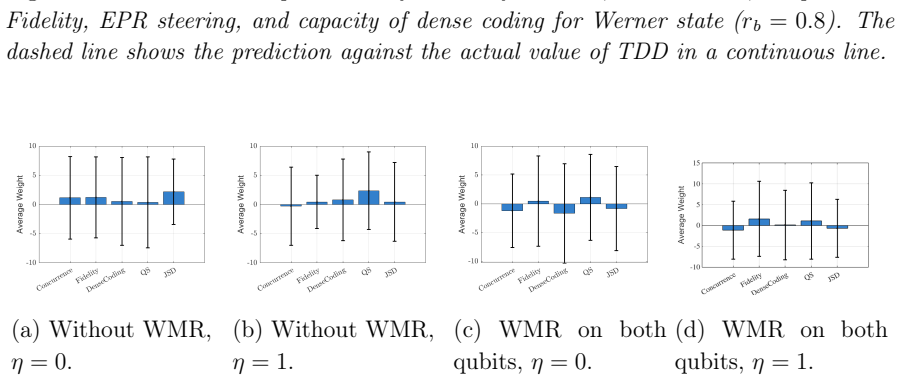
Two devices carry the argument. The first is the WMR protocol: a weak (partial-collapse) measurement of strength $q$ is applied to one or both qubits before the noise channel, and a quantum measurement reversal of strength $r$ is applied afterwards; both operations are non-unitary, and the optimal reversal strength $r$ is found numerically by maximizing the concurrence of the final state for the chosen $p$ and $q$, using closed-form concurrence expressions supplied in the appendices. The second is the correlated amplitude damping (CAD) channel with memory parameter $\eta$, which interpolates between a memoryless amplitude damping channel ($\eta = 0$) and a perfectly correlated one ($\eta = 1$), with Kraus operators that damp the two qubits together when the noise is correlated. For the machine-learning part, the mechanism is a MATLAB fitting network with 80 neurons in three hidden layers (40, 24, 16), using log-sigmoid, tangent-sigmoid, and linear activations, trained with the Levenberg–Marquardt algorithm to map Jensen–Shannon divergence, concurrence, teleportation fidelity, EPR steering, and dense coding capacity onto trace distance discord; the first-layer connection weights are then read as measures of each input's influence on the discord prediction.
What would settle it
A reader could settle the central claim by recomputation: for the Bell state with $p = 0.5$, $\eta = 0$, and two-qubit WMR, scan $q \in [0,1]$ and, at each $q$, find $r$ by a documented optimization of the closed-form concurrence (for example golden-section search to tolerance $10^{-8}$); the claim stands only if the resulting $N[\mathrm{QS}]$ and $N[\chi]$ curves reproduce the threshold crossings of Fig. 1(c). A separate check targets Appendix C directly: at $p = 0.5$, $q = 0.5$, $\eta = 0$, $\gamma = 0.8$ the one-qubit MEMS concurrence references $\sigma_5$, which is never defined, so as written the formula cannot be evaluated. An experimental version would prepare polarization-entangled photon pairs, pass them through an engineered amplitude-damping channel with controllable memory while applying the two-qubit WMR sequence, and verify that the range of $q$ where steering and dense coding stay above their classical limits matches the predicted range.
Extended reading notes
Core claim
The paper's central claim, stated on its own terms: the two-qubit WMR protocol significantly outperforms the single-qubit approach in preserving quantum correlations under a correlated amplitude damping channel. Concretely, for the Bell state, the Werner state with purity parameter $r_b = 0.8$, and a maximally entangled mixed state with $\gamma = 0.8$, all six normalized correlation measures — concurrence, Jensen–Shannon divergence, trace distance discord, EPR steering, dense coding capacity, and teleportation fidelity — recover more strongly under two-qubit WMR than under one-qubit WMR or no WMR, both with channel memory ($\eta = 1$) and without ($\eta = 0$). The paper further establishes that the decay of the correlations respects the known hierarchy of quantumness — steering and dense coding fall below their classical thresholds first, concurrence and teleportation fidelity next, discord and coherence last — and that channel memory slows the decay, delaying sudden death and turning abrupt drops into asymptotic ones. The one clear exception reported is EPR steering in the maximally entangled mixed state, which recovers better under memoryless noise with two-qubit WMR. Finally, the neural-network analysis claims that trace distance discord can be predicted from the other five correlations with low mean-squared error, and that the learned weights show concurrence and EPR steering as the most positive influences on that prediction.
Load-bearing premise
The quantitative results assume that the optimal reversal strength $r$ is found correctly by the numerical maximization of concurrence described in Sec. 2.2; the paper gives no algorithm, tolerance, or code for that maximization, and the appendix expressions meant to support it contain undefined symbols (such as $\sigma_5$ in the one-qubit MEMS case) and apparent typographical errors, so the plotted advantage of two-qubit over single-qubit WMR may not be exactly reproducible as stated.
Editorial extensions
If this is right
- Two-qubit WMR, rather than single-qubit WMR, is the protocol that keeps dense coding capacity and EPR steering above their classical thresholds: for Bell and Werner states it restores both into the useful regime over wide ranges of the weak-measurement strength $q$, where single-qubit WMR often leaves them below threshold.
- Memory in the noise is an ally: every state studied decays more slowly under $\eta = 1$ than under $\eta = 0$, so quantum communication over correlated or structured environments inherits longer-lived resources even without active protection.
- Because the six measures decay and recover in a fixed order (steering and dense coding first, discord and coherence last), no single measure is a reliable proxy for another during decoherence; schemes that need a specific resource must track it directly.
- Teleportation fidelity is not a strict entanglement monotone and dense coding capacity is not a strict monotone of steering, so protection claims require multi-measure characterisation rather than a single figure.
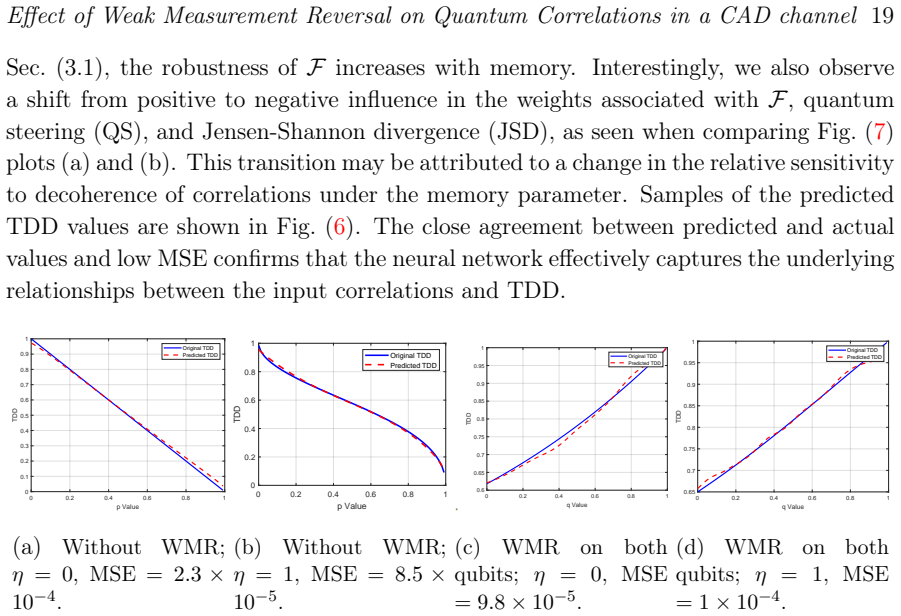
- Trace distance discord can be estimated from the five easier-to-compute correlations by a trained network with mean-squared error of order $10^{-4}$ or better, bypassing the hard optimisation in the definition of discord.
Reading between the lines
- A fully fair practical comparison would weight each recovered correlation by the probability of successful reversal, which falls as $q$ grows; the paper notes this tradeoff qualitatively but does not compute a cost-adjusted figure of merit, leaving open whether two-qubit WMR still wins per successful run.
- The neural-network surrogate points to an experimental shortcut: on platforms with existing concurrence and steering witnesses but expensive tomography, a network trained on simulated CAD dynamics could act as a discord estimator, provided the learned weight pattern generalises beyond Bell, Werner, and MEMS families.
- The MEMS steering exception — memoryless noise beating correlated noise under two-qubit WMR — suggests the optimal protection strategy is resource-dependent; designing a universal WMR setting may be less useful than tailoring $q$ and $r$ to the particular correlation a task needs.
- The claimed hierarchy could be tested dynamically in a single experiment: with a fixed initial state, verifying the ordering of threshold crossings as decoherence strength $p$ increases, and checking that WMR reverses the crossings in the same order, would confirm or refute the ordering picture independent of the specific measure values.
Editorial analysis
A structured set of objections, weighed in public.
Referee Report
Summary. The paper studies the evolution of six quantum correlation measures (Jensen-Shannon divergence, concurrence, trace distance discord, EPR steering, dense coding capacity, and teleportation fidelity) for Bell, Werner, and maximally entangled mixed states under a correlated amplitude-damping channel. It applies weak measurement and quantum measurement reversal (WMR) on one or both qubits and claims that the two-qubit protocol significantly outperforms the single-qubit protocol in preserving all studied correlations. The second part trains a MATLAB neural network to predict trace distance discord from the other five correlations, reporting low MSE and interpreting first-layer weights as feature relevance. The central channel and WMR formulas are standard, but the quantitative comparison is compromised by the trace-decreasing nature of the WMR map, the unspecified numerical optimization of the reversal strength, and the lack of statistical validation of the neural network claims.
Significance. If the central claim were established, the paper would provide a useful comparison of WMR-based protection across several correlation quantifiers, including with channel memory. The systematic study of Bell, Werner, and MEMS states under correlated amplitude damping is a reasonable contribution to the existing WMR literature, and the machine-learning section points to an interesting practical question about predicting hard-to-compute discords from more accessible correlations. The paper does not ship machine-checked derivations or reproducible code, and the appendix formulas contain undefined symbols, so the quantitative results are not currently reproducible as stated. The neural network part is conceptually circular as a predictive claim, since inputs and output are deterministic functions of the same density matrix, and no held-out evaluation is reported.
major comments (4)
- [2.2, Eq. (11); Sec. 3.1, Fig. 1] The WMR map in Eq. (11) is trace-decreasing because the operators in Eqs. (9)-(10) are non-unitary, and the paper never reports the success probability or normalizes the post-WMR state. This makes the claimed comparison between one-qubit and two-qubit WMR physically ambiguous: unnormalized expectation values are not correlation measures, while normalized values describe only the postselected branch. The inconsistency becomes explicit in Sec. 3.1: for q approaching 1, both M_WM factors project the |1> amplitudes to zero, so the normalized final state is |00><00| with zero concurrence, zero steering, and no dense-coding advantage; the statement that correlations approach their maximum values as q→1 in Fig. 1(f) is therefore incompatible with Eqs. (8)-(11) for any normalized state. The authors must either provide the success probability, normalize the state after WMR, or compare resource-normalized correlations; without this, the central claim that two-qubit WMR significantly outperforms single-qubit WMR is not well defined.
- [2.2 and Appendices A-C] The optimization of the QMR strength r is described only as 'can be found numerically by maximizing the entanglement' (Sec. 2.2), with no algorithm, tolerance, grid, or code. The appendix expressions intended to support this are not self-contained: in Appendix C, σ5 is left undefined and σ6 is written as 'if 2/3 ≤ γ ≤ 1'; several σ variables in the MEMS one-qubit blocks are introduced with conditional definitions that do not define the quantities used in the density-matrix entries. As a result, the reported improvement curves cannot be reproduced exactly from the manuscript. The authors should provide well-defined expressions (or a supplementary notebook) for the optimized r and for every density-matrix element and concurrence formula used in Figs. 1-4.
- [4, Eq. (30), Figs. 6 and 7] The neural network prediction is presented as a discovery that TDD can be predicted from JSD, concurrence, fidelity, steering, and dense coding capacity, but all six quantities are deterministic functions of the same two-qubit density matrix, so the network is fitting a known functional relation on in-sample data. The evaluation is also not statistically meaningful: the authors state that they ran over 20 iterations and chose the instance with the lowest MSE (Sec. 4), which is selection bias, and no train/test split, cross-validation, or out-of-distribution test is reported. The weight-relevance plots in Fig. 7 are based on a single selected network and lack error bars across independent initializations. A claim of 'successfully predict' requires held-out data and repeated runs with reported mean and spread, not a best-run MSE.
- [3, normalization of N[correlation]] The normalized correlations N[correlation] are used throughout Figs. 1-3, but the normalization is described only by an example for N[QS] and a list of 'maximum values and classical limits'. There is no explicit formula for N[χ], N[C], N[TDD], or N[JSD], and the list '2, 1, 1, 6, 1, 0.56 and 1, 2/3, 0, 2, 0, 0' is ambiguous about which number belongs to which measure. Because the paper's hierarchy and recovery comparisons rely on these normalized curves, the normalization must be stated unambiguously and, if the quantities are computed from an unnormalized operator, the trace-normalization issue from Eq. (11) propagates into every panel.
minor comments (5)
- [Sec. 3.3, Fig. 3(f)] The abstract states that two-qubit WMR significantly outperforms the single-qubit approach in preserving quantum correlations, but Sec. 3.3 reports that for MEMS with memory N[QS] does not recover at all under two-qubit WMR; the claim should be qualified with this exception.
- [Sec. 4, first paragraph of the Werner-state discussion] The text says 'Samples of the TDD prediction are shown in Fig. (7),' but Fig. 7 shows average weights; the prediction samples are in Fig. 8. The captions of Figs. 7 and 9 both say 'for Bell state' even though the surrounding text describes the Werner state (and the second occurrence should refer to Fig. 9, not Fig. 7).
- [2.6, Eq. (26)] The symbol QS is used both for the left-hand side of the steering inequality and as the name of the steering measure, and the paper later quotes a maximum value 6 and a classical limit 2 without deriving them from Eq. (26); a brief derivation or reference would clarify the range used in the normalized plots.
- [5, Conclusion] The concluding paragraph introduces a comparison between WMR and dynamical decoupling without quantitative support or references for the claimed regimes; this is speculative and could be trimmed or backed by specific citations.
- [Throughout] The typesetting of several appendix formulas is broken, with fragments such as 'σ5, σ6 = if 2/3 ≤ γ ≤ 1' and missing operators; even aside from the undefined symbols in my second major comment, the appendices should be carefully rewritten with consistent notation.
Circularity Check
Secondary neural-network 'prediction' of TDD is an in-sample fit; the central WMR claim is independent but has non-circular consistency defects.
-
fitted input called prediction
[Abstract and Section 4 (Analysis with neural networks), especially Eq. (30) and Figs. 6-8]
"Abstract: 'we successfully predict trace distance discord from other correlations, achieving low prediction errors.' Section 4: 'The neural network prediction performance is assessed using Mean Squared Error (MSE)... We ran over 20 iterations of the neural network predictions and chose the instance with the lowest MSE value.'"
The network is trained with TDD as the target by minimizing the same MSE that is later reported as 'prediction' error, and no train/test split or held-out set is described. The reported agreement between 'Original TDD' and 'Predicted TDD' is therefore the fitting error, not an independent predictive result. Moreover, all inputs (JSD, C, F, QS, chi) and the output TDD are deterministic functions of the same two-qubit density matrix, so the low MSE reflects fitting a known functional map rather than a falsifiable prediction. This is a fitted input renamed as a prediction, and it affects the secondary neural-network claim, not the main WMR comparison.
full rationale
The central WMR result is not circular: Eq. (11) defines rho_WMR as an explicit sequence of operations (WM, CAD, QMR), and the correlations C, JSD, TDD, QS, chi, and F are computed from the formulas in Secs. 2.1-2.6. The only fitted parameter r is optimized for Concurrence, and the one-qubit versus two-qubit comparison is not encoded in the definitions, so the two-qubit advantage is an independent numerical finding rather than a tautology. The paper's self-citations ([38], [78], [85], [88]) are background or supporting references for the hierarchy; none is load-bearing for the WMR claim. However, the neural-network section reports 'prediction' of TDD when the network is trained by minimizing MSE against the same TDD values, with no held-out data described; the low errors are fitting errors, so that specific abstract claim reduces to curve fitting by construction. Other serious defects are correctness/reproducibility issues rather than circularity: Eq. (11) defines a trace-decreasing operation and no success probability is reported, despite the Conclusion conceding the probabilistic nature; the Sec. 3.1 statement that correlations approach their maximum as q to 1 for two-qubit WMR with memory appears inconsistent with a normalized |00> final state; and Appendix C contains undefined symbols such as sigma_5. These do not make the derivation circular, but they prevent the reported numerical comparison from being reproduced as written. Score 6 reflects the fitted-input-called-prediction step in the secondary neural-network result.
Assumptions & free parameters
free parameters (4)
- QMR strength r =
optimized numerically for each p, q, η
- WM strength q =
scanned over [0,1] with p=0.5
- Initial state parameters =
r_b = 0.8, γ = 0.8
- Neural network architecture and run selection =
80 neurons in 3 layers (40,24,16), best of 20 runs
assumptions (5)
- domain assumption CAD channel model Eq. (7) with memory parameter η
- domain assumption WMR protocol operations Eqs. (9)-(11)
- standard math TDD formula Eq. (21) for X-states
- standard math EPR steering inequality Eq. (26)
- ad hoc to paper Neural network weights as feature relevance
Cite this review
Pith. "Pith review of Effect of Weak Measurement Reversal on Quantum Correlations in a Correlated Amplitude Damping Channel, with a Neural Network Perspective." pith.science (2026). https://pith.science/paper/V7WZSUBL
@misc{pith2026250605642,
  author       = {Pith},
  title        = {Pith review of: Effect of Weak Measurement Reversal on Quantum Correlations in a Correlated Amplitude Damping Channel, with a Neural Network Perspective},
  year         = {2026},
  howpublished = {\url{https://pith.science/paper/V7WZSUBL}},
  note         = {Machine review of arXiv:2506.05642}
}
read the original abstract
We study the evolution of quantum correlations in Bell, Werner, and maximally entangled mixed states of two qubits subjected to correlated amplitude-damping channels. Our primary focus is to evaluate the robustness of entanglement as a resource for quantum information protocols such as dense coding, teleportation, and Einstein-Podolsky-Rosen (EPR) steering under the influence of noise. In addition, we investigate the behaviour of other quantum correlations, including quantum discord and coherence, and analyze their hierarchy under decoherence. To counteract the detrimental effects of the channels, we apply the weak measurement and quantum measurement reversal (WMR) protocol, comparing the effectiveness of single-qubit and two-qubit WMR techniques. Our results show that the two-qubit WMR protocol significantly outperforms the single-qubit approach in preserving quantum correlations. Furthermore, we employ a neural network model to enhance our analysis of the relationship between different quantum correlation measures during the evolution. Using a MATLAB-based artificial neural network with 80 neurons across three hidden layers and trained with the Levenberg-Marquardt algorithm, we successfully predict trace distance discord from other correlations, achieving low prediction errors. Besides, our analysis of the neural network weights suggests that concurrence and EPR steering have the most positive influence on the accurate discord predictions.
Figures


Figures from the paper (6 more)




Reference graph
Works this paper leans on
-
[1]
Alexander Streltsov, Gerardo Adesso, and Martin B. Plenio. Colloquium: Quantum coherence as a resource.Rev. Mod. Phys., 89:041003, Oct 2017
2017
-
[2]
Quantum entanglement.Rev
Ryszard Horodecki, Paweł Horodecki, Michał Horodecki, and Karol Horodecki. Quantum entanglement.Rev. Mod. Phys., 81:865–942, Jun 2009
2009
-
[3]
Nielsen and Isaac L
Michael A. Nielsen and Isaac L. Chuang.Quantum Computation and Quantum Information: 10th Anniversary Edition. Cambridge University Press, 2010
2010
-
[4]
Decoherence, einselection, and the quantum origins of the classical.Rev
Wojciech Hubert Zurek. Decoherence, einselection, and the quantum origins of the classical.Rev. Mod. Phys., 75:715–775, May 2003
2003
-
[5]
Ting Yu and J. H. Eberly. Finite-time disentanglement via spontaneous emission.Phys. Rev. Lett., 93:140404, Sep 2004
2004
-
[6]
Sudden death of entanglement.Science, 323(5914):598–601, 2009
Ting Yu and JH Eberly. Sudden death of entanglement.Science, 323(5914):598–601, 2009
2009
-
[7]
Kwiat, Salvador Barraza-Lopez, André Stefanov, and Nicolas Gisin
Paul G. Kwiat, Salvador Barraza-Lopez, André Stefanov, and Nicolas Gisin. Experimental entanglement distillation and ‘hidden’ non-locality.Nature, 409(6823):1014–1017, 2 2001
2001
-
[8]
D. A. Lidar, I. L. Chuang, and K. B. Whaley. Decoherence-free subspaces for quantum computation.Phys. Rev. Lett., 81:2594–2597, Sep 1998
1998
Show all 92 references
-
[9]
Kwiat, Andrew J
Paul G. Kwiat, Andrew J. Berglund, Joseph B. Altepeter, and Andrew G. White. Experimental verification of decoherence-free subspaces.Science, 290(5491):498–501, 2000
2000
-
[10]
Dynamical decoupling of open quantum systems
Lorenza Viola, Emanuel Knill, and Seth Lloyd. Dynamical decoupling of open quantum systems. Phys. Rev. Lett., 82:2417–2421, Mar 1999
1999
-
[11]
Jiangfeng Du, Xing Rong, Nan Zhao, Ya Wang, Jiahui Yang, and R. B. Liu. Preserving electron spin coherence in solids by optimal dynamical decoupling.Nature, 461(7268):1265–1268, 10 2009
2009
-
[12]
Conner, Étienne Dumur, Joel Grebel, Rhys G
Haoxiong Yan, Youpeng Zhong, Hung-Shen Chang, Audrey Bienfait, Ming-Han Chou, Christopher R. Conner, Étienne Dumur, Joel Grebel, Rhys G. Povey, and Andrew N. Cleland. Entanglement purification and protection in a superconducting quantum network.Phys. Rev. Lett., 128:080504, Fe...
2022
-
[13]
Evolution of tripartite entangled states in a decohering environment and their experimental protection using dynamical decoupling.Phys
Harpreet Singh, Arvind, and Kavita Dorai. Evolution of tripartite entangled states in a decohering environment and their experimental protection using dynamical decoupling.Phys. Rev. A, 97:022302, Feb 2018
2018
-
[14]
Facchi, D
P. Facchi, D. A. Lidar, and S. Pascazio. Unification of dynamical decoupling and the quantum zeno effect.Phys. Rev. A, 69:032314, Mar 2004
2004
-
[15]
Zaffino, Nicola Lo Gullo, and Francesco Plastina
Sabrina Maniscalco, Francesco Francica, Rosa L. Zaffino, Nicola Lo Gullo, and Francesco Plastina. Protecting entanglement via the quantum zeno effect.Phys. Rev. Lett., 100:090503, Mar 2008
2008
-
[16]
Reversing the weak quantum measurement for a photonic qubit.Opt
Yong-Su Kim, Young-Wook Cho, Young-Sik Ra, and Yoon-Ho Kim. Reversing the weak quantum measurement for a photonic qubit.Opt. Express, 17(14):11978–11985, Jul 2009
2009
-
[17]
Korotkov and Kyle Keane
Alexander N. Korotkov and Kyle Keane. Decoherence suppression by quantum measurement reversal.Phys. Rev. A, 81:040103, Apr 2010
2010
-
[18]
Experimental demonstration of decoherence suppression via quantum measurement reversal.Opt
Jong-Chan Lee, Youn-Chang Jeong, Yong-Su Kim, and Yoon-Ho Kim. Experimental demonstration of decoherence suppression via quantum measurement reversal.Opt. Express, 19(17):16309–16316, Aug 2011
2011
-
[19]
Protecting entanglement from decoherence using weak measurement and quantum measurement reversal.Nature Physics, 8(2):117–120, 12 2011
Yong-Su Kim, Jong Chan Lee, Oh-Min Kwon, and Yoon-Ho Kim. Protecting entanglement from decoherence using weak measurement and quantum measurement reversal.Nature Physics, 8(2):117–120, 12 2011
2011
-
[20]
A. R. P. Rau, Mazhar Ali, and G. Alber. Hastening, delaying, or averting sudden death of quantum entanglement.EPL (Europhysics Letters), 82(4):40002, 4 2008
2008
-
[21]
Ashutosh Singh, Siva Pradyumna, A. R. P. Rau, and Urbasi Sinha. Manipulation of entanglement sudden death in an all-optical setup.J. Opt. Soc. Am. B, 34(3):681–690, Mar 2017
2017
-
[22]
Entanglement protection in higher-dimensional systems
Ashutosh Singh and Urbasi Sinha. Entanglement protection in higher-dimensional systems. Physica Scripta, 97(8):085104, jul 2022
2022
-
[23]
Saumya Ranjan Behera, Animesh Sinha Roy, Kallol Sen, Ashutosh Singh, A. R. P. Rau, and Urbasi Sinha. Decoherence manipulation through entanglement dynamics: A photonic experiment, arxiv:2505.16622, 2025
2025 arXiv
-
[24]
Reversing measurement and probabilistic quantum error correction.Phys
Masato Koashi and Masahito Ueda. Reversing measurement and probabilistic quantum error correction.Phys. Rev. Lett., 82:2598–2601, Mar 1999
1999
-
[25]
Korotkov and Andrew N
Alexander N. Korotkov and Andrew N. Jordan. Undoing a weak quantum measurement of a solid-state qubit.Phys. Rev. Lett., 97:166805, Oct 2006
2006
-
[26]
Protecting unknown qubit states from decoherence of qubit channels by weak measurement.Journal of Physics A: Mathematical and Theoretical, 55(23):235301, may 2022
Ozra Heibati, Azam Mani, Esfandyar Faizi, and Vahid Karimipour. Protecting unknown qubit states from decoherence of qubit channels by weak measurement.Journal of Physics A: Mathematical and Theoretical, 55(23):235301, may 2022
2022
-
[27]
Pramanik and A.S
T. Pramanik and A.S. Majumdar. Improving the fidelity of teleportation through noisy channels using weak measurement.Physics Letters A, 377(44):3209–3215, 2013
2013
-
[28]
Majumdar
Shounak Datta, Suchetana Goswami, Tanumoy Pramanik, and A.S. Majumdar. Preservation of a lower bound of quantum secret key rate in the presence of decoherence.Physics Letters A, 381(10):897–902, 2017
2017
-
[29]
Controlling the entropic uncertainty lower bound in two-qubit systems under decoherence.Laser Physics Letters, 16(4):045207, mar 2019
S Haseli, H Dolatkhah, S Salimi, and A S Khorashad. Controlling the entropic uncertainty lower bound in two-qubit systems under decoherence.Laser Physics Letters, 16(4):045207, mar 2019
2019
-
[30]
Einstein, B
A. Einstein, B. Podolsky, and N. Rosen. Can quantum-mechanical description of physical reality be considered complete?Phys. Rev., 47:777–780, May 1935
1935
-
[31]
Moctezuma Quistian, Hector Cruz-Ramirez, Sebastián Mur- gueitio Ramirez, Alfred B
Omar Calderón-Losada, Tonatiuh T. Moctezuma Quistian, Hector Cruz-Ramirez, Sebastián Mur- gueitio Ramirez, Alfred B. U’Ren, Alonso Botero, and Alejandra Valencia. A weak values approach for testing simultaneous Einstein–Podolsky–Rosen elements of reality for non-commuting obse...
2020
-
[32]
Entanglement-preserving measurement of the Bell parameter on a single entangled pair.Quantum Science and Technology, 9(4):045027, 8 2024
Salvatore Virzì, Enrico Rebufello, Francesco Atzori, Alessio Avella, Fabrizio Piacentini, Rudi Lussana, Iris Cusini, Francesca Madonini, Federica Villa, Marco Gramegna, Eliahu Cohen, Ivo Pietro Degiovanni, and Marco Genovese. Entanglement-preserving measurement of the Bell par...
2024
-
[33]
Experimental Test of Nonlocality Limits from Relativistic Independence.PRX Quantum, 5(4), 12 2024
Francesco Atzori, Salvatore Virzì, Enrico Rebufello, Alessio Avella, Fabrizio Piacentini, Iris Cusini, Henri Haka, Federica Villa, Marco Gramegna, Eliahu Cohen, Ivo Pietro Degiovanni, and Marco Genovese. Experimental Test of Nonlocality Limits from Relativistic Independence.PR...
2024
-
[34]
W. J. Munro, D. F. V. James, A. G. White, and P. G. Kwiat. Maximizing the entanglement of two mixed qubits.Phys. Rev. A, 64:030302, Aug 2001
2001
-
[35]
W. J. Munro and K. Nemoto. Maximally entangled mixed states and the bell inequality.Zeitschrift für Naturforschung A, 56(1-2):152–154, 2001
2001
-
[36]
Time-correlatedquantumamplitude-dampingchannel.Physical Review A, 67(6):064301, 2003
YeYeoandAndrewSkeen. Time-correlatedquantumamplitude-dampingchannel.Physical Review A, 67(6):064301, 2003
2003
-
[37]
Non-markovian evolution: a quantum walk perspective.Open Systems & Information Dynamics, 25(03):1850014, 2018
N Pradeep Kumar, Subhashish Banerjee, R Srikanth, Vinayak Jagadish, and Francesco Petruccione. Non-markovian evolution: a quantum walk perspective.Open Systems & Information Dynamics, 25(03):1850014, 2018
2018
-
[38]
Natasha Awasthi, Ashutosh Singh, and Dheeraj Kumar Joshi. Postponing the decay of entanglement and quantum coherence for maximally entangled mixed states under the action of correlated noise channels.Frontiers in Quantum Science and Technology, 2:1207793, 2023
2023
-
[39]
Protecting entanglement from correlated amplitude damping channel using weak measurement and quantum measurement reversal.Quantum Information Processing, 15(9):3881–3891, 6 2016
Xing Xiao, Yao Yao, Ying-Mao Xie, Xing-Hua Wang, and Yan-Ling Li. Protecting entanglement from correlated amplitude damping channel using weak measurement and quantum measurement reversal.Quantum Information Processing, 15(9):3881–3891, 6 2016
2016
-
[40]
Distributionofquantumcoherenceinmultipartitesystems.Phys
Chandrashekar Radhakrishnan, Manikandan Parthasarathy, Segar Jambulingam, and Tim Byrnes. Distributionofquantumcoherenceinmultipartitesystems.Phys. Rev. Lett., 116:150504, Apr2016
-
[41]
Toward computability of trace distance discord.New Journal of Physics, 16(1):013038, jan 2014
F Ciccarello, T Tufarelli, and V Giovannetti. Toward computability of trace distance discord.New Journal of Physics, 16(1):013038, jan 2014
2014
-
[42]
Broadbent, Stephen P
James Schneeloch, Curtis J. Broadbent, Stephen P. Walborn, Eric G. Cavalcanti, and John C. Howell. Einstein-podolsky-rosen steering inequalities from entropic uncertainty relations.Phys. Rev. A, 87:062103, Jun 2013
2013
-
[43]
Enhanced superdense coding over correlated amplitude damping channel.Entropy, 21(6):598, 6 2019
Yan-Ling Li, Dong-Mei Wei, Chuan-Jin Zu, and Xiao Xing. Enhanced superdense coding over correlated amplitude damping channel.Entropy, 21(6):598, 6 2019
2019
-
[44]
Enhance quantum teleportation under correlated amplitude damping decoherence by weak measurement and quantum measurement reversal
Yanling Li, Chuan-Jin Zu, and Dong-Mei Wei. Enhance quantum teleportation under correlated amplitude damping decoherence by weak measurement and quantum measurement reversal. Quantum Information Processing, 18(1), 11 2018
2018
-
[45]
Improving the capacity of quantum dense coding and the fidelity of quantum teleportation by weak measurement and measurement reversal.Entropy, 25(5):736, 4 2023
Meijiao Wang, Bing Sun, Liqin Cao, Yang Yang, Xia Liu, Xinle Wang, and Jianhua Zhao. Improving the capacity of quantum dense coding and the fidelity of quantum teleportation by weak measurement and measurement reversal.Entropy, 25(5):736, 4 2023
2023
-
[46]
Measures and applications of quantum correlations.Journal of Physics A Mathematical and Theoretical, 49(47):473001, 11 2016
Gerardo Adesso, Thomas R Bromley, and Marco Cianciaruso. Measures and applications of quantum correlations.Journal of Physics A Mathematical and Theoretical, 49(47):473001, 11 2016
2016
-
[47]
Computingquantumdiscordisnp-complete.New Journal of Physics, 16(3):033027, mar 2014
YichenHuang. Computingquantumdiscordisnp-complete.New Journal of Physics, 16(3):033027, mar 2014
2014
-
[48]
Neural-network quantum state tomography.Nature Physics, 14(5):447–450, May 2018
Giacomo Torlai, Guglielmo Mazzola, Juan Carrasquilla, Matthias Troyer, Roger Melko, and Giuseppe Carleo. Neural-network quantum state tomography.Nature Physics, 14(5):447–450, May 2018
2018
-
[49]
Efficient quantum state tomography with convolutional neural networks.npj Quantum Information, 8(1):115, Sep 2022
Tobias Schmale, Moritz Reh, and Martin Gärttner. Efficient quantum state tomography with convolutional neural networks.npj Quantum Information, 8(1):115, Sep 2022
2022
-
[50]
Finding semi-optimal measurements for entanglement detection using autoencoder neural networks.Quantum Science and Technology, 5(4):045006, jul 2020
Mohammad Yosefpor, Mohammad Reza Mostaan, and Sadegh Raeisi. Finding semi-optimal measurements for entanglement detection using autoencoder neural networks.Quantum Science and Technology, 5(4):045006, jul 2020
2020
-
[51]
Detecting quantum entanglement with unsupervised learning.Quantum Science and Technology, 7(1):015005, nov 2021
Yiwei Chen, Yu Pan, Guofeng Zhang, and Shuming Cheng. Detecting quantum entanglement with unsupervised learning.Quantum Science and Technology, 7(1):015005, nov 2021
2021
-
[52]
Entanglementquantificationfrom collective measurements processed by machine learning.Physics Letters A, 446:128270, 2022
JanRoik, KarolBartkiewicz, AntonínČernoch, andKarelLemr. Entanglementquantificationfrom collective measurements processed by machine learning.Physics Letters A, 446:128270, 2022. REFERENCES30
2022
-
[53]
Duong, and Hyundong Shin
Naema Asif, Uman Khalid, Awais Khan, Trung Q. Duong, and Hyundong Shin. Entanglement detection with artificial neural networks.Scientific Reports, 13(1):1562, Jan 2023
2023
-
[54]
Entanglement detection with classical deep neural networks.Scientific Reports, 14(1):18109, Aug 2024
Julio Ureña, Antonio Sojo, Juani Bermejo-Vega, and Daniel Manzano. Entanglement detection with classical deep neural networks.Scientific Reports, 14(1):18109, Aug 2024
2024
-
[55]
Direct entanglement detection of quantum systems using machine learning.npj Quantum Information, 11(1):29, Feb 2025
Yulei Huang, Liangyu Che, Chao Wei, Feng Xu, Xinfang Nie, Jun Li, Dawei Lu, and Tao Xin. Direct entanglement detection of quantum systems using machine learning.npj Quantum Information, 11(1):29, Feb 2025
2025
-
[56]
Entanglement classification via witness operators generated by support vector machine.The European Physical Journal Plus, 138(10):936, Oct 2023
Claudio Sanavio, Edoardo Tignone, and Elisa Ercolessi. Entanglement classification via witness operators generated by support vector machine.The European Physical Journal Plus, 138(10):936, Oct 2023
2023
-
[57]
S. V. Vintskevich, N. Bao, A. Nomerotski, P. Stankus, and D. A. Grigoriev. Classification of four-qubit entangled states via machine learning.Phys. Rev. A, 107:032421, Mar 2023
2023
-
[58]
Greenwood, Larry T.H
Alexander C.B. Greenwood, Larry T.H. Wu, Eric Y. Zhu, Brian T. Kirby, and Li Qian. Machine- learning-derived entanglement witnesses.Phys. Rev. Appl., 19:034058, Mar 2023
2023
-
[59]
Study on estimating quantum discord by neural network with prior knowledge.Quantum Information Processing, 18(11):355, Oct 2019
Yong-Lei Liu, An-Min Wang, Yi Sun, Peng-Fei Zhang, and Guo-Dong Wang. Study on estimating quantum discord by neural network with prior knowledge.Quantum Information Processing, 18(11):355, Oct 2019
2019
-
[60]
Taghadomi, A
N. Taghadomi, A. Mani, A. Fahim, and A. Bakouei. Effective detection of quantum discord by using convolutional neural networks.Quantum Machine Intelligence, 7(1):40, Mar 2025
2025
-
[61]
Baumgratz, M
T. Baumgratz, M. Cramer, and M. B. Plenio. Quantifying coherence.Phys. Rev. Lett., 113:140401, Sep 2014
2014
-
[62]
Bromley, Marco Cianciaruso, Marco Piani, Nathaniel Johnston, and Gerardo Adesso
Carmine Napoli, Thomas R. Bromley, Marco Cianciaruso, Marco Piani, Nathaniel Johnston, and Gerardo Adesso. Robustness of coherence: An operational and observable measure of quantum coherence.Phys. Rev. Lett., 116:150502, Apr 2016
2016
-
[63]
Measures and applications of quantum correlations.Journal of Physics A: Mathematical and Theoretical, 49(47):473001, nov 2016
Gerardo Adesso, Thomas R Bromley, and Marco Cianciaruso. Measures and applications of quantum correlations.Journal of Physics A: Mathematical and Theoretical, 49(47):473001, nov 2016
2016
-
[64]
Hill and William K
Sam A. Hill and William K. Wootters. Entanglement of a pair of quantum bits.Phys. Rev. Lett., 78:5022–5025, Jun 1997
1997
-
[65]
Wootters
William K. Wootters. Entanglement of formation of an arbitrary state of two qubits.Phys. Rev. Lett., 80:2245–2248, Mar 1998
1998
-
[66]
Lecture notes for physics 229: Quantum information and computation.California Institute of Technology, 16(1):1–8, 1998
John Preskill. Lecture notes for physics 229: Quantum information and computation.California Institute of Technology, 16(1):1–8, 1998
1998
-
[67]
Bennett and Stephen J
Charles H. Bennett and Stephen J. Wiesner. Communication via one- and two-particle operators on einstein-podolsky-rosen states.Phys. Rev. Lett., 69:2881–2884, Nov 1992
1992
-
[68]
Optimal dense coding with mixed state entanglement.Journal of physics, 34(35):6907–6912, 8 2001
Tohya Hiroshima. Optimal dense coding with mixed state entanglement.Journal of physics, 34(35):6907–6912, 8 2001
2001
-
[69]
Bennett, Gilles Brassard, Claude Crépeau, Richard Jozsa, Asher Peres, and William K
Charles H. Bennett, Gilles Brassard, Claude Crépeau, Richard Jozsa, Asher Peres, and William K. Wootters. Teleporting an unknown quantum state via dual classical and einstein-podolsky-rosen channels.Phys. Rev. Lett., 70:1895–1899, Mar 1993
1993
-
[70]
Experimental quantum teleportation.Nature, 390(6660):575–579, 12 1997
Dirk Bouwmeester, Jian-Wei Pan, Klaus Mattle, Manfred Eibl, Harald Weinfurter, and Anton Zeilinger. Experimental quantum teleportation.Nature, 390(6660):575–579, 12 1997
1997
-
[71]
Bennett, David P
Charles H. Bennett, David P. DiVincenzo, John A. Smolin, and William K. Wootters. Mixed-state entanglement and quantum error correction.Physical Review A, 54(5):3824–3851, 11 1996
1996
-
[72]
Grondalski, D.M
J. Grondalski, D.M. Etlinger, and D.F.V. James. The fully entangled fraction as an inclusive measure of entanglement applications.Physics Letters A, 300(6):573–580, 2002
2002
-
[73]
Necessary and sufficient condition for nonzero quantum discord.Phys
Borivoje Dakić, Vlatko Vedral, and Časlav Brukner. Necessary and sufficient condition for nonzero quantum discord.Phys. Rev. Lett., 105:190502, Nov 2010
2010
-
[74]
Xiaoting Wang and S. G. Schirmer. Contractivity of the hilbert-schmidt distance under open- system dynamics.Phys. Rev. A, 79:052326, May 2009
2009
-
[75]
M. Piani. Problem with geometric discord.Phys. Rev. A, 86:034101, Sep 2012. REFERENCES31
2012
-
[76]
Maciel, and Reinaldo O
Tiago Debarba, Thiago O. Maciel, and Reinaldo O. Vianna. Witnessed entanglement and the geometric measure of quantum discord.Phys. Rev. A, 86:024302, Aug 2012
2012
-
[77]
J. D. Montealegre, F. M. Paula, A. Saguia, and M. S. Sarandy. One-norm geometric quantum discord under decoherence.Phys. Rev. A, 87:042115, Apr 2013
2013
-
[78]
Effects of intrinsic decoherence on discord-like correlation measures of two-qubit spin squeezing model.Physica Scripta, 96(12):125114, nov 2021
Venkat Abhignan and R Muthuganesan. Effects of intrinsic decoherence on discord-like correlation measures of two-qubit spin squeezing model.Physica Scripta, 96(12):125114, nov 2021
2021
-
[79]
H. M. Wiseman, S. J. Jones, and A. C. Doherty. Steering, entanglement, nonlocality, and the einstein-podolsky-rosen paradox.Phys. Rev. Lett., 98:140402, Apr 2007
2007
-
[80]
Reinhard F. Werner. Quantum states with einstein-podolsky-rosen correlations admitting a hidden-variable model.Phys. Rev. A, 40:4277–4281, Oct 1989
1989
-
[81]
Clauser, Michael A
John F. Clauser, Michael A. Horne, Abner Shimony, and Richard A. Holt. Proposed experiment to test local hidden-variable theories.Phys. Rev. Lett., 23:880–884, Oct 1969
1969
-
[82]
Uncertainty relations for information entropy in wave mechanics.Communications in Mathematical Physics, 44(2):129–132, Jun 1975
Iwo Białynicki-Birula and Jerzy Mycielski. Uncertainty relations for information entropy in wave mechanics.Communications in Mathematical Physics, 44(2):129–132, Jun 1975
1975
-
[83]
Hans Maassen and J. B. M. Uffink. Generalized entropic uncertainty relations.Phys. Rev. Lett., 60:1103–1106, Mar 1988
1988
-
[84]
Exploration quantum steering, nonlocality and entanglement of two-qubit X-state in structured reservoirs.Scientific Reports, 7(1):39651, Feb 2017
Wen-Yang Sun, Dong Wang, Jia-Dong Shi, and Liu Ye. Exploration quantum steering, nonlocality and entanglement of two-qubit X-state in structured reservoirs.Scientific Reports, 7(1):39651, Feb 2017
2017
-
[85]
Creation, characterization, and manipulation of quantum entanglement in a photonic system, 2022, arXiv:2212.10658, https://doi.org/10.48550/arXiv.2212.10658
Ashutosh Singh. Creation, characterization, and manipulation of quantum entanglement in a photonic system, 2022, arXiv:2212.10658, https://doi.org/10.48550/arXiv.2212.10658
-
[86]
Matlab Deep Learning Toolbox,https://www.mathworks.com/help/releases/ R2024a/deeplearning/ref/fitnet.html, 2024
MathWorks. Matlab Deep Learning Toolbox,https://www.mathworks.com/help/releases/ R2024a/deeplearning/ref/fitnet.html, 2024
2024
-
[87]
K. G. Paulson and S. V. M. Satyanarayana. Hierarchy in loss of nonlocal correlations of two-qubit states in noisy environments.Quantum Information Processing, 15(4):1639–1647, 1 2016
2016
-
[88]
K. G. Paulson, Ekta Panwar, Subhashish Banerjee, and R. Srikanth. Hierarchy of quantum correlations under non-markovian dynamics.Quantum Information Processing, 20(4), April 2021
2021
-
[89]
Fidelity of mixed states of two qubits.Phys
Frank Verstraete and Henri Verschelde. Fidelity of mixed states of two qubits.Phys. Rev. A, 66:022307, Aug 2002
2002
-
[90]
Noise effect on fidelity of two-qubit teleportation.Phys
Xueyuan Hu, Ying Gu, Qihuang Gong, and Guangcan Guo. Noise effect on fidelity of two-qubit teleportation.Phys. Rev. A, 81:054302, May 2010
2010
-
[91]
Quantum teleportation and dense coding in multiple bosonic reservoirs.Entropy, 24(8), 2022
Yu Wang and Ming-Liang Hu. Quantum teleportation and dense coding in multiple bosonic reservoirs.Entropy, 24(8), 2022
2022
-
[92]
Quantum dense coding with gravitational cat states.Communications in Theoretical Physics, 76(3):035101, mar 2024
Saeed Haddadi, Mehrdad Ghominejad, and Artur Czerwinski. Quantum dense coding with gravitational cat states.Communications in Theoretical Physics, 76(3):035101, mar 2024
2024
Reviewed August 7, 2026 · model on record in the stance chip above.
Discussion (0). Sign in to comment.