REVIEW 4 major objections 7 minor 69 references
Zero-Shot Event Causality Identification via Multi-source Evidence Fuzzy Aggregation with Large Language Models
T0 review · 4 major / 7 minor · reviewed 2026-08-07 · deepseek-v4-flash
Pith's one-line read MEFA, a zero-shot framework, identifies event causality by decomposing it into six sub-tasks and fusing uncertain LLM answers with a fuzzy Choquet integral.
desk verdict Promising zero-shot ECI framework with broad experiments, but the fuzzy Choquet aggregation as specified is internally inconsistent and the reported gains are not attributable to the claimed mechanism. read the letter →
The pith
A machine-rendered reading of the paper's core claim, the machinery that carries it, and where it could break.
The reading
What carries the argument
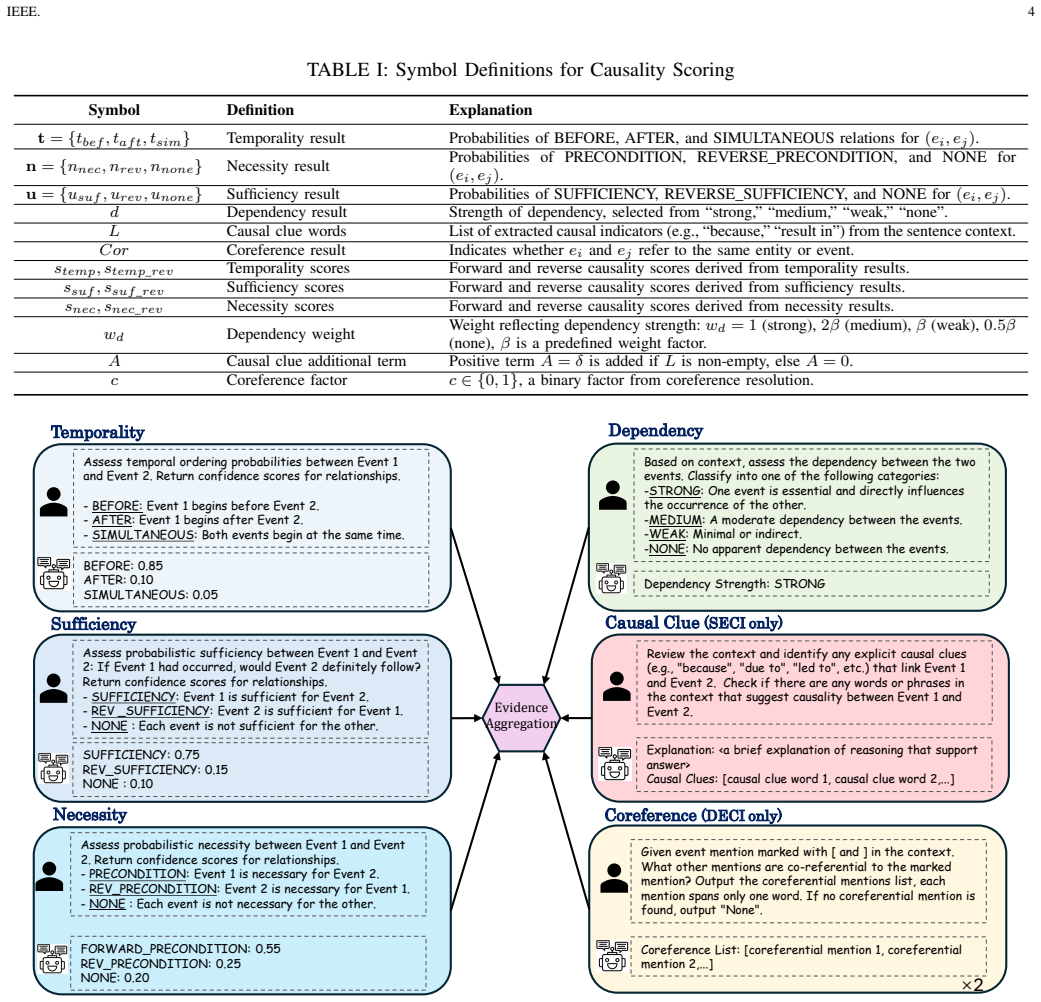
The operative mechanism is an enhanced fuzzy Choquet integral applied to a nine-dimensional evidence vector. The three main tasks produce confidence distributions over temporality, necessity, and sufficiency; these are concatenated, sorted by magnitude, and multiplied element-wise by fixed forward and reverse weight vectors $W_1$ and $W_2$ to obtain $\mathbf{x}^{\mathrm{cause}}$ and $\mathbf{x}^{\mathrm{causedby}}$. Each is aggregated as $f_y(\mathbf{x}^y)=\sum_i x^y_i\,[\mu(S_i)-\mu(S_{i-1})+\alpha\sum_{j,k\in S_i}x^y_j x^y_k]$, where the fuzzy measure $\mu(S_i)=\min(1.0,\,a|S_i|+b\sum_{j\in S_i}u_j)$ weights subset size and high-confidence evidence, and the $\alpha$-scaled synergy term rewards agreement among evidence components. This lets conflicting evidence interact non-additively; dependency, causal clues, and coreference then scale or veto the aggregated score through $w_d$, $A$, and $c$.
What would settle it
Replacing the fuzzy Choquet integral with a weighted average of the same nine evidence scores, using per-source weights, and observing that reported F1 on Causal-TimeBank, EventStoryLine, and MAVEN-ERE does not drop would show the Choquet interaction term is not the source of the improvement.
Extended reading notes
Core claim
The paper's central claim is that MEFA, a zero-shot framework, can outperform all unsupervised baselines for event causality identification by decomposing causality into temporality determination, sufficiency verification, and necessity analysis as main sub-tasks, with dependency assessment, causal clue extraction, and coreference resolution as auxiliary refinements. The LLM is prompted to return probabilities for the main tasks and deterministic labels for the auxiliary tasks; these are converted into forward and reverse causal scores, and the three main evidence sources are aggregated by a fuzzy Choquet integral with directional weighting and a synergy term. The reported experiments show that this reduces the false-positive causal links caused by LLM causal hallucination, improving average precision by 9.3% and F1 by 6.2% over the second-best unsupervised baseline, and bringing zero-shot performance close to supervised methods on ESL and MAVEN-ERE.
Load-bearing premise
The framework's gains rest on sorting the nine LLM confidence scores before weighting them—so the identity of each sub-task is lost—and on a 100-sample LLM-generated validation set selecting hyperparameters that transfer to all three human-annotated benchmarks and all six LLMs.
Editorial extensions
If this is right
- Zero-shot ECI can suppress LLM causal hallucination without gradient training, so causality extraction becomes practical for annotation-scarce domains.
- The 9.3% precision gain over the second-best unsupervised baseline means downstream consumers—knowledge graphs, reading comprehension, QA—receive fewer spurious causal links from LLM outputs.
- Since MEFA improves direction identification more than existence identification, its forward/reverse weighting scheme is capturing causal direction, not just causal presence.
- The gains hold across six different LLMs, including smaller ones, indicating the method is model-agnostic rather than tuned to one model's quirks.
Reading between the lines
- Beyond the paper: because the aggregator sorts the evidence vector, it discards which sub-task produced each score; a shuffled-component control would show whether the Choquet synergy term or merely the fixed weights carries the improvement.
- Beyond the paper: the same decompose-to-confidence-fuse recipe could apply to other relation tasks with conflicting sub-judgments, such as temporal ordering or subevent extraction, though the paper does not test that.
- Beyond the paper: the hyperparameters were selected on 100 synthetic validation samples generated by one LLM; per-model or per-domain recalibration could shift the reported averages, since the paper does not measure that transfer.
Editorial analysis
A structured set of objections, weighed in public.
Referee Report
Summary. The paper proposes MEFA, a zero-shot framework for event causality identification (ECI) that decomposes causality reasoning into three main sub-tasks (temporality, necessity, sufficiency) and three auxiliary sub-tasks (dependency, causal clues, coreference), prompts LLMs to return both uncertain confidence distributions and deterministic outputs, and then aggregates the resulting evidence with a fuzzy Choquet integral enhanced by directional weighting and a synergy term. The method is evaluated on Causal-TimeBank, EventStoryLine, and MAVEN-ERE with six LLMs and five unsupervised prompt-based baselines, plus several supervised baselines. The authors report average improvements over the second-best unsupervised baseline of 9.3% precision and 6.2% F1, and claim that the fuzzy aggregation substantially reduces false positives from causal hallucination. The paper includes ablation studies, aggregation-method comparisons, hyperparameter sensitivity analysis, a case study, and an appendix describing validation-data generation via CauseNet and LLM rewriting.
Significance. If the claims hold, MEFA would be a practically valuable zero-shot ECI method: it is training-free, does not use human-annotated ECI training labels, and its structured decomposition of causality into temporality, necessity, and sufficiency is intuitive and interpretable. The empirical scope is broad (three datasets, six LLMs, multiple baselines, SECI and DECI, existence and direction evaluation), and the authors are transparent about many implementation details, including prompt templates, validation-data generation, and hyperparameter search ranges. The main weaknesses are that the central aggregation formula is not a valid Choquet integral as written, the sorted-vector weighting destroys evidence-source identity, and the reported empirical gains lack error bars and significance tests. These issues prevent the paper's central claim—that fuzzy Choquet aggregation drives the improvements—from being accepted as stated.
major comments (4)
- [IV-C, Eq. (11)] Equation (11) is not the Choquet integral defined in Eq. (3). Eq. (3) sums x_{σ(i)}[μ(S_i)−μ(S_{i+1})] for inputs sorted by a permutation σ, whereas Eq. (11) sums x_i^y[μ(S_i)−μ(S_{i−1}) + αΣ_{j,k∈S_i} x_j^y x_k^y] with no definition of S_i or S_0 in this subsection and no re-sorting of x^y after the Hadamard product. The extra α synergy term is presented as a key feature of the method, so this is not a simple typo; it changes the aggregation operator. In addition, Eq. (12) uses u_j without specifying whether these are raw probabilities or weighted values, so the fuzzy measure μ may fail to be monotone when components of x^y are negative. As written, the central aggregation function is underspecified, and the RQ4 comparison with weighted-average, exponentially weighted, and Einstein aggregators cannot be interpreted as a comparison of the claimed Choquet mechanism.
- [IV-C, Eqs. (9)-(10)] The vector x = ordered([t;n;u]) is sorted by magnitude before W1 and W2 are applied element-wise. This destroys the semantic identity of each evidence component: the largest-magnitude score always receives W1[9] = −0.5 (or W2[9] = −0.5) in the forward (or reverse) vector, regardless of whether that component came from temporality, necessity, or sufficiency. The claimed 'causal-directional weighting' is therefore not a weighting of evidence types; it is a weighting of magnitude ranks. If this is intentional, the authors need to justify why magnitude ranks carry causal-direction information; if it is not intentional, the weights must be applied before sorting so that each evidence source retains its semantic role.
- [IV-B, Eqs. (5)-(8)] There is an arity mismatch in the definition of f. Equations (5)-(8) call f(s_temp, ssuf, snec) with three scalar scores, while Section IV-C defines f on the 9-dimensional vector x = ordered([t;n;u]) and then on the weighted vectors x^cause and x^causedby. No three-argument version of the Choquet aggregator is defined, and the Appendix-I baseline aggregators are not the MEFA aggregator. Because the input to the aggregation is not fixed, the reported causality scores cannot be reproduced from the equations as they stand.
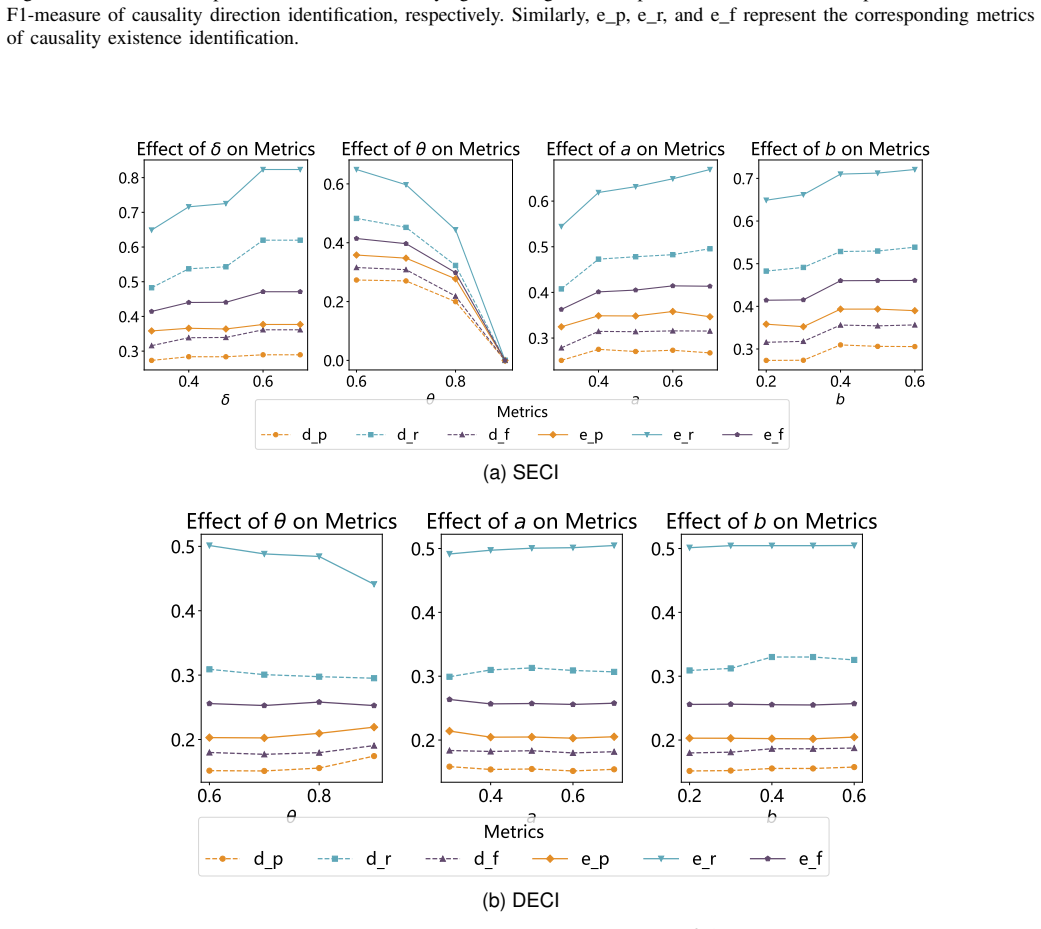
- [V-A3 / Appendix IV] The hyperparameters δ, θ, a, and b are tuned on a 100-sample validation set generated by DeepSeek-Chat from CauseNet and then applied to all three human-annotated test sets and all six LLMs. The manuscript reports no error bars, standard deviations, or significance tests for the five repeated runs, even though Tables II-IV contain many close comparisons (for example, Table II, LLaMA2-7B existence F1: MEFA 20.6 vs. ICL 20.4). The headline improvements of 9.3% precision and 6.2% F1 are therefore point estimates without statistical support, and the transfer of hyperparameters from one LLM's generated validation data to other LLMs and datasets is an assumption that should be explicitly tested, for example by reporting per-LLM validation results or performance across the tuning range.
minor comments (7)
- [Section I] The sentence 'MEFA effectively mitigate false negatives led by causal hallucination of LLMs' should say false positives; causal hallucination creates spurious links, as stated in the abstract and in RQ1.
- [V-B1 and Table III] The claim that MEFA outperforms all unsupervised baselines is contradicted later in the same paragraph: Table III shows DeepSeek-R1 ZSCoT precision 43.7 vs. MEFA precision 40.5 on MAVEN-ERE. The wording should be revised to acknowledge this exception.
- [Abstract / Introduction / Appendix IV] The claim that MEFA requires 'no samples' is too strong because Appendix IV uses CauseNet and LLM-generated validation samples for hyperparameter tuning. Please clarify that MEFA uses no human-annotated ECI training labels.
- [Eq. (12)] The symbol u_j in Eq. (12) is undefined; u already denotes the sufficiency probability vector in Table I, but in Eq. (12) it appears to denote a generic component of the input to the fuzzy measure. Use a distinct symbol and define it.
- [Figures 4 and 6] Figure 4's caption contains 'Demostration' and Figure 6's caption contains 'teasoning'; both should be corrected. Additionally, 'neccesary' appears in the MCoT prompt in Appendix VIII.
- [IV-B, text before Eq. (5)] The text says the SECI score uses five evidence sources and 'fuzzy aggregation function f', but dependency enters as a multiplicative weight and causal clues as an additive term, not through f. The wording should be clarified to avoid implying f aggregates all five sources directly.
- [IV-C, footnote] The cross-reference 'see Appendix-I4' is malformed; it should be 'Appendix I' or 'Appendix -I'.
Circularity Check
No significant circularity: MEFA's results are evaluated on held-out human-annotated benchmarks, and its tuned hyperparameters are drawn from an external CauseNet-based synthetic validation set rather than from the test labels.
full rationale
The paper's central derivation chain is an engineered scoring and aggregation formula applied to LLM probability outputs, followed by evaluation on CTB, ESL, and MAVEN-ERE. The test labels are never used to fit or define the scoring equations (5)-(13), so the headline comparison is not forced by construction. Hyperparameters (delta, theta, a, b) are tuned on a 100-sample synthetic validation set generated from CauseNet via DeepSeek-Chat; this is an external knowledge base, and the tuning set is disjoint from the human-annotated test sets, so the evaluation remains an independent empirical check rather than a fitted-input prediction. The only self-citation identified is reference [7], a survey by one of the authors, used for SECI/DECI taxonomy and for reporting some prior GPT-series baseline numbers; it is not load-bearing for MEFA's derivation or for the claimed improvements. The mathematical inconsistencies noted in the paper (e.g., Eq. 5 passing three scalar scores to f while Eq. 9 defines a 9-dimensional sorted vector, and Eq. 11 not matching the standard Choquet form) are specification and reproducibility issues, not circularity: the scoring function is an explicit, test-label-independent formula, even if that formula is nonstandard or under-specified. No step in the paper reduces, by its own equations or by self-citation, to the target predictions or to the evaluation labels. Therefore, no pattern of circularity is exhibited, and the appropriate finding is no significant circularity.
Assumptions & free parameters
free parameters (8)
- beta (dependency weight factor) =
0.1 (fixed)
- delta (causal clue bonus) =
0.6 (tuned on synthetic validation set)
- theta (decision threshold) =
0.6 (tuned)
- a (fuzzy measure subset-size weight) =
0.5 (tuned)
- b (fuzzy measure confidence weight) =
0.4 (tuned)
- alpha (synergy gain) =
0.3 (hand-set)
- W1 and W2 (directional weighting vectors) =
hand-set 9-dimensional vectors
- l_max (maximum effective distance for threshold decay) =
not specified
assumptions (4)
- domain assumption Event causality can be decomposed into temporality, sufficiency, and necessity (Definition 1, based on Pearl and Mackenzie [11]).
- domain assumption LLM confidence scores for sub-task choices are meaningful probabilities that can be compared and aggregated.
- ad hoc to paper The fuzzy Choquet integral with the specified fuzzy measure and weights is a valid aggregation for conflicting evidence.
- domain assumption The 100-sample synthetic validation set generated from CauseNet by DeepSeek-Chat is representative of the test distributions for hyperparameter tuning.
Cite this review
Pith. "Pith review of Zero-Shot Event Causality Identification via Multi-source Evidence Fuzzy Aggregation with Large Language Models." pith.science (2026). https://pith.science/paper/IM33R4CX
@misc{pith2026250605675,
  author       = {Pith},
  title        = {Pith review of: Zero-Shot Event Causality Identification via Multi-source Evidence Fuzzy Aggregation with Large Language Models},
  year         = {2026},
  howpublished = {\url{https://pith.science/paper/IM33R4CX}},
  note         = {Machine review of arXiv:2506.05675}
}
read the original abstract
Event Causality Identification (ECI) aims to detect causal relationships between events in textual contexts. Existing ECI models predominantly rely on supervised methodologies, suffering from dependence on large-scale annotated data. Although Large Language Models (LLMs) enable zero-shot ECI, they are prone to causal hallucination-erroneously establishing spurious causal links. To address these challenges, we propose MEFA, a novel zero-shot framework based on Multi-source Evidence Fuzzy Aggregation. First, we decompose causality reasoning into three main tasks (temporality determination, necessity analysis, and sufficiency verification) complemented by three auxiliary tasks. Second, leveraging meticulously designed prompts, we guide LLMs to generate uncertain responses and deterministic outputs. Finally, we quantify LLM's responses of sub-tasks and employ fuzzy aggregation to integrate these evidence for causality scoring and causality determination. Extensive experiments on three benchmarks demonstrate that MEFA outperforms second-best unsupervised baselines by 6.2% in F1-score and 9.3% in precision, while significantly reducing hallucination-induced errors. In-depth analysis verify the effectiveness of task decomposition and the superiority of fuzzy aggregation.
Figures


Figures from the paper (6 more)




Reference graph
Works this paper leans on
-
[9]
Causal reasoning and large language models: Opening a new frontier for causality,
E. Kıcıman et al., “Causal reasoning and large language models: Opening a new frontier for causality,” 2024. arXiv: 2305.00050[cs.AI]
arXiv 2024
-
[1]
Weakly supervised multilingual causal- ity extraction from Wikipedia,
C. Hashimoto, “Weakly supervised multilingual causal- ity extraction from Wikipedia,” inProceedings of the 2019 Conference on Empirical Methods in Natural Language Processing and the 9th International Joint Conference on Natural Language Processing (EMNLP- IJCNLP), Nov. 2019, pp. 2988–2999
work page 2019
-
[2]
A survey of event extraction from text,
W. Xiang and B. Wang, “A survey of event extraction from text,”IEEE Access, vol. 7, pp. 173 111–173 137, 2019
2019
-
[3]
Causality extraction from medical text using large language models (llms),
S. Gopalakrishnan, L. Garbayo, and W. Zadrozny, “Causality extraction from medical text using large language models (llms),” 2024. arXiv: 2407 . 10020 [cs.CL]
work page 2024
-
[4]
Modeling biological processes for reading comprehension,
J. Berant et al., “Modeling biological processes for reading comprehension,” inProceedings of the 2014 Conference on Empirical Methods in Natural Language Processing (EMNLP), Oct. 2014, pp. 1499–1510
work page 2014
-
[5]
End-to-End Argumentation Knowl- edge Graph Construction,
K. Al-Khatib et al., “End-to-End Argumentation Knowl- edge Graph Construction,”Proceedings of the AAAI Conference on Artificial Intelligence, vol. 34, no. 05, pp. 7367–7374, Apr. 2020, Number: 05
work page 2020
-
[6]
A semi-supervised learning approach to why-question answering,
J.-H. Oh et al., “A semi-supervised learning approach to why-question answering,” inProceedings of the Thirti- eth AAAI Conference on Artificial Intelligence, Phoenix, Arizona, 2016, pp. 3022–3029
work page 2016
-
[7]
A survey of event causality identifica- tion: Principles, taxonomy, challenges, and assessment,
Q. Cheng et al., “A survey of event causality identifica- tion: Principles, taxonomy, challenges, and assessment,”
Show all 69 references
-
[8]
Is ChatGPT a good causal reasoner? a comprehensive evaluation,
J. Gao et al., “Is ChatGPT a good causal reasoner? a comprehensive evaluation,” inFindings of the Associa- tion for Computational Linguistics: EMNLP 2023, Dec. 2023, pp. 11 111–11 126
2023
-
[10]
Advancing event causality identification via heuristic semantic dependency inquiry network,
H. Li et al., “Advancing event causality identification via heuristic semantic dependency inquiry network,”
-
[11]
Pearl and D
J. Pearl and D. Mackenzie,The Book of Why: The New Science of Cause and Effect, 1st. USA: Basic Books, Inc., 2018,ISBN: 046509760X
2018
-
[12]
arXiv: 2409.13621[cs.CL]
-
[13]
Extracting temporal and causal relations be- tween events,
P. Mirza, “Extracting temporal and causal relations be- tween events,” inProceedings of the ACL 2014 Student Research Workshop, Jun. 2014, pp. 10–17
2014
-
[14]
A method for extracting causal knowl- edge from textual databases,
S. Chan et al., “A method for extracting causal knowl- edge from textual databases,”Singapore Journal of Library & Information Management, pp. 48–63, 1999
1999
-
[15]
Semantic structure enhanced event causal- ity identification,
Z. Hu et al., “Semantic structure enhanced event causal- ity identification,” inProceedings of the 61st Annual Meeting of the Association for Computational Linguis- tics (Volume 1: Long Papers), Jul. 2023, pp. 10 901– 10 913
2023
-
[16]
The event StoryLine corpus: A new benchmark for causal and temporal relation extraction,
T. Caselli and P. V ossen, “The event StoryLine corpus: A new benchmark for causal and temporal relation extraction,” inProceedings of the Events and Stories in the News Workshop, Aug. 2017, pp. 77–86
2017
-
[17]
Knowledge-enriched event causality identification via latent structure induction networks,
P. Cao et al., “Knowledge-enriched event causality identification via latent structure induction networks,” inProceedings of the 59th Annual Meeting of the Asso- ciation for Computational Linguistics and the 11th In- ternational Joint Conference on Natural Language Pro- cessin...
2021
-
[18]
Distill, fuse, pre-train: Towards effec- tive event causality identification with commonsense- aware pre-trained model,
P. Huang et al., “Distill, fuse, pre-train: Towards effec- tive event causality identification with commonsense- aware pre-trained model,” inProceedings of the 2024 Joint International Conference on Computational Lin- guistics, Language Resources and Evaluation (LREC- COLING 2...
2024
-
[19]
LearnDA: Learnable knowledge-guided data augmentation for event causality identification,
X. Zuo, P. Cao, Y . Chen, et al., “LearnDA: Learnable knowledge-guided data augmentation for event causality identification,” inProceedings of the 59th Annual Meet- ing of the Association for Computational Linguistics and the 11th International Joint Conference on Natural Lang...
2021
-
[20]
Improving event causality identification via self-supervised representation learning on external IEEE. 12 causal statement,
X. Zuo et al., “Improving event causality identification via self-supervised representation learning on external IEEE. 12 causal statement,” inFindings of the Association for Computational Linguistics: ACL-IJCNLP 2021, Aug. 2021, pp. 2162–2172
2021
-
[21]
KEPT: Knowledge Enhanced Prompt Tuning for event causality identification,
J. Liu et al., “KEPT: Knowledge Enhanced Prompt Tuning for event causality identification,”Knowledge- Based Systems, vol. 259, p. 110 064, Jan. 2023
2023
-
[22]
KnowDis: Knowledge enhanced data augmentation for event causality detection via distant supervision,
X. Zuo et al., “KnowDis: Knowledge enhanced data augmentation for event causality detection via distant supervision,” inProceedings of the 28th International Conference on Computational Linguistics, Dec. 2020, pp. 1544–1550
2020
-
[23]
Discriminative reasoning with sparse event representation for document-level event-event re- lation extraction,
C. Yuan et al., “Discriminative reasoning with sparse event representation for document-level event-event re- lation extraction,” inProceedings of the 61st Annual Meeting of the Association for Computational Linguis- tics (Volume 1: Long Papers), Jul. 2023, pp. 16 222– 16 234
2023
-
[24]
Daprompt: Deter- ministic assumption prompt learning for event causality identification,
W. Xiang, C. Zhan, and B. Wang, “Daprompt: Deter- ministic assumption prompt learning for event causality identification,” 2023. arXiv: 2307.09813[cs.CL]
2023 arXiv
-
[25]
ERGO: Event relational graph transformer for document-level event causality iden- tification,
M. Chen et al., “ERGO: Event relational graph transformer for document-level event causality iden- tification,” inProceedings of the 29th International Conference on Computational Linguistics, Oct. 2022, pp. 2118–2128
2022
-
[26]
Identifying while learning for document event causality identification,
C. Liu, W. Xiang, and B. Wang, “Identifying while learning for document event causality identification,” inProceedings of the 62nd Annual Meeting of the Association for Computational Linguistics (Volume 1: Long Papers), Aug. 2024, pp. 3815–3827
2024
-
[27]
Causal bert : Language models for causality detection between events expressed in text,
V . Khetan et al., “Causal bert : Language models for causality detection between events expressed in text,”
-
[28]
Graph convolu- tional networks for event causality identification with rich document-level structures,
M. Tran Phu and T. H. Nguyen, “Graph convolu- tional networks for event causality identification with rich document-level structures,” inProceedings of the 2021 Conference of the North American Chapter of the Association for Computational Linguistics: Human Language Technologi...
2021
-
[29]
Document-level causal relation extrac- tion with knowledge-guided binary question answer- ing,
Z. Wang et al., “Document-level causal relation extrac- tion with knowledge-guided binary question answer- ing,” inFindings of the Association for Computational Linguistics: EMNLP 2024, Nov. 2024, pp. 16 944– 16 955
2024
-
[30]
On ordered weighted averaging aggre- gation operators in multicriteria decision making,
R. Yager, “On ordered weighted averaging aggre- gation operators in multicriteria decision making,” IEEE Transactions on Systems, Man, and Cybernetics, vol. 18, no. 1, pp. 183–190, 1988
1988
-
[31]
Causalbert: Injecting causal knowledge into pre-trained models with minimal supervision,
Z. Li et al., “Causalbert: Injecting causal knowledge into pre-trained models with minimal supervision,” 2021. arXiv: 2107.09852[cs.CL]
2021 arXiv
-
[32]
Choquet integral capacities-based data fusion for system health monitoring,
B. Abichou et al., “Choquet integral capacities-based data fusion for system health monitoring,”IFAC Pro- ceedings Volumes, vol. 45, no. 20, pp. 31–36, 2012
2012
-
[33]
Fermatean fuzzy ein- stein aggregation operators-based multimoora method for electric vehicle charging station selection,
P. Rani and A. R. Mishra, “Fermatean fuzzy ein- stein aggregation operators-based multimoora method for electric vehicle charging station selection,”Expert Systems with Applications, vol. 182, p. 115 267, 2021
2021
-
[34]
Information fusion in com- puter vision using the fuzzy integral,
H. Tahani and J. Keller, “Information fusion in com- puter vision using the fuzzy integral,”IEEE Transac- tions on Systems, Man, and Cybernetics, vol. 20, no. 3, pp. 733–741, 1990
1990
-
[35]
The choquet integral for the aggregation of interval scales in multicriteria decision making,
C. Labreuche and M. Grabisch, “The choquet integral for the aggregation of interval scales in multicriteria decision making,”Fuzzy Sets and Systems, vol. 137, no. 1, pp. 11–26, 2003
2003
-
[36]
K-order additive discrete fuzzy mea- sures and their representation,
M. Grabisch, “K-order additive discrete fuzzy mea- sures and their representation,”Fuzzy Sets and Systems, vol. 92, no. 2, pp. 167–189, 1997
1997
-
[37]
Generalizing the dempster-schafer theory to fuzzy sets,
J. Yen, “Generalizing the dempster-schafer theory to fuzzy sets,”IEEE Transactions on Systems, Man, and Cybernetics, vol. 20, no. 3, pp. 559–570, 1990
1990
-
[38]
Yang et al.,Uncertainty-aware language modeling for selective question answering, 2023
Q. Yang et al.,Uncertainty-aware language modeling for selective question answering, 2023. arXiv: 2311 . 15451[cs.CL]
2023
-
[39]
Are large language models good at fuzzy reasoning?
S. Singh, “Are large language models good at fuzzy reasoning?” InProceedings of the 2024 7th Interna- tional Conference on Computational Intelligence and Intelligent Systems, 2025, pp. 1–6
2024
-
[40]
A choquet integral based fuzzy logic ap- proach to solve uncertain multi-criteria decision making problem,
L. Chen et al., “A choquet integral based fuzzy logic ap- proach to solve uncertain multi-criteria decision making problem,”Expert Systems with Applications, vol. 149, p. 113 303, 2020
2020
-
[41]
MA VEN-ERE: A unified large-scale dataset for event coreference, temporal, causal, and subevent relation extraction,
X. Wang et al., “MA VEN-ERE: A unified large-scale dataset for event coreference, temporal, causal, and subevent relation extraction,” inProceedings of the 2022 Conference on Empirical Methods in Natural Language Processing, 2022, pp. 926–941
2022
-
[42]
Modeling document-level causal structures for event causal rela- tion identification,
L. Gao, P. K. Choubey, and R. Huang, “Modeling document-level causal structures for event causal rela- tion identification,” inProceedings of the 2019 Confer- ence of the North American Chapter of the Association for Computational Linguistics: Human Language Tech- nologies, Vo...
2019
-
[43]
Annotating causality in the TempEval- 3 corpus,
P. Mirza et al., “Annotating causality in the TempEval- 3 corpus,” inProceedings of the EACL 2014 Workshop on Computational Approaches to Causality in Language (CAtoCL), Apr. 2014, pp. 10–19
2014
-
[44]
Roberta: A robustly optimized bert pre- training approach,
Y . Liu et al., “Roberta: A robustly optimized bert pre- training approach,” 2019. arXiv: 1907.11692[cs.CL]. IEEE. 13
2019 arXiv
-
[45]
Longformer: The long-document transformer,
I. Beltagy, M. E. Peters, and A. Cohan, “Longformer: The long-document transformer,” 2020. arXiv: 2004 . 05150[cs.CL]. APPENDIX BASELINEAGGREGATIONMETHODS This section describes three baseline aggregation methods for comparison. Given scores (confidence values)s 1, s2, s3 from...
2020
-
[46]
BERT: Pre-training of deep bidi- rectional transformers for language understanding,
J. Devlin et al., “BERT: Pre-training of deep bidi- rectional transformers for language understanding,” in Proceedings of the 2019 Conference of the North Amer- ican Chapter of the Association for Computational Linguistics: Human Language Technologies, Volume 1 (Long and Short...
2019
-
[49]
Identify the temporal order of event1 and event2
-
[50]
Perform necessity analysis: Check if the occurrence of event1 is necessary for the occurrence of event2
-
[51]
Perform sufficiency verification: If event1 happen, will event2 inevitably happen?
-
[52]
Event 1: entering Event 2: begin Answer: NO Example 2: context:
Based on above evidence: If (1) event1 occurs before event2 or event1 and event2 occur simultaneously, (2) event1 is neccesary for event2, and (3) event1 is sufficient for event2, then event1 causes event2. Else event1 does not cause event2. Output Format: Thoughts: [Your thin...
1937
-
[53]
Event 1 (offer) will be followed by Event 2 (sale)
The temporal order of Event 1 (offer) and Event 2 (sale) is clearly stated in the context. Event 1 (offer) will be followed by Event 2 (sale)
-
[54]
Counterfactual reasoning suggests that if Event 1 (offer) did not happen, it is unlikely that Event 2 (sale) would occur as described, because the sale is contingent upon the offer being made
-
[55]
Based on the above analysis, Event 1 (offer) causes Event 2 (sale)
Event 1 (offer) will inevitably lead to the occurrence of Event 2 (sale). Based on the above analysis, Event 1 (offer) causes Event 2 (sale). Answer: <YES> 1.Temporality: {BEFORE: 0.9, AFTER: 0.0, SIMULTANEOUS: 0.1} 2.Necessity: {FORWARD_PRECONDITION: 0.5, REV_PRECONDITION: 0....
-
[56]
Causal Score: Query SP ICL ZSCoT MCoT MEDA 1.Temporality: offer BEFORE sale; 2.Necessity: NONE 3.Sufficiency: NONE
-
[57]
ran") and Event 2 (
Dependency: STRONG. MEFA × × × × √ offer→sale offer→sale offer→sale offer→sale No_Causal No_Causal √ (a) Case 1 (SECI) Arcade Joseph Comeaux Jr . , 49 , ran away on foot with the guards' guns and wearing one of their gray correctional officer uniforms , the statement from the ...
-
[58]
Causal Score: Query SP ICL ZSCoT MCoT MEDA 1.Temporality: SIMULTANEOUS; 2.Necessity: NONE 3.Sufficiency: NONE
-
[59]
smolder,
Dependency: MEDIUM. MEFA √ × × × No_Causal No_Causal No_Causal √ran→wearing × ran→wearing No_Causal (b) Case 2 (SECI) Fig. 8: Part 1: Comparison of ECI results (Cases 1–2). The √ and×marks indicate correct/incorrect identification. IEEE. 20 Historic Mat Maid warehouse burns Ma...
-
[60]
Answer: YES <fire, smolder> Thoughts: In the given context, …Therefore, it is reasonable to consider the fire could lead to the smoldering
The fire was reported later at 3:33 a.m., indicating that the smoldering could have escalated into a fire. Answer: YES <fire, smolder> Thoughts: In the given context, …Therefore, it is reasonable to consider the fire could lead to the smoldering. Answer: YES <smolder, fire> Thoughts:
-
[61]
Remains of the Mat Maid warehouse smolder Tuesday morning,
Identifying the temporal order: The context states that "Remains of the Mat Maid warehouse smolder Tuesday morning," followed by "The fire was reported at 3:33 a.m." …
-
[62]
Answer: YES <fire, smolder> Thoughts:
Performing counterfactual reasoning… Therefore, it is reasonable to consider the fire causes the smoldering. Answer: YES <fire, smolder> Thoughts:
-
[63]
Identifying the temporal order: The context states that the "fire" (Event 1) was reported …
-
[64]
Smoldering is a residual state of burning that follows a fire, so fire is the cause of smolder
Counterfactual reasoning: …. Smoldering is a residual state of burning that follows a fire, so fire is the cause of smolder. Answer: YES 1.Temporality: {BEFORE: 0.55, AFTER: 0.4, SIMULTANEOUS: 0.05} 2.Necessity: {FORWARD_PRECONDITION: 0.6, REV_PRECONDITION: 0.3 NONE: 0.1} 3.Su...
-
[65]
Causal Score: Query SP ICL ZSCoT MCoT MEDA 1.Temporality: smolder AFTER fire; 2.Necessity: REV_PRECONDITION; 3.Sufficiency: REV_SUFFICIENCY
-
[66]
entered") can cause Event 2 (
Dependency: MEDIUM. MEFA × × × fire→smolder No_Causal √ × No_Causal × No_Causal fire→smolder smolder→fire (c) Case 3 (DECI) A Great Western Railway (GWR) luggage train travelling from London Paddington to Bristol Temple Meads station entered SonningCutting. [Other Three Senten...
-
[67]
entered") clearly occurs before Event 2 (
Temporal Order: Event 1 ("entered") clearly occurs before Event 2 ("derailed"). … the derailment would not have happened, we can conclude that Event 1 causes Event 2. Answer: YES 1.Temporality: {BEFORE: 0.95, AFTER: 0.0, SIMULTANEOUS: 0.05} 2.Necessity: {FORWARD_PRECONDITION: ...
-
[68]
Causal Score: Query SP ICL ZSCoT MCoT MEDA 1.Temporality: entered BEFORE derailed; 2.Necessity: PRECONDITION; 3.Sufficiency: SUFFICIENCY
-
[69]
MEFA × √ × No_Causal √ entered→derailed × entered→derailed entered→derailed No_Causal No_Causal √ (d) Case 4 (DECI) Fig
Dependency: WEAK. MEFA × √ × No_Causal √ entered→derailed × entered→derailed entered→derailed No_Causal No_Causal √ (d) Case 4 (DECI) Fig. 8: Part 2: Comparison of ECI results (Cases 3–4)
-
[2021]
arXiv: 2012.05453[cs.CL]
2012 arXiv
-
[2024]
arXiv: 2411.10371[cs.CL]
Reviewed August 7, 2026 · model on record in the stance chip above.
Discussion (0). Sign in to comment.