REVIEW 4 major objections 5 minor 82 references
Lumina: Real-Time Mobile Neural Rendering by Exploiting Computational Redundancy
T0 review · 4 major / 5 minor · reviewed 2026-08-07 · deepseek-v4-flash
Pith's one-line read Lumina makes 3D Gaussian Splatting run 4.5x faster and 5.3x more energy-efficient on mobile hardware by reusing sorting results and cached pixel colors, with under 0.2 dB of quality loss.
desk verdict A solid, genuinely novel 3DGS mobile accelerator paper whose main weakness is quality accounting: the abstract's <0.2 dB claim conflicts with the body, and RC's benefits are entangled with retraining; it still deserves serious peer review. read the letter →
The pith
A machine-rendered reading of the paper's core claim, the machinery that carries it, and where it could break.
The reading
What carries the argument
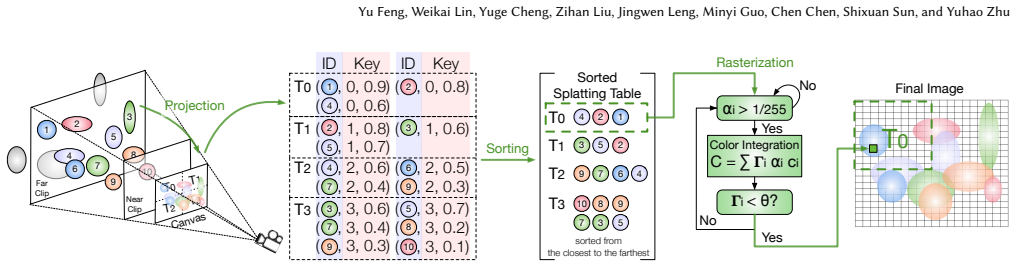
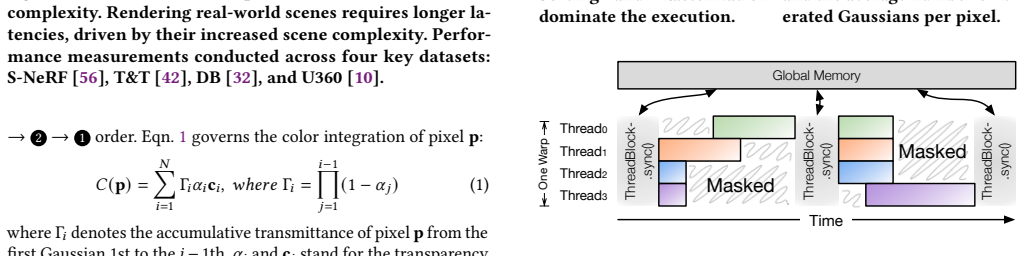
The argument is carried by two algorithms and an accelerator. S2 (Sorting-Shared) exploits temporal coherence: it predicts the next camera pose from the last two poses, speculatively projects and sorts the Gaussian cloud for that predicted pose, and shares that sort across a sharing window of frames, expanding the sorting viewport slightly so tile-edge artifacts do not appear. RC (Radiance Caching) uses a cache whose tag is the concatenation of the first $k$ Gaussian IDs along a ray that pass the significance threshold ($\alpha > 1/255$), and whose value is the finished pixel color; a cache hit terminates the color integration immediately, by skipping the remainder of the equation $C(p)=\sum_{i} \Gamma_i \alpha_i c_i$. LuminCore is the accelerator that makes RC practical: its Neural Rendering Units split transparency computation (frontend) from sparse color integration (backend) to remove GPU warp divergence, and LuminCache is a 4-way set-associative cache using combined tags, low-bit indexing, and a pseudo-LRU replacement policy.
What would settle it
Render a scene dominated by large or elongated Gaussians — or a fast camera move that exposes such Gaussians — through Lumina with and without the cache-aware fine-tuning; if the radiance cache hit rate falls well below the reported 55% and PSNR drops by more than about 0.2 dB relative to the baseline 3DGS, the early-termination premise has failed and the 4.5x and 5.3x headline numbers would not survive.
Extended reading notes
Core claim
The central discovery is that the expensive per-frame work in 3DGS can be largely reused across time and across rays without visible quality loss. Sorting results stay valid for several consecutive camera poses, so the system predicts a future pose, pre-sorts once for that predicted pose, and shares the result across a fixed window of frames; the paper measures that only about 0.2% of Gaussian orders change between nearby poses. For rasterization, the paper observes that fewer than 10% of the Gaussians a pixel visits are significant contributors, and that pixels whose first few significant Gaussian IDs match have nearly identical final colors. Caching a finished pixel under a tag made of those IDs lets later pixels stop color integration early, and a scale-constrained fine-tuning step keeps large Gaussians from violating the caching assumption. Together the radiance cache skips about 55% of color-integration computation, and the combination of sorting sharing, caching, and a small dedicated accelerator yields the reported 4.5x and 5.3x gains against a mobile Volta GPU.
Load-bearing premise
The load-bearing premise is that pixels whose rays pass through the same first few significant Gaussians really do end up with nearly identical final colors, so the cached value can replace the rest of the integration; the paper itself shows large Gaussians violate this, and the scale-constrained retraining that restores it may not transfer to scenes outside the training data.
Editorial extensions
If this is right
- If the central claim holds, 3DGS reaches 218.5 FPS on the synthetic traces and 97.9 FPS on the real-world traces, crossing the 90 FPS VR/AR target.
- The S2 algorithm alone skips projection and sorting for a whole sharing window, which by itself reduces energy by about 20% even on an unmodified GPU.
- RC reduces color-integration computation by 55% on average, and on LuminCore that translates into a further 2.5x speedup of the rasterization stage.
- The full Lumina system reports an average 81% energy saving, rising to 93% on synthetic scenes and 80% on real-world scenes if the target is exactly real-time frame rate.
- When configured with the GSCore accelerator units for fair comparison, the Lumina pipeline reports a 29.6x speedup over the mobile GPU baseline on the evaluated datasets.
Reading between the lines
- If RC generalizes as the paper anticipates, the same tag-and-value idea could be applied to newer rendering primitives such as 2D Gaussians, voxels, or future learned representations, by replacing 'significant Gaussian IDs' with whatever primitives a ray hits first.
- The NRU's frontend-backend design is essentially a parallel sparse-accumulation engine, and the paper notes that pattern also appears in sparse linear algebra and graph neural networks, so a programmable version of LuminCore could plausibly accelerate those workloads on mobile SoCs, though the paper does not demonstrate this.
- The cache hit rate could itself serve as a live measurement of temporal scene redundancy; a testable extension would be to adapt the sharing window size and cache capacity in real time as hit rate rises or falls with camera speed and scene geometry.
- Because cache tags are a hash of ray similarity, the mechanism could combine naturally with foveated rendering, using a lower confidence threshold in the visual periphery to trade quality for energy exactly where the eye is not looking.
Editorial analysis
A structured set of objections, weighed in public.
Referee Report
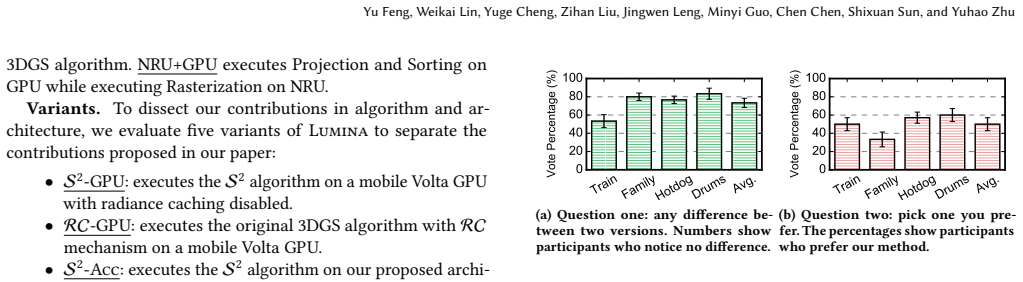
Summary. The paper presents Lumina, a hardware-algorithm co-designed system for accelerating 3D Gaussian Splatting (3DGS) rendering on mobile SoCs. It proposes two algorithmic techniques: S2, which shares sorting results across nearby camera poses and speculatively pre-sorts for future frames, and Radiance Caching (RC), which caches pixel colors keyed by the first few significant Gaussian IDs so that cache hits can skip most color integration. The paper also designs LuminCore hardware with Neural Rendering Units and a specialized LuminCache. The system is evaluated on a mobile Volta GPU baseline with measured GPU execution, RTL synthesis and cycle-accurate simulation, and reports 4.5x speedup, 5.3x energy reduction, and <0.2 dB average PSNR loss across synthetic and real-world datasets, with a user study supporting similar visual quality.
Significance. The paper addresses an important and timely problem: making 3DGS rendering real-time on mobile platforms. Its evaluation is more thorough than many architecture papers in this area: GPU baseline measurements on actual hardware, RTL synthesis with area/power estimates, cycle-accurate simulation, quality metrics on multiple datasets, and a user study. The proposed S2 technique for hiding sorting latency is a plausible and useful contribution. The RC mechanism is a creative use of the sparsity structure of 3DGS color integration, and the LuminCore architecture is described in enough detail to be reproducible in simulation. If the quality and performance claims hold after addressing the confounds noted below, this would be a solid contribution to neural rendering acceleration.
major comments (4)
- [Abstract and Sec. 6.1] The abstract's claim of '<0.2 dB peak signal-to-noise ratio reduction' is internally inconsistent with the paper's own numbers in Fig. 20a: the average synthetic PSNR for Lumina is 33.2 dB versus 33.5 dB for the baseline, a 0.3 dB loss, and Sec. 6.1 states 'minimal quality losses of 0.2dB and 0.3dB' for RC-only and Lumina respectively. The abstract should either use the actual measured loss or report an aggregate across datasets that is consistent with the figure.
- [Sec. 3.3, Eq. (4), and Fig. 21] The claim that RC achieves 'minimal impact on quality' is not isolated from the cache-aware fine-tuning introduced in Eq. (4). The quality numbers in Fig. 20 are obtained on models retrained with the scale-constrained loss, and Fig. 21 shows that this loss changes cache hit rate and improves PSNR by 0.6 dB. Therefore the reported quality loss is the combined effect of caching plus a changed scene model, not the error of caching alone. The paper should provide an ablation that applies RC without the scale-constrained retraining, or otherwise quantify the caching-only error, and should discuss whether the headline speedup transfers to pretrained 3DGS scenes that have not been fine-tuned.
- [Sec. 6.4 and Fig. 25] The GSCore comparison in Fig. 25 is not on the same footing as the main evaluation. The 'baseline hardware' in that comparison incorporates GSCore's CCU and GSU units, so the 9.6x speedup attributed to this baseline is not the same as the NRU+GPU baseline in Sec. 6.2, which reports 1.9x speedup. The text should state clearly that Fig. 25 uses a different baseline configuration and explain why this is a fair comparison, or the 29.6x headline speedup for Lumina against GSCore should be qualified accordingly.
- [Sec. 6.3 and Fig. 23] The sensitivity study shows that S2's quality and speedup depend strongly on the sharing window and expanded margin, but the default settings (expanded margin 4, skipped window 6) are only evaluated on a single synthetic scene (Drums). The paper should report the default-configuration S2 quality/speed trade-off on real-world scenes as well, since real scenes have lower frame rates and larger inter-frame motion (as acknowledged in Sec. 6.1), which may make the chosen default less representative.
minor comments (5)
- [Sec. 5 and Sec. 6] No code, models, or artifacts are released; the 'website' link in Sec. 6.1 is shown only as 'link'. Given the user study and reproducibility claims, providing at least the retrained models and a rendering script would strengthen the paper.
- [Sec. 6] The opening of Sec. 6 contains a duplicated sentence: 'Finally, we show that Lumina performs better against GSCore' appears twice. One occurrence should be removed.
- [Sec. 3.2, Fig. 12] The color-difference analysis in Fig. 12 reports values on a 0-255 scale, but the y-axis label says 'RGB difference' without units; stating the scale explicitly would prevent confusion.
- [Sec. 5, Experimental Setup] The LuminCache is described as caching '64x64 pixels to share across 4x4 image tiles with a size of 16x16'; this phrasing is ambiguous about whether the cache holds 64x64 pixels in total or per tile, and should be clarified.
- [Sec. 6.1, Fig. 19] The user-study methodology says each participant reviews 4 traces, but the number of scenes and the comparison conditions are not fully specified; adding a short description of the traces shown and the baseline condition would improve reproducibility.
Circularity Check
No significant circularity: the central speedup and quality claims are measured outcomes against an unchanged baseline, and the cache-aware fine-tuning is disclosed co-design rather than a fitted value renamed as a prediction.
full rationale
Lumina's central claims (4.5x speedup, 5.3x energy reduction, 55% of color integration avoided) are presented as measured or simulated results over real GPU backends and a cycle-accurate simulator, not as quantities derived from fitted parameters. The RC mechanism's key premise, that rays sharing the first k significant Gaussian IDs have similar colors, is empirically justified in Figs. 11-12 and its known failure mode (large Gaussians, Fig. 13) is explicitly admitted. The mitigation is the scale-constrained loss in Eq. (4), which retrains the scene model so that the caching assumption holds. This is disclosed as end-to-end fine-tuning, and the reported PSNR numbers are measured on the resulting (retrained) Lumina/RC pipeline compared against the original 3DGS baseline. Retraining to make a cache effective is co-design, not circular reasoning: the quality number is not forced by construction, it is an experimental result. S2's trajectory prediction is explicitly attributed to prior work (Cicero) and disclaimed as a contribution, so the self-citation is not load-bearing. No uniqueness theorem is invoked, and no fitted constant is renamed as a prediction. The abstract's '<0.2 dB' claim does appear internally inconsistent with Fig. 20a's 0.3 dB average synthetic loss, but that is a correctness/consistency concern, not evidence of circularity. The empirical and architectural results stand independently of this inconsistency.
Assumptions & free parameters
free parameters (4)
- S2 sharing window N =
6 (default)
- S2 expanded margin =
4 pixels per dimension (default)
- RC alpha-record length k =
5 (default)
- Scale loss threshold theta and weight alpha =
not reported
assumptions (4)
- domain assumption Two rays that intersect the same sequence of Gaussians, or at least share the first k significant Gaussians, will have approximately equal pixel colors.
- domain assumption The depth order of Gaussians stays stable across nearby camera poses, so sorting can be shared over a window of frames.
- domain assumption The cycle-accurate simulator plus RTL synthesis, scaled from 16nm to 12nm, faithfully models the performance and energy of a real mobile SoC.
- ad hoc to paper Retraining the 3DGS model with the scale-constrained loss does not materially change scene representational quality, so comparing against an unretrained baseline is fair.
Cite this review
Pith. "Pith review of Lumina: Real-Time Mobile Neural Rendering by Exploiting Computational Redundancy." pith.science (2026). https://pith.science/paper/IJXOV4SG
@misc{pith2026250605682,
  author       = {Pith},
  title        = {Pith review of: Lumina: Real-Time Mobile Neural Rendering by Exploiting Computational Redundancy},
  year         = {2026},
  howpublished = {\url{https://pith.science/paper/IJXOV4SG}},
  note         = {Machine review of arXiv:2506.05682}
}
read the original abstract
3D Gaussian Splatting (3DGS) has vastly advanced the pace of neural rendering, but it remains computationally demanding on today's mobile SoCs. To address this challenge, we propose Lumina, a hardware-algorithm co-designed system, which integrates two principal optimizations: a novel algorithm, S^2, and a radiance caching mechanism, RC, to improve the efficiency of neural rendering. S2 algorithm exploits temporal coherence in rendering to reduce the computational overhead, while RC leverages the color integration process of 3DGS to decrease the frequency of intensive rasterization computations. Coupled with these techniques, we propose an accelerator architecture, LuminCore, to further accelerate cache lookup and address the fundamental inefficiencies in Rasterization. We show that Lumina achieves 4.5x speedup and 5.3x energy reduction against a mobile Volta GPU, with a marginal quality loss (< 0.2 dB peak signal-to-noise ratio reduction) across synthetic and real-world datasets.
Figures

Figures from the paper (15 more)




Reference graph
Works this paper leans on
-
[1]
Apple Vision Pro screen refresh rate is up to 100Hz
-
[2]
Meta Quest Pro specs
-
[3]
Micron 178-Ball, Single-Channel Mobile LPDDR3 SDRAM Features
-
[4]
Micron System Power Calculators
-
[5]
Nvidia reveals xavier soc details
-
[6]
NVIDIA’s Xavier System-on-Chip, HotChips 30
-
[7]
Qualcomm Powers Next-Gen Spatial Computing With XR2 Gen 2 And AR1 Gen 1 Platforms
-
[8]
Qualcomm QCS8550/QCM8550 Processors
Show all 82 references
-
[9]
Mip-nerf: A multiscale representation for anti-aliasing neural radiance fields
Jonathan T Barron, Ben Mildenhall, Matthew Tancik, Peter Hedman, Ricardo Martin-Brualla, and Pratul P Srinivasan. Mip-nerf: A multiscale representation for anti-aliasing neural radiance fields. InProceedings of the IEEE/CVF International Conference on Computer Vision, pages 58...
2021
-
[10]
Barron, Ben Mildenhall, Dor Verbin, Pratul P
Jonathan T. Barron, Ben Mildenhall, Dor Verbin, Pratul P. Srinivasan, and Peter Hedman. Mip-nerf 360: Unbounded anti-aliased neural radiance fields.CVPR, 2022
2022
-
[11]
The physics of optimal decision making: a formal analysis of models of perfor- mance in two-alternative forced-choice tasks.Psychological review, 113(4):700, 2006
Rafal Bogacz, Eric Brown, Jeff Moehlis, Philip Holmes, and Jonathan D Cohen. The physics of optimal decision making: a formal analysis of models of perfor- mance in two-alternative forced-choice tasks.Psychological review, 113(4):700, 2006
2006
-
[12]
Eva2: Exploiting temporal redundancy in live computer vision
Mark Buckler, Philip Bedoukian, Suren Jayasuriya, and Adrian Sampson. Eva2: Exploiting temporal redundancy in live computer vision. In2018 ACM/IEEE 45th Annual International Symposium on Computer Architecture (ISCA), pages 533–546. IEEE, 2018
2018
-
[13]
Passthrough+ real-time stereoscopic view synthesis for mobile mixed reality.Proceedings of the ACM on Computer Graphics and Interactive Techniques, 3(1):1–17, 2020
Gaurav Chaurasia, Arthur Nieuwoudt, Alexandru-Eugen Ichim, Richard Szeliski, and Alexander Sorkine-Hornung. Passthrough+ real-time stereoscopic view synthesis for mobile mixed reality.Proceedings of the ACM on Computer Graphics and Interactive Techniques, 3(1):1–17, 2020
2020
-
[14]
A survey on 3d gaussian splatting.arXiv preprint arXiv:2401.03890, 2024
Guikun Chen and Wenguan Wang. A survey on 3d gaussian splatting.arXiv preprint arXiv:2401.03890, 2024
2024 arXiv
-
[15]
Geometry-guided progressive nerf for generalizable and efficient neural human rendering
Mingfei Chen, Jianfeng Zhang, Xiangyu Xu, Lijuan Liu, Yujun Cai, Jiashi Feng, and Shuicheng Yan. Geometry-guided progressive nerf for generalizable and efficient neural human rendering. InEuropean Conference on Computer Vision, pages 222–239. Springer, 2022
2022
-
[16]
Quicktime vr: An image-based approach to virtual envi- ronment navigation
Shenchang Eric Chen. Quicktime vr: An image-based approach to virtual envi- ronment navigation. InProceedings of the 22nd annual conference on Computer graphics and interactive techniques, pages 29–38, 1995
1995
-
[17]
View interpolation for image synthe- sis
Shenchang Eric Chen and Lance Williams. View interpolation for image synthe- sis. InSeminal Graphics Papers: Pushing the Boundaries, Volume 2, pages 423–432. 2023
2023
-
[18]
Mobilenerf: Exploiting the polygon rasterization pipeline for efficient neural field rendering on mobile architectures
Zhiqin Chen, Thomas Funkhouser, Peter Hedman, and Andrea Tagliasacchi. Mobilenerf: Exploiting the polygon rasterization pipeline for efficient neural field rendering on mobile architectures. InProceedings of the IEEE/CVF Conference on Computer Vision and Pattern Recognition, p...
2023
-
[19]
An overview of the sparse basic linear algebra subprograms: The new standard from the blas technical forum
Iain S Duff, Michael A Heroux, and Roldan Pozo. An overview of the sparse basic linear algebra subprograms: The new standard from the blas technical forum. ACM Transactions on Mathematical Software (TOMS), 28(2):239–267, 2002
2002
-
[20]
Lightgaussian: Unbounded 3d gaussian compression with 15x reduction and 200+ fps.arXiv preprint arXiv:2311.17245, 2023
Zhiwen Fan, Kevin Wang, Kairun Wen, Zehao Zhu, Dejia Xu, and Zhangyang Wang. Lightgaussian: Unbounded 3d gaussian compression with 15x reduction and 200+ fps.arXiv preprint arXiv:2311.17245, 2023
2023 arXiv
-
[21]
Mini-splatting: Representing scenes with a constrained number of gaussians.arXiv preprint arXiv:2403.14166, 2024
Guangchi Fang and Bing Wang. Mini-splatting: Representing scenes with a constrained number of gaussians.arXiv preprint arXiv:2403.14166, 2024
2024 arXiv
-
[22]
Real-time gaze tracking with event-driven eye segmentation
Yu Feng, Nathan Goulding-Hotta, Asif Khan, Hans Reyserhove, and Yuhao Zhu. Real-time gaze tracking with event-driven eye segmentation. In2022 IEEE Conference on Virtual Reality and 3D User Interfaces (VR), pages 399–408. IEEE, 2022
2022
-
[23]
Fast and accurate: Video enhancement using sparse depth
Yu Feng, Patrick Hansen, Paul N Whatmough, Guoyu Lu, and Yuhao Zhu. Fast and accurate: Video enhancement using sparse depth. InProceedings of the IEEE/CVF Winter Conference on Applications of Computer Vision, pages 4492– 4500, 2023
2023
-
[24]
Potamoi: Accelerating neural rendering via a unified streaming architecture.ACM Transactions on Architecture and Code Optimization, 2024
Yu Feng, Weikai Lin, Zihan Liu, Jingwen Leng, Minyi Guo, Han Zhao, Xiaofeng Hou, Jieru Zhao, and Yuhao Zhu. Potamoi: Accelerating neural rendering via a unified streaming architecture.ACM Transactions on Architecture and Code Optimization, 2024
2024
-
[25]
Cicero: Address- ing algorithmic and architectural bottlenecks in neural rendering by radiance warping and memory optimizations.arXiv preprint arXiv:2404.11852, 2024
Yu Feng, Zihan Liu, Jingwen Leng, Minyi Guo, and Yuhao Zhu. Cicero: Address- ing algorithmic and architectural bottlenecks in neural rendering by radiance warping and memory optimizations.arXiv preprint arXiv:2404.11852, 2024
2024 arXiv
-
[26]
Asv: Accelerated stereo vision system
Yu Feng, Paul Whatmough, and Yuhao Zhu. Asv: Accelerated stereo vision system. InProceedings of the 52nd Annual IEEE/ACM International Symposium 13 Yu Feng, Weikai Lin, Yuge Cheng, Zihan Liu, Jingwen Leng, Minyi Guo, Chen Chen, Shixuan Sun, and Yuhao Zhu on Microarchitecture, ...
2019
-
[27]
Gen-nerf: Efficient and generalizable neural radiance fields via algorithm-hardware co-design
Yonggan Fu, Zhifan Ye, Jiayi Yuan, Shunyao Zhang, Sixu Li, Haoran You, and Yingyan Lin. Gen-nerf: Efficient and generalizable neural radiance fields via algorithm-hardware co-design. InProceedings of the 50th Annual International Symposium on Computer Architecture, pages 1–12, 2023
2023
-
[28]
Dynamic warp formation and scheduling for efficient gpu control flow
Wilson WL Fung, Ivan Sham, George Yuan, and Tor M Aamodt. Dynamic warp formation and scheduling for efficient gpu control flow. In40th Annual IEEE/ACM International Symposium on Microarchitecture (MICRO 2007), pages 407–420. IEEE, 2007
2007
-
[29]
Nerf: Neural radiance field in 3d vision, a comprehensive review.arXiv preprint arXiv:2210.00379, 2022
Kyle Gao, Yina Gao, Hongjie He, Dening Lu, Linlin Xu, and Jonathan Li. Nerf: Neural radiance field in 3d vision, a comprehensive review.arXiv preprint arXiv:2210.00379, 2022
2022 arXiv
-
[30]
Tetris: Scalable and efficient neural network acceleration with 3d memory
Mingyu Gao, Jing Pu, Xuan Yang, Mark Horowitz, and Christos Kozyrakis. Tetris: Scalable and efficient neural network acceleration with 3d memory. InPro- ceedings of the 22nd ACM International Conference on Architectural Support for Programming Languages and Operating Systems, 2017
2017
-
[31]
Megatrack: monochrome egocentric articulated hand-tracking for virtual reality
Shangchen Han, Beibei Liu, Randi Cabezas, Christopher D Twigg, Peizhao Zhang, Jeff Petkau, Tsz-Ho Yu, Chun-Jung Tai, Muzaffer Akbay, Zheng Wang, et al. Megatrack: monochrome egocentric articulated hand-tracking for virtual reality. ACM Transactions on Graphics (ToG), 39(4):87–1, 2020
2020
-
[32]
Deep blending for free-viewpoint image-based rendering
Peter Hedman, Julien Philip, True Price, Jan-Michael Frahm, George Drettakis, and Gabriel Brostow. Deep blending for free-viewpoint image-based rendering. ACM Transactions on Graphics (ToG), 37(6):1–15, 2018
2018
-
[33]
Baking neural radiance fields for real-time view synthesis
Peter Hedman, Pratul P Srinivasan, Ben Mildenhall, Jonathan T Barron, and Paul Debevec. Baking neural radiance fields for real-time view synthesis. In Proceedings of the IEEE/CVF International Conference on Computer Vision, pages 5875–5884, 2021
2021
-
[34]
Head movement amplitude and velocity during a common visual task.Investigative Ophthalmology & Visual Science, 43(13):4668–4668, 2002
PL Hendicott, B Brown, KL Schmid, and S Fisher. Head movement amplitude and velocity during a common visual task.Investigative Ophthalmology & Visual Science, 43(13):4668–4668, 2002
2002
-
[35]
Efficientnerf efficient neural radiance fields
Tao Hu, Shu Liu, Yilun Chen, Tiancheng Shen, and Jiaya Jia. Efficientnerf efficient neural radiance fields. InProceedings of the IEEE/CVF Conference on Computer Vision and Pattern Recognition, pages 12902–12911, 2022
2022
-
[36]
2d gaussian splatting for geometrically accurate radiance fields
Binbin Huang, Zehao Yu, Anpei Chen, Andreas Geiger, and Shenghua Gao. 2d gaussian splatting for geometrically accurate radiance fields. InACM SIGGRAPH 2024 conference papers, pages 1–11, 2024
2024
-
[37]
Neuman: Neural human radiance field from a single video
Wei Jiang, Kwang Moo Yi, Golnoosh Samei, Oncel Tuzel, and Anurag Ranjan. Neuman: Neural human radiance field from a single video. InEuropean Conference on Computer Vision, pages 402–418. Springer, 2022
2022
-
[38]
Parallel multiple-bounce irradiance caching
Nathaniel L Jones and Christoph F Reinhart. Parallel multiple-bounce irradiance caching. InComputer Graphics Forum, volume 35, pages 57–66. Wiley Online Library, 2016
2016
-
[39]
Adapt- ing cache partitioning algorithms to pseudo-lru replacement policies
Kamil Kędzierski, Miquel Moreto, Francisco J Cazorla, and Mateo Valero. Adapt- ing cache partitioning algorithms to pseudo-lru replacement policies. In2010 IEEE International Symposium on Parallel & Distributed Processing (IPDPS), pages 1–12. IEEE, 2010
2010
-
[40]
3d gaussian splatting for real-time radiance field rendering.ACM Transactions on Graphics, 42(4):1–14, 2023
Bernhard Kerbl, Georgios Kopanas, Thomas Leimkühler, and George Drettakis. 3d gaussian splatting for real-time radiance field rendering.ACM Transactions on Graphics, 42(4):1–14, 2023
2023
-
[41]
A hierarchical 3d gaussian repre- sentation for real-time rendering of very large datasets.ACM Transactions on Graphics (TOG), 43(4):1–15, 2024
Bernhard Kerbl, Andreas Meuleman, Georgios Kopanas, Michael Wimmer, Alexandre Lanvin, and George Drettakis. A hierarchical 3d gaussian repre- sentation for real-time rendering of very large datasets.ACM Transactions on Graphics (TOG), 43(4):1–15, 2024
2024
-
[42]
Tanks and temples: Benchmarking large-scale scene reconstruction.ACM Transactions on Graphics, 36(4), 2017
Arno Knapitsch, Jaesik Park, Qian-Yi Zhou, and Vladlen Koltun. Tanks and temples: Benchmarking large-scale scene reconstruction.ACM Transactions on Graphics, 36(4), 2017
2017
-
[43]
Radiance caching for efficient global illumination computation.IEEE Transactions on Visualization and Computer Graphics, 11(5):550–561, 2005
Jaroslav Krivánek, Pascal Gautron, Sumanta Pattanaik, and Kadi Bouatouch. Radiance caching for efficient global illumination computation.IEEE Transactions on Visualization and Computer Graphics, 11(5):550–561, 2005
2005
-
[44]
Compact 3d gaussian representation for radiance field.arXiv preprint arXiv:2311.13681, 2023
Joo Chan Lee, Daniel Rho, Xiangyu Sun, Jong Hwan Ko, and Eunbyung Park. Compact 3d gaussian representation for radiance field.arXiv preprint arXiv:2311.13681, 2023
2023 arXiv
-
[45]
Neurex: A case for neural rendering acceleration
Junseo Lee, Kwanseok Choi, Jungi Lee, Seokwon Lee, Joonho Whangbo, and Jaewoong Sim. Neurex: A case for neural rendering acceleration. InProceedings of the 50th Annual International Symposium on Computer Architecture, pages 1–13, 2023
2023
-
[46]
Vr-pipe: Streamlining hardware graphics pipeline for volume rendering.arXiv preprint arXiv:2502.17078, 2025
Junseo Lee, Jaisung Kim, Junyong Park, and Jaewoong Sim. Vr-pipe: Streamlining hardware graphics pipeline for volume rendering.arXiv preprint arXiv:2502.17078, 2025
2025 arXiv
-
[47]
Gscore: Efficient radiance field rendering via architectural support for 3d gaussian splat- ting
Junseo Lee, Seokwon Lee, Jungi Lee, Junyong Park, and Jaewoong Sim. Gscore: Efficient radiance field rendering via architectural support for 3d gaussian splat- ting. InProceedings of the 29th ACM International Conference on Architectural Support for Programming Languages and O...
2024
-
[48]
Rt-nerf: Real- time on-device neural radiance fields towards immersive ar/vr rendering
Chaojian Li, Sixu Li, Yang Zhao, Wenbo Zhu, and Yingyan Lin. Rt-nerf: Real- time on-device neural radiance fields towards immersive ar/vr rendering. In Proceedings of the 41st IEEE/ACM International Conference on Computer-Aided Design, pages 1–9, 2022
2022
-
[49]
Instant-3d: Instant neural radiance field training towards on-device ar/vr 3d reconstruction
Sixu Li, Chaojian Li, Wenbo Zhu, Boyang Yu, Yang Zhao, Cheng Wan, Haoran You, Huihong Shi, and Yingyan Lin. Instant-3d: Instant neural radiance field training towards on-device ar/vr 3d reconstruction. InProceedings of the 50th Annual International Symposium on Computer Archit...
2023
-
[50]
Envidr: Implicit differentiable renderer with neural envi- ronment lighting.arXiv preprint arXiv:2303.13022, 2023
Ruofan Liang, Huiting Chen, Chunlin Li, Fan Chen, Selvakumar Panneer, and Nandita Vijaykumar. Envidr: Implicit differentiable renderer with neural envi- ronment lighting.arXiv preprint arXiv:2303.13022, 2023
2023 arXiv
-
[51]
Metasapiens: Real-time neural rendering with efficiency-aware pruning and accelerated foveated rendering
Weikai Lin, Yu Feng, and Yuhao Zhu. Metasapiens: Real-time neural rendering with efficiency-aware pruning and accelerated foveated rendering. InProceedings of the 30th ACM International Conference on Architectural Support for Program- ming Languages and Operating Systems, Volu...
2025
-
[52]
Bacon: Band-limited coordinate networks for multiscale scene representation
David B Lindell, Dave Van Veen, Jeong Joon Park, and Gordon Wetzstein. Bacon: Band-limited coordinate networks for multiscale scene representation. InPro- ceedings of the IEEE/CVF conference on computer vision and pattern recognition, pages 16252–16262, 2022
2022
-
[53]
Citygaussian: Real-time high-quality large-scale scene rendering with gaussians
Yang Liu, He Guan, Chuanchen Luo, Lue Fan, Junran Peng, and Zhaoxiang Zhang. Citygaussian: Real-time high-quality large-scale scene rendering with gaussians. arXiv preprint arXiv:2404.01133, 2024
2024 arXiv
-
[54]
Gaussian splatting slam
Hidenobu Matsuki, Riku Murai, Paul HJ Kelly, and Andrew J Davison. Gaussian splatting slam. InProceedings of the IEEE/CVF Conference on Computer Vision and Pattern Recognition, pages 18039–18048, 2024
2024
-
[55]
Dynamic warp subdivision for integrated branch and memory divergence tolerance
Jiayuan Meng, David Tarjan, and Kevin Skadron. Dynamic warp subdivision for integrated branch and memory divergence tolerance. InProceedings of the 37th annual international symposium on Computer architecture, pages 235–246, 2010
2010
-
[56]
Nerf: Representing scenes as neural radiance fields for view synthesis.Communications of the ACM, 65(1):99–106, 2021
Ben Mildenhall, Pratul P Srinivasan, Matthew Tancik, Jonathan T Barron, Ravi Ramamoorthi, and Ren Ng. Nerf: Representing scenes as neural radiance fields for view synthesis.Communications of the ACM, 65(1):99–106, 2021
2021
-
[57]
Hardware acceleration of neural graphics
Muhammad Husnain Mubarik, Ramakrishna Kanungo, Tobias Zirr, and Rakesh Kumar. Hardware acceleration of neural graphics. InProceedings of the 50th Annual International Symposium on Computer Architecture, pages 1–12, 2023
2023
-
[58]
Real-time neural radiance caching for path tracing.arXiv preprint arXiv:2106.12372, 2021
Thomas Müller, Fabrice Rousselle, Jan Novák, and Alexander Keller. Real-time neural radiance caching for path tracing.arXiv preprint arXiv:2106.12372, 2021
2021 arXiv
-
[59]
Improving gpu performance via large warps and two-level warp scheduling
Veynu Narasiman, Michael Shebanow, Chang Joo Lee, Rustam Miftakhutdinov, Onur Mutlu, and Yale N Patt. Improving gpu performance via large warps and two-level warp scheduling. InProceedings of the 44th Annual IEEE/ACM International Symposium on Microarchitecture, pages 308–317, 2011
2011
-
[60]
Icarus: A specialized architecture for neural radiance fields rendering.ACM Transactions on Graphics (TOG), 41(6):1–14, 2022
Chaolin Rao, Huangjie Yu, Haochuan Wan, Jindong Zhou, Yueyang Zheng, Minye Wu, Yu Ma, Anpei Chen, Binzhe Yuan, Pingqiang Zhou, et al. Icarus: A specialized architecture for neural radiance fields rendering.ACM Transactions on Graphics (TOG), 41(6):1–14, 2022
2022
-
[61]
Re-rend: Real-time rendering of nerfs across devices
Sara Rojas, Jesus Zarzar, Juan C Pérez, Artsiom Sanakoyeu, Ali Thabet, Albert Pumarola, and Bernard Ghanem. Re-rend: Real-time rendering of nerfs across devices. InProceedings of the IEEE/CVF International Conference on Computer Vision, pages 3632–3641, 2023
2023
-
[62]
Deepscaletool: A tool for the accurate estima- tion of technology scaling in the deep-submicron era
Satyabrata Sarangi and Bevan Baas. Deepscaletool: A tool for the accurate estima- tion of technology scaling in the deep-submicron era. In2021 IEEE International Symposium on Circuits and Systems (ISCAS), pages 1–5. IEEE, 2021
2021
-
[63]
Pre-convolved radiance caching
Daniel Scherzer, Chuong H Nguyen, Tobias Ritschel, and Hans-Peter Seidel. Pre-convolved radiance caching. InComputer Graphics Forum, volume 31, pages 1391–1397. Wiley Online Library, 2012
2012
-
[64]
Structure-from-motion revisited
Johannes Lutz Schönberger and Jan-Michael Frahm. Structure-from-motion revisited. InConference on Computer Vision and Pattern Recognition (CVPR), 2016
2016
-
[65]
Vr-dann: Real-time video recognition via decoder-assisted neural net- work acceleration
Zhuoran Song, Feiyang Wu, Xueyuan Liu, Jing Ke, Naifeng Jing, and Xiaoyao Liang. Vr-dann: Real-time video recognition via decoder-assisted neural net- work acceleration. In2020 53rd Annual IEEE/ACM International Symposium on Microarchitecture (MICRO), pages 698–710. IEEE, 2020
-
[66]
Scaling equations for the accurate prediction of cmos device performance from 180 nm to 7 nm.Integration, 58:74–81, 2017
Aaron Stillmaker and Bevan Baas. Scaling equations for the accurate prediction of cmos device performance from 180 nm to 7 nm.Integration, 58:74–81, 2017
2017
-
[67]
Block-nerf: Scalable large scene neural view synthesis
Matthew Tancik, Vincent Casser, Xinchen Yan, Sabeek Pradhan, Ben Mildenhall, Pratul P Srinivasan, Jonathan T Barron, and Henrik Kretzschmar. Block-nerf: Scalable large scene neural view synthesis. InProceedings of the IEEE/CVF Conference on Computer Vision and Pattern Recognit...
2022
-
[68]
Real-time radiance caching using chrominance compression.Journal of Computer Graphics Techniques Vol, 3(4), 2014
K Vardis, G Papaioannou, and A Gkaravelis. Real-time radiance caching using chrominance compression.Journal of Computer Graphics Techniques Vol, 3(4), 2014
2014
-
[69]
Effect of frame rate on user experience, performance, and simulator sickness in virtual reality.IEEE Transactions on Visualization and Computer Graphics, 29(5):2478–2488, 2023
Jialin Wang, Rongkai Shi, Wenxuan Zheng, Weijie Xie, Dominic Kao, and Hai- Ning Liang. Effect of frame rate on user experience, performance, and simulator sickness in virtual reality.IEEE Transactions on Visualization and Computer Graphics, 29(5):2478–2488, 2023
2023
-
[70]
Humannerf: Free-viewpoint rendering of moving people from monocular video
Chung-Yi Weng, Brian Curless, Pratul P Srinivasan, Jonathan T Barron, and Ira Kemelmacher-Shlizerman. Humannerf: Free-viewpoint rendering of moving people from monocular video. InProceedings of the IEEE/CVF conference on computer vision and pattern Recognition, pages 16210–16220, 2022
2022
-
[71]
Recent advances in 3d gaussian splatting.arXiv preprint arXiv:2403.11134, 2024
Tong Wu, Yu-Jie Yuan, Ling-Xiao Zhang, Jie Yang, Yan-Pei Cao, Ling-Qi Yan, and Lin Gao. Recent advances in 3d gaussian splatting.arXiv preprint arXiv:2403.11134, 2024
2024 arXiv
-
[72]
Zonghan Wu, Shirui Pan, Fengwen Chen, Guodong Long, Chengqi Zhang, and S Yu Philip. A comprehensive survey on graph neural networks.IEEE transactions 14 Lumina: Real-Time Mobile Neural Rendering by Exploiting Computational Redundancy on neural networks and learning systems, 32...
2020
-
[73]
Bungeenerf: Progressive neural radiance field for extreme multi-scale scene rendering
Yuanbo Xiangli, Linning Xu, Xingang Pan, Nanxuan Zhao, Anyi Rao, Christian Theobalt, Bo Dai, and Dahua Lin. Bungeenerf: Progressive neural radiance field for extreme multi-scale scene rendering. InEuropean conference on computer vision, pages 106–122. Springer, 2022
2022
-
[74]
Neural supersampling for real-time rendering.ACM Transactions on Graphics (TOG), 39(4):142–1, 2020
Lei Xiao, Salah Nouri, Matt Chapman, Alexander Fix, Douglas Lanman, and An- ton Kaplanyan. Neural supersampling for real-time rendering.ACM Transactions on Graphics (TOG), 39(4):142–1, 2020
2020
-
[75]
Gs-slam: Dense visual slam with 3d gaussian splatting
Chi Yan, Delin Qu, Dan Xu, Bin Zhao, Zhigang Wang, Dong Wang, and Xuelong Li. Gs-slam: Dense visual slam with 3d gaussian splatting. InProceedings of the IEEE/CVF Conference on Computer Vision and Pattern Recognition, pages 19595–19604, 2024
2024
-
[76]
Ganax: A unified mimd-simd acceleration for generative adversarial networks
Amir Yazdanbakhsh, Kambiz Samadi, Nam Sung Kim, and Hadi Esmaeilzadeh. Ganax: A unified mimd-simd acceleration for generative adversarial networks. 2018
2018
-
[77]
Intrinsicnerf: Learning intrinsic neural radiance fields for editable novel view synthesis
Weicai Ye, Shuo Chen, Chong Bao, Hujun Bao, Marc Pollefeys, Zhaopeng Cui, and Guofeng Zhang. Intrinsicnerf: Learning intrinsic neural radiance fields for editable novel view synthesis. InProceedings of the IEEE/CVF International Conference on Computer Vision, pages 339–351, 2023
2023
-
[78]
Exploiting frame similarity for efficient inference on edge devices
Ziyu Ying, Shulin Zhao, Haibo Zhang, Cyan Subhra Mishra, Sandeepa Bhuyan, Mahmut T Kandemir, Anand Sivasubramaniam, and Chita R Das. Exploiting frame similarity for efficient inference on edge devices. In2022 IEEE 42nd International Conference on Distributed Computing Systems ...
-
[79]
Ray priors through reprojection: Improving neural radiance fields for novel view extrapolation
Jian Zhang, Yuanqing Zhang, Huan Fu, Xiaowei Zhou, Bowen Cai, Jinchi Huang, Rongfei Jia, Binqiang Zhao, and Xing Tang. Ray priors through reprojection: Improving neural radiance fields for novel view extrapolation. InProceedings of the IEEE/CVF Conference on Computer Vision an...
2022
-
[80]
Déja view: Spatio-temporal compute reuse for ‘energy-efficient 360 vr video streaming
Shulin Zhao, Haibo Zhang, Sandeepa Bhuyan, Cyan Subhra Mishra, Ziyu Ying, Mahmut T Kandemir, Anand Sivasubramaniam, and Chita R Das. Déja view: Spatio-temporal compute reuse for ‘energy-efficient 360 vr video streaming. In 2020 ACM/IEEE 47th Annual International Symposium on C...
2020
-
[81]
Holoar: On-the-fly optimization of 3d holographic processing for augmented reality
Shulin Zhao, Haibo Zhang, Cyan Subhra Mishra, Sandeepa Bhuyan, Ziyu Ying, Mahmut Taylan Kandemir, Anand Sivasubramaniam, and Chita Das. Holoar: On-the-fly optimization of 3d holographic processing for augmented reality. In MICRO-54: 54th Annual IEEE/ACM International Symposium...
2021
-
[82]
Euphrates: Algorithm-soc co-design for low-power mobile continuous vision.arXiv preprint arXiv:1803.11232, 2018
Yuhao Zhu, Anand Samajdar, Matthew Mattina, and Paul Whatmough. Euphrates: Algorithm-soc co-design for low-power mobile continuous vision.arXiv preprint arXiv:1803.11232, 2018. 15
2018 arXiv
Reviewed August 7, 2026 · model on record in the stance chip above.
Discussion (0). Sign in to comment.