REVIEW 5 major objections 4 minor 37 references
Hybrid Stabilization Protocol for Cross-Chain Digital Assets Using Adaptor Signatures and AI-Driven Arbitrage
T0 review · 5 major / 4 minor · reviewed 2026-08-07 · deepseek-v4-flash
Pith's one-line read Stablecoin design turns arbitrage into a peg-stabilizing force
desk verdict Design blueprint with an interesting SFC idea, but the central stability proof is absent and the security reductions don't connect. read the letter →
The pith
A machine-rendered reading of the paper's core claim, the machinery that carries it, and where it could break.
The reading
What carries the argument
The load-bearing object is the Stabilization Futures Contract, defined by payoff $\Phi(P_t,P_{\mathrm{peg}})=\operatorname{sgn}(P_{\mathrm{peg}}-P_t)\cdot\min(\alpha|P_t-P_{\mathrm{peg}}|,\beta\sigma_t)$, which converts a price deviation into a tradable arbitrage opportunity while capping exposure through the volatility term. Around it sits the minting equation $Q_{\mathrm{SFC}}=(V_t/P_{\mathrm{peg}})(1+\alpha\Delta_t)/(1+\gamma\sigma_t^2)$, the adaptor-signature atomic swap that enforces simultaneous settlement across chains, the PID-controlled liquidity provisioning and mean-variance objective of the AI agents, and the dual-threshold collateral buffer at 1.2–1.3. These pieces together implement the negative feedback loop the protocol claims to be the source of stability.
What would settle it
Run the protocol in a simulated environment with an adversarial oracle that systematically reports a collateral asset's price 5% below its true value for a sustained period. Under the paper's claims, SFC issuance and the AI rebalancing should still keep the vault collateralization ratio above 1.2, so if the ratio drops below 1.2 and the peg de-pegs by more than the assumed 0.5% band, the central stability claim is falsified.
Extended reading notes
Core claim
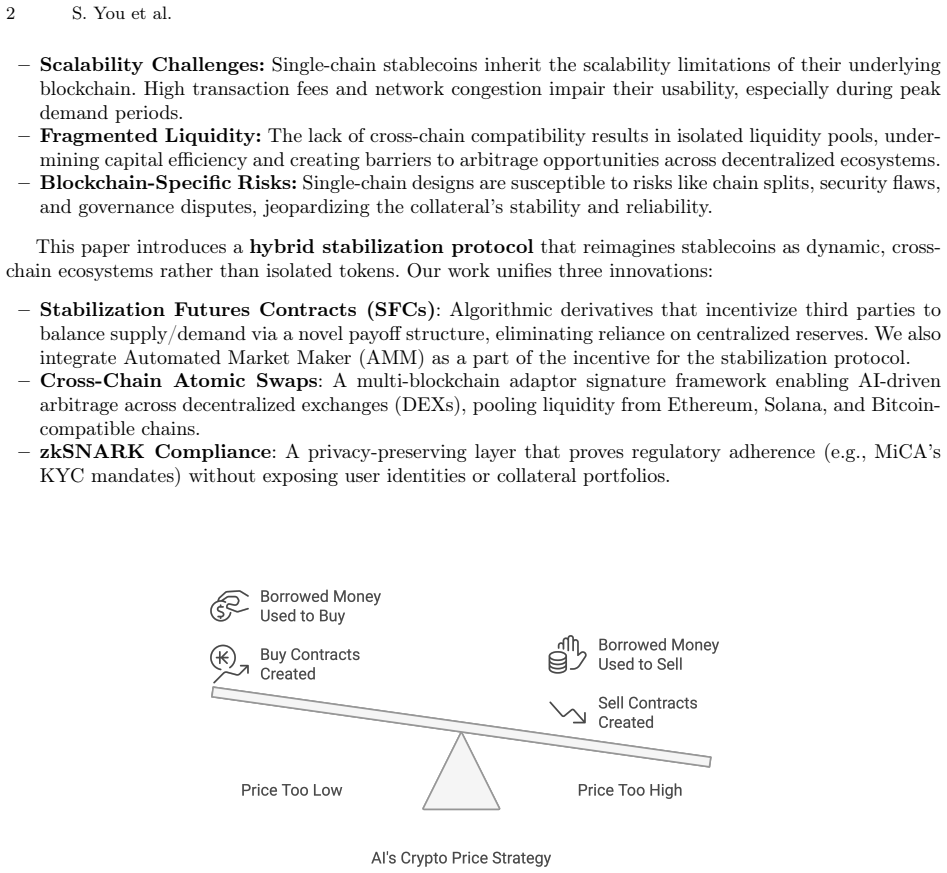
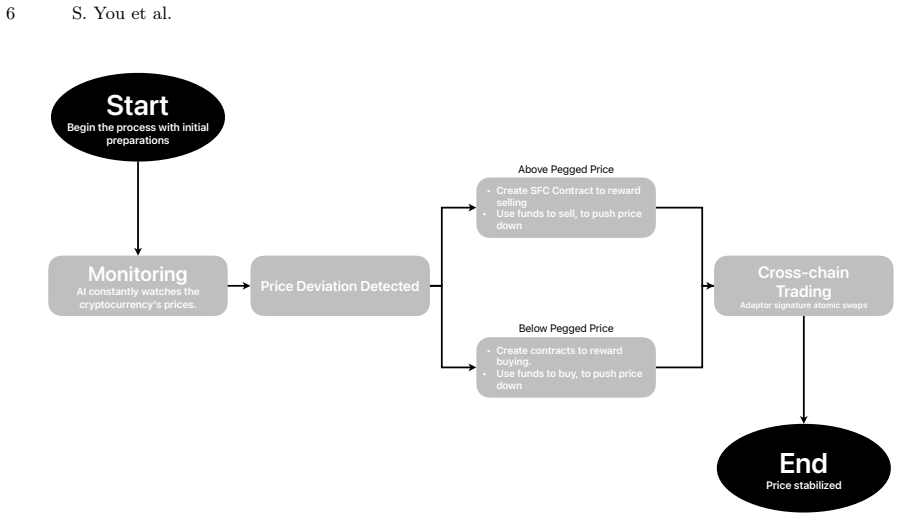
The central discovery is a protocol architecture whose stabilization force comes from instruments called Stabilization Futures Contracts (SFCs): non-collateralized derivatives with a payoff that is positive when the market price deviates from the peg, so a rational third party is paid to buy or sell the stable asset into convergence. The minting formula damps SFC issuance under volatility through a quadratic term, the collateralization ratio is defended by a dual-threshold vault with an AI optimizer rebalancing positions, and cross-chain arbitrage is made atomic and front-running-resistant through Schnorr adaptor signatures. The paper states this mechanism is formally proven stable via Lyapunov stability analysis, and it provides security reductions for vault solvency, market-manipulation resistance, and cross-chain atomicity under standard cryptographic assumptions plus oracle accuracy. Taken together, the claim is that stability emerges from incentive alignment rather than from centralized reserves.
Load-bearing premise
The whole stability case rests on the assumption that price oracles report prices within a bounded error and that no coalition larger than a third of the oracle nodes colludes; if oracles are inaccurate or corrupted, the vault can fall below the 1.2 collateralization threshold and arbitrageurs can game the SFC payoff instead of correcting the peg.
Editorial extensions
If this is right
- If the feedback loop is stable as claimed, the protocol keeps the peg without a trusted issuer, removing the main counterparty risk of fiat-backed coins.
- Cross-chain atomic settlement would let arbitrageurs correct price deviations in subsecond time, making fragmented liquidity a stabilization resource instead of a source of slippage.
- The HHI reduction from 4,900 to 2,400 implies materially lower systemic concentration risk in the stablecoin market.
- The zkSNARK compliance layer would allow regulated entities to prove the KYC status of counterparties without exposing their identities, offering a path to MiCA compliance from a decentralized design.
- The claimed 3.7–5.2x capital-efficiency improvement over overcollateralized designs would free substantial capital for DeFi use.
Reading between the lines
- Editorial: the conclusion asserts a Lyapunov stability proof, but the body contains no Lyapunov function or drift-dissipation argument; the stability claim should be read as an assertion pending a full derivation.
- Editorial: because the security theorems factor oracle error as an additive $q\cdot\delta$ term, the protocol's guarantees degrade linearly with the number of oracle queries, so an adversary who can bias a single oracle feed beyond the assumed $\delta$ would likely break the 1.2 collateral floor before any cryptographic forgery is needed.
- Editorial: the AI agents' centralization risk (biased training data or model failure) is acknowledged in the paper but not included in any security game, so a formal treatment would have to model the agent itself as a potential adversarial participant.
- Editorial: the protocol could be tested in a simulated two-chain environment where the oracle reports a permanently skewed price for one chain; under those conditions the SFC arbitrage loop should recouple prices, and failure to do so would contradict the stability claim even when the cryptographic assumptions hold.
Editorial analysis
A structured set of objections, weighed in public.
Referee Report
Summary. The paper proposes a hybrid stablecoin protocol that combines collateralized vaults, algorithmically minted Stabilization Futures Contracts (SFCs), adaptor-signature-based cross-chain atomic swaps, AI-driven market making, and zkSNARK-based compliance proofs. It claims to resolve the stablecoin trilemma by creating a self-reinforcing stabilization equilibrium, to reduce cross-chain liquidity concentration (HHI 2,400 vs. 4,900), and to provide formal security guarantees for vault solvency, market integrity, and atomicity. The manuscript presents a large number of equations, theorems, and design rationales, but the central stability mechanism is asserted rather than proved, the security reductions do not connect the stated cryptographic assumptions to the claimed game-winning conditions, and no experimental or simulation evidence is included despite claims of simulations and Monte Carlo tuning.
Significance. If the protocol's claims were established, the work would address genuine problems in decentralized stablecoin design: capital efficiency, cross-chain liquidity fragmentation, and regulatory privacy. The paper also covers a broad and relevant literature and attempts to combine control-theoretic stabilization with modern cryptographic primitives. However, as submitted, the central scientific claims are not supported. There are no machine-checked proofs, no reproducible code, no simulations, and no empirical evaluation; several theorems are invalid as written, and the headline 'Lyapunov stability analysis' does not appear in the paper. The manuscript is best read as a design proposal whose viability, stability, and security all remain unverified. Given the load-bearing nature of these gaps, the contribution as it stands is not publishable in its current form.
major comments (5)
- [§8, §4.3, §4.4] The central claim, stated in §8, that the SFC mechanism creates a 'self-reinforcing equilibrium... formally proven via Lyapunov stability analysis' is unsupported. No Lyapunov function, invariant set, or stability theorem appears anywhere in the manuscript. The differential equation dΔ/dt = −αΔ + βΣArbVolume in §4.3 and the PID update in §4.4 are asserted without derivation from arbitrageur incentives, capital constraints, or settlement timing, and the constants κ=0.3, μ=1.1, ν=0.05, λ=2.5 are described as empirically tuned without any supporting experiment. This is a load-bearing gap because the entire stabilization argument rests on this asserted feedback loop.
- [§6.1, Appendix A (Theorem 3/6)] The Vault Solvency proof does not establish the claimed bound. The reduction assumes that an adversary who wins Game_Solvency by causing Ct < 1.2 must produce a Schnorr forgery, but undercollateralization can occur through legitimate price movements, oracle error, or adversarial mint requests without any signature forgery. The step 'Forgery Extraction' is not logically connected to the winning condition. Additionally, the probability bound includes qδ as an additive oracle-error term while also claiming the oracle is (ε,δ)-accurate, without modeling how adaptive oracle queries affect the adversary's ability to trigger the threshold. The proof does not demonstrate vault solvency under the stated assumptions.
- [§6.2, Appendix B (Theorem 4/7)] The Market Integrity proof does not show that LWE hardness or collision resistance prevents price manipulation. The adversary's winning condition is a sustained price deviation |Δt| > 0.5%, which is an economic outcome; the proof only argues that breaking LWE or finding a hash collision would be needed to distinguish encrypted gradients or forge commitments. Nothing in the reduction shows that a manipulator must perform either of those cryptographic breaks. Moreover, the parameter instantiation yields a bound of approximately 2^−48, which is not negligible for a claimed security level of λ=128, undermining the stated security conclusion.
- [§6.3 (Theorem 5)] The atomicity proof reduces the swap game to solving the discrete logarithm from a valid signature on txX, but the game's winning condition is that txX confirms on Bi while txY fails on Bj. The reduction never connects the production of a valid Schnorr signature (under pkB) to the asymmetric confirmation outcome. Even if the DL reduction were valid, it would at most show that the adversary cannot forge a signature; it would not show that a protocol participant cannot cause one transaction to confirm while the other fails through non-cryptographic means such as refusing to reveal the adaptor secret or timing out. The theorem therefore does not prove atomicity.
- [§2.2, §4.2, §7.1, §7.3] Empirical and quantitative claims are not supported by any data or methodology. The paper claims '3.7–5.2×' capital efficiency 'per our simulations' (§2.2) and that the quadratic volatility term was 'chosen through Monte Carlo simulations' (§4.2), yet no simulation description, parameters, or results appear. The HHI reduction to 2,400 in §7.1 is obtained by assuming a uniform six-chain liquidity distribution (20% each) and then presented as a protocol outcome, which is circular. The paper itself later states 'While experimental validation remains' (§7.3), directly contradicting the earlier simulation claims.
minor comments (4)
- [Abstract, Fig. 1] The abstract contains a sentence fragment: 'The protocol's layered architecture encompassing incentive-compatible SFCs, AI-driven market making, and zero-knowledge regulatory proofs.' Figure 1's title contains a typo: 'Stabllization'.
- [Theorems, Appendix A/B] Theorem numbering is duplicated between the main text and appendices (Theorem 3 vs. Theorem 6, Theorem 4 vs. Theorem 7), which makes cross-referencing confusing.
- [§4.1] The adaptor signature construction in §4.1 is written as σadapt = (s + r·H(R||X||Y), R + rG), which is inconsistent with the standard Schnorr adaptor signature definition given in §3. The notation conflates the adaptor secret with the nonce and should be corrected for the cryptographic claims to be meaningful.
- [§4.3] The 'Anti-Dropout Mechanism' states that Bob can compute rB = sB − H(RB||X||Y)skB from public sB, but skB is not public, and if Bob knows his own skB he already knows rB; this does not explain how Bob learns Alice's secret or how atomicity is enforced.
Circularity Check
The only genuine circular reduction is the HHI improvement claim, which is computed from an assumed 20%-per-chain distribution and then presented as a protocol outcome; the central Lyapunov-stability claim is unsupported rather than circular, and the self-citation [36] is not load-bearing.
-
self definitional
[Abstract and Section 7.1 'Market Concentration and Cross-Chain Liquidity']
"Our cryptographic design reduces cross-chain liquidity concentration (Herfindahl-Hirschman Index: 2,400 vs. 4,900 in single-chain systems). ... For instance, distributing liquidity across six chains (20% each) achieves: HHIideal = 6×(0.2)^2 ×10,000 = 2,400 (moderately concentrated)."
The 'predicted' HHI of 2,400 is obtained by plugging an assumed vector of six equal 20% market shares into the HHI formula. It is not derived from SFC incentives, adaptor-signature atomic swaps, or any simulated or measured behavior of the protocol; the reduction from 4,900 is a property of the chosen distribution, so it holds by construction. The abstract then presents this arithmetic identity as an outcome of 'Our cryptographic design.' No protocol parameter or mechanism is shown to produce the 20% shares, so the input distribution and the output metric are the same statement. (The example is also arithmetically inconsistent: six shares of 20% sum to 120%.)
full rationale
The HHI claim is the one place where a marketed result reduces to its own input: the assumed liquidity distribution fully determines the reported index, so calling the resulting 2,400 a consequence of the cryptographic design is circular. The paper's central stabilization claim—the 'self-reinforcing equilibrium formally proven via Lyapunov stability analysis'—is not circular but unsupported: no Lyapunov function, convergence theorem, or simulation appears in Sections 4, 6, or the appendices, so the issue there is a missing proof rather than an input-output equivalence. The invocation of the authors' prior universal-adaptor-secret work ([36]) is a self-citation, but it is not load-bearing for the atomicity guarantee because Section 6.3 provides an in-paper reduction from the Schnorr/DL assumptions. Overall, the paper's core derivations are not forced by self-citation, but the HHI improvement, which appears in the abstract and conclusion, does reduce by construction.
Assumptions & free parameters
free parameters (8)
- alpha (SFC responsiveness)
- beta (volatility cap)
- gamma (volatility damping)
- lambda (rebalancing sparsity) =
0.7
- lambda (profit/risk) =
2.5
- lambda_1 (hedging sparsity) =
0.7
- kappa, mu, nu (PID gains) =
0.3, 1.1, 0.05
- C_min and warning threshold =
1.2 / 1.3
assumptions (7)
- standard math Schnorr signatures are EUF-CMA secure
- standard math Discrete logarithm is hard in G
- standard math Learning With Errors (LWE) is hard
- domain assumption Price oracles are (epsilon, delta)-accurate
- domain assumption Oracle set is honest-minority
- domain assumption Rational arbitrageurs will respond to SFC incentives and can access capital
- domain assumption AI agents can learn and execute the specified optimal policy
invented entities (1)
-
Stabilization Futures Contracts (SFCs)
Cite this review
Pith. "Pith review of Hybrid Stabilization Protocol for Cross-Chain Digital Assets Using Adaptor Signatures and AI-Driven Arbitrage." pith.science (2026). https://pith.science/paper/F6EMXD6A
@misc{pith2026250605708,
  author       = {Pith},
  title        = {Pith review of: Hybrid Stabilization Protocol for Cross-Chain Digital Assets Using Adaptor Signatures and AI-Driven Arbitrage},
  year         = {2026},
  howpublished = {\url{https://pith.science/paper/F6EMXD6A}},
  note         = {Machine review of arXiv:2506.05708}
}
read the original abstract
Stablecoins face an unresolved trilemma of balancing decentralization, stability, and regulatory compliance. We present a hybrid stabilization protocol that combines crypto-collateralized reserves, algorithmic futures contracts, and cross-chain liquidity pools to achieve robust price adherence while preserving user privacy. At its core, the protocol introduces stabilization futures contracts (SFCs), non-collateralized derivatives that programmatically incentivize third-party arbitrageurs to counteract price deviations via adaptor signature atomic swaps. Autonomous AI agents optimize delta hedging across decentralized exchanges (DEXs), while zkSNARKs prove compliance with anti-money laundering (AML) regulations without exposing identities or transaction details. Our cryptographic design reduces cross-chain liquidity concentration (Herfindahl-Hirschman Index: 2,400 vs. 4,900 in single-chain systems) and ensures atomicity under standard cryptographic assumptions. The protocol's layered architecture encompassing incentive-compatible SFCs, AI-driven market making, and zero-knowledge regulatory proofs. It provides a blueprint for next-generation decentralized financial infrastructure.
Figures
Reference graph
Works this paper leans on
-
[1]
Adams, H., Zinsmeister, N., Robinson, D.: Uniswap v2 core (2020),https://app.uniswap.org/whitepaper.pdf
work page 2020
-
[2]
Back, A., Corallo, M., Dashjr, L., Friedenbach, M., Maxwell, G., Miller, A., Poelstra, A., Timón, J., Wuille, P.: Enabling blockchain innovations with pegged sidechains (2014)
work page 2014
-
[3]
In: Proceedings of the 2019 ACM SIGSAC Conference on Computer and Communications Security
Bentov, I., Ji, Y., Zhang, F., Breidenbach, L., Daian, P., Juels, A.: Tesseract: Real-time cryptocurrency exchange using trusted hardware. In: Proceedings of the 2019 ACM SIGSAC Conference on Computer and Communications Security. pp. 1521–1538 (2019)
work page 2019
-
[4]
Chan, B.: Custody and full proof of assets (2019),https://blog.bitgo.com/ wrapped-btc-launches-with-bitgo-custody-and-full-proof-of-assets-c7fbf21e4a66
work page 2019
-
[5]
Cole, J.: Stable coins in crypto: Understanding hybrid token mechanisms.https://blockapps.net/blog/ stable-coins-in-crypto-understanding-hybrid-token-mechanisms/, accessed: 2025-01-23
work page 2025
-
[6]
Consortium, C.: Usd coin (usdc).https://www.usdc.com/, accessed: 2025-01-14
work page 2025
-
[7]
In: 2020 IEEE Symposium on Security and Privacy (SP)
Daian, P., Goldfeder, S., Kell, T., Li, Y., Zhao, X., Bentov, I., Breidenbach, L., Juels, A.: Flash boys 2.0: Frontrun- ning in decentralized exchanges, miner extractable value, and consensus instability. In: 2020 IEEE Symposium on Security and Privacy (SP). pp. 910–927. IEEE (2020)
work page 2020
-
[8]
Deshpande, A., Herlihy, M.: Privacy-preserving cross-chain atomic swaps. In: Financial Cryptography and Data Security: FC 2020 International Workshops, AsiaUSEC, CoDeFi, VOTING, and WTSC, Kota Kinabalu, Malaysia, February 14, 2020, Revised Selected Papers. pp. 540–549. Springer (2020)
work page 2020
Show all 37 references
-
[9]
Economics Letters244(11193), 9 (2024)
Dionysopoulos, L., Urquhart, A.: 10 years of stablecoins. Economics Letters244(11193), 9 (2024)
2024
-
[10]
Eichholz, L.: What really happened to makerdao?https://insights.glassnode.com/ what-really-happened-to-makerdao/, accessed: 2025-01-23
2025
-
[11]
(eds.) Mathematical Research for Blockchain Economy
Hajek,B.,Reijsbergen,D.,Datta,A.,Keppo,J.:Collateralportfoliooptimizationincrypto-backedstablecoins.In: Leonardos, S., Alfieri, E., Knottenbelt, W.J., Pardalos, P. (eds.) Mathematical Research for Blockchain Economy. pp. 93–111. Springer Nature Switzerland, Cham (2024)
2024
-
[12]
In: Proceedings of the 1st ACM Conference on Advances in Financial Technologies
Han, R., Lin, H., Yu, J.: On the optionality and fairness of atomic swaps. In: Proceedings of the 1st ACM Conference on Advances in Financial Technologies. pp. 62–75 (2019) Title Suppressed Due to Excessive Length 17
2019
-
[13]
In: Financial Cryptography and Data Se- curity: 24th International Conference, FC 2020, Kota Kinabalu, Malaysia, February 10–14, 2020 Revised Selected Papers 24
Heilman, E., Lipmann, S., Goldberg, S.: The arwen trading protocols. In: Financial Cryptography and Data Se- curity: 24th International Conference, FC 2020, Kota Kinabalu, Malaysia, February 10–14, 2020 Revised Selected Papers 24. pp. 156–173. Springer (2020)
2020
-
[14]
In: Proceedings of the 2018 ACM Symposium on Principles of Distributed Computing
Herlihy, M.: Atomic cross-chain swaps. In: Proceedings of the 2018 ACM Symposium on Principles of Distributed Computing. pp. 245–254. ACM (2018)
2018
-
[15]
Electronics13(1), 76 (2023)
Ji, Y., Xiao, Y., Gao, B., Zhang, R.: Threshold/multi adaptor signature and their applications in blockchains. Electronics13(1), 76 (2023)
2023
-
[16]
arXiv preprint arXiv:2103.01340 (2021)
Kahya, A., Krishnamachari, B., Yun, S.: Reducing the volatility of cryptocurrencies–a survey of stablecoins. arXiv preprint arXiv:2103.01340 (2021)
2021 arXiv
-
[17]
Cryptology ePrint Archive (2024)
Kajita, K., Ohtake, G., Takagi, T.: Generalized adaptor signature scheme: From two-party to n-party settings. Cryptology ePrint Archive (2024)
2024
-
[18]
Kampakis, S.: Janus: A stablecoin 3.0 blueprint for navigating the stablecoin trilemma through dual-token design, multi-collateralization, soft peg, and ai-driven stabilization (2024),https://arxiv.org/abs/2412.18182
2024 arXiv
-
[19]
Cryptography 6(1), 6 (2022)
Klamti, J.B., Hasan, M.A.: Post-quantum two-party adaptor signature based on coding theory. Cryptography 6(1), 6 (2022)
2022
-
[20]
Kosse, A., Glowka, M., Mattei, I., Rice, T.: Will the real stablecoin please stand up? BIS Papers (2023)
2023
-
[21]
KRISZTIAN SANDOR, E.G.: The fall of terra: A timeline of the me- teoric rise and crash of ust and luna.https://www.coindesk.com/learn/ the-fall-of-terra-a-timeline-of-the-meteoric-rise-and-crash-of-ust-and-luna, accessed: 2025-01-14
2025
-
[22]
Kwon, J., Buchman, E.: Cosmos whitepaper. A Netw. Distrib. Ledgers p. 27 (2019)
2019
-
[23]
RootStock Core Team, White Paper (2015)
Lerner, S.D.: Rsk. RootStock Core Team, White Paper (2015)
2015
-
[24]
Computer Standards & Interfaces87, 103747 (2024)
Li, D., Han, D., Weng, T.H., Zheng, Z., Li, H., Li, K.C.: On stablecoin: Ecosystem, architecture, mechanism and applicability as payment method. Computer Standards & Interfaces87, 103747 (2024)
2024
-
[25]
Lyons, R.K., Viswanath-Natraj, G.: What keeps stablecoins stable? Journal of International Money and Fi- nance131, 102777 (2023).https://doi.org/https://doi.org/10.1016/j.jimonfin.2022.102777,https:// www.sciencedirect.com/science/article/pii/S0261560622001802
2023
-
[26]
Lys,L.,Micoulet,A.,Potop-Butucaru,M.:R-swap:Relaybasedatomiccross-chainswapprotocol.In:Algorithmic Aspects of Cloud Computing: 6th International Symposium, ALGOCLOUD 2021, Lisbon, Portugal, September 6–7, 2021, Revised Selected Papers 6. pp. 18–37. Springer (2021)
2021
-
[27]
MakerDAO Foundation: Makerdao.https://makerdao.com/, accessed: 2025-01-14
2025
-
[28]
In: 2019 8th International Congress on Advanced Applied Informatics (IIAI-AAI)
Mita, M., Ito, K., Ohsawa, S., Tanaka, H.: What is stablecoin?: A survey on price stabilization mechanisms for decentralized payment systems. In: 2019 8th International Congress on Advanced Applied Informatics (IIAI-AAI). pp. 60–66. IEEE (2019)
2019
-
[29]
Network, P.: Building stablecoin protocols.https://www.pyth.network/usecases/stablecoin-protocols, ac- cessed: 2025-01-23
2025
-
[30]
Poon, J., Dryja, T.: The bitcoin lightning network: scalable off-chain instant payments (2016) (2016)
2016
-
[31]
Relay, B.: Btc relay (2023),http://btcrelay.org/
2023
-
[32]
Cryptology ePrint Archive, Paper 2024/1208 (2024),https://eprint.iacr.org/2024/1208
Rosenberg, M., Mopuri, T., Hafezi, H., Miers, I., Mishra, P.: Hekaton: Horizontally-scalable zkSNARKs via proof aggregation. Cryptology ePrint Archive, Paper 2024/1208 (2024),https://eprint.iacr.org/2024/1208
2024
-
[33]
federalreserve.gov/econres/notes/feds-notes/primary-and-secondary-markets-for-stablecoins-20240223
Seira, C.W..J.A..H.D..J.D..D.L..M.R..A.: Primary and secondary markets for stablecoins.https://www. federalreserve.gov/econres/notes/feds-notes/primary-and-secondary-markets-for-stablecoins-20240223. html, accessed: 2025-01-23
2025
-
[34]
Tether Operations Limited: Tether.https://tether.to/, accessed: 2025-01-14
2025
-
[35]
In: Proceedings of the 2021 ACM Symposium on Principles of Distributed Computing
Xue, Y., Herlihy, M.: Hedging against sore loser attacks in cross-chain transactions. In: Proceedings of the 2021 ACM Symposium on Principles of Distributed Computing. pp. 155–164 (2021)
2021
-
[36]
You, S., Joshi, A., Kuehlkamp, A., Nabrzyski, J.: A multi-party, multi-blockchain atomic swap protocol with universal adaptor secret (2024),https://arxiv.org/abs/2406.16822
2024 arXiv
-
[37]
In: 2019 IEEE Symposium on Security and Privacy (SP)
Zamyatin, A., Harz, D., Lind, J., Panayiotou, P., Gervais, A., Knottenbelt, W.: Xclaim: Trustless, interoperable, cryptocurrency-backed assets. In: 2019 IEEE Symposium on Security and Privacy (SP). pp. 193–210. IEEE (2019)
2019
Reviewed August 7, 2026 · model on record in the stance chip above.
Discussion (0). Sign in to comment.