REVIEW 4 major objections 5 minor 40 references
Advancement and Field Evaluation of a Dual-arm Apple Harvesting Robot
T0 review · 4 major / 5 minor · reviewed 2026-08-07 · deepseek-v4-flash
Pith's one-line read A dual-arm, vacuum-based apple harvesting robot reaches 80.7% and 79.7% success rates in two commercial orchards and cuts harvest time 28% versus a single-arm system.
desk verdict A genuine field advance in dual-arm apple harvesting, with real numbers that need a bit more documentation before the headline comparisons fully land. read the letter →
The pith
A machine-rendered reading of the paper's core claim, the machinery that carries it, and where it could break.
The reading
What carries the argument
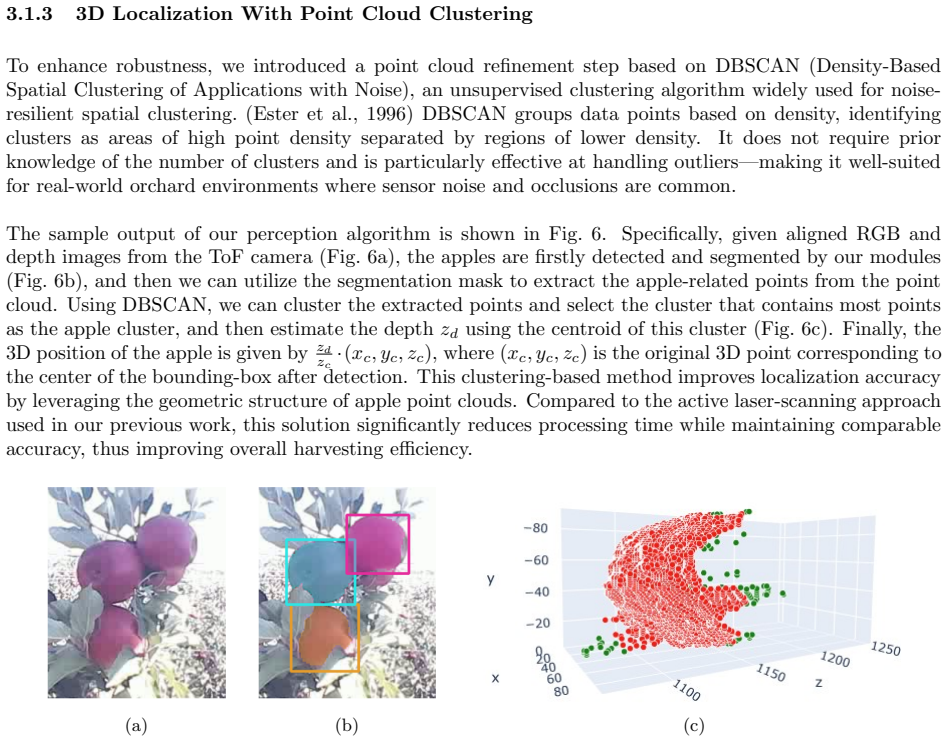
The central mechanism is the shared-vacuum dual-arm system with four butterfly valves and three pressure sensors. Pressure at each arm and at the vacuum source tells the controller whether an apple is sealed to the end-effector; the temporal-logic policy expresses that both arms should always eventually retract with fruit attached, that valves open only after approach, that at most one arm attempts attachment unless the other has already sealed, and that failed or dropped attachments close the valve immediately. This lets two arms run approach and retraction in parallel while sharing one suction source, and it converts failure detection into a faster retry. On the perception side, the load-bearing object is the three-stage pipeline: Grounding-DINO detection boxes prompt a dual-branch segmentation network producing instance masks, and DBSCAN clustering of the masked point cloud picks the densest cluster to give a depth estimate.
What would settle it
Count every apple visible in the camera images inside the robot's reachable workspace before a harvest run, then count how many of those apples end up in the storage bin; if that ratio is substantially below 80.7% and 79.7%, the per-attempt metric overstates the system's picking capability. A single orchard row with pre- and post-harvest enumeration would settle this.
Extended reading notes
Core claim
The central claim is that an integrated dual-arm harvesting robot, with a fixed Time-of-Flight camera, a centralized vacuum shared by two 4-degree-of-freedom suction arms, and a temporal-logic coordination policy driven by pressure feedback, achieves 80.7% and 79.7% harvest success rates in Gala and Fuji commercial orchards, with a 5.97-second mean cycle time per attempt and a 28% time saving over a single-arm baseline. The paper attributes this performance to three interacting components: a detection-to-segmentation-to-DBSCAN localization pipeline that tolerates localization errors of about 1.5 centimeters, a valve system that dynamically routes vacuum to one or both arms, and a coordination policy that forbids simultaneous attachment while allowing parallel approach and retraction based on inferred attachment success. The work is presented as a full-system field validation rather than a component study.
Load-bearing premise
The success rates count only apples the robot chose to attempt; apples the perception system never detected or that were classified as too occluded to harvest are not in the denominator, so the reported 80 percent is not the share of all apples in the robot's workspace that got picked.
Editorial extensions
If this is right
- A 5.97-second average cycle per attempt is well below the greater-than-10-second cycle times cited for earlier fruit-by-fruit harvesting robots, bringing per-attempt speed closer to commercial practicality.
- The 28% time saving over a single-arm baseline shows that a shared-vacuum dual-arm configuration can outperform two independent arms if the coordination policy reacts to attachment failures in real time.
- The failure analysis identifies perception issues, especially exposure, occlusion, and apple clustering, as the dominant cause of missed pick attempts, pointing future improvements toward detection and segmentation rather than arm mechanics.
- Because arm movement speed was deliberately capped at 60% of maximum during field tests, the paper claims substantial efficiency headroom if the system can operate faster without damaging the canopy.
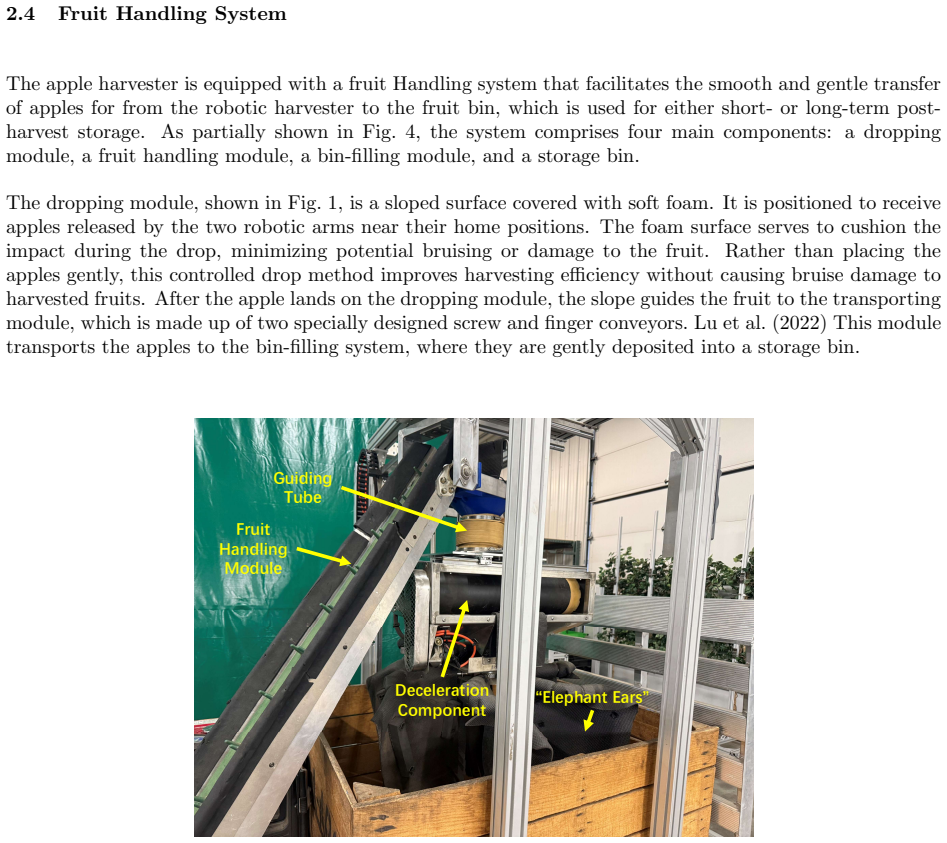
- The interaction between the dropping module and protruding branches suggests that platform movement and trajectory planning, not just picking, now limit safe continuous operation.
Reading between the lines
- Beyond the paper: the reported 80% success is a per-attempt rate, not a per-tree yield rate, because apples the perception system never detects or the authors classify as unharvestable due to heavy occlusion are excluded from the denominator; counting all apples in the robot's workspace would likely give a lower effective harvest fraction.
- Beyond the paper: the pressure-feedback coordination policy is not apple-specific; the pattern of serializing only the resource-contended operation while allowing parallel approach and retraction could transfer to other shared-pump or shared-gripper harvesting robots for strawberries, peppers, or citrus.
- Beyond the paper: the 28% time saving assumes the vacuum seal holds during parallel retraction; if end-effector seals degrade with canopy contact or fruit orientation, the policy would need to serialize retraction more often, making the saving dependent on orchard conditions.
- Beyond the paper: a direct test of the coordination gain would run the same orchard rows with the 2024 policy versus the 2023 policy under matched apple density and arm speed, measuring not just cycle time but also apples harvested per row.
Editorial analysis
A structured set of objections, weighed in public.
Referee Report
Summary. The paper describes the design, implementation, and field evaluation of a dual-arm apple harvesting robot. The system combines a Time-of-Flight camera, two 4-DOF vacuum-based arms, a centralized valve system with pressure feedback, a platform movement module, and a fruit handling module. A perception pipeline based on a fine-tuned Grounding-DINO detector, semantic/instance segmentation, and DBSCAN-based depth estimation is presented, together with a temporal-logic-inspired coordination strategy for the two arms. Field demonstrations in two commercial Michigan orchards (Gala and Fuji) are reported, with success rates of 80.7% and 79.7%, an average cycle time of 5.97 s per attempt, and a claimed 28% harvest-time reduction relative to a single-arm baseline. The paper concludes that the system is approaching practical deployment.
Significance. If the reported field performance is reproducible, this work is a useful contribution to agricultural robotics: it demonstrates a fully integrated dual-arm harvesting platform evaluated in real commercial orchards, with a detailed failure analysis and an honest discussion of limitations. The system-level integration effort is substantial, and the explicit reporting of field conditions and failure categories is a strength. However, the headline performance metrics—success rate and cycle-time reduction—are presently defined over an operator-filtered set of attempts and compared against a baseline whose measurement protocol is not described. These gaps must be addressed before the quantitative claims can be accepted as stated.
major comments (4)
- [Section 4.2, Table 2] The reported success rates (80.7% and 79.7%) are computed only over apples that the system attempted to pick. The text acknowledges that some apples were heavily occluded and thus 'effectively unharvestable', but it never quantifies how many such apples were present in the robot's workspace, nor how many apples were missed entirely by the perception system. If the denominator were expanded to include all apples in the workspace, the success rates could be materially lower. The paper should either report the number of unharvestable/missed apples and recompute rates over the full crop, or explicitly frame the headline numbers as per-attempt success rates conditional on detection and operator selection.
- [Section 4.2, single-arm baseline] The claim that the coordination strategy reduced harvest time by 28% rests on a single-arm baseline cycle time of 8.29 s, but the manuscript provides no experimental protocol for how this baseline was measured. It is not stated whether a single arm was disabled in the same orchard conditions, how many cycles were timed, what the success rate was in that configuration, or whether the baseline reflects the same perception and control software. Without this information, the 28% reduction cannot be evaluated. The authors should report the baseline setup, the number of trials, and ideally the raw per-cycle times.
- [Section 4.2, performance statistics] No confidence intervals, standard deviations, or statistical tests are reported for the success rates or cycle times. With 322 and 285 attempted apples, the binomial 95% confidence intervals for the success rates are roughly ±3–4 percentage points, so the two orchard results (80.7% vs 79.7%) are statistically indistinguishable. Similarly, the average cycle time of 5.97 s should be accompanied by a measure of variability across cycles. Reporting only point estimates makes it difficult to assess the precision and generality of the headline claims.
- [Section 4.2, Fig. 12] The theoretical cycle-time analysis in Fig. 12 uses assumed phase durations (arm movement ≈1.5 s, attachment ≈1.0 s, release ≈0.5 s) and derives per-apple cycle times of roughly 2.25 s for the 2024 coordination strategy under ideal conditions. The measured field cycle time is 5.97 s, a large discrepancy that the text attributes to non-uniform distances and harvest failures. The figure and accompanying comparison of 'Baseline', '2023 Version', and '2024 Version' are therefore illustrative rather than measurements. If the 28% reduction claim is based on the field-measured dual-arm time compared to a field-measured single-arm time, the theoretical analysis is not the basis for that claim and should be presented as a separate, clearly labeled idealized analysis.
minor comments (5)
- [Throughout] The manuscript contains several grammatical errors and typos, e.g., 'post high requirement' in Section 1, 'trailor' in the Fig. 1 caption, 'for from' in Section 2.4, and inconsistent capitalization of 'fruit Handling system'. A careful proofreading pass is recommended.
- [Section 2.4] The citations 'Lu et al. (2022)' and 'Zhang et al. (2017)' appear in the text without supporting context or parentheses, making them read as dangling references. They should be integrated into the sentences properly.
- [Section 3.3] The text states that a temporal logic policy was 'synthesized', but the method described is a manual specification of formulas (Eqs. 7–12) followed by hand-construction of a directed graph. It would be more accurate to describe this as a temporal-logic-based specification and manual translation to a finite-state controller rather than automated synthesis.
- [Section 4.3, Table 3] The failure counts in Table 3 (e.g., 101 exposure, 207 occlusion, 159 cluster) sum to far more than the total number of failed attempts (62 + 58 = 120). The text notes that some failures involve multiple overlapping causes, but it should state explicitly that the counts are per-cause and not per-attempt, so readers are not misled.
- [Section 4.3] The paper says 130 harvesting videos were reviewed, but the two trials involved 607 attempted apples. It is unclear whether these videos cover all attempts or only a subset. Clarifying the selection criterion for the video review would strengthen the failure analysis.
Circularity Check
No circularity: field success rates and cycle-time comparisons are empirical measurements; the temporal-logic policy is a hand-authored specification, not a fit to its own output.
full rationale
Walking the paper's derivation chain, the central quantities are measured rather than derived from fitted parameters. The success rates (80.7% and 79.7%), the average dual-arm cycle time (5.97 s), and the single-arm comparison (8.29 s) are reported as field observations or averaged operational values, not as outputs of a model fitted to those same numbers. The localization pipeline uses a pre-trained Grounding-DINO detector fine-tuned on a proprietary dataset and a DBSCAN-based depth estimate; its performance is evaluated in the field, not inferred from the pipeline's own assumptions. The temporal-logic coordination policy in Eqs. (7)-(12) encodes the authors' intended workflow and hardware constraints (no simultaneous attachment, immediate valve closure on failure) and is a specification of a hand-designed reactive controller, not a regression or fitted predictor of the measured success rate. The claimed 28% harvest-time reduction is a post-hoc comparison of the measured 5.97 s dual-arm figure against the 8.29 s single-arm figure, so it is not circular in the sense of predicting a fitted constant. Heavy self-citation exists (Chu et al., Lammers et al., Zhang et al.), but these citations are used as background for prior hardware, perception, and coordination designs; the present field results are independent empirical evidence and are not forced by those citations. Concerns about the success-rate denominator excluding missed or heavily occluded apples, and about the lack of a detailed single-arm experimental protocol, are legitimate external-validity and measurement-transparency issues, not circularity. No equation in the paper reduces to its own input, and no fitted parameter is renamed as a prediction. Therefore the circularity score is 0.
Assumptions & free parameters
free parameters (4)
- Detection confidence threshold =
0.3
- DBSCAN parameters (eps, min_samples) =
not reported
- Arm movement speed factor =
60% of maximum
- Controller gains k_x, k_y, k_z, t_x, t_y, t_z =
not reported
assumptions (5)
- domain assumption The two field orchards and apple varieties are representative of commercial conditions
- domain assumption Pressure sensor readings reliably indicate apple attachment status
- domain assumption ToF camera depth accuracy and RGB-depth alignment meet the stated specifications
- domain assumption Kinematic parameters in Table 1 are accurate for both arms
- standard math Xian et al. (2004) stability methodology applies to the proposed controller without modification
Cite this review
Pith. "Pith review of Advancement and Field Evaluation of a Dual-arm Apple Harvesting Robot." pith.science (2026). https://pith.science/paper/HLBPESLW
@misc{pith2026250605714,
  author       = {Pith},
  title        = {Pith review of: Advancement and Field Evaluation of a Dual-arm Apple Harvesting Robot},
  year         = {2026},
  howpublished = {\url{https://pith.science/paper/HLBPESLW}},
  note         = {Machine review of arXiv:2506.05714}
}
read the original abstract
Apples are among the most widely consumed fruits worldwide. Currently, apple harvesting fully relies on manual labor, which is costly, drudging, and hazardous to workers. Hence, robotic harvesting has attracted increasing attention in recent years. However, existing systems still fall short in terms of performance, effectiveness, and reliability for complex orchard environments. In this work, we present the development and evaluation of a dual-arm harvesting robot. The system integrates a ToF camera, two 4DOF robotic arms, a centralized vacuum system, and a post-harvest handling module. During harvesting, suction force is dynamically assigned to either arm via the vacuum system, enabling efficient apple detachment while reducing power consumption and noise. Compared to our previous design, we incorporated a platform movement mechanism that enables both in-out and up-down adjustments, enhancing the robot's dexterity and adaptability to varying canopy structures. On the algorithmic side, we developed a robust apple localization pipeline that combines a foundation-model-based detector, segmentation, and clustering-based depth estimation, which improves performance in orchards. Additionally, pressure sensors were integrated into the system, and a novel dual-arm coordination strategy was introduced to respond to harvest failures based on sensor feedback, further improving picking efficiency. Field demos were conducted in two commercial orchards in MI, USA, with different canopy structures. The system achieved success rates of 0.807 and 0.797, with an average picking cycle time of 5.97s. The proposed strategy reduced harvest time by 28% compared to a single-arm baseline. The dual-arm harvesting robot enhances the reliability and efficiency of apple picking. With further advancements, the system holds strong potential for autonomous operation and commercialization for the apple industry.
Figures


Figures from the paper (9 more)



Reference graph
Works this paper leans on
-
[1]
Ringdahl, O., Tielen, T., et al. (2020). Development of a sweet pepper harvesting robot.Journal of field robotics, 37(6):1027–1039
work page 2020
-
[2]
Baier, C. and Katoen, J.-P. (2008).Principles of model checking. MIT press
work page 2008
-
[3]
Barnett, J., Duke, M., Au, C. K., and Lim, S. H. (2020). Work distribution of multiple cartesian robot arms for kiwifruit harvesting.Computers and electronics in agriculture, 169:105202
work page 2020
-
[4]
Brown, J. and Sukkarieh, S. (2021). Design and evaluation of a modular robotic plum harvesting system utilizing soft components.Journal of Field Robotics, 38(2):289–306
work page 2021
-
[5]
Bu, L., Chen, C., Hu, G., Sugirbay, A., Sun, H., and Chen, J. (2022). Design and evaluation of a robotic apple harvester using optimized picking patterns.Computers and electronics in agriculture, 198:107092
work page 2022
-
[6]
Chu, P., Li, Z., Lammers, K., Lu, R., and Liu, X. (2021). Deep learning-based apple detection using a suppression mask r-cnn.Pattern Recognition Letters, 147:206–211
work page 2021
-
[7]
Chu, P., Li, Z., Zhang, K., Chen, D., Lammers, K., and Lu, R. (2023). O2rnet: Occluder-occludee relational network for robust apple detection in clustered orchard environments.Smart Agricultural Technology, 5:100284
work page 2023
-
[8]
Chu, P., Li, Z., Zhang, K., Lammers, K., and Lu, R. (2024). High-precision fruit localization using active laser-camera scanning: Robust laser line extraction for 2d-3d transformation.Smart Agricultural Techno- logy, 7:100391
work page 2024
Show all 40 references
-
[9]
Ester, M., Kriegel, H.-P., Sander, J., Xu, X., et al. (1996). A density-based algorithm for discovering clusters in large spatial databases with noise. Inkdd, volume 96, pages 226–231
1996
-
[10]
Gallardo, R. K. and Galinato, S. P. (2020). 2019 cost estimates of establishing, producing, and packing honeycrisp apples in washington
2020
-
[11]
Gao, J., Zhang, F., Zhang, J., Yuan, T., Yin, J., Guo, H., and Yang, C. (2022). Development and evaluation of a pneumatic finger-like end-effector for cherry tomato harvesting robot in greenhouse.Computers and Electronics in Agriculture, 197:106879. Gen´ e-Mola, J., Ferrer-Fer...
2022
-
[12]
Vilaplana, V., and Ruiz-Hidalgo, J. (2023). Looking behind occlusions: A study on amodal segmentation for robust on-tree apple fruit size estimation.Computers and Electronics in Agriculture, 209:107854
2023
-
[13]
Gursoy, E., Navarro, B., Cosgun, A., Kuli´ c, D., and Cherubini, A. (2023). Towards vision-based dual arm robotic fruit harvesting. In2023 IEEE 19th International Conference on Automation Science and Engineering (CASE), pages 1–6. IEEE
2023
-
[14]
E., and Pappas, G
Kress-Gazit, H., Fainekos, G. E., and Pappas, G. J. (2009). Temporal-logic-based reactive mission and motion planning.IEEE transactions on robotics, 25(6):1370–1381
2009
-
[15]
Lammers, K., Zhang, K., Zhu, K., Chu, P., Li, Z., and Lu, R. (2024). Development and evaluation of a dual-arm robotic apple harvesting system.Computers and Electronics in Agriculture, 227:109586
2024
-
[16]
W., and Perez, T
Lehnert, C., English, A., McCool, C., Tow, A. W., and Perez, T. (2017). Autonomous sweet pepper harvesting for protected cropping systems.IEEE Robotics and Automation Letters, 2(2):872–879
2017
-
[17]
H., Zhang, P., Zhang, H., Yang, J., Li, C., Zhong, Y., Wang, L., Yuan, L., Zhang, L., Hwang, J.-N., et al
Li, L. H., Zhang, P., Zhang, H., Yang, J., Li, C., Zhong, Y., Wang, L., Yuan, L., Zhang, L., Hwang, J.-N., et al. (2022). Grounded language-image pre-training. InProceedings of the IEEE/CVF Conference on Computer Vision and Pattern Recognition, pages 10965–10975
2022
-
[18]
Li, T., Xie, F., Zhao, Z., Zhao, H., Guo, X., and Feng, Q. (2023). A multi-arm robot system for efficient apple harvesting: Perception, task plan and control.Computers and electronics in agriculture, 211:107979
2023
-
[19]
Liu, S., Zeng, Z., Ren, T., Li, F., Zhang, H., Yang, J., Jiang, Q., Li, C., Yang, J., Su, H., et al. (2024). Grounding dino: Marrying dino with grounded pre-training for open-set object detection. InEuropean Conference on Computer Vision, pages 38–55. Springer
2024
-
[20]
Lu, Y., Lu, R., and Zhang, Z. (2022). Development and preliminary evaluation of a new apple harvest assist and in-field sorting machine.Applied Engineering in Agriculture, 38(1):23–35
2022
-
[21]
Magistri, F., Pan, Y., Bartels, J., Behley, J., Stachniss, C., and Lehnert, C. (2024). Improving robotic fruit harvesting within cluttered environments through 3d shape completion.IEEE Robotics and Automation Letters
2024
-
[22]
Miao, Z., Yu, X., Li, N., Zhang, Z., He, C., Li, Z., Deng, C., and Sun, T. (2023). Efficient tomato harvesting robot based on image processing and deep learning.Precision Agriculture, 24(1):254–287
2023
-
[23]
A., and E, A
Parsa, S., Debnath, B., Khan, M. A., and E, A. G. (2024). Modular autonomous strawberry picking robotic system.Journal of Field Robotics, 41(7):2226–2246
2024
-
[24]
Rajendran, V., Debnath, B., Mghames, S., Mandil, W., Parsa, S., Parsons, S., and Ghalamzan-E, A. (2024). Towards autonomous selective harvesting: A review of robot perception, robot design, motion planning and control.Journal of Field Robotics, 41(7):2247–2279
2024
-
[25]
Ren, G., Wu, T., Lin, T., Yang, L., Chowdhary, G., Ting, K., and Ying, Y. (2024). Mobile robotics platform for strawberry sensing and harvesting within precision indoor farming systems.Journal of Field Robotics, 41(7):2047–2065
2024
-
[26]
Ren, S., He, K., Girshick, R., and Sun, J. (2016). Faster r-cnn: Towards real-time object detection with region proposal networks.IEEE transactions on pattern analysis and machine intelligence, 39(6):1137–1149
2016
-
[27]
R., Karkee, M., Mo, C., Zhang, Q., and Lewis, K
Silwal, A., Davidson, J. R., Karkee, M., Mo, C., Zhang, Q., and Lewis, K. (2017). Design, integration, and field evaluation of a robotic apple harvester.Journal of Field Robotics, 34(6):1140–1159
2017
-
[28]
Wang, C.-Y., Yeh, I.-H., and Mark Liao, H.-Y. (2024). Yolov9: Learning what you want to learn using programmable gradient information. InEuropean conference on computer vision, pages 1–21. Springer
2024
-
[29]
Wang, X., Kang, H., Zhou, H., Au, W., and Chen, C. (2022). Geometry-aware fruit grasping estimation for robotic harvesting in apple orchards.Computers and Electronics in Agriculture, 193:106716
2022
-
[30]
A., Jones, M
Williams, H. A., Jones, M. H., Nejati, M., Seabright, M. J., Bell, J., Penhall, N. D., Barnett, J. J., Duke, M. D., Scarfe, A. J., Ahn, H. S., et al. (2019). Robotic kiwifruit harvesting using machine vision, convo- lutional neural networks, and robotic arms.biosystems enginee...
2019
-
[31]
M., de Queiroz, M
Xian, B., Dawson, D. M., de Queiroz, M. S., and Chen, J. (2004). A continuous asymptotic tracking control strategy for uncertain nonlinear systems.IEEE Transactions on Automatic Control, 49(7):1206–1211
2004
-
[32]
Xiong, Y., Ge, Y., Grimstad, L., and From, P. J. (2020). An autonomous strawberry-harvesting robot: Design, development, integration, and field evaluation.Journal of Field Robotics, 37(2):202–224
2020
-
[33]
Yin, H., Sun, Q., Ren, X., Guo, J., Yang, Y., Wei, Y., Huang, B., Chai, X., and Zhong, M. (2023). Development, integration, and field evaluation of an autonomous citrus-harvesting robot.Journal of Field Robotics, 40(6):1363–1387
2023
-
[34]
M., and Shum, H.-Y
Zhang, H., Li, F., Liu, S., Zhang, L., Su, H., Zhu, J., Ni, L. M., and Shum, H.-Y. (2022a). Dino: Detr with improved denoising anchor boxes for end-to-end object detection.arXiv preprint arXiv:2203.03605
2022 arXiv
-
[35]
Zhang, K., Lammers, K., Chu, P., Li, Z., and Lu, R. (2021). System design and control of an apple harvesting robot.Mechatronics, 79:102644
2021
-
[36]
Zhang, K., Lammers, K., Chu, P., Li, Z., and Lu, R. (2024). An automated apple harvesting robot—from system design to field evaluation.Journal of Field Robotics, 41(7):2384–2400
2024
-
[37]
D., and Zhang, Q
Zhang, X., He, L., Karkee, M., Whiting, M. D., and Zhang, Q. (2020). Field evaluation of targeted shake- and-catch harvesting technologies for fresh market apple.Transactions of the ASABE, 63(6):1759–1771
2020
-
[38]
K., and Lu, R
Zhang, Z., Pothula, A. K., and Lu, R. (2017). Development and preliminary evaluation of a new bin filler for apple harvesting and in-field sorting machine.Transactions of the ASABE, 60(6):1839–1849
2017
-
[39]
Zhao, J., Zhu, K., Li, S., and Yin, X. (2023). To explore or not to explore: Regret-based ltl planning in partially-known environments.IF AC-PapersOnLine, 56(2):11337–11343
2023
-
[40]
Zhou, H., Wang, X., Au, W., Kang, H., and Chen, C. (2022). Intelligent robots for fruit harvesting: Recent developments and future challenges.Precision Agriculture, 23(5):1856–1907
2022
Reviewed August 7, 2026 · model on record in the stance chip above.
Discussion (0). Sign in to comment.