REVIEW 4 major objections 4 minor 16 references
Elliptic asymptotic behaviour of $q$-Painlev\'e transcendents
T0 review · 4 major / 4 minor · reviewed 2026-08-07 · deepseek-v4-flash
Pith's one-line read For q close to 1, q-Painlevé solutions are elliptic at leading order and modulate through complete elliptic integrals.
desk verdict Fresh extension of Boutroux averaging to q-PII, but the modulation claim is only proved for near-resonant orbits, not generic ones. read the letter →
The pith
A machine-rendered reading of the paper's core claim, the machinery that carries it, and where it could break.
The reading
What carries the argument
The argument rests on three objects: the leading-order conserved quantity E_n, the finite-difference quantity L_n defined through E_n−E_{n-1}=−(t_n−t_0)(f_{n+1}−f_{n−1})(f_{n+1}f_{n−1}−a)/(f_{n+1}f_{n−1}), and the Jacobi elliptic sine sn(z;k). The proof first bounds |E_n−E_0| by summation by parts, then maps the autonomous equation to the biquadratic identity F_{n+1}²F_n²+γ(F_{n+1}²+F_n²)+ζF_{n+1}F_n+1=0, and finally verifies that the Jacobi sine addition theorem satisfies this identity exactly when A²=k, k²+βk+1=0, and k sn²(p;k)=−1/γ. The modulation theorem then interpolates f_n, E_n, and L_n by continuous functions and applies Euler–Maclaurin summation over a near-period, the period integral being evaluated as 4(2Π(k/c²,k)−Ω(k))/p.
What would settle it
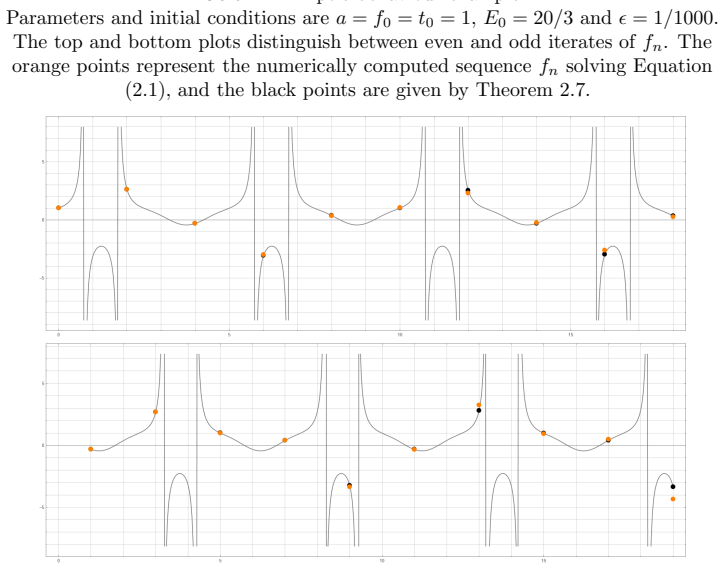
Take a=1, t0=1, f0=1, ϵ=$10^{-4}$ and iterate q-PII for n up to $10^{4}$; compare f_n with the predicted A sn(z0+pn;k) from Theorem 2.7. If the supremum error does not shrink as ϵ→0 while |ϵ|n stays small, the elliptic-limit claim fails. Separately, choose initial data for which the nearest integer η to the complex period ratio Ω/p is bounded away from η (for example Ω/p≈0.37) and check whether E_η−E_0 still matches the complete-elliptic formula; the theorem's assumption says it need not.
Extended reading notes
Core claim
The central discovery is that the autonomous form of q-PII, reached as ϵ→0, is solved by Jacobi's elliptic sine. For a=1 and bounded n, after the fractional-linear change f_n=(c+F_n)/(c−F_n) with c⁴=(2−E0−4t0)/(2−E0+4t0), the sequence satisfies F_n→A sn(z0+pn;k), where A²=k, k is the root |k|<1 of k²+βk+1=0 with β=(4+4γ²−ζ²)/(4γ), and p,z0 encode the initial data. The second part of the discovery is a leading-order modulation law: for an integer near-period η of the discrete solution, the change in the conserved quantity is Eη−E0∼−(t0ϵ/p)[(4+L0)Ω(k)−8Π(k/c²,k)]+Sη, with Sη small when η is within o(1) of a period Ω/p of the elliptic function.
Load-bearing premise
The slow-modulation result assumes that one can find a whole number of steps η whose distance from a period of the underlying elliptic function is tiny; for a randomly chosen starting point there is no reason this has to be true.
Editorial extensions
If this is right
- For a=1 and initial data away from E0=2±4t0, every solution with bounded L_n converges to a Jacobi elliptic sine profile within the window |ϵ|n≪1.
- The slow change in the leading-order invariant E over one elliptic period is predicted by complete elliptic integrals, so the modulation is universal in the same sense as the elliptic profile.
- As the modulus k approaches 0 or ±1, the elliptic behaviour degenerates to constant or singly-periodic (trigonometric/hyperbolic) solutions along specific level curves in the initial-value space, as catalogued in Appendix A.
- The continuously interpolated functions f(x), E(x), and L(x) provide a local continuum model of the q-PII transcendent that is explicit to leading order.
Reading between the lines
- If this transfer holds for other q-Painlevé equations, one would expect theta functions or higher-genus curves to appear in place of the Jacobi sine in analogous continuum limits; the paper stops at q-PII.
- The near-resonance assumption in Theorem 3.2 hints that generic non-resonant solutions may show slower or oscillatory modulation of E, requiring a small-divisor treatment rather than a single-period average; the paper does not address that regime.
- The degeneration curves in Appendix A are natural candidates for q-analogues of Stokes boundaries; testing whether the leading-order elliptic envelope changes discontinuously across these curves would connect the discrete theory to the classical connection-problem picture.
Editorial analysis
A structured set of objections, weighed in public.
Referee Report
Summary. This paper studies the q-difference second Painlevé equation (q-PII) in the continuum limit q = 1 + ε, with t = t0(1 + ε)^n and n bounded, and claims that generic solutions exhibit leading-order Jacobi elliptic behaviour and that the slow modulation of the conserved quantity E_n is approximated by complete elliptic integrals. The paper introduces the quantities E_n and L_n, proves an error bound on E_n − E0 via summation by parts, reduces the leading-order equation to a biquadratic form through a Möbius transformation, and verifies that a Jacobi elliptic sine sequence satisfies that biquadratic form. It then applies an Euler-Maclaurin averaging argument to derive a modulation formula in terms of complete elliptic integrals of the first and third kinds, and catalogues degenerate limits as the elliptic modulus approaches critical values.
Significance. If fully established, the paper would provide a useful discrete analogue of the Boutroux and Joshi-Kruskal theories: q-PII transcendents near q = 1 would reduce to elliptic functions at leading order with modulations expressible through complete elliptic integrals. The explicit Möbius reduction in Lemma 2.5, the hypergeometric period formulas in Corollary 2.10, and the numerical illustrations in Figures 1 and 2 are concrete strengths. However, the generic leading-order statement is not proved beyond an ansatz verification, and the modulation theorem is conditional on a nongeneric near-resonance hypothesis, so the abstract's generic claims are not yet supported by the demonstrated results.
major comments (4)
- [§2, Theorem 2.7] The proof of Theorem 2.7 only verifies that G(z) = A sn(z; k) satisfies the biquadratic equation (2.7) with K_n = 0; it does not prove that the sequence F_n produced by Lemma 2.5 converges to G(z0 + pn), nor that the limiting equation has a unique solution matching the recurrence's initial data. Since the biquadratic relation determines F_{n+1} from F_n only up to a choice of branch, an O(K_n) perturbation could in principle select the other branch. A stability or uniqueness argument is needed; as written, the final sentence of the proof ('it now follows') leaves a gap in the central claim of the paper.
- [§3, paragraph before Theorem 3.2] The hypothesis that there exists η ∈ N with |η − Ω/p| ≪ 1 is a nongeneric resonance condition. The quantity Ω/p is a complex number determined by (E0, t0); its being o(1)-close to a positive integer imposes two real constraints on the initial data. Consequently Theorem 3.2 does not support the abstract's statement that the slow modulation of generic transcendents is approximated by complete elliptic integrals. Either a generic averaging statement must be proved, or the abstract and conclusions must be restricted to the near-resonant case.
- [§3, proof of Theorem 3.2] The proof uses L^(j)(Ω/p) → L^(j)(0) as ε → 0 and integrates L(x) from 0 to Ω/p, but Definition 2.8 defines L(x) only for real x and does not construct an interpolant with the required smoothness. For the Taylor expansion around Ω/p to be meaningful, Ω/p must lie in the domain of L and the near-period assumption must guarantee equality of all derivatives at the two points; neither is established. This is a load-bearing issue for the Euler-Maclaurin step.
- [§3, Theorem 3.2] The assumption |L^(k)(0)| ≤ R for all k ∈ N and some finite R is an external regularity hypothesis. No argument shows that q-PII solutions, or the interpolated L, have derivatives of all orders bounded uniformly at 0. Without such a bound, the estimate for S_η and the validity of the infinite Euler-Maclaurin series are not justified.
minor comments (4)
- [Throughout] The manuscript contains several typographical and typesetting artifacts that should be cleaned up, including the running title 'PAINLEV´E', the Section 3 heading 'A veraging Method', and inconsistent spacing in inline formulas.
- [§2, Theorem 2.7] The symbol k is overloaded: it denotes both the parameter in the quadratic equation k^2 + βk + 1 = 0 and the elliptic modulus of sn(z; k). Although the two are related by A^2 = k, the notation should be clarified to avoid confusion.
- [Figures 1 and 2] The captions do not explain how the black 'Theorem 2.7' points were computed from the elliptic formula; please state explicitly how z0 and p were chosen for each set of initial data.
- [Corollary 2.10] The period integral (2.9) is typeset with a symbol that is not a standard integral sign; use \(\oint\) for the closed contour integral.
Circularity Check
No significant circularity: the elliptic ansatz is verified against the leading-order equation with all constants determined by initial data, not fitted.
full rationale
The derivation chain is self-contained. Theorem 2.7 verifies an explicit elliptic ansatz against the leading-order biquadratic equation; the constants A, k, p, and z0 are determined by E0, t0 and the initial condition, not fitted to the sequence. The error bound in Lemma 2.4 justifies the convergence, and the elliptic modulus k is fixed by a quadratic in terms of γ and ζ, which are themselves explicit functions of E0 and t0. Lemma 2.5 provides an explicit Möbius transformation, so no hidden normalization smuggles in the conclusion. Theorem 3.2 applies Euler–Maclaurin to an exact identity from Lemma 3.1 and evaluates the resulting period integral using the already-established elliptic limit; its near-period hypothesis |η−Ω/p|≪1 is a genuine additional condition restricting applicability, not an input secretly equal to the conclusion. The proof also uses L(j)(Ω/p) → L(j)(0), which follows from the leading-order periodicity of L, not from the desired modulation formula. No load-bearing self-citation appears; the cited references are contextual. The abstract's wording 'generic' may overstate the scope of the slow-modulation theorem, since Theorem 3.2 requires a near-period η, but this is a quantification and applicability issue, not circularity.
Assumptions & free parameters
assumptions (6)
- domain assumption Solutions of q-PII are meromorphic and can be studied in a region where |L_k| remains bounded (Definition 2.3).
- domain assumption The parameter a can be set to 1 without meaningful degeneration (Section 2, before Lemma 2.5).
- ad hoc to paper The leading-order autonomous recurrence has a unique solution given F0, and it is reached by the limit of the perturbed sequence.
- domain assumption There exists an integer η with |η−Ω/p|≪1, a near-period of the discrete function.
- ad hoc to paper The interpolated quantity L has derivatives at 0 bounded by a uniform R for all orders.
- standard math Standard elliptic function identities: the addition theorem, the period integrals, and the hypergeometric expansions.
Cite this review
Pith. "Pith review of Elliptic asymptotic behaviour of $q$-Painlev\'e transcendents." pith.science (2026). https://pith.science/paper/P6JYJT6J
@misc{pith2026250605724,
  author       = {Pith},
  title        = {Pith review of: Elliptic asymptotic behaviour of $q$-Painlev\'e transcendents},
  year         = {2026},
  howpublished = {\url{https://pith.science/paper/P6JYJT6J}},
  note         = {Machine review of arXiv:2506.05724}
}
abstract
The discrete Painlev\'e equations have mathematical properties closely related to those of the differential Painlev\'e equations. We investigate the appearance of elliptic functions as limiting behaviours of $q$-Painlev\'e transcendents, analogous to the asymptotic theory of classical Painlev\'e transcendents. We focus on the $q$-difference second Painlev\'e equation in the asymptotic regime $|q-1|\ll1$, showing that generic leading-order behaviour is given in terms of elliptic functions and that the slow modulation in this behaviour is approximated in terms of complete elliptic integrals.
Figures

Reference graph
Works this paper leans on
-
[1]
A request: the Painlev´ e project
F. Bornemann et al. “A request: the Painlev´ e project”. AMSTAT News 57.11 (2010), p. 1389
work page 2010
-
[2]
P. Boutroux. “Recherches sur les transcendantes de M. Painlev´ e et l’´ etude asymptotique des ´ equations diff´ erentielles du second ordre (suite)”.Annales scientifiques de l’ ´Ecole Normale Sup´ erieure. Vol. 31. 1914, pp. 99–159
work page 1914
-
[3]
P. Boutroux. “Recherches sur les transcendantes de M. Painlev´ e et l’´ etude asymptotique des ´ equations diff´ erentielles du second ordre”.Annales Scien- tifiques de l’ ´Ecole Normale Sup´ erieure. Vol. 30. 1913, pp. 255–375
work page 1913
-
[4]
Sur quelque ´ equations diff´ erentielles lin´ eaires du second ordre
R. Fuchs. “Sur quelque ´ equations diff´ erentielles lin´ eaires du second ordre”. Comptes Rendus des S´ eances de l’Acad´ emie des Sciences141 (1905), pp. 555– 558
work page 1905
-
[5]
B. Gambier. “Sur les ´ equations diff´ erentielles du second ordre et du premier degr´ e dont l’int´ egrale g´ en´ erale est ` a points critiques fixes”.Acta Mathematica 33.1 (1910), pp. 1–55
work page 1910
-
[6]
The isomonodromy approach in the theory of two-dimensional quantum gravitation
A. R. Its, A. V. Kitaev, and A. Fokas. “The isomonodromy approach in the theory of two-dimensional quantum gravitation”. Russian Mathematical Surveys 45.6 (1990), pp. 155–157
work page 1990
-
[7]
The connection problem for the first and the second Painlev´ e tran- scendents
N. Joshi. “The connection problem for the first and the second Painlev´ e tran- scendents”. PhD thesis. Princeton University, 1987
work page 1987
-
[8]
An asymptotic approach to the connection problem for the first and the second Painlev´ e equations
N. Joshi and M. D. Kruskal. “An asymptotic approach to the connection problem for the first and the second Painlev´ e equations”. Physics Letters A 130.3 (1988), pp. 129–137
work page 1988
Show all 16 references
-
[9]
The Painlev´ e connection problem: an asymp- totic approach. I
N. Joshi and M. D. Kruskal. “The Painlev´ e connection problem: an asymp- totic approach. I”. Studies in Applied Mathematics 86.4 (1992), pp. 315–376
1992
-
[10]
Asymptotic behaviours given by elliptic functions in PI-PV
N. Joshi and E. Liu. “Asymptotic behaviours given by elliptic functions in PI-PV”. Nonlinearity 31.8 (2018), pp. 3726–3747
2018
-
[11]
Painlev´ e functions of the third kind
B. M. McCoy, C. A. Tracy, and T. T. Wu. “Painlev´ e functions of the third kind”. Journal of Mathematical Physics 18.5 (1977), pp. 1058–1092
1977
-
[12]
Sur les ´ equations diff´ erentielles du second ordre et d’ordre sup´ erieur dont l’int´ egrale g´ en´ erale est uniforme
P. Painlev´ e. “Sur les ´ equations diff´ erentielles du second ordre et d’ordre sup´ erieur dont l’int´ egrale g´ en´ erale est uniforme”.Acta Mathematica 25.1 (1902), pp. 1–85
1902
-
[13]
Discrete Painlev´ e equations: coalescences, limits and degeneracies
A. Ramani and B. Grammaticos. “Discrete Painlev´ e equations: coalescences, limits and degeneracies”. Physica A: Statistical Mechanics and its Applica- tions 228.1-4 (1996), pp. 160–171
1996
-
[14]
Discrete versions of the Painlev´ e equations
A. Ramani, B. Grammaticos, and J. Hietarinta. “Discrete versions of the Painlev´ e equations”.Physical Review Letters 67.14 (1991), pp. 1829–1832
1991
-
[15]
A differential equation for orthogonal polynomials
J. Shohat. “A differential equation for orthogonal polynomials”. Duke Math- ematical Journal 5.2 (1939), pp. 401–417
1939
-
[16]
Spin-spin correlation functions for the two-dimensional Ising model: Exact theory in the scaling region
T. T. Wu et al. “Spin-spin correlation functions for the two-dimensional Ising model: Exact theory in the scaling region”. Physical Review B 13.1 (1976), pp. 316–374
1976
Reviewed August 7, 2026 · model on record in the stance chip above.
Discussion (0). Sign in to comment.