REVIEW 4 major objections 4 minor 52 references
Two-parameter estimation via photon subtraction operation within a feedback-assisted interferometer
T0 review · 4 major / 4 minor · reviewed 2026-08-07 · deepseek-v4-flash
Pith's one-line read Photon subtraction in a feedback interferometer lowers the quantum limit for measuring two phases at once.
desk verdict Useful QFIM extension of FOPA with photon subtraction, but the central precision and loss-robustness claims live at a divergent operating point and need a fixed-energy re-analysis. read the letter →
The pith
A machine-rendered reading of the paper's core claim, the machinery that carries it, and where it could break.
The reading
What carries the argument
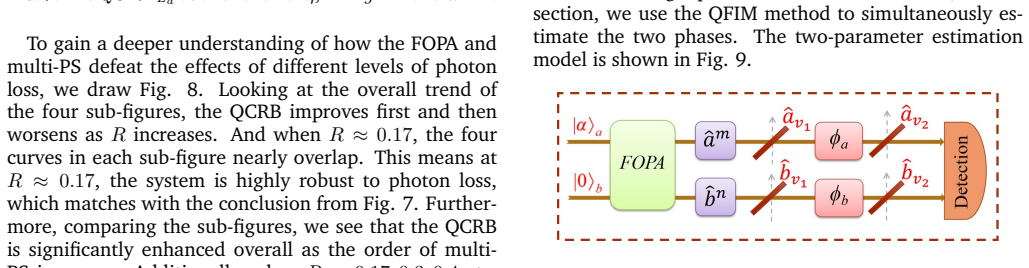
The argument is carried by three pieces of formalism. The first is the FOPA input–output transformation of Eq. (4), derived by the standard signal-flow graph gain formula, whose coefficients in Eq. (5) encode the feedback loops and whose denominator $k_0$ vanishes at the special reflectivity $R_{\rm opt}=3-2\sqrt{2}$ for $g=1$. The second is the multi-photon subtraction operator $\hat U_P=\hat a^m\otimes\hat b^n$, with the normalisation constant $A$ and the $\Gamma_{m,n,x_1,y_1,x_2,y_2}$ moment-generating function (Appendix B) that yields all QFI entries and correlation functions. The third is the quantum Fisher information matrix for two phases, with the variational Kraus-operator extension that converts the lossy channel into a pure-state system-plus-environment estimation problem.
What would settle it
At gain $g=1$, set the feedback reflectivity to $R_{\rm opt}=3-2\sqrt{2}$ and measure the output photon number: the linearized model predicts a divergence there, so a finite photon number (or a smooth QCRB without a sharp dip) would show the reported optimal precision is an artifact of that model.
Extended reading notes
Core claim
On the paper's own terms, the discovery is a recipe: insert a multi-photon subtraction operation ($m$ photons dropped from one arm, $n$ from the other) after a two-port feedback optical parametric amplifier, then estimate one or two phase shifts using the quantum Fisher information matrix. Numerically, the recipe lowers the QCRB below both the no-feedback configuration and the feedback-without-subtraction configuration, and the best working point is the same optimal feedback reflectivity previously identified for the FOPA alone. At that point the QCRB is nearly independent of the loss parameter, so the scheme is robust to photon loss. The authors also account for the improvement in terms of second-order correlations: feedback raises intramode correlations and lowers intermode correlations, and photon subtraction further suppresses intermode correlation.
Load-bearing premise
The linearized FOPA input–output relation with finite coefficients in Eq. (4) is assumed to remain valid at the optimal reflectivity $R_{\rm opt}$, where the denominator $k_0$ vanishes and the predicted average photon number diverges.
Editorial extensions
If this is right
- At $g=1$, setting $R=3-2\sqrt{2}\approx0.17$ gives the lowest QCRB for both single- and two-parameter estimation, and the QCRB stays almost flat as the transmittance $\eta$ decreases, meaning the optimal feedback point is also the most loss-robust one.
- Higher-order photon subtraction ($m=n=1,2,3$) lowers the QCRB further and extends the range of $R$ over which feedback improves on the no-feedback baseline.
- The benefit holds for a simple coherent-state plus vacuum input, so no squeezed or nonclassical input state is required.
- Increasing intramode correlations and decreasing intermode correlations is the correlation signature of improved two-phase estimation accuracy.
- In two-parameter estimation, feedback improves precision mainly when the coherent-state amplitude $\alpha$ is large, unlike single-parameter estimation where the improvement persists for all $\alpha$ shown.
Reading between the lines
- The singular behaviour at $R_{\rm opt}$ suggests the optimal QCRB values are predictions of the linearised FOPA model; testing slightly detuned $R$ values around $R\approx0.17$ would show whether the practical benefit survives the singularity.
- The correlation mechanism identified here may extend to other non-Gaussian operations, such as photon addition or photon catalysis, in the same feedback topology, since the paper's argument only requires suppressing intermode correlations.
- The loss-robustness result is computed with a variational QFI bound; an independent master-equation or full numerical simulation could confirm whether the same robustness holds for actual measurement strategies.
Editorial analysis
A structured set of objections, weighed in public.
Referee Report
Summary. The paper analyzes single- and two-parameter phase estimation in a feedback-assisted interferometer (FOPA) combined with multi-photon subtraction, using the quantum Fisher information (matrix) and the quantum Cramér–Rao bound (QCRB) as figures of merit. It reports that an optimal feedback strength R_opt exists, that for OPA gain g=1 one has R_opt = 3−2√2 ≈ 0.17, and that this operating point yields substantially improved precision and robustness to photon loss compared with the traditional OPA interferometer without feedback. The authors also investigate how intramode and intermode second-order correlations relate to estimation accuracy.
Significance. If the central claims were quantitatively supported, the combination of feedback-assisted operation and non-Gaussian photon subtraction would be a useful new ingredient in multiparameter quantum metrology, and the analytic generating-function expressions for the QFIM elements would be a useful technical contribution. The paper is also commendable for treating ideal and lossy cases, and for explicitly computing the mean photon number behavior. However, the main precision-enhancement and loss-robustness claims are currently evaluated at a point where the model's input–output coefficients diverge and the mean photon number tends to infinity, so the physical significance of the reported QCRB values is not yet established.
major comments (4)
- [§III.A and Eq. (5), Figs. 3–4] The paper's central operating point, R_opt = 3−2√2 for g=1, coincides with a vanishing denominator k0 in the FOPA input–output relation of Eq. (4). With φ1=φ2=π and G=√2, k0 = 1 + G(√R + √R) + R = 0 at R=3−2√2, so the coefficients k1/k0, k2/k0, k3/k0, k4/k0 diverge. This is acknowledged in the text as a 'critical state', and Fig. 4 confirms that the total average photon number tends to infinity. Nevertheless, all later QCRB curves (Figs. 5–8, 10–14) use R=0.17 as the optimal operating point. An un-normalized QCRB computed for a state with unbounded energy is not a physically meaningful precision claim; the apparent optimality may simply be an artifact of unbounded resources. The manuscript needs to either regularize the model (e.g., with a physical saturation mechanism or a finite-bandwidth treatment), or compare different R values at fixed mean photon number, or otherwise show that the claimed enhancement survives a constraint on resources. As it stands, the abstract and conclusion rest on evaluating the theory at a point where the theory itself diverges.
- [§IV.B, Eqs. (25)–(28)] The two-parameter photon-loss QCRB is computed by maximizing Tr[C_Q^{-1}] over the variational Kraus parameters, but the optimization is implicitly restricted to λ_a=λ_b=λ, and only a single common λ is varied. The Escher–Yue variational method allows independent variational parameters for the two modes; restricting them globally may not give the tightest (largest) lower bound, and could either overestimate or underestimate the precision advantage claimed in Figs. 13 and 14. The paper should justify this restriction, or perform the full two-parameter optimization over (λ_a, λ_b), and state whether the reported QCRB_L remains the ultimate bound under that relaxation.
- [§III.B, Eq. (18)] The lossy single-parameter QFI formula F_L^a = 4 F_a η⟨n_a⟩ / ((1−η)F_a + 4η⟨n_a⟩) is quoted from Refs. [27,40], but its domain of validity for the present multi-PS non-Gaussian state is not fully established. In particular, the text states that λ=0 and λ=−1 correspond to photon loss before and after the phase shifter, and that F_L^a = min_λ C_Q^a; Eq. (18) appears to be a closed-form result for a specific configuration (λ=0 or λ=−1). The authors should specify which configuration Eq. (18) corresponds to and why the same formula is used for both, since the two-parameter section later treats loss before and after the phase shifters simultaneously. If Eq. (18) is only valid for loss after the phase shifter, the single-parameter loss analysis in Figs. 7 and 8 needs qualification.
- [§V and Figs. 16–19] The claim that 'increasing intramode correlations while decreasing intermode correlations can improve estimation accuracy' is formulated as a general conclusion, but the evidence is only a set of numerical correlation plots at selected parameters (g=1, α=2, R=0.17). The correlation functions g_a^(2), g_b^(2), g_ab^(2) are not directly linked to the QFI by any derived identity, so the causal statement is not established beyond the specific examples. Either provide an analytical relation or soften the conclusion to a parameter-dependent observation.
minor comments (4)
- [Figure captions, Figs. 16 and 17] The captions contain the typo 'intarmode' (should be 'intramode'), and the phrase 'the solid line corresponds to the system without feedback (i.e., R=0)' is confusing because Fig. 16 also has R=0 curves for different m,n; consider labeling curves more explicitly.
- [Appendix A, after Eq. (A7)] The sentence 'In the transfer relationship between In the transfer relationship between b̂†_3 and â_0' contains a duplicated phrase; please correct.
- [Section IV.B, text before Eq. (24)] The symbol λ is used both as a Kraus-operator variational parameter and later as the differential variable in Appendix B; please use distinct notations to avoid confusion.
- [Eq. (B1)] The exponent in the generating function has nested terms (λ4 k4*/k0* times a second exponential, etc.) that are difficult to parse; rewrite with clearer bracketing or a separate definition of the quadratic form.
Circularity Check
No circularity: the QFIM computation is self-contained; imported formulas are external and parameter-free.
full rationale
The paper's derivation chain is not circular. The FOPA input-output relation (Eq. 4) is derived in Appendix A via Mason's gain formula, and the QFI/QFIM elements are constructed in Appendix B from the explicit generating function Gamma, so the central QCRB quantities are computed from the stated model rather than imported as outputs. The single-parameter photon-loss formula (Eq. 18) is taken from Escher et al.'s general variational framework [37], with the simplification to the closed form being a parameter-free algebraic identity; the two-parameter loss QFIM (Eqs. 25-28) likewise follows the external Kraus-operator method of Yue et al. [20] and the algebraic simplification in Eq. 28 is cited to Ref. [48]. Although Refs. [27, 40, 48] include some of the present authors, these citations supply standard formulas whose assumptions are stated and which do not encode the paper's target claim of enhancement by photon subtraction and feedback. The optimal-feedback relation (Eq. 13) is imported from Refs. [34, 35] as an external benchmark and then independently checked by the computed QCRB curves; it is not fitted from the quantities it is used to explain. No target quantity is defined in terms of the prediction, no fitted parameter is relabeled as a prediction, and no uniqueness theorem from the authors' prior work is invoked to force the choice of R or the photon-subtraction order. The singular behavior at R_opt, where k0 in Eq. (5) vanishes and the average photon number diverges (Fig. 4), is a physical-validity concern about operating at a threshold and about comparing unnormalized QCRB values at divergent energy; it is a correctness risk, not a circular reduction of the QCRB to an input.
Assumptions & free parameters
free parameters (3)
- R (feedback strength) =
R_opt = 3 - 2√2 ≈ 0.1716 for g = 1; R = 0.17 used in most plots
- g (OPA gain) =
1 in most figures
- α (coherent amplitude) =
2 in most figures
assumptions (5)
- domain assumption The FOPA is described by the linear input-output relation in Eq. (4) with coefficients in Eq. (5), derived via Mason's gain formula in Appendix A.
- domain assumption Feedback phases are set to φ1 = φ2 = π and R1 = R2 = R, based on prior work claiming this maximizes entanglement.
- domain assumption Multi-photon subtraction is modeled by applying â^m ⊗ b^n and renormalizing the state.
- standard math Photon loss is modeled by fictitious beam splitters and phase-dependent Kraus operators of Eq. (24).
- ad hoc to paper For the two-parameter loss bound, the optimization over λ in Eq. (25) is restricted to λ_a = λ_b = λ.
Cite this review
Pith. "Pith review of Two-parameter estimation via photon subtraction operation within a feedback-assisted interferometer." pith.science (2026). https://pith.science/paper/TWABGXKM
@misc{pith2026250605756,
  author       = {Pith},
  title        = {Pith review of: Two-parameter estimation via photon subtraction operation within a feedback-assisted interferometer},
  year         = {2026},
  howpublished = {\url{https://pith.science/paper/TWABGXKM}},
  note         = {Machine review of arXiv:2506.05756}
}
read the original abstract
In this paper, we analyze how multi-photon subtraction operations in a feedback-assisted interferometer can enhance measurement precision for single-parameter and two-parameter estimation under both ideal and photon-loss conditions. We examine the effects of the feedback strength R, the optical parametric amplifier's gain g, the coherent state amplitude {\alpha}, and the order of multi-photon subtraction on system performance. We demonstrate that an optimal feedback strength R_{opt} exists in both conditions. Selecting a suitable R can significantly boost the system's robustness to photon loss, and markedly improve measurement precision. And the photon subtraction operations within a feedback-assisted interferometer can further enhance measurement precision effectively. Additionally, we find that increasing intramode correlations while decreasing intermode correlations can improve estimation accuracy. This work investigates a new method through the synergistic integration of feedback topology and non-Gaussian operations into a multiparameter estimation system, along with their systematic study under both ideal and loss conditions. The findings may contribute to improving quantum-enhanced measurements and hold promise for high-precision quantum sensing research.
Figures


Figures from the paper (15 more)




Reference graph
Works this paper leans on
- [27]
-
[1]
J. J. Cooper, D. W. Hallwood, and J. A. Dunningham, Entanglement-enhanced atomic gyroscope, Phys. Rev. A 81(4), 043624 (2010)
work page 2010
-
[2]
W. Wasilewski, K. Jensen, H. Krauter, J. J. Renema, M. V. Balabas, and E. S. Polzik, Quantum Noise Lim- ited and Entanglement-Assisted Magnetometry , Phys. Rev. Lett. 104(13), 133601 (2010)
work page 2010
- [3]
-
[4]
C. F. Ockeloen, R. Schmied, M. F. Riedel, and P. Treutlein, Quantum Metrology with a Scanning Probe Atom Inter- ferometer, Phys. Rev. Lett. 111(14), 143001 (2013)
work page 2013
-
[5]
K. Liu, C. X. Cai, J. Li, L. Ma, H. X. Sun, and J. R. Gao, Squeezing-enhanced rotating-angle measurement beyond the quantum limit, Appl. Phys. Lett. 113(26), 261103 13 (2018)
work page 2018
-
[6]
S. Y. Chen, W. H. Li, et al., Immunomagnetic microscopy of tumor tissues using sensors in diamond, Proc Natl Acad Sci U S A 119(5), e2118876119 (2022)
work page 2022
-
[7]
Q. Shen, J. Y. Guan, J. G. Ren, et al., Free-space dissem- ination of time and frequency with 10-19 instability over 113 km, Nature 610, 661 (2022)
work page 2022
Show all 52 references
-
[8]
Muessel, H
W. Muessel, H. Strobel, D. Linnemann, D. B. Hume, and M. K. Oberthaler, Scalable Spin Squeezing for Quantum- Enhanced Magnetometry with Bose-Einstein Conden- sates, Phys. Rev. Lett. 113(10), 103004 (2014)
2014
-
[9]
Kruse, K
I. Kruse, K. Lange, J. Peise, B. L ¨ucke, L. Pezz`e J. Arlt, W. Ertmer, C. Lisdat, L. Santos, A. Smerzi, and C. Klempt, Im- provement of an Atomic Clock using Squeezed Vacuum, Phys. Rev. Lett. 117(14), 143004 (2016)
2016
-
[10]
The LIGO Scientific Collaboration, A gravitational wave observatory operating beyond the quantum shot-noise limit, Nat. Phys. 7, 962 (2011)
2011
-
[11]
Albarelli, M
F. Albarelli, M. Barbieri, M. G. Genoni, and I. Gianani, A perspective on multiparameter quantum metrology: From theoretical tools to applications in quantum imag- ing, Phys. Lett. A 384(12), 126311 (2020)
2020
-
[12]
Szczykulska, T
M. Szczykulska, T. Baumgratz, and A. Datta, Multi- parameter quantum metrology , Adv. Phys.: X 1(4), 621 (2016)
2016
-
[13]
Pezz `e M
L. Pezz `e M. A. Ciampini, N. Spagnolo, P. C. Humphreys, A. Datta, I. A.Walmsley , M. Barbieri, F. Sciarrino, and A. Smerzi, Optimal Measurements for Simultaneous Quan- tum Estimation of Multiple Phases, Phys. Rev. Lett. 119, 130504 (2017)
2017
-
[14]
Sorelli, M
G. Sorelli, M. Gessner, M. Walschaers, and N. Treps, Op- timal Observables and Estimators for Practical Superreso- lution Imaging, Phys. Rev. Lett. 127(12), 123604 (2021)
2021
-
[15]
A. Z. Goldberg, L. L. S´achez-Soto, and H. Ferretti, Intrinsic Sensitivity Limits for Multiparameter Quantum Metrol- ogy , Phys. Rev. Lett. 127(11), 110501 (2021)
2021
-
[16]
G ´orecki and R
W. G ´orecki and R. Demkowicz-Dobrza ´nski, Multiple- Phase Quantum Interferometry: Real and Apparent Gains of Measuring All the Phases Simultaneously , Phys. Rev. Lett. 128(4), 040504 (2022)
2022
-
[17]
Polino, M
E. Polino, M. Riva, M. Valeri, R. Silvestri, G. Corrielli, A. Crespi, N. Spagnolo, R. Osellame, and F. Sciarrino, Ex- perimental multiphase estimation on a chip, Optica 6(3), 288 (2019)
2019
-
[18]
Valeri, E
M. Valeri, E. Polino, D. Poderini, I. Gianani, G. Corrielli, A. Crespi, R. Osellame, N. Spagnolo, and F. Sciarrino, Exper- imental adaptive Bayesian estimation of multiple phases with limited data, npj Quantum Inf. 6(1), 92 (2020)
2020
-
[20]
Here, nodes denote the probe states of the system, while branches represent the system’s transmission characteristics
This signal flow graph encompasses every compo- nent of the FOPA, representing the entire system as a network of multiple nodes and branches. Here, nodes denote the probe states of the system, while branches represent the system’s transmission characteristics. The signal flow ...
-
[21]
J. D. Yue, Y. R. Zhang, and H. Fan, Quantum-enhanced metrology for multiple phase estimation with noise, Sci. Rep. 4, 5933 (2014)
2014
-
[22]
Pezz `e M
L. Pezz `e M. A. Ciampini, N. Spagnolo, P. C. Humphreys, A. Datta, I. A. Walmsley , M. Barbieri, F. Sciarrino, and A. Smerzi, Optimal Measurements for Simultaneous Quan- tum Estimation of Multiple Phases, Phys. Rev. Lett. 119, 130504 (2017)
2017
-
[23]
Nichols, P
R. Nichols, P. Liuzzo-Scorpo, P. A. Knott, G. Adesso, Multi- parameter Gaussian quantum metrology , Phys. Rev. A 98, 012114 (2018)
2018
-
[24]
J. Yang, S. S. Pang, Y. Y. Zhou, A. N. Jordan, Optimal mea- surements for quantum multiparameter estimation with general states, Phys. Rev. A 100, 032104 (2019)
2019
-
[25]
L. B. Ho, H. Hakoshima, Y. Matsuzaki, M. Matsuzaki, and Y. Kondo, Multiparameter quantum estimation under de- phasing noise, Phys. Rev. A 102, 022602 (2020)
2020
-
[26]
Z. B. Hou, J. F. Tang, H. Z. Chen, H. D. Yuan, G. Y. Xiang, C. F. Li, G. C. Guo, Zero-trade-off multiparameter quan- tum estimation via simultaneously saturating multiple Heisenberg uncertainty relations, Sci. Adv. 7, eabd2986 (2021)
2021
-
[28]
Q. Q. Kang, Z. K. Zhao, T. Zhao, C. J. Liu, and L. Y. Hu, Phase estimation via multi-photon subtraction inside the SU(1,1) interferometer, Phys. Scr. 99, 085111 (2024)
2024
-
[29]
Namekata, Y
N. Namekata, Y. Takahashi, G. Fujii, D. Fukuda, S. Kurimura, S. Inoue, Non-Gaussian operation based on photon subtraction using a photon-number-resolving de- tector at a telecommunications wavelength, Nat. Photon. 4, 655-660 (2010)
2010
-
[30]
Parigi, A
V. Parigi, A. Zavatta, M. Kim, M. Bellini, Probing quantum commutation rules by addition and subtraction of single photons to/from a light field, Science 317, 1890–1893 (2007)
2007
-
[31]
Zhang, Y
K. Zhang, Y. Lv, Y. Guo, J. Jing, and W.-M. Liu, Enhanc- ing the precision of a phase measurement through phase- sensitive non-Gaussianity , Phys. Rev. A 105, 042607 (2022)
2022
-
[32]
J. T. Jing, C. J. Liu, Z. F. Zhou, Z. Y. Ou, and W. P. Zhang, Realization of a nonlinear interferometer with parametric amplifiers, Appl. Phys. Lett. 99, 011110 (2011)
2011
-
[33]
X. Z. Pan, H. Chen, T. X. Wei, J. Zhang, A. M. Marino, N. Treps, R. T. Glasser, and J. T. Jing, Experimental re- alization of a feedback optical parametric amplifier with four-wave mixing, Phys. Rev. B 97, 161115 (2018)
2018
-
[34]
Y. Y. Zhong and J. T. Jing, Enhancement of tripartite quantum correlation by coherent feedback control, Phys. Rev. A 101, 023813 (2020)
2020
-
[35]
J. Xin, X. Z. Pan, X. M. Lu, J. Kong, G. L. Li, and X. M. Li, Entanglement Enhancement from a Two-Port Feedback Optical Parametric Amplifier, Phys. Rev. Appl. 14, 024015 (2020)
2020
-
[36]
G. F. Jiao, Enhanced phase sensitivity in a feedback- assisted interferometer, New J. Phys. 26, 083005 (2024)
2024
-
[37]
Y. K. Xu, T. Zhao, Q. Q. Kang, C. J. Liu, L. Y. Hu, and S. Q. Liu, Phase sensitivity of an SU(1,1) interferometer in photon-loss via photon operations, Opt. Express 31(5), 8414 (2023)
2023
-
[38]
B. M. Escher, R. L. de Matos Filho, and L. Davidovich, General framework for estimating the ultimate precision limit in noisy quantum-enhanced metrology , Nat. Phys. 7(5), 406 (2011)
2011
-
[39]
C. W. Helstrom, Quantum detection and estimation the- ory , J. Stat. Phys. 1(2), 231 (1969)
1969
-
[40]
C. W. Helstrom, Minimum mean-squared error of esti- mates in quantum statistics, Phys. Lett. A 25(2), 101 (1967)
1967
-
[41]
S. K. Chang, W. Ye, H. Zhang, L. Y. Hu, J. H. Huang, and S. Q. Liu, Improvement of phase sensitivity in an SU(1,1) in- terferometer via a phase shift induced by a Kerr medium, Phys. Rev. A 105(3), 033704 (2022)
2022
-
[42]
Q. K. Gong, D. Li, C. H. Yuan, Z. Y. Qu, and W.-P. Zhang, Phase estimation of phase shifts in two arms for 14 an SU(1,1) interferometer with coherent and squeezed vacuum states, Chin. Phys. B 26, 094205 (2017)
2017
-
[43]
C. L. You, S. Adhikari, X. P. Ma, M. Sasaki, M. Takeoka, and J. P. Dowling, Conclusive precision bounds for SU(1,1) interferometers, Phys. Rev. A 99, 042122 (2019)
2019
-
[44]
P. C. Humphreys, M. Barbieri, A. Datta, and I. A. Walms- ley , Quantum Enhanced Multiple Phase Estimation, Phys. Rev. Lett. 111, 070403 (2013)
2013
-
[45]
Zhang and K
L. Zhang and K. W. C. Chan, Quantum multiparameter estimation with generalized balanced multimode NOON- like states, Phys. Rev. A 95, 032321 (2017)
2017
-
[46]
C. N. Gagatsos, D. Branford, and A. Datta, Gaussian sys- tems for quantum-enhanced multiple phase estimation, Phys. Rev. A 94, 042342 (2016)
2016
-
[47]
J. Liu, X. M. Lu, Z. Sun, and X. G. Wang, Quantum mul- tiparameter metrology with generalized entangled coher- ent state, J. Phys. A 49, 115302 (2016)
2016
-
[48]
B. M. Escher, L. Davidovich, N. Zagury , and R. L. de Matos Filho, Quantum Metrological Limits via a Variational Ap- proach, Phys. Rev. Lett. 109, 190404 (2012)
2012
-
[49]
S. K. Chang, W. Ye, X. Rao, J. Wen, H. Zhang, Q. K. Gong, L. Q. Huang, M. M. Luo, Y. T. Chen, L. Y. Hu, and S. Y. Gao, Intramode-correlation–enhanced simulta- neous multiparameter-estimation precision, Phys. Rev. A 106, 062409 (2022)
2022
-
[50]
Sahota, N
J. Sahota, N. Quesada, and D. F. V. James, Physical re- sources for optical phase estimation, Phys. Rev. A 94, 033817 (2016)
2016
-
[51]
S. L. Jeng, R. Roy , and W. H. Chieng, A Matrix Approach for Analyzing Signal Flow Graph, Information 11, 562 (2021)
2021
-
[52]
I. J. Nagrath, M. Gopal, Control System Engineering, vol. 5, New Age International Publishers, (2007)
2007
-
[53]
Q. Q. Kang, Z. K. Zhao, T. Zhao, C. J. Liu, and L. Y. Hu, Phase estimation via a number-conserving opera- tion inside a SU(1,1) interferometer, Phys. Rev. A 110(2), 022432 (2024)
2024
Reviewed August 7, 2026 · model on record in the stance chip above.
Discussion (0). Sign in to comment.