REVIEW 3 major objections 5 minor 37 references
On the effect of the light bending phenomenon for a pulsar in a binary with a Kerr black hole
T0 review · 3 major / 5 minor · reviewed 2026-08-07 · deepseek-v4-flash
Pith's one-line read For a pulsar in a binary with a stellar-mass Kerr black hole, the companion's spin changes light-bending delays by only nanoseconds — three orders below the microsecond delays themselves — so spin can be ignored in timing models unless…
desk verdict First full-Kerr treatment of pulsar light-bending delays, with a careful numerical core and a plausible central result that is broader than the computed parameter coverage supports. read the letter →
The pith
A machine-rendered reading of the paper's core claim, the machinery that carries it, and where it could break.
The reading
What carries the argument
The carrying mechanism is the numerical integration of the null geodesic equations in Kerr spacetime, recast in Boyer-Lindquist coordinates with the two conserved quantities $D_\lambda$ (the conserved angular momentum) and $D_q$ (the Carter-like constant), using the integral formalism that separates the radial and polar parts of the trajectory. The paper computes the initial photon direction in the black hole's frame from the pulsar-beam geometry, evaluates the conserved quantities, integrates the geodesics, and iteratively refines the grid of starting points to find the photon that reaches the observer along the line of sight. From the final direction of that photon it extracts the longitudinal and latitudinal bending delays, and it defines the frame-dragging bending delay as the difference between the Kerr result and the Schwarzschild result. The pulse profile is obtained by projecting the bent photon directions back onto the beam cross-section using a core-double-cone beam model.
What would settle it
Repeat the frame-dragging bending delay calculation for the same binary (M_c = 14.5 solar masses, spin parameter 0.9, inclination 87.5 degrees) but scan the pulsar orientation angles across the full allowed visibility range, for example $\alpha = 10^\circ$ or a beam without the central core component. If any configuration yields a maximum latitudinal or longitudinal frame-dragging delay above 0.1 microseconds, the claim that spin effects are negligible is falsified for that geometry.
Extended reading notes
Core claim
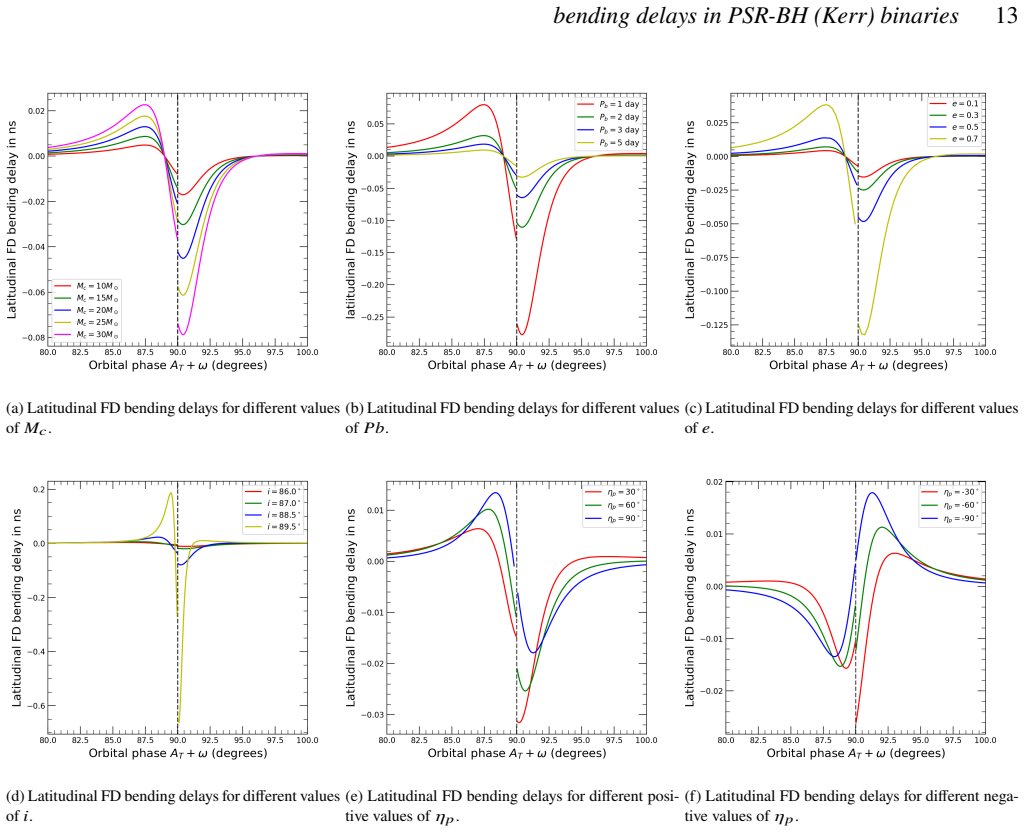
The central claim is that for a pulsar with a stellar-mass rotating black hole companion, the spin of the black hole is effectively invisible in the light-bending phenomenon: the magnitude of the spin (spin parameter from 0 to 0.9) and the orientation of the spin axis change the longitudinal and latitudinal bending delays in the nanosecond range, whereas the delays themselves are in the microsecond range and respond at the microsecond level to changes in companion mass, orbital period, eccentricity, and inclination. Consequently the distortion of the beam and the resulting changes in the pulse shape are minimally influenced by the spin-related parameters. The spin's influence appears only through the frame-dragging bending delay, defined as the difference between the bending delay computed with spin and without spin; this difference exhibits nanosecond discontinuities at orbital phases where the line of sight, the pulsar's position vector, and the black hole's spin axis lie in the same plane, i.e., where the light ray switches from co-rotating to counter-rotating with respect to the spin. For a pulsar with a supermassive black hole companion, the bending delays become three orders of magnitude larger and the pulse profile near superior conjunction is strongly reshaped, yet the profiles computed for different spin parameters remain indistinguishable.
Load-bearing premise
The nanosecond negligibility of the spin rests on a single representative choice of pulsar orientation angles ($\alpha = 50^\circ$, $\eta_p = 45^\circ$, $\lambda_p = 130^\circ$) and a core-double-cone beam model; a substantially different beam geometry or pulsar orientation could make the spin effect larger.
Editorial extensions
If this is right
- Existing Schwarzschild-based analytic bending-delay formulae suffice for timing models of pulsar–stellar-mass black hole binaries unless timing precision reaches the nanosecond level.
- Black hole spin magnitude and orientation can be dropped from the parameter space when fitting pulse-profile distortions, simplifying the timing solution.
- Near superior conjunction, microsecond irregularities in bending delays and the associated profile distortion can bias template-based time-of-arrival estimation, so those phases need special treatment.
- For pulsar–supermassive black hole binaries, bending delays reach the millisecond scale and pulse profiles are strongly reshaped at and near superior conjunction, making timing significantly harder.
Reading between the lines
- If timing precision ever reaches roughly a nanosecond, the frame-dragging delay discontinuity would become a geometric probe: measuring the orbital phase at which the jump occurs would locate the black-hole spin axis direction in the sky.
- Within current and near-future timing precision, the spin of a stellar-mass black hole companion is effectively unmeasurable through light bending; spin might instead be constrained via Shapiro delay asymmetries or orbital precession.
- The strong phase-dependent pulse reshaping around superior conjunction in the supermassive case implies that a single stable template per orbit would introduce systematic time-of-arrival errors, so profile-morphology fitting across orbital phase would be required.
Editorial analysis
A structured set of objections, weighed in public.
Referee Report
Summary. The paper studies light-bending delays and pulse-profile distortion for a pulsar in a binary with a rotating (Kerr) black hole companion, extending the authors' earlier Schwarzschild treatment (Paper-I). The authors integrate null geodesics in Kerr spacetime using the Kapec-Lupsasca / Gralla-Lupsasca formalism, model the pulsar beam with a core-double-cone emission pattern, and compute longitudinal and latitudinal bending delays and their spin-dependent differences (FD bending delays) for a representative stellar-mass black hole binary. They also present a test case with a 10^6 solar-mass black hole companion. The central claim is that black-hole spin magnitude and orientation affect bending delays at the nanosecond level, whereas other parameters affect them at the microsecond level, so spin can be neglected for modeling light-bending delays unless timing precision reaches the nanosecond scale. The paper additionally describes nanosecond-scale discontinuities in FD delays and shows that near superior conjunction the pulse profile is strongly distorted for a supermassive black hole but minimally affected by the spin parameter.
Significance. If the spin-negligibility claim holds, the paper provides practical guidance for future pulsar-black-hole timing models: standard Schwarzschild-based bending-delay formulas would suffice for stellar-mass black holes except at potentially nanosecond-level precision. The work is technically ambitious: it combines full Kerr geodesic integration, a detailed beam model, iterative ray shooting with a reported 0.1 ns convergence after 15 iterations, and a cross-check of the a=0 limit against the Schwarzschild treatment. The supermassive-black-hole test case and the geometric explanation of strong bending near superior conjunction (Appendix) are valuable additions. However, the quantitative hierarchy between spin effects and other parameter effects is established only for a narrow set of configurations, and the numerical validation residual is comparable to the spin effects being isolated. The paper is a useful contribution, but the headline conclusion needs stronger parameter coverage and convergence evidence before it can be accepted as a general statement.
major comments (3)
- [Sec. 3, Figs. 8-11; Sec. 5] The central claim that spin-related parameters affect bending delays only at the nanosecond level is not supported over the full parameter space relevant to pulsar-black-hole binaries. The scans in Figs. 9 and 10 vary M_c, P_b, e, i, and eta_p at i=87.5 degrees, and the only edge-on cases (Fig. 8) use P_b=5.5 days. The authors do not combine i=90 degrees with short orbital periods, where the dominant ray impact parameter is the Einstein radius proportional to sqrt(M_c a) (Eq. 48) and the frame-dragging contribution relative to the monopole bending scales as P_b^{-2/3}. Given that the edge-on FD delays at P_b=5.5 days already reach tens to hundreds of nanoseconds (Fig. 8c,d), shorter periods at the same geometry could plausibly move FD delays into the microsecond regime, contradicting the abstract's nanosecond-level negligibility statement. The conclusion in Sec. 5 should be restricted to the tested parameter region, or new runs at i=90 degrees with P_b in the range 1-3 days (and a scan of pulsar orientation angles alpha, eta_p, lambda_p) should be added.
- [Sec. 3, Fig. 3] The validation of the Kerr code in the a=0 limit against the Schwarzschild treatment shows a residual difference of 0.9 ns in the longitudinal bending delay at superior conjunction and below 0.004 ns elsewhere. This residual is of the same order as the spin-induced FD delays that the paper aims to isolate at i=87.5 degrees (Figs. 6, 9, 10). The authors should demonstrate that the FD delays themselves are converged to well below the nanosecond level in the regions where the spin effect is claimed to be nanosecond-scale, for example by increasing N or the number of iterations and reporting the resulting change in the FD delays. Without this, the quoted nanosecond hierarchy at superior conjunction is not securely separated from numerical discretization error.
- [Sec. 3, Sec. 4] The paper uses a single representative set of unobservable pulsar orientation angles (alpha=50 degrees, eta_p=45 degrees, lambda_p=130 degrees) and a single beam model (core-double cone from Paper-I). The visibility condition (Eq. 25) restricts lambda_p to a narrow range for this alpha, but alpha itself is not scanned, and alternative beam geometries are not tested. Since the bending delays and FD delays depend on the beam geometry through the mapping of the line of sight onto the emission cone, the claim that spin effects are 'minimally influenced' by spin parameters could be a property of this particular geometry rather than a general result. The authors should scan alpha and, ideally, test at least one alternative beam model or explicitly argue that the conclusions are independent of the beam geometry.
minor comments (5)
- [Sec. 1] The text says 'In section 6, these features have been explained with a simplified geometry... The paper is ended with a short conclusive discussion in section 5.' This ordering is inconsistent: Section 5 is the conclusion and the simplified-geometry discussion is the Appendix. Please renumber or rephrase.
- [Captions of Figs. 9 and 10] The captions state 'we have chosen a=0.5 except for panel (f) where a is varied,' but panels (e) and (f) show variations of eta_p, and the spin-parameter variation is shown in Fig. 11. The caption and the text describing these panels should be corrected.
- [Sec. 4] The sentence 'They modelled the spin-spin and spin-curvature using with the help of with the help of Mathisson-Papapetrou-Dixon (MPD) equations' contains a duplicated phrase. Please fix.
- [Sec. 3, Fig. 9 caption] The caption says 'we set lambda_bh=i=87.5 degrees except for panel (c) where i is varied,' but panel (c) varies eccentricity, not inclination. The correct panel for inclination variation is (d).
- [Sec. 4] For the supermassive-black-hole test case, the paper states that omega changes by about 2 degrees per orbit and calls this 'very small' and ignorable, yet later notes that at t=P_b the delays differ from t=0 due to spin and orbital precession. The wording is contradictory; if the precession is included in the numerical runs, the text should say so explicitly, and if it is ignored, the statement about 2-degree change should be revised.
Circularity Check
No significant circularity: the nanosecond-versus-microsecond hierarchy is a computed numerical result, not a fitted or self-referential claim.
full rationale
The central numerical claim—that frame-dragging (spin) contributions to the bending delays are nanosecond-order while the bending delays themselves are microsecond-order—is obtained by explicit ray tracing through Kerr null geodesics, not by fitting or by definitional identity. Equations (28)-(29) define the FD delays as differences of independently computed delays, and the code is checked against the Schwarzschild limit (Fig. 3), which is an internal consistency test, not a circular reduction. The beam geometry and pulse-profile construction are inherited from Paper-I (Debnath, Bagchi, Basu 2023), a self-citation; however, this inheritance supplies the pulsar beam model and visibility conditions, and it does not itself determine the magnitude ordering of FD versus ordinary bending delays. No uniqueness theorem from the authors' prior work is invoked to force the Kerr formalism, and no parameter is fitted to the 'nanosecond vs microsecond' conclusion. The limited scan over inclination and beam models is a robustness limitation, which is outside the scope of circularity. Accordingly, no load-bearing circular step is identified; the paper's result is self-contained given its stated external geodesic formalism.
Assumptions & free parameters
free parameters (7)
- a_tilde (dimensionless black hole spin) =
0.1, 0.5, 0.9
- alpha (angle between pulsar spin and magnetic axes) =
50 deg
- eta_p (azimuthal orientation of pulsar spin in sky plane) =
45 deg
- lambda_p (polar angle of pulsar spin with respect to LoS) =
130 deg
- eta_bh (azimuthal orientation of BH spin in sky plane) =
-90 deg (default), varied 0-360 deg
- lambda_bh (polar angle of BH spin with respect to LoS) =
i (87.5 or 90 deg) default, varied 0-180 deg
- M_c for SMBH test case =
1e6 solar masses
assumptions (5)
- standard math Separability of null geodesics in Kerr spacetime and the integral form of the geodesic equations (Gralla & Lupsasca 2020; Kapec & Lupsasca 2020)
- domain assumption The black hole is treated as stationary during the light-crossing time and its orbital motion is ignored
- domain assumption The black hole spin vector is aligned with the orbital angular momentum vector in the orbital evolution model
- standard math Post-Newtonian equations of Peters (1964), Barker & O'Connell (1975), and Damour & Schafer (1988) describe the orbital and spin evolution
- domain assumption The core-double-cone beam model with the intensity distribution and emission height from Paper-I is a valid description of the pulsar beam
Cite this review
Pith. "Pith review of On the effect of the light bending phenomenon for a pulsar in a binary with a Kerr black hole." pith.science (2026). https://pith.science/paper/PHAVZAMY
@misc{pith2026250605783,
  author       = {Pith},
  title        = {Pith review of: On the effect of the light bending phenomenon for a pulsar in a binary with a Kerr black hole},
  year         = {2026},
  howpublished = {\url{https://pith.science/paper/PHAVZAMY}},
  note         = {Machine review of arXiv:2506.05783}
}
read the original abstract
We study the effect of light-bending on the signal of a pulsar in binaries with rotating black hole companions, focusing on stellar mass black holes. We show that the impacts of various parameters on the bending delays visually match with those observed for a non-rotating black holes, because the magnitude of the spin as well as the orientation of the spin axis of the black hole introduce changes in the nanosecond order and other parameters do so in the microsecond order. Consequently, the distortion of the beam and the resulting changes in the pulse shape are minimally influenced by spin-related parameters of the black hole. We also investigate the impact of various parameters on the difference of the delays with and without the spin of the black hole and notice nanosecond scale discontinuities at orbital phases where the path of the light ray changes its direction with respect to the direction of the spin of the black hole. Moreover, as in the Schwarzschild case, the bending delays become irregular (on the microsecond scale) near the superior conjunction. We also explore the effect of bending on the pulse profiles and bending delays if the companion of the pulsar is a rotating super-massive black hole. We find significant enhancement and change in the shape of the profiles at and near the superior conjunction in comparison to stellar mass black holes. Moreover, bending delays are about three orders of magnitude higher than those in case of the stellar mass black holes.
Figures


Figures from the paper (20 more)




Reference graph
Works this paper leans on
-
[1]
Agazie G., et al., 2024, @doi [ ] 10.3847/1538-4357/ad36be , https://ui.adsabs.harvard.edu/abs/2024ApJ...966..105A 966, 105
-
[2]
Bagchi M., 2010, @doi [ ] 10.1016/j.newast.2009.07.003 , https://ui.adsabs.harvard.edu/abs/2010NewA...15..126B 15, 126
-
[3]
Bagchi M., 2018, @doi [Universe] 10.3390/universe4020036 , 4, 36
-
[4]
Bagchi M., Torres D. F., 2014, @doi [Journal of Cosmology and Astroparticle Physics] 10.1088/1475-7516/2014/08/055 , 2014, 055
-
[5]
Barker B. M., O'Connell R. F., 1975, @doi [ ] 10.1103/PhysRevD.12.329 , https://ui.adsabs.harvard.edu/abs/1975PhRvD..12..329B 12, 329
-
[6]
Ben-Salem B., Hackmann E., 2022, @doi [ ] 10.1093/mnras/stac2337 , https://ui.adsabs.harvard.edu/abs/2022MNRAS.516.1768B 516, 1768
-
[7]
Bunandar D., Caveny S. A., Matzner R. A., 2011, @doi [ ] 10.1103/PhysRevD.84.104005 , https://ui.adsabs.harvard.edu/abs/2011PhRvD..84j4005B 84, 104005
-
[8]
Oxford University Press, New York
Chandrasekhar S., 1983, The Mathematical Theory of Black Holes . Oxford University Press, New York
work page 1983
Show all 37 references
-
[9]
R., Bailes M., Broekgaarden F., 2021, @doi [Monthly Notices of the Royal Astronomical Society] 10.1093/mnras/stab973 , 504, 3682
Chattopadhyay D., Stevenson S., Hurley J. R., Bailes M., Broekgaarden F., 2021, @doi [Monthly Notices of the Royal Astronomical Society] 10.1093/mnras/stab973 , 504, 3682
2021 doi
-
[10]
Damour T., Schafer G., 1988, @doi [Nuovo Cimento B Serie] 10.1007/BF02828697 , https://ui.adsabs.harvard.edu/abs/1988NCimB.101..127D 101B, 127
1988 doi
-
[11]
Debnath J., Bagchi M., Basu A., (Paper-I) 2023, @doi [ ] 10.1093/mnras/stad2147 , https://ui.adsabs.harvard.edu/abs/2023MNRAS.524.5411D 524, 5411
2023 doi
-
[12]
V., Kopeikin S
Doroshenko O. V., Kopeikin S. M., 1995, MNRAS, 274, 1029
1995
-
[13]
H., 2017, @doi [ ] 10.3847/1538-4357/aa610e , https://ui.adsabs.harvard.edu/abs/2017ApJ...837...87E 837, 87
Estes J., Kavic M., Lippert M., Simonetti J. H., 2017, @doi [ ] 10.3847/1538-4357/aa610e , https://ui.adsabs.harvard.edu/abs/2017ApJ...837...87E 837, 87
2017 doi
-
[14]
Fuller J., Ma L., 2019, @doi [ ] 10.3847/2041-8213/ab339b , https://ui.adsabs.harvard.edu/abs/2019ApJ...881L...1F 881, L1
2019 doi
-
[15]
E., Lupsasca A., 2020, @doi [Phys
Gralla S. E., Lupsasca A., 2020, @doi [Phys. Rev. D] 10.1103/PhysRevD.101.044032 , 101, 044032
2020 doi
-
[16]
Hu H., et al., 2022, @doi [ ] 10.1051/0004-6361/202244825 , 667, A149
2022 doi
-
[17]
I., 2012, @doi [ ] 10.1111/j.1365-2966.2011.20238.x , https://ui.adsabs.harvard.edu/abs/2012MNRAS.420.2325J 420, 2325
Jones D. I., 2012, @doi [ ] 10.1111/j.1365-2966.2011.20238.x , https://ui.adsabs.harvard.edu/abs/2012MNRAS.420.2325J 420, 2325
2012
-
[18]
Kapec D., Lupsasca A., 2020, @doi [Class. Quant. Grav.] 10.1088/1361-6382/ab519e , 37, 015006
2020 doi
-
[19]
Kopeikin S., Mashhoon B., 2002, @doi [ ] 10.1103/PhysRevD.65.064025 , https://ui.adsabs.harvard.edu/abs/2002PhRvD..65f4025K 65, 064025
2002 doi
-
[20]
Laguna P., Wolszczan A., 1997, @doi [The Astrophysical Journal] 10.1086/310835 , 486, L27
1997 doi
-
[21]
J., Wu K., Singh D., 2019, @doi [ ] 10.1093/mnras/stz389 , https://ui.adsabs.harvard.edu/abs/2019MNRAS.485.1053L 485, 1053
Li K. J., Wu K., Singh D., 2019, @doi [ ] 10.1093/mnras/stz389 , https://ui.adsabs.harvard.edu/abs/2019MNRAS.485.1053L 485, 1053
2019 doi
-
[22]
J., Wu K., Leung P
Li K. J., Wu K., Leung P. K., Singh D., 2022, @doi [ ] 10.1093/mnras/stab2925 , https://ui.adsabs.harvard.edu/abs/2022MNRAS.511.3602L 511, 3602
2022 doi
-
[23]
M., Lazio T
Liu K., Wex N., Kramer M., Cordes J. M., Lazio T. J. W., 2012, @doi [ ] 10.1088/0004-637X/747/1/1 , https://ui.adsabs.harvard.edu/abs/2012ApJ...747....1L 747, 1
2012 doi
-
[24]
R., Kramer M., 2004, Handbook of Pulsar Astronomy
Lorimer D. R., Kramer M., 2004, Handbook of Pulsar Astronomy . Cambridge University Press, Cambridge
2004
-
[25]
Maj \'a r J., 2009, @doi [ ] 10.1103/PhysRevD.80.104028 , https://ui.adsabs.harvard.edu/abs/2009PhRvD..80j4028M 80, 104028
2009 doi
-
[26]
Maj \'a r J., Mik \'o czi B., 2012, @doi [ ] 10.1103/PhysRevD.86.064028 , https://ui.adsabs.harvard.edu/abs/2012PhRvD..86f4028M 86, 064028
2012 doi
- [27]
-
[28]
C., 1964, @doi [Physical Review] 10.1103/PhysRev.136.B1224 , https://ui.adsabs.harvard.edu/abs/1964PhRv..136.1224P 136, 1224
Peters P. C., 1964, @doi [Physical Review] 10.1103/PhysRev.136.B1224 , https://ui.adsabs.harvard.edu/abs/1964PhRv..136.1224P 136, 1224
1964 doi
-
[29]
R., Lai D., 2006, @doi [ ] 10.1103/PhysRevD.73.063003 , https://ui.adsabs.harvard.edu/abs/2006PhRvD..73f3003R 73, 063003
Rafikov R. R., Lai D., 2006, @doi [ ] 10.1103/PhysRevD.73.063003 , https://ui.adsabs.harvard.edu/abs/2006PhRvD..73f3003R 73, 063003
2006 doi
-
[30]
L., Tartaglia A., 2005, @doi [Phys
Ruggiero M. L., Tartaglia A., 2005, @doi [Phys. Rev. D] 10.1103/PhysRevD.72.084030 , 72, 084030
2005 doi
-
[31]
Schneider J., 1990, , 232, 62
1990
-
[32]
E., 2014, @doi [ ] 10.1093/mnras/stu614 , https://ui.adsabs.harvard.edu/abs/2014MNRAS.441..800S 441, 800
Singh D., Wu K., Sarty G. E., 2014, @doi [ ] 10.1093/mnras/stu614 , https://ui.adsabs.harvard.edu/abs/2014MNRAS.441..800S 441, 800
2014 doi
-
[33]
L., Nagar A., 2005, @doi [Phys
Tartaglia A., Ruggiero M. L., Nagar A., 2005, @doi [Phys. Rev. D] 10.1103/PhysRevD.71.023003 , 71, 023003
2005 doi
-
[34]
L., Capolongo E., 2011, @doi [Advances in Space Research] 10.1016/j.asr.2010.10.023 , https://ui.adsabs.harvard.edu/abs/2011AdSpR..47..645T 47, 645
Tartaglia A., Ruggiero M. L., Capolongo E., 2011, @doi [Advances in Space Research] 10.1016/j.asr.2010.10.023 , https://ui.adsabs.harvard.edu/abs/2011AdSpR..47..645T 47, 645
2011 doi
-
[35]
M., 1999, @doi [ ] 10.1086/306933 , https://ui.adsabs.harvard.edu/abs/1999ApJ...514..388W 514, 388
Wex N., Kopeikin S. M., 1999, @doi [ ] 10.1086/306933 , https://ui.adsabs.harvard.edu/abs/1999ApJ...514..388W 514, 388
1999 doi
-
[36]
Yang X., Wang J., 2013, @doi [The Astrophysical Journal Supplement Series] 10.1088/0067-0049/207/1/6 , 207, 6
2013 doi
-
[37]
Zhang F., Saha P., 2017, @doi [ ] 10.3847/1538-4357/aa8f47 , https://ui.adsabs.harvard.edu/abs/2017ApJ...849...33Z 849, 33
2017 doi
Reviewed August 7, 2026 · model on record in the stance chip above.
Discussion (0). Sign in to comment.