REVIEW 3 major objections 5 minor 43 references
EqCollide: Equivariant and Collision-Aware Deformable Objects Neural Simulator
T0 review · 3 major / 5 minor · reviewed 2026-08-07 · deepseek-v4-flash
Pith's one-line read EqCollide is an end-to-end equivariant neural-field simulator that reports up to 35.82% lower rollout error on deformable-object collisions than the best baseline, while staying robust to translations and rotations of the input.
desk verdict Promising equivariant collision simulator whose headline end-to-end equivariance claim has a proof gap in the decoder's handling of orientation. read the letter →
The pith
A machine-rendered reading of the paper's core claim, the machinery that carries it, and where it could break.
The reading
What carries the argument
The central object is a small set of latent control points $z_t = \{(x^{\mathrm{ctl}}_t, \theta^{\mathrm{ctl}}_t, c^{\mathrm{ctl}}_t)\}$ selected from the mass points by an equivariant farthest-point sampling, evolved by a PONITA-based (position-orientation equivariant) GNN neural ODE, and used to condition an Equivariant Neural Field that outputs the velocity field at any query point. The end-to-end equivariance chain is the key identity that carries the argument: the encoder is equivariant under the chosen group, the processor's adjacency matrix and convolution kernels are built from group-invariant quantities (with separate kernels for inter- and intra-object edges), and the decoder inherits equivariance from the ENF framework, so equation (1) holds for the whole pipeline. Collision-aware message passing is the second key mechanism: inter-object edges are created only when the distance between mass points falls below a threshold, keeping the graph sparse and focusing the model's capacity on actual contact events.
What would settle it
Take a rotationally symmetric point cloud (for example, a regular hexagon) and its rotated copy; run the encoder on both. If the selected control points are not related by the same rotation because of tie-breaking in the sampling step, the decoder's velocity fields will violate the equivariance equation, disproving the claimed end-to-end equivariance.
Extended reading notes
Core claim
The paper's central claim is that EqCollide is the first end-to-end equivariant neural fields simulator for deformable objects and their collisions. Equivariance is maintained at every stage: an equivariant encoder maps mass-point states to a small set of control points; an equivariant GNN-based neural ODE evolves the control points; and an equivariant neural field reconstructs the velocity field at arbitrary query points. Collision-aware message passing adds inter-object edges only when a collision is detected, keeping the graph small and physically grounded. The reported result is that this design reduces rollout MSE by 24.34% to 35.82% relative to the best baseline (ENF-PDE with velocity fields) on held-out combinations and shapes, and the model stays robust under group-transformed inputs. The paper also reports that ablating either equivariance or collision-aware message passing raises error substantially, and that the model generalizes to three-body collisions and longer rollouts.
Load-bearing premise
The end-to-end equivariance guarantee rests on the sampling step that picks the single point farthest from the object's center; with symmetric shapes where several points are equally far, the choice may not transform with the input, breaking the equivariance chain.
Editorial extensions
If this is right
- The same trained model can predict velocity fields at arbitrary resolution, since the decoder is a continuous neural field queried at any point, decoupling accuracy from the mass-point discretization.
- Equivariance to translations and rotations makes the simulator consistent under input transformations, so it can be evaluated in coordinate systems not seen during training without data augmentation.
- Collision-aware sparse message passing keeps the graph small as the number of objects grows; the paper shows a two-object model can be fine-tuned on 10% of three-object data to handle the harder scenario.
- The hard coupling of control-point positions to mass-point motion prevents the latent drift observed in ENF-PDE, preserving physical fidelity over long rollouts.
Reading between the lines
- The equivariance guarantee for the modified farthest-point sampling depends on a unique farthest point from the centroid; rotationally symmetric shapes could produce ties that break equivariance, an edge case the paper does not test.
- The paper's observation that the SE(n)-equivariant variant lags on short rollouts but overtakes at longer horizons suggests that strict symmetry acts as a regularizer that chiefly improves long-term stability—a useful design principle for learned simulators generally.
- The two-stage training recipe (reconstruction pretraining followed by joint dynamics fine-tuning) may transfer to other neural-field-based dynamics models, since it first stabilizes the field decoder and then fits the temporal processor.
- A natural next step implied by the design is to lift the same control-point/neural-field construction to 3D deformable bodies, where the equivariant encoder and PONITA processor already support SE(3) representations.
Editorial analysis
A structured set of objections, weighed in public.
Referee Report
Summary. The paper proposes EqCollide, an encoder-processor-decoder simulator for deformable-object collisions. A PointNet++-based encoder maps mass-point states to a small set of latent control points using an equivariant farthest-point-sampling variant; a PONITA-based GNN-NODE processor evolves control-point orientations and contexts with collision-aware inter-object message passing; and an equivariant neural-field decoder reconstructs the velocity field. The model is trained in two stages with displacement and reconstruction losses, and is evaluated on a new 2D MPM dataset, DeformableObjectsFall, against ENF-PDE, MeshGraphNets, and SGNN. The paper reports substantially lower rollout MSE, an ablation study, and generalization experiments to longer horizons and three-object scenarios.
Significance. If the end-to-end equivariance claim is sound, EqCollide is a practically useful contribution: it couples a compact equivariant latent representation with a resolution-independent neural-field decoder, and it ships code and a new dataset. The collision-aware message-passing scheme and the fixed coupling between control points and mass points are sensible design choices, and the reported gains over ENF-PDE (roughly 24% to 36% lower MSE at 25-step rollouts) are substantial. The main significance is contingent, however, on a formal guarantee that the entire pipeline, including the orientation scalar in the latent state, is equivariant; that guarantee is currently not established. The paper also overstates some results in the abstract and in Section 4.2, and the equivariance ablation is confounded.
major comments (3)
- [Section 3.1, Section 3.3, Appendix A] The end-to-end equivariance claim in Eq. (1) is not established for the orientation component theta^ctl. The paper defines each control point as {x^ctl, theta^ctl, c^ctl} and, in the SE(n) setting, theta^ctl must transform under rotation (Appendix A writes g(theta^ctl, c^ctl)). However, the decoder is only described as "ENF in [29]" (Section 3.1, Appendix B.4.3), and the ENF equivariance proof in [29] assumes the latent code is invariant under the group action; that reference does not cover an equivariant scalar orientation inside the latent code. Appendix A proves processor equivariance by checking that Adj and the kernels are invariant and then asserting F_psi(gz) = gF_psi(z), but it does not show how a real-valued theta^ctl, which may be fed as a raw scalar into MLPs and convolution kernels, transforms correctly under theta -> theta + alpha. The paper needs either a derivation that theta^ctl is used only through invariant relative angles in both the processor and the ENF decoder, or a quantitative equivariance-error experiment over rotations of the full pipeline. Without this, Eq. (1) is a conjecture rather than a theorem, and the headline "end-to-end equivariant" claim lacks support.
- [Section 4.3, Table 3] Ablation-1 is confounded and does not isolate the contribution of equivariance. The text says equivariance is disrupted by "replacing bi-invariants for SE(n) with the sum of features for each edge" and later "replace all bi-invariants with x+p". This simultaneously changes the feature representation, from rotation-invariant scalars to non-invariant coordinates, and changes the information available to the network. The increased MSE in Table 3 could therefore be caused by the loss of useful relative geometric features rather than by the loss of equivariance itself. A cleaner ablation would keep the same invariant input features and break equivariance only through a mechanism such as a fixed global reference frame or a non-equivariant sampling order, allowing the effect of the symmetry constraint to be separated from the effect of feature engineering.
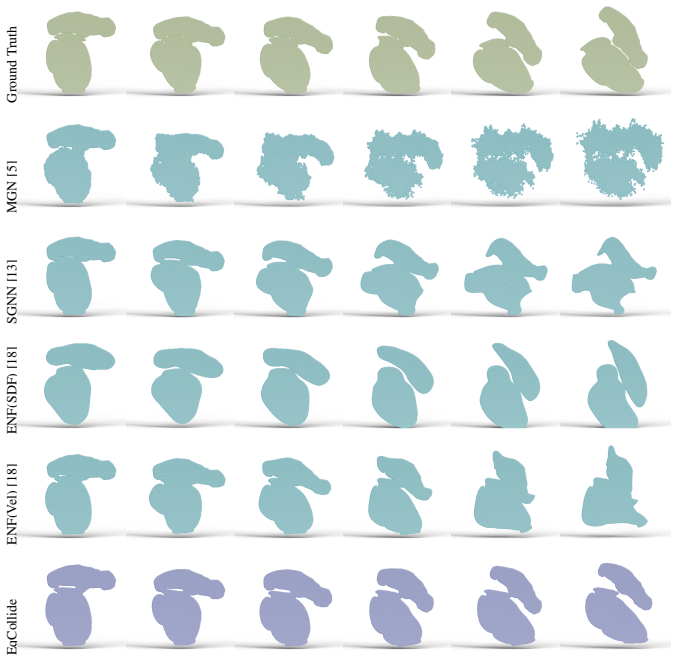
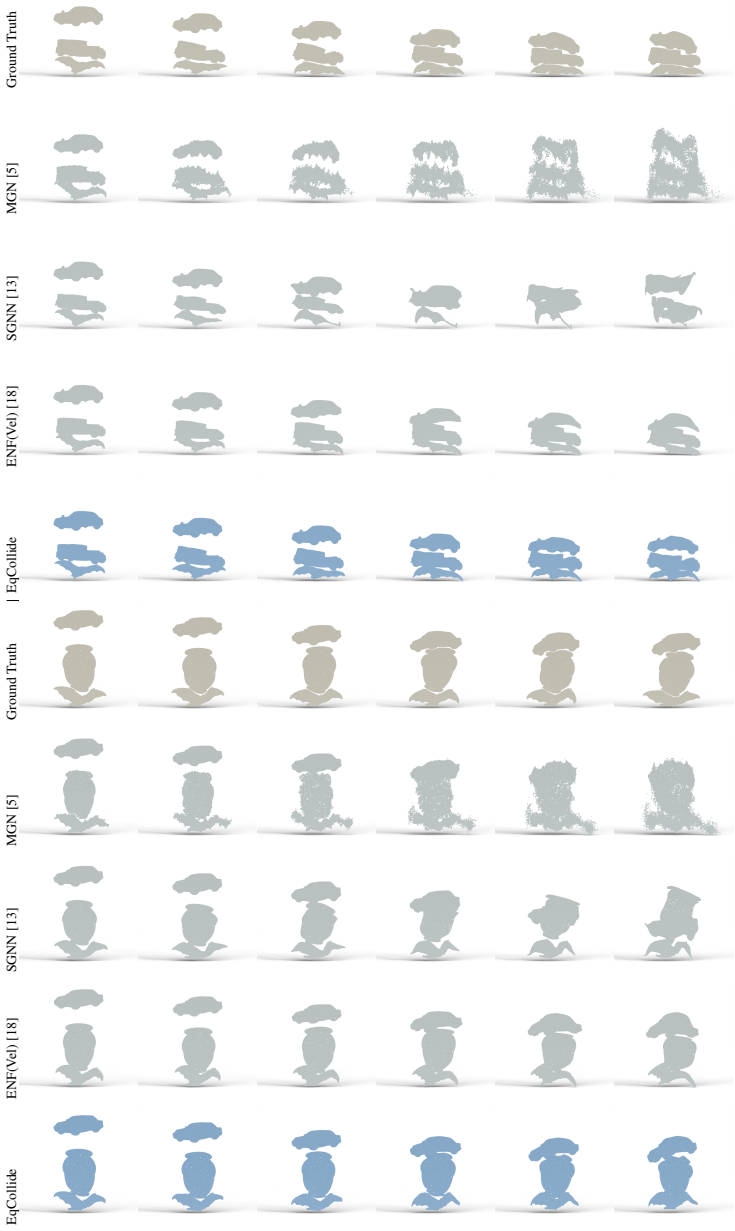
- [Section 4.2, Table 2] The numerical claims in the text are not consistently supported by the table. The abstract reports reductions of 24.34% to 35.82%, but the metadata abstract reports 24.34% to 57.62%, while Section 4.2 additionally reports a 66.89% reduction at 20 steps on unseen object combinations. From Table 2, the 20-step unseen-combination values are ENF-PDE (Vel) 30.806 and EqCollide 11.2, which gives a 63.64% reduction, not 66.89%. The authors should reconcile the abstract, the main text, and the table, and report the exact formula used for the percentage reduction.
minor comments (5)
- [Abstract] The abstract claims experiments on "2D and 3D scenarios", but the dataset and all experiments are 2D only; either add 3D experiments or correct the abstract.
- [Section 4.2, Table 2] All quantitative results are reported without error bars, confidence intervals, or the number of random seeds. Given that the headline results are percentage improvements, the authors should report variance across seeds or explicitly justify single-seed reporting.
- [Section 4.4] The claim that EqCollide "could generalize to more colliding objects" should be qualified, since the zero-shot three-object results are described as having "limited accuracy" and the improved numbers in Table 4 come after finetuning on 10% of a three-object training set.
- [Appendix B.1] The statement that the modified FPS "guarantees both translation and rotation equivariance" is not accompanied by a proof for rotation, and the tie-breaking rule for equidistant farthest points is not specified. With a deterministic index-based argmax the selected set is equivariant, so this is not a correctness issue, but a one-sentence clarification would help.
- [General] There are several typographical errors, including "discribed" in Section 3.1 and "enotes" in the Table 2 note; a careful proofreading pass is needed.
Circularity Check
No material circularity: EqCollide's equivariance is a constructed architectural property, and its predictions are evaluated against externally generated ground-truth trajectories.
full rationale
The paper's derivation chain is self-contained in the sense required here. The end-to-end equivariance claim (Eq. 1) rests on modular equivariance of the encoder, processor, and decoder: the encoder uses modified FPS and invariant features, the processor inherits PONITA equivariance, and the decoder is cited to the external ENF work [29]; none of these references overlaps with the present authors, so there is no self-citation chain making the claim load-bearing. The MSE comparisons (Tables 2 and 4) are standard supervised evaluations against ground truth generated by Taichi-MPM, not predictions that are forced by fitted constants. The equivariance validation in Figure 4 literally checks a designed symmetry, but checking a construction is not deriving a result from its own input; no fitted parameter is renamed as a prediction. The potential gap about how the orientation scalar theta^ctl is handled by the ENF decoder is a correctness/evidence concern, not a circularity, since the paper does not define equivariance in terms of the validation outcome. Likewise, the FPS tie-breaking caveat is a mathematical robustness issue, not a reduction of the conclusion to its premise. No circular step satisfying the quoted-evidence standard was found.
Assumptions & free parameters
free parameters (4)
- collision detection threshold =
0.05
- collision-aware region radius =
0.05
- number of control points =
16
- loss weighting coefficients c1 and c2 =
1, 1
assumptions (4)
- domain assumption MPM-generated trajectories are an accurate ground truth for deformable object dynamics.
- domain assumption The five hand-crafted rotation-invariant scalars (two angles, two squared distances, one cosine) fully preserve the information needed to learn the deformation and collision dynamics.
- standard math The equivariance proofs for PONITA and ENF, cited from prior work, carry over unchanged to this architecture.
- standard math FPS argmax selections are unique, so seeding from the farthest point from the centroid makes sampling deterministic and equivariant.
Cite this review
Pith. "Pith review of EqCollide: Equivariant and Collision-Aware Deformable Objects Neural Simulator." pith.science (2026). https://pith.science/paper/WP3UAGR5
@misc{pith2026250605797,
  author       = {Pith},
  title        = {Pith review of: EqCollide: Equivariant and Collision-Aware Deformable Objects Neural Simulator},
  year         = {2026},
  howpublished = {\url{https://pith.science/paper/WP3UAGR5}},
  note         = {Machine review of arXiv:2506.05797}
}
abstract
Simulating collisions of deformable objects is a fundamental yet challenging task due to the complexity of modeling solid mechanics and multi-body interactions. Existing data-driven methods often suffer from lack of equivariance to physical symmetries, inadequate handling of collisions, and limited scalability. Here we introduce EqCollide, the first end-to-end equivariant neural fields simulator for deformable objects and their collisions. We propose an equivariant encoder to map object geometry and velocity into latent control points. A subsequent equivariant Graph Neural Network-based Neural Ordinary Differential Equation models the interactions among control points via collision-aware message passing. To reconstruct velocity fields, we query a neural field conditioned on control point features, enabling continuous and resolution-independent motion predictions. Experimental results on 2D and 3D scenarios show that EqCollide achieves accurate, stable, and scalable simulations across diverse object configurations. It achieves $24.34\%$ to $57.62\%$ lower rollout MSE, even compared with the best-performing baseline model. Furthermore, EqCollide could generalize to more colliding objects and extended temporal horizons, and stay robust to input transformed with group action. Code is available at: https://github.com/AI4Science-WestlakeU/EqCollide
Figures


Figures from the paper (8 more)




Reference graph
Works this paper leans on
-
[29]
Grounding continuous representations in geometry: Equivariant neural fields,
D. R. Wessels, D. M. Knigge, S. Papa, R. Valperga, S. Vadgama, E. Gavves, and E. J. Bekkers, “Grounding continuous representations in geometry: Equivariant neural fields,”International Conference on Learning Representations (ICLR), 2025
work page 2025
-
[1]
T. Belytschko, W. K. Liu, B. Moran, and K. Elkhodary,Nonlinear finite elements for continua and structures. John wiley & sons, 2014. 10
work page 2014
-
[2]
A material point method for snow simulation,
A. Stomakhin, C. Schroeder, L. Chai, J. Teran, and A. Selle, “A material point method for snow simulation,”ACM Transactions on Graphics (TOG), vol. 32, no. 4, pp. 1–10, 2013
work page 2013
-
[3]
Divergence-free smoothed particle hydrodynamics,
J. Bender and D. Koschier, “Divergence-free smoothed particle hydrodynamics,” inProceedings of the 14th ACM SIGGRAPH/Eurographics symposium on computer animation, pp. 147–155, 2015
work page 2015
-
[4]
Learning particle dynamics for manipulating rigid bodies, deformable objects, and fluids,
Y . Li, J. Wu, R. Tedrake, J. B. Tenenbaum, and A. Torralba, “Learning particle dynamics for manipulating rigid bodies, deformable objects, and fluids,”International Conference on Learning Representations (ICLR), 2019
work page 2019
-
[5]
Learning mesh-based simulation with graph networks,
T. Pfaff, M. Fortunato, A. Sanchez-Gonzalez, and P. Battaglia, “Learning mesh-based simulation with graph networks,” inInternational Conference on Learning Representations (ICLR), 2020
work page 2020
-
[6]
Learning to simulate complex physics with graph networks,
A. Sanchez-Gonzalez, J. Godwin, T. Pfaff, R. Ying, J. Leskovec, and P. Battaglia, “Learning to simulate complex physics with graph networks,” inInternational Conference on Machine Learning (ICML), pp. 8459–8468, PMLR, 2020
work page 2020
-
[7]
Y . Cao, M. Chai, M. Li, and C. Jiang, “Efficient learning of mesh-based physical simulation with bi-stride multi-scale graph neural network,” inInternational Conference on Machine Learning (ICML), pp. 3541–3558, PMLR, 2023
work page 2023
Show all 43 references
-
[8]
Physics-informed neural networks: A deep learning framework for solving forward and inverse problems involving nonlinear partial differential equations,
M. Raissi, P. Perdikaris, and G. E. Karniadakis, “Physics-informed neural networks: A deep learning framework for solving forward and inverse problems involving nonlinear partial differential equations,”Journal of Computational physics, vol. 378, pp. 686–707, 2019
2019
-
[9]
An energy approach to the solution of partial differential equations in computa- tional mechanics via machine learning: Concepts, implementation and applications,
E. Samaniego, C. Anitescu, S. Goswami, V . M. Nguyen-Thanh, H. Guo, K. Hamdia, X. Zhuang, and T. Rabczuk, “An energy approach to the solution of partial differential equations in computa- tional mechanics via machine learning: Concepts, implementation and applications,”Compute...
2020
-
[10]
Lagrangian neural networks,
M. Cranmer, S. Greydanus, S. Hoyer, P. Battaglia, D. Spergel, and S. Ho, “Lagrangian neural networks,”ICLR 2020 Deep Differential Equations Workshop, 2020
2020
-
[11]
Geometric and physical quantities improve e (3) equivariant message passing,
J. Brandstetter, R. Hesselink, E. van der Pol, E. J. Bekkers, and M. Welling, “Geometric and physical quantities improve e (3) equivariant message passing,”International Conference on Learning Representations (ICLR), 2022
2022
-
[12]
E (n) equivariant graph neural networks,
V . G. Satorras, E. Hoogeboom, and M. Welling, “E (n) equivariant graph neural networks,” in International Conference on Machine Learning (ICML), pp. 9323–9332, PMLR, 2021
2021
-
[13]
Learning physical dynamics with subequivariant graph neural networks,
J. Han, W. Huang, H. Ma, J. Li, J. Tenenbaum, and C. Gan, “Learning physical dynamics with subequivariant graph neural networks,”Advances in Neural Information Processing Systems (NeurIPS), vol. 35, pp. 26256–26268, 2022
2022
-
[14]
Equivariant graph mechanics networks with constraints,
W. Huang, J. Han, Y . Rong, T. Xu, F. Sun, and J. Huang, “Equivariant graph mechanics networks with constraints,”International Conference on Learning Representations (ICLR), 2022
2022
-
[15]
Se (3)-equivariant diffusion graph nets: Synthesizing flow fields by denoising invariant latents on graphs,
M. L. Valencia, N. Thuerey, and T. Pfaff, “Se (3)-equivariant diffusion graph nets: Synthesizing flow fields by denoising invariant latents on graphs,” inICML 2024 AI for Science Workshop, 2024
2024
-
[16]
Pointnet++: Deep hierarchical feature learning on point sets in a metric space,
C. R. Qi, L. Yi, H. Su, and L. J. Guibas, “Pointnet++: Deep hierarchical feature learning on point sets in a metric space,”Advances in Neural Information Processing Systems (NeurIPS), 2017
2017
-
[17]
Neural ordinary differential equations,
R. T. Chen, Y . Rubanova, J. Bettencourt, and D. K. Duvenaud, “Neural ordinary differential equations,”Advances in neural information processing systems (NeurIPS), vol. 31, 2018. 11
2018
-
[18]
Space-time continuous pde forecasting using equivariant neural fields,
D. M. Knigge, D. R. Wessels, R. Valperga, S. Papa, J.-J. Sonke, E. Gavves, and E. J. Bekkers, “Space-time continuous pde forecasting using equivariant neural fields,”Advances in Neural Information Processing Systems (NeurIPS), 2024
2024
-
[19]
Deepsdf: Learning continu- ous signed distance functions for shape representation,
J. J. Park, P. Florence, J. Straub, R. Newcombe, and S. Lovegrove, “Deepsdf: Learning continu- ous signed distance functions for shape representation,” inProceedings of IEEE Conference on Computer Vision and Pattern Recognition (CVPR), June 2019
2019
-
[20]
Learning implicit fields for generative shape modeling,
Z. Chen and H. Zhang, “Learning implicit fields for generative shape modeling,”Proceedings of IEEE Conference on Computer Vision and Pattern Recognition (CVPR), 2019
2019
-
[21]
Occupancy networks: Learning 3d reconstruction in function space,
L. Mescheder, M. Oechsle, M. Niemeyer, S. Nowozin, and A. Geiger, “Occupancy networks: Learning 3d reconstruction in function space,” inProceedings of IEEE Conference on Computer Vision and Pattern Recognition (CVPR), pp. 4460–4470, 2019
2019
-
[22]
Nerf: Representing scenes as neural radiance fields for view synthesis,
B. Mildenhall, P. P. Srinivasan, M. Tancik, J. T. Barron, R. Ramamoorthi, and R. Ng, “Nerf: Representing scenes as neural radiance fields for view synthesis,” inEuropean Conference on Computer Vision (ECCV), 2020
2020
-
[23]
Implicit neural rep- resentations with periodic activation functions,
V . Sitzmann, J. N. Martel, A. W. Bergman, D. B. Lindell, and G. Wetzstein, “Implicit neural rep- resentations with periodic activation functions,” inAdvances in Neural Information Processing Systems (NeurIPS), 2020
2020
-
[24]
Metasdf: Meta-learning signed distance functions,
V . Sitzmann, E. R. Chan, R. Tucker, N. Snavely, and G. Wetzstein, “Metasdf: Meta-learning signed distance functions,” inAdvances in Neural Information Processing Systems (NeurIPS), 2020
2020
-
[25]
From data to functa: Your data point is a function and you can treat it like one,
E. Dupont, H. Kim, S. M. A. Eslami, D. J. Rezende, and D. Rosenbaum, “From data to functa: Your data point is a function and you can treat it like one,” inInternational Conference on Machine Learning (ICML), 2022
2022
-
[26]
Implicit neural spatial representations for time-dependent pdes,
H. Chen, R. Wu, E. Grinspun, C. Zheng, and P. Y . Chen, “Implicit neural spatial representations for time-dependent pdes,” inInternational Conference on Machine Learning (ICML), 2023
2023
-
[27]
Fluid simulation on neural flow maps,
Y . Deng, H.-X. Yu, D. Zhang, J. Wu, and B. Zhu, “Fluid simulation on neural flow maps,”ACM Trans. Graph., vol. 42, no. 6, 2023
2023
-
[28]
Neural implicit reduced fluid simulation,
Y . Tao, I. Puhachov, D. Nowrouzezahrai, and P. Kry, “Neural implicit reduced fluid simulation,” inSIGGRAPH Asia 2024 Conference Papers, pp. 1–11, 2024
2024
-
[30]
Fast, expressive se (n) equivariant networks through weight-sharing in position-orientation space,
E. J. Bekkers, S. Vadgama, R. D. Hesselink, P. A. Van der Linden, and D. W. Romero, “Fast, expressive se (n) equivariant networks through weight-sharing in position-orientation space,” International Conference on Learning Representations (ICLR), 2024
2024
-
[31]
Geometry aware infer- ence of steady state pdes using equivariant neural fields representations,
G. Catalani, M. Bauerheim, F. Tost, X. Bertrand, and J. Morlier, “Geometry aware infer- ence of steady state pdes using equivariant neural fields representations,”arXiv preprint arXiv:2504.18591, 2025
2025
-
[32]
Interaction networks for learning about objects, relations and physics,
P. Battaglia, R. Pascanu, M. Lai, D. Jimenez Rezende,et al., “Interaction networks for learning about objects, relations and physics,”Advances in Neural Information Processing Systems (NeurIPS), vol. 29, 2016
2016
-
[33]
Neural relational inference for interacting systems,
T. Kipf, E. Fetaya, K.-C. Wang, M. Welling, and R. Zemel, “Neural relational inference for interacting systems,” inInternational Conference on Machine Learning (ICML), pp. 2688–2697, PMLR, 2018. 12
2018
-
[34]
Graph networks as learnable physics engines for inference and control,
A. Sanchez-Gonzalez, N. Heess, J. T. Springenberg, J. Merel, M. Riedmiller, R. Hadsell, and P. Battaglia, “Graph networks as learnable physics engines for inference and control,” in International Conference on Machine Learning (ICML), pp. 4470–4479, PMLR, 2018
2018
-
[35]
Learning rigid dynamics with face interaction graph networks,
K. R. Allen, Y . Rubanova, T. Lopez-Guevara, W. Whitney, A. Sanchez-Gonzalez, P. Battaglia, and T. Pfaff, “Learning rigid dynamics with face interaction graph networks,”International Conference on Learning Representations (ICLR), 2023
2023
-
[36]
Learning rigid-body simulators over implicit shapes for large-scale scenes and vision,
Y . Rubanova, T. Lopez-Guevara, K. R. Allen, W. F. Whitney, K. Stachenfeld, and T. Pfaff, “Learning rigid-body simulators over implicit shapes for large-scale scenes and vision,”Advances in Neural Information Processing Systems (NeurIPS), 2024
2024
-
[37]
Extending lagrangian and hamiltonian neural networks with differentiable contact models,
Y . D. Zhong, B. Dey, and A. Chakraborty, “Extending lagrangian and hamiltonian neural networks with differentiable contact models,”Advances in Neural Information Processing Systems (NeurIPS), vol. 34, pp. 21910–21922, 2021
2021
-
[38]
Hamiltonian graph networks with ode integrators,
A. Sanchez-Gonzalez, V . Bapst, K. Cranmer, and P. Battaglia, “Hamiltonian graph networks with ode integrators,”Second Workshop on Machine Learning and the Physical Sciences (NeurIPS 2019), 2019
2019
-
[39]
Constraint-based graph network simulator,
Y . Rubanova, A. Sanchez-Gonzalez, T. Pfaff, and P. Battaglia, “Constraint-based graph network simulator,”International Conference on Machine Learning (ICML), 2022
2022
-
[40]
Tensor field networks: Rotation-and translation-equivariant neural networks for 3d point clouds,
N. Thomas, T. Smidt, S. Kearnes, L. Yang, L. Li, K. Kohlhoff, and P. Riley, “Tensor field networks: Rotation-and translation-equivariant neural networks for 3d point clouds,”NeurIPS Molecules and Materials Workshop, 2018
2018
-
[41]
Gemnet: Universal directional graph neural networks for molecules,
J. Gasteiger, F. Becker, and S. Günnemann, “Gemnet: Universal directional graph neural networks for molecules,”Advances in Neural Information Processing Systems (NeurIPS), vol. 34, pp. 6790–6802, 2021
2021
-
[42]
Graph Neural Networks for Learning Equivariant Representations of Neural Networks,
M. Kofinas, B. Knyazev, Y . Zhang, Y . Chen, G. J. Burghouts, E. Gavves, C. G. M. Snoek, and D. W. Zhang, “Graph Neural Networks for Learning Equivariant Representations of Neural Networks,” inInternational Conference on Learning Representations (ICLR), 2024
2024
-
[43]
Vector neurons: A general framework for so (3)-equivariant networks,
C. Deng, O. Litany, Y . Duan, A. Poulenard, A. Tagliasacchi, and L. Guibas, “Vector neurons: A general framework for so (3)-equivariant networks,”International Conference on Computer Vision (ICCV), 2021. 13 A Proof of Equivariant Processor As introduced in Section 3.2, we util...
2021
Reviewed August 7, 2026 · model on record in the stance chip above.
Discussion (0). Sign in to comment.