REVIEW 4 major objections 4 minor 70 references
Learning Along the Arrow of Time: Hyperbolic Geometry for Backward-Compatible Representation Learning
T0 review · 4 major / 4 minor · reviewed 2026-08-07 · deepseek-v4-flash
Pith's one-line read By lifting embeddings into hyperbolic space and constraining new ones inside old entailment cones, this paper claims to keep upgraded models compatible with existing galleries while letting uncertain old embeddings be downweighted.
desk verdict A promising but under-validated hyperbolic approach to backward-compatible retrieval; the uncertainty mechanism is the main risk. read the letter →
The pith
A machine-rendered reading of the paper's core claim, the machinery that carries it, and where it could break.
The reading
What carries the argument
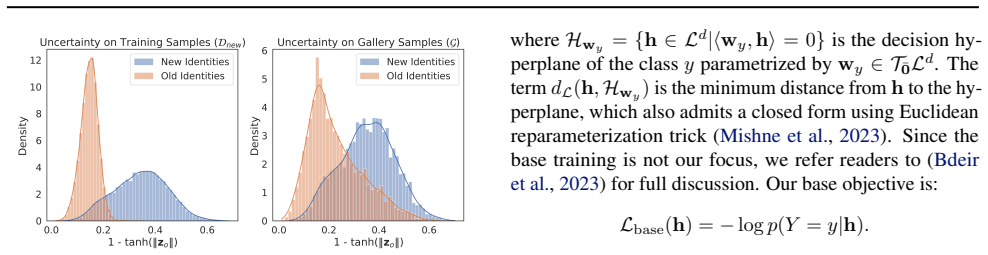
The load-bearing object is the hyperbolic entailment cone in the Lorentz model of hyperbolic space. For an old embedding $h_o$, the cone has half-aperture $\mathrm{aper}(h_o)=\sin^{-1}(2\epsilon\sqrt K/\|h_{o,\mathrm{space}}\|)$, which narrows as the embedding moves away from the origin; the loss $\mathcal L_{\mathrm{entail}}=\max(0,\mathrm{ext}(h_o,h_n)-\mathrm{aper}(h_o))$ penalizes new embeddings that fall outside it. Uncertainty is measured by $\mathrm{Uncertainty}(h)=1-\frac{1}{\sqrt K}\tanh(\sqrt K\|z\|)$, which equals the norm shrinkage caused by the exponential map and is bounded in $[0,1]$ for $K=1$. A robust contrastive alignment loss (RINCE) with $q(h_o)=\mathrm{Uncertainty}(h_o)$ downweights positive pairs whose old embedding is uncertain. The full objective is $\mathcal L=\mathcal L_{\mathrm{base}}+\lambda(\mathcal L_{\mathrm{entail}}+\mathcal L_{\mathrm{contrast}})$, applied after exponential-map lifting of any Euclidean encoder's output.
What would settle it
Measure, on a held-out set, the correlation between the old model's norm-based hyperbolic uncertainty and its actual retrieval errors for each gallery item; if low-uncertainty (high-norm) embeddings are equally or more error-prone, or if downweighting low-norm embeddings does not improve new-to-old retrieval, the central mechanism is falsified. A direct experiment would inject label noise into high-norm training samples so that old-model errors concentrate there, and check whether HBCT's gains invert.
Extended reading notes
Core claim
The central claim is that the radial structure of hyperbolic embeddings provides a usable signal for model evolution: the same coordinate that encodes an old embedding's uncertainty also controls how much the new embedding may deviate from it. Concretely, HBCT defines uncertainty as $1-\frac{1}{\sqrt K}\tanh(\sqrt K\|z\|)$ for the pre-exponential Euclidean vector $z$, and sets the entailment-cone aperture inversely to the old embedding's norm, so unreliable old embeddings produce wider permissible cones. The contrastive term uses RINCE with $q(h_o)=\mathrm{Uncertainty}(h_o)$, dynamically lowering the pull toward uncertain old embeddings. The paper demonstrates across extended-data, extended-class, new-architecture, and combined scenarios that this yields stronger new-to-old retrieval compatibility than Euclidean baselines such as BCT, Hot-Refresh, AdvBCT, and HOC, and that the advantage persists through five consecutive model updates.
Load-bearing premise
The load-bearing premise is that an old embedding's norm in hyperbolic space reliably measures how uncertain or unreliable that embedding is; if low-norm embeddings are not the ones causing retrieval failures, the adaptive weighting and cone-widening would be miscalibrated and the compatibility gains could vanish.
Editorial extensions
If this is right
- An upgraded model can query the existing gallery immediately, so backfilling the vector database becomes optional rather than mandatory.
- Old embeddings are no longer treated as ground truth: high-uncertainty old embeddings are downweighted and allowed to drift more, so the new model can learn better representations without sacrificing compatibility.
- The compatibility advantage is reported to survive multiple consecutive updates, where Euclidean alignment methods' compatibility declines rapidly.
- The method is described as applicable to any base loss, meaning the same hyperbolic alignment could wrap supervised, self-supervised, or foundation-model training.
- Even the hyperbolic method without the entailment loss outperforms Euclidean baselines in several settings, suggesting the geometry itself, not just the cone constraint, drives part of the gain.
Reading between the lines
- One natural test is to replace the norm-based uncertainty with a calibrated measure, such as the old model's own softmax entropy on a probe set, and check whether compatibility improves further; the geometry would stay intact while the weight $q(h_o)$ becomes task-grounded.
- Because the objective is agnostic to the base loss, HBCT could be applied to self-supervised and multimodal foundation-model updates; a concrete extension would be fine-tuning a CLIP-style model with the hyperbolic alignment and measuring zero-shot retrieval compatibility.
- The paper's own limitation about growing clipping thresholds implies a stress test: run fifty or more sequential updates and observe whether norm growth destabilizes training, or whether periodic rescaling of the time coordinate restores stability.
- The exponential volume growth of hyperbolic space suggests the approach may scale naturally to continual learning with many emerging classes, a regime where Euclidean compatibility methods degrade, though the paper only demonstrates five update steps.
Editorial analysis
A structured set of objections, weighed in public.
Referee Report
Summary. The paper proposes HBCT, a method for backward-compatible representation learning that operates in hyperbolic space (Lorentz model). The old and new embedding models are mapped to the hyperboloid, and training enforces two geometric constraints: (i) an entailment-cone loss that keeps each new embedding inside the cone defined by its old counterpart, and (ii) a robust contrastive (RINCE) loss in which the per-pair weighting exponent q is set to a hyperbolic uncertainty estimate of the old embedding (Eq. 10). The uncertainty estimate is a monotone function of the old embedding’s norm, and the paper argues that lower-norm old embeddings are less reliable, so they are downweighted and their cones are widened. Experiments on CIFAR-100 and Tiny-ImageNet across four update scenarios report that HBCT improves backward-compatibility metrics (Pcom) over Euclidean baselines, with claimed average gains of 21.4% in CMC@1 and 44.8% in mAP, at small cost to new-model performance. Ablations and appendices probe the influence of curvature, clipping thresholds, alignment weights, and distance functions.
Significance. If the reported gains are robust, the paper would introduce a useful new perspective: hyperbolic geometry provides a principled way to express both representation uncertainty and the ‘evolution’ of an embedding space across model updates, and the entailment cone offers a natural partial-order constraint for compatibility. The paper ships code, which aids reproducibility, and it is among the first to apply hyperbolic geometry to backward-compatible training. However, the significance is tempered by two factors: the experimental evidence comes from two small image datasets with no large-scale validation, and the central uncertainty mechanism, which is the paper’s main conceptual novelty, has only weak empirical support. The method’s gains appear to come substantially from the hyperbolic geometry/entailment constraint rather than from the uncertainty-aware weighting, and the comparison against Euclidean baselines is confounded by the use of different (and often better) hyperbolic old models. The core idea is promising and worth developing, but the current evidence falls short of establishing that the uncertainty-driven mechanism is the source of the benefits.
major comments (4)
- [§4.1, Eq. (10), Fig. 2] The uncertainty measure q(ho)=1-(1/sqrt(K))tanh(sqrt(K)||z||) is used per-sample to set the RINCE exponent in Eq. (12) and to widen entailment cones via Eq. (11), but the only evidence that this quantity tracks old-model reliability is the aggregate, class-conditional histogram in Fig. 2. Old-model error is per-example: an embedding can have low norm because it is out-of-distribution, because it is a hard example, or because it lies near a classification boundary, and these cases do not necessarily coincide with the errors that actually hurt new-to-old retrieval. The authors should validate the calibration directly, for example by correlating Uncertainty(ho) with per-sample retrieval errors of the old model, or with the distance between same-class old and new embeddings. Without such evidence, the central mechanism of the paper—adaptive downweighting of unreliable old embeddings—remains an unsupported assumption.
- [§5.1, Eq. (14), Table 1] The headline claim that HBCT improves CMC@1 compatibility by 21.4% over the strongest Euclidean baseline is not clearly reproducible from Table 1. In the Both/TinyImageNet scenario the HBCT Pcom (0.348) is actually lower than the best Euclidean baseline Hot-Refresh (0.365), and across all eight cells the relative improvements vary from -4.7% to +53%. Moreover, Pcom as defined in Eq. (14) is not invariant to the choice of old model: its denominator M(phi*, phi*_G) - M(phi_o, phi_o_G) shrinks when the old model improves, so the stronger hyperbolic old models (e.g., 0.425 vs 0.376 on Ext-class CIFAR CMC@1) inflate Pcom even for identical absolute compatibility gains. The paper acknowledges that old models differ but claims Pcom is ‘calibrated’; it is not fully calibrated. The authors should either use the same old model across geometries (e.g., lift a Euclidean old model’s embeddings into hyperbolic space) or report raw cross-retrieval metrics with a careful sensitivity analysis.
- [§5.1, Implementation Details] The experimental protocol has no validation split: for each Euclidean baseline, 10 hyperparameter combinations are evaluated and the run that best performs on the test metrics (subject to not degrading the new model) is selected, while HBCT’s hyperparameters are fixed based on an ablation. No error bars, standard deviations, or multiple seeds are reported. This makes it impossible to assess whether the reported margins are statistically meaningful or whether the baseline tuning procedure overfits the test set. The authors should select hyperparameters on a hold-out validation set and report mean ± std over at least three independent runs for all methods.
- [§5.4, Table 2] The ablation in Table 2 shows that replacing the uncertainty-weighted RINCE loss with a standard InfoNCE loss changes CMC@1 Pcom only from 0.495 to 0.475, while removing the entailment loss reduces it to 0.435. The difference attributable to the uncertainty-aware weighting (0.02) is small relative to the overall improvement over Euclidean baselines (e.g., 0.495 vs 0.360 for the best Euclidean baseline in the same setting). This suggests that the paper’s central narrative—that dynamically adjusting alignment weights based on uncertainty is the key to the gains—is not supported by the ablation. The authors should either provide additional experiments that isolate the effect of q(ho) (e.g., random or reverse uncertainty weighting) or temper the claims about the uncertainty mechanism.
minor comments (4)
- [Abstract and §5.2] The 21.4% and 44.8% improvements are stated without a precise definition of how the average is computed across settings and datasets. Specify the aggregation rule and report the per-setting numbers.
- [§4.1, Eq. (10)] The displayed formula for Uncertainty(h) is garbled in the manuscript, with several alignment artifacts. Please rewrite it clearly, and also clarify the relationship between the Lorentz-model expression and the Poincaré-ball uncertainty used in prior work (the factor 1/sqrt(K) appears inconsistent with the stated equivalence for K ≠ 1).
- [§4.2, Eq. (11)] The aperture constant ε is fixed to 0.1 without discussion. A one-sentence sensitivity analysis or a reference to the original derivation would help.
- [§5.3] The sequential-update experiment reports that HBCT ‘demonstrates superior compatibility maintenance’ but gives no quantitative summary of the compatibility matrices. Include the average or diagonal-to-off-diagonal decay metrics.
Circularity Check
No load-bearing circularity; the headline compatibility gains are held-out empirical results with fixed hyperparameters, leaving only the unvalidated norm-as-uncertainty premise of Eq. (10) as a quasi-circular conceptual loop.
full rationale
I found no circular step that meets the evidence bar. The paper's central claims, a 21.4% average CMC@1 Pcom improvement and a 44.8% mAP Pcom improvement over the strongest Euclidean baseline, are empirical measurements computed with the held-out Pcom/Pup metrics of Eqs. (14)-(15) on test galleries; they do not reduce to any fitted parameter or to any equation equal to the method's input by construction. Hyperparameters are fixed constants (K=1.0, lambda=0.3, tau=0.5, beta=0.01, zeta_o=1.0, zeta_n=1.2), and the Euclidean baselines were actually given more tuning freedom ('For each baseline, we run with 10 combinations of these hyperparameters and choose the best run'), so the fitted-input-called-prediction pattern is inverted if anything. The uncertainty definition in Eq. (10) is transparently imported from external prior work (Franco et al. 2023; Atigh et al. 2022), not from the authors' own papers; the only co-authored references (Yang et al. 2023, 2024) appear in related work and are not load-bearing. The statement that the entailment cone widens as embeddings become more uncertain is a direct, explicitly derived consequence of Eqs. (10)-(11), both of which are monotone functions of the same norm, and the paper presents it as a design note rather than as an empirical discovery; the active contributions of the components are tested by ablation (Table 2: RINCE with entailment Pcom 0.495 vs InfoNCE 0.475 vs 0.431 without entailment). The genuine weakness is calibration, not circularity: the premise that low hyperbolic norm tracks per-example old-model error is supported only by the aggregate class-conditional histogram of Figure 2, so the uncertainty weighting could be miscalibrated and the attributed gains could partly come from the geometry rather than the uncertainty mechanism. That is a correctness risk, which the rules direct to correctness review rather than to a circularity finding. The score of 2 reflects the mild conceptual loop, where 'uncertainty' is defined through the norm and then invoked as the cause of norm-based reweighting, rather than any demonstrated derivation equivalent to its inputs.
Assumptions & free parameters
free parameters (4)
- Curvature K =
1.0
- Clipping thresholds zeta_o and zeta_n =
1.0 and 1.2
- Entailment cone epsilon =
0.1
- Contrastive and alignment hyperparameters lambda, tau, beta =
lambda=0.3, tau=0.5, beta=0.01
assumptions (4)
- domain assumption The L2 norm of a hyperbolic embedding, equivalently Eq. (10), is a valid monotone measure of model uncertainty, so q(ho)=Uncertainty(ho) correctly downweights unreliable old embeddings.
- ad hoc to paper The entailment cone partial order is the right model for embedding-space evolution over time: new embeddings should lie inside the cone of old embeddings.
- domain assumption Both old and new Euclidean features can be lifted to the same Lorentz hyperboloid via the exponential map at the origin, making cross-model geodesic distances meaningful before alignment.
- standard math Hyperbolic MLR classification with decision hyperplanes, Eq. (9), is a valid base loss for training old and new encoders.
Cite this review
Pith. "Pith review of Learning Along the Arrow of Time: Hyperbolic Geometry for Backward-Compatible Representation Learning." pith.science (2026). https://pith.science/paper/MVMQKNS2
@misc{pith2026250605826,
  author       = {Pith},
  title        = {Pith review of: Learning Along the Arrow of Time: Hyperbolic Geometry for Backward-Compatible Representation Learning},
  year         = {2026},
  howpublished = {\url{https://pith.science/paper/MVMQKNS2}},
  note         = {Machine review of arXiv:2506.05826}
}
read the original abstract
Backward compatible representation learning enables updated models to integrate seamlessly with existing ones, avoiding to reprocess stored data. Despite recent advances, existing compatibility approaches in Euclidean space neglect the uncertainty in the old embedding model and force the new model to reconstruct outdated representations regardless of their quality, thereby hindering the learning process of the new model. In this paper, we propose to switch perspectives to hyperbolic geometry, where we treat time as a natural axis for capturing a model's confidence and evolution. By lifting embeddings into hyperbolic space and constraining updated embeddings to lie within the entailment cone of the old ones, we maintain generational consistency across models while accounting for uncertainties in the representations. To further enhance compatibility, we introduce a robust contrastive alignment loss that dynamically adjusts alignment weights based on the uncertainty of the old embeddings. Experiments validate the superiority of the proposed method in achieving compatibility, paving the way for more resilient and adaptable machine learning systems.
Figures


Figures from the paper (3 more)


Reference graph
Works this paper leans on
-
[1]
write newline
" write newline "" before.all 'output.state := FUNCTION n.dashify 't := "" t empty not t #1 #1 substring "-" = t #1 #2 substring "--" = not "--" * t #2 global.max substring 't := t #1 #1 substring "-" = "-" * t #2 global.max substring 't := while if t #1 #1 substring * t #2 global.max substring 't := if while FUNCTION format.date year duplicate empty "emp...
-
[2]
Ara \'u jo, V. and Viana, M. Hyperbolic dynamical systems. arXiv preprint arXiv:0804.3192, 2008
work page Pith review arXiv 2008
-
[3]
G., Schoep, J., Acar, E., Van Noord, N., and Mettes, P
Atigh, M. G., Schoep, J., Acar, E., Van Noord, N., and Mettes, P. Hyperbolic image segmentation. In Proceedings of the IEEE/CVF conference on computer vision and pattern recognition, pp.\ 4453--4462, 2022
work page 2022
-
[4]
Revisiting model stitching to compare neural representations
Bansal, Y., Nakkiran, P., and Barak, B. Revisiting model stitching to compare neural representations. Advances in neural information processing systems, 34: 0 225--236, 2021
2021
-
[5]
Barrett, J. F. The hyperbolic theory of special relativity. arXiv preprint arXiv:1102.0462, 2011
work page Pith review arXiv 2011
-
[6]
Fully Hyperbolic Convolutional Neural Networks for Computer Vision
Bdeir, A., Schwethelm, K., and Landwehr, N. Fully hyperbolic convolutional neural networks for computer vision. arXiv preprint arXiv:2303.15919, 2023
work page Pith review arXiv 2023
-
[7]
Representation learning: A review and new perspectives
Bengio, Y., Courville, A., and Vincent, P. Representation learning: A review and new perspectives. IEEE transactions on pattern analysis and machine intelligence, 35 0 (8): 0 1798--1828, 2013
2013
-
[8]
Biondi, N., Pernici, F., Ricci, S., and Del Bimbo, A. Stationary representations: Optimally approximating compatibility and implications for improved model replacements. In Proceedings of the IEEE/CVF Conference on Computer Vision and Pattern Recognition, pp.\ 28793--28804, 2024
work page 2024
Show all 70 references
-
[9]
A., Adeli, E., Altman, R., Arora, S., von Arx, S., Bernstein, M
Bommasani, R., Hudson, D. A., Adeli, E., Altman, R., Arora, S., von Arx, S., Bernstein, M. S., Bohg, J., Bosselut, A., Brunskill, E., et al. On the opportunities and risks of foundation models. arXiv preprint arXiv:2108.07258, 2021
2021 arXiv
-
[10]
and Mago, V
Chandrasekaran, D. and Mago, V. Evolution of semantic similarity—a survey. ACM Computing Surveys (CSUR), 54 0 (2): 0 1--37, 2021
2021
-
[11]
R3 adversarial network for cross model face recognition
Chen, K., Wu, Y., Qin, H., Liang, D., Liu, X., and Yan, J. R3 adversarial network for cross model face recognition. In Proceedings of the IEEE/CVF Conference on Computer Vision and Pattern Recognition, pp.\ 9868--9876, 2019
2019
-
[12]
A simple framework for contrastive learning of visual representations
Chen, T., Kornblith, S., Norouzi, M., and Hinton, G. A simple framework for contrastive learning of visual representations. In International conference on machine learning, pp.\ 1597--1607. PMLR, 2020
2020
-
[13]
M., Georgiou, T., Fieguth, P., Liu, L., and Lew, M
Chen, W., Liu, Y., Wang, W., Bakker, E. M., Georgiou, T., Fieguth, P., Liu, L., and Lew, M. S. Deep learning for instance retrieval: A survey. IEEE Transactions on Pattern Analysis and Machine Intelligence, 45 0 (6): 0 7270--7292, 2022
2022
-
[14]
D., Wang, X., Vineet, V., Joshi, N., Torralba, A., Jegelka, S., and Song, Y
Chuang, C.-Y., Hjelm, R. D., Wang, X., Vineet, V., Joshi, N., Torralba, A., Jegelka, S., and Song, Y. Robust contrastive learning against noisy views. In Proceedings of the IEEE/CVF Conference on Computer Vision and Pattern Recognition, pp.\ 16670--16681, 2022
2022
-
[15]
Learning continual compatible representation for re-indexing free lifelong person re-identification
Cui, Z., Zhou, J., Wang, X., Zhu, M., and Peng, Y. Learning continual compatible representation for re-indexing free lifelong person re-identification. In Proceedings of the IEEE/CVF Conference on Computer Vision and Pattern Recognition, pp.\ 16614--16623, 2024
2024
-
[16]
Desai, K., Nickel, M., Rajpurohit, T., Johnson, J., and Vedantam, S. R. Hyperbolic image-text representations. In International Conference on Machine Learning, pp.\ 7694--7731. PMLR, 2023
2023
-
[17]
Bert: Pre-training of deep bidirectional transformers for language understanding
Devlin, J. Bert: Pre-training of deep bidirectional transformers for language understanding. arXiv preprint arXiv:1810.04805, 2018
2018 arXiv
-
[18]
J., Norouzi, M., Dai, A
Dhingra, B., Shallue, C. J., Norouzi, M., Dai, A. M., and Dahl, G. E. Embedding text in hyperbolic spaces. CoRR, abs/1806.04313, 2018. URL http://arxiv.org/abs/1806.04313
2018 arXiv
-
[19]
An image is worth 16x16 words: Transformers for image recognition at scale
Dosovitskiy, A. An image is worth 16x16 words: Transformers for image recognition at scale. arXiv preprint arXiv:2010.11929, 2020
2010 arXiv
-
[20]
A., and Weyl, H
Einstein, A., Lorentz, H. A., and Weyl, H. The principle of relativity. Courier Corporation, 2013
2013
-
[21]
Towards artificial general intelligence via a multimodal foundation model
Fei, N., Lu, Z., Gao, Y., Yang, G., Huo, Y., Wen, J., Lu, H., Song, R., Gao, X., Xiang, T., et al. Towards artificial general intelligence via a multimodal foundation model. Nature Communications, 13 0 (1): 0 3094, 2022
2022
-
[22]
Hyperbolic self-paced learning for self-supervised skeleton-based action representations
Franco, L., Mandica, P., Munjal, B., and Galasso, F. Hyperbolic self-paced learning for self-supervised skeleton-based action representations. arXiv preprint arXiv:2303.06242, 2023
2023 arXiv
-
[23]
Hyperbolic entailment cones for learning hierarchical embeddings
Ganea, O., B \'e cigneul, G., and Hofmann, T. Hyperbolic entailment cones for learning hierarchical embeddings. In International conference on machine learning, pp.\ 1646--1655. PMLR, 2018
2018
-
[24]
Retrieval-augmented generation for large language models: A survey
Gao, Y., Xiong, Y., Gao, X., Jia, K., Pan, J., Bi, Y., Dai, Y., Sun, J., and Wang, H. Retrieval-augmented generation for large language models: A survey. arXiv preprint arXiv:2312.10997, 2023
2023 arXiv
-
[25]
Deep multimodal representation learning: A survey
Guo, W., Wang, J., and Wang, S. Deep multimodal representation learning: A survey. Ieee Access, 7: 0 63373--63394, 2019
2019
-
[26]
Deep residual learning for image recognition
He, K., Zhang, X., Ren, S., and Sun, J. Deep residual learning for image recognition. In Proceedings of the IEEE conference on computer vision and pattern recognition, pp.\ 770--778, 2016
2016
-
[27]
Learning backward compatible embeddings
Hu, W., Bansal, R., Cao, K., Rao, N., Subbian, K., and Leskovec, J. Learning backward compatible embeddings. In Proceedings of the 28th ACM SIGKDD Conference on Knowledge Discovery and Data Mining, pp.\ 3018--3028, 2022
2022
-
[28]
G., Noord, N
Ibrahimi, S., Atigh, M. G., Noord, N. V., Mettes, P., and Worring, M. Intriguing properties of hyperbolic embeddings in vision-language models. Transactions on Machine Learning Research, 2024. ISSN 2835-8856. URL https://openreview.net/forum?id=P5D2gfi4Gg
2024
-
[29]
Fastfill: Efficient compatible model update
Jaeckle, F., Faghri, F., Farhadi, A., Tuzel, O., and Pouransari, H. Fastfill: Efficient compatible model update. arXiv preprint arXiv:2303.04766, 2023
2023 arXiv
-
[30]
Jang, Y. K. and Lim, S.-n. Towards cross-modal backward-compatible representation learning for vision-language models. arXiv preprint arXiv:2405.14715, 2024
2024
-
[31]
and Bilge, H
Kaya, M. and Bilge, H. S . Deep metric learning: A survey. Symmetry, 11 0 (9): 0 1066, 2019
2019
-
[32]
Hyperbolic image embeddings
Khrulkov, V., Mirvakhabova, L., Ustinova, E., Oseledets, I., and Lempitsky, V. Hyperbolic image embeddings. In Proceedings of the IEEE/CVF conference on computer vision and pattern recognition, pp.\ 6418--6428, 2020
2020
-
[33]
A survey of recommendation systems: recommendation models, techniques, and application fields
Ko, H., Lee, S., Park, Y., and Choi, A. A survey of recommendation systems: recommendation models, techniques, and application fields. Electronics, 11 0 (1): 0 141, 2022
2022
-
[34]
Learning multiple layers of features from tiny images
Krizhevsky, A., Hinton, G., et al. Learning multiple layers of features from tiny images. 2009
2009
-
[35]
Lorentzian distance learning for hyperbolic representations
Law, M., Liao, R., Snell, J., and Zemel, R. Lorentzian distance learning for hyperbolic representations. In International Conference on Machine Learning, pp.\ 3672--3681. PMLR, 2019
2019
-
[36]
and Yang, X
Le, Y. and Yang, X. Tiny imagenet visual recognition challenge. CS 231N, 7 0 (7): 0 3, 2015
2015
-
[37]
Hyperbolic anomaly detection
Li, H., Chen, Z., Xu, Y., and Hu, J. Hyperbolic anomaly detection. In Proceedings of the IEEE/CVF Conference on Computer Vision and Pattern Recognition, pp.\ 17511--17520, 2024
2024
-
[38]
Convergent learning: Do different neural networks learn the same representations? arXiv preprint arXiv:1511.07543, 2015
Li, Y., Yosinski, J., Clune, J., Lipson, H., and Hopcroft, J. Convergent learning: Do different neural networks learn the same representations? arXiv preprint arXiv:1511.07543, 2015
2015 arXiv
-
[39]
S., and Xu, G
Li, Y., Chen, H., Sun, X., Sun, Z., Li, L., Cui, L., Yu, P. S., and Xu, G. Hyperbolic hypergraphs for sequential recommendation. In Proceedings of the 30th ACM international conference on information & knowledge management, pp.\ 988--997, 2021
2021
-
[40]
Hyperbolic graph neural networks
Liu, Q., Nickel, M., and Kiela, D. Hyperbolic graph neural networks. In Wallach, H., Larochelle, H., Beygelzimer, A., d Alch\' e -Buc, F., Fox, E., and Garnett, R. (eds.), Advances in Neural Information Processing Systems, volume 32. Curran Associates, Inc., 2019. URL https://...
2019
-
[41]
Multimodal recommender systems: A survey
Liu, Q., Hu, J., Xiao, Y., Zhao, X., Gao, J., Wang, W., Li, Q., and Tang, J. Multimodal recommender systems: A survey. ACM Computing Surveys, 57 0 (2): 0 1--17, 2024
2024
-
[42]
C., and Zou, D
Mao, Y., Gu, J., Werner, M. C., and Zou, D. Klein model for hyperbolic neural networks. arXiv preprint arXiv:2410.16813, 2024
2024 arXiv
-
[43]
Umap: Uniform manifold approximation and projection
McInnes, L., Healy, J., Saul, N., and Grossberger, L. Umap: Uniform manifold approximation and projection. The Journal of Open Source Software, 3 0 (29): 0 861, 2018
2018
-
[44]
Learning compatible embeddings
Meng, Q., Zhang, C., Xu, X., and Zhou, F. Learning compatible embeddings. In Proceedings of the IEEE/CVF International Conference on Computer Vision, pp.\ 9939--9948, 2021
2021
-
[45]
The numerical stability of hyperbolic representation learning
Mishne, G., Wan, Z., Wang, Y., and Yang, S. The numerical stability of hyperbolic representation learning. In International Conference on Machine Learning, pp.\ 24925--24949. PMLR, 2023
2023
-
[46]
and Kiela, D
Nickel, M. and Kiela, D. Poincar \'e embeddings for learning hierarchical representations. Advances in neural information processing systems, 30, 2017
2017
-
[47]
Oord, A. v. d., Li, Y., and Vinyals, O. Representation learning with contrastive predictive coding. arXiv preprint arXiv:1807.03748, 2018
2018 arXiv
-
[48]
Pal, A., van Spengler, M., di Melendugno, G. M. D., Flaborea, A., Galasso, F., and Mettes, P. Compositional entailment learning for hyperbolic vision-language models. 2024. URL https://arxiv.org/abs/2410.06912
2024 arXiv
-
[49]
Boundary-aware backward-compatible representation via adversarial learning in image retrieval
Pan, T., Xu, F., Yang, X., He, S., Jiang, C., Guo, Q., Qian, F., Zhang, X., Cheng, Y., Yang, L., et al. Boundary-aware backward-compatible representation via adversarial learning in image retrieval. In Proceedings of the IEEE/CVF Conference on Computer Vision and Pattern Recog...
2023
-
[50]
Hyperbolic deep neural networks: A survey
Peng, W., Varanka, T., Mostafa, A., Shi, H., and Zhao, G. Hyperbolic deep neural networks: A survey. IEEE Transactions on pattern analysis and machine intelligence, 44 0 (12): 0 10023--10044, 2021
2021
-
[51]
Price, W. N. and Cohen, I. G. Privacy in the age of medical big data. Nature medicine, 25 0 (1): 0 37--43, 2019
2019
-
[52]
Improving language understanding by generative pre-training
Radford, A., Narasimhan, K., Salimans, T., and Sutskever, I. Improving language understanding by generative pre-training. 2018
2018
-
[53]
W., Hallacy, C., Ramesh, A., Goh, G., Agarwal, S., Sastry, G., Askell, A., Mishkin, P., Clark, J., et al
Radford, A., Kim, J. W., Hallacy, C., Ramesh, A., Goh, G., Agarwal, S., Sastry, G., Askell, A., Mishkin, P., Clark, J., et al. Learning transferable visual models from natural language supervision. In International conference on machine learning, pp.\ 8748--8763. PMLR, 2021
2021
-
[54]
Ramanujan, V., Vasu, P. K. A., Farhadi, A., Tuzel, O., and Pouransari, H. Forward compatible training for large-scale embedding retrieval systems. In Proceedings of the IEEE/CVF Conference on Computer Vision and Pattern Recognition, pp.\ 19386--19395, 2022
2022
-
[55]
Imagenet-21k pretraining for the masses
Ridnik, T., Ben-Baruch, E., Noy, A., and Zelnik-Manor, L. Imagenet-21k pretraining for the masses. arXiv preprint arXiv:2104.10972, 2021
2021 arXiv
-
[56]
An overview of gradient descent optimization algorithms
Ruder, S. An overview of gradient descent optimization algorithms. arXiv preprint arXiv:1609.04747, 2016
2016 arXiv
-
[57]
Towards backward-compatible representation learning
Shen, Y., Xiong, Y., Xia, W., and Soatto, S. Towards backward-compatible representation learning. In Proceedings of the IEEE/CVF Conference on Computer Vision and Pattern Recognition, pp.\ 6368--6377, 2020
2020
-
[58]
On einstein--minkowski space--time
Stein, H. On einstein--minkowski space--time. The Journal of Philosophy, 65 0 (1): 0 5--23, 1968. ISSN 0022362X. URL http://www.jstor.org/stable/2024512
1968
-
[59]
Learning the predictability of the future
Sur \' s, D., Liu, R., and Vondrick, C. Learning the predictability of the future. In Proceedings of the IEEE/CVF Conference on Computer Vision and Pattern Recognition, pp.\ 12607--12617, 2021
2021
-
[60]
Unified representation learning for cross model compatibility
Wang, C.-Y., Chang, Y.-L., Yang, S.-T., Chen, D., and Lai, S.-H. Unified representation learning for cross model compatibility. arXiv preprint arXiv:2008.04821, 2020
2008 arXiv
-
[61]
Cosface: Large margin cosine loss for deep face recognition
Wang, H., Wang, Y., Zhou, Z., Ji, X., Gong, D., Zhou, J., Li, Z., and Liu, W. Cosface: Large margin cosine loss for deep face recognition. In Proceedings of the IEEE conference on computer vision and pattern recognition, pp.\ 5265--5274, 2018
2018
-
[62]
A comprehensive survey of continual learning: theory, method and application
Wang, L., Zhang, X., Su, H., and Zhu, J. A comprehensive survey of continual learning: theory, method and application. IEEE Transactions on Pattern Analysis and Machine Intelligence, 2024
2024
-
[63]
Exploring hierarchical information in hyperbolic space for self-supervised image hashing
Wei, R., Liu, Y., Song, J., Xie, Y., and Zhou, K. Exploring hierarchical information in hyperbolic space for self-supervised image hashing. IEEE Transactions on Image Processing, 33: 0 1768--1781, 2024. doi:10.1109/TIP.2024.3371358
2024
-
[64]
Positive-congruent training: Towards regression-free model updates
Yan, S., Xiong, Y., Kundu, K., Yang, S., Deng, S., Wang, M., Xia, W., and Soatto, S. Positive-congruent training: Towards regression-free model updates. In Proceedings of the IEEE/CVF Conference on Computer Vision and Pattern Recognition, pp.\ 14299--14308, 2021
2021
-
[65]
Y., and Xu, G
Yang, H., Chen, H., Li, L., Philip, S. Y., and Xu, G. Hyper meta-path contrastive learning for multi-behavior recommendation. In 2021 IEEE International Conference on Data Mining (ICDM), pp.\ 787--796. IEEE, 2021
2021
-
[66]
Hyperbolic representation learning: Revisiting and advancing
Yang, M., Zhou, M., Ying, R., Chen, Y., and King, I. Hyperbolic representation learning: Revisiting and advancing. In International Conference on Machine Learning, pp.\ 39639--39659. PMLR, 2023
2023
-
[67]
Hyperbolic fine-tuning for large language models, 2024
Yang, M., Feng, A., Xiong, B., Liu, J., King, I., and Ying, R. Hyperbolic fine-tuning for large language models, 2024. URL https://arxiv.org/abs/2410.04010
2024
-
[68]
Hot-refresh model upgrades with regression-alleviating compatible training in image retrieval
Zhang, B., Ge, Y., Shen, Y., Li, Y., Yuan, C., Xu, X., Wang, Y., and Shan, Y. Hot-refresh model upgrades with regression-alleviating compatible training in image retrieval. arXiv preprint arXiv:2201.09724, 2022
2022 arXiv
-
[69]
Bt\^ 2: Backward-compatible training with basis transformation
Zhou, Y., Li, Z., Shrivastava, A., Zhao, H., Torralba, A., Tian, T., and Lim, S.-N. Bt\^ 2: Backward-compatible training with basis transformation. In Proceedings of the IEEE/CVF International Conference on Computer Vision, pp.\ 11229--11238, 2023
2023
-
[70]
Large language models for information retrieval: A survey
Zhu, Y., Yuan, H., Wang, S., Liu, J., Liu, W., Deng, C., Chen, H., Liu, Z., Dou, Z., and Wen, J.-R. Large language models for information retrieval: A survey. arXiv preprint arXiv:2308.07107, 2023
2023
Reviewed August 7, 2026 · model on record in the stance chip above.
Discussion (0). Sign in to comment.