REVIEW 4 major objections 5 minor 17 references
$\text{C}^{2}\text{BNVAE}$: Dual-Conditional Deep Generation of Network Traffic Data for Network Intrusion Detection System Balancing
T0 review · 4 major / 5 minor · reviewed 2026-08-07 · deepseek-v4-flash
Pith's one-line read This paper claims that letting a variational autoencoder's normalization layers learn class-specific parameters yields synthetic minority-class traffic samples that train a better intrusion detector than a standard conditional VAE or…
desk verdict A plausible incremental pairing of CBN with CVAE for NIDS augmentation, but the central claim rests on an uncontrolled single-run comparison; worth reviewing, not yet convincing. read the letter →
The pith
A machine-rendered reading of the paper's core claim, the machinery that carries it, and where it could break.
The reading
What carries the argument
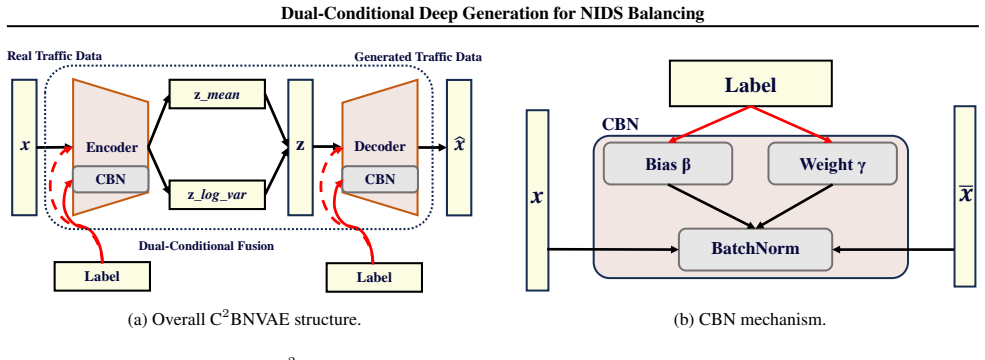
The load-bearing object is Conditional Batch Normalization (CBN), a variant of batch normalization in which the affine transformation applied after normalizing each batch is selected by the sample's class label: $\text{CBN}(x \mid y = i) = \gamma_i \frac{x - \hat{\mu}}{\sqrt{\hat{\sigma}^2 + \epsilon}} + \beta_i$, with one learned scaling $\gamma_i$ and shift $\beta_i$ per class. Where standard batch normalization applies one shared $(\gamma, \beta)$ to every sample and thereby risks smoothing away category-specific features, CBN lets each traffic class keep its own post-normalization distribution. Placed inside the decoder (and potentially encoder) layers of a CVAE, whose label conditioning already informs both the latent representation and the reconstruction, CBN creates the paper's dual conditioning, and this mechanism is what the paper credits for the improved downstream detection performance.
What would settle it
Train C2BNVAE and the standard CVAE from the same codebase with identical architecture, hyperparameters, and random seeds, toggling only the CBN layers, and measure the weighted F1 of the Decision Tree on KDDTest+ across several runs; if the gap does not consistently exceed run-to-run variance, the claimed benefit of CBN is not established. A second check would ablate CBN placement (decoder only versus encoder and decoder) to see which configuration actually produces the reported numbers.
Extended reading notes
Core claim
On the paper's own terms, the discovery is that conditioning the affine parameters of batch normalization on the class label, rather than only conditioning the encoder and decoder on the label as a standard CVAE does, improves the utility of synthetically generated minority-class network traffic. In experiments on NSL-KDD, training a Decision Tree on data balanced by C2BNVAE produced the best results on KDDTest+ across all four reported metrics: Accuracy 79.40%, Weighted Precision 80.69%, Weighted Recall 79.40%, and Weighted F1-Score 78.19%. These numbers beat every classical oversampling baseline (SMOTE family weighted F1 between 72.81% and 76.02%), random oversampling (73.84%), and the standard CVAE without CBN (77.18%). The paper attributes the difference to CBN's class-specific scaling and shift parameters allowing each traffic category to keep its own normalization profile, so generated minority samples stay distinct and help the downstream classifier separate the rare attack classes.
Load-bearing premise
The central comparison assumes the standard CVAE baseline was implemented and tuned exactly like C2BNVAE except for the added CBN layers, so that the 1.01-point F1 gap can be attributed to the new mechanism; the paper provides no code, random seeds, or ablation to confirm this.
Editorial extensions
If this is right
- A Decision Tree trained on C2BNVAE-balanced KDDTrain+ data scores 79.40% accuracy and 78.19% weighted F1 on KDDTest+, surpassing all compared balancing methods.
- The improvement over the standard CVAE shows that class-specific normalization, rather than generation or label conditioning alone, is what the paper credits for the gain.
- At 43,627 parameters and 43,200 FLOPs per sample, the model offers a lighter augmentation alternative to the CGAN baseline's 87,820 parameters and 109,892 FLOPs.
- Because the method generates labeled samples for any requested class, it can balance a training set to any target distribution, not just the NSL-KDD class sizes.
Reading between the lines
- A corollary the paper leaves implicit: if class-specific normalization is the active ingredient, gains should concentrate in the rarest classes (R2L and U2R in NSL-KDD); per-class recall from the same setup would test this directly.
- The dual-conditioning idea is architecture-agnostic, so dropping CBN into a conditional GAN or diffusion model for tabular data is a natural test of whether the mechanism generalizes beyond VAEs.
- The paper tests only a Decision Tree; a deep NIDS classifier is the obvious next check, and if the generated samples genuinely sharpen decision boundaries on rare attacks, the benefit should persist or grow there.
- The parameter-light design implies a deployment path the author does not discuss: periodic retraining of the augmentation model on edge hardware, where the heavier CGAN baseline would be less practical.
Editorial analysis
A structured set of objections, weighed in public.
Referee Report
Summary. The manuscript proposes C2BNVAE, a Conditional Variational Autoencoder augmented with Conditional Batch Normalization, to generate synthetic minority-class samples for balancing the NSL-KDD training set. The authors train a Decision Tree on the augmented data and report, in Table 2, that this yields the best KDDTest+ accuracy (79.40%), weighted precision (80.69%), weighted recall (79.40%), and weighted F1 (78.19%) among the compared balancing methods, including a standard CVAE baseline (F1 77.18%). The paper also reports parameter and FLOP counts showing C2BNVAE is cheaper than a CGAN baseline.
Significance. The proposed mechanism is simple and potentially useful: making batch-normalization affine parameters class-conditional inside a CVAE is a natural extension for generating class-specific tabular data, and the paper evaluates it against a reasonable set of classical oversampling baselines. The paper is clearly written, defines its metrics, and explicitly acknowledges limitations regarding dataset and classifier scope. However, the central claim that CBN is responsible for the improvement is not currently established: the comparison against standard CVAE is not controlled, results come from single runs without variance information, and the preprocessing pipeline is underspecified. These issues are fixable, but they are load-bearing for the paper's main contribution.
major comments (4)
- [Section 3.3, Table 2, and Section 2.2] The CVAE baseline is described only as "Standard CVAE (without CBN)" and the paper does not state whether it uses ordinary Batch Normalization in the same decoder/encoder locations as C2BNVAE. Since Eq. (4) shows that CBN differs from standard BN only in the class-conditional affine parameters (gamma_i, beta_i), the observed roughly 1-point F1 gap could be due to BN's training stabilization rather than to class conditioning. Please add controlled ablations: CVAE with no BN, CVAE with standard BN in the same layers, and CVAE with CBN, keeping architecture, optimizer, and training schedule identical.
- [Section 3.1, Section 3.4, Eq. (2), Table 1] The preprocessing of NSL-KDD is not described, despite being essential for the reconstruction loss. NSL-KDD contains categorical features, and Eq. (2) uses MSE between raw xi and xhat_i; this is only meaningful after a specified encoding and scaling. The decoder output dimension 123 in Table 1 also suggests one-hot expansion (e.g., 122 features plus label or similar), but the exact feature vector, normalization, and inverse mapping used for classifier training are not given. Please specify the full preprocessing pipeline and, ideally, release the code and data-processing scripts to make the results reproducible.
- [Section 4.2 and Table 2] All results appear to be from a single run. No random seeds, number of repetitions, standard deviations, or statistical significance tests are reported. The claimed advantage over standard CVAE is about 1 percentage point in F1, which is within the range of typical run-to-run variation for VAE training. Please report mean and standard deviation over multiple seeds and a paired significance test across repetitions, or otherwise demonstrate that the observed difference is not noise.
- [Section 2.2 and Figure 1] The exact placement of CBN is left vague: "in the decoder (and potentially encoder) layers". Since CBN placement determines the architecture and the number of additional parameters, please specify the exact layers, the number of CBN modules, and how the label selects gamma_i and beta_i at each location. This is needed both for reproducibility and for interpreting the computational overhead in Section 4.1.
minor comments (5)
- [Title and body] The model name is rendered inconsistently as "C2BNV AE" in many places; it should be a single token "C2BNVAE" throughout.
- [Figure 1(b)] Figure 1(b) contains Chinese-language annotations ("输入标签信息", "选择类别特定的变换因子") that should be translated into English for an English-language manuscript.
- [Eq. (8)] Equation (8) uses "Prec" in the numerator and "Recallc" in the denominator; the subscript notation should be made consistent (e.g., Precision_c and Recall_c).
- [References] The GAN reference is dated 2020 (Goodfellow et al., Communications of the ACM), but the original GAN paper appeared in 2014; please cite the original source or clarify why the later version is used.
- [Table 1] Table 1 does not explicitly list the latent dimension; "32" appears in the encoder layer list, and the decoder input dimension 37 is not explained. A short annotation would help the reader.
Circularity Check
No substantive circularity: the central CBN-vs-CVAE claim is an empirical downstream evaluation, and the only self-citation is not load-bearing.
full rationale
The paper's central claim is that C2BNVAE improves Decision Tree intrusion detection on KDDTest+ relative to a Standard CVAE baseline (Section 4.2, Table 2). This is an empirical outcome of training a generative model, synthesizing minority-class samples, retraining a Decision Tree on the balanced set, and evaluating on held-out KDDTest+. No fitted parameter from the paper's own equations is renamed as a prediction; Equation (4) defines the CBN transformation, but the reported Accuracy/Precision/Recall/F1 are measured externally on a test set, not derived from that transformation. The only self-citation (Zeng 2025) appears in the related-work sentence on generative approaches and in Section 4.1 to reference a CGAN baseline implementation used for a FLOPs/parameter comparison. That self-citation does not carry the load of the CBN-benefit argument, which rests on the comparison to the externally cited 'Standard CVAE (without CBN)' (Sohn et al., 2015) under the same reported setup. While the CBN ablation is under-specified (CBN is placed 'in the decoder (and potentially encoder) layers', Section 2.2, and the baseline is only described as 'Standard CVAE (without CBN)', Section 3.3), and no seeds or error bars are reported, these are reproducibility and ablation concerns, not evidence that the result reduces to the model's own inputs. No circular step can be quoted or exhibited from the paper's derivation chain.
Assumptions & free parameters
free parameters (4)
- Encoder and decoder layer sizes =
Encoder [128, 60x4, 32]; Decoder [37, 60x4, 123]
- Learning rate =
1e-4
- Number of epochs =
120
- Loss weighting =
1.0 for reconstruction and KL terms
assumptions (3)
- standard math Evidence lower bound (ELBO) decomposition and the reparameterization trick provide a valid training objective for the CVAE.
- domain assumption NSL-KDD features can be treated as continuous values suitable for MSE reconstruction after some unstated preprocessing.
- domain assumption A Decision Tree classifier trained on the balanced dataset is a meaningful proxy for NIDS detection performance.
Cite this review
Pith. "Pith review of $\text{C}^{2}\text{BNVAE}$: Dual-Conditional Deep Generation of Network Traffic Data for Network Intrusion Detection System Balancing." pith.science (2026). https://pith.science/paper/MR3RQUCB
@misc{pith2026250605844,
  author       = {Pith},
  title        = {Pith review of: $\textC^2\textBNVAE$: Dual-Conditional Deep Generation of Network Traffic Data for Network Intrusion Detection System Balancing},
  year         = {2026},
  howpublished = {\url{https://pith.science/paper/MR3RQUCB}},
  note         = {Machine review of arXiv:2506.05844}
}
abstract
Network Intrusion Detection Systems (NIDS) face challenges due to class imbalance, affecting their ability to detect novel and rare attacks. This paper proposes a Dual-Conditional Batch Normalization Variational Autoencoder ($\text{C}^{2}\text{BNVAE}$) for generating balanced and labeled network traffic data. $\text{C}^{2}\text{BNVAE}$ improves the model's adaptability to different data categories and generates realistic category-specific data by incorporating Conditional Batch Normalization (CBN) into the Conditional Variational Autoencoder (CVAE). Experiments on the NSL-KDD dataset show the potential of $\text{C}^{2}\text{BNVAE}$ in addressing imbalance and improving NIDS performance with lower computational overhead compared to some baselines.
Figures

Reference graph
Works this paper leans on
-
[1]
write newline
" write newline "" before.all 'output.state := FUNCTION n.dashify 't := "" t empty not t #1 #1 substring "-" = t #1 #2 substring "--" = not "--" * t #2 global.max substring 't := t #1 #1 substring "-" = "-" * t #2 global.max substring 't := while if t #1 #1 substring * t #2 global.max substring 't := if while FUNCTION format.date year duplicate empty "emp...
-
[2]
P., Selman, B., and Weinberger, K
Bjorck, N., Gomes, C. P., Selman, B., and Weinberger, K. Q. Understanding batch normalization. Advances in neural information processing systems, 31, 2018
work page 2018
-
[3]
Chawla, N. V., Bowyer, K. W., Hall, L. O., and Kegelmeyer, W. P. Smote: synthetic minority over-sampling technique. Journal of artificial intelligence research, 16: 0 321--357, 2002
work page 2002
-
[4]
Dey, I. and Pratap, V. A comparative study of smote, borderline-smote, and adasyn oversampling techniques using different classifiers. In 2023 3rd international conference on smart data intelligence (ICSMDI), pp.\ 294--302. IEEE, 2023
work page 2023
-
[5]
Generative adversarial networks
Goodfellow, I., Pouget-Abadie, J., Mirza, M., Xu, B., Warde-Farley, D., Ozair, S., Courville, A., and Bengio, Y. Generative adversarial networks. Communications of the ACM, 63 0 (11): 0 139--144, 2020
2020
-
[6]
P., Welling, M., et al
Kingma, D. P., Welling, M., et al. Auto-encoding variational bayes, 2013
2013
-
[7]
Intrusion detection system after data augmentation schemes based on the vae and cvae
Liu, C., Antypenko, R., Sushko, I., and Zakharchenko, O. Intrusion detection system after data augmentation schemes based on the vae and cvae. IEEE Transactions on Reliability, 71 0 (2): 0 1000--1010, 2022
work page 2022
-
[8]
Maulana, D. J., Saadah, S., Yunanto, P. E., et al. Kmeans-smote integration for handling imbalance data in classifying financial distress companies using svm and na \" ve bayes. Jurnal RESTI (Rekayasa Sistem dan Teknologi Informasi), 8 0 (1): 0 54--61, 2024
work page 2024
Show all 17 references
-
[9]
and Osindero, S
Mirza, M. and Osindero, S. Conditional generative adversarial nets. arXiv preprint arXiv:1411.1784, 2014
2014 arXiv
-
[10]
Ravipati, R. D. and Abualkibash, M. Intrusion detection system classification using different machine learning algorithms on kdd-99 and nsl-kdd datasets-a review paper. International Journal of Computer Science & Information Technology (IJCSIT) Vol, 11, 2019
2019
-
[11]
Learning structured output representation using deep conditional generative models
Sohn, K., Lee, H., and Yan, X. Learning structured output representation using deep conditional generative models. Advances in neural information processing systems, 28, 2015
2015
-
[12]
A novel ensemble method for imbalanced data learning: Bagging of extrapolation-smote svm
Wang, Q., Luo, Z., Huang, J., Feng, Y., and Liu, Z. A novel ensemble method for imbalanced data learning: Bagging of extrapolation-smote svm. Computational intelligence and neuroscience, 2017 0 (1): 0 1827016, 2017
2017
-
[13]
Semantics disentangling for text-to-image generation
Yin, G., Liu, B., Sheng, L., Yu, N., Wang, X., and Shao, J. Semantics disentangling for text-to-image generation. In Proceedings of the IEEE/CVF conference on computer vision and pattern recognition, pp.\ 2327--2336, 2019
2019
-
[14]
CSAGC-IDS : A dual-module deep learning network intrusion detection model for complex and imbalanced data
Zeng, Y. CSAGC-IDS : A dual-module deep learning network intrusion detection model for complex and imbalanced data. arXiv preprint arXiv:2505.14027, 2025
2025 arXiv
-
[15]
@esa (Ref
\@ifxundefined[1] #1\@undefined \@firstoftwo \@secondoftwo \@ifnum[1] #1 \@firstoftwo \@secondoftwo \@ifx[1] #1 \@firstoftwo \@secondoftwo [2] @ #1 \@temptokena #2 #1 @ \@temptokena \@ifclassloaded agu2001 natbib The agu2001 class already includes natbib coding, so you should ...
-
[16]
\@lbibitem[] @bibitem@first@sw\@secondoftwo \@lbibitem[#1]#2 \@extra@b@citeb \@ifundefined br@#2\@extra@b@citeb \@namedef br@#2 \@nameuse br@#2\@extra@b@citeb \@ifundefined b@#2\@extra@b@citeb @num @parse #2 @tmp #1 NAT@b@open@#2 NAT@b@shut@#2 \@ifnum @merge>\@ne @bibitem@firs...
-
[17]
@open @close @open @close and [1] URL: #1 \@ifundefined chapter * \@mkboth \@ifxundefined @sectionbib * \@mkboth * \@mkboth\@gobbletwo \@ifclassloaded amsart * \@ifclassloaded amsbook * \@ifxundefined @heading @heading NAT@ctr thebibliography [1] @ \@biblabel @NAT@ctr \@bibset...
Reviewed August 7, 2026 · model on record in the stance chip above.
Discussion (0). Sign in to comment.