REVIEW 4 major objections 6 minor 56 references
ChronoTailor: Harnessing Attention Guidance for Fine-Grained Video Virtual Try-On
T0 review · 4 major / 6 minor · reviewed 2026-08-07 · deepseek-v4-flash
Pith's one-line read ChronoTailor claims that attention-guided diffusion with segmentation-based spatial guidance and pose-aligned multi-scale garment features yields temporally consistent video try-ons that preserve garment details and outperform previous…
desk verdict A useful dataset and a plausible video try-on pipeline, but the load-bearing loss in Eq. (1) is mis-specified as written and the evaluation does not control training data, so the SOTA claim is not yet supported. read the letter →
The pith
A machine-rendered reading of the paper's core claim, the machinery that carries it, and where it could break.
The reading
What carries the argument
The machinery is a pair of attention-guiding modules. Spatial-Temporal Attention Guidance contains Region-Aware Spatial Guidance (RASG), a loss $\mathcal{L}_{\text{RASG}} = \sum_{i\in N} \sum_{a\in A} \|M - A_i^{(a)}\|_2^2 + \lambda_N \sum_{i\in N} \sum_{a\in \bar A} \|1 - A_i^{(a)}\|_2^2$ that pushes attention maps toward the segmentation mask in target areas, and Attention-Driven Temporal Feature Fusion (ATFF), an asymmetric cross-attention layer using current-frame features as queries and randomly fused features from other frames as keys/values. The second pillar is Multi-scale Garment-Pose Feature Alignment: Adaptive Multi-scale Feature Extraction (AMFE) processes the VAE encoder’s last three downsampling feature maps through pixel-shuffle alignment, $1\times1$, $3\times3$, and $7\times7$ convolutions, normalization, and SiLU activation, then fuses them with learnable weights $\vec\alpha$; Garment-Pose Feature Alignment (GPFA) shares cross-attention weight matrices between reference and denoising U-Nets so that CLIP-encoded garment features and pose features are aligned. Together these direct where garment information enters the denoising process and how it moves across frames.
What would settle it
Inspect the training code’s RASG implementation and the attention maps it produces: if the code minimizes $\sum_{a \in \bar A} \|1 - A_i^{(a)}\|_2^2$ over non-target pixels, then attention is being driven to 1 in those regions, contradicting the stated claim that the term regularizes non-target attention; flipping the sign in an ablation would also reveal whether the gains attributed to RASG survive.
Extended reading notes
Core claim
On its own terms, ChronoTailor’s central discovery is that attention guidance, rather than explicit warping, is the right way to inject garment information into a video diffusion model. The framework keeps the standard latent diffusion denoiser, adds a reference U-Net for garment features, and trains two added mechanisms: Region-Aware Spatial Guidance, which uses segmentation masks to align spatial attention with the edit region, and Attention-Driven Temporal Feature Fusion, which uses current-frame queries against randomly fused other-frame keys/values to propagate motion. Multi-scale garment features from the VAE’s last downsampling layers are fused with learnable weights, and cross-attention weights are shared between reference and denoising U-Nets to align garment features with DensePose and CLIP pose features. On VVT the paper reports SSIM 0.978, LPIPS 0.049, and VFIDRes 4.065, which are the best among the compared methods on those metrics, and a user study on ViViD gives ChronoTailor majority preference on garment fidelity, background preservation, temporal consistency, and overall quality. The abstract summarizes the result as significantly outperforming previous methods.
Load-bearing premise
The load-bearing premise is that the attention-regularization loss in Eq. (1) works as described; the printed second term $\lambda_N \sum_{i\in N} \sum_{a\in \bar A} \|1 - A_i^{(a)}\|_2^2$ drives attention toward 1 in non-target regions, which is the opposite of the paper’s stated purpose, and no implementation note explains why the sign is not reversed.
Editorial extensions
If this is right
- If the reported VVT numbers hold, ChronoTailor achieves the highest SSIM and lowest LPIPS among the methods compared, with SSIM 0.978 and LPIPS 0.049.
- StyleDress would give the community a training set with balanced gender, varied body shapes, diverse poses, and indoor/outdoor scenes, covering categories that VVT and ViViD lack.
- The ablation tables attribute gains to each module separately, so RASG, ATFF, AMFE, and GPFA can be adopted independently in other latent-diffusion try-on systems.
- RASG is applied only during training, meaning the reported quality gains do not add inference-time compute per video frame.
- The weight-sharing cross-attention between garment and pose features provides a mechanism for keeping garment texture aligned with body motion, which the paper identifies as a failure mode of flow-based and memory-based prior work.
Reading between the lines
- Taken literally, the second term in Eq. (1) minimizes $\|1 - A_i^{(a)}\|_2^2$ over non-target locations, which would drive attention toward 1 in those regions; if the released implementation does not flip the sign, the reported RASG gains cannot be explained by the paper’s stated mechanism.
- Because RASG is applied only during training, the same training-time attention-regularization recipe could transfer to other diffusion-based video editing tasks that need localized edits, though the paper does not test that.
- The paper’s stated limitation that segmentation and pose estimation degrade under occlusion, low resolution, or high-dynamic motion suggests a concrete stress test: evaluate ChronoTailor on clips with noisy masks or DensePose outputs and compare against the clean-condition results.
- StyleDress is announced but not yet released, so the claim that it surpasses existing datasets in diversity and quality can only be fully verified once the dataset is public and independently used.
Editorial analysis
A structured set of objections, weighed in public.
Referee Report
Summary. ChronoTailor is a diffusion-based framework for video virtual try-on. It introduces two main components: Spatial-Temporal Attention Guidance, consisting of Region-Aware Spatial Guidance (RASG) and Attention-Driven Temporal Feature Fusion (ATFF), and Multi-scale Garment-Pose Feature Alignment, consisting of Adaptive Multi-scale Feature Extraction (AMFE) and Garment-Pose Feature Alignment (GPFA). The paper also introduces a new dataset, StyleDress, and evaluates the method on VVT and ViViD, reporting improved SSIM and LPIPS, competitive VFID scores, and a user study favoring ChronoTailor. The central claim is that the proposed attention-guidance mechanisms yield state-of-the-art fine-grained video virtual try-on with preserved garment details and temporal consistency.
Significance. If the architecture and loss are implemented as intended, the paper would make a meaningful contribution to video virtual try-on by addressing temporal continuity and fine-grained detail preservation without explicit warping. The modular design, the detailed ablation study, and the introduction of the StyleDress dataset are genuine strengths, as is the extensive qualitative comparison in the appendix. However, the significance is currently qualified by two concerns: the central loss in Eq. (1) appears to be mis-specified, and the quantitative comparisons do not control for training distribution or resolution. No code or checkpoints are released, and the loss hyperparameters are not reported, so the reported results cannot be independently reproduced. The paper is a useful step forward if these issues can be resolved, but the current manuscript does not fully support the headline claim of significantly outperforming prior methods across all reported metrics.
major comments (4)
- [Section 3.1.1, Eq. (1)] The second term of Eq. (1), λ_N Σ_{i∈N} Σ_{a∈Ā} ∥1−A_i^{(a)}∥_2^2, is inconsistent with the stated purpose of regularizing attention in non-target regions. Minimizing ∥1−A∥_2^2 drives A_i^{(a)} toward 1 for every non-target attention location, which would concentrate attention on the regions the method is supposed to de-emphasize. The stated goal would instead require a term such as ∥A∥_2^2, pushing non-target attention toward 0. This is not a cosmetic issue: Table 4 credits RASG with large improvements (SSIM 0.850→0.894, VFIDRes 0.630→0.535). If Eq. (1) is a typo, the correct formulation is absent from the manuscript; if it is literal, the reported ablation gains are not explained by the paper's own mathematics. The values of λ_N and λ_R are also not reported, so the loss cannot be reproduced as written.
- [Section 5, Table 2 and Appendix B.1.2] The comparison to prior work is not controlled for training distribution or resolution. Table 2 relies on numbers reported in other papers, while Appendix B.1.2 states that on StyleDress 'our approach demonstrates superior performance compared to methods trained on the VVT dataset.' The main experiments train ChronoTailor at 512×384, whereas VVT was originally 256×192 and ViViD 832×624. Under these conditions, the claim of 'significantly outperforming previous methods' may reflect training-set or resolution advantages rather than the proposed mechanisms. Please re-evaluate all baselines under a single training and evaluation protocol, or clearly restrict the claim to the settings used and disclose the mismatch.
- [Section 5.2, Table 2 and abstract] The abstract's claim of 'significantly outperforming previous methods' is not fully supported by Table 2. On VFID3D, ChronoTailor (3.721) is worse than Tunnel Try-On (3.345) and ViViD (3.405). The text in Section 5.2 does acknowledge 'competitive performance' on VFID3D, but the broader claim in the abstract and contribution list should be tempered or the metric-specific results should be reported more precisely.
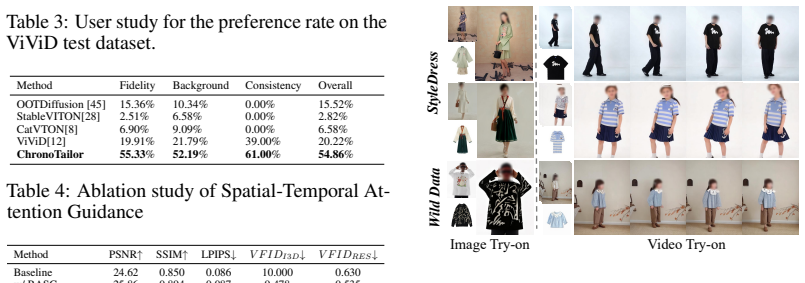
- [Section 5.2 and Appendix B.3] The user study reporting is inconsistent. The main text reports responses from 40 users and 13 video results, while Appendix B.3 says 'A total of 50 evaluation samples are collected' with no clarification of whether these are 50 participants or 50 comparisons. No significance tests, confidence intervals, or per-participant variance are reported. The preference rates in Table 3 are presented as point estimates, so the robustness of the claimed user preference is unclear. Please reconcile the numbers and report full statistical details.
minor comments (6)
- [Section 3.1.2, Eq. (3)] The notation in Eq. (3) is unclear: 'd=-1' is described as a dimensional index for aggregation along the last dimension, but the displayed expression appears to be a summation over a single value. Please clarify the summation range and the meaning of the operator.
- [Section 3.1.2, Eq. (4)] The role of the weights w_j and w_k in Eq. (4) should be clarified. If they are scalar attention scores, the form z = GroupNorm(w_j·z_j + z_i + w_k·z_k) is unusual because no attention sum of all selected features is shown; if they are tensors, their shapes should be specified.
- [Section 2.2 and References [46, 47]] The text attributes 'Tunnel TryOn' to reference [47], but reference [47] is MagicAnimate; Tunnel Try-On is reference [46]. Please correct the citation.
- [Appendix A.2] The name 'AnimeDiff' appears to be a typo for 'AnimateDiff' (reference [17]). Please fix the spelling and ensure the cited work is the correct motion-module source.
- [Tables 2 and 4] The metric is inconsistently labeled 'VFIDResNeXt' in Table 2 and 'VFIDRES' in Table 4. Please use one consistent name and define the metric explicitly.
- [Section 4 and Table 1] The dataset statistics in the introduction (14,258 images and 12,500 videos) and Table 1 (26,758 I-V) should be reconciled, since the table appears to count image-video pairs rather than separate images and videos.
Circularity Check
No significant circularity: ChronoTailor's claims are empirically evaluated against public benchmarks and do not reduce to fitted inputs or self-citations.
full rationale
The paper makes no formal derivation that reduces to its own inputs. The central claim is that the proposed modules—RASG, ATFF, AMFE, GPFA—improve video virtual try-on, supported by quantitative comparisons on VVT/ViViD and ablations. RASG loss Eq. (1) is a training objective, not a fitted prediction; ATFF, AMFE, and GPFA are architectural components trained with standard diffusion loss. The paper cites two prior works by overlapping authors (Moee, Uniavatar) only as general AIGC background, not as load-bearing support. The introduced StyleDress dataset is a contribution; evaluating the method on it and on public benchmarks does not make the evaluation tautological. The suspicious sign in Eq. (1), where minimizing ||1-A||^2 pushes non-target attention toward 1, opposite to the stated regularization, is a possible correctness or typo issue that undermines confidence in the RASG ablation, but it is not a circularity: the claim does not reduce to the equation by construction. No fitted parameter is renamed as a prediction, no uniqueness theorem is imported, and no ansatz is smuggled in solely via citation. Hence circularity score 0.
Assumptions & free parameters
free parameters (3)
- lambda_N (negative attention weight)
- lambda_R (RASG loss weight)
- alpha = [alpha_1, alpha_2, alpha_3] (AMFE fusion weights) =
learned, no fixed values
assumptions (5)
- standard math Diffusion model (LDM/SD 1.5) provides a learnable generative prior
- domain assumption Cross-attention maps can be steered by a loss on attention probabilities
- domain assumption Segmentation masks (SAM2) and DensePose pose are accurate enough for training
- domain assumption CLIP image encoder captures global pose and garment semantics
- ad hoc to paper Randomly fusing frame features provides useful temporal context
Cite this review
Pith. "Pith review of ChronoTailor: Harnessing Attention Guidance for Fine-Grained Video Virtual Try-On." pith.science (2026). https://pith.science/paper/PS5ZZALH
@misc{pith2026250605858,
  author       = {Pith},
  title        = {Pith review of: ChronoTailor: Harnessing Attention Guidance for Fine-Grained Video Virtual Try-On},
  year         = {2026},
  howpublished = {\url{https://pith.science/paper/PS5ZZALH}},
  note         = {Machine review of arXiv:2506.05858}
}
read the original abstract
Video virtual try-on aims to seamlessly replace the clothing of a person in a source video with a target garment. Despite significant progress in this field, existing approaches still struggle to maintain continuity and reproduce garment details. In this paper, we introduce ChronoTailor, a diffusion-based framework that generates temporally consistent videos while preserving fine-grained garment details. By employing a precise spatio-temporal attention mechanism to guide the integration of fine-grained garment features, ChronoTailor achieves robust try-on performance. First, ChronoTailor leverages region-aware spatial guidance to steer the evolution of spatial attention and employs an attention-driven temporal feature fusion mechanism to generate more continuous temporal features. This dual approach not only enables fine-grained local editing but also effectively mitigates artifacts arising from video dynamics. Second, ChronoTailor integrates multi-scale garment features to preserve low-level visual details and incorporates a garment-pose feature alignment to ensure temporal continuity during dynamic motion. Additionally, we collect StyleDress, a new dataset featuring intricate garments, varied environments, and diverse poses, offering advantages over existing public datasets, and will be publicly available for research. Extensive experiments show that ChronoTailor maintains spatio-temporal continuity and preserves garment details during motion, significantly outperforming previous methods.
Figures



Figures from the paper (14 more)




Reference graph
Works this paper leans on
-
[1]
Multimodal garment designer: Human-centric latent diffusion models for fashion image editing
Alberto Baldrati, Davide Morelli, Giuseppe Cartella, Marcella Cornia, Marco Bertini, and Rita Cucchiara. Multimodal garment designer: Human-centric latent diffusion models for fashion image editing. In Proceedings of the IEEE/CVF international conference on computer vision, pages 23393–23402, 2023
work page 2023
-
[2]
Quo vadis, action recognition? a new model and the kinetics dataset
Joao Carreira and Andrew Zisserman. Quo vadis, action recognition? a new model and the kinetics dataset. InProceedings of the IEEE/CVF Conference on Computer Vision and Pattern Recognition, pages 6299–6308, 2017
work page 2017
-
[3]
Fashionmirror: Co-attention feature-remapping virtual try-on with sequential template poses
Chieh-Yun Chen, Ling Lo, Pin-Jui Huang, Hong-Han Shuai, and Wen-Huang Cheng. Fashionmirror: Co-attention feature-remapping virtual try-on with sequential template poses. InProceedings of the IEEE/CVF International Conference on Computer Vision, pages 13809–13818, 2021
work page 2021
-
[4]
Anydoor: Zero-shot object-level image customization
Xi Chen, Lianghua Huang, Yu Liu, Yujun Shen, Deli Zhao, and Hengshuang Zhao. Anydoor: Zero-shot object-level image customization. InProceedings of the IEEE/CVF conference on computer vision and pattern recognition, pages 6593–6602, 2024
2024
-
[5]
Livephoto: Real image animation with text-guided motion control
Xi Chen, Zhiheng Liu, Mengting Chen, Yutong Feng, Yu Liu, Yujun Shen, and Hengshuang Zhao. Livephoto: Real image animation with text-guided motion control. InEuropean Conference on Computer Vision, pages 475–491. Springer, 2024
work page 2024
-
[6]
Viton-hd: High-resolution virtual try-on via misalignment-aware normalization
Seunghwan Choi, Sunghyun Park, Minsoo Lee, and Jaegul Choo. Viton-hd: High-resolution virtual try-on via misalignment-aware normalization. InProceedings of IEEE/CVF Conference on Computer Vision and Pattern Recognition, Jun 2021
work page 2021
-
[7]
Improving diffusion models for virtual try-on
Yisol Choi, Sangkyung Kwak, Kyungmin Lee, Hyungwon Choi, and Jinwoo Shin. Improving diffusion models for virtual try-on. Mar 2024
work page 2024
-
[8]
Zheng Chong, Xiao Dong, Haoxiang Li, Shiyue Zhang, Wenqing Zhang, Xujie Zhang, Hanqing Zhao, Dongmei Jiang, and Xiaodan Liang. Catvton: Concatenation is all you need for virtual try-on with diffusion models.arXiv preprint arXiv:2407.15886, 2024
arXiv 2024
Show all 56 references
-
[9]
Dressing in order: Recurrent person image generation for pose transfer, virtual try-on and outfit editing
Aiyu Cui, Daniel McKee, and Svetlana Lazebnik. Dressing in order: Recurrent person image generation for pose transfer, virtual try-on and outfit editing. InProceedings of the IEEE/CVF international conference on computer vision, pages 14638–14647, 2021
2021
-
[10]
Fw-gan: Flow-navigated warping gan for video virtual try-on
Haoye Dong, Xiaodan Liang, Xiaohui Shen, Bowen Wu, Bing-Cheng Chen, and Jian Yin. Fw-gan: Flow-navigated warping gan for video virtual try-on. In2019 IEEE/CVF International Conference on Computer Vision (ICCV), Oct 2019
2019
-
[11]
Structure and content-guided video synthesis with diffusion models
Patrick Esser, Johnathan Chiu, Parmida Atighehchian, Jonathan Granskog, and Anastasis Germanidis. Structure and content-guided video synthesis with diffusion models. InProceedings of the IEEE/CVF international conference on computer vision, pages 7346–7356, 2023
2023
-
[12]
Vivid: Video virtual try-on using diffusion models.arXiv preprint arXiv:2405.11794, 2024
Zixun Fang, Wei Zhai, Aimin Su, Hongliang Song, Kai Zhu, Mao Wang, Yu Chen, Zhiheng Liu, Yang Cao, and Zheng-Jun Zha. Vivid: Video virtual try-on using diffusion models.arXiv preprint arXiv:2405.11794, 2024
2024 arXiv
-
[13]
Parser-free virtual try-on via distilling appearance flows
Yuying Ge, Yibing Song, Ruimao Zhang, Chongjian Ge, Wei Liu, and Ping Luo. Parser-free virtual try-on via distilling appearance flows. InProceedings of IEEE/CVF Conference on Computer Vision and Pattern Recognition, Jun 2021
2021
-
[14]
Generative adversarial nets.Advances in neural information processing systems, 27, 2014
Ian J Goodfellow, Jean Pouget-Abadie, Mehdi Mirza, Bing Xu, David Warde-Farley, Sherjil Ozair, Aaron Courville, and Yoshua Bengio. Generative adversarial nets.Advances in neural information processing systems, 27, 2014
2014
-
[15]
Taming the power of diffusion models for high-quality virtual try-on with appearance flow
Junhong Gou, Siyu Sun, Jianfu Zhang, Jianlou Si, Chen Qian, and Liqing Zhang. Taming the power of diffusion models for high-quality virtual try-on with appearance flow. InProceedings of the 31st ACM International Conference on Multimedia, pages 7599–7607, 2023
2023
-
[16]
Densepose: Dense human pose estimation in the wild
Rıza Alp Güler, Natalia Neverova, and Iasonas Kokkinos. Densepose: Dense human pose estimation in the wild. InProceedings of the IEEE/CVF conference on computer vision and pattern recognition, pages 7297–7306, 2018
2018
-
[17]
Animatediff: Animate your personalized text-to-image diffusion models without specific tuning.arXiv preprint arXiv:2307.04725, 2023
Yuwei Guo, Ceyuan Yang, Anyi Rao, Zhengyang Liang, Yaohui Wang, Yu Qiao, Maneesh Agrawala, Dahua Lin, and Bo Dai. Animatediff: Animate your personalized text-to-image diffusion models without specific tuning.arXiv preprint arXiv:2307.04725, 2023. 10
2023 arXiv
-
[18]
Xintong Han, Zuxuan Wu, Zhe Wu, Ruichi Yu, and Larry S. Davis. Viton: An image-based virtual try-on network. InProceedings of IEEE/CVF Conference on Computer Vision and Pattern Recognition, Jun 2018
2018
-
[19]
Efficient diffusion training via min-snr weighting strategy
Tiankai Hang, Shuyang Gu, Chen Li, Jianmin Bao, Dong Chen, Han Hu, Xin Geng, and Baining Guo. Efficient diffusion training via min-snr weighting strategy. InProceedings of the IEEE/CVF international conference on computer vision, pages 7441–7451, 2023
2023
-
[20]
Can spatiotemporal 3d cnns retrace the history of 2d cnns and imagenet? InProceedings of the IEEE/CVF conference on Computer Vision and Pattern Recognition, pages 6546–6555, 2018
Kensho Hara, Hirokatsu Kataoka, and Yutaka Satoh. Can spatiotemporal 3d cnns retrace the history of 2d cnns and imagenet? InProceedings of the IEEE/CVF conference on Computer Vision and Pattern Recognition, pages 6546–6555, 2018
2018
-
[21]
Denoising diffusion probabilistic models.Advances in neural information processing systems, 33:6840–6851, 2020
Jonathan Ho, Ajay Jain, and Pieter Abbeel. Denoising diffusion probabilistic models.Advances in neural information processing systems, 33:6840–6851, 2020
2020
-
[22]
Viton-gan: Virtual try-on image generator trained with adversarial loss.arXiv preprint arXiv:1911.07926, 2019
Shion Honda. Viton-gan: Virtual try-on image generator trained with adversarial loss.arXiv preprint arXiv:1911.07926, 2019
1911 arXiv
-
[23]
Animate anyone: Consistent and controllable image-to-video synthesis for character animation
Li Hu. Animate anyone: Consistent and controllable image-to-video synthesis for character animation. In Proceedings of the IEEE/CVF Conference on Computer Vision and Pattern Recognition, pages 8153–8163, 2024
2024
-
[24]
Make it move: controllable image-to-video generation with text descriptions
Yaosi Hu, Chong Luo, and Zhenzhong Chen. Make it move: controllable image-to-video generation with text descriptions. InProceedings of the IEEE/CVF Conference on Computer Vision and Pattern Recognition, pages 18219–18228, 2022
2022
-
[25]
Fitdit: Advancing the authentic garment details for high-fidelity virtual try-on.arXiv preprint arXiv:2411.10499, 2024
Boyuan Jiang, Xiaobin Hu, Donghao Luo, Qingdong He, Chengming Xu, Jinlong Peng, Jiangning Zhang, Chengjie Wang, Yunsheng Wu, and Yanwei Fu. Fitdit: Advancing the authentic garment details for high-fidelity virtual try-on.arXiv preprint arXiv:2411.10499, 2024
2024 arXiv
-
[26]
Clothformer: Taming video virtual try-on in all module
Jianbin Jiang, Tan Wang, He Yan, Junhui Liu, and Bigo Bigo. Clothformer: Taming video virtual try-on in all module
-
[27]
Dreampose: Fashion image-to-video synthesis via stable diffusion
Johanna Karras, Aleksander Holynski, Ting-Chun Wang, and Ira Kemelmacher-Shlizerman. Dreampose: Fashion image-to-video synthesis via stable diffusion. In2023 IEEE/CVF International Conference on Computer Vision (ICCV), pages 22623–22633. IEEE, 2023
2023
-
[28]
Stableviton: Learning semantic correspondence with latent diffusion model for virtual try-on
Jeongho Kim, Gyojung Gu, Minho Park, Sunghyun Park, and Jaegul Choo. Stableviton: Learning semantic correspondence with latent diffusion model for virtual try-on. Dec 2023
2023
-
[29]
Shineon: Illuminating de- sign choices for practical video-based virtual clothing try-on
Gaurav Kuppa, Andrew Jong, Xin Liu, Ziwei Liu, and Teng-Sheng Moh. Shineon: Illuminating de- sign choices for practical video-based virtual clothing try-on. InProceedings of the IEEE/CVF Winter Conference on Applications of Computer Vision, pages 191–200, 2021
2021
-
[30]
High-resolution virtual try-on with misalignment and occlusion-handled conditions
Sangyun Lee, Gyojung Gu, Sunghyun Park, Seunghwan Choi, and Jaegul Choo. High-resolution virtual try-on with misalignment and occlusion-handled conditions. InEuropean Conference on Computer Vision, pages 204–219. Springer, 2022
2022
-
[31]
Blip-2: Bootstrapping language-image pre-training with frozen image encoders and large language models
Junnan Li, Dongxu Li, Silvio Savarese, and Steven Hoi. Blip-2: Bootstrapping language-image pre-training with frozen image encoders and large language models. InInternational conference on machine learning, pages 19730–19742. PMLR, 2023
2023
-
[32]
Diffcloth: Differentiable cloth simulation with dry frictional contact.ACM Transactions on Graphics (TOG), 42(1):1–20, 2022
Yifei Li, Tao Du, Kui Wu, Jie Xu, and Wojciech Matusik. Diffcloth: Differentiable cloth simulation with dry frictional contact.ACM Transactions on Graphics (TOG), 42(1):1–20, 2022
2022
-
[33]
Moee: Mixture of emotion experts for audio-driven portrait animation.arXiv preprint arXiv:2501.01808, 2025
Huaize Liu, Wenzhang Sun, Donglin Di, Shibo Sun, Jiahui Yang, Changqing Zou, and Hujun Bao. Moee: Mixture of emotion experts for audio-driven portrait animation.arXiv preprint arXiv:2501.01808, 2025
2025 arXiv
-
[34]
Dress code: High-resolution multi-category virtual try-on
Davide Morelli, Matteo Fincato, Marcella Cornia, Federico Landi, Fabio Cesari, and Rita Cucchiara. Dress code: High-resolution multi-category virtual try-on. InProceedings of the IEEE/CVF conference on computer vision and pattern recognition, pages 2231–2235, 2022
2022
-
[35]
Ladi-vton: Latent diffusion textual-inversion enhanced virtual try-on
Davide Morelli, Alberto Baldrati, Giuseppe Cartella, Marcella Cornia, Marco Bertini, and Rita Cucchiara. Ladi-vton: Latent diffusion textual-inversion enhanced virtual try-on. InProceedings of the 31st ACM international conference on multimedia, pages 8580–8589, 2023
2023
-
[36]
Swifttry: Fast and consistent video virtual try-on with diffusion models.arXiv preprint arXiv:2412.10178, 2024
Hung Nguyen, Quang Qui-Vinh Nguyen, Khoi Nguyen, and Rang Nguyen. Swifttry: Fast and consistent video virtual try-on with diffusion models.arXiv preprint arXiv:2412.10178, 2024. 11
2024 arXiv
-
[37]
Sam 2: Segment anything in images and videos.arXiv preprint arXiv:2408.00714, 2024
Nikhila Ravi, Valentin Gabeur, Yuan-Ting Hu, Ronghang Hu, Chaitanya Ryali, Tengyu Ma, Haitham Khedr, Roman Rädle, Chloe Rolland, Laura Gustafson, et al. Sam 2: Segment anything in images and videos.arXiv preprint arXiv:2408.00714, 2024
2024 arXiv
-
[38]
High-resolution image synthesis with latent diffusion models
Robin Rombach, Andreas Blattmann, Dominik Lorenz, Patrick Esser, and Björn Ommer. High-resolution image synthesis with latent diffusion models. InProceedings of the IEEE/CVF conference on computer vision and pattern recognition, pages 10684–10695, 2022
2022
-
[39]
U-net: Convolutional networks for biomedical image segmentation
Olaf Ronneberger, Philipp Fischer, and Thomas Brox. U-net: Convolutional networks for biomedical image segmentation. InMedical image computing and computer-assisted intervention–MICCAI 2015: 18th international conference, Munich, Germany, October 5-9, 2015, proceedings, part I...
2015
-
[40]
Uniavatar: Taming lifelike audio-driven talking head generation with comprehensive motion and lighting control.arXiv preprint arXiv:2412.19860, 2024
Wenzhang Sun, Xiang Li, Donglin Di, Zhuding Liang, Qiyuan Zhang, Hao Li, Wei Chen, and Jianxun Cui. Uniavatar: Taming lifelike audio-driven talking head generation with comprehensive motion and lighting control.arXiv preprint arXiv:2412.19860, 2024
2024 arXiv
-
[41]
Toward characteristic-preserving image-based virtual try-on network
Bochao Wang, Huabin Zheng, Xiaodan Liang, Yimin Chen, Liang Lin, and Meng Yang. Toward characteristic-preserving image-based virtual try-on network. InProceedings of the European conference on computer vision (ECCV), pages 589–604, 2018
2018
-
[42]
Image quality assessment: from error visibility to structural similarity.IEEE transactions on image processing, 13(4):600–612, 2004
Zhou Wang, Alan C Bovik, Hamid R Sheikh, and Eero P Simoncelli. Image quality assessment: from error visibility to structural similarity.IEEE transactions on image processing, 13(4):600–612, 2004
2004
-
[43]
3dv-ton: Textured 3d-guided consistent video try-on via diffusion models.arXiv preprint arXiv:2504.17414, 2025
Min Wei, Chaohui Yu, Jingkai Zhou, and Fan Wang. 3dv-ton: Textured 3d-guided consistent video try-on via diffusion models.arXiv preprint arXiv:2504.17414, 2025
2025 arXiv
-
[44]
Sam2-unet: Segment anything 2 makes strong encoder for natural and medical image segmentation.arXiv preprint arXiv:2408.08870, 2024
Xinyu Xiong, Zihuang Wu, Shuangyi Tan, Wenxue Li, Feilong Tang, Ying Chen, Siying Li, Jie Ma, and Guanbin Li. Sam2-unet: Segment anything 2 makes strong encoder for natural and medical image segmentation.arXiv preprint arXiv:2408.08870, 2024
2024
-
[45]
Ootdiffusion: Outfitting fusion based latent diffusion for controllable virtual try-on
Yuhao Xu, Tao Gu, Weifeng Chen, and Arlene Chen. Ootdiffusion: Outfitting fusion based latent diffusion for controllable virtual try-on. InProceedings of the AAAI Conference on Artificial Intelligence, volume 39, pages 8996–9004, 2025
2025
-
[46]
Tunnel try-on: Excavating spatial-temporal tunnels for high-quality virtual try-on in videos
Zhengze Xu, Mengting Chen, Zhao Wang, Linyu Xing, Zhonghua Zhai, Nong Sang, Jinsong Lan, Shuai Xiao, and Changxin Gao. Tunnel try-on: Excavating spatial-temporal tunnels for high-quality virtual try-on in videos. InProceedings of the 32nd ACM International Conference on Multim...
2024
-
[47]
Magicanimate: Temporally consistent human image animation using diffusion model
Zhongcong Xu, Jianfeng Zhang, JunHao Liew, Hanshu Yan, Jia-Wei Liu, Chenxu Zhang, Jiashi Feng, and MikeZheng Shou. Magicanimate: Temporally consistent human image animation using diffusion model
-
[48]
Cat-dm: Con- trollable accelerated virtual try-on with diffusion model
Jianhao Zeng, Dan Song, Weizhi Nie, Hongshuo Tian, Tongtong Wang, and An-An Liu. Cat-dm: Con- trollable accelerated virtual try-on with diffusion model. InProceedings of the IEEE/CVF conference on computer vision and pattern recognition, pages 8372–8382, 2024
2024
-
[49]
Semantic latent motion for portrait video generation, 2025
Qiyuan Zhang, Chenyu Wu, Wenzhang Sun, Huaize Liu, Donglin Di, Wei Chen, and Changqing Zou. Semantic latent motion for portrait video generation, 2025
2025
-
[50]
The unreasonable effectiveness of deep features as a perceptual metric
Richard Zhang, Phillip Isola, Alexei A Efros, Eli Shechtman, and Oliver Wang. The unreasonable effectiveness of deep features as a perceptual metric. InProceedings of the IEEE/CVF conference on computer vision and pattern recognition, pages 586–595, 2018
2018
-
[51]
Improved adam optimizer for deep neural networks
Zijun Zhang. Improved adam optimizer for deep neural networks. In2018 IEEE/ACM 26th international symposium on quality of service (IWQoS), pages 1–2. Ieee, 2018
2018
-
[52]
Mv-ton: Memory-based video virtual try-on network
Xiaojing Zhong, Zhonghua Wu, Taizhe Tan, Guosheng Lin, and Qingyao Wu. Mv-ton: Memory-based video virtual try-on network. InProceedings of the 29th ACM International Conference on Multimedia, Oct 2021
2021
-
[53]
Tryondiffusion: A tale of two unets
Luyang Zhu, Dawei Yang, Tyler Zhu, Fitsum Reda, William Chan, Chitwan Saharia, Mohammad Norouzi, and Ira Kemelmacher-Shlizerman. Tryondiffusion: A tale of two unets. InProceedings of the IEEE/CVF Conference on Computer Vision and Pattern Recognition, pages 4606–4615, 2023
2023
-
[54]
Champ: Controllable and consistent human image animation with 3d parametric guidance
Shenhao Zhu, Junming Leo Chen, Zuozhuo Dai, Zilong Dong, Yinghui Xu, Xun Cao, Yao Yao, Hao Zhu, and Siyu Zhu. Champ: Controllable and consistent human image animation with 3d parametric guidance. InEuropean Conference on Computer Vision, pages 145–162. Springer, 2024. 12 A APP...
2024
-
[55]
w/o STAG
and CatVTON [8] produce clothing category errors—for example, transforming shorts into long 13 pants or skirts. ViViD not only shows color deviations but also introduces spurious patterns absent from the input. Qualitative results on the VVT dataset.The experimental results on...
-
[56]
18 Input StableVITON Anydoor OOTDiffusion Ours CatVTON CP-VTON Figure 15: Qualitative comparison on the VITON-HD dataset
spatiotemporal texture consistency during walking/turning motions (third row); 3) background integrity preservation during clothing replacement (fourth row). 18 Input StableVITON Anydoor OOTDiffusion Ours CatVTON CP-VTON Figure 15: Qualitative comparison on the VITON-HD datase...
Reviewed August 7, 2026 · model on record in the stance chip above.
Discussion (0). Sign in to comment.