REVIEW 5 major objections 5 minor 39 references
Microstructural Studies Using Generative Adversarial Network (GAN): a Case Study
T0 review · 5 major / 5 minor · reviewed 2026-08-07 · deepseek-v4-flash
Pith's one-line read A GAN trained on phase-field spinodal microstructures generates synthetic images whose finite-element mechanical response matches the original simulations.
desk verdict Plausible GAN-for-microstructure pipeline, but the FEM 'excellent agreement' rests on a single matched pair and the coarsening 'validation' is built into the sorting procedure. read the letter →
The pith
A machine-rendered reading of the paper's core claim, the machinery that carries it, and where it could break.
The reading
What carries the argument
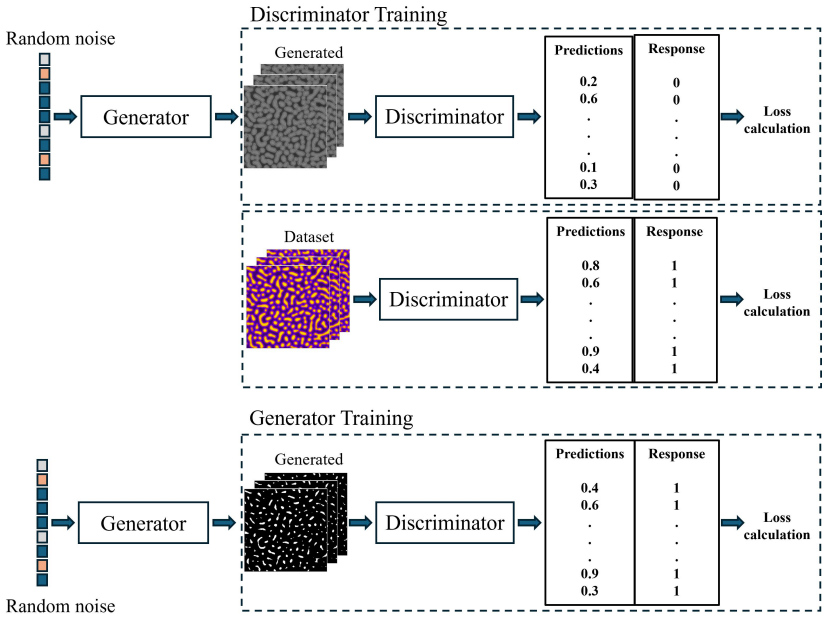
The load-bearing object is a Wasserstein GAN, a GAN variant trained with the Earth-Mover distance for stability, whose generator upsamples random noise through transposed convolutions to 256×256 grayscale images and is trained on roughly 10,000 phase-field microstructures from the Cahn-Hilliard equation for a binary alloy undergoing spinodal decomposition. The argument then leans on a post-hoc labeling scheme: average pixel value maps an image to a composition, and sorting a composition's images by average particle size reconstructs a time axis. Validation uses the coarsening law $r^3 \propto t$, the two-point correlation function $S_2(r)$, and a finite-element pipeline—OOF2 image meshing followed by an Abaqus elastoplastic solve with periodic boundary conditions—that turns morphology into true stress–plastic strain curves.
What would settle it
Draw many GAN and phase-field images at a fixed composition without particle-count matching, compute the FEM stress–strain curves for each, and compare the distributions: if the phase-field curves fall outside the GAN spread, the reported agreement was selection, not generation. As a second check, shuffle the time labels during training and re-run the coarsening analysis: if the sorted $r^3$ versus $t$ plot stays linear, the coarsening law is an artifact of sorting by particle size.
Extended reading notes
Core claim
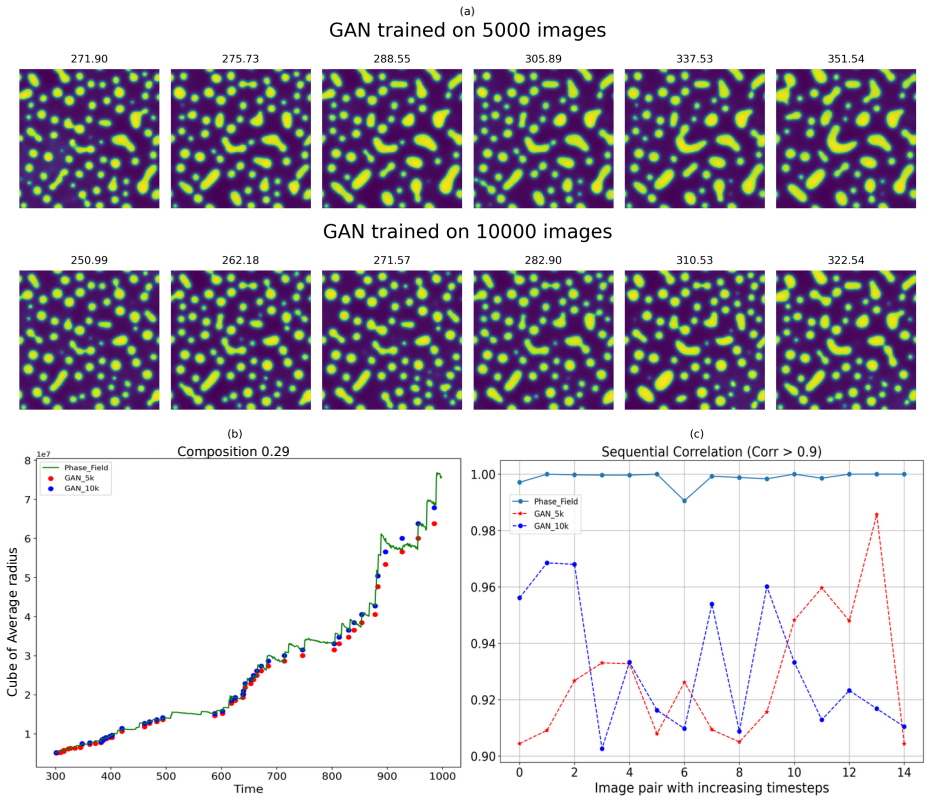
The central claim is that the GAN is capable of producing synthetic microstructures which obey the theoretically predicted coarsening rate and whose mechanical properties, computed by the finite element method, show excellent agreement with phase-field-generated microstructures. Composition of a generated image is read from its average pixel value, and time is reconstructed by sorting the images of a given composition by average particle size; under that ordering the cube of the average radius grows linearly in time for both the 5,000- and 10,000-image training sets. For compositions 0.28, 0.30, and 0.32, true stress–plastic strain curves from GAN and phase-field microstructures with similar particle counts are reported to be in excellent agreement and within the rule-of-mixtures bounds. The paper also reports Fréchet Inception Distance values between 59 and 75, taken as evidence that the model has learned the distribution rather than memorizing training images, and sequential correlation above 0.9 in the generated sequence.
Load-bearing premise
The FEM validation matches one GAN image to one phase-field image per composition using only particle count, so the claimed excellent agreement assumes that a single favorable pair represents the whole output distribution of each model.
Editorial extensions
If this is right
- Trained GAN models can replace phase-field simulation as the source of large microstructure datasets for FEM-based property prediction, reducing generation time by a factor of roughly 45 in the reported case.
- Property calculations could sample thousands of microstructures instead of a handful, yielding distributions of mechanical response rather than single curves.
- The workflow should transfer to other microstructure classes, such as precipitate growth, grain growth, or solidification, wherever phase-field training images can be produced.
- Because the GAN generates from noise, it removes the RNN/LSTM requirement of seeding each prediction with a phase-field image.
- The agreement between GAN and phase-field FEM curves implies that the morphology statistics relevant to elastoplastic response are captured in the synthetic database.
Reading between the lines
- Inference: The sorting-by-particle-size step is what turns an unordered GAN into a time series, but it also means the GAN has no direct time control; conditioning the generator explicitly on composition and time would remove the need for post-hoc sorting.
- Inference: The FEM comparison matches a single GAN image to a single phase-field image per composition; a stronger test would compute the spread of stress–strain curves over many random GAN samples and check whether the phase-field curve falls inside that distribution.
- Inference: The moderate FID scores suggest the generated images are not pixel-identical to phase-field ones, so properties highly sensitive to fine morphological details, such as percolation or local stress concentrations, may not match as well as the area-averaged response shown here.
- Inference: A natural extension is to apply the same validation machinery to other generative models, such as diffusion models, on the same phase-field dataset to quantify the trade-off between GAN speed and any mode-coverage advantages.
Editorial analysis
A structured set of objections, weighed in public.
Referee Report
Summary. The paper trains a Wasserstein GAN on 2D phase-field simulations of spinodal decomposition in a binary A-B alloy, generates synthetic microstructure images, and then reports three types of validation: (i) generated images follow the theoretical LSW coarsening law r^3 ~ t, (ii) consecutive generated images have high sequential correlation, and (iii) finite-element elastoplastic stress-strain curves computed on GAN-generated microstructures agree excellently with those computed on phase-field microstructures. The claimed payoff is an orders-of-magnitude cheaper source of microstructures for FEM property prediction.
Significance. If the central claims were established, the paper would deliver a practically useful demonstration that generative models can supply large numbers of realistic spinodal microstructures for downstream mechanical-property calculations, and the comparative timing estimate (40 s for 20,000 images versus 1,800 s for phase-field) is attractive. The paper also openly discusses limitations such as lack of explicit physical constraints and limited extrapolation outside training composition/time ranges. However, the current evidence does not establish the claims at the level claimed: the coarsening and sequential-correlation evidence is produced after sorting generated images by particle size, and the FEM agreement rests on a single hand-matched image pair per composition. The authors are to be credited for attempting a downstream-task validation rather than reporting only image-quality metrics, but the validation design currently precludes a distribution-level statement.
major comments (5)
- [Section 3, Figure 6(b)] The coarsening-law validation is circular. The generated images are sorted in ascending order by average particle size, and the sorted rank is then used as time; measuring the cube of the average radius against this constructed time guarantees an increasing trend and cannot test the physical r proportional to t^(1/3) law against the phase-field data. To validate coarsening, the GAN should be conditioned on an explicit time label (or trained on separate time slices), and generated images at each labeled time should be compared with phase-field images of the same time.
- [Section 3, Figure 6(c)] The sequential-correlation analysis is also a consequence of the sorting procedure: consecutive images in a list sorted by particle size are similar by construction, so a high Pearson correlation (>0.9) does not indicate that the generator produces temporally consistent sequences. The GAN is trained on shuffled images without time labels, and there is no temporal-conditioning mechanism that could produce a time-ordered sequence; the order is imposed after generation.
- [Section 3, Figure 7] The FEM comparison rests on exactly one GAN-generated image and one phase-field image per composition, matched to have a similar number of particles, and the paper reports no error bars, replicate curves, or statistical test for the flow stress. This does not establish agreement for the generator's output distribution, especially given the reported FID scores of 59.75-73.88, which indicate a nontrivial distributional gap. The authors should compare multiple random draws from each generator (or use a distributional metric over the FEM responses) and report the mean and variance of the stress-strain response.
- [Section 2.3 and Table 1] The architecture description is internally inconsistent: the text says the model implements a Wasserstein GAN with the Wasserstein loss in Eq. (5), but Table 1 lists Binary Cross-Entropy as the loss function, and the Lipschitz-constraint implementation (gradient clipping or gradient penalty) is not specified. Please reconcile the loss description and provide the missing training details, such as the clipping parameter or gradient-penalty coefficient and the number of critic updates per generator update.
- [Section 3, Figure 5 and composition assignment] The composition of generated images is inferred from the average pixel value, but no calibration or uncertainty analysis is provided for this mapping. Since the phase-field images have known composition from the simulation setting, the paper can easily demonstrate the accuracy of the average-pixel-value proxy on the training data; without this, the grouping into composition bins and the subsequent FEM comparison are built on an unvalidated assumption.
minor comments (5)
- [Abstract vs. Section 5] The abstract says 'excellent agreement' for the FEM comparison while Section 5 says 'good match'; please use consistent wording.
- [Section 2.4] The phrase 'plain strain' appears twice and should be 'plane strain'.
- [Section 6, Data availability] The data availability statement says 'available in this link' and 'available in this link' without actual URLs or repository identifiers, making the reproducibility claim unverifiable; please provide concrete links.
- [Section 2.4, Eq. (6)-(7)] The notation in the constraint equations is not fully defined: the coefficients A_m, A_n, etc., and how the sums expand to the periodic-boundary conditions are left implicit; a short explanation would help readability.
- [References [29]-[31]] References [29]-[31] are only loosely connected to the microstructure-generation topic and are not cited in any of the validation arguments; consider removing or integrating them more substantively.
Circularity Check
Coarsening-rate and sequential-correlation claims are largely constructed by the paper's own sorting procedure, while the FEM agreement rests on selected single-image comparisons.
-
self definitional
[Section 3, Figure 6(b) and surrounding text]
"Next, we methodically sort the microstructures in ascending order for a given composition based on the average particle size. ... Figure 6(b) depicts the cube of the average radius as a function of time. ... Clearly, GAN is capable of producing synthetic microstructures, which obey the theoretically predicted coarsening rate."
The 'time' axis for the GAN-generated microstructures is not produced by the model; it is assigned as the rank after sorting images by average particle size. Measuring the cube of the average radius against this constructed time therefore guarantees a monotonic increase in r with the assigned t. The reported r^3 vs t trend is an artifact of the sorting step, not independent evidence that the GAN learned the coarsening law. Any set of generated images with a spread of particle sizes would show an increasing r^3 curve after sorting, so the validation reduces to the sorting procedure by construction.
-
self definitional
[Section 3, Figure 6(c) and surrounding text]
"Next, we methodically sort the microstructures in ascending order for a given composition based on the average particle size. ... Interestingly, synthetic microstructures generated by GAN also have reasonably high sequential correlation (>0.9). This finding is pivotal as it confirms the model’s reliability in producing sequentially dependent microstructures, which is essential for temporal evolution studies."
The 'consecutive pairs' used to compute the Pearson sequential correlation are consecutive in the sorted-by-average-particle-size order. Sorting by particle size forces neighboring images to have similar particle sizes and hence similar two-point statistics, inflating the pixel-level correlation coefficient. The high sequential correlation is therefore a property of the ordering imposed by the authors, not a property of temporal dynamics learned by the GAN. The claim that the GAN produces sequentially dependent microstructures reduces to the sorting step by construction.
full rationale
The strongest load-bearing claims of temporal physical validity are circular: chronological order for GAN-generated microstructures is defined by sorting them by average particle size, and the same sorted sequence is then used to demonstrate both the r proportional to t^(1/3) coarsening law and high sequential correlation. These validations are largely constructed by the sorting procedure, so the score is elevated. The FEM property comparison is not circular in the same way, but it is statistically weak: for each composition one GAN image and one phase-field image with a similar number of particles are selected, and the reported FID scores (59.75-73.88) indicate nontrivial distributional mismatch, so 'excellent agreement' for the generator's full output distribution is not established. No load-bearing self-citation chain was found, and the image-generation, FID, and FEM pipeline retain independent content, which prevents a higher score.
Assumptions & free parameters
free parameters (3)
- Training set selection (set 4 with maximum standard deviation) =
set 4, std 0.3155
- GAN hyperparameters =
learning rate 2e-4, batch size 32
- Composition and time assignment for generated images =
average pixel value for composition, particle-size ordering for time
assumptions (5)
- domain assumption Cahn-Hilliard equation with double-well free energy (Eqs. 1-3) generates physically valid spinodal microstructures.
- ad hoc to paper Average pixel value is a valid proxy for composition, and sorting by average particle size reconstructs the true time ordering.
- ad hoc to paper Matching particle count between GAN and phase-field images is sufficient for a fair mechanical-property comparison.
- domain assumption Pure iron and pure chromium single-crystal properties from the cited literature are valid inputs for the phase-level elastoplastic FEM model.
- domain assumption WGAN convergence can be judged by loss oscillation and visual inspection every 100 epochs.
Cite this review
Pith. "Pith review of Microstructural Studies Using Generative Adversarial Network (GAN): a Case Study." pith.science (2026). https://pith.science/paper/CXCLJ4DX
@misc{pith2026250605860,
  author       = {Pith},
  title        = {Pith review of: Microstructural Studies Using Generative Adversarial Network (GAN): a Case Study},
  year         = {2026},
  howpublished = {\url{https://pith.science/paper/CXCLJ4DX}},
  note         = {Machine review of arXiv:2506.05860}
}
read the original abstract
The generative adversarial network (GAN) is one of the most widely used deep generative models for synthesizing high-quality images with the same statistics as the training set. Finite element method (FEM) based property prediction often relies on synthetically generated microstructures. The phase-field model is a computational method of generating realistic microstructures considering the underlying thermodynamics and kinetics of the material. Due to the expensive nature of the simulations, it is not always feasible to use phase-field for synthetic microstructure generation. In this work, we train a GAN with microstructures generated from the phase-field simulations. Mechanical properties calculated using the finite element method on synthetic and actual phase field microstructures show excellent agreement. Since the GAN model generates thousands of images within seconds, it has the potential to improve the quality of synthetic microstructures needed for FEM calculations or any other applications requiring a large number of realistic synthetic images at minimal computational cost.
Figures


Figures from the paper (4 more)



Reference graph
Works this paper leans on
-
[1]
F. Roters, P. Eisenlohr, L. Hantcherli, D.D. Tjahjanto, T.R. Bieler, and D. Raabe. Overview of constitutive laws, kine- matics, homogenization and multiscale methods in crystal plasticity finite-element modeling: Theory, experiments, applications.Acta Materialia, 58(4):1152–1211, 2010
work page 2010
-
[2]
Dassault Systémes Simulia Corp, United States, 2009
Michael Smith.ABAQUS/Standard User’s Manual, Ver- sion 6.9. Dassault Systémes Simulia Corp, United States, 2009
work page 2009
-
[3]
S.A. Langer, E.R. Fuller, and W.C. Carter. Oof: an image- based finite-element analysis of material microstructures. Computing in Science&Engineering, 3(3):15–23, 2001
work page 2001
-
[4]
Bradley S. Fromm, Kunok Chang, David L. McDow- ell, Long-Qing Chen, and Hamid Garmestani. Link- ing phase-field and finite-element modeling for pro- cess–structure–property relations of a ni-base superalloy. Acta Materialia, 60(17):5984–5999, 2012
work page 2012
-
[5]
Albert Linda, Ankit Singh Negi, Vishal Panwar, Rupesh Chafle, Somnath Bhowmick, Kaushik Das, and Rajdip Mukherjee.µ2mech: A software package combining mi- crostructure modeling and mechanical property predic- tion.Physica Scripta, 99(5):055256, apr 2024
work page 2024
-
[6]
Wenqi Liu, Junhe Lian, Nikolaos Aravas, and Sebastian Münstermann. A strategy for synthetic microstructure generation and crystal plasticity parameter calibration of fine-grain-structured dual-phase steel.International Jour- nal of Plasticity, 126:102614, 2020
work page 2020
-
[7]
Michael A. Groeber and Michael A. Jackson. Dream.3d: A digital representation environment for the analysis of microstructure in 3d.Integrating Materials and Manufac- turing Innovation, 3:56–72, 2014
work page 2014
-
[8]
R. Mukherjee, T.A. Abinandanan, and M.P. Gurura- jan. Phase field study of precipitate growth: Effect of misfit strain and interface curvature.Acta Materialia, 57(13):3947–3954, 2009
work page 2009
Show all 39 references
-
[9]
Mukherjee, T.A
R. Mukherjee, T.A. Abinandanan, and M.P. Gururajan. Precipitate growth with composition-dependent diffusiv- ity: Comparison between theory and phase field simula- tions.Scripta Materialia, 62(2):85–88, 2010
2010
-
[10]
Gururajan and T.A
M.P. Gururajan and T.A. Abinandanan. Phase field study of precipitate rafting under a uniaxial stress.Acta Materi- alia, 55(15):5015–5026, 2007. 10
2007
-
[11]
Effect of strong nonuniformity in grain bound- ary energy on 3-D grain growth behavior: A phase- field simulation study.Computational Materials Science, 127:67–77, 2017
Kunok Chang, Long-Qing Chen, Carl E Krill, and Nele Moelans. Effect of strong nonuniformity in grain bound- ary energy on 3-D grain growth behavior: A phase- field simulation study.Computational Materials Science, 127:67–77, 2017
2017
-
[12]
Verma and R
M. Verma and R. Mukherjee. Grain growth stagnation in solid state thin films: A phase-field study.Journal of Applied Physics, 130(2):025305, 2021
2021
-
[13]
C. E. Krill, L. Helfen, D. Michels, H. Natter, A. Fitch, O. Masson, and R. Birringer. Size-dependent grain- growth kinetics observed in nanocrystalline fe.Phys. Rev. Lett., 86:842–845, Jan 2001
2001
-
[14]
David Molnar, Rajdip Mukherjee, Abhik Choudhury, Alejandro Mora, Peter Binkele, Michael Selzer, Britta Nestler, and Siegfried Schmauder. Multiscale simulations on the coarsening of cu-rich precipitates inα-fe using ki- netic monte carlo, molecular dynamics and phase-field simu...
2012
-
[15]
Phase-field simulation for the evolu- tion of solid/liquid interface front in directional solidifica- tion process.Journal of Materials Science&Technology, 35(6):1044–1052, 2019
Yuhong Zhao, Bing Zhang, Hua Hou, Weipeng Chen, and Meng Wang. Phase-field simulation for the evolu- tion of solid/liquid interface front in directional solidifica- tion process.Journal of Materials Science&Technology, 35(6):1044–1052, 2019
2019
-
[16]
Subhradeep Chatterjee, TA Abinandanan, and Kamanio Chattopadhyay. Phase-field simulation of fusion interface events during solidification of dissimilar welds: effect of composition inhomogeneity.Metallurgical and Materials Transactions A, 39:1638–1646, 2008
2008
-
[17]
Effect of co-existing external fields on a binary spin- odal system: A phase-field study.Journal of Physics and Chemistry of Solids, 132:236–243, 2019
Rupesh Chafle, Somnath Bhowmick, and Rajdip Mukher- jee. Effect of co-existing external fields on a binary spin- odal system: A phase-field study.Journal of Physics and Chemistry of Solids, 132:236–243, 2019
2019
-
[18]
Mushongera, and Kumar Ankit
Rahul Raghavan, William Farmer, Leslie T. Mushongera, and Kumar Ankit. Multiphysics approaches for modeling nanostructural evolution during physical vapor deposition of phase-separating alloy films.Computational Materials Science, 199:110724, 2021
2021
-
[19]
Parallel computing for phase-field models.The International journal of high performance computing applications, 28(1):61–72, 2014
Alexander V ondrous, Michael Selzer, Johannes Hötzer, and Britta Nestler. Parallel computing for phase-field models.The International journal of high performance computing applications, 28(1):61–72, 2014
2014
-
[20]
Murdock, Steven K
Anthony Yu-Tung Wang, Ryan J. Murdock, Steven K. Kauwe, Anton O. Oliynyk, Aleksander Gurlo, Jakoah Br- goch, Kristin A. Persson, and Taylor D. Sparks. Ma- chine learning for materials scientists: An introductory guide toward best practices.Chemistry of Materials, 32(12):4954–4...
2020
-
[21]
Physics-embedded graph network for accelerating phase- field simulation of microstructure evolution in additive manufacturing.npj Computational Materials, 8(1):201, 2022
Tianju Xue, Zhengtao Gan, Shuheng Liao, and Jian Cao. Physics-embedded graph network for accelerating phase- field simulation of microstructure evolution in additive manufacturing.npj Computational Materials, 8(1):201, 2022
2022
-
[22]
Learn- ing two-phase microstructure evolution using neural op- erators and autoencoder architectures.npj Computational Materials, 8(1):190, 2022
Vivek Oommen, Khemraj Shukla, Somdatta Goswami, Rémi Dingreville, and George Em Karniadakis. Learn- ing two-phase microstructure evolution using neural op- erators and autoencoder architectures.npj Computational Materials, 8(1):190, 2022
2022
-
[23]
Peichen Wu, Ashif Sikandar Iquebal, and Kumar Ankit. Emulating microstructural evolution during spinodal de- composition using a tensor decomposed convolutional and recurrent neural network.Computational Materials Sci- ence, 224:112187, 2023
2023
-
[24]
C Hu, S Martin, and R Dingreville. Accelerating phase- field predictions via recurrent neural networks learn- ing the microstructure evolution in latent space.Com- puter Methods in Applied Mechanics and Engineering, 397:115128, 2022
2022
-
[25]
Accelerating phase-field-based mi- crostructure evolution predictions via surrogate models trained by machine learning methods.npj Computational Materials, 7(1):1–11, 2021
David Montes de Oca Zapiain, James A Stewart, and Rémi Dingreville. Accelerating phase-field-based mi- crostructure evolution predictions via surrogate models trained by machine learning methods.npj Computational Materials, 7(1):1–11, 2021
2021
-
[26]
Time series forecasting of multiphase microstructure evo- lution using deep learning.Computational Materials Sci- ence, 247:113518, 2025
Saurabh Tiwari, Prathamesh Satpute, and Supriyo Ghosh. Time series forecasting of multiphase microstructure evo- lution using deep learning.Computational Materials Sci- ence, 247:113518, 2025
2025
-
[27]
Accelerating microstructure mod- eling via machine learning: A method combining autoen- coder and convlstm.Phys
Owais Ahmad, Naveen Kumar, Rajdip Mukherjee, and Somnath Bhowmick. Accelerating microstructure mod- eling via machine learning: A method combining autoen- coder and convlstm.Phys. Rev. Mater., 7:083802, Aug 2023
2023
-
[28]
Integrated phase field and ma- chine learning study of microstructure evolution during interface-controlled spinodal decomposition.Solid State Phenomena, 357:101–106, 6 2024
Owais Ahmad, Rakesh Maurya, Rajdip Mukherjee, and Somnath Bhowmick. Integrated phase field and ma- chine learning study of microstructure evolution during interface-controlled spinodal decomposition.Solid State Phenomena, 357:101–106, 6 2024
2024
-
[29]
Generative artificial intelligence: Analyzing its future applications in additive manufacturing.Big Data and Cognitive Computing, 8(7), 2024
Erik Westphal and Hermann Seitz. Generative artificial intelligence: Analyzing its future applications in additive manufacturing.Big Data and Cognitive Computing, 8(7), 2024
2024
-
[30]
Generative artificial intelligence and its applications in materials science: Current situation and future perspectives.Journal of Materiomics, 9(4):798– 816, 2023
Yue Liu, Zhengwei Yang, Zhenyao Yu, Zitu Liu, Dahui Liu, Hailong Lin, Mingqing Li, Shuchang Ma, Maxim Avdeev, and Siqi Shi. Generative artificial intelligence and its applications in materials science: Current situation and future perspectives.Journal of Materiomics, 9(4):798–...
2023
-
[31]
M Vinodhini and Sujatha Rajkumar. A deep learning ap- proach for predicting and optimizing the v2x network pa- rameters for sustainable smart transportation systems.En- gineering Research Express, 7(1):015268, feb 2025. 11
2025
-
[32]
Free Energy of a Nonuniform System
John W Cahn and John E Hilliard. Free Energy of a Nonuniform System. I. Interfacial Free Energy.The Jour- nal of Chemical Physics, 28(2):258–267, 1958
1958
-
[33]
On spinodal decomposition.Acta metal- lurgica, 9(9):795–801, 1961
John W Cahn. On spinodal decomposition.Acta metal- lurgica, 9(9):795–801, 1961
1961
-
[34]
Generative adversarial networks-based syn- thetic microstructures for data-driven materials design
Ryuichi Narikawa, Yoshihito Fukatsu, Zhi-Lei Wang, Toshio Ogawa, Yoshitaka Adachi, Yuji Tanaka, and Shin Ishikawa. Generative adversarial networks-based syn- thetic microstructures for data-driven materials design. Advanced Theory and Simulations, 5(5):2100470, 2022
2022
-
[35]
Alexander Henkes and Henning Wessels. Three- dimensional microstructure generation using generative adversarial neural networks in the context of continuum micromechanics.Computer Methods in Applied Mechan- ics and Engineering, 400:115497, 2022
2022
-
[36]
Predic- tive microstructure image generation using denoising dif- fusion probabilistic models.Acta Materialia, 261:119406, 2023
Erfan Azqadan, Hamid Jahed, and Arash Arami. Predic- tive microstructure image generation using denoising dif- fusion probabilistic models.Acta Materialia, 261:119406, 2023
2023
-
[37]
Fritz, D
R. Fritz, D. Wimler, A. Leitner, V . Maier-Kiener, and D. Kiener. Dominating deformation mechanisms in ultrafine-grained chromium across length scales and tem- peratures.Acta Materialia, 140:176 – 187, 2017
2017
-
[38]
Plane strain compression test and simple shear test of sin- gle crystal pure iron.Procedia Engineering, 81:1342– 1347, 2014
Shintaro Yabe, Motoki Terano, and Masahiko Yoshino. Plane strain compression test and simple shear test of sin- gle crystal pure iron.Procedia Engineering, 81:1342– 1347, 2014. 11th International Conference on Technology of Plasticity, ICTP 2014, 19-24 October 2014, Nagoya Con...
2014
-
[39]
Hertzberg, R.P
R.W. Hertzberg, R.P. Vinci, and J.L. Hertzberg.Deforma- tion and Fracture Mechanics of Engineering Materials. Wiley, 2012. 12
2012
Reviewed August 7, 2026 · model on record in the stance chip above.
Discussion (0). Sign in to comment.