REVIEW 3 major objections 5 minor 39 references
Strong Mitigation of the Magnetic-Field-Induced Frequency Shift in Coherent-Population-Trapping Atomic Clocks
T0 review · 3 major / 5 minor · reviewed 2026-08-07 · deepseek-v4-flash
Pith's one-line read By picking a specific modulation frequency and bias field, this paper suppresses the magnetic-field-induced shift of a CPT atomic clock to about 72 µHz/mG, a roughly 1000-fold improvement over conventional operation.
desk verdict A believable proof-of-principle: a 'magic' bias field in a PDH-modulated CPT clock flattens the magnetic-field shift to ~72 µHz/mG over 6 mG, but missing error bars and single-point robustness limit the claim. read the letter →
The pith
A machine-rendered reading of the paper's core claim, the machinery that carries it, and where it could break.
The reading
What carries the argument
The mechanism is the interference between two magnetic-field dependences: the quadratic Zeeman shift of the clock transition and the frequency pulling exerted by neighboring magnetically sensitive CPT resonances. Under PDH fast modulation, each of the three basic CPT resonances splits into five, and as $B_z$ moves, the '+1-2' and '+1-1' side resonances cross the clock resonance and pull it through dispersion-shaped contributions, Eq. (5): $\zeta(B_z)=\frac{C_1(B_z-b_1)}{\Gamma_{31}^2+(B_z-b_1)^2}+\frac{C_2(B_z-b_2)}{\Gamma_{32}^2+(B_z-b_2)^2}$, with the resonance positions $b_1,b_2$ proportional to $f_m$. Adjusting $f_m$ places these two dispersion features so that their steep slopes oppose the parabolic Zeeman slope, producing the flat shelf. The argument rests on a multi-Lorentzian lineshape model of the PDH-modulated CPT spectrum.
What would settle it
Reproduce the frequency-versus-field measurement in an engineered cell with an optimized buffer-gas mixture, varying laser power, cell temperature, and microwave power around the operating point ($f_m\approx56$ kHz, $B_z\approx67$ mG). If the slope over the 64--70 mG window departs markedly from about $72\ \mu$Hz/mG, or the shelf shifts or disappears, the claimed immunity is not robust. A direct system-level test would be to compare the clock against a reference while deliberately tilting the cell in a field of $\pm0.5$ G and checking that the fractional shift stays near $1\times10^{-14}$ with realistic shielding.
Extended reading notes
Core claim
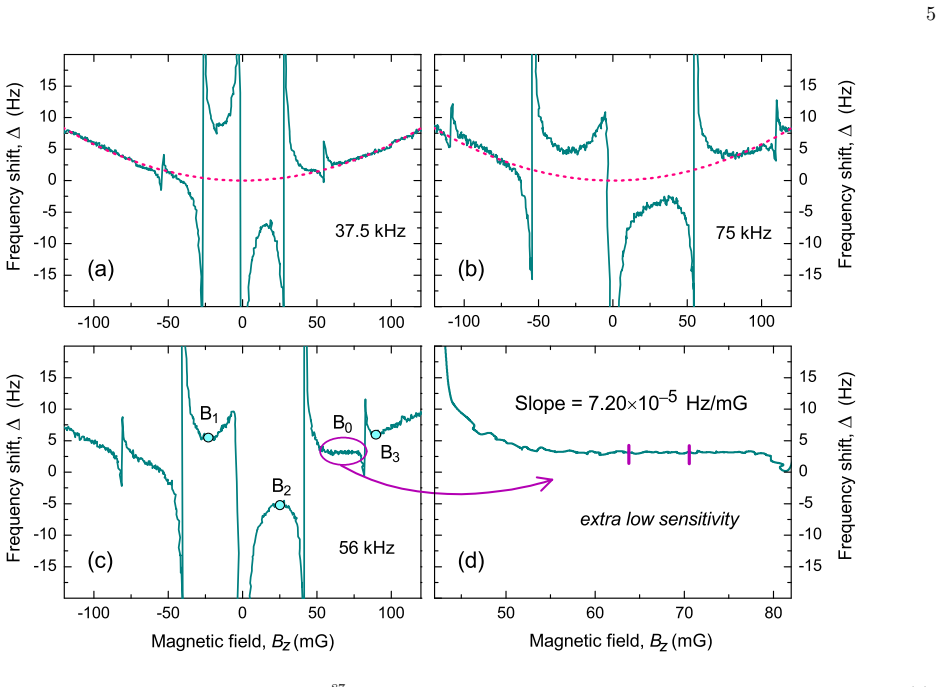
The central claim is that a specific combination of the fast-modulation frequency $f_m$ and the longitudinal bias field $B_z$ creates a flat region in the magnetic-field-induced shift $\Delta(B_z)$ of the '0--0' clock transition. In the PDH regime the CPT lineshape splits into multiple resonances, and the magnetically sensitive ones (labeled '+1-2' and '+1-1') pull the central clock resonance as $B_z$ is scanned. This frequency-pulling contribution $\zeta(B_z)$, modeled as a sum of two dispersion-like terms, adds to the smooth quadratic Zeeman parabola $\Delta_{QZ}(B_z)=\kappa(B_z+\delta B_z)^2$; for $f_m\approx56$ kHz the two effects cancel over a roughly 6 mG window around $B_z\approx67$ mG. The measured residual slope is about $7.2\times10^{-5}$ Hz/mG, meaning the fractional shift $\Delta/\Delta_g$ is about $1\times10^{-14}$ per mG. The work is presented as a proof of principle, with the authors noting that a buffer gas mixture must be optimized before an Allan-deviation measurement.
Load-bearing premise
The flat shelf survives realistic changes in laser power, cell temperature, microwave power, and buffer-gas composition; the paper itself states that the buffer gas mixture should be optimized before measuring Allan deviation.
Editorial extensions
If this is right
- A miniature CPT clock set to $B_z\approx67$ mG and $f_m\approx56$ kHz would see a fractional frequency shift below $1\times10^{-14}$ for each milligauss of longitudinal field variation over a 6 mG range.
- Because the residual shift is about three orders of magnitude smaller than in conventional bias-field operation, longitudinal magnetic shielding requirements for future miniature clocks could be substantially relaxed.
- The compensation applies to longitudinal field components; transverse components still follow the smooth quadratic Zeeman law, but in typical miniature clocks transverse shielding is already an order of magnitude stronger.
- The same PDH-based cancellation should transfer to other alkali species and to Ramsey-like pulsed excitation, because it relies on the generic competition between Zeeman and pulling shifts rather than on rubidium-specific parameters.
Reading between the lines
- A natural extension, not stated in the paper, is that clock designers could lock the bias field to the center of the shelf and use a simple servo instead of heavy longitudinal magnetic shielding, if the shelf position proves stable enough.
- The pulling strengths scale with resonance amplitudes and widths, so the magic-combination condition should be predictable in cesium by rescaling $\kappa$, the gyromagnetic ratio, and the Zeeman splittings; a numerical scan of the two-dispersion model with cesium parameters would indicate where the shelf should appear.
- If the shelf survives buffer-gas optimization, the technique could push miniature clock stability into the low $10^{-13}$ range even without laser-power or temperature stabilization much beyond current practice, because the dominant magnetic drift channel would be closed.
Editorial analysis
A structured set of objections, weighed in public.
Referee Report
Summary. The manuscript reports a proof-of-principle demonstration that the longitudinal magnetic-field-induced frequency shift (MFS) of the clock transition in a CPT rubidium vapor cell can be suppressed to about 72 µHz/mG over a 6 mG interval using a "magic" combination of PDH modulation frequency fm≈56 kHz and bias field Bz≈67 mG. The suppression is attributed to cancellation between the quadratic Zeeman slope and a dispersion-like frequency-pulling contribution from neighboring CPT resonances, described by Eq. (5). The authors argue that this reduces the clock's magnetic-field sensitivity by roughly three orders of magnitude relative to conventional operation and suggest the method may extend to other excitation schemes such as Ramsey-like CPT clocks.
Significance. If the measured suppression is robust, the result is a valuable step toward improving the long-term stability of miniature CPT clocks, for which magnetic-field sensitivity is a known limiting factor. The experimental geometry and the qualitative mechanism are clearly presented, and the direct measurement of the MFS slope is a strength: it is a falsifiable quantitative result that does not rely on the ad hoc model. The claim is, however, currently supported by a single operating point with no uncertainty analysis and no characterization of how the shelf behaves under the parameter drifts (optical power, microwave power, temperature, modulation frequency) that matter in a real clock. The paper is therefore a promising but not yet fully supported proof of principle.
major comments (3)
- [Experiments, Fig. 5(d)] The central quantitative claim rests on the measured slope of ≈7.2×10⁻⁵ Hz/mG over the 64–70 mG interval, but the paper provides no error bars on the data points in Fig. 5(d), no uncertainty estimate for the slope, and no description of how the slope was extracted (e.g., linear fit range, number of measurements, integration time per point, or repeatability). Without this information, the claimed three-orders-of-magnitude suppression relative to the quadratic Zeeman slope is not statistically established. Please add a full uncertainty budget and, if possible, a table of the raw measured frequency shifts.
- [Experiments and Conclusion] The "magic" shelf is demonstrated at one operating point, fm≈56 kHz and Bz≈67 mG, with no experimental study of its robustness. In particular, the paper does not report how the slope or the shelf width changes when fm is detuned around 56 kHz, or when the optical power (stated as 17 µW), the microwave power, or the cell temperature (335 K) are varied around their nominal values. Because Eq. (5) shows that the cancellation depends on the amplitudes and widths (A31, A32, Γ31, Γ32) of the neighboring resonances, which in turn depend on these experimental parameters, an unquantified knife-edge shelf could restore the magnetic sensitivity in a real clock experiencing parameter drifts. The authors' own conclusion that a buffer gas mixture should be optimized before Allan deviation measurements reinforces that the demonstrated operating point is not yet an engineered clock feature.
- [Qualitative analysis, Eq. (5) and Fig. 2] The theoretical model used to illustrate the flat shelf is not fitted to the measured ∆(Bz) data. The parameters C1, C2, Γ31, Γ32, b1, b2 in Eq. (5) are chosen ad hoc to produce a shelf in Fig. 2(c), so the simulation cannot serve as independent quantitative evidence for the magnitude or location of the measured shelf. The qualitative explanation is plausible, but the manuscript should state clearly that Eq. (5) is an illustrative heuristic and should not imply that the model validates the experimental slope. A fit of Eq. (5) to the data in Fig. 5(c), or an equivalent first-principles lineshape model, would materially strengthen the claim.
minor comments (5)
- [Experiments] The sentence "The experimental setup is shown in Fig. with a photo of the cell in the insert" is missing the figure number; it should refer to Fig. 3.
- [Introduction] There is a typo in "directed long the z-axis"; it should be "directed along the z-axis."
- [Abstract and Introduction] The fractional sensitivity is quoted as ≈1×10⁻¹⁴ mG⁻¹ in the abstract and as ∆/∆g ≈ 1×10⁻¹⁴δB mG⁻¹ in the introduction; the units and the meaning of δB should be defined consistently.
- [Fig. 2 caption] The model parameters in the Fig. 2 caption (C1=6C2=30 mG·Hz, Γ31=Γ32=0.2 mG, b2=2b1=82 mG) should include an explicit statement of units and a brief explanation of why these particular values were chosen, since they are not derived from the experiment.
- [General] The paper would benefit from a data availability statement or supplementary material containing the measured frequency-shift values underlying Fig. 5, given that the headline slope is a single-number quantitative claim.
Circularity Check
No circularity: the central slope is a directly measured observable, and Eq. (5) is an illustrative heuristic whose parameters are not fitted to the data.
full rationale
The paper's central claim is the measured residual slope of about 72 µHz/mG over the 64 to 70 mG interval at fm approximately 56 kHz. This is a direct experimental observable read from Fig. 5(d), not an output of the model. Equation (5) is introduced only as a qualitative model, with the text saying it 'can be qualitatively modeled as follows,' and its parameters C1, C2, b1, b2, Gamma31, and Gamma32 are chosen in Fig. 2 to show that a flat shelf can in principle arise from the sum of a quadratic Zeeman term and dispersion-like pulling terms. The paper does not fit these parameters to the experimental curve, nor does it use the model to predict the magic point. The existence of PDH-induced extrema is also demonstrated independently in the paper's own Fig. 5 for three modulation frequencies, so the citation to the authors' prior work Ref. [22] is background context rather than load-bearing. No uniqueness theorem, ansatz imported by citation, or renaming of a known result is used. The comparison with conventional sensitivity is arithmetic: the quadratic Zeeman slope 2*kappa*Bz is about 0.077 Hz/mG, which divided by the measured 7.2e-5 Hz/mG gives the claimed three-orders-of-magnitude suppression. No step in the derivation chain reduces to its own inputs, and the empirical claim is self-contained.
Assumptions & free parameters
free parameters (6)
- C1 =
30 mG·Hz (with C1 = 6C2)
- C2 =
5 mG·Hz
- Γ31 =
0.2 mG
- Γ32 =
0.2 mG
- b1 =
41 mG
- b2 =
82 mG
assumptions (3)
- domain assumption The CPT resonance lineshape is modeled as a sum of Lorentzian profiles (Eq. 2 and Eq. 3).
- ad hoc to paper The total magnetic-field-induced shift is the sum of the quadratic Zeeman shift and a dispersion-like frequency-pulling term (Eqs. 4 and 5).
- standard math The 87Rb ground-state Landé g-factor and quadratic Zeeman coefficient κ≈575 Hz/G^2 are taken from prior literature.
Cite this review
Pith. "Pith review of Strong Mitigation of the Magnetic-Field-Induced Frequency Shift in Coherent-Population-Trapping Atomic Clocks." pith.science (2026). https://pith.science/paper/E45CWAV5
@misc{pith2026250605865,
  author       = {Pith},
  title        = {Pith review of: Strong Mitigation of the Magnetic-Field-Induced Frequency Shift in Coherent-Population-Trapping Atomic Clocks},
  year         = {2026},
  howpublished = {\url{https://pith.science/paper/E45CWAV5}},
  note         = {Machine review of arXiv:2506.05865}
}
abstract
We study the magnetic-field-induced frequency shift (MFS) of the clock (``0--0'') transition in coherent-population-trapping (CPT) microwave atomic clock. It is shown that the use of the Pound-Drever-Hall-like (PDH) technique for frequency locking provides brilliant opportunities for mitigating the MFS. Using a $0.125$ cm$^3$ rubidium vapor cell with a buffer gas, we have measured a residual sensitivity of the clock transition frequency to be $\approx\,72$ $\mu$Hz/mG over $\approx\,$$6$ mG interval. It means that a fractional frequency shift is extremely small ($\approx\,$$1$$\,\times\,$$10^{-14}$ mG$^{-1}$). The results contribute to the development of a new-generation CPT-based miniature atomic clock (MAC) with improved long-term frequency stability. The proposed method is quite general and can be used for other excitation schemes in atomic clocks, including Ramsey-like techniques.
Figures


Figures from the paper (2 more)

Reference graph
Works this paper leans on
-
[1]
Vanier, Atomic clocks based on coherent population trapping: a review, Appl
J. Vanier, Atomic clocks based on coherent population trapping: a review, Appl. Phys. B 81, 421 (2005)
work page 2005
-
[2]
Kitching, Chip-scale atomic devices, Appl
J. Kitching, Chip-scale atomic devices, Appl. Phys. Rev. 5, 031302 (2018)
2018
-
[3]
Y. Meng, D. Weng, C. Yang, W. Chen, and Z. Hou, Chip- scale atomic clock (CSAC) aided GNSS in urban canyons, GPS Solutions 28, 195 (2024)
work page 2024
-
[4]
K. Aheieva, R. Rahmatillah, R. Ninagawa, I. O. Ade- bolu, H. Masui, T. Yamauchi, S. Kim, M. Cho, C. L. Chow, M. S. Tse, and K. H. H. Li, CubeSat mission for ionosphere mapping and weather forecasting using chip- scale atomic clock, in 2017 Progress in Electromagnetics Research Symposium - Fall (PIERS - F ALL) (2017) p. 761
work page 2017
-
[5]
P. Cash, W. Krzewick, P. Machado, K. Richard Over- street, M. Silveira, M. Stanczyk, D. Taylor, and X. Zhang, Microsemi chip scale atomic clock (CSAC) technical status, applications, and future plans, in 2018 European Frequency and Time Forum (EFTF) (2018) p. 65
work page 2018
- [6]
-
[7]
M. N. Skvortsov, S. M. Ignatovich, V. I. Vishnyakov, N. L. Kvashnin, I. S. Mesenzova, D. V. Brazhnikov, V. A. Vasil’ev, A. V. Taichenachev, V. I. Yudin, S. N. Bagayev, I. Y. Blinov, V. G. Pal’chikov, Y. S. Samokhvalov, and D. A. Parekhin, Miniature quantum frequency standard based on the phenomenon of coherent population trap- ping in vapours of 87Rb atom...
work page 2020
-
[8]
A. T. Dellis, V. Shah, E. A. Donley, S. Knappe, and J. Kitching, Low helium permeation cells for atomic mi- crosystems technology, Opt. Lett. 41, 2775 (2016)
work page 2016
Show all 39 references
-
[9]
Carl´ e, M
C. Carl´ e, M. Abdel Hafiz, S. Keshavarzi, R. Vicarini, N. Passilly, and R. Boudot, Pulsed-CPT Cs-Ne microcell atomic clock with frequency stability below 2 × 10⁻¹² at 105 s, Opt. Express 31, 8160 (2023)
2023
-
[10]
Vicarini, M
R. Vicarini, M. Abdel Hafiz, V. Maurice, N. Passilly, E. Kroemer, L. Ribetto, V. Gaff, C. Gorecki, S. Galliou, and R. Boudot, Mitigation of temperature-induced light- shift effects in miniaturized atomic clocks, IEEE Trans. UFFC 66, 1962 (2019)
2019
-
[11]
Vanier, R
J. Vanier, R. Kunski, N. Cyr, J. Y. Savard, and M. Tˆ etu, On hyperfine frequency shifts caused by buffer gases: Ap- plication to the optically pumped passive rubidium fre- quency standard, J. Appl. Phys. 53, 5387 (1982)
1982
-
[12]
Kozlova, S
O. Kozlova, S. Gu´ erandel, and E. de Clercq, Tempera- ture and pressure shift of the Cs clock transition in the presence of buffer gases: Ne, N 2, Ar, Phys. Rev. A 83, 062714 (2011)
2011
-
[13]
F. Levi, A. Godone, and J. Vanier, The light shift effect in the coherent population trapping cesium maser, IEEE Tran. UFFC 47, 466 (2000)
2000
-
[14]
M. I. Vaskovskaya, D. S. Chuchelov, E. A. Tsygankov, V. V. Vassiliev, S. A. Zibrov, and V. L. Velichansky, Dual microwave frequency modulation of the VCSEL injection current for a CPT-based atomic clock, Opt. Lett. 49, 4791 (2024)
2024
-
[15]
Miletic, C
D. Miletic, C. Affolderbach, M. Hasegawa, R. Boudot, C. Gorecki, and G. Mileti, AC Stark-shift in CPT-based Cs miniature atomic clocks, Appl. Phys. B 109, 89 (2012)
2012
-
[16]
Radnatarov, S
D. Radnatarov, S. Kobtsev, V. Andryushkov, and T. Steschenko, Suppression of light-field shift of CPT resonances in optically dense media, SPIE Proc. 11817, 118170O (2021)
2021
-
[17]
M. I. Vaskovskaya, E. A. Tsygankov, D. S. Chuchelov, S. A. Zibrov, V. V. Vassiliev, and V. L. Velichansky, Ef- fect of the buffer gases on the light shift suppression pos- sibility, Opt. Express 27, 35856 (2019)
2019
-
[18]
D. V. Brazhnikov, S. M. Ignatovich, and M. N. Skvortsov, Light shift mitigation in microcell-based coherent-population-trapping atomic clocks in the field of two circularly polarized light beams, Phys. Rev. Appl. 21, 054046 (2024)
2024
-
[19]
Knappe, V
S. Knappe, V. Gerginov, V. Shah, A. Brannon, L. Holl- berg, and J. Kitching, Long-term stability of NIST chip- scale atomic clock physics packages, SPIE Proc. 6466, 64660O (2007)
2007
-
[20]
H.-G. Hong, J. Park, T. H. Kim, H. Y. Kim, S. E. Park, S.-B. Lee, M.-S. Heo, and T. Y. Kwon, Magnetic shield integration for a chip-scale atomic clock, Appl. Phys. Ex- press 13, 106504 (2020)
2020
-
[21]
E. A. Tsygankov, M. I. Vaskovskaya, D. S. Chuchelov, S. A. Zibrov, V. V. Vassiliev, V. L. Velichansky, and V. P. Yakovlev, Polarization asymmetry of the dark-resonance frequency dependence on the magnetic field, J. Opt. Soc. Am. B 38, 1742 (2021)
2021
-
[22]
V. I. Vishnyakov, D. V. Brazhnikov, and M. N. Skvortsov, Reduction of magnetic-field-induced shift in quantum frequency standards based on coherent popula- tion trapping, J. Appl. Phys. 137, 164402 (2025)
2025
-
[23]
Kitching, S
J. Kitching, S. Knappe, M. Vukicevic, L. Hollberg, R. Wynands, and W. Weidmann, A microwave frequency reference based on VCSEL-driven dark line resonances in Cs vapor, IEEE Trans. Instrum. Meas. 49, 1313 (2000)
2000
-
[24]
Ben-Aroya, M
I. Ben-Aroya, M. Kahanov, and G. Eisenstein, Optimiza- tion of FM spectroscopy parameters for a frequency lock- ing loop in small scale CPT based atomic clocks, Opt. Express 15, 15060 (2007)
2007
-
[25]
V. I. Yudin, A. V. Taichenachev, M. Y. Basalaev, and D. V. Kovalenko, Dynamic regime of coherent population trapping and optimization of frequency modulation pa- rameters in atomic clocks, Opt. Express 25, 2742 (2017)
2017
-
[26]
Kobtsev, D
S. Kobtsev, D. Radnatarov, S. Khripunov, I. Popkov, V. Andryushkov, and T. Steschenko, Atomic clock sta- bility under dynamic excitation of coherent population trapping resonance in cells without buffer gas, SPIE Proc. 10548, 1054820 (2018)
2018
-
[27]
D. S. Chuchelov, V. V. Vassiliev, M. I. Vaskovskaya, V. L. Velichansky, E. A. Tsygankov, S. A. Zibrov, S. V. Petropavlovsky, and V. P. Yakovlev, Modulation spec- troscopy of coherent population trapping resonance and light shifts, Phys. Scr. 93, 114002 (2018)
2018
-
[28]
V. I. Yudin, M. Y. Basalaev, A. V. Taichenachev, O. N. Prudnikov, D. A. Radnatarov, S. M. Kobtsev, S. M. Igna- tovich, and M. N. Skvortsov, Frequency shift caused by the line-shape asymmetry of the resonance of coherent population trapping, Phys. Rev. A 108, 013103 (2023). 7
2023
-
[29]
E. A. Tsygankov, D. S. Chuchelov, M. I. Vaskovskaya, V. V. Vassiliev, S. A. Zibrov, and V. L. Velichansky, Fre- quency locking: A distinctive feature of the coherent pop- ulation trapping, J. Appl. Phys. 137, 104502 (2025)
2025
-
[30]
G. S. Pati, R. Tripathi, R. S. Grewal, M. Pulido, and R. A. Depto, Synchronous coherent population trapping and its magnetic spectral response in rubidium vapor, Phys. Rev. A 104, 033116 (2021)
2021
-
[31]
E. A. Tsygankov, D. S. Chuchelov, M. I. Vaskovskaya, V. V. Vassiliev, S. A. Zibrov, and V. L. Velichansky, Non- linear frequency shift caused by asymmetry of the multi- peak coherent population trapping resonance, Phys. Rev. A 109, 053703 (2024)
2024
-
[32]
Micalizio and A
S. Micalizio and A. Godone, Raman-Ramsey resonances in atomic vapor cells: Rabi pulling and optical-density effects, Phys. Rev. A 99, 043425 (2019)
2019
-
[33]
V. I. Yudin, A. V. Taichenachev, O. N. Prudnikov, M. Y. Basalaev, V. G. Pal’chikov, M. von Boehn, T. E. Mehlst¨ aubler, and S. N. Bagayev, Probe-field-ellipticity- induced shift in an atomic clock, Phys. Rev. Applied 19, 014022 (2023)
2023
-
[34]
E. E. Mikhailov, T. Horrom, N. Belcher, and I. Novikova, Performance of a prototype atomic clock based on lin||lin coherent population trapping resonances in Rb atomic vapor, J. Opt. Soc. Am. B 27, 417 (2010)
2010
-
[35]
Makarov, K
A. Makarov, K. Kozlova, D. Brazhnikov, V. Vishnyakov, and A. Goncharov, All-optical atomic magnetometry us- ing an elliptically polarized amplitude-modulated light wave, Opt. Commun. 577, 131369 (2025)
2025
-
[36]
Datasheets of Microsemi SA.45S and Teledyne TS5-10
-
[37]
Y.-Y. Jau, A. B. Post, N. N. Kuzma, A. M. Braun, M. V. Romalis, and W. Happer, Intense, narrow atomic-clock resonances, Phys. Rev. Lett. 92, 110801 (2004)
2004
-
[38]
Mejri, F
S. Mejri, F. Tricot, J.-M. Danet, P. Yun, E. D. Clercq, and S. Guerandel, Atomic clock using coherent popula- tion trapping in a cesium cell: frequency stability and limitations, J. Phys. Conf. Ser. 723, 012014 (2016)
2016
-
[39]
Shuker, J
M. Shuker, J. W. Pollock, R. Boudot, V. I. Yudin, A. V. Taichenachev, J. Kitching, and E. A. Donley, Ramsey spectroscopy with displaced frequency jumps, Phys. Rev. Lett. 122, 113601 (2019)
2019
Reviewed August 7, 2026 · model on record in the stance chip above.
Discussion (0). Continue with ORCID to comment.