REVIEW 3 major objections 4 minor 10 references
Transport of soft matter in complex and confined environments
T0 review · 3 major / 4 minor · reviewed 2026-08-07 · deepseek-v4-flash
Pith's one-line read This review proposes that shear flow over soft particles can reorganize nanoscale matter by driving soft objects away from walls and letting rigid ones gather there.
desk verdict A clean, honest primer on elastohydrodynamic lift whose one speculative idea—flow-induced effective attraction between rigid objects and a wall—lacks a quantitative mechanism. read the letter →
The pith
A machine-rendered reading of the paper's core claim, the machinery that carries it, and where it could break.
The reading
What carries the argument
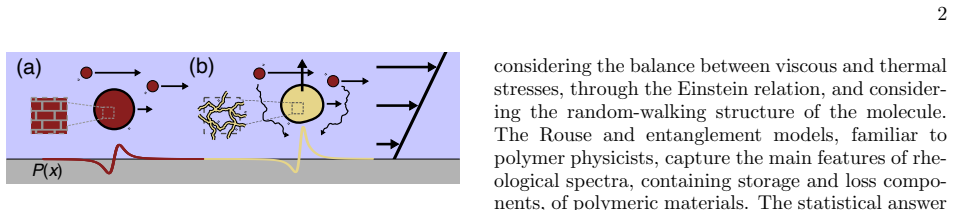
The mechanism is elastohydrodynamic lift: in a shear flow near a boundary, viscous stresses deform a soft particle or elastic surface, making the hydrodynamic pressure field asymmetric, so the integrated pressure gives a force perpendicular to the wall. The paper calls the resulting Brownian elastohydrodynamics an 'effective physicochemical lever' because it controls spatial organization without changing chemistry such as salt concentration. On the transport side, the key object is Taylor dispersion, the enhancement of spreading that comes from the coupling of advection and diffusion in a confined flow with non-uniform velocity; the paper argues that when species segregate at different wall distances, they sample different velocity streamlines and thus different effective dispersion rates.
What would settle it
A microfluidic experiment with a dilute mixture of fluorescent rigid and soft colloidal particles in a steady shear flow near a single wall, measuring the steady-state concentration profiles of both species: if rigid particles do not accumulate near the wall beyond their equilibrium Boltzmann profile while soft particles are depleted there, the effective-attraction hypothesis would be refuted.
Extended reading notes
Core claim
The central claim is that combining the intrinsic softness of macromolecular and colloidal objects with hydrodynamic energy input from a confining shear flow opens physical modes of nanoscale organization that equilibrium, potential-based descriptions miss. When a soft particle or a deformable wall is sheared in a viscous fluid, viscous stresses deform the interface, breaking the symmetry of the pressure field around the particle and producing a net lift away from the wall. In a multicomponent suspension, species with different softness experience different lift magnitudes at the same distance from the wall. The paper hypothesizes that this differential repulsion can drive segregation: soft objects vacate the near-wall region, and rigid objects, which feel little or no lift, are free to explore it, so an 'effective' attractive interaction between rigid particles and the wall emerges purely from the flow. The essay is explicit that this segregation mechanism is speculative and not yet quantified.
Load-bearing premise
The speculation that flow can separate soft from rigid particles assumes that the hydrodynamic repulsion pushing soft objects away from the wall is strong enough, relative to Brownian diffusion and interactions with other particles, to measurably change where each species sits, and that the vacant region left near the wall is then a genuine effective attraction for rigid particles.
Editorial extensions
If this is right
- Micro- and nanofluidic devices could sort or separate species by softness alone, using shear flow rather than surface chemistry.
- Tuning the distribution of softness in a mixture could prepare controlled vertical concentration profiles at chosen distances from a wall.
- Wall-normal segregation changes the average advection speed of each species, so downstream temporal concentration profiles become designable.
- The mechanisms would apply broadly to biological and synthetic soft objects, since they rely only on deformability and flow.
- Coupling segregation with Taylor dispersion could produce enhanced spreading patterns that are otherwise inaccessible to equilibrium transport.
Reading between the lines
- A quantitative test would be to measure the lift-force magnitude against the thermal force $k_BT/a$ in a bidisperse suspension; if the lift is too weak, the effective-attraction effect would be swamped by diffusion.
- The idea connects naturally to driven and active systems where wall accumulation plays a role; one could ask whether the same differential-repulsion mechanism sharpens or destroys such accumulation.
- The segregation hypothesis could be tested with existing microfluidic techniques by imaging fluorescent rigid and soft colloids near a wall in a pressure-driven flow, looking for a soft-depleted, rigid-enriched layer.
Editorial analysis
A structured set of objections, weighed in public.
Referee Report
Summary. The manuscript is a short perspective on transport of soft matter in confined, flowing environments. It reviews Brownian motion and Boltzmann statistics as equilibrium foundations, then introduces elastohydrodynamic lift forces that act on deformable particles or soft boundaries under shear flow. The core forward-looking proposal is that in a mixture of soft and rigid objects near a wall, the flow-induced repulsion of soft objects could deplete the near-wall region and thereby create an "effective" attractive interaction between rigid objects and the wall, enabling new segregation and transport schemes in micro- and nanofluidic devices. The paper explicitly labels these final considerations as speculative and connects them to Taylor dispersion and broader calls for research in nanoscale transport.
Significance. If the hypothesized mechanism were established, it would offer a new, potentially useful route to spatially organize colloidal and macromolecular species in confined flows, complementing equilibrium potential-based strategies. The paper's strengths are its clear and accurate exposition of the established elastohydrodynamic lift physics, its careful citation of the relevant literature, and its explicit flagging of the speculative character of the forward-looking claims. However, the central proposal is presented only at the level of a metaphor: no scaling estimate, simulation, or experimental test is offered, and the logical connection between soft-particle depletion and persistent rigid-particle accumulation is not argued. The value of the paper therefore lies mainly in its concise synthesis of known results and in articulating a research direction, not in demonstrating the proposed effect.
major comments (3)
- [Segregation and transport in heterogeneous soft matter] The proposed "effective" attraction between rigid objects and a wall is not supported by a flux balance. If rigid particles experience no wall-normal hydrodynamic force, they will diffuse into the wall-adjacent region cleared by soft-particle lift only until their concentration gradient vanishes; no steady-state excess of rigid particles can be maintained without an ongoing flux, such as an osmotic pressure gradient arising from the soft-particle concentration profile or an indirect hydrodynamic coupling. The text does not provide such a mechanism, nor an order-of-magnitude comparison of the elastohydrodynamic lift velocity with Brownian diffusion and interparticle interactions. Because this hypothesis is the central forward-looking claim of the paper, it requires either a quantitative plausibility argument or an explicit reformulation as a transient or concentration-gradient-driven effect.
- [Segregation and transport in heterogeneous soft matter] The analogy to van der Waals interactions "with a sign inversion" is not developed and is potentially misleading. In the van der Waals case, the effective interaction between interfaces arises from collective many-body dispersion forces; here, the proposed wall attraction for rigid objects depends on a non-equilibrium concentration gradient whose steady-state existence is not established. The analogy does not add explanatory power and should either be replaced by a concrete mechanistic discussion or removed.
- [Elastohydrodynamic interactions under flow / Fig. 1] The argument hinges on the asymmetry that soft particles are repelled from the wall while rigid particles are not. The text should state more explicitly the conditions under which rigid objects can be treated as force-free in the wall-normal direction and whether residual lift effects (e.g., finite Reynolds number, surface slip, or particle anisotropy) would erode the proposed segregation. Without this clarification, the scope of the hypothesis is undefined.
minor comments (4)
- [Introduction] Page 2 contains the typo "a such an environment"; it should read "such an environment."
- [References] In the reference to Taylor dispersion, the citation "[9] [9]" appears with a duplicated marker; this should be corrected.
- [Fig. 1 caption] The caption could explicitly note that the anti-symmetric pressure field in (a) gives zero net wall-normal force, whereas the symmetry-broken field in (b) produces a lift force; this would help readers connect the schematic to the central argument.
- [Elastohydrodynamic interactions under flow] The term "Brownian elastohydrodynamics" is used without a definition; a brief parenthetical explanation of how thermal fluctuations enter the elastohydrodynamic lift description would improve accessibility.
Circularity Check
No significant circularity: the paper is a speculative perspective with no fitted-to-input predictions and no load-bearing self-citation.
full rationale
The manuscript is a self-contained perspective essay rather than a derivation. It states a central speculative hypothesis about elastohydrodynamic lift segregating soft and rigid objects near walls in confined shear flow, but it explicitly labels the discussion speculative ('Even while highly speculative...' in the 'Segregation and transport in heterogeneous soft matter' section). No new equations are derived, no parameters are fitted, and no quantity is called a prediction while being constructed from the data it supposedly predicts. The only self-citation is Ref. [10] (Vilquin, Bertin, Raphaël, Dean, Salez, and McGraw), which is used to support a background statement about recent experimental work on nanoscale Taylor dispersion near charged boundaries. That citation is not load-bearing for the paper's forward-looking segregation claim, which rests on previously established elastohydrodynamic lift literature (Refs. [5,6,8]) rather than on the author's own prior result. The paper therefore does not reduce its central claim to its inputs by definition, fitting, or self-citation. The absence of a quantitative coupling argument for the rigid-particle excess is a weakness in plausibility, not a form of circularity.
Assumptions & free parameters
assumptions (3)
- standard math Einstein relation and fluctuation-dissipation theorem apply to soft matter transport.
- domain assumption Elastohydrodynamic lift forces exist and behave as described in Refs. [5,6].
- ad hoc to paper The effective attraction hypothesis follows by analogy to van der Waals interactions with a sign inversion.
invented entities (1)
-
Flow-induced effective attraction between rigid objects and a bounding wall
Cite this review
Pith. "Pith review of Transport of soft matter in complex and confined environments." pith.science (2026). https://pith.science/paper/5NFTWUDA
@misc{pith2026250605884,
  author       = {Pith},
  title        = {Pith review of: Transport of soft matter in complex and confined environments},
  year         = {2026},
  howpublished = {\url{https://pith.science/paper/5NFTWUDA}},
  note         = {Machine review of arXiv:2506.05884}
}
read the original abstract
Brownian motion provides a bedrock for the understanding of soft condensed matter and, therefore, of the physical description of the microscopic biological world. Inspired by this domain, and combining softness with hydrodynamic energy inputs, new physical modes of nanoscale organization and transport may now be accessible.
Figures

Reference graph
Works this paper leans on
-
[1]
M. D. Haw, Colloidal suspensions, Brownian mo- tion, molecular reality: A short history, Journal of Physics: Condensed Matter 14, 7769 (2002)
work page 2002
-
[2]
B. Duplantier, Brownian Motion, “Diverse and Undulating”, in Einstein, 1905–2005 , edited by T. Damour, O. Darrigol, B. Duplantier, and V. Ri- vasseau (Birkh¨ auser Basel, Basel, 2005) pp. 201–293
work page 1905
-
[3]
L. Bocquet and E. Lauga, A smooth future?, Nature Materials 10, 334 (2011)
work page 2011
-
[4]
F. Restagno and T. Dauxois, Prospectives de CNRS Physique 2024, (2024), HAL:04800073
work page 2024
- [5]
-
[6]
B. Rallabandi, Fluid-Elastic Interactions Near Con- tact at Low Reynolds Number, Annual Review of Fluid Mechanics 56, 491 (2024)
work page 2024
-
[7]
M. D. Graham, Fluid Dynamics of Dissolved Poly- mer Molecules in Confined Geometries, Annual Re- view of Fluid Mechanics 43, 273 (2011)
work page 2011
- [8]
Show all 10 references
-
[9]
Taylor, Dispersion of soluble matter in solvent flowing slowly through a tube, Proceedings of the Royal Society of London
G. Taylor, Dispersion of soluble matter in solvent flowing slowly through a tube, Proceedings of the Royal Society of London. Series A. Mathematical and Physical Sciences 219, 186 (1953)
1953
-
[10]
Vilquin, V
A. Vilquin, V. Bertin, E. Rapha¨ el, D. S. Dean, T. Salez, and J. D. McGraw, Nanoparticle Tay- lor dispersion near charged surfaces with an open boundary, Physical Review Letters 130, 038201 (2023)
2023
Reviewed August 7, 2026 · model on record in the stance chip above.
Discussion (0). Sign in to comment.