REVIEW 3 major objections 5 minor 49 references
Few Labels are all you need: A Weakly Supervised Framework for Appliance Localization in Smart-Meter Series
T0 review · 3 major / 5 minor · reviewed 2026-08-07 · deepseek-v4-flash
Pith's one-line read Appliance usage can be localized from a single possession label per household.
desk verdict A genuinely new weakly supervised NILM idea with a strong empirical package, but the headline label-reduction claim is inflated by test-set-based window selection and an unverified CAM-faithfulness assumption. read the letter →
The pith
A machine-rendered reading of the paper's core claim, the machinery that carries it, and where it could break.
The reading
What carries the argument
The load-bearing object is the class activation map (CAM) of a trained detection classifier, defined as the weighted sum of the last convolutional layer's feature maps using the class weights. CamAL uses an ensemble of five convolutional ResNets with different kernel sizes (5, 7, 9, 15, 25), averages their normalized CAMs for the 'appliance used' class, and applies the averaged CAM as an attention mask over the input series; the masked signal is squashed by a sigmoid and thresholded at 0.5 to produce the predicted status signal $\hat{s}(t)$. The ensemble's varied receptive fields and the attention-sigmoid post-processing are what turn a whole-window detection score into a per-timestamp localizer.
What would settle it
Take any dataset with per-timestamp appliance ground truth, train CamAL with possession labels only, and build test windows in which the target appliance is off but another high-power appliance with a similar signature is on. If the averaged CAM assigns high attention to those off-target windows while presence detection stays above 0.9, the localization claim is falsified; a calibrated version would compare CamAL's F1 on such adversarial windows to its F1 on ordinary windows.
Extended reading notes
Core claim
The central discovery is that the 'when' of appliance use can be recovered from a model trained only on the 'whether'. CamAL first learns to classify whether a given aggregate consumption window contains any activation of the target appliance, using one label per window or per household. For windows where the appliance is detected, it extracts the class activation map of each ResNet in the ensemble, averages the normalized maps, multiplies this averaged map pointwise by the input signal, and passes the result through a sigmoid followed by rounding to produce a binary on/off status per timestamp. The paper argues this signal localizes appliance activations accurately enough to compete with fully supervised sequence-to-sequence approaches, and demonstrates that possession-only labels from questionnaires are sufficient.
Load-bearing premise
The load-bearing premise is that the timestamps a detection classifier's class activation map highlights are the actual moments the target appliance is running; if the map instead lights up on correlated high-power appliances or household-specific patterns, localization fails even when presence detection is accurate.
Editorial extensions
If this is right
- If the central claim holds, smart-grid operators can build non-invasive load monitoring services from questionnaire data alone, with no per-appliance submetering, and the cost and CO2 footprint of label collection drops by more than two orders of magnitude.
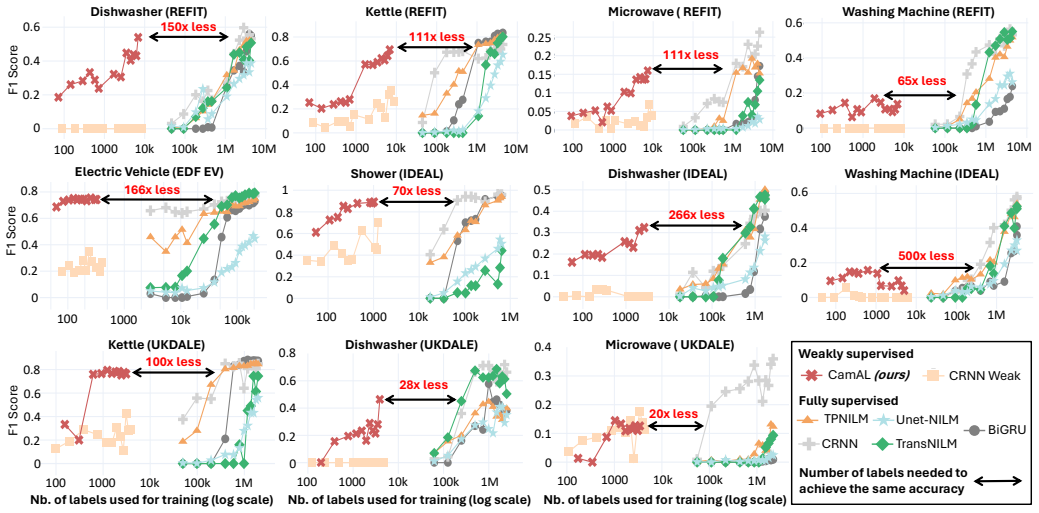
- Fully supervised sequence-to-sequence NILM models would be recast as label-hungry special cases rather than the default starting point, because CamAL reaches comparable localization with about 144 times fewer labels on average and thousands of times fewer in the most extreme reported case.
- CamAL's predicted status signal can be multiplied by an appliance's average power and clipped to the aggregate to estimate consumption, yielding usable energy estimates on several appliances.
- When strong labels are scarce, the paper's soft-label experiment implies that CamAL predictions can substitute for or complement ground truth, improving fully supervised models by 34% to 1200% depending on the architecture.
Reading between the lines
- Editorial extension: the same possession-to-localization recipe could transfer to other aggregate signals such as water, gas, or industrial machinery, since the machinery only requires a binary presence label and a CAM-capable classifier.
- Editorial extension: the paper's correlation analysis suggests a cheap quality gate: monitor detection balanced accuracy as a proxy for localization reliability, but the non-reciprocal cases warn that high localization with low detection may be fragile across datasets.
- Editorial extension: a testable next step is iterative self-training, in which CamAL's soft labels retrain the same ensemble; the paper stops at using soft labels to train external baselines.
- Editorial extension: the window-length sensitivity for small versus large appliances hints that per-appliance window schedules, rather than one global window, would improve label efficiency further; the paper does not test this.
Editorial analysis
A structured set of objections, weighed in public.
Referee Report
Summary. The paper introduces CamAL, a weakly supervised framework that trains an ensemble of ResNet time-series classifiers using only appliance possession labels (one label per household series) and then localizes appliance usage by extracting, averaging, and thresholding class activation maps (CAMs) from the trained classifiers. The authors evaluate CamAL on four (or five, depending on counting) real-world datasets, comparing against weakly supervised and strongly supervised NILM baselines. They report that CamAL outperforms the weakly supervised CRNN baseline and reaches performance comparable to fully supervised methods while using orders of magnitude fewer labels, with the headline example being a 5200x reduction in labels for dishwasher localization on the IDEAL dataset. They also report ablations on window length, ensemble size, and kernel diversity, a possession-only extreme scenario using the IDEAL and EDF Weak datasets, and an experiment showing that CamAL's outputs can serve as soft labels to augment strongly supervised training.
Significance. If the central claim holds, CamAL would be a meaningful step toward practical non-intrusive load monitoring, as it removes the need for per-timestamp appliance-level ground truth, which is expensive and invasive to collect. The paper is strong in several respects: the code is publicly available, the experimental comparison spans multiple real datasets and six baselines, the label-scaling analysis is clearly presented, and the cost/carbon footprint analysis adds a practical dimension that is often missing in NILM papers. The proposed combination of time-series classification with CAM-based localization is novel in this application area, and the RQ5 soft-label augmentation result is a useful contribution in its own right. However, the validity of the core claim rests on the assumption that CAMs from a weakly supervised presence-detection classifier faithfully localize actual appliance ON intervals; the paper's current evidence for this assumption is indirect, and the possession-only experiment contains a potential selection-on-test issue that affects the strength of the 5200x claim.
major comments (3)
- [Section V-H] The possession-only experiment reports that 'the reported localization score corresponds to the best score reached in terms of classification (Balanced Accuracy) for a given window length w.' This wording is ambiguous and, under one plausible reading, means that the window length w is selected by maximizing Balanced Accuracy on the test set. If that is the case, the reported localization F1 values (and the '5200x fewer labels' claim in Figure 1) are optimistically biased, because w influences the training set composition and hence the classifier and its CAMs. The authors must clarify whether w is selected on the validation split only, and ideally report results for a single fixed w or averaged over all tested w values. This is load-bearing because RQ4 is the flagship demonstration that one possession label per household suffices for localization.
- [Section IV-B and Section V-F] The central mechanism assumes that the averaged CAM of the presence-detection classifiers highlights the timestamps where the target appliance is actually ON. The paper's only support for this is the RQ2 correlation analysis (Figure 6b), which is an aggregate cross-appliance scatter plot, and the Table IV ablation showing that the attention-sigmoid module improves F1. Neither establishes per-timestamp faithfulness: a classifier can achieve high detection accuracy while its CAMs respond to correlated high-power appliances or house-specific base-load patterns. Moreover, Step 5 of Section IV-B computes s(t) = Sigmoid(CAM_ens(t) * x(t)), so the output is sensitive to the raw power magnitude, and the fixed 0.5 threshold is not calibrated against ground-truth ON intervals. I request a direct per-timestamp evaluation on submetered houses (e.g., UKDALE, REFIT, IDEAL) reporting per-appliance precision/recall on the ON class, or an analysis of cases where detection is correct but localization is wrong, to confirm that CAMs localize the target appliance rather than some other discriminative feature.
- [Section V-I (RQ5)] The RQ5 experiment trains strong baselines on CamAL's own outputs ('soft labels') and shows that this improves performance when strong labels are scarce. Because the soft labels are generated by CamAL itself, this experiment measures consistency with CamAL's predictions rather than external validity; errors in CamAL's localization are propagated into the trained baselines. This is acceptable if the experiment is framed strictly as a data-augmentation technique, but the conclusion that it 'compensate[s] for the scarcity of strong labels' should be tempered by noting that the soft labels inherit any systematic errors of CamAL, and the current experimental design does not quantify how those errors affect downstream baselines.
minor comments (5)
- [Definition II.1] The definition of the Class Activation Map contains a garbled phrase: 'let denotef k(t)thek−th feature map' should read 'let f_k(t) denote the k-th feature map at timestamp t.'
- [Section V-A / Abstract / Conclusion] The paper is inconsistent about the number of datasets used: the Abstract and Conclusion state '4 real-world datasets,' while Section V-A states 'We use 5 datasets in our study.' Please clarify whether EDF Weak is counted separately or as part of the EDF EV dataset.
- [Table I] The column header 'Max. ffill' is not defined in the table caption or the text; consider replacing it with a more descriptive phrase such as 'Maximum forward-fill gap' and explaining the preprocessing step it refers to.
- [Figure 3] The subfigure labels (a), (b), and (c) in Figure 3 are not referenced in the main text, and some of the labels inside the figure (e.g., the arrow labels) are difficult to read at normal zoom. Please add explicit references and increase font sizes.
- [Section V-E] In the comparison of learning curves, the strong supervised baselines are trained with default parameters from their original papers. This is a reasonable default, but the label-efficiency ratios (e.g., 144.27x) should be caveated as depending on those hyperparameter choices; a sentence acknowledging that tuning the baselines for low-label regimes could change the ratios would improve fairness.
Circularity Check
No significant circularity: external per-timestamp benchmarks ground the central claim; the CAM-faithfulness assumption is empirical, and the only self-referential elements (RQ5 soft labels, RQ2 proxy) are labeled and non-derivational.
full rationale
CamAL is an empirical pipeline, not a derivation, and its central claim is benchmarked against external per-timestamp ground truth (UKDALE, REFIT, IDEAL, EDF EV), so no reported result reduces to its training inputs by construction. The localization output s(t)=Sigmoid(CAM_ens(t)∘x(t)) (Section IV-B, steps 5-6) is a deterministic function of the possession-trained ensemble and the aggregate input; the per-timestamp ground truth of Eqs. 2-3 enters only at evaluation, never in training or in the CAM definition, so the 'prediction' is not fitted to its target. The load-bearing step is the assumption that CAMs of a possession classifier highlight true ON intervals; that assumption is empirical and tested only indirectly (RQ2 correlation, Figure 6b), which is a validity risk, not circularity. The paper does contain minor self-citations: [7]-[8] (the current authors' prior work) justify deep-learning backbones for appliance detection and subsequence slicing, but these choices are additionally supported by external works ([6], [14]) and by the paper's own ablations (Table IV, Figure 6c), so they are not load-bearing in a circular way. RQ5 (Section V-I) trains strong baselines on CamAL's own outputs as soft labels — a self-referential loop — but the paper labels it explicitly as a data-augmentation perspective and evaluates against external ground truth; the result measures CamAL's signal indirectly rather than closing a derivation cycle. RQ2's suggestion that detection accuracy can serve as a proxy for localization is internal correlation, offered as an operational heuristic, not as the evidence for the central claim. Overall: no equation-level circularity; score 2 reflects only minor, non-load-bearing self-citations.
Assumptions & free parameters
free parameters (8)
- Detection threshold =
0.5
- Status rounding threshold =
0.5
- Number of ResNets n =
5
- Kernel sizes Kp =
{5, 7, 9, 15, 25}
- Training window length w (main experiments) =
510
- Appliance average power Pa =
Table I values, e.g., Dishwasher 800W
- ON power thresholds =
Table I values, e.g., Dishwasher 300W
- RQ4 window length w =
Best among {1440..50400} for IDEAL and {256,512,1024} for EDF Weak
assumptions (5)
- domain assumption The aggregate meter signal is the sum of individual appliance signals plus independent noise (Eq. 1).
- domain assumption Appliance state is binary ON/OFF at each timestamp (Eq. 3).
- standard math Class Activation Maps provide meaningful spatial localization in time series (Definition II.1).
- domain assumption Possession of an appliance in a household justifies labeling every subsequence of that household as positive.
- ad hoc to paper CAMs from a weak-label classifier highlight actual appliance usage intervals.
Cite this review
Pith. "Pith review of Few Labels are all you need: A Weakly Supervised Framework for Appliance Localization in Smart-Meter Series." pith.science (2026). https://pith.science/paper/QTA3LT2T
@misc{pith2026250605895,
  author       = {Pith},
  title        = {Pith review of: Few Labels are all you need: A Weakly Supervised Framework for Appliance Localization in Smart-Meter Series},
  year         = {2026},
  howpublished = {\url{https://pith.science/paper/QTA3LT2T}},
  note         = {Machine review of arXiv:2506.05895}
}
read the original abstract
Improving smart grid system management is crucial in the fight against climate change, and enabling consumers to play an active role in this effort is a significant challenge for electricity suppliers. In this regard, millions of smart meters have been deployed worldwide in the last decade, recording the main electricity power consumed in individual households. This data produces valuable information that can help them reduce their electricity footprint; nevertheless, the collected signal aggregates the consumption of the different appliances running simultaneously in the house, making it difficult to apprehend. Non-Intrusive Load Monitoring (NILM) refers to the challenge of estimating the power consumption, pattern, or on/off state activation of individual appliances using the main smart meter signal. Recent methods proposed to tackle this task are based on a fully supervised deep-learning approach that requires both the aggregate signal and the ground truth of individual appliance power. However, such labels are expensive to collect and extremely scarce in practice, as they require conducting intrusive surveys in households to monitor each appliance. In this paper, we introduce CamAL, a weakly supervised approach for appliance pattern localization that only requires information on the presence of an appliance in a household to be trained. CamAL merges an ensemble of deep-learning classifiers combined with an explainable classification method to be able to localize appliance patterns. Our experimental evaluation, conducted on 4 real-world datasets, demonstrates that CamAL significantly outperforms existing weakly supervised baselines and that current SotA fully supervised NILM approaches require significantly more labels to reach CamAL performances. The source of our experiments is available at: https://github.com/adrienpetralia/CamAL. This paper appeared in ICDE 2025.
Figures


Figures from the paper (7 more)



Reference graph
Works this paper leans on
-
[1]
Nonintrusive appliance load monitoring,
G. Hart, “Nonintrusive appliance load monitoring,”Proceedings of the IEEE, vol. 80, no. 12, pp. 1870–1891, 1992
work page 1992
-
[2]
Redd: A public data set for energy disaggregation research,
J. Z. Kolter and M. J. Johnson, “Redd: A public data set for energy disaggregation research,” inProceedings of the SustKDD workshop on Data Mining Applications in Sustainability, 2011
work page 2011
-
[3]
J. Kelly and W. Knottenbelt, “The uk-dale dataset, domestic appliance- level electricity demand and whole-house demand from five uk homes,” Scientific Data, vol. 2, 03 2015
work page 2015
-
[4]
REFIT Smart Home dataset,
S. Firth, T. Kane, V . Dimitriou, T. Hassan, F. Fouchal, M. Coleman et al., “REFIT Smart Home dataset,” 2017
2017
-
[5]
Multilabel appliance classifica- tion with weakly labeled data for non-intrusive load monitoring,
G. Tanoni, E. Principi, and S. Squartini, “Multilabel appliance classifica- tion with weakly labeled data for non-intrusive load monitoring,”IEEE Transactions on Smart Grid, 2023
work page 2023
-
[6]
Residential appliance detection using attention-based deep convolutional neural network,
C. Deng, K. Wu, and B. Wang, “Residential appliance detection using attention-based deep convolutional neural network,”CSEE Journal of Power and Energy Systems, vol. 8, no. 2, pp. 621–633, 2022
work page 2022
-
[7]
Appliance detection using very low-frequency smart meter time series,
A. Petralia, P. Charpentier, P. Boniol, and T. Palpanas, “Appliance detection using very low-frequency smart meter time series,” in Proceedings of the 14th ACM International Conference on Future Energy Systems, ser. e-Energy ’23. New York, NY , USA: Association for Computing Machinery, 2023, p. 214–225. [Online]. Available: https://doi.org/10.1145/3575813.3595198
arXiv 2023
-
[8]
A. Petralia, P. Charpentier, and T. Palpanas, “Adf & transapp: A transformer-based framework for appliance detection using smart meter consumption series,”Proc. VLDB Endow., vol. 17, no. 3, p. 553–562, nov
Show all 49 references
-
[9]
Limesegment: Meaningful, realistic time series explanations,
T. Sivill and P. Flach, “Limesegment: Meaningful, realistic time series explanations,” inProceedings of The 25th International Conference on Artificial Intelligence and Statistics, ser. Proceedings of Machine Learning Research, G. Camps-Valls, F. J. R. Ruiz, and I. Valera, Eds...
2022
-
[10]
A unified approach to interpreting model predictions,
S. M. Lundberg and S.-I. Lee, “A unified approach to interpreting model predictions,” inAdvances in Neural Information Processing Systems, I. Guyon, U. V . Luxburg, S. Bengio, H. Wallach, R. Fergus, S. Vishwanathan, and R. Garnett, Eds., vol. 30. Curran Associates, Inc., 2017
2017
-
[11]
Learning deep features for discriminative localization,
B. Zhou, A. Khosla, `A. Lapedriza, A. Oliva, and A. Torralba, “Learning deep features for discriminative localization,”2016 IEEE Conference on Computer Vision and Pattern Recognition (CVPR), pp. 2921–2929,
2016
-
[12]
Grad-cam: Visual explanations from deep networks via gradient-based localization,
R. R. Selvaraju, M. Cogswell, A. Das, R. Vedantam, D. Parikh, and D. Batra, “Grad-cam: Visual explanations from deep networks via gradient-based localization,” in2017 ICCV, 2017
2017
-
[13]
Dcam: Dimension- wise class activation map for explaining multivariate data series classification,
P. Boniol, M. Meftah, E. Remy, and T. Palpanas, “Dcam: Dimension- wise class activation map for explaining multivariate data series classification,” inProceedings of the 2022 International Conference on Management of Data, ser. SIGMOD ’22. New York, NY , USA: Association for C...
2022
-
[14]
Time series classification from scratch with deep neural networks: A strong baseline,
Z. Wang, W. Yan, and T. Oates, “Time series classification from scratch with deep neural networks: A strong baseline,” 2016. [Online]. Available: https://arxiv.org/abs/1611.06455
2016 arXiv
-
[15]
dcnn/dcam: anomaly precursors discovery in multivariate time series with deep convolutional neural networks,
P. Boniol, M. Meftah, E. Remy, B. Didier, and T. Palpanas, “dcnn/dcam: anomaly precursors discovery in multivariate time series with deep convolutional neural networks,”Data-Centric Engineering, vol. 4, p. e30, 2023
2023
-
[16]
Snorkel: rapid training data creation with weak supervision,
A. Ratner, S. H. Bach, H. Ehrenberg, J. Fries, S. Wu, and C. R ´e, “Snorkel: rapid training data creation with weak supervision,”Proc. VLDB Endow., vol. 11, no. 3, p. 269–282, Nov. 2017. [Online]. Available: https://doi.org/10.14778/3157794.3157797
2017
-
[17]
Snorkel: Fast training set generation for information extraction,
A. J. Ratner, S. H. Bach, H. R. Ehrenberg, and C. R ´e, “Snorkel: Fast training set generation for information extraction,” inProceedings of the 2017 ACM International Conference on Management of Data, ser. SIGMOD ’17. New York, NY , USA: Association for Computing Machinery, 2...
2017
-
[18]
A review of current methods and challenges of advanced deep learning-based non-intrusive load monitoring (nilm) in residential context,
H. Rafiq, P. Manandhar, E. Rodriguez-Ubinas, O. Ahmed Qureshi, and T. Palpanas, “A review of current methods and challenges of advanced deep learning-based non-intrusive load monitoring (nilm) in residential context,”Energy and Buildings, vol. 305, p. 113890, 2024. [Online]. A...
2024
-
[19]
Electricity demand activation extraction: From known to unknown signatures, using similarity search,
P. Laviron, X. Dai, B. Huquet, and T. Palpanas, “Electricity demand activation extraction: From known to unknown signatures, using similarity search,” ine-Energy ’21: The Twelfth ACM International Conference on Future Energy Systems, Virtual Event, Torino, Italy, 28 June - 2 J...
2021
-
[20]
Towards trustworthy energy disaggregation: A review of challenges, methods, and perspectives for non-intrusive load moni- toring,
M. Kaselimi, E. Protopapadakis, A. V oulodimos, N. Doulamis, and A. Doulamis, “Towards trustworthy energy disaggregation: A review of challenges, methods, and perspectives for non-intrusive load moni- toring,”Sensors, vol. 22, p. 5872, 08 2022
2022
-
[21]
Unsupervised disaggregation of low frequency power measurements,
H. Kim, M. Marwah, M. F. Arlitt, G. Lyon, and J. Han, “Unsupervised disaggregation of low frequency power measurements,” inSDM, 2011. [Online]. Available: https://api.semanticscholar.org/CorpusID:18447017
2011
-
[22]
Neural NILM,
J. Kelly and W. Knottenbelt, “Neural NILM,” inProceedings of the 2nd ACM International Conference on Embedded Systems for Energy-Efficient Built Environments. ACM, nov 2015. [Online]. Available: https://doi.org/10.1145\%2F2821650.2821672
2015
-
[23]
Sequence- to-point learning with neural networks for non-intrusive load mon- itoring,
C. Zhang, M. Zhong, Z. Wang, N. Goddard, and C. Sutton, “Sequence- to-point learning with neural networks for non-intrusive load mon- itoring,” inProceedings of the Thirty-Second AAAI Conference on Artificial Intelligence and Thirtieth Innovative Applications of Artificial Int...
2018
-
[24]
Dilated residual attention network for load disaggregation,
M. Xia, W. Liu, Y . Xu, K. Wang, and X. Zhang, “Dilated residual attention network for load disaggregation,”Neural Computing and Applications, vol. 31, no. 12, pp. 8931–8953, 12 2019
2019
-
[25]
U-net: Convolutional networks for biomedical image segmentation,
O. Ronneberger, P. Fischer, and T. Brox, “U-net: Convolutional networks for biomedical image segmentation,” inMedical Image Computing and Computer-Assisted Intervention – MICCAI 2015, N. Navab, J. Horneg- ger, W. M. Wells, and A. F. Frangi, Eds. Cham: Springer International Pu...
2015
-
[26]
Non-intrusive load disaggregation by convolutional neural network and multilabel classification,
L. Massidda, M. Marrocu, and S. Manca, “Non-intrusive load disaggregation by convolutional neural network and multilabel classification,”Applied Sciences, vol. 10, no. 4, 2020. [Online]. Available: https://www.mdpi.com/2076-3417/10/4/1454
2020
-
[28]
Thresholding methods in non-intrusive load monitoring,
D. Precioso Garcel ´an and D. Gomez-Ullate, “Thresholding methods in non-intrusive load monitoring,”The Journal of Supercomputing, vol. 79, pp. 1–24, 04 2023
2023
-
[29]
Bert: Pre-training of deep bidirectional transformers for language understanding,
J. Devlin, M.-W. Chang, K. Lee, and K. Toutanova, “Bert: Pre-training of deep bidirectional transformers for language understanding,” inNorth American Chapter of the Association for Computational Linguistics,
-
[30]
Bert4nilm: A bidirectional transformer model for non-intrusive load monitoring,
Z. Yue, C. R. Witzig, D. Jorde, and H.-A. Jacobsen, “Bert4nilm: A bidirectional transformer model for non-intrusive load monitoring,” inProceedings of the 5th International Workshop on Non-Intrusive Load Monitoring, ser. NILM’20. New York, NY , USA: Association for Computing M...
2020
-
[31]
Transnilm: A transformer-based deep learning model for non-intrusive load moni- toring,
X. Cheng, M. Zhao, J. Zhang, J. Wang, X. Pan, and X. Liu, “Transnilm: A transformer-based deep learning model for non-intrusive load moni- toring,” inProceedings of the 2022 International Conference on High Performance Big Data and Intelligent Systems (HDIS), 2022, pp. 13–20
2022
-
[32]
Timeshap: Explaining recurrent models through sequence perturbations,
J. a. Bento, P. Saleiro, A. F. Cruz, M. A. Figueiredo, and P. Bizarro, “Timeshap: Explaining recurrent models through sequence perturbations,” inProceedings of the 27th ACM SIGKDD Conference on Knowledge Discovery & Data Mining, ser. KDD ’21. New York, NY , USA: Association fo...
2021
-
[33]
Grad-cam++: Generalized gradient-based visual explanations for deep convolutional networks,
A. Chattopadhay, A. Sarkar, P. Howlader, and V . N. Balasubramanian, “Grad-cam++: Generalized gradient-based visual explanations for deep convolutional networks,” in2018 IEEE Winter Conference on Applica- tions of Computer Vision (WACV), 2018, pp. 839–847
2018
-
[34]
Score-cam: Score-weighted visual explanations for convo- lutional neural networks,
H. Wang, Z. Wang, M. Du, F. Yang, Z. Zhang, S. Ding, P. Mardziel, and X. Hu, “Score-cam: Score-weighted visual explanations for convo- lutional neural networks,” inProceedings of the IEEE/CVF conference on computer vision and pattern recognition workshops, 2020, pp. 24–25
2020
-
[35]
Rocket: exceptionally fast and accurate time series classification using random convolutional kernels,
A. Dempster, F. Petitjean, and G. I. Webb, “Rocket: exceptionally fast and accurate time series classification using random convolutional kernels,”Data Mining and Knowledge Discovery, vol. 34, no. 5, pp. 1454–1495, 2020
2020
-
[36]
MiniRocket: A very fast (almost) deterministic transform for time series classification,
A. Dempster, D. F. Schmidt, and G. I. Webb, “MiniRocket: A very fast (almost) deterministic transform for time series classification,” in Proceedings of the 27th ACM SIGKDD Conference on Knowledge Discovery and Data Mining. New York: ACM, 2021, pp. 248–257
2021
-
[37]
InceptionTime: Finding AlexNet for time series classification,
H. I. Fawaz, B. Lucas, G. Forestier, C. Pelletier, D. F. Schmidt, J. Weber, G. I. Webb, L. Idoumghar, P.-A. Muller, and F. Petitjean, “InceptionTime: Finding AlexNet for time series classification,”Data Mining and Knowledge Discovery, vol. 34, no. 6, pp. 1936–1962, sep 2020
1936
-
[38]
Deep residual learning for image recognition,
K. He, X. Zhang, S. Ren, and J. Sun, “Deep residual learning for image recognition,” in2016 IEEE Conference on Computer Vision and Pattern Recognition (CVPR), 2016, pp. 770–778
2016
-
[39]
Deep learning for time series classification: A review,
H. Ismail Fawaz, G. Forestier, J. Weber, L. Idoumghar, and P.-A. Muller, “Deep learning for time series classification: A review,”Data Min. Knowl. Discov., vol. 33, no. 4, p. 917–963, jul 2019
2019
-
[40]
Petralia
A. Petralia. Source code of camal experiments. [Online]. Available: https://github.com/adrienpetralia/CamAL
-
[41]
Devicescope: An interactive app to detect and localize appliance patterns in electricity consumption time series,
A. Petralia, P. Boniol, P. Charpentier, and T. Palpanas, “Devicescope: An interactive app to detect and localize appliance patterns in electricity consumption time series,” in2025 IEEE 41st International Conference on Data Engineering (ICDE), 2025
2025
-
[42]
The ideal household energy dataset, electricity, gas, contextual sensor data and survey data for 255 uk homes,
M. Pullinger, J. Kilgour, N. Goddard, N. Berliner, L. Webb, M. Dzikovska, H. Lovell, J. Mann, C. Sutton, J. Webb, and M. Zhong, “The ideal household energy dataset, electricity, gas, contextual sensor data and survey data for 255 uk homes,”Scientific Data, 2021
2021
-
[43]
Load disaggregation technologies: Real world and laboratory performance,
E. Mayhorn, G. Sullivan, J. M. Petersen, R. Butner, and E. M. Johnson, “Load disaggregation technologies: Real world and laboratory performance,” 2016. [Online]. Available: https://api.semanticscholar. org/CorpusID:115779193
2016
-
[44]
´Evolution du taux moyen d’ ´emissions de CO2 en France,
Agence de la transition ´ecologique (ADEME), “ ´Evolution du taux moyen d’ ´emissions de CO2 en France,” https://carlabelling.ademe.fr/chiffrescles/r/evolutionTauxCo2, accessed: 2024-11
2024
-
[45]
Se d ´eplacer au quotidien : enjeux spatiaux, enjeux sociaux,
Observatoire des Territoires, “Se d ´eplacer au quotidien : enjeux spatiaux, enjeux sociaux,” 2019, Accessed: 2024-11. [Online]. Available: https://www.observatoire-des-territoires.gouv.fr/sites/default/ files/2023-05/fiche\ analyse\ mobilites\ quotidiennes.pdf
2019
-
[46]
What’s the Carbon Footprint of Your Website?
RESET.org, “What’s the Carbon Footprint of Your Website?” 2024, accessed: 2024-11. [Online]. Available: https://en.reset.org/ whats-carbon-footprint-your-website/
2024
-
[47]
On the impact of the sequence length on sequence-to-sequence and sequence-to-point learning for nilm,
A. Reinhardt and M. Bouchur, “On the impact of the sequence length on sequence-to-sequence and sequence-to-point learning for nilm,” inProceedings of the 5th International Workshop on Non-Intrusive Load Monitoring, ser. NILM’20. New York, NY , USA: Association for Computing Ma...
2020
-
[2015]
Available: https://api.semanticscholar.org/CorpusID: 6789015
[Online]. Available: https://api.semanticscholar.org/CorpusID: 6789015
-
[2019]
Available: https://api.semanticscholar.org/CorpusID: 52967399
[Online]. Available: https://api.semanticscholar.org/CorpusID: 52967399
-
[2023]
Available: https://doi.org/10.14778/3632093.3632115
[Online]. Available: https://doi.org/10.14778/3632093.3632115
Reviewed August 7, 2026 · model on record in the stance chip above.
Discussion (0). Sign in to comment.