REVIEW 3 major objections 5 minor 13 references
DeviceScope: An Interactive App to Detect and Localize Appliance Patterns in Electricity Consumption Time Series
T0 review · 3 major / 5 minor · reviewed 2026-08-07 · deepseek-v4-flash
Pith's one-line read DeviceScope and its CamAL method claim that individual appliance patterns in aggregate smart meter data can be detected and localized using only weak possession labels, reaching the accuracy of strongly supervised NILM with far fewer…
desk verdict The system demo is coherent, but the paper's central claim—that CamAL localizes appliances from possession labels alone—is not supported by the experiments as described, so the headline numbers should be read with skepticism until the labeling details and a control experiment are clarified. read the letter →
The pith
A machine-rendered reading of the paper's core claim, the machinery that carries it, and where it could break.
The reading
What carries the argument
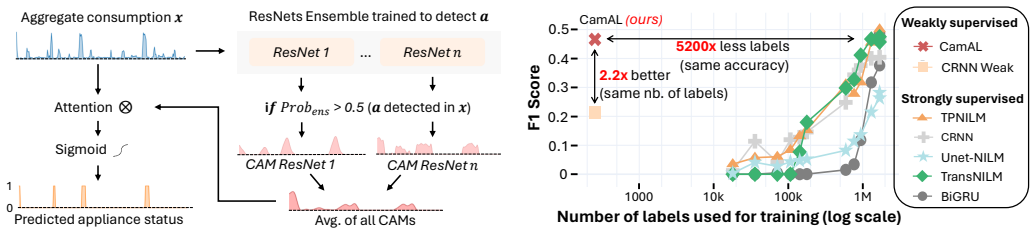
The machinery is the ensemble Class Activation Map (CAM). For a window $x$, each ResNet in the ensemble (kernel sizes $5,7,9,15$, selected per appliance) produces $\mathrm{CAM}_n(t) = \sum_k w^k_c\, f^k(t)$, where $w^k_c$ are the weights for class $c$ and $f^k(t)$ is the activation of the $k$-th feature map at time $t$. Each CAM is normalized to $[0,1]$, the normalized maps are averaged to $\mathrm{CAM}_{\mathrm{avg}}(t)$, that average is multiplied pointwise by the input $x(t)$ as an attention mask, passed through a sigmoid, and thresholded at $0.5$ to produce the predicted binary appliance status $\hat{y}(t)$. This converts a window-level detection decision into per-timestamp attributions, with the ensemble and attention multiplication suppressing the background aggregate consumption.
What would settle it
Take a house with submetered ground truth from UKDALE or REFIT, train CamAL only on window-level labels from other houses, and compare its thresholded binary status against the true appliance on-intervals timestamp by timestamp; if localization F1 is no better than a baseline that marks the whole window as active, or if it collapses on low-power continuous devices, the central localization claim fails.
Extended reading notes
Core claim
CamAL's central claim is that appliance detection and localization in aggregate electricity series can be solved without strong labels. A binary classifier ensemble is trained only on window-level labels; when the ensemble detects the appliance in a window, the normalized class activation maps of all models are averaged, multiplied point-wise by the input consumption, passed through a sigmoid, and thresholded at 0.5 to produce a binary status per timestamp. The paper presents this as the first explainability-based NILM approach and reports that on the Dishwasher case of the IDEAL dataset it achieves 2.2x higher F1 than the weakly supervised baseline at the same label count, and uses 5200x fewer training labels than strong-supervised seq2seq NILM baselines at equal accuracy.
Load-bearing premise
The method assumes that the averaged class activation maps of a classifier trained only on window-level labels point exactly at the timestamps when the target appliance is actually on, rather than at correlated background consumption or other appliances.
Editorial extensions
If this is right
- Appliance localization no longer requires per-timestamp ground truth; possession surveys or window-level presence labels are enough for training.
- The label bottleneck that limits NILM deployments is relaxed by orders of magnitude, by a factor of 5200x in the reported Dishwasher case.
- Explainability methods become a practical route to NILM, not merely post-hoc interpretation tools.
- Tools like DeviceScope can show consumers and suppliers which appliances run and when, directly from aggregate meter data.
- Because training and testing use distinct houses, the method is intended to transfer across households without submetering every home.
Reading between the lines
- An implication the paper leaves implicit is that CamAL's predicted binary status could be used as weak supervision to bootstrap stronger NILM models, or its attention weights could serve as soft targets.
- The reported 2.2x and 5200x factors come from one appliance (Dishwasher) on one dataset; the same margins are not demonstrated for all five appliances, so generalizing the exact factors to kettles, microwaves, washing machines, or showers is an extrapolation.
- Because localization inherits the classifier's discriminative signal, appliances with low power or long flat consumption profiles may produce fragmented on/off predictions under the 0.5 threshold, which is a testable prediction for future evaluation.
- The paper alternates between true possession-only labels (IDEAL survey) and window-presence labels derived from disaggregated data (UKDALE, REFIT); these two regimes may behave differently, and the possession-only case is the hardest and most deployment-relevant.
Editorial analysis
A structured set of objections, weighed in public.
Referee Report
Summary. The paper presents DeviceScope, an interactive web application for visualizing electricity consumption time series and for detecting and localizing appliance usage from aggregate smart-meter data. The underlying method, CamAL, trains an ensemble of residual-network classifiers on weak labels (appliance possession for IDEAL, window-level presence for UKDALE/REFIT), then extracts and averages class activation maps, masks the input signal, and thresholds the result to produce a binary per-timestamp appliance status prediction. The authors report that CamAL achieves 2.2x better F1 than a weakly supervised baseline and requires 5200x fewer labels than strongly supervised NILM methods on the dishwasher case of the IDEAL dataset. The paper also describes three demonstration scenarios for users to explore the data and compare CamAL against six baselines.
Significance. If the central claim holds, CamAL would be a genuinely useful step toward appliance localization with minimal annotation cost, which is relevant for smart-meter analytics and NILM research. The paper has clear strengths: it provides a live interactive demo (devicescope.streamlit.app), uses three public datasets, and compares against several recent NILM baselines. However, the empirical evidence currently consists of a single figure for one appliance and one dataset, with no error bars, no per-appliance or per-dataset tables, and no ablation study. The label discrepancy between the possession-only claim and the window-presence labels used for two of the three datasets is a load-bearing issue that needs to be resolved before the main claim is credible.
major comments (3)
- [II-A] The paper claims that CamAL 'only requires the knowledge of the existence of an appliance in a household to be trained', but the IDEAL training protocol assigns the same possession label to every subsequence of an owning household. A classifier trained on such labels can only separate owning from non-owning households; its CAMs are not anchored to actual activation intervals. The reported localization results on the IDEAL dishwasher case in Fig. 3 therefore need a control experiment to establish that the localization is driven by appliance activations rather than by baseline consumption or correlated appliances. Since the UKDALE and REFIT protocols use window-level presence labels derived from disaggregated data, the paper must report results separately for possession-only and window-presence training, or explicitly weaken the claim to window-presence supervision.
- [II-C, Fig. 3] The quantitative evidence is limited to one figure for one appliance (dishwasher, IDEAL). No per-appliance or per-dataset tables are given, no standard deviations or multiple runs are reported, and the exact evaluation protocol is not specified (e.g., window length, overlap, and how predicted binary status is matched to ground-truth appliance state for F1 computation). The 2.2x and 5200x figures may reflect a single favorable configuration. Please add full results for all five appliances across all three datasets, with error bars, and state the evaluation protocol precisely.
- [II-B, Steps 5-6] The localization formula s(t) = Sigmoid(CAM_avg(t) ∘ x(t)), followed by rounding at 0.5, is introduced without justification or comparison to simpler alternatives such as thresholding CAM_avg directly or applying Grad-CAM weights. The localization threshold, detection threshold, and ensemble architecture are hand-picked, so a sensitivity analysis or ablation is needed to show that the reported results are not artifacts of these choices.
minor comments (5)
- [II-A] The phrase 'using only one label for an entire series' is imprecise because each subsequence receives its own label; please clarify that the label is constant across all subsequences for the IDEAL possession protocol.
- [Fig. 1] It is unclear whether the colored intervals in the illustrative figure are ground truth or CamAL predictions; please add a caption explaining the visual encoding.
- [Fig. 3] The markers for the seven methods are not all identified in the caption, and the '2.2x' and '5200x' annotations should be explained in the caption or text.
- [II-A] The sentence 'we selected the networks that best detected specific appliances' does not state a selection criterion; please specify how the ensemble members are chosen and whether this selection is done on a validation set.
- [Abstract] The statement 'This paper appeared in ICDE 2025' belongs in a footnote or camera-ready notice, not in the abstract of a submission under review.
Circularity Check
No significant circularity: CamAL's localization is a post-hoc CAM heuristic, not a relabeled copy of its training inputs, and the few self-citations are not load-bearing.
full rationale
The derivation chain in CamAL is not circular. Training uses weak window-level labels (possession for IDEAL; presence/absence for UKDALE/REFIT), and the localization output is produced by thresholding a sigmoid of the averaged class activation map multiplied by the input. The CAM is a function of the trained classifier's parameters, not a direct transcription of the training labels, so the predicted appliance status is not equivalent to the input labels by construction. The paper's self-citations ([2], [5], [8]) justify architectural choices and the CAM formulation, but the CAM concept itself is attributed to external prior work ([9], [10]), and the cited results are empirically falsifiable rather than definitions of the central claim. Figure 3's 2.2x/5200x numbers are experimental comparisons, not fitted-input predictions. One genuine concern, noted by the skeptic, is that for IDEAL each subsequence receives the same possession label, so a classifier trained on those labels may not contain temporal information about appliance activation; but this is an overclaim or validity gap about whether the weak supervision is sufficient, not a circular reduction. Similarly, the abstract's 'only requires knowledge of existence' is stronger than the window-level presence labels actually used for UKDALE/REFIT, but again this is a scope mismatch rather than a self-referential derivation. No step in the paper reduces, by equation or by self-citation, to its own input, so the circularity score is 0.
Assumptions & free parameters
free parameters (3)
- Localization threshold =
0.5
- Detection threshold =
0.5
- Ensemble architecture choice =
5 models, kernel sizes {5,7,9,15}
assumptions (3)
- domain assumption CAM relevance from weak-label classifiers localizes actual appliance activation intervals
- ad hoc to paper A sigmoid of the pointwise product of normalized average CAM and the raw signal is a valid probability of appliance status
- domain assumption Window-level presence labels carry enough information to learn appliance-specific discriminative features
Cite this review
Pith. "Pith review of DeviceScope: An Interactive App to Detect and Localize Appliance Patterns in Electricity Consumption Time Series." pith.science (2026). https://pith.science/paper/KHCIV3SK
@misc{pith2026250605912,
  author       = {Pith},
  title        = {Pith review of: DeviceScope: An Interactive App to Detect and Localize Appliance Patterns in Electricity Consumption Time Series},
  year         = {2026},
  howpublished = {\url{https://pith.science/paper/KHCIV3SK}},
  note         = {Machine review of arXiv:2506.05912}
}
read the original abstract
In recent years, electricity suppliers have installed millions of smart meters worldwide to improve the management of the smart grid system. These meters collect a large amount of electrical consumption data to produce valuable information to help consumers reduce their electricity footprint. However, having non-expert users (e.g., consumers or sales advisors) understand these data and derive usage patterns for different appliances has become a significant challenge for electricity suppliers because these data record the aggregated behavior of all appliances. At the same time, ground-truth labels (which could train appliance detection and localization models) are expensive to collect and extremely scarce in practice. This paper introduces DeviceScope, an interactive tool designed to facilitate understanding smart meter data by detecting and localizing individual appliance patterns within a given time period. Our system is based on CamAL (Class Activation Map-based Appliance Localization), a novel weakly supervised approach for appliance localization that only requires the knowledge of the existence of an appliance in a household to be trained. This paper appeared in ICDE 2025.
Figures


Figures from the paper (1 more)

Reference graph
Works this paper leans on
-
[1]
A. Petralia, P. Boniol, P. Charpentier, and T. Palpanas. DeviceScope. [Online]. Available: https://devicescope.streamlit.app/
-
[2]
Appliance detection using very low-frequency smart meter time series,
A. Petralia, P. Charpentier, P. Boniol, and T. Palpanas, “Appliance detection using very low-frequency smart meter time series,” ine-Energy ’23, 2023
work page 2023
-
[3]
H. Rafiq, P. Manandhar, E. Rodriguez-Ubinas, O. Ahmed Qureshi, and T. Palpanas, “A review of current methods and challenges of advanced deep learning-based non-intrusive load monitoring (nilm) in residential context,”Energy and Buildings, 2024
work page 2024
-
[4]
P. Laviron, X. Dai, B. Huquet, and T. Palpanas, “Electricity demand ac- tivation extraction: From known to unknown signatures, using similarity search,” ine-Energy ’21, 2021
work page 2021
-
[5]
A. Petralia, P. Charpentier, and T. Palpanas, “Adf & transapp: A transformer-based framework for appliance detection using smart meter consumption series,”PVLDB, vol. 17, no. 3, 2023
work page 2023
-
[6]
M. Middlehurst, P. Sch ¨afer, and A. Bagnall, “Bake off redux: a review and experimental evaluation of recent time series classification algo- rithms,”Data Min. Knowl. Discov., vol. 38, 2024
work page 2024
-
[7]
Time series classification from scratch with deep neural networks: A strong baseline,
Z. Wang, W. Yan, and T. Oates, “Time series classification from scratch with deep neural networks: A strong baseline,”IJCNN, 2016
work page 2016
-
[8]
Dcam: Dimension- wise class activation map for explaining multivariate data series classi- fication,
P. Boniol, M. Meftah, E. Remy, and T. Palpanas, “Dcam: Dimension- wise class activation map for explaining multivariate data series classi- fication,” inSIGMOD ’22, 2022
work page 2022
Show all 13 references
-
[9]
Learning deep features for discriminative localization,
B. Zhou, A. Khosla, A. Lapedriza, A. Oliva, and A. Torralba, “Learning deep features for discriminative localization,” inCVPR, 2016
2016
-
[10]
Grad-cam: Visual explanations from deep networks via gradient-based localization,
R. R. Selvaraju, M. Cogswell, A. Das, R. Vedantam, D. Parikh, and D. Batra, “Grad-cam: Visual explanations from deep networks via gradient-based localization,” in2017 ICCV, 2017
2017
-
[11]
The uk-dale dataset, domestic appliance- level electricity demand and whole-house demand from five uk homes,
J. Kelly and W. Knottenbelt, “The uk-dale dataset, domestic appliance- level electricity demand and whole-house demand from five uk homes,” Scientific Data, vol. 2, 2015
2015
-
[12]
REFIT Smart Home dataset,
S. Firth, T. Kane, V . Dimitriou, T. Hassan, F. Fouchal, M. Coleman et al., “REFIT Smart Home dataset,” 2017
2017
-
[13]
The ideal household energy dataset, electricity, gas, contextual sensor data and survey data for 255 uk homes,
M. Pullinger, J. Kilgour, N. Goddard, N. Berliner, L. Webb, M. Dzikovska, H. Lovell, J. Mann, C. Sutton, J. Webb, and M. Zhong, “The ideal household energy dataset, electricity, gas, contextual sensor data and survey data for 255 uk homes,”Scientific Data, 2021
2021
Reviewed August 7, 2026 · model on record in the stance chip above.
Discussion (0). Sign in to comment.