REVIEW 3 major objections 6 minor 223 references
The Interplay of Polar and Nematic Order in Active Matter: Implications for Non-Equilibrium Physics and Biology
T0 review · 3 major / 6 minor · reviewed 2026-08-07 · deepseek-v4-flash
Pith's one-line read Biological active matter routinely mixes polar and nematic order, so single-symmetry theories miss essential physics.
desk verdict Useful review of mixed polar-nematic order, but the evidence for genuine local coexistence is thinner than the abstract suggests. read the letter →
The pith
A machine-rendered reading of the paper's core claim, the machinery that carries it, and where it could break.
The reading
What carries the argument
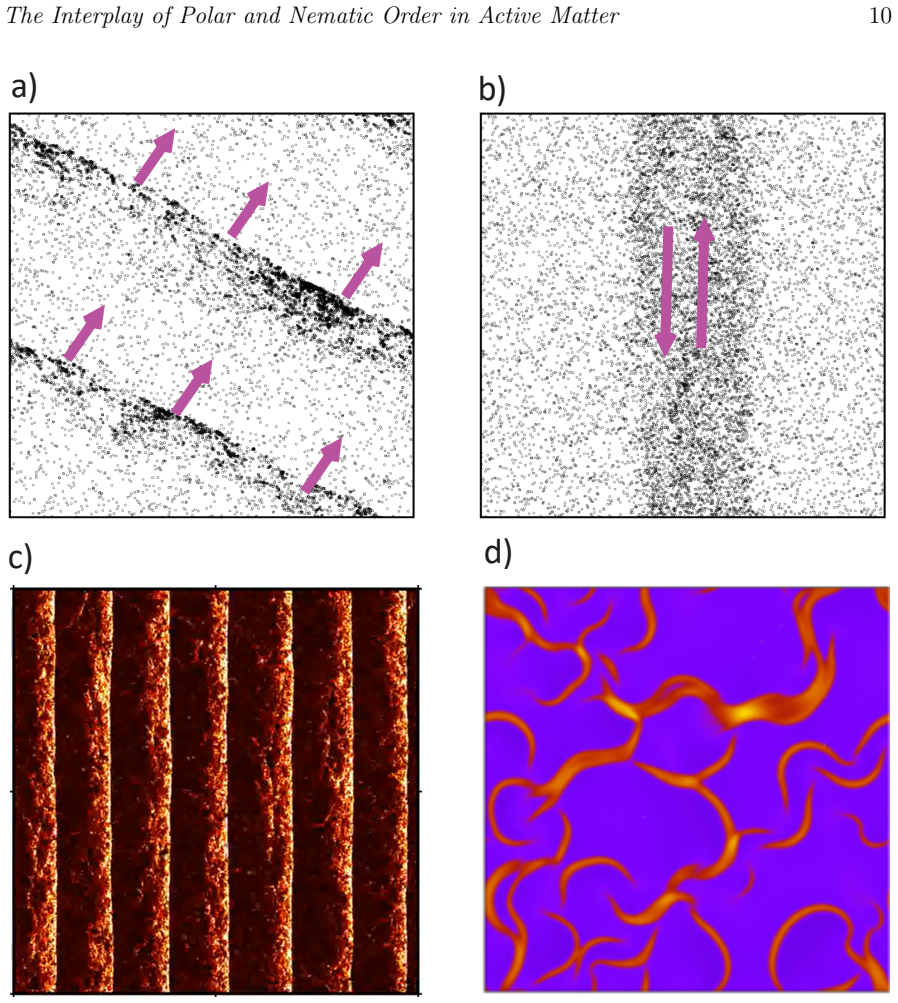
The central object is the coupled polar-nematic order parameter pair (P, Q), a vector polarization field P and a traceless second-rank nematic tensor Q, evolved together through free energies or kinetic equations. The key identity doing the work is the topological charge: polar fields admit integer defects (±1) while nematic fields admit half-integer defects (±1/2), so the presence of both charge types in one system is taken as the fingerprint of mixed symmetry. The specific mechanism reviewed is the addition of a nematic gradient term, (∇(PPᵀ − P²I/2))², to a polar free energy, which penalizes head-tail-symmetric distortions and lets the same field produce both integer and half-integer defects; along with kinetic collision rules with a polar-bias parameter ψ that interpolates between purely nematic (ψ=0) and purely polar (ψ=π/2) alignment, producing bistable coexistence of nematic bands and polar waves.
What would settle it
A decisive test would be to take a dense bacterial suspension in which half-integer defects are observed and continuously increase cell aspect ratio, alignment strength, or confinement; if the system transitions directly from half-integer nematic defects to full-integer polar defects with no regime in which both defect types coexist, the central claim of pervasive mixed symmetry would fail. Alternatively, a measurement showing that the kinetic energy spectrum of a 3D E. coli suspension matches pure nematic theory once boundary and finite-size effects are removed would undercut the need for mixed-symmetry models.
Extended reading notes
Core claim
The paper's central claim is that the symmetry dichotomy between polar and nematic active matter, though useful as a starting point, is insufficient for real biological systems where the two symmetries intertwine. Concretely, it assembles evidence that dense bacterial suspensions, actomyosin motility assays, epithelial monolayers, and endothelial cell layers under shear exhibit signatures of both order types at once—for example, half-integer nematic defects arising in populations of individually polar cells, or polar clusters coexisting with nematic lanes. The review argues that these observations are naturally accommodated by models that couple a polar order parameter P with a nematic tensor Q, either by adding nematic elastic terms to a polar free energy or by allowing collisions with a tunable polar bias. In such mixed-symmetry theories, full-integer and half-integer defects can coexist, and a distinct 'nematopolar' phase can form in which polar defects are connected by confining strings. The paper therefore establishes coexistence of symmetries as a general organizing principle for active matter, with consequences for how turbulence spectra, defect dynamics, and tissue morphogenesis are interpreted.
Load-bearing premise
The argument rests on the interpretation that the experimental systems cited—bacteria, actomyosin networks, and cell monolayers—genuinely exhibit coexisting polar and nematic order rather than being single-symmetry systems whose defect dynamics only look mixed.
Editorial extensions
If this is right
- Experimental systems such as dense bacteria and cell monolayers should be re-analyzed with both P and Q fields measured, rather than assuming one symmetry class.
- Active turbulence energy spectra that currently fit neither polar nor nematic theories (e.g., 3D E. coli suspensions with E(q)∝q^−3) may be explained by mixed-symmetry models.
- Mixed-symmetry theories predict a nematopolar phase where polar defects are connected by confining strings, offering a testable signature in experiments such as endothelial layers under shear.
- Coupled polar-nematic models could guide design of synthetic active materials with tunable defect textures and programmable flows.
- A unified polar-nematic framework would connect the physics of active turbulence, interfacial dynamics, and biological morphogenesis under one set of equations.
Reading between the lines
- If the coexistence claim is right, the ratio of +1/2 to +1 defect populations could serve as an order parameter for the polar-nematic balance, and should be continuously tunable by alignment strength or cell aspect ratio in experiments.
- The defect strings in the nematopolar phase may have an analogue in ferroelectric nematic liquid crystals, where polar domains are separated by walls; comparing string tension measurements across these systems could test whether the same coupling physics is at work.
- A sharper test would be measuring the kinetic energy spectrum in a single bacterial species across densities: it should show a crossover from pure-nematic scaling to mixed scaling as polar order grows, and the review's own Table 1 suggests where to look.
- The review's emphasis on mixed order implies that standard motility-induced phase separation theories extended to p-atic symmetries may need to include polar-nematic cross-coupling terms to capture dense-phase structure.
Editorial analysis
A structured set of objections, weighed in public.
Referee Report
Summary. This review paper argues that polar and nematic order often coexist in biological active matter, and that single-symmetry theoretical frameworks are therefore insufficient to capture the behavior of many real-world systems. It surveys discrete particle models and continuum theories for polar and nematic active matter, covering phase separation, topological defects, active turbulence, and active interfaces. The later sections focus on recent models and experiments that aim to capture mixed polar–nematic order, including defect-string structures and phase diagrams with coexisting full- and half-integer defects, and conclude with an outlook toward future experimental and theoretical work.
Significance. If the central claim is correct, the review would articulate a genuinely important limitation of the standard polar/nematic dichotomy and could motivate new modeling frameworks for bacteria, cell monolayers, and cytoskeletal networks. The paper is well organized, covers a broad and current literature, and draws useful connections between discrete, continuum, and experimental studies. It also gives explicit attention to open challenges and future directions. However, the strength of the evidence presented is not fully commensurate with the claim, and the review would benefit from a more careful calibration of its conclusions.
major comments (3)
- [Sec. 4.5 and Sec. 5.1] The statement that the polar/nematic distinction is 'insufficient to describe many real-world systems' is stronger than the experimental evidence assembled in the review. The two principal experimental examples are (i) bacterial suspensions with half-integer defects, which Sec. 4.1 immediately qualifies with 'Defects, however, are not conclusive evidence that systems exhibit dual polar and nematic behavior,' and (ii) the actomyosin motility assay (Ref. [30]), which shows spatial coexistence of polar waves and nematic lanes in different regions rather than local intertwining of the order parameters. The genuinely local evidence, defect strings in endothelial cell layers (Ref. [219]), is a bioRxiv preprint, and Sec. 5.1 admits 'experimental validation remains limited' and 'there is a lack of experimental data to support these predictions.' The central claim should be reframed as a promising but still partially supported hypothesis, with an explicit distinction between spatial coexistence and local order-parameter coupling.
- [Sec. 3.4.1] The text states that 'polar defects with full-integer charges remain symmetric and cannot self-propel; they instead rotate or diffuse passively with the flow field' and cites Refs. [159–162]. Reference [159] is Rønning et al., 'Spontaneous flows and dynamics of full-integer topological defects in polar active matter,' a paper specifically devoted to the spontaneous flows and dynamics of such defects. This citation appears to contradict the claim it is meant to support. Please either correct the statement (e.g., distinguish defect self-propulsion from flow-induced motion) or replace the citation with ones that actually support the claim.
- [Sec. 4.3–4.5] The discussion of mixed-symmetry models leans very heavily on the authors' own group's work (Refs. [36], [104], [154], [218]) together with two other recent preprints (Refs. [219], [221]). While self-citation is not inherently problematic, the review presents these models and predictions as an emerging consensus without noting that they have not yet been independently reproduced or, in several cases, peer-reviewed. For a review aimed at establishing a new research direction, it would be appropriate to explicitly flag the preprint status of Refs. [218], [219], and [221] and to frame these as a small set of recent proposals rather than as an established framework.
minor comments (6)
- [Throughout] The manuscript contains many typos and grammatical errors, including 'co-exit' (Sec. 4.1), 'halg-integer' (Sec. 4.5), 'nemetic' (Fig. 9 caption), 'isotorpic' (Sec. 2), 'exbibit' (Sec. 2.3.1), 'self-population' (Sec. 2.3.2, presumably 'self-propulsion'), 'Onsaguer' (Sec. 3.2.5), and 'Squiermers' (Sec. 2.1.2). A careful proofreading pass is needed.
- [Box 1] The text says the topological charge m is 'determined as multiples of π'; the standard definition is that the winding number is the total rotation divided by 2π, so the phrasing is confusing and should be clarified.
- [Eq. (7)] The displayed equation for the orientation dynamics of a hydrodynamic particle has a mismatched bracket and an unexplained tensor-product symbol; the standard Jeffery-type equation should be written with the projector (I - e_i e_i^T) acting on (Ω·e_i + B E·e_i). Please check the formula.
- [Sec. 2.2.1] The nematic tensor Q is displayed as an unformatted matrix with unclear entries; a standard 2x2 matrix definition would improve readability.
- [References] Several key claims in the review rely on arXiv or bioRxiv preprints (Refs. [43], [218], [219], [221]). Where possible, update these to published versions, and in the text mark the preprint status so that readers can assess the evidence appropriately.
- [Sec. 3.4.1] The phrase 'in passive system [152]' should be 'in passive systems' and the citation to Mermin-Wagner should be supplemented with a more specific reference to the 2D continuous-symmetry result.
Circularity Check
No significant circularity: the review is a synthesis, its self-citations are illustrative rather than load-bearing, and the central claim is anchored by independent experiments plus explicit admissions of limited validation.
full rationale
This is a review article, not a derivation: it introduces no new equations, fits no parameters to data, and makes no numerical prediction that is obtained from its own inputs by construction. The central thesis—that polar and nematic order often coexist and that single-symmetry descriptions are insufficient—rests on a combination of independent experiments and theory, including the actomyosin experiment of Huber et al. [30], bacterial active turbulence of Wensink et al. [140], living liquid crystals of Zhou et al. [206], and the kinetic model of Denk and Frey [34]. The authors' own models, such as the mixed polar-nematic free energy of Ref. [36] and the nematopolar theory of Ref. [218], are presented as illustrative theoretical proposals, not as unique derivations or as the sole justification for the review's thesis. The manuscript also repeatedly disclaims evidentiary strength: Section 4.1 states 'Defects, however, are not conclusive evidence that systems exhibit dual polar and nematic behavior,' and Section 5.1 acknowledges that 'experimental validation remains limited' and 'there is a lack of experimental data to support these predictions.' These caveats show that the modeling examples are not being used as fitted predictions or as self-referential proofs. While the review contains several self-citations by the same group, none is load-bearing in the sense of replacing an external benchmark or forcing the central claim by a self-citation chain. The self-cited works are part of the normal scholarly record of the field and are accompanied by independent experimental evidence. I therefore find no circular step meeting the required evidentiary standard; the score of 2 reflects minor self-citation that is not load-bearing, not actual circularity.
Assumptions & free parameters
assumptions (3)
- domain assumption The experimental systems cited genuinely exhibit coexisting polar and nematic order.
- domain assumption Mermin-Wagner theorem can be violated in active systems due to breaking of detailed balance.
- standard math Near-isotropy of the one-particle distribution in the Boltzmann derivation (Section 3.1.1), used to truncate the expansion to order epsilon^3.
Cite this review
Pith. "Pith review of The Interplay of Polar and Nematic Order in Active Matter: Implications for Non-Equilibrium Physics and Biology." pith.science (2026). https://pith.science/paper/I4OYO2KW
@misc{pith2026250605931,
  author       = {Pith},
  title        = {Pith review of: The Interplay of Polar and Nematic Order in Active Matter: Implications for Non-Equilibrium Physics and Biology},
  year         = {2026},
  howpublished = {\url{https://pith.science/paper/I4OYO2KW}},
  note         = {Machine review of arXiv:2506.05931}
}
read the original abstract
Active matter has played a pivotal role in advancing our understanding of non-equilibrium systems, leading to a fundamental shift in the study of biophysical phenomena. The foundation of active matter research is built on assumptions regarding the symmetry of microscopic constituents. While these assumptions have been validated extensively, instances of mixed or joint symmetries are prevalent in biological systems. This review explores the coexistence of polar and nematic order in active matter, emphasizing the theoretical and experimental challenges associated with these systems. By integrating insights from recent studies, we highlight the importance of considering mixed symmetries to accurately describe biological processes. This exploration not only benefits the field of biology but could also open new horizons for non-equilibrium physics, offering a comprehensive framework for understanding complex behavior in active matter.
Figures


Figures from the paper (6 more)


Reference graph
Works this paper leans on
-
[159]
Toner, J. Giant number fluctuations in dry active polar fluids: A shocking analogy with lightning rods.The Journal of Chemical Physics150, 154120 (2019)
work page 2019
-
[30]
Biol.5, 1026–1035 (2013)
Doxzen, K.et al.Guidance of collective cell migration by substrate geometry.Integr. Biol.5, 1026–1035 (2013)
2013
-
[219]
Giomi, L., Toner, J. & Sarkar, N. Hydrodynamic theory of p-atic liquid crystals.Physical Review E106, 024701 (2022)
work page 2022
-
[36]
& Frey, E
Denk, J. & Frey, E. Pattern-induced local symmetry breaking in active-matter systems. Proceedings of the National Academy of Sciences117, 31623–31630 (2020)
2020
-
[104]
Zantop, A. W. & Stark, H. Emergent collective dynamics of pusher and puller squirmer rods: swarming, clustering, and turbulence.Soft Matter18, 6179–6191 (2022)
2022
-
[154]
Mermin, N. D. & Wagner, H. Absence of ferromagnetism or antiferromagnetism in one-or two- dimensional isotropic heisenberg models.Phys. Rev. Lett.17, 1133 (1966)
work page 1966
-
[218]
Flexoelectricity versus Electrostatics in Polar Nematic Liquid Crystals
Paik, L. & Selinger, J. V. Flexoelectricity versus electrostatics in polar nematic liquid crystals. arXiv preprint arXiv:2408.10347(2024)
work page Pith review arXiv 2024
-
[221]
Ruider, I.et al.Topological excitations govern ordering kinetics in endothelial cell layers.bioRxiv 2024.09.26.615134(2024)
work page 2024
Show all 223 references
-
[1]
Pedley, T. J. & Kessler, J. O. Hydrodynamic phenomena in suspensions of swimming microorganisms.Annual Review of Fluid Mechanics24, 313–358 (1992)
1992
-
[2]
& Powers, T
Lauga, E. & Powers, T. R. The hydrodynamics of swimming microorganisms.Reports on Progress in Physics72, 096601 (2009)
2009
-
[3]
Bechinger, C.et al.Active particles in complex and crowded environments.Reviews of modern physics88, 045006 (2016)
2016
-
[4]
Mixed polar and nematic order in active matter The review of polar and nematic order in active matter highlights the fundamentally different physics that emerge when these symmetries are explored in isolation, both at the discrete particle level and at the continuum level. As ...
-
[5]
Current Challenges and Future Directions The study of coexisting symmetries in active matter, particularly focusing on polar and nematic order, is an emerging field with increasing evidence pointing to their coexistence and its importance. While significant progress has been m...
-
[6]
Gompper, G.et al.The 2020 motile active matter roadmap.Journal of Physics: Condensed Matter32, 193001 (2020)
2020
-
[7]
C.et al.Hydrodynamics of soft active matter.Rev
Marchetti, M. C.et al.Hydrodynamics of soft active matter.Rev. Mod. Phys.85, 1143–1189 (2013)
2013
-
[8]
& Joanny, J.-F
Prost, J., J¨ ulicher, F. & Joanny, J.-F. Active gel physics.Nature Physics11, 111–117 (2015)
2015
-
[9]
Doostmohammadi, A., Ign´ es-Mullol, J., Yeomans, J. M. & Sagu´ es, F. Active nematics.Nature Communications9, 3246 (2018)
2018
-
[10]
Dry aligning dilute active matter.Annual Review of Condensed Matter Physics11, 189–212 (2020)
Chat´ e, H. Dry aligning dilute active matter.Annual Review of Condensed Matter Physics11, 189–212 (2020)
2020
-
[11]
& Dogic, Z
Needleman, D. & Dogic, Z. Active matter at the interface between materials science and cell biology.Nature Reviews Materials2, 1–14 (2017)
2017
-
[12]
J., Fakhri, N., Marchetti, M
Bowick, M. J., Fakhri, N., Marchetti, M. C. & Ramaswamy, S. Symmetry, thermodynamics, and topology in active matter.Phys. Rev. X12, 010501 (2022)
2022
-
[13]
& Nagpal, R
Rubenstein, M., Cornejo, A. & Nagpal, R. Programmable self-assembly in a thousand-robot swarm.Science345, 795–799 (2014)
2014
-
[14]
& Stark, H
Z¨ ottl, A. & Stark, H. Emergent behavior in active colloids.Journal of Physics: Condensed Matter28, 253001 (2016)
2016
-
[15]
& Shochet, O
Vicsek, T., Czir´ ok, A., Ben-Jacob, E., Cohen, I. & Shochet, O. Novel type of phase transition in a system of self-driven particles.Phys. Rev. Lett.75, 1226–1229 (1995)
1995
-
[16]
Dombrowski, C., Cisneros, L., Chatkaew, S., Goldstein, R. E. & Kessler, J. O. Self-concentration and large-scale coherence in bacterial dynamics.Phys. Rev. Lett.93, 098103 (2004)
2004
-
[17]
Sanchez, T., Chen, D. T. N., DeCamp, S. J., Heymann, M. & Dogic, Z. Spontaneous motion in hierarchically assembled active matter.Nature491, 431–434 (2012)
2012
-
[18]
L., Gardel, M
Zhang, R., Kumar, N., Ross, J. L., Gardel, M. L. & de Pablo, J. J. Interplay of structure, elasticity, and dynamics in actin-based nematic materials.Proceedings of the National Academy of Sciences115, E124–E133 (2018)
2018
-
[19]
& Levis, D
Liebchen, B. & Levis, D. Collective behavior of chiral active matter: Pattern formation and enhanced flocking.Phys. Rev. Lett.119, 058002 (2017)
2017
-
[20]
Toner, J.The Physics of Flocking: Birth, Death, and Flight in Active Matter(Cambridge University Press, 2024)
2024
-
[21]
Buhl, C.et al.From disorder to order in marching locusts.Science312, 1402–1406 (2006)
2006
-
[22]
Cates, M. E. & Tailleur, J. Motility-induced phase separation.Annual Review of Condensed Matter Physics6, 219–244 (2015)
2015
-
[23]
J., Mishra, P., Sknepnek, R
Giomi, L., Bowick, M. J., Mishra, P., Sknepnek, R. & Cristina Marchetti, M. Defect dynamics in active nematics.Philosophical Transactions of the Royal Society A: Mathematical, Physical and Engineering Sciences372, 20130365 (2014)
2014
-
[24]
Edwards, S. A. & Yeomans, J. M. Spontaneous flow states in active nematics: A unified picture. EPL (Europhysics Letters)85, 18008 (2009)
2009
-
[25]
G., Dunkel, J., Kessler, J
Wioland, H., Woodhouse, F. G., Dunkel, J., Kessler, J. O. & Goldstein, R. E. Confinement stabilizes a bacterial suspension into a spiral vortex.Phys. Rev. Lett.110, 268102 (2013)
2013
-
[26]
B., Xi, W., Ladoux, B
Saw, T. B., Xi, W., Ladoux, B. & Lim, C. T. Biological tissues as active nematic liquid crystals. Advanced Materials30, 1802579 (2018)
2018
-
[27]
& Ladoux, B
Balasubramaniam, L., M` ege, R.-M. & Ladoux, B. Active nematics across scales from cytoskeleton organization to tissue morphogenesis.Current Opinion in Genetics & Development73, 101897 (2022). The Interplay of Polar and Nematic Order in Active Matter43
2022
-
[28]
& Cheng, X
Liu, Z., Zeng, W., Ma, X. & Cheng, X. Density fluctuations and energy spectra of 3d bacterial suspensions.Soft Matter17, 10806–10817 (2021)
2021
-
[29]
Duclos, G.et al.Spontaneous shear flow in confined cellular nematics.Nature Physics14, 728–732 (2018)
2018
-
[31]
B.et al.Topological defects in epithelia govern cell death and extrusion.Nature544, 212–216 (2017)
Saw, T. B.et al.Topological defects in epithelia govern cell death and extrusion.Nature544, 212–216 (2017)
2017
-
[32]
& Bausch, A
Huber, L., Suzuki, R., Kr¨ uger, T., Frey, E. & Bausch, A. R. Emergence of coexisting ordered states in active matter systems.Science361, 255–258 (2018)
2018
-
[33]
Ruider, I.et al.Topological excitations govern ordering kinetics in endothelial cell layers.bioRxiv 2024.09.26.615134 (2024)
2024
-
[34]
& Roux, A
Guillamat, P., Blanch-Mercader, C., Pernollet, G., Kruse, K. & Roux, A. Integer topological defects organize stresses driving tissue morphogenesis.Nature Materials21, 588–597 (2022)
2022
-
[35]
P´ erez-Gonz´ alez, C.et al.Active wetting of epithelial tissues.Nature Physics15, 79–88 (2019)
2019
-
[37]
J., Doostmohammadi, A., Foster, K
Meacock, O. J., Doostmohammadi, A., Foster, K. R., Yeomans, J. M. & Durham, W. M. Bacteria solve the problem of crowding by moving slowly.Nature Physics17, 205–210 (2021)
2021
-
[38]
& Doostmohammadi, A
Amiri, A., Mueller, R. & Doostmohammadi, A. Unifying polar and nematic active matter: emergence and co-existence of half-integer and full-integer topological defects.Journal of Physics A: Mathematical and Theoretical55, 094002 (2022)
2022
-
[39]
Han, E.et al.Local polar order controls mechanical stress and triggers layer formation in myxococcus xanthus colonies.Nature Communications16, 952 (2025)
2025
-
[40]
H., Foster, K
Wheeler, J. H., Foster, K. R. & Durham, W. M. Individual bacterial cells can use spatial sensing of chemical gradients to direct chemotaxis on surfaces.Nature Microbiology9, 2308–2322 (2024)
2024
-
[41]
& Harne, R
Pishvar, M. & Harne, R. L. Foundations for soft, smart matter by active mechanical metamaterials.Advanced Science7, 2001384 (2020)
2020
-
[42]
& Coulais, C
Brandenbourger, M., Scheibner, C., Veenstra, J., Vitelli, V. & Coulais, C. Limit cycles turn active matter into robots.arXiv preprint arXiv:2108.08837(2022)
2022 arXiv
-
[43]
& Laukaityte, U
Harrison, D., Rorot, W. & Laukaityte, U. Mind the matter: Active matter, soft robotics, and the making of bio-inspired artificial intelligence.Frontiers in Neurorobotics16, 880724 (2022)
2022
-
[44]
J., Marchetti, M
Shankar, S., Souslov, A., Bowick, M. J., Marchetti, M. C. & Vitelli, V. Topological active matter. Nature Reviews Physics4, 380–398 (2022)
2022
-
[45]
Pearce, D. J. G., Mart ´ ınez-Prat, B., Ign´ es-Mullol, J. & Sagu´ es, F. Topological defects lead to energy transfer in active nematics.arXiv preprint arXiv:2411.18214(2024)
2024
-
[46]
& Schweitzer, F
Erdmann, U., Ebeling, W., Schimansky-Geier, L. & Schweitzer, F. Brownian particles far from equilibrium.The European Physical Journal B15, 105–113 (2000)
2000
-
[47]
Cates, M. E. Diffusive transport without detailed balance in motile bacteria: does microbiology need statistical physics?Reports on Progress in Physics75, 042601 (2012)
2012
-
[48]
N., Rosso, A
Basu, U., Majumdar, S. N., Rosso, A. & Schehr, G. Active brownian motion in two dimensions. Physical Review E98, 062121 (2018)
2018
-
[49]
& Cates, M
Tailleur, J. & Cates, M. E. Statistical Mechanics of Interacting Run-and-Tumble Bacteria.Phys. Rev. Lett.100, 218103 (2008). Publisher: American Physical Society
2008
-
[50]
Fodor, E.et al.How far from equilibrium is active matter?Phys. Rev. Lett.117, 038103 (2016)
2016
-
[51]
Bonilla, L. L. Active ornstein-uhlenbeck particles.Physical Review E100, 022601 (2019)
2019
-
[52]
Martin, D.et al.Statistical mechanics of active ornstein-uhlenbeck particles.Physical Review E103, 032607 (2021)
2021
-
[53]
Maggi, C., Marconi, U. M. B., Gnan, N. & Di Leonardo, R. Multidimensional stationary probability distribution for interacting active particles.Scientific Reports5, 10742 (2015). The Interplay of Polar and Nematic Order in Active Matter44
2015
-
[54]
Uhlenbeck, G. E. & Ornstein, L. S. On the theory of the brownian motion.Physical Review36, 823–841 (1930)
1930
-
[55]
& Di Leonardo, R
Koumakis, N., Maggi, C. & Di Leonardo, R. Directed transport of active particles over asymmetric energy barriers.Soft Matter10, 5695–5701 (2014)
2014
-
[56]
& Silberzan, P
Deforet, M., Hakim, V., Yevick, H., Duclos, G. & Silberzan, P. Emergence of collective modes and tri-dimensional structures from epithelial confinement.Nature Communications5, 3747 (2014)
2014
-
[57]
& Silberzan, P
Hakim, V. & Silberzan, P. Collective cell migration: a physics perspective.Reports on Progress in Physics80, 076601 (2017)
2017
-
[58]
Khatami, M., Wolff, K., Pohl, O., Ejtehadi, M. R. & Stark, H. Active brownian particles and run-and-tumble particles separate inside a maze.Scientific Reports6, 37670 (2016)
2016
-
[59]
& Schimansky-Geier, L
Romanczuk, P., B¨ ar, M., Ebeling, W., Lindner, B. & Schimansky-Geier, L. Active brownian particles: From individual to collective stochastic dynamics.The European Physical Journal Special Topics202, 1–162 (2012)
2012
-
[60]
Higdon, J. J. L. A hydrodynamic analysis of flagellar propulsion.Journal of Fluid Mechanics 90, 685 (1979)
1979
-
[61]
Deng, J., Molaei, M., Chisholm, N. G. & Stebe, K. J. Interfacial flow around a pusher bacterium. Journal of Fluid Mechanics976, A18 (2023)
2023
-
[62]
& Alam, M.-R
Mirzakhanloo, M., Esmaeilzadeh, S. & Alam, M.-R. Active cloaking in stokes flows via reinforcement learning.Journal of Fluid Mechanics903, A34 (2020)
2020
-
[63]
A., Ishikawa, T., Yamaguchi, T
Evans, A. A., Ishikawa, T., Yamaguchi, T. & Lauga, E. Orientational order in concentrated suspensions of spherical microswimmers.Physics of Fluids23, 111702 (2011)
2011
-
[64]
Lighthill, M. J. On the squirming motion of nearly spherical deformable bodies through liquids at very small reynolds numbers.Communications on Pure and Applied Mathematics5, 109–118 (1952)
1952
-
[65]
& Menzel, A
Pessot, G., L¨ owen, H. & Menzel, A. M. Binary pusher–puller mixtures of active microswimmers and their collective behaviour.Molecular Physics116, 3401–3408 (2018)
2018
-
[66]
& Doi, M
Makino, M. & Doi, M. Brownian motion of a particle of general shape in newtonian fluid.Journal of the Physical Society of Japan73, 2739–2745 (2004)
2004
-
[67]
Reinken, H.Derivation of a Continuum Theory for Polar Active Fluids, 61–91 (Springer Nature Switzerland, 2024)
2024
-
[68]
Blake, J. R. A spherical envelope approach to ciliary propulsion.Journal of Fluid Mechanics 46, 199–208 (1971)
1971
-
[69]
G¨ otze, I. O. & Gompper, G. Mesoscale simulations of hydrodynamic squirmer interactions. Physical Review E82, 041921 (2010)
2010
-
[70]
& Pedley, T
Ishikawa, T., Simmonds, M. & Pedley, T. J. Hydrodynamic interaction of two swimming model micro-organisms.Journal of Fluid Mechanics568, 119–160 (2006)
2006
-
[71]
& Chat´ e, H
Mahault, B. & Chat´ e, H. Long-range nematic order in two-dimensional active matter.Phys. Rev. Lett.127, 048003 (2021)
2021
-
[72]
& Chat´ e, H
Ngo, S., Ginelli, F. & Chat´ e, H. Competing ferromagnetic and nematic alignment in self-propelled polar particles.Physical Review E86, 050101 (2012)
2012
-
[73]
P., Chat´ e, H
Solon, A. P., Chat´ e, H. & Tailleur, J. From phase to microphase separation in flocking models: The essential role of nonequilibrium fluctuations.Phys. Rev. Lett.114, 068101 (2015)
2015
-
[74]
Ngo, S.et al.Large-scale chaos and fluctuations in active nematics.Phys. Rev. Lett.113, 038302 (2014)
2014
-
[75]
& Montagne, R
Chat´ e, H., Ginelli, F. & Montagne, R. Simple model for active nematics: Quasi-long-range order and giant fluctuations.Phys. Rev. Lett.96, 180602 (2006)
2006
-
[76]
& Morozov, A
ˇSkult´ ety, V., Nardini, C., Stenhammar, J., Marenduzzo, D. & Morozov, A. Swimming suppresses correlations in dilute suspensions of pusher microorganisms.Physical Review X10, 031059 (2020)
2020
-
[77]
& Marchetti, M
Fily, Y. & Marchetti, M. C. Athermal phase separation of self-propelled particles with no The Interplay of Polar and Nematic Order in Active Matter45 alignment.Phys. Rev. Lett.108, 235702 (2012)
2012
-
[78]
F., Gonnella, G
Digregorio, P., Levis, D., Cugliandolo, L. F., Gonnella, G. & Pagonabarraga, I. Unified analysis of topological defects in 2d systems of active and passive disks.Soft Matter18, 566–591 (2022)
2022
-
[79]
T., L¨ owen, H
Bialk´ e, J., Siebert, J. T., L¨ owen, H. & Speck, T. Negative interfacial tension in phase-separated active brownian particles.Phys. Rev. Lett.115, 098301 (2015)
2015
-
[80]
& Nardini, C
Fausti, G., Tjhung, E., Cates, M. & Nardini, C. Capillary interfacial tension in active phase separation.Phys. Rev. Lett.127, 068001 (2021)
2021
-
[81]
& Schmidt, M
Hermann, S., de las Heras, D. & Schmidt, M. Non-negative interfacial tension in phase-separated active brownian particles.Phys. Rev. Lett.123, 268002 (2019)
2019
-
[82]
& L¨ owen, H
Mandal, S., Liebchen, B. & L¨ owen, H. Motility-induced temperature difference in coexisting phases.Phys. Rev. Lett.123, 228001 (2019)
2019
-
[83]
Lee, C. F. An infinite set of integral formulae for polar, nematic, and higher order structures at the interface of motility-induced phase separation.New Journal of Physics24, 043010 (2022)
2022
-
[84]
& Levis, D
Ses´ e-Sansa, E., Pagonabarraga, I. & Levis, D. Velocity alignment promotes motility-induced phase separation.EPL (Europhysics Letters)124, 30004 (2018)
2018
-
[85]
& Tailleur, J
Spera, G., Duclut, C., Durand, M. & Tailleur, J. Nematic torques in scalar active matter: When fluctuations favor polar order and persistence.Phys. Rev. Lett.132, 078301 (2024)
2024
-
[86]
& L¨ owen, H
Caprini, L. & L¨ owen, H. Flocking without alignment interactions in attractive active brownian particles.Phys. Rev. Lett.130, 148202 (2023)
2023
-
[87]
& Stark, H
Kneˇ zevi´ c, M., Welker, T. & Stark, H. Collective motion of active particles exhibiting non- reciprocal orientational interactions.Scientific Reports12, 19437 (2022)
2022
-
[88]
Fruchart, M., Hanai, R., Littlewood, P. B. & Vitelli, V. Non-reciprocal phase transitions.Nature 592, 363–369 (2021)
2021
-
[89]
Dinelli, A.et al.Non-reciprocity across scales in active mixtures.Nature Communications14, 7035 (2023)
2023
-
[90]
arXiv preprint arXiv:2410.18017(2024)
Chao, Y.-C.et al.Selective excitation of work-generating cycles in nonreciprocal living solids. arXiv preprint arXiv:2410.18017(2024)
2024 arXiv
-
[91]
& Pedley, T
Ishikawa, T. & Pedley, T. J. Coherent structures in monolayers of swimming particles.Phys. Rev. Lett.100, 088103 (2008)
2008
-
[92]
& Pagonabarraga, I
Alarc´ on, F., Valeriani, C. & Pagonabarraga, I. Morphology of clusters of attractive dry and wet self-propelled spherical particle suspensions.Soft Matter13, 814–826 (2017)
2017
-
[93]
& Stenhammar, J
B´ ardfalvy, D.,ˇSkult´ ety, V., Nardini, C., Morozov, A. & Stenhammar, J. Collective motion in a sheet of microswimmers.Communications Physics7, 93 (2024)
2024
-
[94]
& Chat´ e, H
Shi, X.-q. & Chat´ e, H. Self-propelled rods: Linking alignment-dominated and repulsion- dominated active matter.arXiv preprint arXiv:1807.00294(2018)
2018 arXiv
-
[95]
H., Kruse, K
Riedel, I. H., Kruse, K. & Howard, J. A self-organized vortex array of hydrodynamically entrained sperm cells.Science309, 300–303 (2005)
2005
-
[96]
& Peruani, F
B¨ ar, M., Großmann, R., Heidenreich, S. & Peruani, F. Self-propelled rods: Insights and perspectives for active matter.Annual Review of Condensed Matter Physics11, 441–466 (2020)
2020
-
[97]
Großmann, R., Aranson, I. S. & Peruani, F. A particle-field approach bridges phase separation and collective motion in active matter.Nature Communications11, 5365 (2020)
2020
-
[98]
& Peruani, F
Weitz, S., Deutsch, A. & Peruani, F. Self-propelled rods exhibit a phase-separated state characterized by the presence of active stresses and the ejection of polar clusters.Physical Review E92, 012322 (2015)
2015
-
[99]
Wensink, H. H. & L¨ owen, H. Aggregation of self-propelled colloidal rods near confining walls. Physical Review E78, 031409 (2008)
2008
-
[100]
& Gompper, G
Abkenar, M., Marx, K., Auth, T. & Gompper, G. Collective behavior of penetrable self-propelled rods in two dimensions.Physical Review E88, 062314 (2013)
2013
-
[101]
& Gompper, G
Yang, Y., Marceau, V. & Gompper, G. Swarm behavior of self-propelled rods and swimming flagella.Physical Review E82, 031904 (2010). The Interplay of Polar and Nematic Order in Active Matter46
2010
-
[102]
R., Baskaran, A
McCandlish, S. R., Baskaran, A. & Hagan, M. F. Spontaneous segregation of self-propelled particles with different motilities.Soft Matter8, 2527 (2012)
2012
-
[103]
& Ma, Y.-q
Shi, X.-q. & Ma, Y.-q. Topological structure dynamics revealing collective evolution in active nematics.Nature Communications4, 3013 (2013)
2013
-
[105]
& Winkler, R
Qi, K., Westphal, E., Gompper, G. & Winkler, R. G. Emergence of active turbulence in microswimmer suspensions due to active hydrodynamic stress and volume exclusion. Communications Physics5, 49 (2022)
2022
-
[106]
& Doostmohammadi, A
Venkatesh, V., Mondal, C. & Doostmohammadi, A. Distinct impacts of polar and nematic self-propulsion on active unjamming.The Journal of Chemical Physics157, 164901 (2022)
2022
-
[107]
& Zhao, N
Zhao, C., Yan, R. & Zhao, N. Collective behavior of active filaments with homogeneous and heterogeneous stiffness.The Journal of Chemical Physics161, 154901 (2024)
2024
-
[108]
Dynamics of deformable active particles.Journal of the Physical Society of Japan86, 072001 (2017)
Ohta, T. Dynamics of deformable active particles.Journal of the Physical Society of Japan86, 072001 (2017)
2017
-
[109]
& Hagan, M
Joshi, A., Putzig, E., Baskaran, A. & Hagan, M. F. The interplay between activity and filament flexibility determines the emergent properties of active nematics.Soft Matter15, 94–101 (2019)
2019
-
[110]
E., Elgeti, J
Duman, O., Isele-Holder, R. E., Elgeti, J. & Gompper, G. Collective dynamics of self-propelled semiflexible filaments.Soft Matter14, 4483–4494 (2018)
2018
-
[111]
& Frey, E
Huber, L., Kr¨ uger, T. & Frey, E. Microphase separation in active filament systems maintained by cyclic dynamics of cluster size and order.Physical Review Research3, 013280 (2021)
2021
-
[112]
A., Ravichandran, A., Ripoll, M., Auth, T
Vliegenthart, G. A., Ravichandran, A., Ripoll, M., Auth, T. & Gompper, G. Filamentous active matter: Band formation, bending, buckling, and defects.Science Advances6, eaaw9975 (2020)
2020
-
[113]
Peterson, M. S. E., Baskaran, A. & Hagan, M. F. Vesicle shape transformations driven by confined active filaments.Nature Communications12, 7247 (2021)
2021
-
[114]
Dunajova, Z.et al.Chiral and nematic phases of flexible active filaments.Nature Physics19, 1916–1926 (2023)
2023
-
[115]
Mueller, R., Yeomans, J. M. & Doostmohammadi, A. Emergence of active nematic behavior in monolayers of isotropic cells.Phys. Rev. Lett.122, 048004 (2019)
2019
-
[116]
& M` ege, R.-M
Ladoux, B. & M` ege, R.-M. Mechanobiology of collective cell behaviours.Nature reviews Molecular cell biology18, 743–757 (2017)
2017
-
[117]
Balasubramaniam, L.et al.Investigating the nature of active forces in tissues reveals how contractile cells can form extensile monolayers.Nature materials20, 1156–1166 (2021)
2021
-
[118]
& Doostmohammadi, A
Mueller, R. & Doostmohammadi, A. Phase field models of active matter.arXiv preprint arXiv:2102.05557(2021)
2021 arXiv
-
[119]
& Yeomans, J
Zhang, G., Mueller, R., Doostmohammadi, A. & Yeomans, J. M. Active inter-cellular forces in collective cell motility.Journal of The Royal Society Interface17, 20200312 (2020)
2020
-
[120]
& Doostmohammadi, A
Ardaˇ seva, A., Mueller, R. & Doostmohammadi, A. Bridging microscopic cell dynamics to nematohydrodynamics of cell monolayers.Soft Matter18, 4737–4746 (2022)
2022
-
[121]
& Marchetti, M
Hopkins, A., Chiang, M., Loewe, B., Marenduzzo, D. & Marchetti, M. C. Local yield and compliance in active cell monolayers.Phys. Rev. Lett.129, 148101 (2022)
2022
-
[122]
Chiang, M., Hopkins, A., Loewe, B., Marchetti, M. C. & Marenduzzo, D. Intercellular friction and motility drive orientational order in cell monolayers.Proceedings of the National Academy of Sciences121, e2319310121 (2024)
2024
-
[123]
& Doostmohammadi, A
Monfared, S., Ravichandran, G., Andrade, J. & Doostmohammadi, A. Mechanical basis and topological routes to cell elimination.Elife12, e82435 (2023)
2023
-
[124]
Tiribocchi, A.et al.The crucial role of adhesion in the transmigration of active droplets through interstitial orifices.Nature Communications14, 1096 (2023)
2023
-
[125]
& Yeomans, J
Zhang, G. & Yeomans, J. M. Active forces in confluent cell monolayers.Phys. Rev. Lett.130, 038202 (2023). The Interplay of Polar and Nematic Order in Active Matter47
2023
-
[126]
& Giardina, I
Cavagna, A. & Giardina, I. Bird flocks as condensed matter.Annual Review of Condensed Matter Physics5, 183–207 (2014)
2014
-
[127]
K., Viscido, S
Parrish, J. K., Viscido, S. V. & Gr¨ unbaum, D. Self-organized fish schools: An examination of emergent properties.The Biological Bulletin202, 296–305 (2002)
2002
-
[128]
M., Sknepnek, R
Henkes, S., Kostanjevec, K., Collinson, J. M., Sknepnek, R. & Bertin, E. Dense active matter model of motion patterns in confluent cell monolayers.Nature Communications11, 1405 (2020)
2020
-
[129]
& Gr´ egoire, G
Bertin, E., Droz, M. & Gr´ egoire, G. Boltzmann and hydrodynamic description for self-propelled particles.Phys. Rev. E74, 022101 (2006)
2006
-
[130]
& Gr´ egoire, G
Bertin, E., Droz, M. & Gr´ egoire, G. Hydrodynamic equations for self-propelled particles: microscopic derivation and stability analysis.Journal of Physics A: Mathematical and Theoretical42, 445001 (2009)
2009
-
[131]
Toner, J. & Tu, Y. Flocks, herds, and schools: A quantitative theory of flocking.Physical Review E58, 4828–4858 (1998)
1998
-
[132]
Dunkel, J.et al.Fluid dynamics of bacterial turbulence.Phys. Rev. Lett.110, 228102 (2013)
2013
-
[133]
L ˚ ang, E.et al.Topology-guided polar ordering of collective cell migration.Science Advances 10, eadk4825 (2024)
2024
-
[134]
Peyret, G.et al.Sustained oscillations of epithelial cell sheets.Biophysical journal117, 464–478 (2019)
2019
-
[135]
& Marchetti, M
Mishra, S., Baskaran, A. & Marchetti, M. C. Fluctuations and pattern formation in self-propelled particles.Physical Review E81, 061916 (2010)
2010
-
[136]
& Menon, N
Narayan, V., Ramaswamy, S. & Menon, N. Long-lived giant number fluctuations in a swarming granular nematic.Science317, 105–108 (2007)
2007
-
[137]
& Marchetti, M
Baskaran, A. & Marchetti, M. C. Hydrodynamics of self-propelled hard rods.Phys. Rev. E77, 011920 (2008)
2008
-
[138]
& Marchetti, M
Bertin, E., Baskaran, A., Chat´ e, H. & Marchetti, M. C. Comparison between smoluchowski and boltzmann approaches for self-propelled rods.Phys. Rev. E92, 042141 (2015)
2015
-
[139]
S., Bertin, E., Chat´ e, H
Peshkov, A., Aranson, I. S., Bertin, E., Chat´ e, H. & Ginelli, F. Nonlinear field equations for aligning self-propelled rods.Phys. Rev. Lett.109, 268701 (2012)
2012
-
[140]
S., Bertin, E
Patelli, A., Djafer-Cherif, I., Aranson, I. S., Bertin, E. & Chat´ e, H. Understanding dense active nematics from microscopic models.Phys. Rev. Lett.123, 258001 (2019)
2019
-
[141]
Chen, L., Lee, C. F. & Toner, J. Mapping two-dimensional polar active fluids to two-dimensional soap and one-dimensional sandblasting.Nature Communications7, 12215 (2016)
2016
-
[142]
H.et al.Meso-scale turbulence in living fluids.Proceedings of the National Academy of Sciences109, 14308–14313 (2012)
Wensink, H. H.et al.Meso-scale turbulence in living fluids.Proceedings of the National Academy of Sciences109, 14308–14313 (2012)
2012
-
[143]
& Shelley, M
Saintillan, D. & Shelley, M. J. Instabilities and pattern formation in active particle suspensions: Kinetic theory and continuum simulations.Phys. Rev. Lett.100, 178103 (2008)
2008
-
[144]
Jeffery, G. B. The motion of ellipsoidal particles immersed in a viscous fluid.Proceedings of the Royal Society of London. Series A102, 161–179 (1922)
1922
-
[145]
Ezhilan, B., Shelley, M. J. & Saintillan, D. Instabilities and nonlinear dynamics of concentrated active suspensions.Physics of Fluids25, 070607 (2013)
2013
-
[146]
& Shelley, M
Saintillan, D. & Shelley, M. J. Theory of active suspensions. InComplex Fluids in Biological Systems, 319–355 (Springer, 2015)
2015
-
[147]
& Joanny, J.-F
J¨ ulicher, F., Kruse, K., Prost, J. & Joanny, J.-F. Active behavior of the cytoskeleton.Physics Reports449, 3–28 (2007)
2007
-
[148]
& Callan-Jones, A
Salbreux, G., J¨ ulicher, F., Prost, J. & Callan-Jones, A. Theory of nematic and polar active fluid surfaces.Phys. Rev. Res.4, 033158 (2022)
2022
-
[149]
J¨ ulicher, F., Grill, S. W. & Salbreux, G. Hydrodynamic theory of active matter.Reports on Progress in Physics81, 076601 (2018)
2018
-
[150]
Beris, A. N. & Edwards, B. J.Thermodynamics of Flowing Systems: with Internal Microstructure (Oxford University Press, 1994). The Interplay of Polar and Nematic Order in Active Matter48
1994
-
[151]
Oza, A. U. & Dunkel, J. Antipolar ordering of topological defects in active liquid crystals.New Journal of Physics18, 093006 (2016)
2016
-
[152]
Communications Physics2, 121 (2019)
Hardo¨ uin, J.et al.Reconfigurable flows and defect landscape of confined active nematics. Communications Physics2, 121 (2019)
2019
-
[153]
P., Be’er, A., Florin, E.-L
Zhang, H. P., Be’er, A., Florin, E.-L. & Swinney, H. L. Collective motion and density fluctuations in bacterial colonies.Proceedings of the National Academy of Sciences107, 13626–13630 (2010)
2010
-
[155]
Hohenberg-mermin-wagner-type theorems for equilibrium models of flocking.Phys
Tasaki, H. Hohenberg-mermin-wagner-type theorems for equilibrium models of flocking.Phys. Rev. Lett.125, 220601 (2020)
2020
-
[156]
H., Renaud, J., Rønning, J., Angheluta, L
Andersen, B. H., Renaud, J., Rønning, J., Angheluta, L. & Doostmohammadi, A. Symmetry- restoring crossover from defect-free to defect-laden turbulence in polar active matter.Physical Review Fluids8, 063101 (2023)
2023
-
[157]
& Golestanian, R
Pisegna, G., Saha, S. & Golestanian, R. Emergent polar order in nonpolar mixtures with nonreciprocal interactions.Proceedings of the National Academy of Sciences121, e2407705121 (2024)
2024
-
[158]
Ramaswamy, S., Simha, R. A. & Toner, J. Active nematics on a substrate: Giant number fluctuations and long-time tails.Europhysics Letters (EPL)62, 196–202 (2003)
2003
-
[160]
& Bausch, A
Schaller, V. & Bausch, A. R. Topological defects and density fluctuations in collectively moving systems.Proceedings of the National Academy of Sciences110, 4488–4493 (2013)
2013
-
[161]
& Angheluta, L
Rønning, J., Renaud, J., Doostmohammadi, A. & Angheluta, L. Spontaneous flows and dynamics of full-integer topological defects in polar active matter.Soft Matter19, 7513–7527 (2023)
2023
-
[162]
F., J¨ ulicher, F., Prost, J
Kruse, K., Joanny, J. F., J¨ ulicher, F., Prost, J. & Sekimoto, K. Asters, vortices, and rotating spirals in active gels of polar filaments.Phys. Rev. Lett.92, 078101 (2004)
2004
-
[163]
& Doostmohammadi, A
Ardaˇ seva, A. & Doostmohammadi, A. Topological defects in biological matter.Nature Reviews Physics4, 354–356 (2022)
2022
-
[164]
Vafa, F., Nelson, D. R. & Doostmohammadi, A. Active topological defect absorption by a curvature singularity.Journal of Physics: Condensed Matter35, 425101 (2023)
2023
-
[165]
J.et al.Topological chaos in active nematics.Nature Physics15, 1033–1039 (2019)
Tan, A. J.et al.Topological chaos in active nematics.Nature Physics15, 1033–1039 (2019)
2019
-
[166]
& Mahadevan, L
Serra, M., Lemma, L., Giomi, L., Dogic, Z. & Mahadevan, L. Defect-mediated dynamics of coherent structures in active nematics.Nature Physics19, 1355–1361 (2023)
2023
-
[167]
& Sano, M
Kawaguchi, K., Kageyama, R. & Sano, M. Topological defects control collective dynamics in neural progenitor cell cultures.Nature545, 327–331 (2017)
2017
-
[168]
Maroudas-Sacks, Y.et al.Topological defects in the nematic order of actin fibres as organization centres of hydra morphogenesis.Nature Physics17, 251–259 (2020)
2020
-
[169]
Copenhagen, K., Alert, R., Wingreen, N. S. & Shaevitz, J. W. Topological defects promote layer formation in myxococcus xanthus colonies.Nature Physics17, 211–215 (2021)
2021
-
[170]
& Ladoux, B
Doostmohammadi, A. & Ladoux, B. Physics of liquid crystals in cell biology.Trends in cell biology32, 140–150 (2022)
2022
-
[171]
Ross, T.et al.Controlling organization and forces in active matter through optically-defined boundaries.Nature572, 224–229 (2019)
2019
-
[172]
D., Kim, M., Pittman, M., Chen, Y
Endresen, K. D., Kim, M., Pittman, M., Chen, Y. & Serra, F. Topological defects of integer charge in cell monolayers.Soft Matter17, 5878–5887 (2021)
2021
-
[173]
J., Surrey, T., Maggs, A
N´ ed´ elec, F. J., Surrey, T., Maggs, A. C. & Leibler, S. Self-organization of microtubules and motors.Nature389, 305–308 (1997)
1997
-
[174]
Woodhouse, F. G. & Goldstein, R. E. Spontaneous circulation of confined active suspensions. Phys. Rev. Lett.109, 168105 (2012)
2012
-
[175]
& Hagan, M
Ghosh, S., Joshi, C., Baskaran, A. & Hagan, M. F. Spatiotemporal control of structure and The Interplay of Polar and Nematic Order in Active Matter49 dynamics in a polar active fluid.Soft Matter7059–7071 (2024)
2024
-
[176]
& Pagonabarraga, I
Rorai, C., Toschi, F. & Pagonabarraga, I. Coexistence of active and hydrodynamic turbulence in two-dimensional active nematics.Phys. Rev. Lett.129, 218001 (2022)
2022
-
[177]
Mart ´ ınez-Prat, B.et al.Scaling regimes of active turbulence with external dissipation.Phys. Rev. X11, 031065 (2021)
2021
-
[178]
& Doostmohammadi, A
Saghatchi, R., Yildiz, M. & Doostmohammadi, A. Nematic order condensation and topological defects in inertial active nematics.Physical Review E106, 014705 (2022)
2022
-
[179]
& Ravnik, M
Krajnik, ˇZ., Kos, ˇZ. & Ravnik, M. Spectral energy analysis of bulk three-dimensional active nematic turbulence.Soft Matter16, 9059–9068 (2020)
2020
-
[180]
& Joanny, J.-F
Alert, R., Casademunt, J. & Joanny, J.-F. Active Turbulence.Annual Review of Condensed Matter Physics13, 143–170 (2022)
2022
-
[181]
& Frey, E
Bratanov, V., Jenko, F. & Frey, E. New class of turbulence in active fluids.Proceedings of the National Academy of Sciences112, 15048–15053 (2015)
2015
-
[182]
& Feng, X.-Q
Lin, S.-Z., Zhang, W.-Y., Bi, D., Li, B. & Feng, X.-Q. Energetics of mesoscale cell turbulence in two-dimensional monolayers.Communications Physics4, 21 (2021)
2021
-
[183]
Creppy, A., Praud, O., Druart, X., Kohnke, P. L. & Plourabou´ e, F. Turbulence of swarming sperm.Phys. Rev. E92, 032722 (2015)
2015
-
[184]
& Cheng, X
Peng, Y., Liu, Z. & Cheng, X. Imaging the emergence of bacterial turbulence: Phase diagram and transition kinetics.Science Advances7, eabd1240 (2021)
2021
-
[185]
Geometry and topology of turbulence in active nematics.Physical Review X5, 031003 (2015)
Giomi, L. Geometry and topology of turbulence in active nematics.Physical Review X5, 031003 (2015)
2015
-
[186]
Doostmohammadi, A.et al.Celebrating soft matter’s 10th anniversary: Cell division: a source of active stress in cellular monolayers.Soft Matter11, 7328–7336 (2015)
2015
-
[187]
& Risler, T
Basan, M., Joanny, J.-F., Prost, J. & Risler, T. Undulation instability of epithelial tissues.Phys. Rev. Lett.106, 158101 (2011)
2011
-
[188]
Comelles, J.et al.Epithelial colonies in vitro elongate through collective effects.Elife10, e57730 (2021)
2021
-
[189]
R., Yeomans, J
Xu, H., Nejad, M. R., Yeomans, J. M. & Wu, Y. Geometrical control of interface patterning underlies active matter invasion.Proceedings of the National Academy of Sciences120, e2219708120 (2023)
2023
-
[190]
Adkins, R.et al.Dynamics of active liquid interfaces.Science377, 768–772 (2022)
2022
-
[191]
Doostmohammadi, A., Thampi, S. P. & Yeomans, J. M. Defect-mediated morphologies in growing cell colonies.Phys. Rev. Lett.117, 048102 (2016)
2016
-
[192]
Fingering instability of active nematic droplets.Journal of Physics A: Mathematical and Theoretical55, 234009 (2022)
Alert, R. Fingering instability of active nematic droplets.Journal of Physics A: Mathematical and Theoretical55, 234009 (2022)
2022
-
[193]
L., Thampi, S
Blow, M. L., Thampi, S. P. & Yeomans, J. M. Biphasic, lyotropic, active nematics.Phys. Rev. Lett.113, 248303 (2014)
2014
-
[194]
& Marchetti, M
Caballero, F. & Marchetti, M. C. Activity-suppressed phase separation.Phys. Rev. Lett.129, 268002 (2022)
2022
-
[195]
Chaithanya, K.et al.Transport of topological defects in a biphasic mixture of active and passive nematic fluids.Communications Physics7, 302 (2024)
2024
-
[196]
C.et al.Topology and dynamics of active nematic vesicles.Science345, 1135–1139 (2014)
Keber, F. C.et al.Topology and dynamics of active nematic vesicles.Science345, 1135–1139 (2014)
2014
-
[197]
Kumar, N., Zhang, R., de Pablo, J. J. & Gardel, M. L. Tunable structure and dynamics of active liquid crystals.Science Advances4, eaat7779 (2018)
2018
-
[198]
Complex collective dynamics of active torque-driven colloids at interfaces.Current opinion in colloid & interface science21, 65–75 (2016)
Snezhko, A. Complex collective dynamics of active torque-driven colloids at interfaces.Current opinion in colloid & interface science21, 65–75 (2016)
2016
-
[199]
& Casademunt, J
Alert, R., Blanch-Mercader, C. & Casademunt, J. Active fingering instability in tissue spreading. Phys. Rev. Lett.122, 088104 (2019)
2019
-
[200]
Scientific Reports10, 15936 (2020)
Carenza, L.et al.Soft channel formation and symmetry breaking in exotic active emulsions. Scientific Reports10, 15936 (2020). The Interplay of Polar and Nematic Order in Active Matter50
2020
-
[201]
Coelho, R. C. V., Ara´ ujo, N. A. M. & Telo da Gama, M. M. Active nematic–isotropic interfaces in channels.Soft Matter15, 6819–6829 (2019)
2019
-
[202]
Fins Carreira, A.et al.How to steer active colloids up a vertical wall.Nature communications 15, 1710 (2024)
2024
-
[203]
K., Soni, H., Sood, A
Kant, R., Gupta, R. K., Soni, H., Sood, A. & Ramaswamy, S. Bulk condensation by an active interface.Phys. Rev. Lett.133, 208301 (2024)
2024
-
[204]
Whitfield, C., Marenduzzo, D., Voituriez, R
A. Whitfield, C., Marenduzzo, D., Voituriez, R. & J. Hawkins, R. Active polar fluid flow in finite droplets.The European Physical Journal E37, 8 (2014)
2014
-
[205]
& Cates, M
Tjhung, E., Marenduzzo, D. & Cates, M. Spontaneous symmetry breaking in active droplets provides a generic route to motility.Proceedings of the National Academy of Sciences of the United States of America109, 12381–6 (2012)
2012
-
[206]
& Cates, M
Tjhung, E., Tiribocchi, A., Marenduzzo, D. & Cates, M. E. A minimal physical model captures the shapes of crawling cells.Nature Communications6, 5420 (2015)
2015
-
[207]
Gao, T. & Li, Z. Self-driven droplet powered by active nematics.Phys. Rev. Lett.119, 108002 (2017)
2017
-
[208]
Zhou, S., Sokolov, A., Lavrentovich, O. D. & Aranson, I. S. Living liquid crystals.Proceedings of the National Academy of Sciences111, 1265–1270 (2014)
2014
-
[209]
Makhija, E.et al.Topological defects in self-assembled patterns of mesenchymal stromal cells in vitro are predictive attributes of condensation and chondrogenesis.PLoS ONE19, e0297769 (2024)
2024
-
[210]
& Surrey, T
Roostalu, J., Rickman, J., Thomas, C., N´ ed´ elec, F. & Surrey, T. Determinants of polar versus nematic organization in networks of dynamic microtubules and mitotic motors.Cell175, 796–808.e14 (2018)
2018
-
[211]
& Doostmohammadi, A
Thijssen, K. & Doostmohammadi, A. Binding self-propelled topological defects in active turbulence.Physical Review Research2, 042008 (2020)
2020
-
[212]
Defect dynamics in active polar fluids vs
Vafa, F. Defect dynamics in active polar fluids vs. active nematics.Soft Matter18, 8087–8097 (2022)
2022
-
[213]
A., Perlekar, P
Chatterjee, R., Rana, N., Simha, R. A., Perlekar, P. & Ramaswamy, S. Inertia drives a flocking phase transition in viscous active fluids.Physical Review X11, 031063 (2021)
2021
-
[214]
& Schmidt, T
Eckert, J., Ladoux, B., M` ege, R.-M., Giomi, L. & Schmidt, T. Hexanematic crossover in epithelial monolayers depends on cell adhesion and cell density.Nature Communications14, 5762 (2023)
2023
-
[215]
Sebasti´ an, N.et al.Polarization patterning in ferroelectric nematic liquids via flexoelectric coupling.Nature Communications14, 3029 (2023)
2023
-
[216]
Revealing the polar nature of a ferroelectric nematic by means of circular alignment
Rudquist, P. Revealing the polar nature of a ferroelectric nematic by means of circular alignment. Scientific Reports11, 24411 (2021)
2021
-
[217]
Chen, X.et al.First-principles experimental demonstration of ferroelectricity in a thermotropic nematic liquid crystal: Polar domains and striking electro-optics.Proceedings of the National Academy of Sciences117, 14021–14031 (2020)
2020
-
[220]
& Doostmohammadi, A
Vafa, F. & Doostmohammadi, A. Phase diagram, confining strings, and a new universality class in nematopolar matter.arXiv preprint arXiv:2501.04769(2025)
2025 arXiv
-
[222]
& Lamacraft, A
James, A. & Lamacraft, A. Phase diagram of two-dimensional polar condensates in a magnetic field.Physical Review Letters106, 140402 (2011)
2011
-
[223]
K., Mondal, P
Mishra, P. K., Mondal, P. S., Jena, P. & Mishra, S. String formation and arrested ordering kinetics in nematics induced by polar particles.arXiv preprint arXiv:2502.15477(2025)
2025 arXiv
Reviewed August 7, 2026 · model on record in the stance chip above.
Discussion (0). Sign in to comment.