REVIEW 4 major objections 7 minor 62 references
Pruning Spurious Subgraphs for Graph Out-of-Distribution Generalization
T0 review · 4 major / 7 minor · reviewed 2026-08-07 · deepseek-v4-flash
Pith's one-line read By pruning spurious edges instead of trying to identify invariant ones, PrunE preserves the invariant subgraph and achieves state-of-the-art graph out-of-distribution generalization.
desk verdict PrunE's pruning recipe is simple, well-tested, and likely useful, but its 'provable' theory is circular and should be replaced or reframed. read the letter →
The pith
A machine-rendered reading of the paper's core claim, the machinery that carries it, and where it could break.
The reading
What carries the argument
The mechanism is a learnable subgraph selector t(·) that models each edge as independently drawn from a Bernoulli distribution with probability p_ij, trained alongside the GNN with two extra regularizers: L_e = E_G[(Σ eÃ_ij / |E| - η)^2], which caps the total retained edge weight, and L_s = E_G[(1/|E_s|) Σ_{e_ij in E_s} |p_ij - ε|], which aligns the lowest K% of edge probabilities to near zero. These regularizers act directly on the selector, while the ERM loss keeps informative edges alive. The proof of Proposition 1 rests on the assumption that adding Gc always improves prediction more than any same-sized subgraph, and Theorem 5.2 combines the size constraint with the epsilon-alignment to show the expected sampled graph is dominated by Gc.
What would settle it
On a synthetic dataset with a controlled spurious-correlation strength b (as in SPMotif), progressively increase b toward 1 so that a spurious subgraph of the same size as Gc becomes equally predictive of the label, and record PrunE's test accuracy and the fraction of top-K selected edges that lie in Gs. If accuracy collapses toward ERM and many spurious edges survive pruning, the strict-predictiveness assumption is load-bearing; if PrunE still preserves Gc, the assumption can be relaxed.
Extended reading notes
Core claim
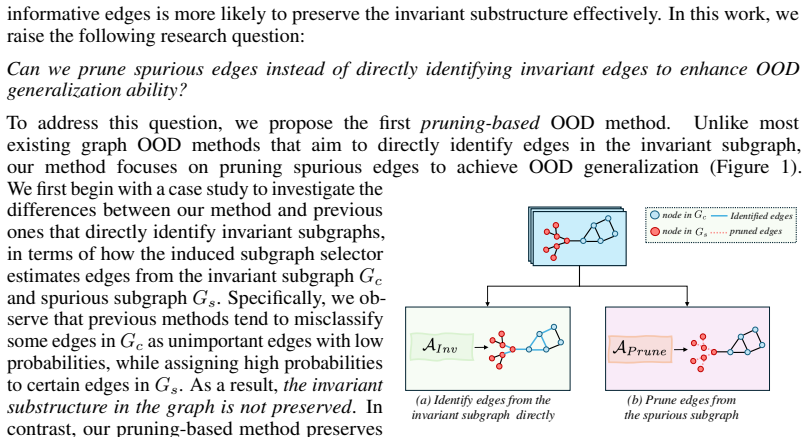
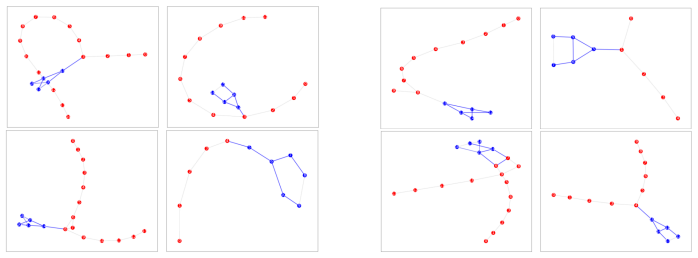
The central claim is that pruning spurious edges, rather than directly selecting invariant edges, is the more reliable route to graph OOD generalization. Under Assumption 1 (a stable subgraph Gc causally determines the label), the size-constraint loss provably prunes edges from the spurious subgraph Gs while preserving Gc, and the full objective of Eqn. 5 yields a selector t*(·) that, in expectation, retains only the invariant subgraph (Theorem 5.2). The paper further proves a generalization bound that tightens as |Gs| shrinks (Theorem 5.1), so pruning uninformative edges improves the worst-case gap between train and test. Empirically, PrunE preserves more edges of Gc than baselines that identify Gc directly, and outperforms them by up to 24.19% on GOODMotif-base while remaining competitive or better on molecular benchmarks.
Load-bearing premise
The proof of Proposition 1 assumes that swapping in the invariant subgraph for any equal-sized alternative always strictly improves the prediction, an assumption that can fail when spurious edges are themselves strongly label-correlated.
Editorial extensions
If this is right
- If the central claim is right, graph OOD methods should be re-targeted from invariant-edge selection to spurious-edge pruning, a paradigm that is simpler and, on these benchmarks, more accurate.
- Theorem 5.1 gives a concrete contract: every spurious edge removed tightens the train-test generalization bound, so pruning is a direct way to improve OOD guarantees.
- Theorem 5.2 implies the learned selector can be read as an explainer: the kept subgraph is the invariant subgraph, so PrunE's pruning decisions double as an explanation of the prediction.
- The two regularizers are lightweight and architecture-agnostic, so they can be added to any GNN with an edge-probability selector without introducing new OOD objectives.
Reading between the lines
- A testable extension: the pruning paradigm should transfer to other structured inputs, such as images or text, whenever spurious parts are abundant and individually weak even if invariant parts are hard to isolate; the paper leaves this extension open.
- The strict-predictiveness assumption suggests a stress test: when spurious edges are engineered to be as predictive as invariant edges, PrunE's margin over direct-identification baselines should shrink, which is where the method is most vulnerable.
- The approach implicitly relies on ERM's tendency to learn core features despite spurious ones; a self-supervised variant without labeled ERM pretraining, which the paper flags as future work, would test whether the pruning signal alone suffices.
Editorial analysis
A structured set of objections, weighed in public.
Referee Report
Summary. The paper proposes PrunE, a pruning-based method for graph out-of-distribution (OOD) generalization. Instead of directly identifying edges of the invariant subgraph Gc, PrunE regularizes a learnable subgraph selector with two terms: a graph size constraint Le that limits the total retained edge weight to eta|G|, and an epsilon-probability alignment Ls that pushes the lowest K% edge probabilities toward epsilon close to zero. The authors claim theoretical guarantees: Proposition 1 states that Le prunes spurious edges while preserving Gc; Theorem 5.1 gives an OOD generalization bound that depends on |Gs|; and Theorem 5.2 states that the optimal selector t*(G) retains only Gc in expectation. Empirically, PrunE is evaluated against 15 baselines on synthetic datasets (GOOD-Motif, SPMotif) and real-world molecular datasets (GOOD-HIV, OGBG-Molbbbp, DrugOOD), reporting large improvements, including 24.19% accuracy gain over the second-best method on Motif-base. Code is provided.
Significance. If the claims were fully established, the pruning-based paradigm would be a valuable complement to invariant-subgraph identification, and the empirical results are indeed extensive and mostly consistent: the paper reports ablations, hyperparameter sensitivity, concept-shift experiments, additional application domains, and runtime/memory comparisons, and releases code. However, the central theoretical guarantees are not currently supported. The proofs of Proposition 1 and Theorem 5.2 rely on assumptions stronger than or unrelated to Assumption 1, and Theorem 5.1 invokes an unstated proportionality that builds the conclusion into the premise. The empirical contribution may stand on its own, but the advertised 'provably identifies the invariant subgraph' claim needs either a correct proof or a significant softening.
major comments (4)
- [Appendix F.1, Eq. (13)] The proof of Proposition 1 assumes P(Y|f(G' union Gc)) > P(Y|f(G' union g)) for every subgraph g with |g|=|Gc|. This inequality is not a consequence of Assumption 1, which only states that Gc is stable across environments and that Y=f*(Gc)+epsilon with epsilon independent of G. In the strongly label-correlated spurious regime that motivates the paper, there can exist equal-sized spurious subgraphs that are at least as predictive as Gc in the training distribution, so Eq. (13) can fail exactly where PrunE is meant to help. Moreover, the inequality conditions on f(·), the learned model, so the argument assumes the conclusion that the trained classifier is more confident with Gc than with any alternative. Since Proposition 1 underpins Theorem 5.2, the claimed pruning guarantee is not established.
- [Appendix F.2, Eq. (16)] Theorem 5.1's bound is derived from the unstated assumption Ls(theta; ·) = c|Gs| Lc(theta; ·). This proportionality is not derived from Assumption 1 and effectively encodes the conclusion that the spurious-edge loss scales linearly with |Gs|, which is precisely the relationship the theorem is supposed to quantify after applying Le. The proof also does not connect the 0-1 edge-presence loss l(·) used in the theorem to the actual training objective LGT + lambda1 Le + lambda2 Ls, so it is unclear how the bound reflects the effect of Le. The bound may be a valid in-expectation statement under additional assumptions, but as written it does not support the claim that Le provably improves OOD generalization by shrinking |Gs|.
- [Appendix F.3, Eq. (36)] The proof of Theorem 5.2 asserts E[X'_ij] = 1/|E| for every retained spurious edge because of the epsilon-probability alignment Ls. However, Ls only aligns the bottom K% of edges to epsilon, not all spurious edges; spurious edges that are strongly label-correlated can remain above the bottom-K threshold and receive high probability. The equality |G^P_s| = eta|E| - |Gc| also assumes that Le is satisfied exactly and that all retained non-Gc edges are spurious, which is not guaranteed by the regularized objective. Consequently, the conclusion Gc approximately equals E[t*(G)] does not follow from the stated steps.
- [Appendix K] The paper's own limitation statement says 'some spurious edges may still persist due to their strong correlation with target labels,' which directly contradicts Theorem 5.2's assertion that sampling from t*(G) retains only the invariant subgraph in expectation. The manuscript should reconcile this discrepancy, either by qualifying Theorem 5.2 to allow residual spurious edges within the approximation or by providing empirical evidence that such edges have vanishing probability mass.
minor comments (7)
- [Algorithm 1 (Appendix E)] The symbol eta is used both for the learning rate in the input line and for the edge budget in Le; using different symbols (e.g., lr and eta) would avoid confusion.
- [Section 4, Eq. (4)] The set Es denotes the lowest-K% edges in the estimated weights, while Gs denotes the spurious subgraph; this notational collision is confusing and should be renamed (e.g., E_low or E_K).
- [Figure 3(a)] The caption contains garbled characters ('w/o ' and 'se����') and the ablation bar labels are partially missing; the figure should be regenerated with clear labels.
- [Appendix J.2 and Section 4] There are typographical errors: 'seached' should be 'searched' in Appendix J.2, and 'occurence' should be 'occurrence' in Section 4.
- [Theorem 5.1] The constant c appears in the generalization bound but is not defined in the theorem statement; it should be defined or absorbed into the bound.
- [Theorem 5.2] The approximate equality Gc approximately equals E[t*(G)] is not made quantitative; the paper should specify in what sense (e.g., edge-probability mass or total variation) the approximation holds.
- [Introduction and Related Work] The claim of being 'the first pruning-based graph OOD method' should be carefully positioned against DropEdge and other edge-masking baselines; at least state the distinction between regularizing a learned selector and applying a fixed random drop.
Circularity Check
The central theoretical guarantee is partly self-supplied: Proposition 1 assumes the exact predictive-dominance condition it sets out to derive, and Theorems 5.1–5.2 inject the spurious-loss scaling and uniform spurious-edge probabilities on which their conclusions depend.
-
self definitional
[Appendix F.1, proof of Proposition 1, Eq. (13)]
"Under Assumption 1, we know that the invariant subgraph Gc holds sufficient predictive power to Y, and Gc is more informative to Y than Gs, therefore including Gc will always make the prediction more certain, i.e., P(Y|f(G′∪Gc))>P(Y|f(G′∪g)),∀g⊆ eG, (13)"
Assumption 1 states only that P(Y|Gc) is environment-invariant and that Y=f*(Gc)+ε with ε⊥⊥G. It does not imply that the learned classifier f is more confident with Gc than with any equal-sized subgraph g. Eq. (13) is precisely the retention/pruning conclusion Proposition 1 is supposed to prove: under ERM plus a size budget, Gc is kept because it dominates all equal-sized alternatives. In the strongly label-correlated spurious regime that motivates the paper, an equal-sized spurious subgraph can be equally or more predictive, so Eq. (13) is an assumption of the desired outcome, not a consequence of Assumption 1.
-
other
[Appendix F.2, proof of Theorem 5.1, Eq. (16)]
"We assume: Ls(θ;·) :=c|Gs|Lc(θ;·), (16) where c is a proportionality constant. As Ls(·) is defined to a summation over all spurious edges, we put |Gs| in the r.h.s to account for this factor."
The theorem's advertised conclusion—that the OOD gap grows with |Gs|—is produced by substituting this postulated scaling into Eq. (20). The factor (c|Gs|+1) in the bound is not derived from Assumption 1 or from the definition of the losses; it is assumed. Thus the statement 'Theorem 5.1 shows that Le enhances OOD generalization by reducing |Gs|' restates the input assumption rather than establishing a consequence of the method.
1 more flagged steps
-
other
[Appendix F.3, proof of Theorem 5.2, Eq. (36)]
"In Eqn. 36, E[X′ij] = 1/|E|,∀eij ∈ GPs, due to that P(X′ij) = 1/|E| enforced by ϵ-probability alignment penalty Ls."
Ls (Eq. 4) aligns only the lowest K% of edges, ranked by predicted weight, toward ε=1/|E|; it does not force every retained spurious edge to probability 1/|E|. The paper itself concedes that strongly label-correlated spurious edges persist with high probability (Section K), and such edges can fall outside the bottom K%. Setting E[X'_ij]=1/|E| for all spurious edges therefore assumes the pruning success that Theorem 5.2 is meant to prove. The conclusion Gc≈E[t*(G)] additionally relies on Proposition 1's already-assumed claim that all Gc edges are kept with probability 1.
full rationale
The theoretical core of PrunE is partly circular. Proposition 1's proof (Appendix F.1, Eq. 13) assumes that, for the learned classifier f, adding Gc always increases predictive confidence more than adding any equal-sized subgraph g. This is not implied by Assumption 1, which only asserts cross-environment stability of P(Y|Gc) and Y=f*(Gc)+ε with ε independent of G. In the paper's own motivating regime—spurious edges strongly correlated with labels—an equal-sized spurious subgraph can be as predictive as Gc, so Eq. 13 is exactly the pruning success the proposition claims to establish. The proof therefore assumes its conclusion. Theorem 5.2 inherits this and adds a second self-supplied premise: it treats Ls as forcing every retained spurious edge to probability 1/|E| (Eq. 36), although Ls only suppresses the lowest K% edges and the paper's limitations section concedes strongly correlated spurious edges persist. Theorem 5.1's bound is likewise obtained by postulating the scaling Ls=c|Gs|Lc (Eq. 16), which puts the |Gs| factor into the bound by assumption. These are not merely omitted details: each is the load-bearing step that converts 'PrunE works' into 'provably identifies the invariant subgraph.' The empirical evaluation—especially the ground-truth-edge ROC-AUC on GOOD-Motif and comparisons against 15 baselines—is independent of these proofs and supports the method's practical value. Self-citations to EQuAD/LIRS appear only in related work and baselines and are not load-bearing. Overall: partial circularity in the theoretical guarantees, with independent empirical content.
Assumptions & free parameters
free parameters (5)
- η (edge budget in Le) =
0.5, 0.75, 0.85 (per dataset by validation)
- K (bottom K% edges in Ls) =
50, 70, 90
- λ1 (weight of Le) =
10, 40
- λ2 (weight of Ls) =
0.1, 0.01, 0.001
- ε (alignment target) =
1/|E|
assumptions (4)
- domain assumption Assumption 1: there exists a stable invariant subgraph Gc per class such that P(Y|Gc) is invariant across training environments and Y = f*(Gc) + noise.
- ad hoc to paper Gc is strictly more predictive than any equal-sized subgraph g: P(Y|G' ∪ Gc) > P(Y|G' ∪ g), ∀ g ⊆ eG with |g|=|Gc|.
- ad hoc to paper Spurious-edge loss is proportional to the number of spurious edges times invariant-edge loss: Ls(θ;·) = c|Gs| Lc(θ;·).
- domain assumption ERM training preserves all features strongly correlated with the target, including the invariant subgraph.
Cite this review
Pith. "Pith review of Pruning Spurious Subgraphs for Graph Out-of-Distribution Generalization." pith.science (2026). https://pith.science/paper/YRK7IYTT
@misc{pith2026250605957,
  author       = {Pith},
  title        = {Pith review of: Pruning Spurious Subgraphs for Graph Out-of-Distribution Generalization},
  year         = {2026},
  howpublished = {\url{https://pith.science/paper/YRK7IYTT}},
  note         = {Machine review of arXiv:2506.05957}
}
abstract
Graph Neural Networks (GNNs) often encounter significant performance degradation under distribution shifts between training and test data, hindering their applicability in real-world scenarios. Recent studies have proposed various methods to address the out-of-distribution generalization challenge, with many methods in the graph domain focusing on directly identifying an invariant subgraph that is predictive of the target label. However, we argue that identifying the edges from the invariant subgraph directly is challenging and error-prone, especially when some spurious edges exhibit strong correlations with the targets. In this paper, we propose PrunE, the first pruning-based graph OOD method that eliminates spurious edges to improve OOD generalizability. By pruning spurious edges, PrunE retains the invariant subgraph more comprehensively, which is critical for OOD generalization. Specifically, PrunE employs two regularization terms to prune spurious edges: 1) graph size constraint to exclude uninformative spurious edges, and 2) $\epsilon$-probability alignment to further suppress the occurrence of spurious edges. Through theoretical analysis and extensive experiments, we show that PrunE achieves superior OOD performance and outperforms previous state-of-the-art methods significantly. Codes are available at: \href{https://github.com/tianyao-aka/PrunE-GraphOOD}{https://github.com/tianyao-aka/PrunE-GraphOOD}.
Figures


Figures from the paper (5 more)




Reference graph
Works this paper leans on
-
[1]
Invariance principle meets information bottleneck for out-of-distribution generalization.Advances in Neural Information Processing Systems, 34:3438–3450, 2021
Kartik Ahuja, Ethan Caballero, Dinghuai Zhang, Jean-Christophe Gagnon-Audet, Yoshua Bengio, Ioannis Mitliagkas, and Irina Rish. Invariance principle meets information bottleneck for out-of-distribution generalization.Advances in Neural Information Processing Systems, 34:3438–3450, 2021
2021
-
[2]
Invariant risk minimization.arXiv preprint arXiv:1907.02893, 2019
Martin Arjovsky, Léon Bottou, Ishaan Gulrajani, and David Lopez-Paz. Invariant risk minimization.arXiv preprint arXiv:1907.02893, 2019
arXiv 1907
-
[3]
The properties of known drugs
Guy W Bemis and Mark A Murcko. The properties of known drugs. 1. molecular frameworks.Journal of medicinal chemistry, 39(15):2887–2893, 1996
1996
-
[4]
Yoshua Bengio, Nicholas Léonard, and Aaron Courville. Estimating or propagating gradients through stochastic neurons for conditional computation.arXiv preprint arXiv:1308.3432, 2013
arXiv 2013
-
[5]
Davide Buffelli, Pietro Liò, and Fabio Vandin. Sizeshiftreg: a regularization method for improving size-generalization in graph neural networks.Advances in Neural Information Processing Systems, 35:31871–31885, 2022
work page 2022
-
[6]
Yongqiang Chen, Yatao Bian, Kaiwen Zhou, Binghui Xie, Bo Han, and James Cheng. Does invariant graph learning via environment augmentation learn invariance? InThirty-seventh Conference on Neural Information Processing Systems, 2023
work page 2023
-
[7]
Yongqiang Chen, Wei Huang, Kaiwen Zhou, Yatao Bian, Bo Han, and James Cheng. Understanding and improving feature learning for out-of-distribution generalization.Advances in Neural Information Processing Systems, 36:68221–68275, 2023
work page 2023
-
[8]
Yongqiang Chen, Yonggang Zhang, Yatao Bian, Han Yang, MA Kaili, Binghui Xie, Tongliang Liu, Bo Han, and James Cheng. Learning causally invariant representations for out-of-distribution generalization on graphs.Advances in Neural Information Processing Systems, 35:22131–22148, 2022
work page 2022
Show all 62 references
-
[9]
Environment inference for invariant learning
Elliot Creager, Jörn-Henrik Jacobsen, and Richard Zemel. Environment inference for invariant learning. In International Conference on Machine Learning, pages 2189–2200. PMLR, 2021
2021
-
[10]
Debiasing graph neural networks via learning disentangled causal substructure.Advances in Neural Information Processing Systems, 35:24934–24946, 2022
Shaohua Fan, Xiao Wang, Yanhu Mo, Chuan Shi, and Jian Tang. Debiasing graph neural networks via learning disentangled causal substructure.Advances in Neural Information Processing Systems, 35:24934–24946, 2022
2022
-
[11]
Fast graph representation learning with pytorch geometric, 2019
Matthias Fey and Jan Eric Lenssen. Fast graph representation learning with pytorch geometric, 2019
2019
-
[12]
Neural message passing for quantum chemistry
Justin Gilmer, Samuel S Schoenholz, Patrick F Riley, Oriol Vinyals, and George E Dahl. Neural message passing for quantum chemistry. InInternational Conference on Machine Learning, pages 1263–1272. PMLR, 2017
2017
-
[13]
GOOD: A graph out-of-distribution benchmark
Shurui Gui, Xiner Li, Limei Wang, and Shuiwang Ji. GOOD: A graph out-of-distribution benchmark. In Thirty-sixth Conference on Neural Information Processing Systems Datasets and Benchmarks Track, 2022
2022
-
[14]
Joint learning of label and environ- ment causal independence for graph out-of-distribution generalization.Advances in Neural Information Processing Systems, 36, 2023
Shurui Gui, Meng Liu, Xiner Li, Youzhi Luo, and Shuiwang Ji. Joint learning of label and environ- ment causal independence for graph out-of-distribution generalization.Advances in Neural Information Processing Systems, 36, 2023
2023
-
[15]
G-mixup: Graph data augmentation for graph classification
Xiaotian Han, Zhimeng Jiang, Ninghao Liu, and Xia Hu. G-mixup: Graph data augmentation for graph classification. InInternational Conference on Machine Learning, pages 8230–8248. PMLR, 2022
2022
-
[16]
Open graph benchmark: Datasets for machine learning on graphs.Advances in Neural Information Processing Systems, 33:22118–22133, 2020
Weihua Hu, Matthias Fey, Marinka Zitnik, Yuxiao Dong, Hongyu Ren, Bowen Liu, Michele Catasta, and Jure Leskovec. Open graph benchmark: Datasets for machine learning on graphs.Advances in Neural Information Processing Systems, 33:22118–22133, 2020
2020
-
[17]
Therapeutics data commons: Machine learning datasets and tasks for drug discovery and development.arXiv preprint arXiv:2102.09548, 2021
Kexin Huang, Tianfan Fu, Wenhao Gao, Yue Zhao, Yusuf Roohani, Jure Leskovec, Connor W Coley, Cao Xiao, Jimeng Sun, and Marinka Zitnik. Therapeutics data commons: Machine learning datasets and tasks for drug discovery and development.arXiv preprint arXiv:2102.09548, 2021
2021 arXiv
-
[18]
Yuanfeng Ji, Lu Zhang, Jiaxiang Wu, Bingzhe Wu, Long-Kai Huang, Tingyang Xu, Yu Rong, Lanqing Li, Jie Ren, Ding Xue, et al. Drugood: Out-of-distribution (ood) dataset curator and benchmark for ai-aided drug discovery–a focus on affinity prediction problems with noise annotatio...
2022 arXiv
-
[19]
Graph invariant learning with subgraph co-mixup for out-of-distribution generalization
Tianrui Jia, Haoyang Li, Cheng Yang, Tao Tao, and Chuan Shi. Graph invariant learning with subgraph co-mixup for out-of-distribution generalization. InProceedings of the AAAI Conference on Artificial Intelligence, volume 38, pages 8562–8570, 2024. 10
2024
-
[20]
Domain extrapolation via regret minimization.arXiv preprint arXiv:2006.03908, 3, 2020
Wengong Jin, Regina Barzilay, and Tommi Jaakkola. Domain extrapolation via regret minimization.arXiv preprint arXiv:2006.03908, 3, 2020
2006 arXiv
-
[21]
Adam: A method for stochastic optimization.arXiv preprint arXiv:1412.6980, 2014
Diederik P Kingma and Jimmy Ba. Adam: A method for stochastic optimization.arXiv preprint arXiv:1412.6980, 2014
2014 arXiv
-
[22]
Kipf and Max Welling
Thomas N. Kipf and Max Welling. Semi-supervised classification with graph convolutional networks. In International Conference on Learning Representations, 2017
2017
-
[23]
Last layer re-training is sufficient for robustness to spurious correlations
Polina Kirichenko, Pavel Izmailov, and Andrew Gordon Wilson. Last layer re-training is sufficient for robustness to spurious correlations. InThe Eleventh International Conference on Learning Representations, 2023
2023
-
[24]
Wilds: A benchmark of in- the-wild distribution shifts
Pang Wei Koh, Shiori Sagawa, Henrik Marklund, Sang Michael Xie, Marvin Zhang, Akshay Balsubramani, Weihua Hu, Michihiro Yasunaga, Richard Lanas Phillips, Irena Gao, et al. Wilds: A benchmark of in- the-wild distribution shifts. InInternational Conference on Machine Learning, p...
2021
-
[25]
Robust optimization as data augmentation for large-scale graphs
Kezhi Kong, Guohao Li, Mucong Ding, Zuxuan Wu, Chen Zhu, Bernard Ghanem, Gavin Taylor, and Tom Goldstein. Robust optimization as data augmentation for large-scale graphs. InProceedings of the IEEE/CVF conference on computer vision and pattern recognition, pages 60–69, 2022
2022
-
[26]
Out-of-distribution generalization via risk extrapolation (rex)
David Krueger, Ethan Caballero, Joern-Henrik Jacobsen, Amy Zhang, Jonathan Binas, Dinghuai Zhang, Remi Le Priol, and Aaron Courville. Out-of-distribution generalization via risk extrapolation (rex). In International Conference on Machine Learning, pages 5815–5826. PMLR, 2021
2021
-
[27]
A reduction of a graph to a canonical form and an algebra arising during this reduction.Nauchno-Technicheskaya Informatsiya, 2(9):12–16, 1968
Andrei Leman and Boris Weisfeiler. A reduction of a graph to a canonical form and an algebra arising during this reduction.Nauchno-Technicheskaya Informatsiya, 2(9):12–16, 1968
1968
-
[28]
Ood-gnn: Out-of-distribution generalized graph neural network.IEEE Transactions on Knowledge and Data Engineering, 2022
Haoyang Li, Xin Wang, Ziwei Zhang, and Wenwu Zhu. Ood-gnn: Out-of-distribution generalized graph neural network.IEEE Transactions on Knowledge and Data Engineering, 2022
2022
-
[29]
Learning invariant graph representations for out-of-distribution generalization
Haoyang Li, Ziwei Zhang, Xin Wang, and Wenwu Zhu. Learning invariant graph representations for out-of-distribution generalization. In Alice H. Oh, Alekh Agarwal, Danielle Belgrave, and Kyunghyun Cho, editors,Advances in Neural Information Processing Systems, 2022
2022
-
[30]
Invariant node representation learning under distribution shifts with multiple latent environments.ACM Transactions on Information Systems, 42(1):1– 30, 2023
Haoyang Li, Ziwei Zhang, Xin Wang, and Wenwu Zhu. Invariant node representation learning under distribution shifts with multiple latent environments.ACM Transactions on Information Systems, 42(1):1– 30, 2023
2023
-
[31]
Graph structure and feature extrapolation for out-of-distribution generalization.arXiv preprint arXiv:2306.08076, 2023
Xiner Li, Shurui Gui, Youzhi Luo, and Shuiwang Ji. Graph structure and feature extrapolation for out-of-distribution generalization.arXiv preprint arXiv:2306.08076, 2023
2023 arXiv
-
[32]
Graph structure extrapolation for out-of-distribution generalization
Xiner Li, Shurui Gui, Youzhi Luo, and Shuiwang Ji. Graph structure extrapolation for out-of-distribution generalization. InForty-first International Conference on Machine Learning, 2024
2024
-
[33]
Graph rationalization with environment- based augmentations
Gang Liu, Tong Zhao, Jiaxin Xu, Tengfei Luo, and Meng Jiang. Graph rationalization with environment- based augmentations. InProceedings of the 28th ACM SIGKDD Conference on Knowledge Discovery and Data Mining, KDD ’22. ACM, August 2022
2022
-
[34]
Flood: A flexible invariant learning framework for out-of-distribution generalization on graphs
Yang Liu, Xiang Ao, Fuli Feng, Yunshan Ma, Kuan Li, Tat-Seng Chua, and Qing He. Flood: A flexible invariant learning framework for out-of-distribution generalization on graphs. InProceedings of the 29th ACM SIGKDD Conference on Knowledge Discovery and Data Mining, pages 1548–1...
2023
-
[35]
Parameterized explainer for graph neural network.Advances in Neural Information Processing Systems, 33:19620–19631, 2020
Dongsheng Luo, Wei Cheng, Dongkuan Xu, Wenchao Yu, Bo Zong, Haifeng Chen, and Xiang Zhang. Parameterized explainer for graph neural network.Advances in Neural Information Processing Systems, 33:19620–19631, 2020
2020
-
[36]
The concrete distribution: A continuous relaxation of discrete random variables.arXiv preprint arXiv:1611.00712, 2016
Chris J Maddison, Andriy Mnih, and Yee Whye Teh. The concrete distribution: A continuous relaxation of discrete random variables.arXiv preprint arXiv:1611.00712, 2016
2016 arXiv
-
[37]
Interpretable and generalizable graph learning via stochastic attention mechanism
Siqi Miao, Mia Liu, and Pan Li. Interpretable and generalizable graph learning via stochastic attention mechanism. InInternational Conference on Machine Learning, pages 15524–15543. PMLR, 2022
2022
-
[38]
Pytorch: An imperative style, high-performance deep learning library, 2019
Adam Paszke, Sam Gross, Francisco Massa, Adam Lerer, James Bradbury, Gregory Chanan, Trevor Killeen, Zeming Lin, Natalia Gimelshein, Luca Antiga, Alban Desmaison, Andreas Köpf, Edward Yang, Zach DeVito, Martin Raison, Alykhan Tejani, Sasank Chilamkurthy, Benoit Steiner, Lu Fan...
2019
-
[39]
Jonas Peters, Peter Bühlmann, and Nicolai Meinshausen. Causal inference by using invariant prediction: identification and confidence intervals.Journal of the Royal Statistical Society Series B: Statistical Methodology, 78(5):947–1012, 2016
2016
-
[40]
Gradient starvation: A learning proclivity in neural networks.Advances in Neural Information Processing Systems, 34:1256–1272, 2021
Mohammad Pezeshki, Oumar Kaba, Yoshua Bengio, Aaron C Courville, Doina Precup, and Guillaume Lajoie. Gradient starvation: A learning proclivity in neural networks.Advances in Neural Information Processing Systems, 34:1256–1272, 2021
2021
-
[41]
On the spectral bias of neural networks: International conference on machine learning.arXiv, 2019
N Rahaman, A Baratin, D Arpit, F Draxler, M Lin, F Hamprecht, Y Bengio, and A Courville. On the spectral bias of neural networks: International conference on machine learning.arXiv, 2019
2019
-
[42]
Dropedge: Towards deep graph convolu- tional networks on node classification.arXiv preprint arXiv:1907.10903, 2019
Yu Rong, Wenbing Huang, Tingyang Xu, and Junzhou Huang. Dropedge: Towards deep graph convolu- tional networks on node classification.arXiv preprint arXiv:1907.10903, 2019
1907 arXiv
-
[43]
Distributionally robust neural networks for group shifts: On the importance of regularization for worst-case generalization.arXiv preprint arXiv:1911.08731, 2019
Shiori Sagawa, Pang Wei Koh, Tatsunori B Hashimoto, and Percy Liang. Distributionally robust neural networks for group shifts: On the importance of regularization for worst-case generalization.arXiv preprint arXiv:1911.08731, 2019
1911 arXiv
-
[44]
The pitfalls of simplicity bias in neural networks.Advances in Neural Information Processing Systems, 33:9573–9585, 2020
Harshay Shah, Kaustav Tamuly, Aditi Raghunathan, Prateek Jain, and Praneeth Netrapalli. The pitfalls of simplicity bias in neural networks.Advances in Neural Information Processing Systems, 33:9573–9585, 2020
2020
-
[45]
Manning, Andrew Ng, and Christopher Potts
Richard Socher, Alex Perelygin, Jean Wu, Jason Chuang, Christopher D. Manning, Andrew Ng, and Christopher Potts. Recursive deep models for semantic compositionality over a sentiment treebank. In David Yarowsky, Timothy Baldwin, Anna Korhonen, Karen Livescu, and Steven Bethard,...
2013
-
[46]
Unleashing the power of graph data augmentation on covariate distribution shift.Advances in Neural Information Processing Systems, 36, 2023
Yongduo Sui, Qitian Wu, Jiancan Wu, Qing Cui, Longfei Li, Jun Zhou, Xiang Wang, and Xiangnan He. Unleashing the power of graph data augmentation on covariate distribution shift.Advances in Neural Information Processing Systems, 36, 2023
2023
-
[47]
Deep learning and the information bottleneck principle, 2015
Naftali Tishby and Noga Zaslavsky. Deep learning and the information bottleneck principle, 2015
2015
-
[48]
Vapnik.The nature of statistical learning theory
Vladimir N. Vapnik.The nature of statistical learning theory. Springer-Verlag New York, Inc., 1995
1995
-
[49]
Graph attention networks.arXiv preprint arXiv:1710.10903, 2017
Petar Veliˇckovi´c, Guillem Cucurull, Arantxa Casanova, Adriana Romero, Pietro Lio, and Yoshua Bengio. Graph attention networks.arXiv preprint arXiv:1710.10903, 2017
2017 arXiv
-
[50]
Advancing molecule invariant represen- tation via privileged substructure identification
Ruijia Wang, Haoran Dai, Cheng Yang, Le Song, and Chuan Shi. Advancing molecule invariant represen- tation via privileged substructure identification. InProceedings of the 30th ACM SIGKDD Conference on Knowledge Discovery and Data Mining, pages 3188–3199, 2024
2024
-
[51]
Handling distribution shifts on graphs: An invariance perspective.arXiv preprint arXiv:2202.02466, 2022
Qitian Wu, Hengrui Zhang, Junchi Yan, and David Wipf. Handling distribution shifts on graphs: An invariance perspective.arXiv preprint arXiv:2202.02466, 2022
2022 arXiv
-
[52]
Discovering invariant rationales for graph neural networks
Yingxin Wu, Xiang Wang, An Zhang, Xiangnan He, and Tat-Seng Chua. Discovering invariant rationales for graph neural networks. InInternational Conference on Learning Representations, 2022
2022
-
[53]
Moleculenet: a benchmark for molecular machine learning.Chemical science, 9(2):513–530, 2018
Zhenqin Wu, Bharath Ramsundar, Evan N Feinberg, Joseph Gomes, Caleb Geniesse, Aneesh S Pappu, Karl Leswing, and Vijay Pande. Moleculenet: a benchmark for molecular machine learning.Chemical science, 9(2):513–530, 2018
2018
-
[54]
How powerful are graph neural networks? arXiv preprint arXiv:1810.00826, 2018
Keyulu Xu, Weihua Hu, Jure Leskovec, and Stefanie Jegelka. How powerful are graph neural networks? arXiv preprint arXiv:1810.00826, 2018
2018 arXiv
-
[55]
Learning substructure invariance for out-of-distribution molecular representations
Nianzu Yang, Kaipeng Zeng, Qitian Wu, Xiaosong Jia, and Junchi Yan. Learning substructure invariance for out-of-distribution molecular representations. In Alice H. Oh, Alekh Agarwal, Danielle Belgrave, and Kyunghyun Cho, editors,Advances in Neural Information Processing Systems, 2022
2022
-
[56]
Improving out- of-distribution robustness via selective augmentation
Huaxiu Yao, Yu Wang, Sai Li, Linjun Zhang, Weixin Liang, James Zou, and Chelsea Finn. Improving out- of-distribution robustness via selective augmentation. InInternational Conference on Machine Learning, pages 25407–25437. PMLR, 2022
2022
-
[57]
Empowering graph invariance learning with deep spurious infomax
Tianjun Yao, Yongqiang Chen, Zhenhao Chen, Kai Hu, Zhiqiang Shen, and Kun Zhang. Empowering graph invariance learning with deep spurious infomax. InForty-first International Conference on Machine Learning, 2024. 12
2024
-
[58]
Learning graph invariance by harnessing spuriosity
Tianjun Yao, Yongqiang Chen, Kai Hu, Tongliang Liu, Kun Zhang, and Zhiqiang Shen. Learning graph invariance by harnessing spuriosity. InThe Thirteenth International Conference on Learning Representations, 2025
2025
-
[59]
Gnnexplainer: Generating explanations for graph neural networks.Advances in Neural Information Processing Systems, 32, 2019
Zhitao Ying, Dylan Bourgeois, Jiaxuan You, Marinka Zitnik, and Jure Leskovec. Gnnexplainer: Generating explanations for graph neural networks.Advances in Neural Information Processing Systems, 32, 2019
2019
-
[60]
Mind the label shift of augmentation-based graph ood generalization
Junchi Yu, Jian Liang, and Ran He. Mind the label shift of augmentation-based graph ood generalization. InProceedings of the IEEE/CVF Conference on Computer Vision and Pattern Recognition, pages 11620– 11630, 2023
2023
-
[61]
Explainability in graph neural networks: A taxonomic survey.IEEE transactions on pattern analysis and machine intelligence, 45(5):5782–5799, 2022
Hao Yuan, Haiyang Yu, Shurui Gui, and Shuiwang Ji. Explainability in graph neural networks: A taxonomic survey.IEEE transactions on pattern analysis and machine intelligence, 45(5):5782–5799, 2022
2022
-
[62]
Learning invariant molecular representation in latent discrete space.Advances in Neural Information Processing Systems, 36, 2023
Xiang Zhuang, Qiang Zhang, Keyan Ding, Yatao Bian, Xiao Wang, Jingsong Lv, Hongyang Chen, and Huajun Chen. Learning invariant molecular representation in latent discrete space.Advances in Neural Information Processing Systems, 36, 2023. 13 Appendix of PrunE Contents A Notation...
2023
Reviewed August 7, 2026 · model on record in the stance chip above.
Discussion (0). Sign in to comment.