REVIEW 3 major objections 5 minor 33 references
AQUATIC-Diff: Additive Quantization for Truly Tiny Compressed Diffusion Models
T0 review · 3 major / 5 minor · reviewed 2026-08-07 · deepseek-v4-flash
Pith's one-line read Codebook-based additive vector quantization pushes diffusion-model weight compression to a new Pareto frontier, with 2-bit weights outperforming the full-precision model on FID and sFID.
desk verdict Useful first pass at additive vector quantization for diffusion models, but the headline W2A8/W4A8 rows are not tied to a single described configuration; the Pareto claim needs code and a clarification before I would trust it. read the letter →
The pith
A machine-rendered reading of the paper's core claim, the machinery that carries it, and where it could break.
The reading
What carries the argument
The load-bearing mechanism is additive vector quantization in the style of AQLM: a group of $g$ weights is represented not by one scalar but by $M$ codebook indices, and the reconstructed weight is $\widehat{W}^{(i)}=\sum_{m=1}^{M} C^{(m)}_{b_{i,m}}$, the sum of $M$ vectors drawn from $M$ learned codebooks. A convolutional-kernel-aware grouping sets $g=9$ for $3\times3$ convolutions so that each input-channel/output-channel filter becomes one quantized vector. The pipeline is two-stage: per-layer calibration minimizes $\|W A - \widehat{W} A\|_2^2$ on uniform-timestep calibration data, then PV-Tuning performs knowledge distillation against the full-precision teacher with a feature loss, timestep-normalized output loss, and a selective momentum-invalidation step that prevents optimizer states from going stale under trajectory-ordered training.
What would settle it
Re-run EfficientDM's W2A8 checkpoint under the exact protocol used here (CFG 7.5, 20 DDIM steps, 50,000 generated images, same seeds) and recompute FID, sFID, and IS; if its FID drops to 6.07 or below and its sFID to 6.55 or below, the claimed Pareto frontier over the previous state of the art disappears.
Extended reading notes
Core claim
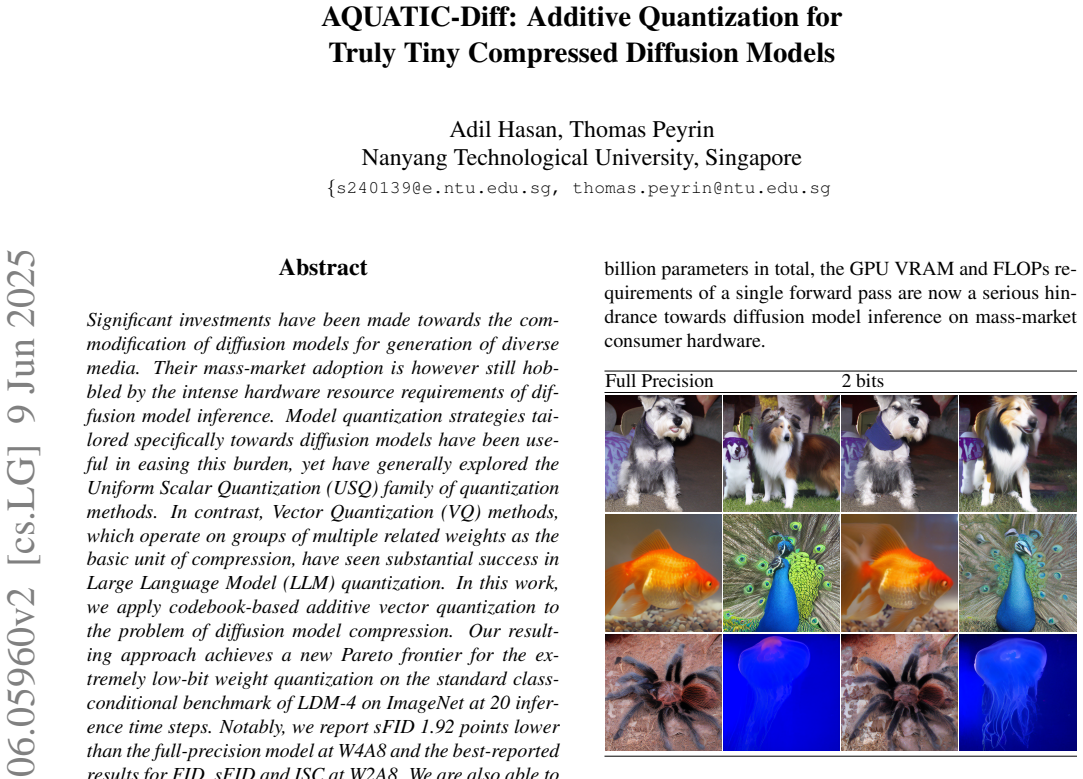
The paper's central claim is that additive quantization, where each group of weights is reconstructed as a sum of codebook vectors rather than as a single scaled integer, gives a new quality-versus-compression frontier for diffusion-model weights. Applied to the convolutional U-Net of LDM-4 on ImageNet, it reports FID 9.77 and sFID 5.78 at W4A8, respectively 1.51 and 1.92 points better than the full-precision model, and at an average of 1.95 bits per weight (W2A8) it reports FID 6.07, sFID 6.55, and IS 258.16, beating the previous best-reported W2A8 results from EfficientDM (FID 7.60, sFID 8.12, IS 175.03). The paper interprets this as establishing a new Pareto frontier for extremely low-bit weight quantization on this benchmark.
Load-bearing premise
The headline quality gains are computed against published FID, sFID, and IS numbers from EfficientDM rather than a re-run of those baselines under the same seeds and evaluation pipeline, so the claimed Pareto frontier assumes those published numbers were measured under identical conditions.
Editorial extensions
If this is right
- Diffusion U-Nets can be compressed to an average below 2 bits per weight while keeping or improving FID and sFID relative to the full-precision model at 20 DDIM steps.
- Codebook-based vector quantization, not just uniform scalar quantization, becomes a viable and apparently superior tool for diffusion-model weight compression at extreme bit-widths.
- A 1.95-bit average weight quantization gives roughly a 16 times reduction in weight storage for the LDM-4 U-Net, making local deployment on consumer hardware more plausible.
- The reported inference kernel reduces measured FLOPs by about 9.22 percent on a single forward pass without assuming hardware support for low-bit integer arithmetic.
- The two-stage pipeline runs on a single RTX 3090, in about 36 hours, contrasting with quantization-aware training approaches that require large multi-GPU clusters.
Reading between the lines
- The ablation finding that mixed-precision bit allocation helps before distillation but hurts after suggests that layer-wise bit allocation and global knowledge distillation interact non-trivially; a joint allocation-distillation objective might recover the pre-distillation gains, but that is an extension the paper does not test.
- Because the method is demonstrated quantitatively only on LDM-4 ImageNet, its transfer to larger text-to-image U-Nets such as Stable Diffusion is plausible but remains conjectural, despite the paper's motivational claims.
- The hardware-agnostic FLOPs reduction from the lookup-table kernel may translate into real latency savings mainly on memory-bound devices; the paper derives FLOPs but does not measure wall-clock speedup.
Editorial analysis
A structured set of objections, weighed in public.
Referee Report
Summary. The paper proposes AQUATIC-Diff, a two-stage pipeline for extremely low-bit weight quantization of diffusion models based on additive vector quantization (AQLM-style codebooks). The first stage performs layer-wise calibration with kernel-aware group sizes (g=9 for 3x3 convolutions) and a greedy mixed-precision layer assignment called GreedyQuant; the second stage applies knowledge distillation with the PV-Tuning optimizer, random uncorrelated trajectory sampling, a feature loss, and per-timestep loss normalization. The main empirical claim is a new Pareto frontier on LDM-4 ImageNet 256x256 at 20 DDIM steps: W4A8 outperforms the full-precision model on FID and sFID, and W2A8 exceeds EfficientDM by large margins. The paper also claims hardware-agnostic FLOPs savings through a LUT-based inference kernel described in an appendix.
Significance. If the reported numbers are reproducible, this would be the first demonstration that codebook-based vector quantization can outperform uniform scalar quantization for diffusion models at 2 and 4 weight bits, with a pipeline that runs on a single RTX 3090. The paper contains a useful ablation of sampling and distillation strategies, a clear statement of limitations, and an unusually candid admission that the inference kernel was not implemented. However, the central results are currently not tied to a single coherent configuration, the headline comparison relies on baselines borrowed from another paper, and the FLOPs claim rests on an unimplemented kernel. These issues are load-bearing for the paper's main claims and must be resolved before the results can be accepted.
major comments (3)
- [Table 2, Section 4.3] There is a direct contradiction about whether GreedyQuant is used in the final method. Section 3.2.4 states that GreedyQuant "actually decreases model accuracy after knowledge distillation" and concludes that the final configuration uses the same number of codebooks for all layers, while Section 4.2.1 says "For WkA8 quantization, a target of k bits per weight on average is used with the GreedyQuant mixed-precision strategy." Since Table 2 reports W2A8 and W4A8 results, the headline rows are not connected to the configuration recommended by the ablation. Moreover, the final-method row in Table 1 (W2/32: IS 242.89, FID 6.23, sFID 7.52) is worse than the W2A8 row in Table 2 (IS 258.16, FID 6.07, sFID 6.55) on every metric, which is unexplained if the only difference is 8-bit activation quantization. Please specify the exact configuration that produced each Table 2 row and reconcile the discrepancy.
- [Section 4.4 and Appendix A.1] The caption states "Results not of our quantized model sourced from EfficientDM [7]", so the claimed Pareto frontier assumes that those published numbers were obtained under exactly the same evaluation protocol (CFG 7.5, 20 DDIM steps, 50,000 images, same random seed or seed distribution, and the same ADM evaluation suite). The paper does not report per-seed variation or demonstrate protocol matching, and a difference of one to two FID points could easily result from sampling noise or a different number of generation steps. Please either rerun the baselines under the exact protocol or provide published evidence that the protocols are identical, and report confidence intervals or seed variation for the headline numbers.
- [Section 4.3 and Table 2] The abstract and Section 5 claim that the paper "demonstrate[s] FLOPs savings on arbitrary hardware via an efficient inference kernel," but Section 4.4 explicitly says the kernel was not implemented and no latency or energy measurement is reported. Appendix A.1 provides only a theoretical FLOPs count for a hypothetical LUT-based kernel, and the count in Eq. (13) omits costs such as index decoding, codebook lookups, and memory traffic. A FLOPs estimate of an unimplemented kernel is not a demonstration of savings. Please either report measured speedup or energy on at least one hardware target, or rephrase the claim as a theoretical estimate.
minor comments (5)
- [Section 4.3] The text says "W2A8 (2-bit weight, 4-bit activation)" but W2A8 means 8-bit activations; this is a typo that should be corrected.
- [Section 3.2] The sentence "BitsFusion [1] both perform knowledge distillation" cites reference [1], which is the AlphaFold 3 paper, not BitsFusion; the citation should be [29].
- [Abstract and Section 4.3] The abstract uses "ISC" while the tables and body use "IS" for Inception Score; the notation should be consistent.
- [Section 4.2.3] The activation quantization is said to follow "the methodology of Q-Diffusion [15]", but reference [15] is Q-DM, not Q-Diffusion; please correct the citation and clarify which methodology is actually used.
- [Appendix A.1] The breakpoint inequality at the end of the appendix is stated without derivation; please define all variables and show the algebra used to obtain it.
Circularity Check
No circularity found: the headline metrics are measured on 50k generated images, and the derivation chain is self-contained; the main weaknesses are reproducibility and internal consistency, not circularity.
full rationale
No circular step meets the evidentiary bar in the instructions. The paper's central claims are FID/sFID/IS values measured on 50,000 generated images under a stated DDIM/CFG protocol; these numbers are not derived from fitted constants or from definitions. The per-timestep loss normalization factors are estimated from a small calibration batch before distillation, but they only rescale the training objective and do not directly determine the reported metrics; this is training machinery, not a prediction reducible to its input. Hyperparameter choices such as the group size g=9 and the decision to reject GreedyQuant are justified by ablation studies on the same benchmark, which is model selection rather than circularity. The comparison rows in Table 2 are copied from EfficientDM instead of re-run; that is an external-baseline evidence weakness, and EfficientDM has no author overlap with this paper, so it is not a self-citation chain. The appendix FLOPs derivation is a self-contained arithmetic count, and the paper explicitly admits the inference kernel was not implemented to actually accelerate inference, so no predicted speedup is disguised as measured. The apparent inconsistency between Table 1's final-method ablation, Table 2's W2A8 row, and Section 4.2.1's GreedyQuant statement is a reproducibility/correctness concern, but it does not make any claimed result equivalent to its inputs by construction. Accordingly, the appropriate circularity score is 0.
Assumptions & free parameters
free parameters (7)
- Number of codebooks M =
2 (W2A8) and 4 (W4A8)
- Group size g =
8 for linear/1x1 conv, 9 for 3x3 conv
- Codebook index bits n =
8
- Feature loss weight alpha =
chosen so feature and output loss have similar magnitude
- Per-timestep normalization factors =
100 values from calibration trajectories
- Optimizer learning rates =
continuous 4e-5 to 1e-6, discrete 1e-4
- Distillation iterations and batch size =
32000 iterations, batch size 4
assumptions (5)
- domain assumption AQLM's additive quantization converges to a low-error solution for convolutional layers when applied via im2col (Section 3.1.1).
- domain assumption The EfficientDM baselines in Table 2 were computed under protocols equivalent to the paper's own 20-step DDIM, CFG 7.5, 50k-image evaluation.
- ad hoc to paper The empirical per-timestep loss normalization factors, estimated from saved denoising trajectories, remain valid for the final model and do not overfit the calibration set.
- ad hoc to paper The FLOPs count in Appendix A.1 models a realizable LUT-based kernel, despite the kernel not being implemented (Section 4.4).
- domain assumption Knowledge distillation with the feature loss and normalized output loss optimizes generation quality better than straight-through estimation or trajectory-aware sampling.
Cite this review
Pith. "Pith review of AQUATIC-Diff: Additive Quantization for Truly Tiny Compressed Diffusion Models." pith.science (2026). https://pith.science/paper/UFWIRGLU
@misc{pith2026250605960,
  author       = {Pith},
  title        = {Pith review of: AQUATIC-Diff: Additive Quantization for Truly Tiny Compressed Diffusion Models},
  year         = {2026},
  howpublished = {\url{https://pith.science/paper/UFWIRGLU}},
  note         = {Machine review of arXiv:2506.05960}
}
read the original abstract
Significant investments have been made towards the commodification of diffusion models for generation of diverse media. Their mass-market adoption is however still hobbled by the intense hardware resource requirements of diffusion model inference. Model quantization strategies tailored specifically towards diffusion models have been useful in easing this burden, yet have generally explored the Uniform Scalar Quantization (USQ) family of quantization methods. In contrast, Vector Quantization (VQ) methods, which operate on groups of multiple related weights as the basic unit of compression, have seen substantial success in Large Language Model (LLM) quantization. In this work, we apply codebook-based additive vector quantization to the problem of diffusion model compression. Our resulting approach achieves a new Pareto frontier for the extremely low-bit weight quantization on the standard class-conditional benchmark of LDM-4 on ImageNet at 20 inference time steps. Notably, we report sFID 1.92 points lower than the full-precision model at W4A8 and the best-reported results for FID, sFID and ISC at W2A8. We are also able to demonstrate FLOPs savings on arbitrary hardware via an efficient inference kernel, as opposed to savings resulting from small integer operations which may lack broad hardware support.
Figures


Figures from the paper (2 more)


Reference graph
Works this paper leans on
-
[7]
EfficientDM: Efficient quantization-aware fine- tuning of low-bit diffusion models
Yefei He, Jing Liu, Weijia Wu, Hong Zhou, and Bohan Zhuang. EfficientDM: Efficient quantization-aware fine- tuning of low-bit diffusion models. InThe Twelfth Interna- tional Conference on Learning Representations, 2024. 1, 2, 3, 4, 5, 6, 7, 8, 9
work page 2024
-
[1]
Ballard, Joshua Bambrick, Se- bastian W
Josh Abramson, Jonas Adler, Jack Dunger, Richard Evans, Tim Green, Alexander Pritzel, Olaf Ronneberger, Lind- say Willmore, Andrew J. Ballard, Joshua Bambrick, Se- bastian W. Bodenstein, David A. Evans, Chia-Chun Hung, Michael O’Neill, David Reiman, Kathryn Tunyasuvu- nakool, Zachary Wu, Akvil ˙e ˇZemgulyt˙e, Eirini Arvaniti, Charles Beattie, Ottavia Bert...
work page 2024
-
[2]
Meta AI. fvcore: Collection of common code that’s shared among different research projects in fair computer vision team.https://github.com/facebookresearch/ fvcore, 2019. 9
work page 2019
-
[3]
Jia Deng, Wei Dong, Richard Socher, Li-Jia Li, K. Li, and Li Fei-Fei. Imagenet: A large-scale hierarchical image database.2009 IEEE Conference on Computer Vision and Pattern Recognition, pages 248–255, 2009. 8
work page 2009
-
[4]
Diffu- sion models beat gans on image synthesis
Prafulla Dhariwal and Alexander Quinn Nichol. Diffu- sion models beat gans on image synthesis. InAdvances in Neural Information Processing Systems 34: Annual Con- ference on Neural Information Processing Systems 2021, 9 NeurIPS 2021, December 6-14, 2021, virtual, pages 8780– 8794, 2021. 1, 7, 8
work page 2021
-
[5]
Extreme com- pression of large language models via additive quantization
Vage Egiazarian, Andrei Panferov, Denis Kuznedelev, Elias Frantar, Artem Babenko, and Dan Alistarh. Extreme com- pression of large language models via additive quantization. InProceedings of the 41st International Conference on Ma- chine Learning, pages 12284–12303. PMLR, 2024. 2, 3, 4, 5, 6, 8, 9
work page 2024
-
[6]
Scaling rec- tified flow transformers for high-resolution image synthesis
Patrick Esser, Sumith Kulal, Andreas Blattmann, Rahim Entezari, Jonas M ¨uller, Harry Saini, Yam Levi, Dominik Lorenz, Axel Sauer, Frederic Boesel, Dustin Podell, Tim Dockhorn, Zion English, and Robin Rombach. Scaling rec- tified flow transformers for high-resolution image synthesis. InForty-first International Conference on Machine Learn- ing, ICML 2024,...
work page 2024
-
[8]
Yefei He, Luping Liu, Jing Liu, Weijia Wu, Hong Zhou, and Bohan Zhuang. Ptqd: Accurate post-training quantization for diffusion models.Advances in Neural Information Pro- cessing Systems, 36, 2024. 1, 2
work page 2024
Show all 33 references
-
[9]
Gans trained by a two time-scale update rule converge to a local nash equilib- rium
Martin Heusel, Hubert Ramsauer, Thomas Unterthiner, Bernhard Nessler, and Sepp Hochreiter. Gans trained by a two time-scale update rule converge to a local nash equilib- rium. InNeural Information Processing Systems, 2017. 7, 8
2017
-
[10]
Denoising dif- fusion probabilistic models.Advances in neural information processing systems, 33:6840–6851, 2020
Jonathan Ho, Ajay Jain, and Pieter Abbeel. Denoising dif- fusion probabilistic models.Advances in neural information processing systems, 33:6840–6851, 2020. 1, 2
2020
-
[11]
Tfmq-dm: Temporal feature maintenance quantization for diffusion models
Yushi Huang, Ruihao Gong, Jing Liu, Tianlong Chen, and Xianglong Liu. Tfmq-dm: Temporal feature maintenance quantization for diffusion models. InProceedings of the IEEE/CVF Conference on Computer Vision and Pattern Recognition, pages 7362–7371, 2024. 2, 3, 4, 8
2024
-
[12]
Mistral 7b.ArXiv, abs/2310.06825, 2023
Albert Qiaochu Jiang, Alexandre Sablayrolles, Arthur Men- sch, Chris Bamford, Devendra Singh Chaplot, Diego de Las Casas, Florian Bressand, Gianna Lengyel, Guillaume Lample, Lucile Saulnier, L’elio Renard Lavaud, Marie-Anne Lachaux, Pierre Stock, Teven Le Scao, Thibaut Lavril,...
-
[13]
Kingma and Jimmy Ba
Diederik P. Kingma and Jimmy Ba. Adam: A method for stochastic optimization. In3rd International Conference on Learning Representations, ICLR 2015, San Diego, CA, USA, May 7-9, 2015, Conference Track Proceedings, 2015. 3, 9
2015
-
[14]
Q-diffusion: Quantizing diffusion models
Xiuyu Li, Yijiang Liu, Long Lian, Huanrui Yang, Zhen Dong, Daniel Kang, Shanghang Zhang, and Kurt Keutzer. Q-diffusion: Quantizing diffusion models. InProceedings of the IEEE/CVF International Conference on Computer Vi- sion, pages 17535–17545, 2023. 1, 2, 4, 8, 9
2023
-
[15]
Q-dm: An efficient low-bit quantized dif- fusion model.Advances in Neural Information Processing Systems, 36, 2024
Yanjing Li, Sheng Xu, Xianbin Cao, Xiao Sun, and Baochang Zhang. Q-dm: An efficient low-bit quantized dif- fusion model.Advances in Neural Information Processing Systems, 36, 2024. 1, 2, 3, 7, 8
2024
-
[16]
Pseudo numerical methods for diffusion models on manifolds
Luping Liu, Yi Ren, Zhijie Lin, and Zhou Zhao. Pseudo numerical methods for diffusion models on manifolds. In International Conference on Learning Representations. 1, 2
-
[17]
Dpm-solver: A fast ode solver for diffusion probabilistic model sampling in around 10 steps.Advances in Neural Information Processing Systems, 35:5775–5787,
Cheng Lu, Yuhao Zhou, Fan Bao, Jianfei Chen, Chongxuan Li, and Jun Zhu. Dpm-solver: A fast ode solver for diffusion probabilistic model sampling in around 10 steps.Advances in Neural Information Processing Systems, 35:5775–5787,
-
[18]
Pv-tuning: Beyond straight-through es- timation for extreme LLM compression
Vladimir Malinovskii, Denis Mazur, Ivan Ilin, Denis Kuznedelev, Konstantin Burlachenko, Kai Yi, Dan Alistarh, and Peter Richt´arik. Pv-tuning: Beyond straight-through es- timation for extreme LLM compression. InAdvances in Neu- ral Information Processing Systems 38: Annual Con...
2024
-
[19]
On distillation of guided diffusion models
Chenlin Meng, Robin Rombach, Ruiqi Gao, Diederik Kingma, Stefano Ermon, Jonathan Ho, and Tim Salimans. On distillation of guided diffusion models. InProceedings of the IEEE/CVF Conference on Computer Vision and Pat- tern Recognition, pages 14297–14306, 2023. 1
2023
-
[20]
Yang, Zachary DeVito, Mar- tin Raison, Alykhan Tejani, Sasank Chilamkurthy, Benoit Steiner, Lu Fang, Junjie Bai, and Soumith Chintala
Adam Paszke, Sam Gross, Francisco Massa, Adam Lerer, James Bradbury, Gregory Chanan, Trevor Killeen, Zem- ing Lin, Natalia Gimelshein, Luca Antiga, Alban Desmai- son, Andreas K ¨opf, Edward Z. Yang, Zachary DeVito, Mar- tin Raison, Alykhan Tejani, Sasank Chilamkurthy, Benoit S...
2019
-
[21]
Blattmann, Dominik Lorenz, Patrick Esser, and Bj ¨orn Ommer
Robin Rombach, A. Blattmann, Dominik Lorenz, Patrick Esser, and Bj ¨orn Ommer. High-resolution image synthesis with latent diffusion models.2022 IEEE/CVF Conference on Computer Vision and Pattern Recognition (CVPR), pages 10674–10685, 2021. 1, 2, 4, 5, 6, 7, 8, 9
2022
-
[22]
U-net: Convolutional networks for biomedical image segmentation
Olaf Ronneberger, Philipp Fischer, and Thomas Brox. U-net: Convolutional networks for biomedical image segmentation. InMedical Image Computing and Computer-Assisted Inter- vention - MICCAI 2015 - 18th International Conference Mu- nich, Germany, October 5 - 9, 2015, Proceedings...
2015
-
[23]
Mehdi S. M. Sajjadi, Olivier Bachem, Mario Lucic, Olivier Bousquet, and Sylvain Gelly. Assessing generative models via precision and recall. InAdvances in Neural Information Processing Systems 31: Annual Conference on Neural Infor- mation Processing Systems 2018, NeurIPS 2018,...
2018
-
[24]
Progressive distillation for fast sampling of diffusion models
Tim Salimans and Jonathan Ho. Progressive distillation for fast sampling of diffusion models. InThe Tenth International Conference on Learning Representations, ICLR 2022, Vir- tual Event, April 25-29, 2022. OpenReview.net, 2022. 1, 7, 8
2022
-
[25]
Goodfellow, Wojciech Zaremba, Vicki Cheung, Alec Radford, and Xi Chen
Tim Salimans, Ian J. Goodfellow, Wojciech Zaremba, Vicki Cheung, Alec Radford, and Xi Chen. Improved techniques for training gans. InAdvances in Neural Information Pro- cessing Systems 29: Annual Conference on Neural Infor- 10 mation Processing Systems 2016, December 5-10, 201...
2016
-
[26]
Post-training quantization on diffusion models
Yuzhang Shang, Zhihang Yuan, Bin Xie, Bingzhe Wu, and Yan Yan. Post-training quantization on diffusion models. In Proceedings of the IEEE/CVF conference on computer vi- sion and pattern recognition, pages 1972–1981, 2023. 1, 2, 8
1972
-
[27]
Temporal dynamic quantization for dif- fusion models.Advances in Neural Information Processing Systems, 36, 2024
Junhyuk So, Jungwon Lee, Daehyun Ahn, Hyungjun Kim, and Eunhyeok Park. Temporal dynamic quantization for dif- fusion models.Advances in Neural Information Processing Systems, 36, 2024. 1, 2, 4, 5, 8
2024
-
[28]
Denois- ing diffusion implicit models
Jiaming Song, Chenlin Meng, and Stefano Ermon. Denois- ing diffusion implicit models. In9th International Con- ference on Learning Representations, ICLR 2021, Virtual Event, Austria, May 3-7, 2021. OpenReview.net, 2021. 1, 2, 7, 8
2021
-
[29]
Bitsfusion: 1.99 bits weight quantization of diffusion model
Yang Sui, Yanyu Li, Anil Kag, Yerlan Idelbayev, Junli Cao, Ju Hu, Dhritiman Sagar, Bo Yuan, Sergey Tulyakov, and Jian Ren. Bitsfusion: 1.99 bits weight quantization of diffusion model. InAdvances in Neural Information Processing Sys- tems 38: Annual Conference on Neural Inform...
2024
-
[30]
Stone, Peter Al- bert, Amjad Almahairi, Yasmine Babaei, Nikolay Bash- lykov, Soumya Batra, Prajjwal Bhargava, Shruti Bhosale, Daniel M
Hugo Touvron, Louis Martin, Kevin R. Stone, Peter Al- bert, Amjad Almahairi, Yasmine Babaei, Nikolay Bash- lykov, Soumya Batra, Prajjwal Bhargava, Shruti Bhosale, Daniel M. Bikel, Lukas Blecher, Cristian Cant ´on Ferrer, Moya Chen, Guillem Cucurull, David Esiobu, Jude Fer- nan...
2023 arXiv
-
[31]
Quip#: Even better LLM quantization with hadamard incoherence and lattice code- books
Albert Tseng, Jerry Chee, Qingyao Sun, V olodymyr Kuleshov, and Christopher De Sa. Quip#: Even better LLM quantization with hadamard incoherence and lattice code- books. InForty-first International Conference on Machine Learning, ICML 2024, Vienna, Austria, July 21-27, 2024. O...
2024
-
[32]
QTIP: quantization with trellises and incoherence pro- cessing
Albert Tseng, Qingyao Sun, David Hou, and Christopher De Sa. QTIP: quantization with trellises and incoherence pro- cessing. InAdvances in Neural Information Processing Sys- tems 38: Annual Conference on Neural Information Process- ing Systems 2024, NeurIPS 2024, Vancouver, BC...
2024
-
[33]
Quest: Low-bit diffusion model quantization via efficient selective finetuning, 2024
Haoxuan Wang, Yuzhang Shang, Zhihang Yuan, Junyi Wu, Junchi Yan, and Yan Yan. Quest: Low-bit diffusion model quantization via efficient selective finetuning, 2024. 1, 8, 9 A. Appendix A.1. Proof of FLOPs savings via Efficient Inference Kernel Consider a convolutional layer wit...
2024
Reviewed August 7, 2026 · model on record in the stance chip above.
Discussion (0). Sign in to comment.