REVIEW 5 major objections 5 minor 39 references
CrimeMind: Simulating Urban Crime with Multi-Modal LLM Agents
T0 review · 5 major / 5 minor · reviewed 2026-08-07 · deepseek-v4-flash
Pith's one-line read CrimeMind, an LLM-driven agent-based model grounded in Routine Activity Theory, reproduces spatial crime patterns across four US cities and beats the strongest baseline by up to 24%.
desk verdict CrimeMind is a genuinely new LLM-agent crime simulation that deserves reading, but its headline claim is contradicted by its own Table 1 and the evaluation needs error bars and metric definitions. read the letter →
The pith
A machine-rendered reading of the paper's core claim, the machinery that carries it, and where it could break.
The reading
What carries the argument
The load-bearing mechanism is the Routine Activity Theory-guided reasoning prompt: each criminal LLM agent is forced through stepwise assessment of its own motivation, the suitability of nearby targets, and the absence of capable guardianship, then outputs a binary decision and a justification. Around that prompt sits a perception pipeline in which street-view images are scored for safety by a vision-language model whose prompt has been iteratively refined, using a training-free textual gradient loop and a 100-image human-rated dataset, until predicted safety correlates at 0.79 with human ratings.
What would settle it
Recruit local raters in New York, Dallas, and Los Angeles to score a held-out sample of their own city's street-view images with the same rubric, then correlate their scores with CrimeMind's Chicago-aligned predictions; if the correlation is far below the 0.79 reported for Chicago, the guardianship signal is miscalibrated for the cross-city experiments.
Extended reading notes
Core claim
The central discovery is that LLM agents, when constrained to reason through the three components of Routine Activity Theory, can generate spatially realistic crime patterns without supervised training on crime labels. The criminal agent receives a multimodal description of its block, including a street-view safety score aligned to human perception, and produces both a crime decision and a natural-language justification. On the paper's metrics, this design beats rule-based agent-based models and deep learning baselines in all four cities tested, and it responds to injected counterfactual context such as protest conditions or altered police deployment with the expected changes in hotspot structure.
Load-bearing premise
The street-view safety prompt is tuned to Chicago residents' ratings on 100 images, and the paper assumes that calibrated perception transfers unchanged to New York, Dallas, and Los Angeles, where it is never directly tested.
Editorial extensions
If this is right
- Crime simulation becomes a counterfactual testbed: protests, patrol changes, and offender-removal policies can be injected as prompt context and evaluated for their spatial effects before real-world deployment.
- Human-aligned street-view safety scoring can be reused as an input for other agent-based urban models, not just crime simulators.
- The reported ablation results imply the full advantage comes from joining Routine Activity Theory reasoning, multimodal urban context, and LLM commonsense, not from any one component alone.
- Because the crime decisions come with natural-language justifications, the simulation output can be audited for the reasons behind each generated hotspot.
Reading between the lines
- A testable extension beyond the paper is per-city recalibration of the street-view safety prompt; if local raters in Dallas, New York, or Los Angeles disagree with the Chicago-tuned scores, cross-city gains may shrink once perception is calibrated locally.
- The paper keeps agent mobility on a non-LLM exploration-and-preferential-return model, so the reported realism comes from crime decisions rather than movement; an LLM-driven mobility module could either strengthen or overturn the current spatial patterns.
- The same training-free alignment loop could be pointed at other subjective urban perceptions, such as walkability, disorder, or gentrification pressure, giving a generic way to inject human judgment into LLM urban agents.
- The 100-image annotation set is small, and the 0.79 correlation is measured on the same city whose raters shaped the prompt; a held-out, multi-city safety-correlation test would be the natural stress test.
Editorial analysis
A structured set of objections, weighed in public.
Referee Report
Summary. The manuscript introduces CrimeMind, an LLM-driven agent-based model for simulating urban crime. The framework embeds Routine Activity Theory (RAT) into the reasoning prompts of LLM criminal agents, enriches a Census Block Group (CBG) level environment with SafeGraph demographics, POI data, and street-view imagery processed by a VLM into perceived-safety scores and semantic descriptions, and aligns the VLM's safety scoring to human judgments via a training-free textual prompt optimization procedure. Experiments across Chicago, Dallas, Los Angeles, and New York compare CrimeMind to ABM and deep learning baselines on crime hotspot hit rate (HR@K), Jensen-Shannon divergence (JSD), and root mean squared error (RMSE), and the paper reports ablations, LLM-type comparisons, and counterfactual simulations of BLM protests and a Dallas police redistribution plan. The abstract and Section 5.2 claim that CrimeMind outperforms all baselines across all metrics and achieves up to a 24% improvement.
Significance. The paper targets a timely and socially important problem, and its core design---grounding LLM agent decisions in Routine Activity Theory and coupling them with multimodal urban perception---is a genuinely new combination that other groups are likely to build on. The open-source code, detailed prompts, and explicit human-alignment evaluation are strengths that aid reproducibility. If the performance claims were fully supported, the work would be a useful step toward interpretable, counterfactual-capable crime simulation. However, the central quantitative claim as written is not entailed by the paper's own results: the headline superiority statement is contradicted by several entries in Table 1, and the evaluation protocol has ambiguities that prevent the reader from verifying the comparison. These issues are fixable within the scope of the paper, but they require a re-analysis and a more careful presentation.
major comments (5)
- [Section 5.2, Table 1] The sentence 'As shown in Table 1, CrimeMind outperforms all baselines across all metrics' is directly contradicted by the table's own numbers. In Chicago, CrimeMind's JSD (0.0838) is worse than ABM-Hotspot's (0.0774); in Los Angeles, CrimeMind's JSD (0.1022) is worse than both ABM-Routine (0.0874) and ABM-Hotspot (0.0765). On RMSE, CrimeMind is worse than the best baseline in Dallas (18.5 vs 18.0 for ABM-Hotspot), in Los Angeles (2.43 vs 2.22 for ABM-Hotspot), and in New York (15.3 vs 12.8 for DL-UVI). The only metric on which CrimeMind is consistently best is HR@K. The abstract's headline 'up to a 24% improvement' is computed from the Chicago HR@1.0 column, which selects the metric and city with the largest favorable gap. The authors should reanalyze the results, report per-metric per-city wins and losses, and rephrase the central claims so that they are supported by the evidence.
- [Section 3.3, Definition 2] The definition of HR@K and the normalization of crime counts are ambiguous, which makes the central comparison difficult to reproduce. Definition 1 defines hotspots as 'the top alpha% of grids that cumulatively account for beta% of all crimes' with alpha=20%, beta=50%, but Definition 2 simultaneously identifies Hreal as 'the top grids that account for 50% of total observed crimes (typically the top 20% of CBGs)', leaving unresolved whether the hotspot set is selected by cumulative crime share, by top fraction, or by both. The paper also states that simulated crime events are 'normalized to mitigate biases from absolute crime volume' but never specifies the normalization (e.g., division by total simulated cases, per-capita rates, or z-scores). Finally, 'New Hotspot Concordance' in Section 5.4 is never defined. These details are needed to verify every headline result.
- [Sections 5.1-5.2] No error bars, confidence intervals, or significance tests are reported for any of the simulation results. CrimeMind uses 5,000 agents, stochastic LLM decoding, and prompt-based reasoning, so a single run of each condition cannot be assumed to be representative. Without multiple seeds or bootstrap intervals, the reported HR@K advantages---and even the cases where CrimeMind loses on JSD or RMSE---cannot be separated from simulation noise. The authors should report means and variances across independent simulation runs, or otherwise justify why a single run is sufficient.
- [Section 4.3 and Appendix A.4.2] The perceived-safety alignment is calibrated on a dataset of 100 Chicago images using a prompt that explicitly instructs the VLM to act as 'a Chicago resident trained in public safety', and the evaluation split is 70/30 on that same city. This optimized prompt is then applied citywide to Chicago, New York, Dallas, and Los Angeles. No cross-city validation is provided to show that the 'Chicago resident' persona and the specific RAT rubric transfer to other cities. If perceived-safety scores are miscalibrated in New York, Dallas, or Los Angeles, then the guardianship term in the RAT reasoning is miscalibrated for three of the four studied cities. The authors should either validate the transfer of human-alignment across cities or calibrate the prompt separately per city.
- [Section 5.4] The counterfactual evaluations are presented selectively and their evaluation protocol is unclear. In the BLM experiment, Figure 4b shows that RMSE worsens after adding the BLM context (from 0.000212 to 0.000253), but the text claims only that hotspot prediction and spatial distribution improve; all reported metrics should be discussed. In the Dallas policy experiment, the model is evaluated against 'actual crime data from Dallas for the 2021-2024 period', but the simulation environment and agent profiles are built on 2019 data; the paper does not explain how a 2019-calibrated simulation can be compared with a 2021-2024 ground truth, nor whether the 'before policy' and 'after policy' simulations use the same period and same normalization. The counterfactual claims need a precise statement of the target period, the comparison protocol, and the metrics used.
minor comments (5)
- [Section 1, Contributions] The word 'gradiant' in 'textual gradiant approach' is a typo and should be 'gradient'.
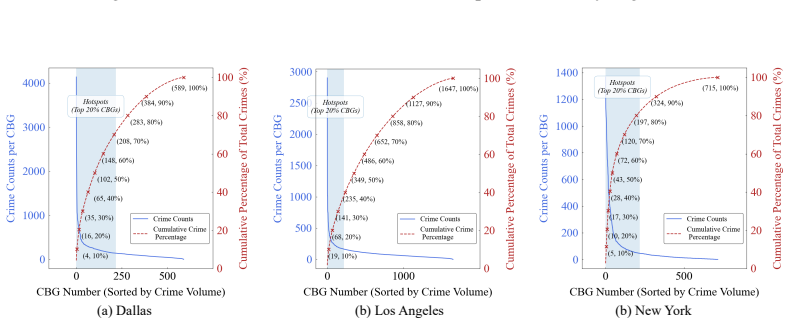
- [Section 3.2, Definition 1] The sentence 'In Chicago, approximately 50% of crimes occur within just 20% of the CBGs' is a useful motivating statistic, but it is presented as if it holds for all cities; the paper should state whether hotspot concentration was checked in the other three cities or show the cumulative curves.
- [Appendix A.2, Figure 8] In the caption of Figure 8, the subfigure labels are inconsistent: the text reads '(a) Dallas(b) Los Angeles(b) New York', with '(b)' appearing twice. The labels should be corrected to (a), (b), (c).
- [Section 5.4 and Figure 4b] When reporting the BLM counterfactual result, the text says 'JSD decreases from 0.0776 to 0.0672' and 'HR@1.0 increases from 0.4257 to 0.4478', but the RMSE worsens. The paper should report all three metrics together and explain any trade-off.
- [Appendix A.3.1, Limitations] The limitations section mentions EPR-based mobility and LLM bias, but does not mention the potential cross-city transfer limitation of the safety alignment, which is one of the more consequential assumptions in the method. Adding a sentence here would help the reader calibrate confidence in the cross-city results.
Circularity Check
No significant circularity: CrimeMind does not fit its parameters to the crime data it is evaluated against, and self-citations are contextual rather than load-bearing.
full rationale
The core derivation is self-contained with respect to the paper's central claim. Model inputs are census/SafeGraph demographics, Google Street View imagery, and LLM prompts; none are fit to the ground-truth crime distributions used in Table 1. The human-judgment alignment in Section 4.3 optimizes the VLM prompt against 100 human safety ratings, not against crime labels or the HR@K/JSD/RMSE metrics, so the resulting citywide safety scores are an independent perceptual input rather than a fitted crime predictor. The evaluation against real crime data is an external benchmark that the model can fail; indeed Table 1 shows CrimeMind loses to baselines on JSD in Chicago and Los Angeles and on RMSE in Dallas, Los Angeles, and New York, which demonstrates the outcome is not forced by construction. The acknowledged EPR mobility limitation in Section A.3.1 is a scope limitation, not a circular step. Self-citations such as [31] appear only in Related Work and are not load-bearing for the framework's design or evaluation. The reader's concern that the 'outperforms all baselines across all metrics' claim is overstated is an internal-consistency/correctness issue, which per the review rules is not circularity and does not raise the circularity score.
Assumptions & free parameters
free parameters (6)
- agent population sizes =
4,000 residents, 1,000 criminals, 500 police
- simulation time steps =
50
- hotspot parameters =
alpha=20%, beta=50%
- safety score discretization bins =
20 levels
- alignment optimization rounds =
until convergence, not specified
- counterfactual intervention strength =
e.g., top 10 offenders arrested per step in Dallas plan
assumptions (5)
- domain assumption Routine Activity Theory adequately explains spatial crime patterns at CBG level
- domain assumption EPR mobility model reproduces realistic daily routines for residents and criminals
- domain assumption LLM prompt-based reasoning can emulate criminal decision-making
- domain assumption Perceived safety from street view images is a valid proxy for guardianship
- domain assumption Official open-data crime records are accurate ground truth
Cite this review
Pith. "Pith review of CrimeMind: Simulating Urban Crime with Multi-Modal LLM Agents." pith.science (2026). https://pith.science/paper/4IRA72SI
@misc{pith2026250605981,
  author       = {Pith},
  title        = {Pith review of: CrimeMind: Simulating Urban Crime with Multi-Modal LLM Agents},
  year         = {2026},
  howpublished = {\url{https://pith.science/paper/4IRA72SI}},
  note         = {Machine review of arXiv:2506.05981}
}
read the original abstract
Modeling urban crime is an important yet challenging task that requires understanding the subtle visual, social, and cultural cues embedded in urban environments. Previous work has mainly focused on rule-based agent-based modeling (ABM) and deep learning methods. ABMs offer interpretability of internal mechanisms but exhibit limited predictive accuracy. In contrast, deep learning methods are often effective in prediction but are less interpretable and require extensive training data. Moreover, both lines of work lack the cognitive flexibility to adapt to changing environments. Leveraging the capabilities of large language models (LLMs), we propose CrimeMind, a novel LLM-driven ABM framework for simulating urban crime within a multi-modal urban context. A key innovation of our design is the integration of the Routine Activity Theory (RAT) into the agentic workflow of CrimeMind, enabling it to process rich multi-modal urban features and reason about criminal behavior. However, RAT requires LLM agents to infer subtle cues in evaluating environmental safety as part of assessing guardianship, which can be challenging for LLMs. To address this, we collect a small-scale human-annotated dataset and align CrimeMind's perception with human judgment via a training-free textual gradient method. Experiments across four major U.S. cities demonstrate that CrimeMind outperforms both traditional ABMs and deep learning baselines in crime hotspot prediction and spatial distribution accuracy, achieving up to a 24% improvement over the strongest baseline. Furthermore, we conduct counterfactual simulations of external incidents and policy interventions and it successfully captures the expected changes in crime patterns, demonstrating its ability to reflect counterfactual scenarios. Overall, CrimeMind enables fine-grained modeling of individual behaviors and facilitates evaluation of real-world interventions.
Figures


Figures from the paper (10 more)





Reference graph
Works this paper leans on
-
[1]
Elizabeth R Groff, Shane D Johnson, and Amy Thornton. State of the art in agent-based modeling of urban crime: An overview.Journal of Quantitative Criminology, 35:155–193, 2019
work page 2019
-
[2]
Streetscore-predicting the perceived safety of one million streetscapes
Nikhil Naik, Jade Philipoom, Ramesh Raskar, and César Hidalgo. Streetscore-predicting the perceived safety of one million streetscapes. InProceedings of the IEEE conference on computer vision and pattern recognition workshops, pages 779–785, 2014
work page 2014
-
[3]
Victor Rotaru, Yi Huang, Timmy Li, James Evans, and Ishanu Chattopadhyay. Event-level prediction of urban crime reveals a signature of enforcement bias in us cities.Nature human behaviour, 6(8):1056–1068, 2022
work page 2022
-
[4]
Diffcrime: A multimodal conditional diffusion model for crime risk map inference
Shuliang Wang, Xinyu Pan, Sijie Ruan, Haoyu Han, Ziyu Wang, Hanning Yuan, Jiabao Zhu, and Qi Li. Diffcrime: A multimodal conditional diffusion model for crime risk map inference. In Proceedings of the 30th ACM SIGKDD Conference on Knowledge Discovery and Data Mining, pages 3212–3221, 2024
work page 2024
-
[5]
Nick Malleson, Alison Heppenstall, and Linda See. Crime reduction through simulation: An agent-based model of burglary.Computers, environment and urban systems, 34(3):236–250, 2010
work page 2010
-
[6]
Haojie Zhu and Fahui Wang. An agent-based model for simulating urban crime with improved daily routines.Computers, Environment and Urban Systems, 89:101680, 2021
work page 2021
-
[7]
Role play with large language models
Murray Shanahan, Kyle McDonell, and Laria Reynolds. Role play with large language models. Nature, 623(7987):493–498, 2023
2023
-
[8]
Nian Li, Chen Gao, Mingyu Li, Yong Li, and Qingmin Liao. Econagent: large language model- empowered agents for simulating macroeconomic activities.arXiv preprint arXiv:2310.10436, 2023
arXiv 2023
Show all 39 references
-
[9]
Artificial leviathan: Exploring social evolution of llm agents through the lens of hobbesian social contract theory.arXiv preprint arXiv:2406.14373, 2024
Gordon Dai, Weijia Zhang, Jinhan Li, Siqi Yang, Srihas Rao, Arthur Caetano, Misha Sra, et al. Artificial leviathan: Exploring social evolution of llm agents through the lens of hobbesian social contract theory.arXiv preprint arXiv:2406.14373, 2024
2024 arXiv
-
[10]
Emergence of human-like polarization among large language model agents.arXiv preprint arXiv:2501.05171, 2025
Jinghua Piao, Zhihong Lu, Chen Gao, Fengli Xu, Fernando P Santos, Yong Li, and James Evans. Emergence of human-like polarization among large language model agents.arXiv preprint arXiv:2501.05171, 2025
2025 arXiv
-
[11]
Routine activity theory.The encyclopedia of theoretical criminology, pages 1–7, 2014
Fernando Miró. Routine activity theory.The encyclopedia of theoretical criminology, pages 1–7, 2014. 10
2014
-
[12]
Optimizing generative ai by backpropagating language model feedback.Nature, 639(8055):609–616, 2025
Mert Yuksekgonul, Federico Bianchi, Joseph Boen, Sheng Liu, Pan Lu, Zhi Huang, Carlos Guestrin, and James Zou. Optimizing generative ai by backpropagating language model feedback.Nature, 639(8055):609–616, 2025
2025
-
[13]
Machine learning in crime prediction.Journal of Ambient Intelligence and Humanized Computing, 14(3):2887–2913, 2023
Karabo Jenga, Cagatay Catal, and Gorkem Kar. Machine learning in crime prediction.Journal of Ambient Intelligence and Humanized Computing, 14(3):2887–2913, 2023
2023
-
[14]
Rational choice theory.Understanding contemporary society: Theories of the present, 129:126–138, 2000
John Scott et al. Rational choice theory.Understanding contemporary society: Theories of the present, 129:126–138, 2000
2000
-
[15]
Can hot spots policing reduce crime in urban areas? an agent-based simulation.Criminology, 55(1):137–173, 2017
David Weisburd, Anthony A Braga, Elizabeth R Groff, and Alese Wooditch. Can hot spots policing reduce crime in urban areas? an agent-based simulation.Criminology, 55(1):137–173, 2017
2017
-
[16]
Towards large reasoning models: A survey of reinforced reasoning with large language models.arXiv preprint arXiv:2501.09686, 2025
Fengli Xu, Qianyue Hao, Zefang Zong, Jingwei Wang, Yunke Zhang, Jingyi Wang, Xiaochong Lan, Jiahui Gong, Tianjian Ouyang, Fanjin Meng, et al. Towards large reasoning models: A survey of reinforced reasoning with large language models.arXiv preprint arXiv:2501.09686, 2025
2025 arXiv
-
[17]
Chain-of-planned-behaviour workflow elicits few-shot mobility generation in llms.arXiv preprint arXiv:2402.09836, 2024
Chenyang Shao, Fengli Xu, Bingbing Fan, Jingtao Ding, Yuan Yuan, Meng Wang, and Yong Li. Chain-of-planned-behaviour workflow elicits few-shot mobility generation in llms.arXiv preprint arXiv:2402.09836, 2024
2024 arXiv
-
[18]
Zou, Aaron Shaw, Benjamin Mako Hill, Carrie Cai, Meredith Ringel Morris, Robb Willer, Percy Liang, and Michael S
Joon Sung Park, Carolyn Q. Zou, Aaron Shaw, Benjamin Mako Hill, Carrie Cai, Meredith Ringel Morris, Robb Willer, Percy Liang, and Michael S. Bernstein. Generative agent simulations of 1,000 people, 2024
2024
-
[19]
Llm-augmented agent-based modelling for social simulations: Challenges and opportunities, 2024
Onder Gurcan. Llm-augmented agent-based modelling for social simulations: Challenges and opportunities, 2024
2024
-
[20]
Predicting results of social science experiments using large language models.Preprint, 2024
Luke Hewitt, Ashwini Ashokkumar, Isaias Ghezae, and Robb Willer. Predicting results of social science experiments using large language models.Preprint, 2024
2024
-
[21]
Invisible walls in cities: Leveraging large language models to predict urban segregation experience with social media content.arXiv preprint arXiv:2503.04773, 2025
Bingbing Fan, Lin Chen, Songwei Li, Jian Yuan, Fengli Xu, Pan Hui, and Yong Li. Invisible walls in cities: Leveraging large language models to predict urban segregation experience with social media content.arXiv preprint arXiv:2503.04773, 2025
2025
-
[22]
Opencity: A scalable platform to simulate urban activities with massive llm agents
Yuwei Yan, Qingbin Zeng, Zhiheng Zheng, Jingzhe Yuan, Jie Feng, Jun Zhang, Fengli Xu, and Yong Li. Opencity: A scalable platform to simulate urban activities with massive llm agents. arXiv preprint arXiv:2410.21286, 2024
2024 arXiv
-
[23]
Agentsociety challenge: Designing llm agents for user modeling and recommendation on web platforms
Yuwei Yan, Yu Shang, Qingbin Zeng, Yu Li, Keyu Zhao, Zhiheng Zheng, Xuefei Ning, Tianji Wu, Shengen Yan, Yu Wang, et al. Agentsociety challenge: Designing llm agents for user modeling and recommendation on web platforms. InCompanion Proceedings of the ACM on Web Conference 202...
2025
-
[24]
Large language model-driven meta-structure discovery in heterogeneous information network
Lin Chen, Fengli Xu, Nian Li, Zhenyu Han, Meng Wang, Yong Li, and Pan Hui. Large language model-driven meta-structure discovery in heterogeneous information network. InProceedings of the 30th ACM SIGKDD Conference on Knowledge Discovery and Data Mining, pages 307–318, 2024
2024
-
[25]
Predicting multi-level socioeconomic indicators from structural urban imagery
Tong Li, Shiduo Xin, Yanxin Xi, Sasu Tarkoma, Pan Hui, and Yong Li. Predicting multi-level socioeconomic indicators from structural urban imagery. InProceedings of the 31st ACM international conference on information & knowledge management, pages 3282–3291, 2022
2022
-
[26]
Visualization and analysis of mapping knowledge domain of urban vitality research.Sustainability, 11(4):988, 2019
Jian-gang Shi, Wei Miao, and Hongyun Si. Visualization and analysis of mapping knowledge domain of urban vitality research.Sustainability, 11(4):988, 2019
2019
-
[27]
A multi-modal graph neural network approach to traffic risk forecasting in smart urban sensing
Yang Zhang, Xiangyu Dong, Lanyu Shang, Daniel Zhang, and Dong Wang. A multi-modal graph neural network approach to traffic risk forecasting in smart urban sensing. In2020 17th Annual IEEE international conference on sensing, communication, and networking (SECON), pages 1–9. IE...
2020
-
[28]
Using human mobility data to quantify experienced urban inequalities.Nature Human Behaviour, pages 1–11, 2025
Fengli Xu, Qi Wang, Esteban Moro, Lin Chen, Arianna Salazar Miranda, Marta C González, Michele Tizzoni, Chaoming Song, Carlo Ratti, Luis Bettencourt, et al. Using human mobility data to quantify experienced urban inequalities.Nature Human Behaviour, pages 1–11, 2025
2025
-
[29]
Computer vision uncovers predictors of physical urban change.Proceedings of the National Academy of Sciences, 114(29):7571–7576, 2017
Nikhil Naik, Scott Duke Kominers, Ramesh Raskar, Edward L Glaeser, and César A Hidalgo. Computer vision uncovers predictors of physical urban change.Proceedings of the National Academy of Sciences, 114(29):7571–7576, 2017
2017
-
[30]
Crime prediction using machine learning and deep learning: A systematic review and future directions.Ieee Access, 11:60153–60170, 2023
Varun Mandalapu, Lavanya Elluri, Piyush Vyas, and Nirmalya Roy. Crime prediction using machine learning and deep learning: A systematic review and future directions.Ieee Access, 11:60153–60170, 2023
2023
-
[31]
Perceive, reflect, and plan: Designing llm agent for goal-directed city navigation without instructions.arXiv preprint arXiv:2408.04168, 2024
Qingbin Zeng, Qinglong Yang, Shunan Dong, Heming Du, Liang Zheng, Fengli Xu, and Yong Li. Perceive, reflect, and plan: Designing llm agent for goal-directed city navigation without instructions.arXiv preprint arXiv:2408.04168, 2024
2024 arXiv
-
[32]
Modelling the scaling properties of human mobility.Nature physics, 6(10):818–823, 2010
Chaoming Song, Tal Koren, Pu Wang, and Albert-László Barabási. Modelling the scaling properties of human mobility.Nature physics, 6(10):818–823, 2010
2010
-
[33]
Criminal justice information services division.Federal Bureau of Investigation, US Department of Justice (Testimony before the Senate Committee on the Judiciary), 1996
CW Archer. Criminal justice information services division.Federal Bureau of Investigation, US Department of Justice (Testimony before the Senate Committee on the Judiciary), 1996
1996
-
[34]
Urban visual intelligence: Uncovering hidden city profiles with street view images.Proceedings of the National Academy of Sciences, 120(27):e2220417120, 2023
Zhuangyuan Fan, Fan Zhang, Becky PY Loo, and Carlo Ratti. Urban visual intelligence: Uncovering hidden city profiles with street view images.Proceedings of the National Academy of Sciences, 120(27):e2220417120, 2023
2023
-
[35]
Medvedev, and Devon L
Sophie Curtis-Ham, Wim Bernasco, Oleg N. Medvedev, and Devon L. L. Polaschek. Relation- ships between offenders’ crime locations and different prior activity locations as recorded in police data.Journal of Police and Criminal Psychology, 8 2022
2022
-
[36]
WHERE OFFENDERS CHOOSE TO ATTACK: A DIS- CRETE CHOICE MODEL OF ROBBERIES IN CHICAGO*.Criminology, 47(1):93–130, 2 2009
Wim Bernasco and Richard Block. WHERE OFFENDERS CHOOSE TO ATTACK: A DIS- CRETE CHOICE MODEL OF ROBBERIES IN CHICAGO*.Criminology, 47(1):93–130, 2 2009
2009
-
[37]
Douglas S. Massey. Getting Away with Murder: Segregation and Violent Crime in Urban America.University of Pennsylvania Law Review, 143(5):1203, 5 1995
1995
-
[38]
Crime and segregation.Journal of Economic Behavior & Organization, 64(3):391–405, 2007
Brendan O’Flaherty and Rajiv Sethi. Crime and segregation.Journal of Economic Behavior & Organization, 64(3):391–405, 2007. Networks, Aggregation and Markets Conference, Marseilles 20-21 June 2005, in honor of Alan Kirman
2007
-
[39]
status": true,
Lauren J. Krivo, Ruth D. Peterson, and Danielle C. Kuhl. Segregation, racial structure, and neighborhood violent crime.American Journal of Sociology, 114(6):1765–1802, 5 2009. 12 A Appendix A.1 Additional Experiments A.1.1 Ablation Study To further understand the internal mech...
2009
Reviewed August 7, 2026 · model on record in the stance chip above.
Discussion (0). Sign in to comment.