REVIEW 4 major objections 7 minor 1 cited by
Spatially-Enhanced Recurrent Memory for Long-Range Mapless Navigation via End-to-End Reinforcement Learning
T0 review · 4 major / 7 minor · reviewed 2026-08-07 · deepseek-v4-flash
Pith's one-line read Standard RNNs remember what happened but not where from a moving viewpoint; this paper claims a small multiplicative gate fixes that and lifts long-range mapless navigation success by 23.5%.
desk verdict The SRU is a neat, simple gate with consistent navigation gains, but the central diagnostic gives away the ego-motion and the headline number leans on a regularization trick; worth reviewing, not accepting yet. read the letter →
The pith
A machine-rendered reading of the paper's core claim, the machinery that carries it, and where it could break.
The reading
What carries the argument
The load-bearing component is the Spatially-Enhanced Recurrent Unit (SRU), a modification of LSTM and GRU: it computes an extra spatial transformation term $s_t = W_{xs} x_t + b_s$ from the current input and multiplies it elementwise into the candidate activation before the $ anh$, so the input can locally transform the candidate state in a way the authors liken to the multiplicative structure of homogeneous transformation matrices. The SRU-Ours variant adds a refined gating law $r_t = i_t \odot (1-(1-f_t)^2) + (1-i_t) \odot f_t^2$ for the cell update to avoid saturation during recurrent training. Around this unit, the network uses a depth encoder pretrained on large-scale synthetic data, then a two-stage spatial attention (self-attention over visual features, then cross-attention using proprioception and goal as queries) that compresses the feature map before it enters the SRU; the recurrent hidden state feeds an MLP head that outputs velocity commands. Two regularizers, deep mutual learning between twin policies and temporally consistent dropout, prevent early convergence to solutions that rely on temporal features alone, which the paper finds necessary to unlock SRU's spatial memory.
What would settle it
Train the same navigation architecture twice, once with the SRU multiplicative gate and once with that gate removed but the refined gating kept, under the proprioceptive noise levels described in Appendix C; if the success-rate gap drops well below the reported 23.5% or disappears, the gate itself is not the cause. A second, cheaper check is to rerun the synthetic landmark task without providing the true transformation matrix $M_t^{t-1}$, instead letting the network infer ego-motion from noisy inputs; if SRU's spatial mean-squared-error advantage over LSTM shrinks to the baseline gap, the diagnostic is not representative of the real problem.
Extended reading notes
Core claim
The paper's central claim is that recurrent units used for navigation fail at spatial registration: when a robot moves, the same landmark is observed in a new coordinate frame each step, and LSTM, GRU, S4, and Mamba hidden states blur or drop the positions of earlier observations even while they perfectly recall the order of what was seen. The authors demonstrate this in a synthetic task where, at the last step, the network must recall all landmark coordinates transformed into the final robot frame; standard units show high mean squared error that grows for older observations. The discovery is that a single multiplicative term, $s_t = W_{xs} x_t + b_s$, multiplied elementwise into the candidate activation before the $ anh$, gives the hidden state the capacity to align observations across frames, and a refined gating rule $r_t = i_t \odot (1-(1-f_t)^2) + (1-i_t) \odot f_t^2$ further stabilizes training. In end-to-end reinforcement-learning navigation across maze, pillar, stair, and pit environments, this SRU memory raises success rates from roughly 61–63% for GRU and LSTM to 78.9%, with the largest gains in stair environments where occlusion forces the policy to remember what it no longer sees. Real-world zero-shot deployments on a legged-wheel robot, with the same pretrained depth encoder and no fine-tuning, complete office, terrace, and forest navigation tasks, including a 100-meter traverse.
Load-bearing premise
The argument rests on the assumption that the synthetic spatial-memory task, which supplies the network with the exact robot motion between steps and clean landmark coordinates, captures the same difficulty as inferring and composing spatial transformations from noisy depth images and proprioceptive cues in the real navigation policy.
Editorial extensions
If this is right
- Long-range mapless navigation can be achieved without any explicit map: SRU's implicit recurrent memory handles rerouting from dead ends and remembering obstacles that are no longer visible, at least within local planning horizons of tens to roughly 120 meters.
- Recurrent policies with SRU outperform fixed-window explicit-mapping baselines once travel distance exceeds the baselines' context window of about 40 meters, so the advantage should grow with task horizon rather than shrink.
- The architectural insight extends to any recurrent policy that fuses egocentric observations: replacing LSTM or GRU with SRU in an existing end-to-end pipeline should reproduce a large share of the reported 23.5% gain without changing the rest of the system.
- Synthetic landmark-registration tests can screen recurrent architectures for spatial memory cheaply before running expensive reinforcement-learning training, since spatial loss in that task predicts relative navigation success.
- Depth-encoder pretraining on large-scale synthetic data with simulated stereo noise, combined with temporally consistent recurrent training, is sufficient for zero-shot real-world deployment of the whole policy without real data or fine-tuning.
Reading between the lines
- The paper's diagnostic feeds the true ego-motion transformation into the network, so a stricter test would require the SRU to estimate transformations from noisy proprioceptive and visual flow; until that is run, part of the claimed spatial-memory gain may be a generic optimization benefit of the multiplicative gate rather than true spatial registration.
- Because S4 and Mamba show the worst spatial-registration errors in the diagnostic, adding SRU-style multiplicative gates to state-space models is a natural next experiment, one the paper does not report.
- The distance-sorted success-rate curves suggest the policy generalizes beyond its 30-meter training range; a direct extension would be chaining multiple goal segments without resetting episodic memory, which the paper identifies as future work.
- The same observation-alignment problem appears in manipulation and 3D reconstruction, so SRU's multiplicative gate is plausibly reusable there; this is speculation until tested.
Editorial analysis
A structured set of objections, weighed in public.
Referee Report
Summary. The manuscript studies spatial memorization in recurrent networks for end-to-end mapless navigation. It first diagnoses that standard recurrent units (LSTM, GRU, S4, Mamba) fail at a synthetic spatial-memory task, then proposes Spatially-Enhanced Recurrent Units (SRUs), a modification that adds a multiplicative input projection s_t = W_xs x_t + b_s to the candidate activations of LSTM and GRU, together with a refined gating mechanism. The SRU is integrated into an attention-based policy trained with PPO, deep mutual learning (DML), and temporally consistent dropout, with the depth encoder pretrained on synthetic data and a parallel stereo-depth noise model. Experiments report a 23.5% success-rate improvement over standard LSTM/GRU policies, superiority over an explicit-mapping baseline (EMHP) and a frame-stacking baseline (GTRL) by 29.6% and 105.0%, respectively, and zero-shot real-world deployment on a legged-wheel robot across office, terrace, and forest environments.
Significance. If the claims hold, the paper makes a practical contribution: a simple, architecture-level change that substantially improves long-range mapless navigation, with careful attention to training regularization and sim-to-real transfer. The synthetic spatial-memory diagnostic is clean and the comparative navigation results, including the DML ablation and real-world zero-shot transfer, are valuable. However, the central conceptual claim—that standard RNNs lack spatial memorization—is only supported by a toy task that provides exact ego-motion matrices and landmark coordinates, and the headline quantitative results are reported without error bars and with best-seed selection. The core idea is therefore defensible but not yet fully established; the paper would be strengthened by additional controls and uncertainty-aware reporting.
major comments (4)
- [Sec. 4.3, 4.4, Appendix A] The synthetic spatial-memory task provides the true ego-motion transformation matrix M_t^{t-1} and exact landmark coordinates at every step, so it tests the ability to compose given transformations, not the ability to infer and register spatial information from noisy sensor streams. In the navigation policy (Sec. 4.6, Appendix C), no such matrix is provided; the agent must infer ego-motion from noisy velocities and depth features. Moreover, Sec. 4.4 states that the SRU design 'emerged through iterative experimentation and analysis of spatial mapping performance,' using this same task. This circularity, combined with the toy-to-real gap, means the diagnostic does not, by itself, establish that standard RNNs lack spatial memory in the actual navigation setting. Please add a variant of the synthetic task with noisy or estimated transformations, or provide a navigation control in which LSTM receives an analogous input-dependent multiplicative gate, to show the effect is specifically about spatial registration.
- [Sec. 5.2, Table 1] The headline 23.5% improvement is based on selecting the best-performing model per unit ('The best-performing model from each unit ... is selected for comparison') and excluding unstable GRU runs ('only its successful runs are included in the analysis'). No variance or confidence intervals are reported. This selection and exclusion introduces bias and makes the quantitative claim difficult to assess. Please report mean and standard deviation over all seeds, include all runs, or define a fixed, pre-registered criterion for excluding runs, and state how many seeds were used.
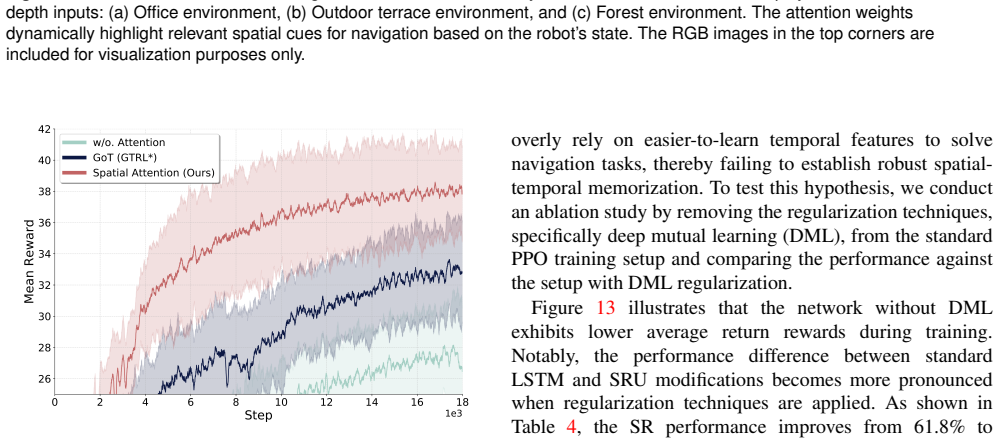
- [Sec. 5.5, Table 4] The DML ablation shows that without DML the SRU-vs-LSTM gap is only 6.3% (61.8% vs 65.7%), whereas with DML it becomes 24.3% (63.5% vs 78.9%). This indicates that the multiplicative gate alone yields a small improvement and that the large reported gain depends on the interaction with DML. Since DML is part of the proposed training recipe, the paper should not attribute the full 23.5% gain to the SRU architecture alone. Please provide a control with an LSTM trained under the same DML tuning/search budget, or a clear argument that DML is not specifically more beneficial to SRU than to LSTM.
- [Sec. 5.3, 5.4, Tables 2 and 3] The GTRL* success rate is reported as 66.3% in Table 2 and as 68.4% in Table 3, and the text says these correspond to different robot models, but the difference is not explained at the first occurrence. Since the authors use this comparison to quantify the contribution of the attention layers (15.4% vs 18.1%), the evaluation protocol must be stated clearly: which table uses which robot, what the exact evaluation episodes are, and why the GTRL* numbers differ. Without this, the cross-table comparisons are confusing and the reader cannot verify the consistency of the results.
minor comments (7)
- [Sec. 4.2] In the discrete state-space model, the state variable and the input both use the symbol x_t (x_t = A x_{t-1} + B u_t); please rename the state to, e.g., z_t or h_t to avoid confusion with the sequence input x_t.
- [Section titles] The section titles 'Comparsion with Recurrent Units' and 'Comparsion against RL-based Navigation Baselines' contain a typo; they should read 'Comparison'.
- [Figures 1 and 2] Figure 1(b) shows training loss curves without a y-axis label or legend, and Figure 2(c) is described as 'log scale' in the caption but Figure 1 does not indicate whether its loss axis is also logarithmic. Please add consistent axis labels and legends.
- [Appendix C, Table C.1] The noise ranges in Table C.1 are given as uniform bounds, but it is not specified whether the noise is sampled independently at every time step, per episode, or per roll-out segment. This detail is important for reproducibility of the recurrent training.
- [Sec. 5.3, Table 2] The EMHP baseline uses a complete 360-degree height scan while the proposed method and GTRL use only a front-facing camera. This asymmetry is stated in the text but not in the table caption; please add it to the caption so the comparison is unambiguous.
- [Sec. 5.6, Figure 16] The Mahalanobis distance computation is attributed to Lee et al. (2018), but the exact feature layer or latent dimension on which the distance is computed is not specified. Please provide the implementation detail, since the reported distances (1.15, 0.82, 0.69) are otherwise hard to interpret.
- [Sec. 6] The limitations section correctly clarifies that 'long-range' refers to local mapless navigation beyond the perception radius rather than global-scale navigation. This qualification should be stated earlier, in the abstract or introduction, to avoid overstating the scope of the contribution.
Circularity Check
Partial circularity: the SRU gate was iteratively engineered on the same synthetic spatial-memory task that is then cited as evidence of an RNN spatial-registration deficit; the navigation success-rate comparisons remain independent external measurements.
-
fitted input called prediction
[Sec. 4.4 (SRU design) vs. Sec. 4.3/Fig. 1 and Appendix A (spatial-memory task)]
"The design of SRUs emerged through iterative experimentation and analysis of spatial mapping performance. ... The effectiveness of this approach is demonstrated by the training results of the spatial mapping task mentioned above and illustrated in Figure 1. ... The spatial task is optimized using the Mean Squared Error (MSE) loss, while the temporal task is optimized using the Binary Cross-Entropy (BCE) loss."
The spatial-memory task in Appendix A is not an independent probe: the SRU's multiplicative gate st = W_xs xt + b_s was selected by iterative experimentation on exactly the 'spatial mapping performance' of this task (Sec. 4.4), and the spatial task is scored by MSE on regressed landmark coordinates. Reporting Figure 1(b)/Figure 2(c) as evidence of 'superior spatial memorization' therefore evaluates the architecture on its own selection criterion; the result is forced by construction up to the capacity of the gate, not an independent falsification of the claim that LSTMs/GRUs/S4/Mamba lack spatial registration. The navigation success rates in Tables 1-2 are separate external measurements, so the headline improvement does not itself reduce to the fitted diagnostic.
full rationale
The main comparative claims, Tables 1 and 2, are external navigation benchmarks with a fixed end-to-end policy; no equation in the paper reduces its navigation success rate to an input or to a fitted parameter. The SRU equations are explicit architectural modifications, not a restatement of the spatial-memory objective. The only circularity-like step is the synthetic spatial-memory task: it is both the basis for the SRU design (Sec. 4.4 explicitly says the design 'emerged through iterative experimentation and analysis of spatial mapping performance') and the evidence cited for the RNN spatial-memory deficit and SRU remedy (Fig. 1). Because the architecture was selected on exactly that MSE spatial-memory objective (Appendix A), Figure 1(b) is in-sample by construction; it cannot independently prove that RNNs lack general spatial registration or that the gate's benefit transfers to navigation. That transfer claim is instead supported by the independent RL navigation results, so the circularity is partial and does not reduce the headline results. Self-citations in the paper, such as the use of Xie et al. 2025 for DML (co-authored by one of the current authors), the TartanAir pretraining dataset, and the Lee et al. 2024 baselines, are not load-bearing circularity: DML is an established external method, TartanAir is an external dataset, and the baselines are standard comparisons. The concern that the synthetic task provides exact ego-motion matrices while the real policy must infer ego-motion from noisy cues is a validity/representativeness limitation, not a circular-derivation flaw. Overall, the paper's core navigation improvements are self-contained empirical results, and the flagged synthetic-task loop is a moderate methodological circularity rather than a forced reduction of the central claim.
Assumptions & free parameters
free parameters (2)
- Reward coefficients =
not reported
- Depth noise parameters =
not reported
assumptions (4)
- domain assumption The synthetic landmark-registration task is a valid proxy for the spatial-memorization demands of mapless navigation.
- domain assumption The robot has access to accurate relative goal position p_t and proprioceptive state (linear/angular velocity, projected gravity) at all times.
- domain assumption PPO with asymmetric actor-critic and the described rewards reliably optimizes the navigation policy to a stationary point.
- domain assumption The depth-noise model (edge, filling, rounding) approximates real ZEDX stereo noise well enough that zero-shot transfer succeeds.
Cite this review
Pith. "Pith review of Spatially-Enhanced Recurrent Memory for Long-Range Mapless Navigation via End-to-End Reinforcement Learning." pith.science (2026). https://pith.science/paper/2R66FPXT
@misc{pith2026250605997,
  author       = {Pith},
  title        = {Pith review of: Spatially-Enhanced Recurrent Memory for Long-Range Mapless Navigation via End-to-End Reinforcement Learning},
  year         = {2026},
  howpublished = {\url{https://pith.science/paper/2R66FPXT}},
  note         = {Machine review of arXiv:2506.05997}
}
read the original abstract
Recent advancements in robot navigation, particularly with end-to-end learning approaches such as reinforcement learning (RL), have demonstrated strong performance. However, successful navigation still depends on two key capabilities: mapping and planning (explicitly or implicitly). Classical approaches rely on explicit mapping pipelines to register egocentric observations into a coherent map. In contrast, end-to-end learning often achieves this implicitly -- through recurrent neural networks (RNNs) that fuse current and historical observations into a latent space for planning. While existing architectures, such as LSTM and GRU, can capture temporal dependencies, our findings reveal a critical limitation: their inability to effectively perform spatial memorization. This capability is essential for integrating sequential observations from varying perspectives to build spatial representations that support planning. To address this, we propose Spatially-Enhanced Recurrent Units (SRUs) -- a simple yet effective modification to existing RNNs -- that enhance spatial memorization. We further introduce an attention-based network architecture integrated with SRUs, enabling long-range mapless navigation using a single forward-facing stereo camera. We also employ regularization techniques to facilitate robust end-to-end recurrent training via RL. Experimental results show 23.5% overall improvement in long-range navigation compared to existing RNNs. With SRU memory, our method outperforms RL baselines -- one relying on explicit mapping and the other on stacked historical observations -- by 29.6% and 105.0%, respectively, across diverse environments requiring long-horizon mapping and memorization. Finally, we address the sim-to-real gap by leveraging large-scale pretraining on synthetic depth data, enabling zero-shot transfer for deployment across diverse and complex real-world environments.
Figures


Figures from the paper (15 more)




Forward citations
Cited by 1 Pith paper
-
RSL-RL: A Learning Library for Robotics Research
RSL-RL is a compact, GPU-accelerated open-source RL library for robotics, providing PPO, DAgger-style behavior cloning, and auxiliary techniques in an easily modifiable codebase.
Reference graph
Works this paper leans on
-
[1]
, " * write output.state after.block = add.period write newline
ENTRY address author booktitle chapter doi edition editor eid howpublished institution isbn journal key month note number organization pages publisher school series title type url volume year label extra.label sort.label short.list INTEGERS output.state before.all mid.sentence after.sentence after.block FUNCTION init.state.consts #0 'before.all := #1 'mid...
-
[2]
write newline
" write newline "" before.all 'output.state := FUNCTION n.dashify 't := "" t empty not t #1 #1 substring "-" = t #1 #2 substring "--" = not "--" * t #2 global.max substring 't := t #1 #1 substring "-" = "-" * t #2 global.max substring 't := while if t #1 #1 substring * t #2 global.max substring 't := if while FUNCTION word.in bbl.in capitalize ":" * " " *...
-
[3]
, " * write output.state after.block = add.period write newline
ENTRY address archive author booktitle chapter doi edition editor eid eprint howpublished institution isbn journal key month note number organization pages publisher school series title type url volume year label INTEGERS output.state before.all mid.sentence after.sentence after.block FUNCTION init.state.consts #0 'before.all := #1 'mid.sentence := #2 'af...
-
[4]
write newline
" write newline "" before.all 'output.state := FUNCTION n.dashify 't := "" t empty not t #1 #1 substring "-" = t #1 #2 substring "--" = not "--" * t #2 global.max substring 't := t #1 #1 substring "-" = "-" * t #2 global.max substring 't := while if t #1 #1 substring * t #2 global.max substring 't := if while FUNCTION word.in bbl.in capitalize " " * FUNCT...
-
[5]
Barron JT and Malik J (2013 a ) Intrinsic scene properties from a single rgb-d image. CVPR
2013
-
[6]
In: Proceedings of the IEEE Conference on Computer Vision and Pattern Recognition
Barron JT and Malik J (2013 b ) Intrinsic scene properties from a single rgb-d image. In: Proceedings of the IEEE Conference on Computer Vision and Pattern Recognition. pp. 17--24
work page 2013
-
[7]
Vision Transformers for End-to-End Vision-Based Quadrotor Obstacle Avoidance
Bhattacharya A, Rao N, Parikh D, Kunapuli P, Wu Y, Tao Y, Matni N and Kumar V (2024) Vision transformers for end-to-end vision-based quadrotor obstacle avoidance. arXiv preprint arXiv:2405.10391
work page Pith review arXiv 2024
-
[8]
Bohg J, Romero J, Herzog A and Schaal S (2014 a ) Robot arm pose estimation through pixel-wise part classification. ICRA
work page 2014
Show all 85 references
-
[9]
In: 2014 IEEE International Conference on Robotics and Automation (ICRA)
Bohg J, Romero J, Herzog A and Schaal S (2014 b ) Robot arm pose estimation through pixel-wise part classification. In: 2014 IEEE International Conference on Robotics and Automation (ICRA). IEEE, pp. 3143--3150
2014
-
[10]
In: Proceedings 2000 ICRA
Bohlin R and Kavraki LE (2000) Path planning using lazy prm. In: Proceedings 2000 ICRA. Millennium conference. IEEE international conference on robotics and automation. Symposia proceedings (Cat. No. 00CH37065), volume 1. IEEE, pp. 521--528
2000
-
[11]
(2016) End to end learning for self-driving cars
Bojarski M, Del Testa D, Dworakowski D, Firner B, Flepp B, Goyal P, Jackel LD, Monfort M, Muller U, Zhang J et al. (2016) End to end learning for self-driving cars. arXiv preprint arXiv:1604.07316
2016 arXiv
-
[12]
In: Proceedings of the IEEE/CVF international conference on computer vision
Caron M, Touvron H, Misra I, J \'e gou H, Mairal J, Bojanowski P and Joulin A (2021) Emerging properties in self-supervised vision transformers. In: Proceedings of the IEEE/CVF international conference on computer vision. pp. 9650--9660
2021
-
[13]
Frontiers in Robotics and AI 8: 627730
C \`e sar-Tondreau B, Warnell G, Stump E, Kochersberger K and Waytowich NR (2021) Improving autonomous robotic navigation using imitation learning. Frontiers in Robotics and AI 8: 627730
2021
-
[14]
2023 IEEE International Conference on Robotics and Automation (ICRA) : 3983--3989doi:10.1109/ICRA48891.2023.10160508
Chen K, Nemiroff R and Lopez BT (2023) Direct lidar-inertial odometry: Lightweight lio with continuous-time motion correction. 2023 IEEE International Conference on Robotics and Automation (ICRA) : 3983--3989doi:10.1109/ICRA48891.2023.10160508
2023
-
[15]
arXiv preprint arXiv:1406.1078
Cho K, Van Merri \"e nboer B, Gulcehre C, Bahdanau D, Bougares F, Schwenk H and Bengio Y (2014) Learning phrase representations using rnn encoder-decoder for statistical machine translation. arXiv preprint arXiv:1406.1078
2014 arXiv
-
[16]
In: 2019 International Conference on Robotics and Automation (ICRA)
Choi J, Park K, Kim M and Seok S (2019) Deep reinforcement learning of navigation in a complex and crowded environment with a limited field of view. In: 2019 International Conference on Robotics and Automation (ICRA). IEEE, pp. 5993--6000
2019
-
[17]
IEEE Robotics and Automation Letters 7(2): 730--737
Cimurs R, Suh IH and Lee JH (2021) Goal-driven autonomous exploration through deep reinforcement learning. IEEE Robotics and Automation Letters 7(2): 730--737
2021
-
[18]
Numerische mathematik 1(1): 269--271
Dijkstra EW (1959) A note on two problems in connexion with graphs. Numerische mathematik 1(1): 269--271
1959
-
[19]
The International Journal of Robotics Research 33(1): 18--47
Dobson A and Bekris KE (2014) Sparse roadmap spanners for asymptotically near-optimal motion planning. The International Journal of Robotics Research 33(1): 18--47
2014
-
[20]
Dozat T (2016) Incorporating nesterov momentum into adam
2016
-
[21]
In: ICAART (2)
Duarte FF, Lau N, Pereira A and Reis LP (2023) Lstm, convlstm, mdn-rnn and gridlstm memory-based deep reinforcement learning. In: ICAART (2). pp. 169--179
2023
-
[22]
Dunteman GH (1989) Principal components analysis, volume 69. Sage
1989
-
[23]
IEEE Transactions on Robotics 36(4): 1115--1134
Francis A, Faust A, Chiang HTL, Hsu J, Kew JC, Fiser M and Lee TWE (2020) Long-range indoor navigation with prm-rl. IEEE Transactions on Robotics 36(4): 1115--1134
2020
-
[24]
In: Proceedings of the IEEE/CVF Conference on Computer Vision and Pattern Recognition
Fu Z, Kumar A, Agarwal A, Qi H, Malik J and Pathak D (2022) Coupling vision and proprioception for navigation of legged robots. In: Proceedings of the IEEE/CVF Conference on Computer Vision and Pattern Recognition. pp. 17273--17283
2022
-
[25]
arXiv preprint arXiv:2312.00752
Gu A and Dao T (2023) Mamba: Linear-time sequence modeling with selective state spaces. arXiv preprint arXiv:2312.00752
2023 arXiv
-
[26]
Advances in neural information processing systems 33: 1474--1487
Gu A, Dao T, Ermon S, Rudra A and R \'e C (2020 a ) Hippo: Recurrent memory with optimal polynomial projections. Advances in neural information processing systems 33: 1474--1487
2020
-
[27]
arXiv preprint arXiv:2111.00396
Gu A, Goel K and R \'e C (2021) Efficiently modeling long sequences with structured state spaces. arXiv preprint arXiv:2111.00396
2021 arXiv
-
[28]
In: International conference on machine learning
Gu A, Gulcehre C, Paine T, Hoffman M and Pascanu R (2020 b ) Improving the gating mechanism of recurrent neural networks. In: International conference on machine learning. PMLR, pp. 3800--3809
2020
-
[29]
Handa A, Whelan T, McDonald J and Davison AJ (2014 a ) A benchmark for rgb-d visual odometry, 3d reconstruction and slam. ICRA
2014
-
[30]
In: 2014 IEEE international conference on Robotics and automation (ICRA)
Handa A, Whelan T, McDonald J and Davison AJ (2014 b ) A benchmark for rgb-d visual odometry, 3d reconstruction and slam. In: 2014 IEEE international conference on Robotics and automation (ICRA). IEEE, pp. 1524--1531
2014
-
[31]
IEEE Transactions on Systems Science and Cybernetics 4(2): 100--107
Hart P, Nilsson N and Raphael B (1968) A formal basis for the heuristic determination of minimum cost paths. IEEE Transactions on Systems Science and Cybernetics 4(2): 100--107
1968
-
[32]
arXiv preprint arXiv:2202.11818
Hausknecht M and Wagener N (2022) Consistent dropout for policy gradient reinforcement learning. arXiv preprint arXiv:2202.11818
2022 arXiv
-
[33]
In: Proceedings of Robotics: Science and Systems
He T, Zhang C, Xiao W, He G, Liu C and Shi G (2024) Agile But Safe: Learning Collision-Free High-Speed Legged Locomotion . In: Proceedings of Robotics: Science and Systems. Delft, Netherlands. doi:10.15607/RSS.2024.XX.059
2024 doi
-
[34]
Neural computation 9(8): 1735--1780
Hochreiter S and Schmidhuber J (1997) Long short-term memory. Neural computation 9(8): 1735--1780
1997
-
[35]
IEEE Robotics and Automation Letters 6(3): 5081--5088
Hoeller D, Wellhausen L, Farshidian F and Hutter M (2021) Learning a state representation and navigation in cluttered and dynamic environments. IEEE Robotics and Automation Letters 6(3): 5081--5088
2021
-
[36]
IEEE Transactions on Intelligent Transportation Systems 25(2): 1832--1845
Huang W, Zhou Y, He X and Lv C (2023) Goal-guided transformer-enabled reinforcement learning for efficient autonomous navigation. IEEE Transactions on Intelligent Transportation Systems 25(2): 1832--1845
2023
-
[37]
(2016) Anymal-a highly mobile and dynamic quadrupedal robot
Hutter M, Gehring C, Jud D, Lauber A, Bellicoso CD, Tsounis V, Hwangbo J, Bodie K, Fankhauser P, Bloesch M et al. (2016) Anymal-a highly mobile and dynamic quadrupedal robot. In: 2016 IEEE/RSJ international conference on intelligent robots and systems (IROS). IEEE, pp. 38--44
2016
-
[38]
The international journal of robotics research 30(7): 846--894
Karaman S and Frazzoli E (2011) Sampling-based algorithms for optimal motion planning. The international journal of robotics research 30(7): 846--894
2011
-
[39]
In: 2023 IEEE International Conference on Robotics and Automation (ICRA)
Kareer S, Yokoyama N, Batra D, Ha S and Truong J (2023) Vinl: Visual navigation and locomotion over obstacles. In: 2023 IEEE International Conference on Robotics and Automation (ICRA). IEEE, pp. 2018--2024
2023
-
[40]
In: 2022 International Conference on Robotics and Automation (ICRA)
Karnan H, Warnell G, Xiao X and Stone P (2022) Voila: Visual-observation-only imitation learning for autonomous navigation. In: 2022 International Conference on Robotics and Automation (ICRA). IEEE, pp. 2497--2503
2022
-
[41]
IEEE transactions on Robotics and Automation 12(4): 566--580
Kavraki LE, Svestka P, Latombe JC and Overmars MH (1996) Probabilistic roadmaps for path planning in high-dimensional configuration spaces. IEEE transactions on Robotics and Automation 12(4): 566--580
1996
-
[42]
In: Proceedings 2000 ICRA
Kuffner JJ and LaValle SM (2000) Rrt-connect: An efficient approach to single-query path planning. In: Proceedings 2000 ICRA. Millennium conference. IEEE international conference on robotics and automation. Symposia proceedings (Cat. No. 00CH37065), volume 2. IEEE, pp. 995--1001
2000
-
[43]
(2001) Rapidly-exploring random trees: Progress and prospects
LaValle SM, Kuffner JJ, Donald B et al. (2001) Rapidly-exploring random trees: Progress and prospects. Algorithmic and computational robotics: new directions 5: 293--308
2001
-
[44]
Science Robotics 9(89): eadi9641
Lee J, Bjelonic M, Reske A, Wellhausen L, Miki T and Hutter M (2024) Learning robust autonomous navigation and locomotion for wheeled-legged robots. Science Robotics 9(89): eadi9641
2024
-
[45]
Advances in neural information processing systems 31
Lee K, Lee K, Lee H and Shin J (2018) A simple unified framework for detecting out-of-distribution samples and adversarial attacks. Advances in neural information processing systems 31
2018
-
[46]
In: Proceedings of the IEEE conference on computer vision and pattern recognition
Lin TY, Doll \'a r P, Girshick R, He K, Hariharan B and Belongie S (2017) Feature pyramid networks for object detection. In: Proceedings of the IEEE conference on computer vision and pattern recognition. pp. 2117--2125
2017
-
[47]
Science Robotics 6(59): eabg5810
Loquercio A, Kaufmann E, Ranftl R, M \"u ller M, Koltun V and Scaramuzza D (2021) Learning high-speed flight in the wild. Science Robotics 6(59): eabg5810
2021
-
[48]
In: Proceedings of the IEEE/CVF Conference on Computer Vision and Pattern Recognition
Ma X, Dai X, Bai Y, Wang Y and Fu Y (2024) Rewrite the stars. In: Proceedings of the IEEE/CVF Conference on Computer Vision and Pattern Recognition. pp. 5694--5703
2024
-
[49]
Current Biology 28(8): 1224--1233
Matthis JS, Yates JL and Hayhoe MM (2018) Gaze and the control of foot placement when walking in natural terrain. Current Biology 28(8): 1224--1233
2018
-
[50]
In: Proceedings of the IEEE/CVF conference on computer vision and pattern recognition
Mescheder L, Oechsle M, Niemeyer M, Nowozin S and Geiger A (2019) Occupancy networks: Learning 3d reconstruction in function space. In: Proceedings of the IEEE/CVF conference on computer vision and pattern recognition. pp. 4460--4470
2019
-
[51]
Neurocomputing 563: 126919
Mi JX, Jiang X, Luo L and Gao Y (2024) Toward explainable artificial intelligence: A survey and overview on their intrinsic properties. Neurocomputing 563: 126919
2024
-
[52]
Science robotics 7(62): eabk2822
Miki T, Lee J, Hwangbo J, Wellhausen L, Koltun V and Hutter M (2022 a ) Learning robust perceptive locomotion for quadrupedal robots in the wild. Science robotics 7(62): eabk2822
2022
-
[53]
In: 2022 IEEE/RSJ International Conference on Intelligent Robots and Systems (IROS)
Miki T, Wellhausen L, Grandia R, Jenelten F, Homberger T and Hutter M (2022 b ) Elevation mapping for locomotion and navigation using gpu. In: 2022 IEEE/RSJ International Conference on Intelligent Robots and Systems (IROS). IEEE, pp. 2273--2280
2022
-
[54]
IEEE Robotics and Automation Letters 8(6): 3740--3747
Mittal M, Yu C, Yu Q, Liu J, Rudin N, Hoeller D, Yuan JL, Singh R, Guo Y, Mazhar H, Mandlekar A, Babich B, State G, Hutter M and Garg A (2023) Orbit: A unified simulation framework for interactive robot learning environments. IEEE Robotics and Automation Letters 8(6): 3740--37...
2023
-
[55]
In: Proceedings of the IEEE/CVF Conference on Computer Vision and Pattern Recognition
Mohajerin N and Rohani M (2019) Multi-step prediction of occupancy grid maps with recurrent neural networks. In: Proceedings of the IEEE/CVF Conference on Computer Vision and Pattern Recognition. pp. 10600--10608
2019
-
[56]
IEEE Transactions on Robotics
Ortiz-Haro J, H \"o nig W, Hartmann VN and Toussaint M (2024) idb-a*: Iterative search and optimization for optimal kinodynamic motion planning. IEEE Transactions on Robotics
2024
-
[57]
In: IEEE International Conference on Robotics and Automation (ICRA)
Pfeiffer M, Schaeuble M, Nieto J, Siegwart R and Cadena C (2017) From perception to decision: A data-driven approach to end-to-end motion planning for autonomous ground robots. In: IEEE International Conference on Robotics and Automation (ICRA). IEEE, p. 1527–1533
2017
-
[58]
arXiv preprint arXiv:1710.06542
Pinto L, Andrychowicz M, Welinder P, Zaremba W and Abbeel P (2017) Asymmetric actor critic for image-based robot learning. arXiv preprint arXiv:1710.06542
2017 arXiv
-
[59]
In: Proceedings of the IEEE/CVF conference on computer vision and pattern recognition
Radosavovic I, Kosaraju RP, Girshick R, He K and Doll \'a r P (2020) Designing network design spaces. In: Proceedings of the IEEE/CVF conference on computer vision and pattern recognition. pp. 10428--10436
2020
-
[60]
In: 2022 IEEE/RSJ International Conference on Intelligent Robots and Systems (IROS)
Rudin N, Hoeller D, Bjelonic M and Hutter M (2022) Advanced skills by learning locomotion and local navigation end-to-end. In: 2022 IEEE/RSJ International Conference on Intelligent Robots and Systems (IROS). IEEE, pp. 2497--2503
2022
-
[61]
arXiv preprint arXiv:2209.07043
Ruiz-Serra J, White J, Petrie S, Kameneva T and McCarthy C (2022) Towards self-attention based visual navigation in the real world. arXiv preprint arXiv:2209.07043
2022 arXiv
-
[62]
arXiv preprint arXiv:1803.00653
Savinov N, Dosovitskiy A and Koltun V (2018) Semi-parametric topological memory for navigation. arXiv preprint arXiv:1803.00653
2018 arXiv
-
[63]
arXiv preprint arXiv:1707.06347
Schulman J, Wolski F, Dhariwal P, Radford A and Klimov O (2017) Proximal policy optimization algorithms. arXiv preprint arXiv:1707.06347
2017 arXiv
-
[64]
arXiv preprint arXiv:2210.03370
Shah D, Sridhar A, Bhorkar A, Hirose N and Levine S (2022) Gnm: A general navigation model to drive any robot. arXiv preprint arXiv:2210.03370
2022 arXiv
-
[65]
In: 7th Annual Conference on Robot Learning
Shah D, Sridhar A, Dashora N, Stachowicz K, Black K, Hirose N and Levine S (2023) Vi NT : A foundation model for visual navigation. In: 7th Annual Conference on Robot Learning
2023
-
[66]
IEEE Transactions on Industrial Informatics 16(4): 2393--2402
Shi H, Shi L, Xu M and Hwang KS (2019) End-to-end navigation strategy with deep reinforcement learning for mobile robots. IEEE Transactions on Industrial Informatics 16(4): 2393--2402
2019
-
[67]
In: 2019 IEEE International conference on big data (Big Data)
Siami-Namini S, Tavakoli N and Namin AS (2019) The performance of lstm and bilstm in forecasting time series. In: 2019 IEEE International conference on big data (Big Data). IEEE, pp. 3285--3292
2019
-
[68]
arXiv preprint arXiv:2005.13857
Surmann H, Jestel C, Marchel R, Musberg F, Elhadj H and Ardani M (2020) Deep reinforcement learning for real autonomous mobile robot navigation in indoor environments. arXiv preprint arXiv:2005.13857
2020 arXiv
-
[69]
Advances in neural information processing systems 27
Sutskever I, Vinyals O and Le QV (2014) Sequence to sequence learning with neural networks. Advances in neural information processing systems 27
2014
-
[70]
In: 2021 IEEE/RSJ International Conference on Intelligent Robots and Systems (IROS)
Truong J, Yarats D, Li T, Meier F, Chernova S, Batra D and Rai A (2021) Learning navigation skills for legged robots with learned robot embeddings. In: 2021 IEEE/RSJ International Conference on Intelligent Robots and Systems (IROS). IEEE, pp. 484--491
2021
-
[71]
In: 2020 IEEE/RSJ International Conference on Intelligent Robots and Systems (IROS)
Wang W, Zhu D, Wang X, Hu Y, Qiu Y, Wang C, Hu Y, Kapoor A and Scherer S (2020) Tartanair: A dataset to push the limits of visual slam. In: 2020 IEEE/RSJ International Conference on Intelligent Robots and Systems (IROS). IEEE, pp. 4909--4916
2020
-
[72]
arXiv preprint arXiv:2503.24381
Wang Y, Huang X, Sun X, Yan M, Xing S, Tu Z and Li J (2025) Uniocc: A unified benchmark for occupancy forecasting and prediction in autonomous driving. arXiv preprint arXiv:2503.24381
2025 arXiv
-
[73]
arXiv preprint arXiv:1205.5088
Webb DJ and Berg Jvd (2012) Kinodynamic rrt*: Optimal motion planning for systems with linear differential constraints. arXiv preprint arXiv:1205.5088
2012 arXiv
-
[74]
In: 2022 International Conference on Robotics and Automation (ICRA)
Weerakoon K, Sathyamoorthy AJ, Patel U and Manocha D (2022) Terp: Reliable planning in uneven outdoor environments using deep reinforcement learning. In: 2022 International Conference on Robotics and Automation (ICRA). IEEE, pp. 9447--9453
2022
-
[75]
In: Proceedings of the IEEE/CVF International Conference on Computer Vision
Wei Y, Zhao L, Zheng W, Zhu Z, Zhou J and Lu J (2023) Surroundocc: Multi-camera 3d occupancy prediction for autonomous driving. In: Proceedings of the IEEE/CVF International Conference on Computer Vision. pp. 21729--21740
2023
-
[76]
Field Robotics 3: 413--434
Wellhausen L and Hutter M (2023) Artplanner: Robust legged robot navigation in the field. Field Robotics 3: 413--434
2023
-
[77]
arXiv preprint arXiv:1911.00357
Wijmans E, Kadian A, Morcos A, Lee S, Essa I, Parikh D, Savva M and Batra D (2019) Dd-ppo: Learning near-perfect pointgoal navigators from 2.5 billion frames. arXiv preprint arXiv:1911.00357
2019 arXiv
-
[78]
AI Matters 9(2): 8--14
Wijmans E, Savva M, Essa I, Lee S, Morcos AS and Batra D (2023) Emergence of maps in the memories of blind navigation agents. AI Matters 9(2): 8--14
2023
-
[79]
IEEE Transactions on Industrial Electronics 69(5): 5342--5352
Wu K, Wang H, Esfahani MA and Yuan S (2021) Learn to navigate autonomously through deep reinforcement learning. IEEE Transactions on Industrial Electronics 69(5): 5342--5352
2021
-
[80]
arXiv preprint arXiv:2501.02481
Xie Z, Cao J, Zhang Q, Zhang J, Wang C and Xu R (2025) The meta-representation hypothesis. arXiv preprint arXiv:2501.02481
2025
-
[81]
In: 2022 ieee/rsj international conference on intelligent robots and systems (iros)
Yang F, Cao C, Zhu H, Oh J and Zhang J (2022 a ) Far planner: Fast, attemptable route planner using dynamic visibility update. In: 2022 ieee/rsj international conference on intelligent robots and systems (iros). IEEE, pp. 9--16
2022
-
[82]
In: International Conference on Learning Representations
Yang R, Zhang M, Hansen N, Xu H and Wang X (2022 b ) Learning vision-guided quadrupedal locomotion end-to-end with cross-modal transformers. In: International Conference on Learning Representations
2022
-
[83]
arXiv preprint arXiv:2406.20083
Zeng KH, Zhang Z, Ehsani K, Hendrix R, Salvador J, Herrasti A, Girshick R, Kembhavi A and Weihs L (2024) Poliformer: Scaling on-policy rl with transformers results in masterful navigators. arXiv preprint arXiv:2406.20083
2024 arXiv
-
[84]
In: 2024 IEEE International Conference on Robotics and Automation (ICRA)
Zhang C, Jin J, Frey J, Rudin N, Mattamala M, Cadena C and Hutter M (2024) Resilient legged local navigation: Learning to traverse with compromised perception end-to-end. In: 2024 IEEE International Conference on Robotics and Automation (ICRA). IEEE, pp. 34--41
2024
-
[85]
In: 2017 IEEE international conference on robotics and automation (ICRA)
Zhu Y, Mottaghi R, Kolve E, Lim JJ, Gupta A, Fei-Fei L and Farhadi A (2017) Target-driven visual navigation in indoor scenes using deep reinforcement learning. In: 2017 IEEE international conference on robotics and automation (ICRA). IEEE, pp. 3357--3364
2017
Reviewed August 7, 2026 · model on record in the stance chip above.
Discussion (0). Sign in to comment.