REVIEW 3 major objections 5 minor 38 cited by
RSL-RL argues that a compact, GPU-only RL library centered on PPO and DAgger-style behavior cloning can meet most robotics research needs, including sim-to-real transfer.
Reviewed by Pith at T0; open to challenge. T0 means a machine referee read the full paper against a public rubric. the ladder, T0–T4 →
T0 review · deepseek-v4-flash
2026-08-04 17:34 UTC pith:LETPGUWX
load-bearing objection RSL-RL is a real, widely used library and the paper explains it clearly, but the high-throughput claim is asserted, not shown, and the validation rests on a chain of prior papers. the 3 major comments →
RSL-RL: A Learning Library for Robotics Research
The pith
A machine-rendered reading of the paper's core claim, the machinery that carries it, and where it could break.
Core claim
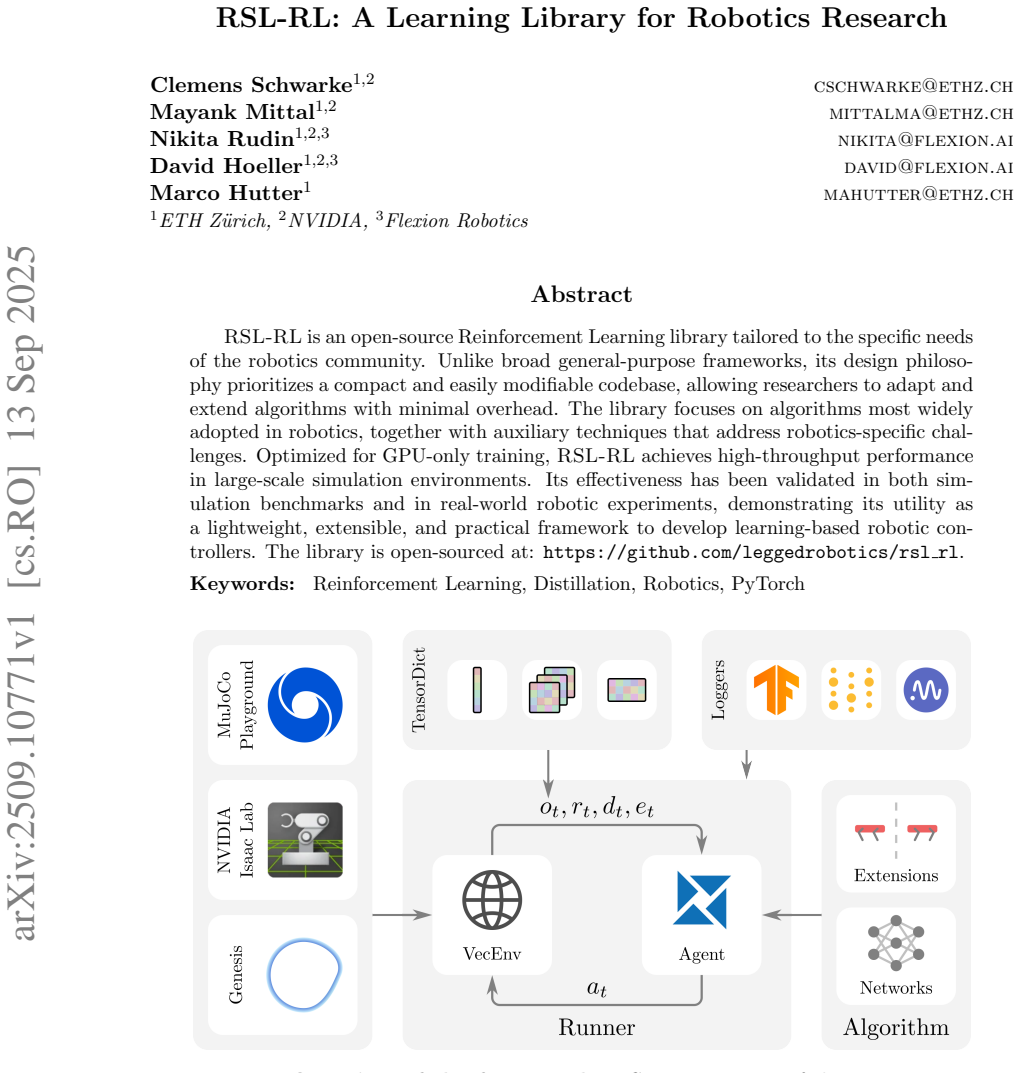
The paper argues that a deliberately narrow RL library can serve the robotics community better than a broad framework. Concretely, RSL-RL implements exactly two algorithms—PPO for on-policy learning and a DAgger-style behavior-cloning routine for distilling a trained teacher into a deployable student—plus symmetry augmentation and a partial-state curiosity reward. The framework is organized into three independently modifiable components (Runner, Algorithm, Network) with an environment interface that passes observations as nested tensor containers, and training runs entirely on GPU with native multi-GPU and multi-node support. The claimed payoff is that this combination has produced walking p
What carries the argument
The load-bearing piece is the three-part architecture—Runner, Algorithm, Network—with a same-step-reset environment interface and nested-tensor observation containers. This structure is what makes the codebase modifiable in a few files and keeps the training loop GPU-only and batched. The PPO implementation carries the throughput; the DAgger-style behavior-cloning loop carries sim-to-real distillation; symmetry augmentation and subset-state curiosity carry the robotics-specific sample-efficiency gains.
Load-bearing premise
The central claim assumes that the throughput and real-world successes credited to RSL-RL by the cited prior applications reflect the library as packaged, not bespoke modifications each project made.
What would settle it
Run the repository's default PPO example on the same GPU simulator and hardware class as the paper's cited 'walking in minutes' result, and measure wall-clock time until a walking gait appears. If training takes hours rather than minutes, or if multi-GPU scaling is not observed, the high-throughput premise fails.
If this is right
- If the paper is right, a robotics lab can train a locomotion or manipulation policy on a single GPU in minutes and deploy it on hardware through the built-in teacher-student distillation path.
- New robot-learning tasks can be tackled by editing at most the runner, algorithm, and network files, lowering the barrier to reproducing and extending published results.
- Because the library integrates with several GPU-accelerated simulators, it can serve as a common baseline that makes published robotics results easier to compare.
- The included symmetry augmentation and curiosity reward become reusable building blocks, reducing manual reward shaping on sparse-reward and symmetric-robot problems.
- Researchers who need to benchmark many RL algorithms would still require a broader tool; the paper is explicit that RSL-RL is intentionally not designed for that.
Where Pith is reading between the lines
- If RSL-RL's throughput claim is general, its simple interface could make it a natural testbed for scaling studies: sweeping batch size and GPU count to find where wall-clock performance saturates would be a direct extension the paper does not report.
- The partial-state curiosity variant suggests a broader design principle: intrinsic rewards can focus on task-relevant degrees of freedom rather than the full state; testing this on non-locomotion sparse-reward tasks would be a cheap next experiment.
- The paper's emphasis on PPO plus distillation implies that many real deployments do not need off-policy or model-based algorithms—a hypothesis worth testing by comparing policy performance and engineering cost on the same hardware.
- Because no standalone imitation-learning path is included, extending the behavior-cloning routine into a demonstration-only pipeline would let the library serve tasks where no RL-trained teacher exists.
Editorial analysis
A structured set of objections, weighed in public.
Referee Report
Summary. The paper presents RSL-RL, a PyTorch-based reinforcement-learning library aimed at robotics researchers. It describes a deliberately minimal design with three extension points (runners, algorithms, networks), two main algorithms (PPO and DAgger-style behavior cloning), auxiliary techniques (symmetry augmentation and RND-based curiosity), logging and distributed-training utilities, and integration with several GPU-accelerated simulators. The manuscript asserts that the library is compact, easily modifiable, high-throughput, and validated in both simulation and real-world experiments. However, these assertions are not accompanied by any quantitative measurements, benchmarks, training curves, or runtime comparisons within the paper itself; validation is deferred to a list of external publications, many from the same research group. The paper includes a brief discussion of intended use and limitations.
Significance. RSL-RL is a real, publicly available library that has been used in several well-known robotics results, and the paper provides a useful high-level description of its design and components. If the central claim of high-throughput, validated utility were supported by measurements, the paper would be a valuable system description for robotics practitioners selecting a lightweight RL codebase. As it stands, however, the paper functions more as an announcement and an adoption list than as a self-contained evaluation. The absence of direct benchmarks and version pinning creates a reproducibility gap that prevents the reader from verifying the current release against the claimed properties. The authors are in a strong position to close this gap by adding experiments and precise version metadata.
major comments (3)
- [Abstract and §1 (Introduction)] The abstract and the bullet point 'High-throughput training' in §1 assert that RSL-RL achieves high-throughput performance, but the manuscript contains no quantitative evidence: no samples-per-second or wall-clock measurements, no hardware description, no training curves, and no comparison with existing libraries such as rl_games, CleanRL, or TorchRL. Section 4 lists external papers, but those cannot validate the current release without a version/commit pin. Please add a benchmark section, at minimum for a canonical legged-locomotion task, reporting throughput and training time, and give the exact commit or release version of the code used.
- [§4 (Applications in Research)] The validation-by-publication argument is structurally weak because most cited applications originate from the same group (e.g., Rudin et al. 2022, Schwarke et al. 2023, Hoeller et al. 2024, He et al. 2025). No mapping is provided between each cited work and the RSL-RL version/API described in this paper, so the current codebase could have diverged from those forks. To support the claim of 'effectiveness validated,' state the version or commit used in each external study and include at least one reproducibility test or independent evaluation against the current release.
- [§2.2 (Auxiliary Techniques)] The RND modification is described only qualitatively: 'computes the reward using only a subset of the full state of the system.' There is no equation, no detail about how the subset is selected, and no ablation or reference supporting the claimed benefit over standard RND. Since this is presented as a distinguishing feature, please specify the formulation formally and provide evidence, or cite a publication that contains the full details.
minor comments (5)
- [Abstract] The repository URL appears as 'rsl rl' because of a line break; fix the URL formatting so it reads 'https://github.com/leggedrobotics/rsl_rl'.
- [Figure 1] The figure has no detailed caption. It would help to annotate the data flow between Runners, Algorithms, and Networks, and to indicate which components users typically modify.
- [References] Several bibliography entries contain encoding artifacts, e.g., the author name 'Jo ˜AG ¸ o GM Ara˜Aˇ sjo' in the CleanRL reference. Please regenerate or clean the reference list.
- [§3 (Implementation Details)] The term 'same-step reset mode' in the VecEnv interface is not defined. Since this is part of the environment contract, give a brief explanation or a pointer to Gymnasium's terminology.
- [§2.3 (Utilities)] The claim of 'distributed training over multiple nodes and multi-GPUs' has no configuration details or measured scaling behavior. At minimum, describe the launching mechanism and any known limitations.
Circularity Check
No significant circularity; the paper's performance and validation claims rest on external published applications, not on an in-paper derivation that reduces to its inputs.
full rationale
This manuscript is a software description, not a derivation or prediction paper. The central claims—compact design, high-throughput GPU-only training, and demonstrated utility—are presented as properties of an open-source codebase. The paper does not fit any parameter, define a quantity in terms of the quantity it claims to predict, or invoke a uniqueness theorem. Its strongest empirical assertions, such as 'RSL-RL achieves high-throughput performance' and 'effectiveness has been validated in both simulation benchmarks and in real-world robotic experiments,' are supported in Section 4 by a list of externally published peer-reviewed papers, including several from the same ETH/NVIDIA group. That reliance on prior work is a normal evidentiary pattern for a library paper: the cited papers contain their own experiments, benchmarks, and sim-to-real results, and they use the library as a tool rather than presupposing the library's performance claims. The overlap in authorship is a credibility and reproducibility concern, not a logical circularity. The absence of an in-manuscript throughput benchmark, a version pin, or a reproduction script is a verification gap—correctness risk, not a circularity risk. Because no load-bearing step reduces by construction to an input or to an unverified self-citation chain, the paper receives a circularity score of 0.
Axiom & Free-Parameter Ledger
axioms (4)
- domain assumption Compactness and modifiability are the primary needs of robotics researchers using RL libraries.
- domain assumption PPO and DAgger-style BC are sufficient for the majority of robotics RL tasks.
- domain assumption GPU-only training is the appropriate target; CPU support is unnecessary.
- domain assumption Prior publications cited in §4 used the library in a way that validates its design.
read the original abstract
RSL-RL is an open-source Reinforcement Learning library tailored to the specific needs of the robotics community. Unlike broad general-purpose frameworks, its design philosophy prioritizes a compact and easily modifiable codebase, allowing researchers to adapt and extend algorithms with minimal overhead. The library focuses on algorithms most widely adopted in robotics, together with auxiliary techniques that address robotics-specific challenges. Optimized for GPU-only training, RSL-RL achieves high-throughput performance in large-scale simulation environments. Its effectiveness has been validated in both simulation benchmarks and in real-world robotic experiments, demonstrating its utility as a lightweight, extensible, and practical framework to develop learning-based robotic controllers. The library is open-sourced at: https://github.com/leggedrobotics/rsl_rl.
Figures
Forward citations
Cited by 38 Pith papers
-
EgoEngine: From Egocentric Human Videos to High-Fidelity Dexterous Robot Demonstrations
EgoEngine transforms egocentric human videos into high-fidelity robot data enabling zero-shot visuomotor dexterous policy learning without real-robot demonstrations.
-
Beyond Binary: Sim-to-Real Dexterous Manipulation with Physics-Grounded Contact Representation
CoP tactile representation with differentiable calibration enables zero-shot sim-to-real transfer and outperforms binary and raw-taxel baselines on peg-in-hole insertion and ball balancing with a multi-fingered hand.
-
Betting for Sim-to-Real Performance Evaluation
Betting mechanisms can yield provably more accurate and efficient estimates of real-world robot behavior than Monte Carlo sampling under specified conditions, with practical approximations demonstrated on synthetic da...
-
HALO: Hybrid Auto-encoded Locomotion with Learned Latent Dynamics, Poincar\'e Maps, and Regions of Attraction
HALO learns latent reduced-order models with Poincaré maps for hybrid locomotion dynamics, allowing Lyapunov-based regions of attraction to be lifted from latent space to the full-order system.
-
Bounded Ratio Reinforcement Learning
BRRL derives an analytic optimal policy for regularized constrained RL that guarantees monotonic improvement and yields the BPO algorithm that matches or exceeds PPO.
-
Open-DiffLoco: Open-Source Differentiable Learning for Deployable Blind Quadruped Locomotion
Differentiable simulation with SHAC and a simplified reward set trains deployable blind quadruped policies that transfer to a real Unitree Go2, plus a new critic-Jacobian supervision method (JAVE).
-
Learning Adaptive Multi-Task Guidance, Navigation, and Control via Hypernetworks
A hypernetwork maps continuous physics-informed task embeddings to shared actor-critic weights, mastering four orbital GNC tasks and composing novel ones without retraining, with sim-to-real on a floating platform.
-
Sling2Sim2Real: One-Shot Elastic System Identification for Non-Destructive Slingshot Policy Learning
A one-shot Real2Sim2Real framework fits five elastic parameters from a single non-destructive interaction and zero-shot transfers a slingshot RL policy to a real Franka arm.
-
Cross-Embodiment Robot Manipulation via a Unified Hand Action Space
UHAS maps hand actions to deformations of a shared unit sphere and recovers joint commands via cascade IK, enabling multi-hand RL, zero-shot transfer, and modest real-world cube reorientation on LEAP and Allegro.
-
Learning Locomotion on Discrete Terrain via Minimal Proximity Sensing
Foot-mounted proximity sensors provide pre-contact feedback that, when integrated into RL, improves quadruped traversal robustness on discrete terrain with reliable sim-to-real transfer.
-
MAPL: Multi-Objective Preference Learning for Robot Locomotion
MAPL trains quadruped locomotion policies from LLM-generated multi-objective trajectory preferences and matches or exceeds expert-designed reward performance in four environments without manual reward engineering.
-
Rotation-Aware Point-Cloud Embeddings for Vision-Based In-Hand Reorientation
Learns rotation-aware point-cloud embeddings calibrated to SO(3) geodesic error, enabling model-free RL for vision-based in-hand reorientation without pose or flow inputs.
-
TAGA: Terrain-aware Active Gaze Learning for Generalizable Agile Humanoid Locomotion
TAGA learns terrain-aware active gaze behaviors for humanoid robots via RL alone, enabling generalizable locomotion with 1.2m real-world gap traversal.
-
HORIZON: Recoverability-Governed Curriculum for Physical-Domain Scaling
HORIZON is a recoverability-governed checkpointed frontier curriculum for on-policy physical-domain scaling on quadruped locomotion that identifies three regularities: uneven widening, non-monotonic composition, and t...
-
S-Cheetah: A Novel Quadrupedal Robot with a 3-DOF Active Spine Learning Agile Locomotion
A quadruped robot with a three-degree-of-freedom active spine reaches 6.9 m/s top speed and 7.2 rad/s turning rate via an RL framework that rewards spine engagement and gallop gaits.
-
ViserDex: Visual Sim-to-Real for Robust Dexterous In-hand Reorientation
A framework using 3D Gaussian Splatting for visual domain randomization enables robust monocular RGB-based dexterous in-hand reorientation on real hardware for multiple objects under varied lighting.
-
PriPG-RL: Privileged Planner-Guided Reinforcement Learning for Partially Observable Systems with Anytime-Feasible MPC
PriPG-RL trains RL policies for POMDPs by distilling knowledge from a privileged anytime-feasible MPC planner into a P2P-SAC policy, improving sample efficiency and performance in partially observable robotic navigation.
-
FlashSAC: Fast and Stable Off-Policy Reinforcement Learning for High-Dimensional Robot Control
FlashSAC improves training speed and final performance of off-policy RL on high-dimensional robot tasks by reducing update frequency, increasing model scale, and bounding norms to limit critic error accumulation.
-
FlashSAC: Fast and Stable Off-Policy Reinforcement Learning for High-Dimensional Robot Control
FlashSAC scales up Soft Actor-Critic with fewer updates, larger models, higher data throughput, and norm bounds to deliver faster, more stable training than PPO on high-dimensional robot control tasks across dozens of...
-
SERNF: Sample-Efficient Real-World Dexterous Policy Fine-Tuning via Action-Chunked Critics and Normalizing Flows
SERNF achieves sample-efficient real-world fine-tuning of multimodal dexterous policies by pairing exact-likelihood normalizing flow policies with action-chunked value critics.
-
SERNF: Sample-Efficient Real-World Dexterous Policy Fine-Tuning via Action-Chunked Critics and Normalizing Flows
SERNF fine-tunes dexterous manipulation policies on real hardware by pairing normalizing-flow policies with action-chunked critics and conservative off-policy RL.
-
Isaac Lab: A GPU-Accelerated Simulation Framework for Multi-Modal Robot Learning
Isaac Lab is a unified GPU-native platform combining high-fidelity physics, photorealistic rendering, multi-frequency sensors, domain randomization, and learning pipelines for scalable multi-modal robot policy training.
-
Pretraining in Actor-Critic Reinforcement Learning for Locomotion
Pretraining an inverse dynamics model on task-agnostic exploration data and using its weights to initialize PPO actor and critic improves sample efficiency by ~37% and final performance by ~7% across nine simulated lo...
-
RANDPOL: Parameter-Efficient End-to-End Quadruped Locomotion via Randomized Policy Learning
RANDPOL achieves effective quadruped locomotion by training only the final linear readout of a randomly initialized and fixed neural network policy, matching PPO results with reduced parameters and enabling zero-shot ...
-
PAC-MAN: Perception-Aware CBF-RL for Whole-Body Safety in Humanoid Dodgeball
Link-CBF training with masked onboard depth lets a humanoid dodge whole-body contact near oracle rates in sim and on 95% of real throws, while stronger Joint-CBF needs better ball observability.
-
Learning Locomotion on Discrete Terrain via Minimal Proximity Sensing
Foot-mounted infrared proximity sensors supply pre-contact signals that, when incorporated into RL, improve quadrupedal traversal of discrete terrain such as gaps and stepping stones.
-
PPO-EAL: Exact Augmented Lagrangian Proximal Policy Optimization for Safe Robotic Control
PPO-EAL integrates exact augmented Lagrangian optimization into PPO for safe robotic control, with claimed theoretical guarantees and better empirical safety-performance tradeoffs on several robot benchmarks including...
-
CTS-MoE: Implicit Terrain Adaptation via Mixture-of-Experts for Perceptive Locomotion
CTS-MoE combines a dense MoE actor with perception-based gating and a multi-critic architecture to enable adaptive perceptive locomotion on discontinuous terrain in a single-stage teacher-student training setup.
-
Redesigning Regularization for Effective Policy Smoothing
Redesigned regularization addresses implementation gaps in policy smoothing for RL, yielding smoother motions with improved performance and robustness on a quadruped robot in sim-to-real settings.
-
MARCH: Model-Assisted Reinforcement Learning for the Perceptive Control of Humanoids over Sparse Footholds
MARCH combines simplified-model trajectory generation with CLF-guided teacher RL and vision-policy distillation to enable stable humanoid locomotion over sparse terrain with better sample efficiency than pure model-fr...
-
HANDOFF: Humanoid Agentic Task-Space Whole-Body Control via Distilled Complementary Teachers
HANDOFF is a distilled mixture-of-experts humanoid whole-body controller that follows a compact task-space interface, matches SOTA velocity tracking, provides large manipulation workspace on Unitree G1, and supports V...
-
Bridging the Gap: Enabling Soft Actor Critic for High Performance Legged Locomotion
Targeted changes to policy initialization, critic targets, and return estimation let SAC match PPO performance across legged locomotion tasks in massively parallel simulation.
-
Terrain Consistent Reference-Guided RL for Humanoid Navigation Autonomy
Terrain-consistent reference modulation during RL training yields SE(2)-controllable humanoid locomotion policies that improve tracking in simulation and enable over 70 m closed-loop autonomous navigation on rough ter...
-
End-to-End Crop Row Navigation via LiDAR-Based Deep Reinforcement Learning
Raw 3D LiDAR, compressed into flattened voxel maps, trains a reinforcement learning policy that reliably follows straight crop rows in simulation and degrades on curvier rows.
-
WaveLander: A Generalizable Hierarchical Control Framework for UAV Landing on Wave-Disturbed Platforms via Reinforcement Learning
WaveLander is a hierarchical RL control system for UAV landing on wave-disturbed platforms that uses RL for vertical velocity reference and conventional controller for attitude and lateral stability, showing robust pe...
-
Efficient On-policy Visual-RL via Stochastic Decoupled Policy Gradient
SDPG is a new on-policy visual RL algorithm that estimates gradients via stochastic perturbations of rollouts, achieving faster training and lower memory use than baselines on visual MuJoCo tasks while adding new robo...
-
Robotic Strawberry Harvesting with Robust Vision and Deep Reinforcement Learning based Sim-to-Real Control
A modified YOLO segmentation model plus sim-trained PPO control yields 84.3% overall success harvesting 281 strawberries in greenhouse trials on a real UR10e manipulator.
-
The Unified Autonomy Stack: Toward a Blueprint for Generalizable Robot Autonomy
An open-sourced Unified Autonomy Stack fuses LiDAR, radar, vision and inertial data with sampling-based planning and control barrier functions to deliver resilient autonomy on aerial and ground robots in challenging r...
Reference graph
Works this paper leans on
-
[1]
Tensorflow: Large-scale machine learning on heterogeneous distributed systems
Mart \' n Abadi, Ashish Agarwal, Paul Barham, Eugene Brevdo, Zhifeng Chen, Craig Citro, Greg S Corrado, Andy Davis, Jeffrey Dean, Matthieu Devin, et al. Tensorflow: Large-scale machine learning on heterogeneous distributed systems. arXiv e-prints, pages arXiv--1603, 2016
2016
-
[2]
Pedipulate: Enabling manipulation skills using a quadruped robot’s leg
Philip Arm, Mayank Mittal, Hendrik Kolvenbach, and Marco Hutter. Pedipulate: Enabling manipulation skills using a quadruped robot’s leg. In Proceedings of the IEEE International Conference on Robotics and Automation (ICRA), pages 5717--5723. IEEE, 2024
2024
-
[3]
Experiment tracking with weights and biases, 2020
Lukas Biewald. Experiment tracking with weights and biases, 2020. URL https://www.wandb.com/. Software available from wandb.com
2020
-
[4]
Torchrl: A data-driven decision-making library for pytorch, 2023
Albert Bou, Matteo Bettini, Sebastian Dittert, Vikash Kumar, Shagun Sodhani, Xiaomeng Yang, Gianni De Fabritiis, and Vincent Moens. Torchrl: A data-driven decision-making library for pytorch, 2023
2023
-
[5]
Exploration by random network distillation
Yuri Burda, Harrison Edwards, Amos Storkey, and Oleg Klimov. Exploration by random network distillation. In International Conference on Learning Representations (ICLR), pages 1--17, 2019
2019
-
[6]
Cat: Constraints as terminations for legged locomotion reinforcement learning
Elliot Chane-Sane, Pierre-Alexandre Leziart, Thomas Flayols, Olivier Stasse, Philippe Sou \`e res, and Nicolas Mansard. Cat: Constraints as terminations for legged locomotion reinforcement learning. In Proceedings of the IEEE/RSJ International Conference on Intelligent Robots and Systems (IROS), pages 13303--13310. IEEE, 2024
2024
-
[7]
Extreme parkour with legged robots
Xuxin Cheng, Kexin Shi, Ananye Agarwal, and Deepak Pathak. Extreme parkour with legged robots. Conference on Robot Learning (CoRL), 2023
2023
-
[8]
Dynamic object goal pushing with mobile manipulators through model-free constrained reinforcement learning
Ioannis Dadiotis, Mayank Mittal, Nikos Tsagarakis, and Marco Hutter. Dynamic object goal pushing with mobile manipulators through model-free constrained reinforcement learning. Proceedings of the IEEE International Conference on Robotics and Automation (ICRA), 2025
2025
-
[9]
Deep whole-body control: learning a unified policy for manipulation and locomotion
Zipeng Fu, Xuxin Cheng, and Deepak Pathak. Deep whole-body control: learning a unified policy for manipulation and locomotion. In Conference on Robot Learning (CoRL), pages 138--149. PMLR, 2023
2023
-
[10]
Dextreme: Transfer of agile in-hand manipulation from simulation to reality
Ankur Handa, Arthur Allshire, Viktor Makoviychuk, Aleksei Petrenko, Ritvik Singh, Jingzhou Liu, Denys Makoviichuk, Karl Van Wyk, Alexander Zhurkevich, Balakumar Sundaralingam, et al. Dextreme: Transfer of agile in-hand manipulation from simulation to reality. In Proceedings of the IEEE International Conference on Robotics and Automation (ICRA), pages 5977...
2023
-
[11]
Attention-based map encoding for learning generalized legged locomotion
Junzhe He, Chong Zhang, Fabian Jenelten, Ruben Grandia, Moritz B \"a cher, and Marco Hutter. Attention-based map encoding for learning generalized legged locomotion. Science Robotics, 10 0 (105): 0 eadv3604, 2025
2025
-
[12]
Hover: Versatile neural whole-body controller for humanoid robots
Tairan He, Wenli Xiao, Toru Lin, Zhengyi Luo, Zhenjia Xu, Zhenyu Jiang, Jan Kautz, Changliu Liu, Guanya Shi, Xiaolong Wang, et al. Hover: Versatile neural whole-body controller for humanoid robots. arXiv preprint arXiv:2410.21229, 2024
Pith/arXiv arXiv 2024
-
[13]
Anymal parkour: Learning agile navigation for quadrupedal robots
David Hoeller, Nikita Rudin, Dhionis Sako, and Marco Hutter. Anymal parkour: Learning agile navigation for quadrupedal robots. Science Robotics, 9 0 (88): 0 eadi7566, 2024
2024
-
[14]
The 37 implementation details of proximal policy optimization
Shengyi Huang, Rousslan Fernand Julien Dossa, Antonin Raffin, Anssi Kanervisto, and Weixun Wang. The 37 implementation details of proximal policy optimization. In ICLR Blog Track, 2022 a . URL https://iclr-blog-track.github.io/2022/03/25/ppo-implementation-details/. https://iclr-blog-track.github.io/2022/03/25/ppo-implementation-details/
2022
-
[15]
Cleanrl: High-quality single-file implementations of deep reinforcement learning algorithms
Shengyi Huang, Rousslan Fernand Julien Dossa, Chang Ye, Jeff Braga, Dipam Chakraborty, Kinal Mehta, and Jo \ A G o GM Ara \ A s jo. Cleanrl: High-quality single-file implementations of deep reinforcement learning algorithms. Journal of Machine Learning Research (JMLR), 23 0 (274): 0 1--18, 2022 b
2022
-
[16]
Learning agile and dynamic motor skills for legged robots
Jemin Hwangbo, Joonho Lee, Alexey Dosovitskiy, Dario Bellicoso, Vassilios Tsounis, Vladlen Koltun, and Marco Hutter. Learning agile and dynamic motor skills for legged robots. Science Robotics, 4 0 (26): 0 eaau5872, 2019
2019
-
[17]
Learning robust autonomous navigation and locomotion for wheeled-legged robots
Joonho Lee, Marko Bjelonic, Alexander Reske, Lorenz Wellhausen, Takahiro Miki, and Marco Hutter. Learning robust autonomous navigation and locomotion for wheeled-legged robots. Science Robotics, 9 0 (89): 0 eadi9641, 2024
2024
-
[18]
Marladona-towards cooperative team play using multi-agent reinforcement learning
Zichong Li, Filip Bjelonic, Victor Klemm, and Marco Hutter. Marladona-towards cooperative team play using multi-agent reinforcement learning. In Proceedings of the IEEE International Conference on Robotics and Automation (ICRA), 2025
2025
-
[19]
Rllib: Abstractions for distributed reinforcement learning
Eric Liang, Richard Liaw, Robert Nishihara, Philipp Moritz, Roy Fox, Ken Goldberg, Joseph Gonzalez, Michael Jordan, and Ion Stoica. Rllib: Abstractions for distributed reinforcement learning. In International Conference on Machine Learning (ICML), pages 3053--3062, 2018
2018
-
[20]
rl-games: A high-performance framework for reinforcement learning
Denys Makoviichuk and Viktor Makoviychuk. rl-games: A high-performance framework for reinforcement learning. https://github.com/Denys88/rl_games, May 2021
2021
-
[21]
Isaac gym: High performance gpu based physics simulation for robot learning
Viktor Makoviychuk, Lukasz Wawrzyniak, Yunrong Guo, Michelle Lu, Kier Storey, Miles Macklin, David Hoeller, Nikita Rudin, Arthur Allshire, Ankur Handa, and Gavriel State. Isaac gym: High performance gpu based physics simulation for robot learning. In Proceedings of the Neural Information Processing Systems Track on Datasets and Benchmarks, volume 1, 2021
2021
-
[22]
Margolis and Pulkit Agrawal
Gabriel B. Margolis and Pulkit Agrawal. Walk these ways: Tuning robot control for generalization with multiplicity of behavior. In Conference on Robot Learning (CoRL), volume 205, pages 22--31. PMLR, 2023
2023
-
[23]
Learning robust perceptive locomotion for quadrupedal robots in the wild
Takahiro Miki, Joonho Lee, Jemin Hwangbo, Lorenz Wellhausen, Vladlen Koltun, and Marco Hutter. Learning robust perceptive locomotion for quadrupedal robots in the wild. Science Robotics, 7 0 (62), 2022
2022
-
[24]
Orbit: A unified simulation framework for interactive robot learning environments
Mayank Mittal, Calvin Yu, Qinxi Yu, Jingzhou Liu, Nikita Rudin, David Hoeller, Jia Lin Yuan, Ritvik Singh, Yunrong Guo, Hammad Mazhar, et al. Orbit: A unified simulation framework for interactive robot learning environments. IEEE Robotics and Automation Letters (RA-L), 8 0 (6): 0 3740--3747, 2023
2023
-
[25]
Symmetry considerations for learning task symmetric robot policies
Mayank Mittal, Nikita Rudin, Victor Klemm, Arthur Allshire, and Marco Hutter. Symmetry considerations for learning task symmetric robot policies. In Proceedings of the IEEE International Conference on Robotics and Automation (ICRA), pages 7433--7439. IEEE, 2024
2024
-
[26]
neptune.ai: experiment tracker, 2024
neptune.ai . neptune.ai: experiment tracker, 2024. URL https://neptune.ai
2024
-
[27]
Pytorch: An imperative style, high-performance deep learning library
Adam Paszke, Sam Gross, Francisco Massa, Adam Lerer, James Bradbury, Gregory Chanan, Trevor Killeen, Zeming Lin, Natalia Gimelshein, Luca Antiga, et al. Pytorch: An imperative style, high-performance deep learning library. Advances in Neural Information Processing Systems (NeurIPS), 32, 2019
2019
-
[28]
Stable-baselines3: Reliable reinforcement learning implementations
Antonin Raffin, Ashley Hill, Adam Gleave, Anssi Kanervisto, Maximilian Ernestus, and Noah Dormann. Stable-baselines3: Reliable reinforcement learning implementations. Journal of Machine Learning Research (JMLR), 22 0 (268): 0 1--8, 2021
2021
-
[29]
A reduction of imitation learning and structured prediction to no-regret online learning
St \'e phane Ross, Geoffrey Gordon, and Drew Bagnell. A reduction of imitation learning and structured prediction to no-regret online learning. In Proceedings of the fourteenth international conference on artificial intelligence and statistics, pages 627--635. JMLR Workshop and Conference Proceedings, 2011
2011
-
[30]
Learning to walk in minutes using massively parallel deep reinforcement learning
Nikita Rudin, David Hoeller, Philipp Reist, and Marco Hutter. Learning to walk in minutes using massively parallel deep reinforcement learning. In Conference on Robot Learning (CoRL), pages 91--100, 2022
2022
-
[31]
Parkour in the wild: Learning a general and extensible agile locomotion policy using multi-expert distillation and rl fine-tuning
Nikita Rudin, Junzhe He, Joshua Aurand, and Marco Hutter. Parkour in the wild: Learning a general and extensible agile locomotion policy using multi-expert distillation and rl fine-tuning. International Journal of Robotics Research (IJRR), 2025
2025
-
[32]
Proximal policy optimization algorithms
John Schulman, Filip Wolski, Prafulla Dhariwal, Alec Radford, and Oleg Klimov. Proximal policy optimization algorithms. arXiv e-prints, pages arXiv--1707, 2017
2017
-
[33]
Curiosity-driven learning of joint locomotion and manipulation tasks
Clemens Schwarke, Victor Klemm, Matthijs Van der Boon, Marko Bjelonic, and Marco Hutter. Curiosity-driven learning of joint locomotion and manipulation tasks. In Conference on Robot Learning (CoRL), volume 229, pages 2594--2610, 2023
2023
-
[34]
skrl: Modular and flexible library for reinforcement learning
Antonio Serrano-Munoz, Dimitrios Chrysostomou, Simon B gh, and Nestor Arana-Arexolaleiba. skrl: Modular and flexible library for reinforcement learning. Journal of Machine Learning Research (JMLR), 24 0 (254): 0 1--9, 2023
2023
-
[35]
Reinforcement learning algorithms: A brief survey
Ashish Kumar Shakya, Gopinatha Pillai, and Sohom Chakrabarty. Reinforcement learning algorithms: A brief survey. Expert Systems with Applications, 231: 0 120495, 2023
2023
-
[36]
Guided reinforcement learning for robust multi-contact loco-manipulation
Jean-Pierre Sleiman, Mayank Mittal, and Marco Hutter. Guided reinforcement learning for robust multi-contact loco-manipulation. In Conference on Robot Learning (CoRL), 2024
2024
-
[37]
Gymnasium: A standard interface for reinforcement learning environments
Mark Towers, Ariel Kwiatkowski, Jordan Terry, John U Balis, Gianluca De Cola, Tristan Deleu, Manuel Goul \ a o, Andreas Kallinteris, Markus Krimmel, Arjun KG, et al. Gymnasium: A standard interface for reinforcement learning environments. arXiv preprint arXiv:2407.17032, 2024
Pith/arXiv arXiv 2024
-
[38]
Advanced skills through multiple adversarial motion priors in reinforcement learning
Eric Vollenweider, Marko Bjelonic, Victor Klemm, Nikita Rudin, Joonho Lee, and Marco Hutter. Advanced skills through multiple adversarial motion priors in reinforcement learning. arXiv preprint arXiv:2203.14912, 2022
Pith/arXiv arXiv 2022
-
[39]
Fan Yang, Per Frivik, David Hoeller, Chen Wang, Cesar Cadena, and Marco Hutter. Improving long-range navigation with spatially-enhanced recurrent memory via end-to-end reinforcement learning. arXiv preprint arXiv:2506.05997, 2025
Pith/arXiv arXiv 2025
-
[40]
Mujoco playground
Kevin Zakka, Baruch Tabanpour, Qiayuan Liao, Mustafa Haiderbhai, Samuel Holt, Jing Yuan Luo, Arthur Allshire, Erik Frey, Koushil Sreenath, Lueder A Kahrs, et al. Mujoco playground. Robotics: Science and Systems (RSS), 2025
2025
-
[41]
Learning agile locomotion on risky terrains
Chong Zhang, Nikita Rudin, David Hoeller, and Marco Hutter. Learning agile locomotion on risky terrains. In 2024 IEEE/RSJ International Conference on Intelligent Robots and Systems (IROS), pages 11864--11871. IEEE, 2024 a
2024
-
[42]
Wococo: Learning whole-body humanoid control with sequential contacts
Chong Zhang, Wenli Xiao, Tairan He, and Guanya Shi. Wococo: Learning whole-body humanoid control with sequential contacts. arXiv preprint arXiv:2406.06005, 2024 b
Pith/arXiv arXiv 2024
-
[43]
Penalized proximal policy optimization for safe reinforcement learning
Linrui Zhang, Li Shen, Long Yang, Shixiang Chen, Bo Yuan, Xueqian Wang, and Dacheng Tao. Penalized proximal policy optimization for safe reinforcement learning. arXiv preprint arXiv:2205.11814, 2022
Pith/arXiv arXiv 2022
discussion (0)
Sign in with ORCID, Apple, or X to comment. Anyone can read and Pith papers without signing in.