REVIEW 5 major objections 6 minor 66 references
LaDEEP: A Deep Learning-based Surrogate Model for Large Deformation of Elastic-Plastic Solids
T0 review · 5 major / 6 minor · reviewed 2026-08-07 · deepseek-v4-flash
Pith's one-line read LaDEEP predicts stretch-bending final shapes 10,000–60,000x faster than FEM with comparable accuracy.
desk verdict A credible engineering surrogate with a real deployment, but the abstract over-sells 'comparable accuracy' and the production numbers lean on the outer-loop compensation more than the paper admits. read the letter →
The pith
A machine-rendered reading of the paper's core claim, the machinery that carries it, and where it could break.
The reading
What carries the argument
The load-bearing object is the property-aware token sequence. Instead of treating the workpiece and mold as point clouds, LaDEEP patches the sampled characteristic lines into N ordered region tokens, each augmented with a global feature and the cross-section's signed-distance-function embedding, so the model retains which region is next to which. The Deformation Predictor is a two-stage Transformer: the first stage builds queries from the concatenation of mold and motion tokens and applies cross-attention to workpiece tokens, modeling how the moving arms and mold contact load each region; the second stage applies self-attention among the loaded workpiece tokens, modeling elastic rebound after unloading. A coordinated L2 loss with per-axis weights keeps the three-dimensional characteristic-line prediction stable despite imbalanced coordinate ranges.
What would settle it
Run LaDEEP on a mold and workpiece combination outside the training distribution, physically execute that exact stretch-bending motion, and measure the final shape; the claim is contradicted if the mean absolute distance grows beyond the roughly 1 mm production tolerance while a fine-mesh FEM simulation of the same case stays near its reported error.
Extended reading notes
Core claim
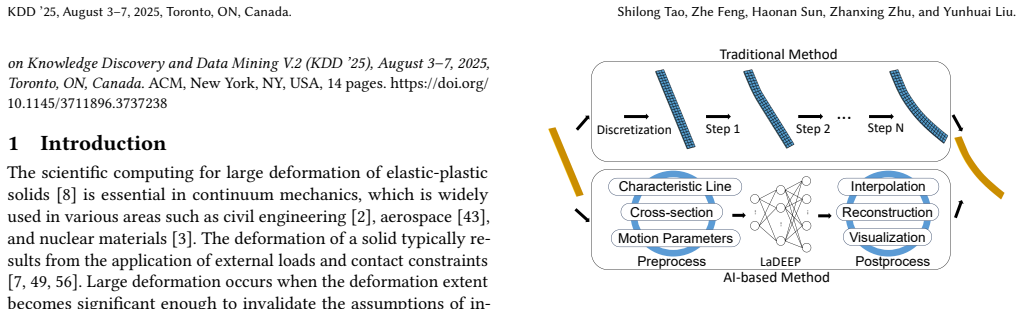
The paper argues that large deformation of elastic-plastic solids in stretch bending can be approximated as a sequence-to-sequence mapping if the objects are encoded with their inherent order preserved. It claims that a two-stage Transformer—cross-attention from mold-plus-motion tokens to workpiece tokens for the loading stage, then self-attention on the loaded workpiece tokens for the unloading and rebound stage—captures the contact-dominated physics better than general-purpose neural operators and Transformer PDE solvers. On a new 3000-sample dataset generated by fine-mesh finite-element simulation, the model reaches 0.1698 mm MAD, 86.58% IoU 3D, and 0.4591 mm tail error, with 0.0453 s inference time per case versus 342–598 s for FEM. The paper also reports a production deployment: seven products designed with LaDEEP, two in production with final mean absolute distance 0.32 mm and 0.29 mm.
Load-bearing premise
The entire approach depends on the final bent shape being fully determined by the inputs the model sees, and on the simulated training data being an honest stand-in for real factory physics.
Editorial extensions
If this is right
- Mold design for stretch bending can move from a 2–3 month FEM iteration cycle to roughly one week, because a single LaDEEP evaluation costs about 0.045 seconds once trained.
- On a new cross-section shape, zero-shot performance is limited, but 200 epochs of fine-tuning brings MAD from 0.4122 mm to 0.2232 mm, close to the full-data baseline of 0.2313 mm.
- On a new aluminum alloy, a pre-trained LaDEEP reaches 0.1711 mm MAD after fine-tuning on only 240 samples, so material transfer requires small datasets.
- The reported 20.47% average relative improvement over ten deep-learning baselines suggests that encoding problem-specific order and staged loading/unloading is more effective than generic operator-learning architectures for this contact problem.
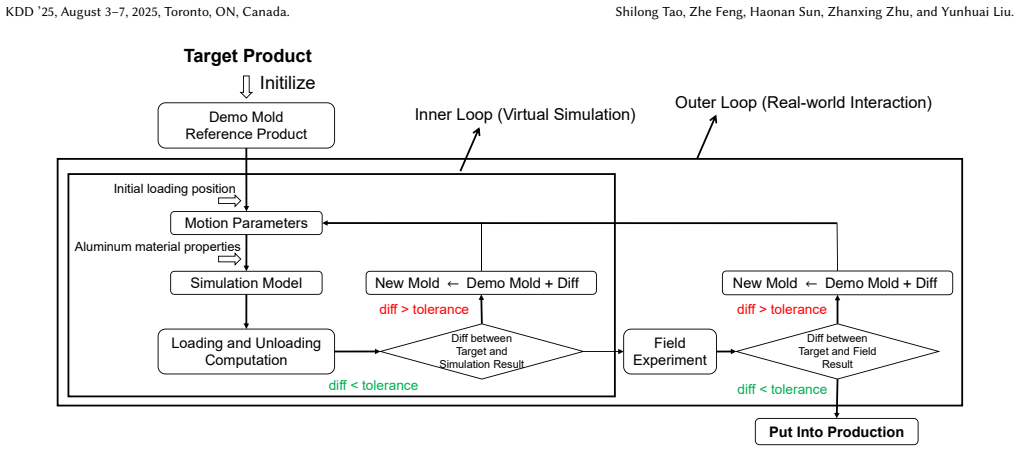
- The two-loop mold design paradigm with LaDEEP can hold final production error below 1 mm after on-site adjustment, as demonstrated by production errors of 0.32 mm and 0.29 mm on two products.
Reading between the lines
- A testable extension, not claimed by the paper: the same order-preserving region-token encoding could apply to roll forming or multi-pass bending, where a constant cross-section slides along a 1D centerline; LaDEEP only demonstrates stretch bending.
- The paper's deployment includes an outer-loop on-site adjustment that absorbs errors the model cannot see; a direct follow-up would isolate the raw surrogate error by comparing LaDEEP output to measured production shapes before any empirical compensation.
- Since the FEM speed comparison is against CPU-based commercial software, the 10,000–60,000x figure is hardware-dependent; a benchmark against a GPU-accelerated FEM or reduced-order model on the same machine would give a cleaner efficiency statement.
- The constant-cross-section representation is a modeling choice, not a limit of the method; replacing the single SDF token with a per-region cross-section sequence would let the architecture handle tapered or varying cross-sections without changing the Transformer core.
Editorial analysis
A structured set of objections, weighed in public.
Referee Report
Summary. This paper proposes LaDEEP, a Transformer-based surrogate model for predicting the final deformed shape of an aluminum workpiece in a stretch-bending process. The inputs are the workpiece characteristic line (sampled point sequence), its cross-section (SDF image), the mold characteristic line, and six DoFs of each working arm. The model encodes these into property-aware token sequences, applies a two-stage Deformation Predictor (cross-attention for loading, self-attention for unloading), and decodes into characteristic-line point coordinates; losses include a coordinate-weighted L2 loss and an SDF reconstruction loss. Experiments compare with FEM at various mesh densities and with ten deep-learning PDE-solver baselines on a new Abaqus-generated dataset of 3000 samples, report OOD and ablation results, and describe deployment for seven real product designs with two reported production errors.
Significance. If the claims hold, the work is of practical and methodological interest: it demonstrates a domain-adapted token-sequence representation for an elasto-plastic large-deformation industrial process, provides a new benchmark-style dataset with baselines, reports a large speed advantage over FEM on this workload, and documents a real deployment pipeline. Strengths include: a concrete, reproducible dataset-generation protocol (Abaqus, explicit/implicit solvers, parameter distributions listed in Appendix A); public code; a clear architecture description that is checkable; and an evaluation that includes OOD generalization and ablation variants.
major comments (5)
- [Sec. 4.4 and Appendix B] The central claim of 'comparable accuracy' is not directly supported by the reported numbers. The paper reports LaDEEP MAD of 0.1823 mm for type-1 workpieces, while fine-mesh FEM achieves 0.0568 mm, and the speedup of about 9603x is computed against coarser FEM with MAD 2.0092 mm. Comparing LaDEEP to coarse FEM yields a 3.2x accuracy gap (0.1823 vs 0.0568) while comparing to the fine FEM loses most of the stated speedup. The claim 'with the similar computation accuracy, the accelerations range from 9603 to around 60068' appears to assert a comparison class that is not identified in numbers, and the text conflates accuracy comparisons with different FEM mesh levels. Please report a consistent comparison: e.g., LaDEEP MAD against a FEM mesh of comparable MAD, or a full Pareto-style error-versus-time table for each mesh level.
- [Sec. 4.4 and Appendix B] The deployment evidence does not validate raw surrogate accuracy. The paper states that the average application error (AE) for seven LaDEEP-based designs is about 8.5 mm, and that final production errors of 0.32 and 0.29 mm in Table 4 are achieved after the outer loop of on-site adjustment (mold machining and arm fine-tuning). Since the AE range for the whole process is given as 1-10 mm even for FEM-based design, the reported final PE does not distinguish LaDEEP from FEM. Please report, for the deployed products, the raw AE of LaDEEP predictions before compensation, and compare it with the corresponding raw AE of FEM-based design under matched conditions; otherwise the abstract's 'remarkable performance' claim is not attributable to the surrogate.
- [Sec. 4.1; Table 1] No measure of variability is reported for any experimental result. The dataset is generated by random sampling of 600 samples per cross-section type, yet the main results are single-run point estimates, and the 20.47% average improvement claim is computed from these point estimates. Please report the number of random seeds or data splits, standard deviations, and significance tests for Table 1, Fig. 7, and Tables 2-3; this is load-bearing because the improvements over the second-best baseline on several metrics are small (e.g., 2.81% IoU improvement in setting (2)).
- [Sec. 4.1 and Sec. 4.2] The FEM-vs-LaDEEP efficiency comparison is not fully specified. The FEM timings are for a 32-core CPU server with MPI, whereas LaDEEP inference time of 0.0453 s presumably runs on a GPU; the hardware, batch size (Fig. 9 mentions batch size 8), and whether the reported LaDEEP time includes preprocessing/decoding are not stated for Fig. 7. Please report hardware specifications, batch size, and warm-up details for both methods, and discuss whether the speedup comparison is on an equal footing.
- [Sec. 4.3, Fig. 9] The ablation experiments appear to be single-run point estimates as well, and the text reports percentage differences and even runtime comparisons (67.9 ms vs 86.1 ms) without any error bars or repetitions. Because the ablation motivates architectural choices (OFF over attention, SDF over gray image, order-preserving CLE), please provide standard deviations over multiple runs for the ablation metrics.
minor comments (6)
- [Sec. 3.2] The notation in the SDF definition is inconsistent: g(i,j) is defined as, yes, g(i,j) = -1 inside and +1 outside, but the formula for SDF writes D(i,j) = min |(i,j)-(i'-j')| * g(i,j); the typo (i'-j') should be (i',j'), and the sign convention should be stated consistently with g.
- [Sec. 3.2] In the text, y is introduced as motion-parameter tokens, but in Sec. 3.2 the sentence 'the final output are the tokens y_m' and later 'three sequences x, y, z' uses y for mold, while Eq. (1) says q is built from concat(x0, y0) with x as motion and y as mold; the notation is confusing and should be unified.
- [Sec. 4.2] Table 1 heading says 'Improvement in the last column refers to the average relative error reduction across all metrics of corresponding models', but the improvement numbers are per-model (setting (1) vs (2)); the wording is unclear and the table would benefit from explicit formulas.
- [Sec. 4.2, Tables 2 and 3] Table 3 is captioned 'Results of Cross-section Generalization' but reports material-generalization (alloy) results; the caption should be corrected.
- [Sec. 3.3] There are minor typos: 'Transormer' in Sec. 3.3, 'a two-cycled mold design paradigm' in Sec. 4.4, and 'listd' in Table 5 caption; please proofread.
- [Sec. 4.4] The text says 'average application error is around 8.5mm. This is sufficient for on-site adjustment' — this sentence appears to support the outer-loop argument but should be clarified as the raw AE, not a compensated value.
Circularity Check
No significant circularity: LaDEEP is a supervised surrogate fitted to FEM outputs and evaluated on held-out FEM cases; no load-bearing self-citation or fitted-input-as-prediction step is present.
full rationale
The paper's derivation chain is a standard supervised learning pipeline. Section 3 defines an encoder-decoder/Transformer mapping from workpiece characteristic line, cross-section SDF, mold characteristic line, and 6-DoF motion parameters to the deformed characteristic line, and Section 4.1 generates 3000 FEM (Abaqus) samples split 8:1:1. The test-set MAD/IoU/TE numbers in Table 1 measure this learned mapping against held-out FEM labels; they are not the same samples used to fit parameters, so the 'prediction' is not a fitted input renamed as a prediction. The comparison with FEM is an empirical speed/accuracy benchmark, not an analytical derivation, and the paper does not claim to derive FEM results from first principles. There are no references to the present authors' prior work, so no self-citation chain is load-bearing. The deployment section explicitly separates simulation error, application error, and production error, and reports raw AE around 8.5 mm before on-site adjustment; final PE values in Table 4 are not presented as raw LaDEEP predictions. This may be an attribution or validation-strength concern, but it is not circularity: no quantity used as evidence is defined in terms of the claim it supports, and no step reduces to its own input by construction.
Assumptions & free parameters
free parameters (2)
- Axis loss weights lambda_x, lambda_y, lambda_z =
derived from data range per axis, not listed numerically
- Architecture hyperparameters N (token count), C (embedding size), S_a and S_b (layer counts) =
not reported explicitly in the main text
assumptions (4)
- domain assumption FEM-generated data (Abaqus) represents the ground-truth physics of the stretch-bending process.
- domain assumption The final deformed shape is fully determined by the characteristic line, cross-section, mold geometry, and the six motion degrees of freedom.
- domain assumption Order-preserving tokenization of the characteristic line retains the essential physical interactions (contact, loading, unloading).
- standard math A Transformer with cross-attention and self-attention is a suitable approximator for the loading and unloading mappings.
Cite this review
Pith. "Pith review of LaDEEP: A Deep Learning-based Surrogate Model for Large Deformation of Elastic-Plastic Solids." pith.science (2026). https://pith.science/paper/LLTZ2W6E
@misc{pith2026250606001,
  author       = {Pith},
  title        = {Pith review of: LaDEEP: A Deep Learning-based Surrogate Model for Large Deformation of Elastic-Plastic Solids},
  year         = {2026},
  howpublished = {\url{https://pith.science/paper/LLTZ2W6E}},
  note         = {Machine review of arXiv:2506.06001}
}
read the original abstract
Scientific computing for large deformation of elastic-plastic solids is critical for numerous real-world applications. Classical numerical solvers rely primarily on local discrete linear approximation and are constrained by an inherent trade-off between accuracy and efficiency. Recently, deep learning models have achieved impressive progress in solving the continuum mechanism. While previous models have explored various architectures and constructed coefficient-solution mappings, they are designed for general instances without considering specific problem properties and hard to accurately handle with complex elastic-plastic solids involving contact, loading and unloading. In this work, we take stretch bending, a popular metal fabrication technique, as our case study and introduce LaDEEP, a deep learning-based surrogate model for \textbf{La}rge \textbf{De}formation of \textbf{E}lastic-\textbf{P}lastic Solids. We encode the partitioned regions of the involved slender solids into a token sequence to maintain their essential order property. To characterize the physical process of the solid deformation, a two-stage Transformer-based module is designed to predict the deformation with the sequence of tokens as input. Empirically, LaDEEP achieves five magnitudes faster speed than finite element methods with a comparable accuracy, and gains 20.47\% relative improvement on average compared to other deep learning baselines. We have also deployed our model into a real-world industrial production system, and it has shown remarkable performance in both accuracy and efficiency.
Figures


Figures from the paper (8 more)


Reference graph
Works this paper leans on
-
[1]
G Abaqus. 2011. Abaqus 6.11.Dassault Systemes Simulia Corporation, Providence, RI, USA(2011), 3
work page 2011
-
[2]
Simaan M AbouRizk and Dany Hajjar. 1998. A framework for applying simulation in construction.Canadian journal of civil engineering25, 3 (1998), 604–617
work page 1998
-
[3]
2012.Comprehensive nuclear materials
Todd R Allen, Roger E Stoller, and Prof Shinsuke Yamanaka. 2012.Comprehensive nuclear materials. Technical Report. Oak Ridge National Lab.(ORNL), Oak Ridge, TN (United States)
work page 2012
-
[4]
Pierre Alliez, David Cohen-Steiner, Mariette Yvinec, and Mathieu Desbrun. 2005. Variational tetrahedral meshing. InACM SIGGRAPH 2005 Papers. 617–625
work page 2005
-
[5]
Vladimir Igorevich Arnold, Sabir Medzhidovich Guse ˘ın-Zade, and Alek- sandr Nikolaevich Varchenko. 2012. The classification of critical points, caustics and wave fronts.(No Title)(2012)
work page 2012
-
[6]
2023.Finite element analysis of composite materials using Abaqus®
Ever J Barbero. 2023.Finite element analysis of composite materials using Abaqus®. CRC press
work page 2023
-
[7]
2006.Finite element procedures
Klaus-Jürgen Bathe. 2006.Finite element procedures. Klaus-Jurgen Bathe
work page 2006
-
[8]
Klaus-Jürgen Bathe and Haluk Ozdemir. 1976. Elastic-plastic large deformation static and dynamic analysis.Computers & Structures6, 2 (1976), 81–92
work page 1976
Show all 66 references
-
[9]
Peter W Battaglia, Jessica B Hamrick, Victor Bapst, Alvaro Sanchez-Gonzalez, Vinicius Zambaldi, Mateusz Malinowski, Andrea Tacchetti, David Raposo, Adam Santoro, Ryan Faulkner, et al. 2018. Relational inductive biases, deep learning, and graph networks.arXiv preprint arXiv:180...
2018 arXiv
-
[10]
Boris Bonev, Thorsten Kurth, Christian Hundt, Jaideep Pathak, Maximilian Baust, Karthik Kashinath, and Anima Anandkumar. 2023. Spherical fourier neural operators: Learning stable dynamics on the sphere. InInternational conference on machine learning. PMLR, 2806–2823
2023
-
[11]
2009.Applied mechanics of solids
Allan F Bower. 2009.Applied mechanics of solids. CRC press
2009
-
[12]
G Cafuta, N Mole, and B Štok. 2012. An enhanced displacement adjustment method: Springback and thinning compensation.Materials & Design40 (2012), 476–487
2012
-
[13]
Chun-Fu Richard Chen, Quanfu Fan, and Rameswar Panda. 2021. Crossvit: Cross- attention multi-scale vision transformer for image classification. InProceedings of the IEEE/CVF international conference on computer vision. 357–366
2021
-
[14]
Tianping Chen and Hong Chen. 1995. Universal approximation to nonlinear operators by neural networks with arbitrary activation functions and its appli- cation to dynamical systems.IEEE transactions on neural networks6, 4 (1995), 911–917
1995
-
[15]
Arild H Clausen, Odd S Hopperstad, and Magnus Langseth. 2000. Stretch bend- ing of aluminium extrusions for car bumpers.Journal of Materials Processing Technology102, 1-3 (2000), 241–248
2000
-
[16]
1977.Numerical analysis of spectral methods: theory and applications
David Gottlieb and Steven A Orszag. 1977.Numerical analysis of spectral methods: theory and applications. SIAM
1977
-
[17]
Xiaoxiao Guo, Wei Li, and Francesco Iorio. 2016. Convolutional neural net- works for steady flow approximation. InProceedings of the 22nd ACM SIGKDD international conference on knowledge discovery and data mining. 481–490
2016
-
[18]
Gaurav Gupta, Xiongye Xiao, and Paul Bogdan. 2021. Multiwavelet-based opera- tor learning for differential equations.Advances in neural information processing systems34 (2021), 24048–24062
2021
-
[19]
Ehsan Haghighat, Maziar Raissi, Adrian Moure, Hector Gomez, and Ruben Juanes
-
[20]
Zhongkai Hao, Zhengyi Wang, Hang Su, Chengyang Ying, Yinpeng Dong, Song- ming Liu, Ze Cheng, Jian Song, and Jun Zhu. 2023. GNOT: A General Neural Operator Transformer for Operator Learning. arXiv:2302.14376
2023 arXiv
-
[21]
Junyan He, Diab Abueidda, Rashid Abu Al-Rub, Seid Koric, and Iwona Jasiuk. 2023. A deep learning energy-based method for classical elastoplasticity.International Journal of Plasticity162 (2023), 103531
2023
-
[22]
Kaiming He, Xiangyu Zhang, Shaoqing Ren, and Jian Sun. 2016. Deep residual learning for image recognition. InProceedings of the IEEE conference on computer vision and pattern recognition. 770–778
2016
-
[23]
2003.Solving nonlinear equations with Newton’s method
Carl T Kelley. 2003.Solving nonlinear equations with Newton’s method. SIAM
2003
-
[24]
2013.Introduction to finite element analysis using MATLAB® and abaqus
Amar Khennane. 2013.Introduction to finite element analysis using MATLAB® and abaqus. CRC Press
2013
-
[25]
Diederik P Kingma and Max Welling. 2022. Auto-Encoding Variational Bayes. arXiv:1312.6114 [stat.ML]
2022 arXiv
-
[26]
Mario Köppen. 2000. The curse of dimensionality. In5th online world conference on soft computing in industrial applications (WSC5), Vol. 1. 4–8
2000
-
[27]
Jean Kossaifi, Nikola Kovachki, Kamyar Azizzadenesheli, and Anima Anandku- mar. 2023. Multi-grid tensorized Fourier neural operator for high-resolution PDEs.arXiv preprint arXiv:2310.00120(2023)
2023 arXiv
-
[28]
Philipp Lechner, Lorenzo Scandola, Daniel Maier, Christoph Hartmann, Yevgen Rizaiev, and Mona Lieb. 2024. A physically-informed machine learning model for freeform bending.Journal of Intelligent Manufacturing(2024), 1–13
2024
-
[29]
Xiang Li, Yulei Liao, and Pingbing Ming. 2023. A pre-training deep learning method for simulating the large bending deformation of bilayer plates.arXiv preprint arXiv:2308.04967(2023). LaDEEP: A Deep Learning-based Surrogate Model for Large Deformation of Elastic-Plastic Solid...
2023 arXiv
-
[30]
Zongyi Li, Daniel Zhengyu Huang, Burigede Liu, and Anima Anandkumar. 2022. Fourier neural operator with learned deformations for pdes on general geometries. arXiv preprint arXiv:2207.05209(2022)
2022 arXiv
-
[31]
Zongyi Li, Daniel Zhengyu Huang, Burigede Liu, and Anima Anandkumar. 2023. Fourier neural operator with learned deformations for pdes on general geometries. Journal of Machine Learning Research24, 388 (2023), 1–26
2023
-
[32]
Zongyi Li, Nikola Kovachki, Kamyar Azizzadenesheli, Burigede Liu, Kaushik Bhat- tacharya, Andrew Stuart, and Anima Anandkumar. 2020. Neural operator: Graph kernel network for partial differential equations.arXiv preprint arXiv:2003.03485 (2020)
2020 arXiv
-
[33]
Zongyi Li, Nikola Kovachki, Chris Choy, Boyi Li, Jean Kossaifi, Shourya Otta, Mohammad Amin Nabian, Maximilian Stadler, Christian Hundt, Kamyar Aziz- zadenesheli, et al. 2024. Geometry-informed neural operator for large-scale 3d pdes.Advances in Neural Information Processing S...
2024
-
[34]
Zijie Li, Kazem Meidani, and Amir Barati Farimani. 2023. Transformer for Partial Differential Equations’ Operator Learning. arXiv:2205.13671
2023 arXiv
-
[35]
Zijie Li, Dule Shu, and Amir Barati Farimani. 2024. Scalable transformer for pde surrogate modeling.Advances in Neural Information Processing Systems36 (2024)
2024
-
[36]
Zhihao Li, Haoze Song, Di Xiao, Zhilu Lai, and Wei Wang. 2024. Harnessing Scale and Physics: A Multi-Graph Neural Operator Framework for PDEs on Arbitrary Geometries.arXiv preprint arXiv:2411.15178(2024)
2024 arXiv
-
[37]
Xinliang Liu, Bo Xu, Shuhao Cao, and Lei Zhang. 2024. Mitigating spectral bias for the multiscale operator learning. arXiv:2210.10890
2024 arXiv
-
[38]
Ze Liu, Yutong Lin, Yue Cao, Han Hu, Yixuan Wei, Zheng Zhang, Stephen Lin, and Baining Guo. 2021. Swin transformer: Hierarchical vision transformer us- ing shifted windows. InProceedings of the IEEE/CVF international conference on computer vision. 10012–10022
2021
-
[39]
Lu Lu, Pengzhan Jin, and George Em Karniadakis. 2019. Deeponet: Learning nonlinear operators for identifying differential equations based on the universal approximation theorem of operators.arXiv preprint arXiv:1910.03193(2019)
2019 arXiv
-
[40]
Mingjun Ma, Haiying Xia, Yumei Tan, Haisheng Li, and Shuxiang Song. 2022. HT-Net: hierarchical context-attention transformer network for medical ct image segmentation.Applied Intelligence(2022), 1–14
2022
-
[41]
Lawrence E Murr, Sara M Gaytan, Diana A Ramirez, Edwin Martinez, Jennifer Hernandez, Krista N Amato, Patrick W Shindo, Francisco R Medina, and Ryan B Wicker. 2012. Metal fabrication by additive manufacturing using laser and electron beam melting technologies.Journal of Materia...
2012
-
[42]
Aaron van den Oord, Sander Dieleman, Heiga Zen, Karen Simonyan, Oriol Vinyals, Alex Graves, Nal Kalchbrenner, Andrew Senior, and Koray Kavukcuoglu
-
[43]
Rakesh Kumar Phanden, Priavrat Sharma, and Anubhav Dubey. 2021. A review on simulation in digital twin for aerospace, manufacturing and robotics.Materials today: proceedings38 (2021), 174–178
2021
-
[44]
Allan Pinkus. 1999. Approximation theory of the MLP model in neural networks. Acta numerica8 (1999), 143–195
1999
-
[45]
Charles R Qi, Hao Su, Kaichun Mo, and Leonidas J Guibas. 2017. Pointnet: Deep learning on point sets for 3d classification and segmentation. InProceedings of the IEEE conference on computer vision and pattern recognition. 652–660
2017
-
[46]
Md Ashiqur Rahman, Zachary E Ross, and Kamyar Azizzadenesheli. 2022. U-no: U-shaped neural operators.arXiv preprint arXiv:2204.11127(2022)
2022 arXiv
-
[47]
Maziar Raissi, Paris Perdikaris, and George E Karniadakis. 2019. Physics-informed neural networks: A deep learning framework for solving forward and inverse problems involving nonlinear partial differential equations.Journal of Computa- tional physics378 (2019), 686–707
2019
-
[48]
2019.Introduction to the finite element method
Junuthula Narasimha Reddy. 2019.Introduction to the finite element method. McGraw-Hill Education
2019
-
[49]
2020.Dynamics of multibody systems
Ahmed A Shabana. 2020.Dynamics of multibody systems. Cambridge university press
2020
-
[50]
Alasdair Tran, Alexander Mathews, Lexing Xie, and Cheng Soon Ong. 2021. Factorized fourier neural operators.arXiv preprint arXiv:2111.13802(2021)
2021 arXiv
-
[51]
Ashish Vaswani, Noam Shazeer, Niki Parmar, Jakob Uszkoreit, Llion Jones, Aidan N Gomez, Łukasz Kaiser, and Illia Polosukhin. 2017. Attention is all you need.Advances in neural information processing systems30 (2017)
2017
-
[52]
Athanasios Voulodimos, Nikolaos Doulamis, Anastasios Doulamis, Eftychios Protopapadakis, et al. 2018. Deep learning for computer vision: A brief review. Computational intelligence and neuroscience2018 (2018)
2018
-
[53]
David W Walker and Jack J Dongarra. 1996. MPI: a standard message passing interface.Supercomputer12 (1996), 56–68
1996
-
[54]
Gege Wen, Zongyi Li, Kamyar Azizzadenesheli, Anima Anandkumar, and Sally M Benson. 2022. U-FNO—An enhanced Fourier neural operator-based deep-learning model for multiphase flow.Advances in Water Resources163 (2022), 104180
2022
-
[55]
1995.Introduction to multigrid methods
Pieter Wesseling. 1995.Introduction to multigrid methods. Technical Report
1995
-
[56]
2006.Computational contact mechanics
Peter Wriggers and Tod A Laursen. 2006.Computational contact mechanics. Vol. 2. Springer
2006
-
[57]
Haixu Wu, Tengge Hu, Huakun Luo, Jianmin Wang, and Mingsheng Long. 2023. Solving high-dimensional pdes with latent spectral models.arXiv preprint arXiv:2301.12664(2023)
2023 arXiv
-
[58]
Haixu Wu, Huakun Luo, Haowen Wang, Jianmin Wang, and Mingsheng Long
-
[59]
Zipeng Xiao, Zhongkai Hao, Bokai Lin, Zhijie Deng, and Hang Su. 2024. Im- proved Operator Learning by Orthogonal Attention. InProceedings of the 41st International Conference on Machine Learning (Proceedings of Machine Learning Research, Vol. 235). PMLR, 54288–54299
2024
-
[60]
Zhihao Xiong, Ping Yang, and Pengyang Zhao. 2024. Physics-driven neural networks for nonlinear micromechanics.International Journal of Mechanical Sciences273 (2024), 109214
2024
-
[61]
Zhenze Yang, Chi-Hua Yu, and Markus J Buehler. 2021. Deep learning model to predict complex stress and strain fields in hierarchical composites.Science Advances7, 15 (2021), eabd7416
2021
-
[62]
Jiaqi Yu, Yi Li, Fei Teng, Jicai Liang, Xiangfeng Lin, Ce Liang, Guangyi Chen, and Guangping Sun. 2018. Research on the Cross Section Forming Quality of Three-Dimensional Multipoint Stretch Forming Parts.Advances in Materials Science and Engineering2018, 1 (2018), 4265617
2018
-
[63]
s" means start arc and
Hang Zhou, Yuezhou Ma, Haixu Wu, Haowen Wang, and Mingsheng Long. 2024. Unisolver: PDE-Conditional Transformers Are Universal PDE Solvers. (2024). arXiv:2405.17527 A Dataset Generation The training of deep learning models requires sufficient amount of data, which can hardly be...
2024 arXiv
-
[2016]
Wavenet: A generative model for raw audio.arXiv preprint arXiv:1609.03499 (2016)
2016 arXiv
-
[2021]
A physics-informed deep learning framework for inversion and surro- gate modeling in solid mechanics.Computer Methods in Applied Mechanics and Engineering379 (2021), 113741
2021
-
[2024]
Transolver: A fast transformer solver for pdes on general geometries.arXiv preprint arXiv:2402.02366(2024)
2024 arXiv
Reviewed August 7, 2026 · model on record in the stance chip above.
Discussion (0). Sign in to comment.