REVIEW 2 major objections 4 minor 1 cited by
Quark-universal $U(1)$ breaking scalar at the LHC
T0 review · 2 major / 4 minor · reviewed 2026-08-07 · deepseek-v4-flash
Pith's one-line read The scalar that breaks a quark-universal U(1)_B symmetry decays mostly to photon pairs at LHC-accessible masses, making a diphoton resonance the likely discovery channel and a possible explanation of the 95 GeV excess.
desk verdict Solid benchmark paper for a leptophobic Z' scalar, with a real but fixable ambiguity in what enters the Rγγ predictions. read the letter →
The pith
A machine-rendered reading of the paper's core claim, the machinery that carries it, and where it could break.
The reading
What carries the argument
The central object is the radial mode $\phi$ of the complex scalar $\Phi$ that spontaneously breaks $U(1)_B$ and gives mass to the $Z'$ and to the anomalons. Its couplings to gauge-boson pairs are generated at one loop by charged anomalons $E_1$, $E_2$ whose masses come from both the $U(1)_B$ vacuum expectation value and the electroweak Higgs vacuum expectation value, so their loop contributions do not decouple, following the Higgs low-energy theorems. The ratio $M_\phi/M_{Z'}$ controls whether the tree-level decay $\phi \to Z'Z'^{(*)}$ is open or phase-space suppressed, and the Higgs-portal mixing angle $\alpha_h$ controls gluon-fusion production and the interference pattern between SM and anomalon loop amplitudes in $\phi \to \gamma\gamma$. These ingredients turn the diphoton branching fraction and signal strength $R_{\gamma\gamma}$ into the model's main observables.
What would settle it
A dedicated search for a diphoton resonance near 95 GeV with an associated dijet resonance at about 70 GeV, or an exclusion of $R_{\gamma\gamma} > 0.2$ at $M_\phi \approx 95$ GeV for $g_B = 0.3$ and $\sin\alpha_h = 0.05$, would falsify the predicted parameter region. Measuring the $\phi \to Z'\gamma$ branching fraction and comparing it with $\phi \to \gamma\gamma$ would test the anomalon loop structure that drives the predicted pattern.
Extended reading notes
Core claim
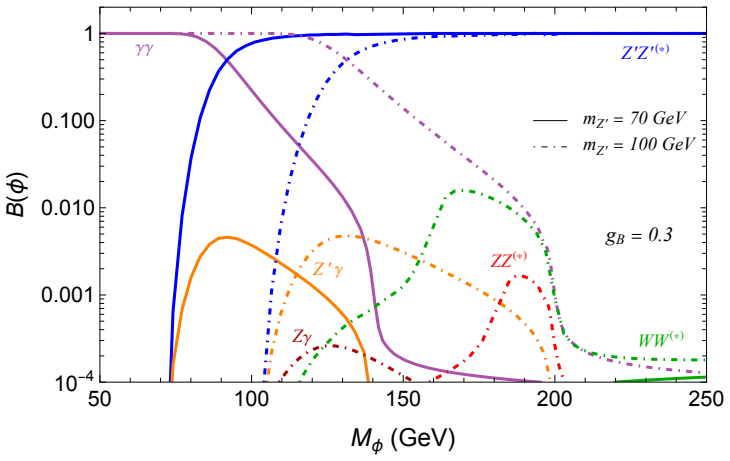
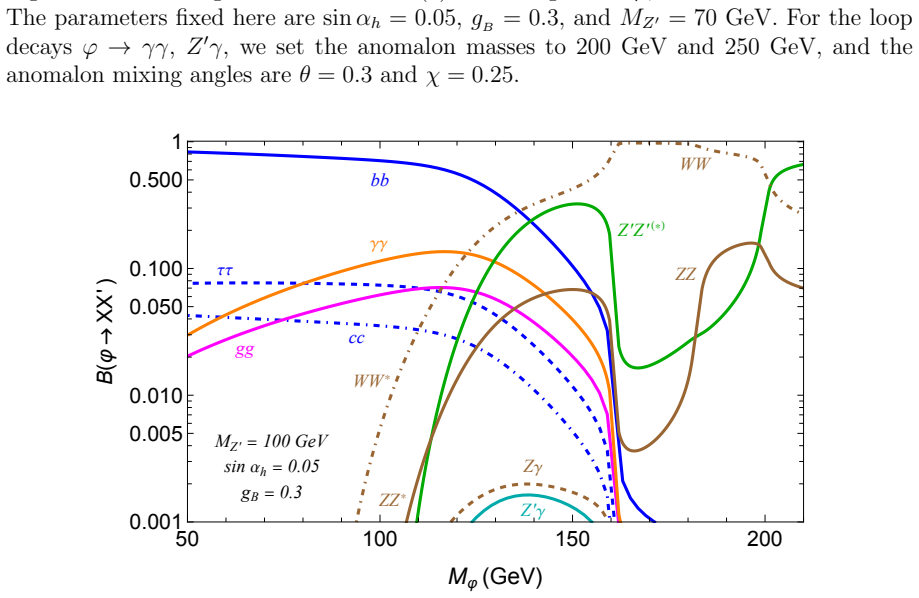
The central claim is that in the minimal renormalizable quark-universal $U(1)_B$ model, where the new $Z'$ couples to all quarks with equal charge and the anomaly-canceling anomalons are colorless, the $U(1)_B$-breaking scalar $\phi$ has a distinctive and observable phenomenology. Its tree-level decay to $Z'$ pairs is phase-space suppressed for $M_\phi$ below $2M_{Z'}$, while loop-induced decays through anomalons—nondecoupling because of Higgs low-energy theorems—give large branching fractions to $\gamma\gamma$, $Z'\gamma$, $Z\gamma$, $ZZ$, and $WW$. In the low-$M_\phi/M_{Z'}$ range the diphoton mode dominates at the level above 60%, so the leading LHC signatures are a $\gamma\gamma$ resonance at $M_\phi$ accompanied either by a dijet resonance at $M_{Z'}$ (from associated $Z'\phi$ production) or by forward jets (from $Z'$ fusion). With Higgs mixing, $\phi$ acquires gluon-fusion production and SM-like decays, but the anomalon-induced diphoton amplitude interferes destructively with the $W$ loop, producing a nearly constant $R_{\gamma\gamma}$ for mixing angles $\sin\alpha_h = 0.05$ to $0.1$ at low masses. The predicted $R_{\gamma\gamma}$ at 95.4 GeV sits in the unexcluded region and can accommodate the observed 2.9$\sigma$ local diphoton excess, while the dominant constraint on the model comes from reinterpreting diphoton resonance searches.
Load-bearing premise
The prediction assumes that the new $Z'$ boson has no direct mixing with the Standard Model gauge bosons before loop effects, a condition the paper imposes by appealing to a non-Abelian ultraviolet completion; if that mixing exists, the $Z'$ couplings to quarks and the scalar's decay pattern change.
Editorial extensions
If this is right
- For $M_\phi \lesssim 1.5 M_{Z'}$, the $\phi \to \gamma\gamma$ branching fraction exceeds 60%, so a diphoton resonance search, especially with an associated dijet resonance at $M_{Z'}$ or two forward jets, is the most sensitive discovery channel.
- With $\sin\alpha_h = 0.05$ to $0.1$, gluon fusion dominates $\phi$ production above about 100 GeV, while $Z'$-associated production dominates at lower masses; the crossover depends on $g_B$ and the mixing angle.
- The predicted $R_{\gamma\gamma} \approx 0.2$ to $0.4$ at $M_\phi \approx 95$ GeV with $M_{Z'} = 70$ GeV and $g_B = 0.3$ lies in the region not yet excluded, so the model can accommodate the observed 95 GeV diphoton excess without violating current constraints.
- The bound on undetected 125 GeV Higgs decays, $\Gamma(h^0 \to \phi\phi^{(*)}) \le 0.12\,\Gamma_{\text{SM}}(h^0)$, restricts small $M_\phi$ and specific mixing angles, while for $M_\phi > M_h/2$ the new contribution to the Higgs width is negligible.
- The deviations of the 125 GeV Higgs couplings from Standard Model predictions are not a simple mixing-angle rescaling, because anomalon loops modify $h^0 \to \gamma\gamma$ and $h^0 \to Z\gamma$; this gives a new benchmark for Higgs coupling measurements.
Reading between the lines
- If tree-level $Z'$--Standard Model kinetic mixing is generated in an ultraviolet completion, the $Z'$ couplings to quarks and the scalar's decay pattern change; then $R_{\gamma\gamma}$ measurements could indirectly bound the size of that mixing, a constraint the paper's minimal setup does not quantify.
- The same production and decay machinery applies to any leptophobic $U(1)$ extension with chiral anomalons, so the predicted $(\gamma\gamma)(jj)$ and $(\gamma\gamma)j_f j_f$ signatures form a generic search program for the radial scalar mode of a new gauge symmetry.
- A dedicated search that combines a diphoton peak near 95 GeV with a dijet resonance near 70 GeV, or with forward jet tags, would discriminate this model from a Higgs-mixing-only interpretation of the excess.
- The near-constant $R_{\gamma\gamma}$ for $\sin\alpha_h$ between 0.05 and 0.1 implies that improved diphoton limits in the 80 to 95 GeV window would cut sharply into the allowed parameter space, making that mass region a decisive test.
Editorial analysis
A structured set of objections, weighed in public.
Referee Report
Summary. The paper studies the minimal renormalizable quark-universal U(1)_B extension of the Standard Model, in which the new gauge symmetry is broken by a complex scalar Φ whose radial mode is a physical scalar ϕ. The anomalon content required for anomaly cancellation is colorless but carries electroweak and U(1)_B charges. The authors derive analytic expressions for the anomalon masses, mixing angles, Yukawa couplings, and loop-induced partial widths of ϕ into γγ, Z′γ, Zγ, ZZ, and WW, and they compute NLO production cross sections for pp → Z′ϕ and pp → ϕjj via Z′ fusion at the 13.6 TeV LHC. They then introduce Higgs mixing through the portal coupling, identify the lighter physical scalar φ, and study its modified decay rates, the constraints from the 125 GeV Higgs measurements, and the diphoton signal strength Rγγ relative to current ATLAS and CMS searches. The paper highlights the possibility that a φ with mass near 95.4 GeV could account for the observed diphoton excess while remaining within the unexcluded region of parameter space.
Significance. If the central claims hold, the paper provides a concrete, renormalizable benchmark for a U(1)_B-breaking scalar with distinctive loop-induced diphoton decays and associated Z′ signatures. The analytic derivations in Section 2 are explicit and use standard tools, and the numerical cross sections from MadGraph and MCFM are in principle reproducible. The predicted dominance of the γγ channel at low Mφ and the nontrivial interference pattern after Higgs mixing are falsifiable predictions that can be tested by dedicated diphoton and dijet-plus-diphoton searches. The paper is also cautious in presenting the 95 GeV excess as a possible explanation rather than a definitive fit. However, the quantitative comparison with experimental limits, and in particular the claimed compatibility of the benchmark points with the unexcluded region of Figure 13, depends on an unresolved ambiguity in how Rγγ is defined and which production modes are included.
major comments (2)
- [Sec. 2.3, Eq. (2.20), Fig. 4] The paper defines Rγγ ≡ σ(φ→γγ)/σ(H→γγ)_SM but never states which φ production processes enter σ(φ→γγ). Section 3.2.1 and Figure 9 show that for Mφ near 95 GeV and MZ′ = 70 GeV, Z′φ associated production is comparable to or larger than gg→φ for sin αh = 0.05. The text explaining the near-constancy of Rγγ between 80 and 95 GeV refers only to the sin²αh scaling of gluon fusion and to the destructive interference in the γγ amplitude. If Rγγ includes only gg→φ, the comparison with the ATLAS and CMS limits is internally consistent with those searches' production assumptions, but the inclusive φ diphoton rate is underestimated by roughly a factor of two near 95 GeV. If Rγγ includes Z′φ associated production, the cancellation argument is incomplete and the exclusion contours in Figure 13 would need to be recomputed, potentially excluding benchmark points that the paper claims are viable. This ambiguity directly affects the quantitative support for the 95 GeV excess interpretation, which is a central load-bearing assertion of the paper. Please specify the production modes summed in σ(φ→γγ), and if only gg→φ is used, quantify the impact of the omitted Z′φ contribution on the inclusive diphoton signal and on the claimed unexcluded region in Figure 13.
- [Sec. 2.3, Eq. (2.20), Fig. 4] The branching fractions in Figure 4 are shown down to Mφ = 50 GeV, i.e. below MZ′ = 70 and 100 GeV. In this region the four-body decay φ → Z′∗Z′∗ → 4j is kinematically allowed, and the text states that γγ dominates over this four-body mode. However, Eq. (2.20) provides partial-width formulas only for Mφ > MZ′; no expression or reference is given for the fully off-shell four-body width. The low-mass claim that B(φ→γγ) exceeds 60% for Mφ ≲ 1.5 MZ′ depends on the size of this subdominant four-body contribution. Please provide the four-body width formula or state explicitly how the Z′Z′(∗) branching fraction was computed in Figure 4 for Mφ < MZ′, and verify that the γγ dominance conclusion is unaffected by this mode.
minor comments (4)
- [Sec. 3.2.1, Fig. 9 caption] The caption states that the Z′ fusion cross section scales as gB^8, while Section 2.2 and the caption of Figure 2 state gB^6. For fixed MZ′, the φZ′Z′ vertex scales as gB v′ ∝ gB, so the gB^6 scaling is the correct one; the caption should be corrected for consistency, even though the plotted numerical cross sections are presumably unaffected.
- [Fig. 13] The caption shows vertical dot-dashed lines at m1 = 150, 200, and 300 GeV, but the text in Section 3.2.2 fixes the anomalon masses to 200 and 250 GeV and the mixing angles to θ = 0.3 and χ = 0.25. To make the Rγγ contours in Figure 13 reproducible, the corresponding values of m2 and of the mixing angles used for the m1 = 150 and 300 GeV lines should be stated explicitly.
- [Sec. 2.4.1] The estimate of 4×10^4 (γγ)(jj) events in Run 3 assumes a specific integrated luminosity, but the value is not stated in the text. Please specify the assumed luminosity (e.g. 300 fb^-1) used for the event-count estimate.
- [References] The reference list contains multiple unnumbered entries after Ref. [49] (the entries beginning with D. Liu, J. Liu, C. E. M. Wagner and X. P. Wang, and with R. Vega, R. Vega-Morales and K. Xie). These need to be separated and numbered properly.
Circularity Check
No significant circularity: the φ phenomenology and Rγγ predictions are derived from the explicit Lagrangian with hand-chosen benchmark parameters, not fitted to the 95 GeV diphoton excess.
full rationale
The central derivation chain is self-contained in this paper. Production cross sections (Fig. 2, Sec. 2.2) are computed with MadGraph/MCFM from the Lagrangian in Eqs. (2.2)-(2.19); decay widths and branching fractions (Secs. 2.3 and 3.2.2, Eqs. (2.20)-(2.34), (3.18)-(3.21)) are evaluated from the same Lagrangian with stated anomalon masses, mixing angles, and sin αh values chosen by hand. No parameter is fitted to the diphoton data used for comparison: the 95.4 GeV excess is discussed as a possible interpretation (Sec. 3.2.2, Fig. 13), with Rγγ contours computed for fixed gB, MZ′, Mφ, and anomalon parameters. The self-citations [9,10,13,14] provide the anomalon content, the no-tree-level-kinetic-mixing assumption, and external limits; these are inputs from prior work, and the φ decay-rate and Rγγ derivations are carried out here rather than imported. The only caveat is that Fig. 12 does not explicitly state whether Z′φ associated production is included in the plotted Rγγ; at Mφ≈95 GeV this mode is comparable to gluon fusion (Fig. 9), so there is a potential ambiguity in the signal definition. This is a completeness/correctness issue, not a circular reduction, because neither the model parameters nor the plotted quantity is defined in terms of the excess it is compared with.
Assumptions & free parameters
free parameters (6)
- gB =
0.3 (benchmark; gB < 0.52 from dijet searches, Ref [14])
- MZ' =
70 GeV and 100 GeV (benchmarks)
- M1, M2 (charged anomalon masses) =
200 GeV and 250 GeV
- θ, χ (anomalon mixing angles) =
θ = 0.3, χ = 0.25
- sin αh =
0.03, 0.05, 0.10 (bounded by |sin αh| ≤ 0.24)
- Yukawa hierarchy y1,y2 ≪ yL,yE =
not specified numerically
assumptions (6)
- domain assumption The chiral fermion content of Eq (2.1) cancels all U(1)_B gauge anomalies.
- domain assumption A single SM-singlet scalar Φ with U(1)_B charge +3 and its vev constitute the minimal symmetry-breaking sector, generating Z' and anomalon masses.
- ad hoc to paper The anomalons are colorless (no SU(3)c charges).
- domain assumption Tree-level kinetic mixing between Z' and SM gauge bosons is absent; only a 1-loop logarithmic mixing arises.
- standard math The Higgs low-energy theorem applies to the anomalon loops, giving non-decoupling loop-induced couplings of φ to gauge bosons.
- ad hoc to paper The benchmark anomalon masses (M1,M2) exceed Mφ/2, closing the tree-level φ → anomalon decays.
Cite this review
Pith. "Pith review of Quark-universal $U(1)$ breaking scalar at the LHC." pith.science (2026). https://pith.science/paper/TBOGVJJO
@misc{pith2026250606068,
  author       = {Pith},
  title        = {Pith review of: Quark-universal $U(1)$ breaking scalar at the LHC},
  year         = {2026},
  howpublished = {\url{https://pith.science/paper/TBOGVJJO}},
  note         = {Machine review of arXiv:2506.06068}
}
abstract
If the quarks or leptons are charged under a new $U(1)$ gauge symmetry, then besides a $Z'$ boson there must exist at least one new boson whose decay products include Standard Model particles. In the case of a minimal symmetry breaking sector, that new boson is a scalar $\phi$ that couples to the $Z'$ boson as well as to the new fermions required to cancel the $U(1)$ gauge anomalies. The scalar may be produced at the LHC in association with a $Z'$ boson, or through $Z'$ boson fusion, while its decays are typically into four jets or two photons. We analyze in detail the case where the $Z'$ boson is leptophobic, and all the quarks have the same charge under the new $U(1)$. If $\phi$ mixes with the Standard Model Higgs boson, then the new scalar can also be produced via gluon fusion, and the discovery mode is likely to be a diphoton resonance.
Figures


Figures from the paper (10 more)




Forward citations
Cited by 1 Pith paper
-
A framework for missing-energy searches with anomalous light vectors
For light U(1)X vectors coupled to anomaly-sensitive currents, Wess-Zumino coefficients are fixed by anomaly matching, which lets all missing-energy searches (K, B, D, Z) be mapped onto one (m_X,g_X) plane with minima...
Reference graph
Works this paper leans on
-
[1]
Remark on baryon conservation,
A. Pais, “Remark on baryon conservation,” Phys. Rev. D 8, 1844-1846 (1973)
work page 1973
-
[2]
Possible light U(1) gauge boson coupled to baryon number,
C. D. Carone and H. Murayama, “Possible light U(1) gauge boson coupled to baryon number,” Phys. Rev. Lett. 74, 3122 (1995) [hep-ph/9411256]
arXiv 1995
-
[3]
Is there a Vector Boson Coupling to Baryon Number?
D. C. Bailey and S. Davidson, “Is there a vector boson coupling to baryon number?,” Phys. Lett. B 348, 185 (1995) [hep-ph/9411355]
work page Pith review arXiv 1995
-
[4]
Realistic models with a light U(1) gauge boson coupled to baryon number,
C. D. Carone and H. Murayama, “Realistic models with a light U(1) gauge boson coupled to baryon number,” Phys. Rev. D 52, 484 (1995) [hep-ph/9501220]
arXiv 1995
-
[5]
Limits on a Light Leptophobic Gauge Boson
A. Aranda and C. D. Carone, “Limits on a light leptophobic gauge boson,” Phys. Lett. B 443, 352 (1998) [hep-ph/9809522]
work page Pith review arXiv 1998
-
[6]
Z ′ gauge bosons at the Tevatron,
M. Carena, A. Daleo, B. A. Dobrescu and T. M. P. Tait, “ Z ′ gauge bosons at the Tevatron,” Phys. Rev. D 70, 093009 (2004) [arXiv:hep-ph/0408098 [hep-ph]]
arXiv 2004
-
[7]
Breaking Local Baryon and Lepton Number at the TeV Scale
P. Fileviez Perez and M. B. Wise, “Breaking Local Baryon and Lepton Number at the TeV Scale,” JHEP 08, 068 (2011) [arXiv:1106.0343 [hep-ph]]
work page Pith review arXiv 2011
-
[8]
Gauge theory for baryon and lepton numbers with leptoquarks,
M. Duerr, P. Fileviez Perez and M.B. Wise, “Gauge theory for baryon and lepton numbers with leptoquarks,” Phys. Rev. Lett. 110, 231801 (2013) [arXiv:1304.0576]
arXiv 2013
Show all 52 references
-
[9]
Coupling-Mass Mapping of Dijet Peak Searches,
B. A. Dobrescu and F. Yu, “Coupling-Mass Mapping of Dijet Peak Searches,” Phys. Rev. D 88, no.3, 035021 (2013) [erratum: Phys. Rev. D 90, no.7, 079901 (2014)] [arXiv:1306.2629 [hep-ph]]. 32
2013 arXiv
-
[10]
Hidden GeV-scale interactions of quarks,
B. A. Dobrescu and C. Frugiuele, “Hidden GeV-scale interactions of quarks,” Phys. Rev. Lett. 113, 061801 (2014) [arXiv:1404.3947 [hep-ph]]
2014 arXiv
-
[11]
Leptophobic boson signals with leptons, jets and missing energy,
B. A. Dobrescu, “Leptophobic boson signals with leptons, jets and missing energy,” arXiv:1506.04435 [hep-ph]
-
[12]
Higgs-photon resonances,
B. A. Dobrescu, P. J. Fox and J. Kearney, “Higgs-photon resonances,” Eur. Phys. J. C 77, no. 10, 704 (2017) [arXiv:1705.08433 [hep-ph]]
2017 arXiv
-
[13]
Probing new U (1) gauge symmetries via exotic Z → Z ′γ decays,
L. Michaels and F. Yu, “Probing new U (1) gauge symmetries via exotic Z → Z ′γ decays,” JHEP 03, 120 (2021) [arXiv:2010.00021 [hep-ph]]
2021 arXiv
-
[14]
Dijet and electroweak limits on a Z’ boson coupled to quarks,
B. A. Dobrescu and F. Yu, “Dijet and electroweak limits on a Z’ boson coupled to quarks,” Phys. Rev. D 109, no.3, 3 (2024) [arXiv:2112.05392 [hep-ph]]
2024 arXiv
-
[15]
Axion couplings in gauged U(1)’ extensions of the Standard Model,
A. Kivel, J. Laux and F. Yu, “Axion couplings in gauged U(1)’ extensions of the Standard Model,” JHEP 03, 078 (2023) [arXiv:2211.12155 [hep-ph]]
2023 arXiv
-
[16]
Baryonic Higgs at the LHC,
M. Duerr, P. Fileviez Perez and J. Smirnov, “Baryonic Higgs at the LHC,” JHEP 09, 093 (2017) [arXiv:1704.03811 [hep-ph]]
2017 arXiv
-
[17]
Low-Energy Theorems for Higgs Boson Couplings to Photons,
M. A. Shifman, A. I. Vainshtein, M. B. Voloshin and V. I. Zakharov, “Low-Energy Theorems for Higgs Boson Couplings to Photons,” Sov. J. Nucl. Phys. 30, 711-716 (1979) ITEP-42-1979
1979
-
[18]
Effects from New Colored States and the Higgs Portal on Gluon Fusion and Higgs Decays,
K. Kumar, R. Vega-Morales and F. Yu, “Effects from New Colored States and the Higgs Portal on Gluon Fusion and Higgs Decays,” Phys. Rev. D 86, 113002 (2012) [erratum: Phys. Rev. D 87, no.11, 119903 (2013)] [arXiv:1205.4244 [hep-ph]]
2012 arXiv
-
[19]
A portrait of the Higgs boson by the CMS experiment ten years after the discovery.,
A. Tumasyan et al. [CMS], “A portrait of the Higgs boson by the CMS experiment ten years after the discovery.,” Nature 607, no.7917, 60-68 (2022) [erratum: Nature 623, no.7985, E4 (2023)] [arXiv:2207.00043 [hep-ex]]
2022 arXiv
-
[20]
A detailed map of Higgs boson interactions by the ATLAS experiment ten years after the discovery,
G. Aad et al. [ATLAS], “A detailed map of Higgs boson interactions by the ATLAS experiment ten years after the discovery,” Nature 607, no.7917, 52-59 (2022) [erratum: Nature 612, no.7941, E24 (2022)] [arXiv:2207.00092 [hep-ex]]
2022 arXiv
-
[21]
Characterising the Higgs boson with ATLAS data from Run 2 of the LHC,
G. Aad et al. [ATLAS], “Characterising the Higgs boson with ATLAS data from Run 2 of the LHC,” Phys. Rept. 11, 001 (2024) [arXiv:2404.05498 [hep-ex]]. 33
2024 arXiv
-
[22]
Dark matter from anomaly cancellation at the LHC,
J. Butterworth, H. Debnath, P. Fileviez Perez and Y. Yeh, “Dark matter from anomaly cancellation at the LHC,” Phys. Rev. D 110, no.7, 075001 (2024) [arXiv:2405.03749 [hep-ph]]
2024 arXiv
-
[23]
Gauge anomalies in an effective field theory,
J. Preskill, “Gauge anomalies in an effective field theory,” Annals Phys. 210, 323-379 (1991)
1991
-
[24]
Unitarity Bound on the Scale of Fermion Mass Generation,
T. Appelquist and M. S. Chanowitz, “Unitarity Bound on the Scale of Fermion Mass Generation,” Phys. Rev. Lett. 59, 2405 (1987) [erratum: Phys. Rev. Lett. 60, 1589 (1988)]
1987
-
[25]
Effective field theory of St¨ uckelberg vector bosons,
G. D. Kribs, G. Lee and A. Martin, “Effective field theory of St¨ uckelberg vector bosons,” Phys. Rev. D 106, no.5, 055020 (2022) [arXiv:2204.01755 [hep-ph]]
2022
-
[26]
Baryon and lepton number as local gauge symmetries,
P. Fileviez Perez and M. B. Wise, “Baryon and lepton number as local gauge symmetries,” Phys. Rev. D 82, 011901 (2010) [erratum: Phys. Rev. D 82, 079901 (2010)] [arXiv:1002.1754 [hep-ph]]
2010 arXiv
-
[27]
Vectorlike leptons and long-lived bosons at the LHC,
E. Bernreuther and B. A. Dobrescu, “Vectorlike leptons and long-lived bosons at the LHC,” JHEP 07, 079 (2023) [arXiv:2304.08509 [hep-ph]]
2023 arXiv
-
[28]
Weak interactions at very high-energies: the role of the Higgs boson mass,
B. W. Lee, C. Quigg and H. B. Thacker, “Weak interactions at very high-energies: the role of the Higgs boson mass,” Phys. Rev. D 16, 1519 (1977)
1977
-
[29]
The automated computation of tree-level and next-to-leading order differential cross sections, and their matching to parton shower simulations,
J. Alwall et al., “The automated computation of tree-level and next-to-leading order differential cross sections, and their matching to parton shower simulations,” JHEP 1407, 079 (2014) [arXiv:1405.0301 [hep-ph]]
2014 arXiv
-
[30]
FeynRules 2.0 - A complete toolbox for tree-level phenomenology,
A. Alloul, N. D. Christensen, C. Degrande, C. Duhr and B. Fuks, “FeynRules 2.0 - A complete toolbox for tree-level phenomenology,” Comput. Phys. Commun. 185, 2250 (2014) [arXiv:1310.1921 [hep-ph]]
2014 arXiv
-
[31]
Generating Feynman diagrams and amplitudes with FeynArts 3,
T. Hahn, “Generating Feynman diagrams and amplitudes with FeynArts 3,” Comput. Phys. Commun. 140, 418 (2001) [hep-ph/0012260]
2001 arXiv
-
[32]
Parton distributions with QED corrections,
R. D. Ball et al. [NNPDF], “Parton distributions with QED corrections,” Nucl. Phys. B 877, 290-320 (2013) [arXiv:1308.0598 [hep-ph]]
2013 arXiv
-
[33]
The Anatomy of electro-weak symmetry breaking. I: The Higgs boson in the standard model,
A. Djouadi, “The Anatomy of electro-weak symmetry breaking. I: The Higgs boson in the standard model,” Phys. Rept. 457, 1 (2008) [hep-ph/0503172]. 34
2008 arXiv
-
[34]
One Loop Corrections for e+ e- Annihilation Into mu+ mu- in the Weinberg Model,
G. Passarino and M. J. G. Veltman, “One Loop Corrections for e+ e- Annihilation Into mu+ mu- in the Weinberg Model,” Nucl. Phys. B 160, 151-207 (1979)
1979
-
[35]
Package-X: A Mathematica package for the analytic calculation of one-loop integrals,
H. H. Patel, “Package-X: A Mathematica package for the analytic calculation of one-loop integrals,” Comput. Phys. Commun. 197, 276 (2015) [arXiv:1503.01469]; “Package-X 2.0: A Mathematica package for the analytic calculation of one-loop integrals,” Comput. Phys. Commun. 218, 6...
2015 arXiv
-
[36]
Measurement of the Higgs boson inclusive and differential fiducial production cross sections in the diphoton decay channel with pp collisions at √s = 13 TeV,
A. Tumasyan et al. [CMS], “Measurement of the Higgs boson inclusive and differential fiducial production cross sections in the diphoton decay channel with pp collisions at √s = 13 TeV,” JHEP 07, 091 (2023) [arXiv:2208.12279 [hep-ex]]
2023 arXiv
-
[37]
Measurement of the H → γγ and H → ZZ ∗ → 4ℓ cross-sections in pp collisions at √s = 13.6 TeV with the ATLAS detector,
G. Aad et al. [ATLAS], “Measurement of the H → γγ and H → ZZ ∗ → 4ℓ cross-sections in pp collisions at √s = 13.6 TeV with the ATLAS detector,” Eur. Phys. J. C 84, no.1, 78 (2024) [arXiv:2306.11379 [hep-ex]]
2024 arXiv
-
[38]
Search for dark photons in Higgs boson production via vector boson fusion in proton-proton collisions at √s = 13 TeV,
A. M. Sirunyan et al. [CMS], “Search for dark photons in Higgs boson production via vector boson fusion in proton-proton collisions at √s = 13 TeV,” JHEP 03, 011 (2021) [arXiv:2009.14009 [hep-ex]]
2021 arXiv
-
[39]
Consistent electroweak phenomenology of a nearly degenerate Z’ boson,
P. Lo Chiatto and F. Yu, “Consistent electroweak phenomenology of a nearly degenerate Z’ boson,” Phys. Rev. D 111, no.3, 035001 (2025) [arXiv:2405.03396 [hep-ph]]
2025 arXiv
-
[40]
Measurements of the Higgs boson production and decay rates and constraints on its couplings from a combined ATLAS and CMS analysis of the LHC pp collision data at √s = 7 and 8 TeV,
G. Aad et al. [ATLAS and CMS Collaborations], “Measurements of the Higgs boson production and decay rates and constraints on its couplings from a combined ATLAS and CMS analysis of the LHC pp collision data at √s = 7 and 8 TeV,” JHEP 1608, 045 (2016) [arXiv:1606.02266 [hep-ex]]
2016 arXiv
-
[41]
Color singlet production at NNLO in MCFM,
R. Boughezal, J. M. Campbell, R. K. Ellis, C. Focke, W. Giele, X. Liu, F. Petriello and C. Williams, “Color singlet production at NNLO in MCFM,” Eur. Phys. J. C 77, no.1, 7 (2017) [arXiv:1605.08011 [hep-ph]]
2017 arXiv
-
[42]
Precision Phenomenology with MCFM,
J. Campbell and T. Neumann, “Precision Phenomenology with MCFM,” JHEP 12, 034 (2019) [arXiv:1909.09117 [hep-ph]]
2019 arXiv
-
[43]
RunDec: A Mathematica package for running and decoupling of the strong coupling and quark masses,
K. G. Chetyrkin, J. H. Kuhn and M. Steinhauser, “RunDec: A Mathematica package for running and decoupling of the strong coupling and quark masses,” Comput. Phys. Commun. 133, 43 (2000) [hep-ph/0004189]. 35
2000 arXiv
-
[44]
Search for boosted diphoton resonances in the 10 to 70 GeV mass range using 138 fb −1 of 13 TeV pp collisions with the ATLAS detector,
G. Aad et al. [ATLAS], “Search for boosted diphoton resonances in the 10 to 70 GeV mass range using 138 fb −1 of 13 TeV pp collisions with the ATLAS detector,” JHEP 07, 155 (2023) [arXiv:2211.04172 [hep-ex]]
2023 arXiv
-
[45]
Search for a standard model-like Higgs boson in the mass range between 70 and 110 GeV in the diphoton final state in proton-proton collisions at √s = 13 TeV,
A. Hayrapetyan et al. [CMS], “Search for a standard model-like Higgs boson in the mass range between 70 and 110 GeV in the diphoton final state in proton-proton collisions at √s = 13 TeV,” Phys. Lett. B 860, 139067 (2025) [arXiv:2405.18149]
2025 arXiv
-
[46]
Search for diphoton resonances in the 66 to 110 GeV mass range using pp collisions at √s = 13 TeV with the ATLAS detector,
G. Aad et al. [ATLAS], “Search for diphoton resonances in the 66 to 110 GeV mass range using pp collisions at √s = 13 TeV with the ATLAS detector,” JHEP 01, 053 (2025) [arXiv:2407.07546 [hep-ex]]
2025
-
[47]
Search for scalar diphoton resonances in the mass range 65 − 600 GeV with the ATLAS detector in pp collision data at √s = 8 T eV
G. Aad et al. [ATLAS Collaboration], “Search for scalar diphoton resonances in the mass range 65 − 600 GeV with the ATLAS detector in pp collision data at √s = 8 T eV”, Phys. Rev. Lett. 113, no. 17, 171801 (2014) [arXiv:1407.6583 [hep-ex]]
2014 arXiv
-
[48]
The Higgs Boson Masses and Mixings of the Complex MSSM in the Feynman-Diagrammatic Approach,
M. Frank, T. Hahn, S. Heinemeyer, W. Hollik, H. Rzehak and G. Weiglein, “The Higgs Boson Masses and Mixings of the Complex MSSM in the Feynman-Diagrammatic Approach,” JHEP 02, 047 (2007) [arXiv:hep-ph/0611326 [hep-ph]]
2007 arXiv
-
[49]
Breit-Wigner approximation for propagators of mixed unstable states,
E. Fuchs and G. Weiglein, “Breit-Wigner approximation for propagators of mixed unstable states,” JHEP 09, 079 (2017) [arXiv:1610.06193 [hep-ph]]. D. Liu, J. Liu, C. E. M. Wagner and X. P. Wang, “A Light Higgs at the LHC and the B-Anomalies,” JHEP 1806, 150 (2018) [arXiv:1805.0...
2017 arXiv
-
[50]
Searches for additional Higgs bosons and for vector leptoquarks in τ τfinal states in proton-proton collisions at √s = 13 TeV,
A. Tumasyan et al. [CMS], “Searches for additional Higgs bosons and for vector leptoquarks in τ τfinal states in proton-proton collisions at √s = 13 TeV,” JHEP 07, 073 (2023) [arXiv:2208.02717 [hep-ex]]
2023 arXiv
-
[51]
Minimal Theory for Lepto-Baryons,
P. Fileviez Perez, S. Ohmer and H. H. Patel, “Minimal Theory for Lepto-Baryons,” Phys. Lett. B 735, 283-287 (2014) [arXiv:1403.8029 [hep-ph]]
2014 arXiv
-
[52]
Light Signals from a Lighter Higgs,
P. J. Fox and N. Weiner, “Light Signals from a Lighter Higgs,” JHEP 08, 025 (2018) [arXiv:1710.07649 [hep-ph]]. 36
2018 arXiv
Reviewed August 7, 2026 · model on record in the stance chip above.
Discussion (0). Sign in to comment.