REVIEW 4 major objections 5 minor 15 references
A Novel, Human-in-the-Loop Computational Grounded Theory Framework for Big Social Data
T0 review · 4 major / 5 minor · reviewed 2026-08-07 · deepseek-v4-flash
Pith's one-line read The paper proposes a three-phase, human-in-the-loop framework that scales Computational Grounded Theory to big social data, demonstrated on 52,000 Reddit posts about gig-economy tutoring.
desk verdict A clearly written HITL integration for computational grounded theory, but the central LDA-vs-GT validation is too thin to carry the trustworthiness claim; worth reviewing with revisions. read the letter →
The pith
A machine-rendered reading of the paper's core claim, the machinery that carries it, and where it could break.
The reading
What carries the argument
The load-bearing mechanism is Query-Driven Topic Modelling (QDTM), a semi-supervised hierarchical topic model built on a Hierarchical Dirichlet Process. The researcher inputs curated query terms per topic; QDTM expands them using frequency-based extraction, KL-divergence-based extraction, and a relevance model with word embeddings, then organises the corpus into main topics and automatically inferred subtopics. Its tree-like structure is what lets the framework map main topics to focused codes and subtopics to sub-codes, supporting constant comparison and partially automating theoretical sampling. The framework's validation step, comparing hand-derived Grounded Theory codes with LDA topics, is the trust mechanism that carries the claim that the machine outputs can substitute for human reading at scale.
What would settle it
Take a new random sample of posts from the same 18 subreddits, have independent researchers code them, and measure the agreement between those codes and the LDA topics quantitatively; if the overlap on this second sample falls well below the reported 12 of 13 on the first, or if two independent coding teams produce materially different codes, then the validation step does not establish that the topic model reliably substitutes for human reading.
Extended reading notes
Core claim
The claim is that a human-in-the-loop pipeline can automate enough of Grounded Theory's coding work to make it scalable without sacrificing the methodology's rigour. Concretely, the paper argues that treating topic models as provisional codes, validating them against independently derived human codes, expanding them through a semi-supervised hierarchical model, and then reserving hand-coding for representative documents preserves the analytical steps that make a theory grounded. The pipeline is shown to work end to end on a large real-world corpus, yielding a theory in which tutors' core concern is financial survival and their core behaviour is persistence through Redditing, solving, strategising, and sometimes leaving.
Load-bearing premise
The framework's trustworthiness rests on the assumption that a randomly selected roughly 160-post subset of the corpus, hand-coded by the researchers, is representative enough that LDA topics matching those codes across the full 52,000 posts can be taken as proof that the topic model substitutes for human reading.
Editorial extensions
If this is right
- Social scientists can now apply Grounded Theory's open, focused, and theoretical coding to corpora of tens of thousands of posts, with hand-coding confined to representative subsets.
- The framework's use of automatically inferred subtopics provides a concrete way to implement constant comparison and theoretical saturation in big-data settings where returning to fieldwork is impossible.
- Human evaluation of topic quality, issue identification, labelling, and main-subtopic relatedness, combined with majority voting and explicit exclusion criteria, offers a template for trust in computational coding.
- The case study demonstrates that the framework produces domain-level findings, here a substantive theory of gig-economy tutor persistence, rather than only a methodological demonstration.
- Because the framework is described as NLP-technique agnostic, it can in principle accommodate newer language models without changing the three-phase structure.
Reading between the lines
- A natural testable extension would measure the GT-LDA overlap quantitatively on several random samples of different sizes to establish how small a subset still yields stable validation, rather than relying on a single roughly 160-post sample.
- The exclusion of abstract codes from validation suggests that LDA may systematically miss emotional and interactional dimensions of the data; future work could ask whether the framework's claims hold for studies whose core concerns are primarily affective.
- The framework equates saturation with computational coverage of terms and subtopics; one could compare this with traditional theoretical sampling by having a researcher conduct purposive follow-up analysis after coding to see whether new categories still emerge.
- If the validation step is the sole gate for trusting the topic model, its reliability across different platforms, languages, and corpus sizes is an open empirical question that the paper does not address.
Editorial analysis
A structured set of objections, weighed in public.
Referee Report
Summary. This paper presents a three-phase human-in-the-loop computational grounded theory (CGT) framework for large qualitative datasets. Phase One combines grounded-theory (GT) coding of a random subset of data with LDA topic modelling on the full corpus, using the comparison as concurrent validation. Phase Two applies a query-driven topic model (QDTM) with term expansion, followed by human annotation of topic coherence, labelling, and main-subtopic relatedness. Phase Three involves line-by-line hand-coding of representative documents, construction of higher-level categories, and computational theoretical sampling (sentiment analysis) to saturate core categories. The framework is illustrated through a Reddit case study of gig-economy tutors (52K posts, 18 subreddits), producing a substantive grounded theory centred on 'staying financially afloat' and 'persisting'. The paper argues that the framework maintains GT rigour while enabling analysis of data too large for manual coding alone.
Significance. The paper addresses a genuine methodological gap: existing CGT frameworks often omit explicit validation of unsupervised topic models and rarely implement theoretical sampling. The proposed framework is described in unusual operational detail, including annotation guidelines (Appendix A), term extraction tables (Appendix B), and extensive coding outputs (Appendices C and D), which strengthen reproducibility. The case study contributes substantive findings about an under-studied gig-economy population. However, the paper's central trustworthiness claim rests on the Phase One concurrent validation, and that validation is currently too weak to establish the claim. If the authors can strengthen or reframe this validation, the framework would be a valuable addition to the CGT literature.
major comments (4)
- [Phase One (Data Exploration), Table 3] The concurrent validation of LDA topics against GT codes is the load-bearing step for the paper's trustworthiness claim, but the reported 12-of-13 overlap is a selected and unquantified comparison. Two of the 15 GT codes (Codes 14 and 15) are excluded from comparison because 'LDA is not expected to model them', which is a post hoc selection; no confusion matrix, chance-adjusted agreement, or reliability statistic is reported; and the same researchers who produced the GT codes judged the overlap. Because QDTM queries in Phase Two are built from these 'validated' topics, the rest of the pipeline inherits this unmeasured agreement.
- [Phase One (Data Exploration), Case study data] The validation sample is not shown to represent the corpus. GT coding is performed on approximately 160 posts randomly drawn from only two of the 18 subreddits (GoGoKidTeach and Palfish), while LDA is run on the full 52K posts. The manuscript provides no analysis of whether these two subreddits are typical of the remaining 16, and platform-specific issues could dominate the codes. Without a representativeness argument or a multi-sample validation, the Phase One result cannot license full-corpus generalization.
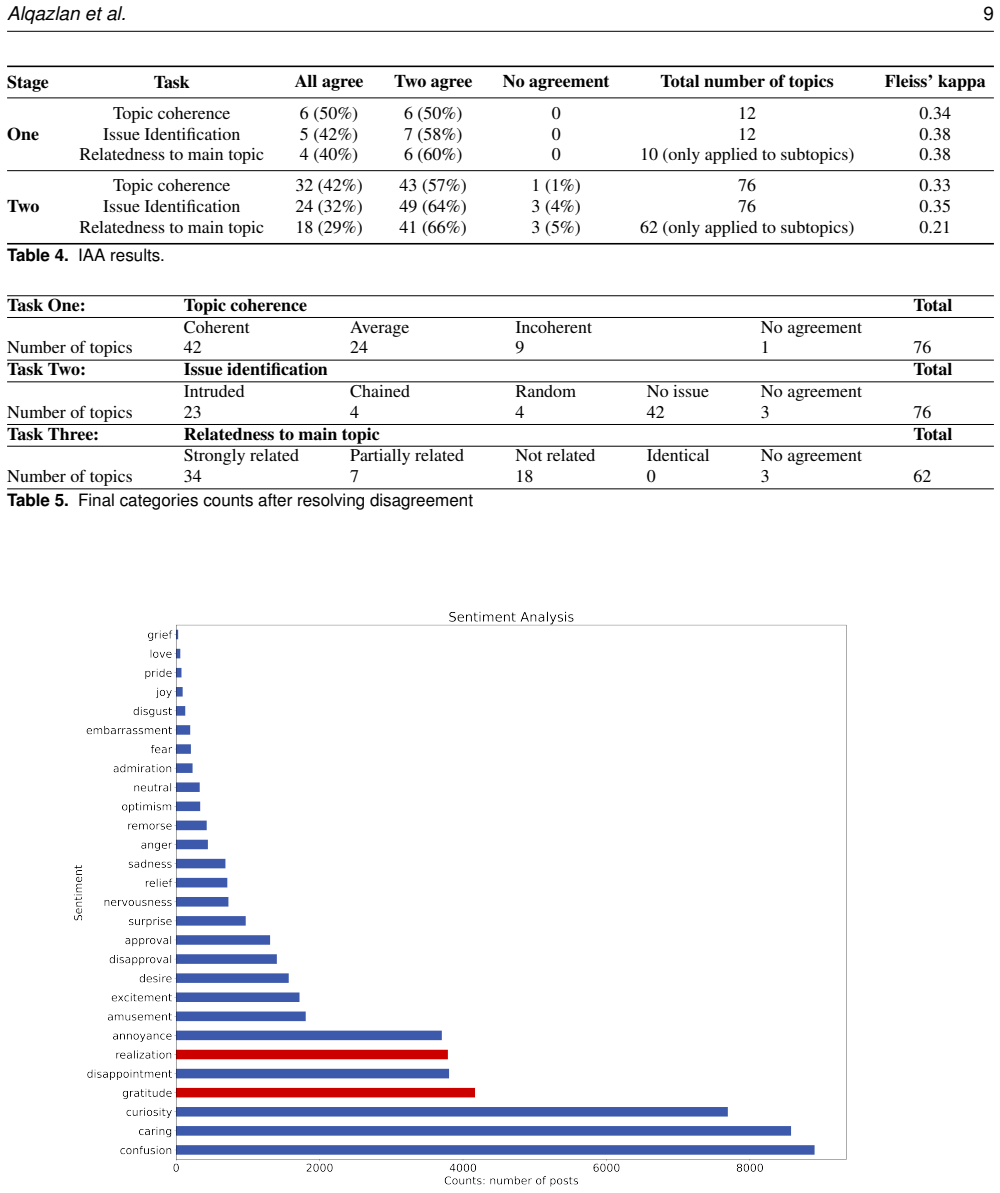
- [Phase Two (Human Evaluation of QDTM Topics), Table 4] The reported inter-annotator agreement (Fleiss' kappa 0.21-0.38) is 'fair' at best, and the paper's fallback to 97% majority agreement does not address the fact that chance-adjusted agreement is low. Additionally, 27% of QDTM topics are excluded based on annotator disagreement or quality; the manuscript should explain how this exclusion could bias the remaining 55 topics and whether the excluded topics were distributed evenly across main topics. This matters because Phase Three hand-codes only the top-10 posts of the surviving topics.
- [Phase Three (Supporting Theoretical Sampling), Figure 2] The theoretical sampling step selects 'Gratitude' and 'Realization' after inspecting the emotion frequencies in Figure 2, and then randomly samples 50 posts per emotion. While theoretical sampling is legitimately iterative and data-driven, the manuscript should report the full set of emotions considered and justify why only these two were sampled, in order to distinguish gap-driven sampling from cherry-picking of emotions that happen to confirm the emerging 'Redditing' category.
minor comments (5)
- [Introduction and Background] The sentence 'Sometimes, these models even outperform humans' is vague; specify the task types and benchmarks being referenced.
- [Phase One (Data Exploration)] The decision rule for excluding Codes 14 and 15 is stated only as a researcher judgment; a more principled criterion (e.g., based on whether a code is a communicative function rather than a topic) would improve replicability.
- [Appendix B, Table 8] The term extraction table lists terms from the 13-topic LDA even though the 17-topic model was eventually selected; clarify the role of the 13-topic model in the term curation process.
- [Phase Two, Table 4] The denominators for Stage One differ across tasks (12 topics for coherence and issue identification, 10 for relatedness to main topic); these should be stated explicitly in the table.
- [General presentation] The manuscript references Figure 1 and Appendices A-D; verify that all are included in the final version and that Figure 1 clearly labels the three phases.
Circularity Check
LDA validation is in-sample: the GT codes come from 160 posts inside the same 52K corpus used to train LDA, so the 12/13 overlap is not an independent test; the 'Realising' code also renames the 'Realization' emotion filter.
-
fitted input called prediction
[Phase One, 'Case study data' / 'Phase One' (validation paragraph)]
"Given the fact that our dataset consists of 18 subreddits, two relatively small subreddits were randomly selected, namely GoGoKidTeach and Palfish. This selection resulted in about 160 posts. ... Next, using LDA TM (See Figure 1), the entire dataset is explored to identify the main patterns. ... For validation, by considering both LDA models (with 13 and 17 topics), it was found that they were collectively able to detect 12 topics that were identified by GT analysis."
The GT codes used as the validation reference were produced from roughly 160 posts that are a subset of the same 52K corpus on which the LDA models were trained. The reported 12-of-13 overlap is therefore an in-sample agreement: LDA had already seen the very texts from which the GT codes were derived. This does not test whether the computational model 'effectively replaces human reading' on new or held-out data; it re-identifies patterns in the training data. The post hoc exclusion of two GT codes because 'LDA is not expected to model them' further removes potentially falsifying cases, but the core circularity is the training/validation overlap.
-
renaming known result
[Phase Three, 'Supporting Theoretical Sampling' / 'Commencement of Phase Three Analysis' (Table 6)]
"Then, we purposely selected 'Gratitude' and 'Realization' emotions (See Figure 2) for further analysis. Then, we randomly sampled 50 posts assigned to each emotion (See Table 6). Our analysis revealed that the data met our needs, leading to the creation of a new code, 'Realising' as a result of tutors' Redditing behaviour."
The new code 'Realising' is introduced immediately after the authors deliberately sampled posts pre-labelled 'Realization' by the GoEmotions sentiment model. The code name and the sampling criterion refer to the same concept, so the 'finding' is effectively a relabeling of the input filter: posts were chosen because they expressed realization, and the analysis then reports that tutors engage in 'realising'. This does not independently confirm the Redditing-to-Realising pathway; it restates the emotion label used to select the posts.
full rationale
The claimed derivation chain is a qualitative workflow rather than a symbolic derivation, so there are no equations to compare directly. The main circularity is empirical: in Phase One, the GT codes used to validate LDA come from a ~160-post subset of the same 52K corpus on which LDA is trained, making the reported 12-topics overlap an in-sample agreement rather than an independent confirmation that computational coding substitutes for human reading. This is compounded by the post hoc exclusion of two GT codes and by the absence of any quantitative agreement measure. The QDTM component is taken from the authors' prior work (Fang et al., 2021), but that is a tool citation rather than a circular derivation: the pipeline's outputs are human-annotated, and the sentiment model used later is an external benchmark. The 'Realising' code is a second, narrower circularity, because the posts were pre-selected on the GoEmotions 'Realization' label and the code restates that filter. Overall, the central framework has substantial independent content, but its headline trustworthiness claim is weakened by one in-sample validation loop and one self-naming finding, so the circularity score is moderate rather than extreme.
Assumptions & free parameters
free parameters (7)
- Number of LDA topics K =
13 and 17 tested; 17 selected
- Top-N documents per topic for evaluation =
5 (LDA labelling) and 10 (QDTM top posts)
- Vocabulary document-frequency cutoff =
words in fewer than 5 documents excluded
- Sub-topic prevalence cutoff =
0.2%
- Number of initial coding posts =
~160
- Number of annotators =
3
- Emotions selected for theoretical sampling =
Gratitude and Realization
assumptions (5)
- domain assumption GT codes from a small random subset (about 160 posts) can serve as a valid reference for evaluating LDA topics on the full corpus.
- ad hoc to paper LDA is expected to model concrete topics but not abstract themes such as 'Sharing experiences and feelings'.
- domain assumption Annotator agreement at Fleiss kappa between 0.21 and 0.38 ('fair' by Landis and Koch) with 97% two-rater agreement is acceptable evidence of topic quality.
- domain assumption Hand-coding the top-10 posts per topic (550 posts) is sufficient to reach theoretical saturation of core categories.
- ad hoc to paper Sentiment analysis on emotions selected post hoc provides valid theoretical sampling data that can confirm a new code.
Cite this review
Pith. "Pith review of A Novel, Human-in-the-Loop Computational Grounded Theory Framework for Big Social Data." pith.science (2026). https://pith.science/paper/5UVYW4R7
@misc{pith2026250606083,
  author       = {Pith},
  title        = {Pith review of: A Novel, Human-in-the-Loop Computational Grounded Theory Framework for Big Social Data},
  year         = {2026},
  howpublished = {\url{https://pith.science/paper/5UVYW4R7}},
  note         = {Machine review of arXiv:2506.06083}
}
read the original abstract
The availability of big data has significantly influenced the possibilities and methodological choices for conducting large-scale behavioural and social science research. In the context of qualitative data analysis, a major challenge is that conventional methods require intensive manual labour and are often impractical to apply to large datasets. One effective way to address this issue is by integrating emerging computational methods to overcome scalability limitations. However, a critical concern for researchers is the trustworthiness of results when Machine Learning (ML) and Natural Language Processing (NLP) tools are used to analyse such data. We argue that confidence in the credibility and robustness of results depends on adopting a 'human-in-the-loop' methodology that is able to provide researchers with control over the analytical process, while retaining the benefits of using ML and NLP. With this in mind, we propose a novel methodological framework for Computational Grounded Theory (CGT) that supports the analysis of large qualitative datasets, while maintaining the rigour of established Grounded Theory (GT) methodologies. To illustrate the framework's value, we present the results of testing it on a dataset collected from Reddit in a study aimed at understanding tutors' experiences in the gig economy.
Figures

Reference graph
Works this paper leans on
-
[1]
Asubjectis a group of at least two posts referring to the same topic
Evaluate the quality (coherence) of each topic, meaning the degree to which the posts in a topic are related to each other and discuss the same subject. Asubjectis a group of at least two posts referring to the same topic
-
[2]
Identify the reasons for lower ratings for topics rated as average coherence and incoherent
-
[3]
Provide a label for each topic
-
[4]
Annotation procedure You will be provided with an Excel workbook with number of spreadsheets
Determine the degree to which each subtopic is related to the main topic. Annotation procedure You will be provided with an Excel workbook with number of spreadsheets. Each spreadsheet consists of one main topic and its respective subtopics for which you are requested to perform the following four tasks: Task One: Rate the quality of topics
-
[7]
Carefully read all five associated posts and identify the topic of discussion in each post
-
[8]
Decide whether the set of posts is coherent or not and assign a coherence score on a scale of 1 to 3 as follows: (a) Assign a coherence score of 3 (Coherent) to the topic if you conclude that all five posts are related and discuss the same subject. (b) Assign a coherence score of 2 (Average) to the topic if you conclude that three or four out of the five ...
-
[9]
Please type(N/A)in the column for topics rated as 3 (Coherent). The table below illustrates the possible outcomes of the issue identification task: Table 7.Possible outcomes of the issue identification task Topic coher- ence Number of related posts Unrelated posts Justification Examples Coherent (5) - No issue N/A 16 Big Data & Society XX(X) Topic coher- ...
-
[10]
In the Topic label/s column, provide high-level labels (a word or a short phrase) for each topic. Please provide only one label for topics rated as coherent and up to two labels for topics rated as average
Show all 15 references
-
[11]
Where this applies, please note(N/A)in both columns
Do not complete this task for topics with coherence scores of 1 (Incoherent). Where this applies, please note(N/A)in both columns. Task Four: Judge the relationship between the main topic and subtopics Once the previous three tasks have been completed for the main topic and a ...
-
[12]
Assign a score of 3 (Strongly related) where the main topic and the subtopic are discussing related topics. For example, a point of discussion may have been mentioned in the main topic with more detail provided in the subtopic, or the subtopic has focused on an issue or topic ...
-
[13]
Assign a score of 2 (Partially related) where the main topic and the subtopic are somewhat related; for instance, if you believe the topics might be related but the relatedness is not readily apparent, direct, or comprehensive
-
[14]
Springer, pp. 578–589. Jiang JA, Wade K, Fiesler C and Brubaker JR (2021) Supporting serendipity: Opportunities and challenges for human-ai collaboration in qualitative analysis.Proceedings of the ACM on Human-Computer Interaction5(CSCW1): 1–23. Johnson SC (1967) Hierarchical ...
2021 arXiv
-
[15]
Assign a score of 1 (Not related) where the main topic and the subtopic are not related and discuss different topics
-
[16]
Part of being a freelancer is always worrying about job security. Definitely not the best part of the job
Assign a score of 0 (Identical) where the main and subtopic are identical and discussing exactly the same subject. For use when the subtopic does not provide any new information or nuance to the discussion of the topic under review, or where you find it difficult to distinguis...
-
[1312]
Salganik MJ (2019)Bit by bit: Social research in the digital age
Springer Nature. Salganik MJ (2019)Bit by bit: Social research in the digital age. Princeton University Press. Shenton AK (2004) Strategies for ensuring trustworthiness in qualitative research projects.Education for information22(2): 63–75. Sievert C and Shirley K (2014) Ldavi...
2019 arXiv
Reviewed August 7, 2026 · model on record in the stance chip above.
Discussion (0). Sign in to comment.