REVIEW 3 major objections 7 minor 109 references
WoundAIssist: A Patient-Centered Mobile App for AI-Assisted Wound Care With Physicians in the Loop
T0 review · 3 major / 7 minor · reviewed 2026-08-07 · deepseek-v4-flash
Pith's one-line read WoundAIssist is a patient-centered chronic wound app that runs a lightweight AI segmenter on the phone to guide photo capture, keeps physicians in the loop via remote monitoring and video consultations, and reports 'excellent' usability…
desk verdict A serious system paper whose 'excellent usability' claim is undermined by a negative SUS reliability estimate; worth reviewing but needs major revisions. read the letter →
The pith
A machine-rendered reading of the paper's core claim, the machinery that carries it, and where it could break.
The reading
What carries the argument
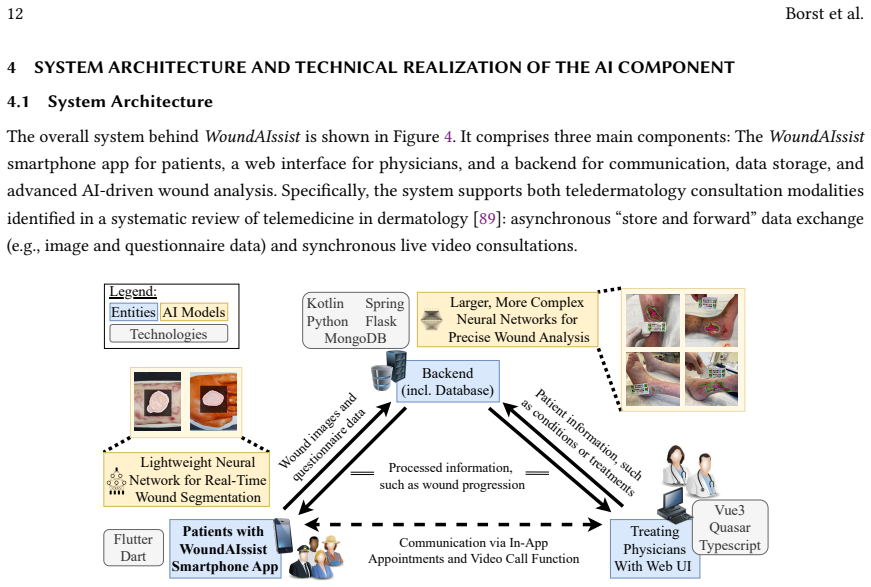
The central mechanism is TopFormer-Tiny, a 1.39-million-parameter hybrid network that combines a CNN token pyramid built from MobileNetV2 blocks with a vision-transformer semantics extractor; the trained model is converted to TorchScript, optimized for mobile, and embedded in the Flutter app so that wound-pixel segmentation runs in real time on the patient's phone (input images of $224 \times 224$ pixels, prediction threshold 0.75). The live segmentation mask is what guides the patient during image capture: the recognized wound region appears in the camera stream (or at the confirmation step in the a posteriori variant), helping the user frame consistent, well-lit photos and giving an immediate quality check. Around this sits a three-part system, the patient app, a physician web interface, and a backend that stores data, hosts larger server-side segmentation models, and estimates real-world wound size from a reference object in the image. The usability and quality claims are carried by three standardized instruments: SUS-DE for usability, MARS-G for app quality, and the TAM perceived-usefulness and perceived-ease-of-use scales for the AI feature.
What would settle it
A usability pass with a larger, more representative sample, for example thirty or more chronic wound patients including non-smartphone users and people with low digital literacy, that returns a mean SUS-DE below 70 (the 'above average' threshold) would contradict the excellence claim, as would systematic task failures in image capture or appointment scheduling. On the AI side, comparing the deployed TopFormer-Tiny masks against expert manual tracing on home-captured images under varied lighting, and finding that estimated wound areas deviate from planimetric ground truth by a clinically meaningful margin, would undermine the claim that the AI provides reliable capture guidance.
Extended reading notes
Core claim
On its own terms, the paper establishes that a patient-centered wound telemedicine system can combine automated AI wound segmentation, structured patient-reported outcomes, and direct clinician connectivity in one app while remaining easy for the target population to use. The supporting evidence is the Study B evaluation: a mean SUS-DE score of 87.00 (patients 86.00, physicians 88.00), classified as 'excellent'; a mean MARS-G score of 4.04, classified as 'good'; and Technology Acceptance Model scores for the AI segmentation of 76.39 (perceived usefulness) and 83.89 (perceived ease of use) for a posteriori feedback, and 70.83 and 82.78 for live feedback. Patients and physicians did not differ significantly on any of these measures, and the app's usability significantly exceeded that of the comparison patient-focused app WUND APP (87.00 vs 75.12, p = .022). The paper further claims, based on qualitative results and over three years of co-development with dermatologists and patients, a reusable set of design patterns for remote patient monitoring apps.
Load-bearing premise
The study assumes that ten participants, five chronic wound patients and five physicians (two of whom co-developed the app), are representative enough of the wider population of wound patients and their clinicians that a mean SUS-DE of 87.00 means the app is genuinely 'excellent' for that population, an assumption the paper's own Section 8.4 acknowledges limits generalizability.
Editorial extensions
If this is right
- If the usability ratings hold beyond this sample, patients can reliably take home photographs and answer structured questionnaires on their own, so wound healing trajectories can be monitored continuously instead of at sporadic clinic visits.
- Because patients and physicians rated usability, quality, and AI perception similarly with no significant differences, one interface may serve both stakeholder groups, which would simplify clinical deployment.
- The significant usability advantage over the comparison app WUND APP (87.00 vs 75.12, p = .022) supports the claim that the iterative user-centered development process, together with the AI capture guidance, adds measurable value over existing patient-focused wound apps.
- The slightly higher perceived usefulness of a posteriori over live segmentation (76.39 vs 70.83), though not statistically significant, suggests that deferred AI feedback may be as acceptable as real-time annotation, a relevant design choice for low-end devices.
- The patient SUS-DE increase from 75.30 on the low-fidelity prototype to 86.00 on the final app indicates that the Study A refinements moved usability toward 'excellent', although the paper notes this change did not reach statistical significance.
Reading between the lines
- A testable extension the paper does not run: randomize whether patients capture wounds with live AI guidance, a posteriori feedback, or no feedback, and measure the server-side segmentation accuracy and size estimates on the resulting photos, which would show whether the AI guidance actually improves the clinical utility of home images rather than only perceived ease of use.
- The paper's design patterns (guided data acquisition, transparent access to health trends, reciprocal communication, sustained physician engagement) are framed for wound care but read naturally as a general template for remote monitoring of other chronic conditions; a direct test would be applying them to another condition and checking whether SUS scores stay above the 'excellent' threshold with a
- Because two of the five physicians helped develop the app, the physician ratings may be partly inflated by authorship; the paper acknowledges this, and the ongoing six-month longitudinal pilot with a larger cohort is the natural place to check whether the excellent ratings survive independent clinicians and patients with lower digital affinity.
- If the longitudinal study confirms sustained use, the on-device segmenter could shift home wound assessment away from the ruler-and-multiplication method that systematically overestimates irregular wound areas, but the current study demonstrates positive perception, not long-term adherence or measurement accuracy.
Editorial analysis
A structured set of objections, weighed in public.
Referee Report
Summary. The manuscript presents WoundAIssist, a patient-centered mobile app that combines on-device AI-based wound segmentation with structured patient-reported questionnaires and telemedical physician consultations. The authors describe an iterative development process (Study A with a low-fidelity prototype, n=11) and a final evaluation (Study B with 5 chronic-wound patients and 5 physicians), reporting SUS-DE = 87.00 ('excellent'), MARS-G = 4.04 ('good'), and positive TAM scores for the AI segmentation feature, with no significant patient-physician differences. The paper also derives experience-based design patterns for remote patient monitoring apps.
Significance. If the reported usability and quality ratings are valid, the work makes a useful contribution to mHealth design for chronic wound care, particularly in documenting how an AI segmentation model was integrated and transparently described, and in synthesizing design patterns from iterative user testing. The authors are transparent about key limitations (small sample, qualitative AI validation, low reliability) and use standardized instruments (SUS-DE, MARS-G, TAM, ATI). However, the primary SUS result is called into question by a negative internal-consistency estimate, which substantially weakens confidence in the central 'excellent usability' claim.
major comments (3)
- [Table 1, Section 7.2.1] The central claim that WoundAIssist has 'excellent' usability (mean SUS-DE = 87.00, Section 7.2.1) is not statistically interpretable because Table 1 reports Cronbach's alpha = -0.05 for the SUS-DE in Study B. A negative alpha indicates that the ten SUS items do not positively covary, so the summed scale does not measure a single construct. Given that SUS contains five negatively worded items (items 2, 4, 6, 8, 10), the most plausible explanation is a reverse-scoring or data-entry error. Section 8.4 dismisses this as 'low' reliability without item-level diagnostics. The authors must report item means, inter-item correlations, and a corrected alpha; if the corrected scoring changes the total, the abstract, Section 7.2.1, and Section 9 must be revised accordingly.
- [Table 1, Section 7.2.2] The TAM subscale 'PEU - A posteriori' also has a negative Cronbach's alpha (-0.12, Table 1), which undermines the claim in Section 7.2.2 that a posteriori segmentation is perceived as easy to use (mean PEU = 83.89). The same diagnostic and corrective steps requested for the SUS-DE are needed for this subscale before the RQ-B2 conclusions can be drawn.
- [Abstract, Section 7.1.1, Section 9] Calling Study B a 'conclusive usability study' (abstract) overstates what can be concluded from 10 participants recruited from a single clinic, with two of the five physician participants being co-developers of the app. Although Section 8.4 acknowledges the small sample and limited generalizability, the abstract and the conclusion still present the findings as conclusive and 'excellent.' The wording should be revised to characterize the evaluation as a preliminary feasibility study, and the conflict of interest involving the two physician co-developers should be disclosed more prominently.
minor comments (7)
- [Abstract] 'an user-friendly' should be 'a user-friendly'.
- [Section 7.3] 'assssment' should be 'assessment'.
- [Section 5.2.2] 'tough they provided valid responses' should be 'though they provided valid responses'.
- [Section 7.2.2] The value '83.80' in the discussion should match Table 3's '83.89'.
- [Table 2] Please explain why the patients' MARS-G overall is based on n=4 (footnote b) while SUS-DE is based on n=5.
- [Section 7.2.3] The comparison with WUND APP uses data from a separate study (Dege et al. [17]) with different participants and settings; state this indirect-comparison limitation explicitly and discuss its impact on the significant SUS difference.
- [Section 4.2.4] Consider reporting a small quantitative accuracy evaluation (e.g., Dice) on the patient-captured images, or explicitly restrict the claim to qualitative feasibility in the abstract and conclusions.
Circularity Check
No significant circularity: usability and quality claims rest on external standardized measures, not on fitted inputs or self-citation chains.
full rationale
WoundAIssist's central claims—excellent SUS-DE usability (87.00), good MARS-G quality (4.04), and positive TAM perceptions of the AI segmentation—are direct observations from Study B using standardized, externally validated instruments (SUS, MARS-G, TAM, ATI). These scores are not derived from fitted parameters, nor are they equivalent to the app's design inputs by construction. The 0.75 segmentation threshold is a tuned value in the AI pipeline, but it does not feed back into the usability, quality, or perception outcomes. Self-citations to prior work [7] for TopFormer-Tiny training and to [17] for the WUND APP benchmark are prior published, externally checkable results; the paper does not invoke a uniqueness theorem, does not redefine WUND APP scores in this study, and does not use those citations to derive the central usability findings. The acknowledged limitations—small sample size, two physicians involved in development, and the low SUS-DE reliability (Cronbach's alpha = -0.05)—are methodological and statistical-validity concerns, not circular reasoning: a negative alpha would undermine the measure's validity but does not make the reported score equal to its inputs by construction. No specific step can be quoted where a predicted outcome reduces to its own inputs, so the appropriate finding is no significant circularity.
Assumptions & free parameters
free parameters (1)
- Prediction threshold for binary wound mask =
0.75
assumptions (4)
- domain assumption The participants in the usability studies are representative of the target population of chronic wound patients and clinicians.
- domain assumption Standardized instruments (SUS-DE, MARS-G, TAM) provide valid measures of usability, quality, and AI acceptance for this population.
- domain assumption The qualitatively validated TopFormer-Tiny model is sufficiently accurate for guiding patient image capture.
- domain assumption Task success in the usability study reflects real-world app use.
Cite this review
Pith. "Pith review of WoundAIssist: A Patient-Centered Mobile App for AI-Assisted Wound Care With Physicians in the Loop." pith.science (2026). https://pith.science/paper/N2CVKUNM
@misc{pith2026250606104,
  author       = {Pith},
  title        = {Pith review of: WoundAIssist: A Patient-Centered Mobile App for AI-Assisted Wound Care With Physicians in the Loop},
  year         = {2026},
  howpublished = {\url{https://pith.science/paper/N2CVKUNM}},
  note         = {Machine review of arXiv:2506.06104}
}
read the original abstract
The rising prevalence of chronic wounds, especially in aging populations, presents a significant healthcare challenge due to prolonged hospitalizations, elevated costs, and reduced patient quality of life. Traditional wound care is resource-intensive, requiring frequent in-person visits that strain both patients and healthcare professionals (HCPs). Therefore, we present WoundAIssist, a patient-centered, AI-driven mobile application designed to support telemedical wound care. WoundAIssist enables patients to regularly document wounds at home via photographs and questionnaires, while physicians remain actively engaged in the care process through remote monitoring and video consultations. A distinguishing feature is an integrated lightweight deep learning model for on-device wound segmentation, which, combined with patient-reported data, enables continuous monitoring of wound healing progression. Developed through an iterative, user-centered process involving both patients and domain experts, WoundAIssist prioritizes an user-friendly design, particularly for elderly patients. A conclusive usability study with patients and dermatologists reported excellent usability, good app quality, and favorable perceptions of the AI-driven wound recognition. Our main contribution is two-fold: (I) the implementation and (II) evaluation of WoundAIssist, an easy-to-use yet comprehensive telehealth solution designed to bridge the gap between patients and HCPs. Additionally, we synthesize design insights for remote patient monitoring apps, derived from over three years of interdisciplinary research, that may inform the development of similar digital health tools across clinical domains.
Figures


Figures from the paper (7 more)


Reference graph
Works this paper leans on
-
[1]
Kevin Anderson, Oksana Burford and Lynne Emmerton. 2016. Mobile health apps to facilitate self-care: a qualitative study of user experiences. PloS one 11, 5 (2016), e0156164
2016
-
[2]
Can Ateş et al. 2019. Comparison of Test Statistics of Nonnormal and Unbalanced Samples for Multivariate Analysis of Variance in terms of Type-I Error Rates. Computational and mathematical methods in medicine 2019 (2019), 2173638
2019
-
[3]
Ponrathi Athilingam and Bradlee Jenkins. 2018. Mobile phone apps to support heart failure self-care management: integrative review. JMIR cardio 2, 1 (2018), e10057
2018
-
[4]
Aaron Bangor, Philip Kortum and James Miller. 2009. Determining What Individual SUS Scores Mean: Adding an Adjective Rating Scale. Journal of Usability Studies 4, 3 (2009), 114–123
2009
-
[5]
Timothy Bickmore. 2022. Health-Related Applications of Socially Interactive Agents. In The handbook on socially interactive agents , Birgit Lugrin, Catherine Pelachaud, and David R. Traum (Eds.). Association for Computing Machinery, New York, NY, 403–436
2022
-
[6]
Vanessa Borst et al. 2025. WoundAmbit: Bridging State-of-the-Art Semantic Segmentation and Real-World Wound Care. InEuropean Conference on Machine Learning and Principles and Practice of Knowledge Discovery in Databases . To appear
2025
-
[7]
Vanessa Borst et al. 2024. Early Explorations of Lightweight Models for Wound Segmentation on Mobile Devices. InGerman Conference on Artificial Intelligence. Springer Nature Switzerland, 282–291
2024
-
[8]
Marijke Broekhuis, Lex van Velsen and Hermie Hermens. 2019. Assessing usability of eHealth technology: A comparison of usability benchmarking instruments. International journal of medical informatics 128 (2019), 24–31
2019
Show all 109 references
-
[9]
John Brooke. 2013. SUS: a retrospective. Journal of Usability Studies 8, 2 (2013), 29–40
2013
-
[10]
Mirela T Cazzolato et al. 2020. Semi-automatic ulcer segmentation and wound area measurement supporting telemedicine. In 2020 IEEE 33rd International Symposium on Computer-Based Medical Systems (CBMS) . IEEE, 356–361
2020
-
[11]
Mirela T Cazzolato et al. 2021. The UTrack framework for segmenting and measuring dermatological ulcers through telemedicine. Computers in Biology and Medicine 134 (2021), 104489
2021
-
[12]
Jieneng Chen et al. 2021. Transunet: Transformers make strong encoders for medical image segmentation. (2021). arXiv:2102.04306
2021 arXiv
-
[13]
Bowen Cheng et al. 2022. Masked-attention mask transformer for universal image segmentation. In Proceedings of the IEEE/CVF conference on computer vision and pattern recognition . 1290–1299
2022
-
[14]
Daniel YT Chino et al. 2020. Segmenting skin ulcers and measuring the wound area using deep convolutional networks. Computer methods and programs in biomedicine 191 (2020), 105376
2020
-
[15]
Roberto Collado-Borrell et al. 2016. Smartphone applications for cancer patients; what we know about them? Farmacia Hospitalaria 40, 1 (2016), 25–35. Manuscript submitted to ACM 30 Borst et al
2016
-
[16]
Fred D. Davis. 1989. Perceived Usefulness, Perceived Ease of Use, and User Acceptance of Information Technology. MIS Quarterly 13, 3 (1989), 319
1989
-
[17]
Tassilo Dege et al. 2024. Patient-Centered Chronic Wound Care Mobile Apps: Systematic Identification, Analysis, and Assessment. JMIR mHealth and uHealth 12 (2024), e51592
2024
-
[18]
Mrinal Kanti Dhar et al. 2024. FUSegNet: A deep convolutional neural network for foot ulcer segmentation. Biomedical Signal Processing and Control 92 (2024), 106057
2024
-
[19]
Alexey Dosovitskiy et al. 2021. An Image is Worth 16x16 Words: Transformers for Image Recognition at Scale. In 9th International Conference on Learning Representations
2021
-
[20]
Mingyuan Fan et al. 2021. Rethinking bisenet for real-time semantic segmentation. In Proceedings of the IEEE/CVF conference on computer vision and pattern recognition. 9716–9725
2021
-
[21]
Filipe Ferreira et al. 2021. Experimental study on wound area measurement with mobile devices. Sensors 21, 17 (2021), 5762
2021
-
[22]
FIEW. 2023. Die WUND APP - Zum Empowerment von Menschen mit chronischen Wunden. https://wundapp.at/, Accessed: 2024-02-07
2023
-
[23]
Piotr Foltynski et al. 2015. Wound area measurement with digital planimetry: improved accuracy and precision with calibration based on 2 rulers. PloS one 10, 8 (2015), e0134622
2015
-
[24]
Thomas Franke, Christiane Attig and Daniel Wessel. 2019. A Personal Resource for Technology Interaction: Development and Validation of the Affinity for Technology Interaction (ATI) Scale. International Journal of Human–Computer Interaction 35, 6 (2019), 456–467
2019
-
[25]
Anna-Lena Frey et al. 2023. Association Between the Characteristics of mHealth Apps and User Input During Development and Testing: Secondary Analysis of App Assessment Data. JMIR mHealth and uHealth 11 (2023), e46937
2023
-
[26]
Meiyuzi Gao, Philip Kortum and Frederick L. Oswald. 2020. Multi-Language Toolkit for the System Usability Scale. International Journal of Human–Computer Interaction 36, 20 (2020), 1883–1901
2020
-
[27]
A Geirhos et al. 2022. Standardized evaluation of the quality and persuasiveness of mobile health applications for diabetes management. Scientific reports 12, 1 (2022), 3639
2022
-
[28]
Ross Girshick et al. 2014. Rich feature hierarchies for accurate object detection and semantic segmentation. In Proceedings of the IEEE conference on computer vision and pattern recognition . 580–587
2014
-
[29]
Lisa Gould et al. 2015. Chronic wound repair and healing in older adults: current status and future research. Wound Repair and Regeneration 23, 1 (2015), 1–13
2015
-
[30]
Manu Goyal et al. 2017. Fully convolutional networks for diabetic foot ulcer segmentation. In 2017 IEEE international conference on systems, man, and cybernetics (SMC). IEEE, 618–623
2017
-
[31]
Davide Griffa et al. 2024. Artificial Intelligence in Wound Care: A Narrative Review of the Currently Available Mobile Apps for Automatic Ulcer Segmentation. BioMedInformatics 4, 4 (2024), 2321–2337
2024
-
[32]
Omar Haggag et al. 2022. A large scale analysis of mHealth app user reviews. Empirical Software Engineering 27, 7 (2022), 196
2022
-
[33]
Saee Hamine et al. 2015. Impact of mHealth chronic disease management on treatment adherence and patient outcomes: a systematic review. Journal of medical Internet research 17, 2 (2015), e52
2015
-
[34]
Kaiming He et al. 2016. Deep residual learning for image recognition. In Proceedings of the IEEE conference on computer vision and pattern recognition . 770–778
2016
-
[35]
K Herberger et al. 2011. Quality of life and satisfaction of patients with leg ulcers–results of a community-based study. Vasa 40, 2 (2011), 131–138
2011
-
[36]
Andrew Howard et al. 2019. Searching for mobilenetv3. In Proceedings of the IEEE/CVF international conference on computer vision . 1314–1324
2019
-
[37]
imito AG. 2024. imitoWound. https://imito.io/imitowound, Accessed: 2024-09-20
2024
-
[38]
Maša Isaković et al. 2016. Usability Pitfalls of Diabetes mHealth Apps for the Elderly. Journal of diabetes research 2016 (2016), 1604609
2016
-
[39]
Ergonomics of human-system interaction — Part 11: Usability: Definitions and concepts
ISO 9241-11:2018 2018. Ergonomics of human-system interaction — Part 11: Usability: Definitions and concepts . Standard. International Organization for Standardization
2018
-
[40]
JASP Team. 2021. JASP. https://jasp-stats.org/
2021
-
[41]
Das ist gar kein Modell!
Maike Jockisch. 2009. Das Technologieakzeptanzmodell. In "Das ist gar kein Modell!" , Gerhard Bandow and Hartmut H. Holzmüller (Eds.). Gabler, Wiesbaden, 233–254
2009
-
[42]
Line Bisgaard Jørgensen et al. 2016. Methods to assess area and volume of wounds–a systematic review. International wound journal 13, 4 (2016), 540–553
2016
-
[43]
Muhammad Ashad Kabir et al. 2024. Mobile apps for wound assessment and monitoring: limitations, advancements and opportunities. Journal of Medical Systems 48, 1 (2024), 1–14
2024
-
[44]
Connah Kendrick et al. 2022. Translating clinical delineation of diabetic foot ulcers into machine interpretable segmentation. (2022). arXiv:2204.11618
2022 arXiv
-
[45]
Alexander Kirillov et al. 2023. Segment anything. In Proceedings of the IEEE/CVF International Conference on Computer Vision . 4015–4026
2023
-
[46]
Marina Kolesnik and Ales Fexa. 2005. Multi-dimensional color histograms for segmentation of wounds in images. InImage Analysis and Recognition: Second International Conference, ICIAR 2005, Toronto, Canada, September 28-30, 2005. Proceedings 2 . Springer, 1014–1022
2005
-
[47]
Zeki Kuş and Musa Aydin. 2024. MedSegBench: A comprehensive benchmark for medical image segmentation in diverse data modalities. Scientific Data 11, 1 (2024), 1283
2024
-
[48]
Diane Langemo et al. 2008. Measuring wound length, width, and area: which technique? Advances in skin & wound care 21, 1 (2008), 42–45
2008
-
[49]
Fahad Lateef and Yassine Ruichek. 2019. Survey on semantic segmentation using deep learning techniques. Neurocomputing 338 (2019), 321–348. Manuscript submitted to ACM WoundAIssist: A Patient-Centered Mobile App for AI-Assisted Wound Care With Physicians in the Loop 31
2019
-
[50]
James R. Lewis. 2019. Comparison of four TAM item formats: effect of response option labels and order. Journal of Usability Studies 14, 4 (2019), 224–236
2019
-
[51]
Fangzhao Li et al. 2018. A composite model of wound segmentation based on traditional methods and deep neural networks. Computational intelligence and neuroscience 2018 (2018)
2018
-
[52]
Na Liu et al. 2021. Mobile health applications for older adults: a systematic review of interface and persuasive feature design. Journal of the American Medical Informatics Association : JAMIA 28, 11 (2021), 2483–2501
2021
-
[53]
Xiaohui Liu et al. 2017. A framework of wound segmentation based on deep convolutional networks. In 2017 10th international congress on image and signal processing, biomedical engineering and informatics (CISP-BMEI) . IEEE, 1–7
2017
-
[54]
Ze Liu et al. 2021. Swin transformer: Hierarchical vision transformer using shifted windows. In Proceedings of the IEEE/CVF international conference on computer vision. 10012–10022
2021
-
[55]
Jonathan Long, Evan Shelhamer and Trevor Darrell. 2015. Fully convolutional networks for semantic segmentation. In Proceedings of the IEEE conference on computer vision and pattern recognition . 3431–3440
2015
-
[56]
Christian Lull et al. 2022. German mobile apps for patients with psoriasis: systematic search and evaluation. JMIR mHealth and uHealth 10, 5 (2022), e34017
2022
-
[57]
Dee Luo et al. 2019. Mobile apps for individuals with rheumatoid arthritis: a systematic review. JCR: Journal of Clinical Rheumatology 25, 3 (2019), 133–141
2019
-
[58]
Jun Ma et al. 2024. Segment anything in medical images. Nature Communications 15, 1 (2024), 654
2024
-
[59]
Ji-Ye Mao et al. 2005. The state of user-centered design practice. Commun. ACM 48, 3 (2005), 105–109
2005
-
[60]
Harvey N Mayrovitz and Lisa B Soontupe. 2009. Wound areas by computerized planimetry of digital images: accuracy and reliability. Advances in skin & wound care 22, 5 (2009), 222–229
2009
-
[61]
Sachin Mehta and Mohammad Rastegari. 2021. MobileViT: Light-weight, General-purpose, and Mobile-friendly Vision Transformer. InInternational Conference on Learning Representations
2021
-
[62]
Eva-Maria Messner et al. 2020. The German Version of the Mobile App Rating Scale (MARS-G): Development and Validation Study. JMIR mHealth and uHealth 8, 3 (2020), e14479
2020
-
[63]
HT Mohammed et al. 2023. Implementing Technology in Practice: Factors Associated with Clinicians’ Satisfaction with an AI Wound Assessment Solution. Int J Nurs Health Care Res 6 (2023), 1452
2023
-
[64]
Anthony Molloy and Page L Anderson. 2021. Engagement with mobile health interventions for depression: A systematic review. Internet interventions 26 (2021), 100454
2021
-
[65]
Aurélie Najm et al. 2019. Mobile health apps for self-management of rheumatic and musculoskeletal diseases: systematic literature review. JMIR mHealth and uHealth 7, 11 (2019), e14730
2019
-
[66]
Net Health. 2025. The Essential Wound Imaging Solution for Consistently Accurate Wound Assessments. https://www.nethealth.com/tissue- analytics/, Accessed: 2025-04-25
2025
-
[67]
Elizabeth Nichols. 2015. Wound assessment part 1: how to measure a wound. Wound Essentials 10, 2 (2015), 51–55
2015
-
[68]
Subba Reddy Oota et al. 2023. WSNet: towards an effective method for wound image segmentation. InProceedings of the IEEE/CVF Winter Conference on Applications of Computer Vision . IEEE, 3234–3243
2023
-
[69]
Calvin Kalun Or, Richard J Holden and Rupa S Valdez. 2022. Human factors engineering and user-centered design for mobile health technology: enhancing effectiveness, efficiency, and satisfaction. In Human-Automation interaction: mobile computing. 97–118
2022
-
[70]
Nuno Pereira-Azevedo et al. 2015. mHealth in urology: a review of experts’ involvement in app development. PLoS One 10, 5 (2015), e0125547
2015
-
[71]
Nuno Pereira-Azevedo et al. 2016. Expert involvement predicts mHealth app downloads: multivariate regression analysis of urology apps. JMIR mHealth and uHealth 4, 3 (2016), e5738
2016
-
[72]
Sandra Purwins et al. 2010. Cost-of-illness of chronic leg ulcers in Germany. International wound journal 7, 2 (2010), 97–102
2010
-
[73]
Imran Qureshi et al. 2023. Medical image segmentation using deep semantic-based methods: A review of techniques, applications and emerging trends. Information Fusion 90 (2023), 316–352
2023
-
[74]
Dhanesh Ramachandram et al. 2022. Fully automated wound tissue segmentation using deep learning on mobile devices: Cohort study. JMIR mHealth and uHealth 10, 4 (2022), e36977
2022
-
[75]
R Renner and C Erfurt-Berge. 2017. Depression and quality of life in patients with chronic wounds: ways to measure their influence and their effect on daily life. Chronic Wound Care Management and Research (2017), 143–151
2017
-
[76]
Da Rocha et al
Carlos Diego F. Da Rocha et al. 2021. WoundArch: A Hybrid Architecture System for Segmentation and Classification of Chronic Wounds. In Proceedings of the 14th International Joint Conference on Biomedical Engineering Systems and Technologies . INSTICC, SciTePress, 651–658
2021
-
[77]
Olaf Ronneberger, Philipp Fischer and Thomas Brox. 2015. U-net: Convolutional networks for biomedical image segmentation. In Medical image computing and computer-assisted intervention–MICCAI 2015: 18th international conference, Munich, Germany, October 5-9, 2015, proceedings, part III
2015
-
[78]
Mark Rubin. 2021. When to adjust alpha during multiple testing: a consideration of disjunction, conjunction, and individual testing. Synthese 199, 3-4 (2021), 10969–11000
2021
-
[79]
Mark Sandler et al. 2018. Mobilenetv2: Inverted residuals and linear bottlenecks. In Proceedings of the IEEE conference on computer vision and pattern recognition. 4510–4520. Manuscript submitted to ACM 32 Borst et al
2018
-
[80]
Chandan K. Sen. 2023. Human Wound and Its Burden: Updated 2022 Compendium of Estimates. Advances in Wound Care 12, 12 (2023), 657–670. PMID: 37756368
2023
-
[81]
Julia Shaw and Patrick M Bell. 2011. Wound measurement in diabetic foot ulceration . IntechOpen
2011
-
[82]
Varun N Shenoy et al. 2018. Deepwound: Automated postoperative wound assessment and surgical site surveillance through convolutional neural networks. In IEEE International Conference on Bioinformatics and Biomedicine . 1017–1021
2018
-
[83]
Bo Song and Ahmet Sacan. 2012. Automated wound identification system based on image segmentation and artificial neural networks. In 2012 IEEE International Conference on bioinformatics and biomedicine . IEEE, 1–4
2012
-
[84]
Stoyanov et al
Stoyan R. Stoyanov et al. 2016. Development and Validation of the User Version of the Mobile Application Rating Scale (uMARS). JMIR mHealth and uHealth 4, 2 (2016), e72
2016
-
[85]
Stoyanov et al
Stoyan R. Stoyanov et al. 2015. Mobile app rating scale: a new tool for assessing the quality of health mobile apps. JMIR mHealth and uHealth 3, 1 (2015), e27
2015
-
[86]
Swift Medical Inc. 2024. Swift Skin and Wound - The New Standard for Wound Care. https://swiftmedical.com/, Accessed: 2024-10-07
2024
-
[87]
Tetsuyu Healthcare. 2024. CARES4WOUNDS. https://tetsuyuhealthcare.com/solutions/wound-management-system/, Accessed: 2025-05-26
2024
-
[88]
Hans Thisanke et al. 2023. Semantic segmentation using Vision Transformers: A survey. Engineering Applications of Artificial Intelligence 126 (2023), 106669
2023
-
[89]
A Trettel, L Eissing and M Augustin. 2018. Telemedicine in dermatology: findings and experiences worldwide–a systematic literature review. Journal of the European Academy of Dermatology and Venereology 32, 2 (2018), 215–224
2018
-
[90]
Jeya Maria Jose Valanarasu and Vishal M Patel. 2022. Unext: Mlp-based rapid medical image segmentation network. In International conference on medical image computing and computer-assisted intervention . Springer, 23–33
2022
-
[91]
Anudeep Varma et al. 2016. Vision based pus segmentation and area estimation of wound using android application. Indian Journal of Science and Technology (2016)
2016
-
[92]
A Vaswani. 2017. Attention is all you need. Advances in Neural Information Processing Systems (2017)
2017
-
[93]
Fenne Verhoeven et al. 2010. Asynchronous and synchronous teleconsultation for diabetes care: a systematic literature review. Journal of diabetes science and technology 4, 3 (2010), 666–684
2010
-
[94]
Qiang Wan et al. 2023. SeaFormer: Squeeze-enhanced Axial Transformer for Mobile Semantic Segmentation. InInternational Conference on Learning Representations
2023
-
[95]
Chuanbo Wang et al. 2020. Fully automatic wound segmentation with deep convolutional neural networks. Scientific reports 10, 1 (2020), 21897
2020
-
[96]
Chuanbo Wang et al. 2024. FUSeg: The foot ulcer segmentation challenge. Information 15, 3 (2024), 140
2024
-
[97]
Lei Wang et al. 2016. Area determination of diabetic foot ulcer images using a cascaded two-stage SVM-based classification. IEEE Transactions on Biomedical Engineering 64, 9 (2016), 2098–2109
2016
-
[98]
Qiuyi Wang et al. 2022. Usability evaluation of mHealth apps for elderly individuals: a scoping review. BMC Medical Informatics and Decision Making 22, 1 (2022), 317
2022
-
[99]
Risheng Wang et al. 2022. Medical image segmentation using deep learning: A survey. IET image processing 16, 5 (2022), 1243–1267
2022
-
[100]
Pawel Weichbroth. 2020. Usability of Mobile Applications: A Systematic Literature Study. IEEE Access 8 (2020), 55563–55577
2020
-
[101]
WoundVision ™. 2024. WoundVision. https://woundvision.com/, Accessed: 2025-05-26
2024
-
[102]
Wei-Ling Wu et al. 2019. The APD Skin Monitoring App for wound monitoring: Image processing, area plot, and colour histogram. Scientific Phone Apps and Mobile Devices 5, 3 (2019)
2019
-
[103]
Jiacong Xu, Zixiang Xiong and Shankar P Bhattacharyya. 2023. PIDNet: A real-time semantic segmentation network inspired by PID controllers. In Proceedings of the IEEE/CVF conference on computer vision and pattern recognition . 19529–19539
2023
-
[104]
Keith Jun-Yi Yeo et al. 2019. Application Notes: Wound Education App - Providing digitized wound care information on-the-go. APD Trove 2, 3 (2019)
2019
-
[105]
AA Zaidan et al. 2018. A review on smartphone skin cancer diagnosis apps in evaluation and benchmarking: coherent taxonomy, open issues and recommendation pathway solution. Health and Technology 8 (2018), 223–238
2018
-
[106]
Chongzhi Zhang et al. 2022. Delving deep into the generalization of vision transformers under distribution shifts. In Proceedings of the IEEE/CVF conference on Computer Vision and Pattern Recognition . 7277–7286
2022
-
[107]
Ruyi Zhang et al. 2022. A survey of wound image analysis using deep learning: Classification, detection, and segmentation. IEEE Access 10 (2022), 79502–79515
2022
-
[108]
Wenqiang Zhang et al. 2022. Topformer: Token pyramid transformer for mobile semantic segmentation. In Proceedings of the IEEE/CVF Conference on Computer Vision and Pattern Recognition . 12083–12093
2022
-
[109]
Sixiao Zheng et al. 2021. Rethinking semantic segmentation from a sequence-to-sequence perspective with transformers. In Proceedings of the IEEE/CVF conference on computer vision and pattern recognition . 6881–6890. Manuscript submitted to ACM
2021
Reviewed August 7, 2026 · model on record in the stance chip above.
Discussion (0). Sign in to comment.