REVIEW 1 major objections 3 minor 22 references
On the motion of a point charge in a plate capacitor considering influence effects
T0 review · 1 major / 3 minor · reviewed 2026-08-07 · deepseek-v4-flash
Pith's one-line read A point charge moving between capacitor plates feels the charges it induces on the plates; the paper derives the exact equation of motion and shows the transit-time correction is $O(-\lambda\log\lambda)$.
desk verdict Solid math, wrong energy: the mirror-charge series and psi-function summation are good, but the induced-charge potential is off by a factor of 2, so the 'exact' equation of motion and all numerical results describe twice the physical image force. read the letter →
The pith
A machine-rendered reading of the paper's core claim, the machinery that carries it, and where it could break.
The reading
What carries the argument
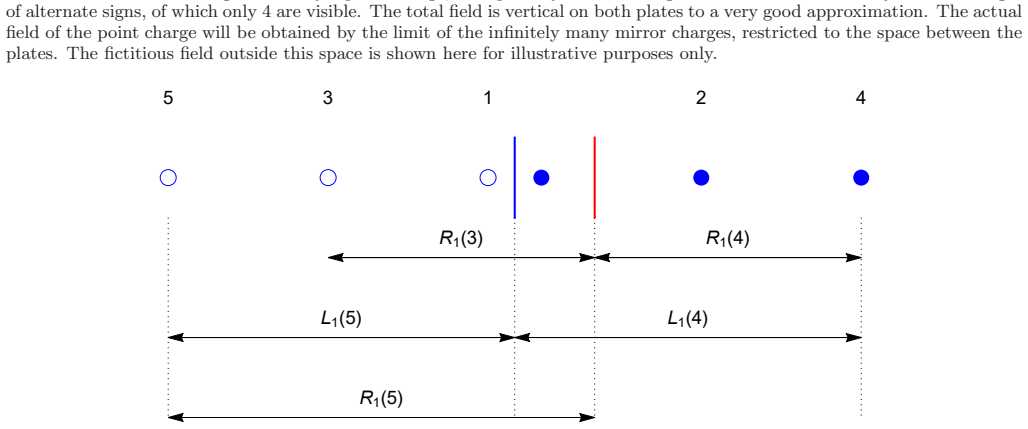
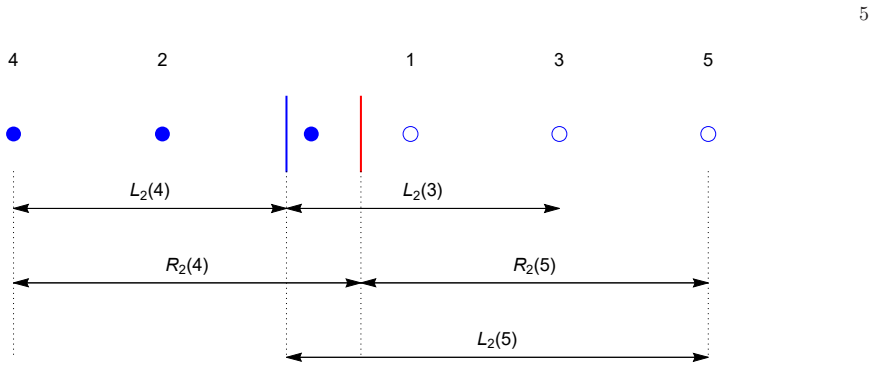
The central object is the infinite mirror-charge series representation of the Dirichlet Green's function for two parallel conducting plates, organized into two generations of mirror charges whose distances from the plates follow simple recurrences. On the central line (the symmetry axis through the charge and all mirror charges), the pairwise grouped series is summed in closed form using the digamma function $\psi(z)=\Gamma'(z)/\Gamma(z)$, giving the potential (33) in terms of four $\psi$ values. This object carries the argument because it turns an infinite sum of Coulomb potentials into an elementary special function; the equation of motion, its numerical integration, the Cornell-potential approximations, and the $O(-\lambda\log\lambda)$ transit-time analysis all follow from this closed-form potential.
What would settle it
Compute the near-plate force independently, either from the Maxwell stress tensor on the plates or from the energy $\tfrac12 q\Phi_{\rm ind}$ of the induced-charge system, and compare its small-$x$ asymptote with Eq. (35): the paper's potential gives $F\sim-\lambda/x^2$ near the left plate, while the standard half-factor convention gives $-\lambda/(2x^2)$; a measurement of the acceleration of a charged object at controlled small separation from one plate would also settle which force law is physical.
Extended reading notes
Core claim
The central discovery is that the back-reaction of the induced charges can be folded into an exact one-dimensional potential energy for a point charge moving along the symmetry line between two parallel conducting plates: in dimensionless units $V(x)=\lambda(\psi(1-x)+\psi(x)+2\gamma)-x$, where $x$ is the fraction of the plate separation, $\lambda=q/(8\pi\epsilon_0 U d)$ measures the relative strength of influence effects, and $\psi$ is the digamma function. The corresponding force, $F(x)=1+\lambda(\psi^{(1)}(1-x)-\psi^{(1)}(x))$, includes all mirror-charge contributions rather than only the nearest primary image. The transit time from one plate to the other is $T(\lambda)=\int_0^1 dx/\sqrt{2(E-V(x))}$, and its deviation from the no-influence value is $\delta T=T(0)-T(\lambda)=O(-\lambda\log\lambda)$ as $\lambda\to0$; this non-analytic dependence comes from the Coulomb singularities of the primary mirror charges near the plates. Because the exact equation of motion has no elementary closed solution, the paper also provides a piecewise analytic approximation—the Cornell potential $-\lambda/x$ near the left plate, its mirror image near the right plate, and a quadratic Taylor approximation centered between the plates—that reproduces the numerical trajectory and transit time to a relative accuracy around $4\times10^{-4}$ for the parameter values studied.
Load-bearing premise
The load-bearing premise is that the point charge's potential energy in the field of the induced charges is $q$ times the induced potential at the charge itself, with no factor of $1/2$; if the standard half-factor for induced-charge energy is the correct bookkeeping, the paper's force law (34) and everything built on it would need to be rescaled.
Editorial extensions
If this is right
- The exact one-dimensional equation of motion can be integrated numerically for arbitrary $\lambda$, so trajectories and transit times are available without any perturbative assumption about the strength of influence effects.
- The influence correction to the transit time is non-analytic in $\lambda$ at $\lambda=0$, behaving as $O(-\lambda\log\lambda)$; any treatment that keeps only the linear term in $\lambda$ will miss the true leading small-coupling correction.
- Near either plate the motion reduces to motion in a Cornell potential, so the travel time can be expressed with Legendre elliptic integrals at high energy and Carlson symmetric integrals at arbitrary energy.
- The three-piece analytic approximation matches the exact numerical motion to about $4\times10^{-4}$ relative accuracy for $\lambda=0.01$, $E=0.4$, providing a closed-form practical substitute for the numerical solution.
- For macroscopic parameters typical of electrostatic pendulum experiments quoted in the paper ($q=4\times10^{-9}$ As, $d=0.04$ m, $m=0.003$ kg, $U=10^3$ V), $\lambda\approx0.45$ and the influence correction reaches about 12% of the transit time, so the effect is experimentally relevant.
Reading between the lines
- The paper evaluates the mirror-charge Green's function only on the central line; expanding the same series off-axis would give the exact restoring force for small transverse displacements and would settle whether the axial trajectory is transversally stable, which the paper leaves open.
- The non-analytic $O(-\lambda\log\lambda)$ scaling suggests that back-reaction corrections in other image-charge problems, such as a charge approaching a single conducting plane or moving along the axis of a conducting cylinder, may also be logarithmic rather than linear in the coupling; this scaling could be tested by the same kind of asymptotic analysis.
- Using the paper's own electrostatic-pendulum parameters, the predicted 12% timing shift is a measurable prediction; an experiment that varies the charge on a small conducting body and records plate-to-plate transit times could test $T(\lambda)$ directly.
Editorial analysis
A structured set of objections, weighed in public.
Referee Report
Summary. The manuscript develops an infinite mirror-charge series representation for the Dirichlet Green's function of a point charge between two parallel conducting plates, proves its convergence, and explicitly sums it on the symmetry axis in terms of digamma functions. Using this, the authors write down an 'exact' equation of motion for the point charge, propose a three-piece analytical approximation based on the Cornell potential, and derive an asymptotic scaling law for the influence correction to the transit time, O(-λ log λ). The paper also compares the approximation with numerical integration of the exact equation of motion.
Significance. The mirror-charge series and its rigorous convergence proof are valuable, and the explicit digamma-function summation is an elegant technical achievement. The analytical approximation via the Cornell potential and elliptic integrals is a nice pedagogical contribution. However, the central physical input—the potential energy of the induced charges—is computed incorrectly: the manuscript omits the standard factor 1/2 for the energy of induced charges, so the 'exact' equation of motion is not exact and all quantitative results (transit times, correction size, pendulum parameters) are physically wrong by a factor of two in the influence term. The O(-λ log λ) scaling is likely robust, but the present version's central claims are not supported as written. The error is a simple factor and may be fixable, but the numerical results and physical conclusions would need to be reworked.
major comments (1)
- [IV A, Eqs. (32)-(35)] The potential energy V1 in Eq. (32) is set equal to qΦ_ind, i.e., twice the actual mechanical energy of the induced charges. As the charge moves, the image charges move with it, so the potential energy of the induced-charge interaction is (1/2)qΦ_ind, not qΦ_ind. Consequently, the force in Eq. (34) is twice the physical image force. This is immediately visible in the near-plate limit: Eq. (35) gives V1 ≈ -λ/x, whereas the standard image-charge result for a charge at dimensionless distance x from a grounded plane is V1 ≈ -λ/(2x) and the force is -λ/(2x^2), not -λ/x^2. Since Eq. (34) defines the 'exact' equation of motion used in Sec. IV D and the transit-time analysis of Sec. V, all quantitative results (e.g., T_num = 0.731182 and the 12% correction for the electrostatic pendulum parameters) are computed with a doubled influence effect. The authors should either multiply the influence term by 1/2 or redefine λ accordingly, and then redo the numerical integrations and the asymptotic analysis.
minor comments (3)
- [Title] The word 'considering' is split as 'consideri ng' in the running title on the first line of the manuscript.
- [Sec. V, Eq. (62)] The notation δT = O(-λ log λ) is unconventional; since λ log λ is negative for small λ, writing O(λ |log λ|) would be clearer and would avoid the appearance of a negative-order symbol.
- [Fig. 8] The figure shows excellent agreement between the numerical and analytical curves, but the reported relative deviation of about 4e-4 is not visible in the plot; a residual plot would make the comparison more informative.
Circularity Check
No circularity: the central potential and equation of motion are derived from the Dirichlet Green's function and mirror-charge series, not fitted to the target results.
full rationale
The paper's central quantity, the dimensionless potential V(x) = λ(ψ(1-x)+ψ(x)+2γ) - x in Eq. (33), is obtained by explicitly summing the mirror-charge series (23) on the central line, using standard psi-function identities, and then adding the constant capacitor potential. No parameter is fitted to the subsequent transit-time or O(-λ log λ) results; λ is defined in Eq. (31) from the Coulomb energy of a mirror-charge pair and the capacitor energy scale. The analytical approximation in Eq. (39) is compared with numerical integration of the same exact potential in Section IV D, which is a consistency check of the approximation, not circular reasoning. The O(-λ log λ) scaling in Section V is derived from the explicit integrals (63)-(71), not assumed. There are no load-bearing self-citations: the paper cites standard references for mathematical functions and electrostatics, and independently verifies its Green's function representation against the known mixed series/integral form in Appendix B. The skeptic's concern about a missing factor of 1/2 in identifying qΦ_ind as the induced-energy contribution is a possible physical or correctness issue in the modeling of induced charges, but it is not a circularity: the derivation does not reduce to its inputs or rename a fitted quantity as a prediction. Therefore the circularity score is 0.
Assumptions & free parameters
free parameters (1)
- piecewise approximation boundaries =
1/3 and 2/3
assumptions (3)
- domain assumption The influenced surface charges react instantaneously to the motion of the point charge without any delay.
- domain assumption The capacitor plates are infinite, planar, perfect conductors with Dirichlet boundary conditions.
- standard math The motion of the point charge can be restricted to the central line perpendicular to the plates because transverse motion is rectilinear and uniform.
Cite this review
Pith. "Pith review of On the motion of a point charge in a plate capacitor considering influence effects." pith.science (2026). https://pith.science/paper/QB4IXSIC
@misc{pith2026250606132,
  author       = {Pith},
  title        = {Pith review of: On the motion of a point charge in a plate capacitor considering influence effects},
  year         = {2026},
  howpublished = {\url{https://pith.science/paper/QB4IXSIC}},
  note         = {Machine review of arXiv:2506.06132}
}
abstract
A point charge between the plates of a capacitor generates an influence charge distribution on the plates that modify the electric field acting upon the point charge. This effect is described by the well-known Dirichlet Green's function for the two parallel conducting plate problem for which we derive an infinite mirror charge series representation. At the line perpendicular to the plates and passing through the point charge this Green's function and hence the total force can be explicitly evaluated in terms of the psi function. For the motion of the point charge we develop an analytical approximation and compare it with the numerical integration of the exact equations of motion. The correction due to influence effects is shown to be of order $O(-\lambda \log \lambda)$ where $\lambda$ denotes the relative strength of the Green's function compared with the pure capacitor potential.
Figures


Figures from the paper (11 more)


Reference graph
Works this paper leans on
-
[1]
Motion under the influence of the left plate, large energy c ase Again using dimensionless quantities we can write the potential energ y as V (x) = −x − λ x . (40) As with all one-dimensional mechanical problems with constant tota l energy E, the inverse function t(x) can be expressed by the indefinite integral t(x) = ∫ dx√ 2(E −V (x)) = 1√ 2 ∫ dx√ E +x + λ...
-
[2]
Motion under the influence of the right plate, large energy case The mathematical treatment is largely analogous to that of the pre ceding subsection. The potential energy now assumes the form V (x) = −x − λ 1 −x , (49) and t(x) is given by the integral t(x) = 1√ 2 ∫ dx√ E +x + λ 1−x = − 1√ 2 ∫ 2y√ E + 1 −y2 + λ y2 dy = − √ 2 ∫ y2 √ (E + 1)y2 −y4 +λ dy , (...
-
[3]
The image of a point charge in an infinite conducting cylinder
M. Majic, The image of a point charge in an infinite conduct ing cylinder, Preprint, arXiv:2001.10651 (2020)
work page Pith review arXiv 2020
-
[4]
J. D. Jackson, Classical electrodynamics, 3rd edition, Hoboken, John Wiley & Sons, 2021
work page 2021
-
[5]
J. Dougall, The determination of Green’s Function by mea ns of cylindrical or spherical harmonics, Proceedings of the Edinburgh Mathematical Society 18, 33 – 83, (1900)
work page 1900
-
[6]
M. Seetharaman, S. Raghavan, and S. S. Vasan, Analytic WK B energy expression for the linear plus Coulomb potential, J. Phys. A: Math. Gen. 51, 455 – 462, (1983)
work page 1983
-
[7]
W. A. Newcomb, Trouble with the method of images, Am. J. Phys. 50 (7), 601 – 607, (1982)
work page 1982
-
[8]
W. R. Smythe, Static and dynamic electricity , 3rd edition, revised printing, London, Taylor & Francis, 1 998
Show all 22 references
-
[9]
Asano, On the theory of an electrostatic pendulum osci llator, Am
K. Asano, On the theory of an electrostatic pendulum osci llator, Am. J. Phys. 43 (5), 423 – 427, (1975)
1975
-
[10]
test particles
Hence we introduce the scaled family of functions K(z,λ ) = 1√ λ H( √ λz,λ ), (65) such that ∆LT = ∫ 1/2 0 H(y,λ )dy =λ ∫ 1/(2 √ λ) 0 K(z,λ )dz . (66) Forλ → 0 the function K(z,λ ) assumes the limit value K(z, 0) = √ 2z ( 1√ E − z√ Ez 2 + 1 ) , (67) with a maximum of α =K(β, 0...
-
[11]
Courtney, N
M. Courtney, N. Spellmeyer, H. Jiao, and D. Kleppner, Cla ssical, semiclassical, and quantum dynamics in the lithium Stark system, Phys. Rev. A 16 (5), 3604 – 3620, (1995)
1995
-
[12]
D. H. Martin and R. L. Longbrake, An electrostatic oscill ator experiment, Am. J. Phys. 40 (3), 395 – 398, (1972)
1972
-
[13]
A. T. P´ erez, Charge and force on a conducting sphere bet ween two parallel electrodes, Journal of Electrostatics 56, 199 – 217, (2002)
2002
-
[14]
V. A. Saranin, Electrostatic oscillators, Physics-Uspekhi 55 (7) , 700 – 708, (2012)
2012
-
[15]
Forjan, M
M. Forjan, M. Marhl, and V. Grubelnik, Mathematical mod elling of the electrostatic pendulum in school and undergra duate education, Eur. J. Phys. 35, 015022, (2014)
2014
-
[16]
D. S. Goodman, R. D. Fischetti, A. Hodges, and H. A. Tekal p, Image-charge effects on an electrostatic pendulum in mechanical equilibrium, Am. J. Phys. 88 (3), 222 – 228, (2020)
2020
-
[17]
http://dlmf.nist.gov/, Release 1.1.1 of 2021-03-15
NIST Digital Library of Mathematical Functions . http://dlmf.nist.gov/, Release 1.1.1 of 2021-03-15. F. W . J. Olver, A. B. Olde Daalhuis, D. W. Lozier, B. I. Schneider, R. F. Boisvert, C. W. Clark, B. R. Miller, B. V. Saunders, H. S. Cohl, and M. A. McClain, eds
2021
-
[18]
Elizalde, Ten physical applications of spectral zeta functions , Lecture Notes in Physics 855, Berlin - Heidelberg - New York, Springer, 1995
E. Elizalde, Ten physical applications of spectral zeta functions , Lecture Notes in Physics 855, Berlin - Heidelberg - New York, Springer, 1995
1995
-
[19]
M. W. Coffey, On one-dimensional digamma and polygamma s eries related to the evaluation of Feynman diagrams, J. Comp. Appl. Math. 183 (1), 84 – 100, (2005)
2005
-
[20]
M. A. Liberman, Hydrogen Atom in Electric and Magnetic F ields: Dynamical Symmetries, Superintegrable and Integra ble Systems, Exact Solutions, Preprint, arXiv:2203.02730 (20 22)
-
[21]
E. W. Weisstein, Fourier Series–Sawtooth Wave, From MathWorld–A Wolfram Web Resource, https://mathworld.wolfram.com/FourierSeriesSawtoothWave.html, (2022)
2022
-
[22]
B. C. Carlson, Normal elliptic integrais of the first and second kinds, Duke Math. J. 31 (3), 405 – 419, (1964)
1964
Reviewed August 7, 2026 · model on record in the stance chip above.
Discussion (0). Sign in to comment.