Impact of initial mass function on the chemical evolution of high-redshift galaxies
Pith reviewed 2026-05-19 10:44 UTC · model grok-4.3
The pith
Only galaxies with an IMF extending to stars above 200 solar masses match the observed mass-metallicity-star formation rate relation at z greater than or equal to 4.
A machine-rendered reading of the paper's core claim, the machinery that carries it, and where it could break.
Core claim
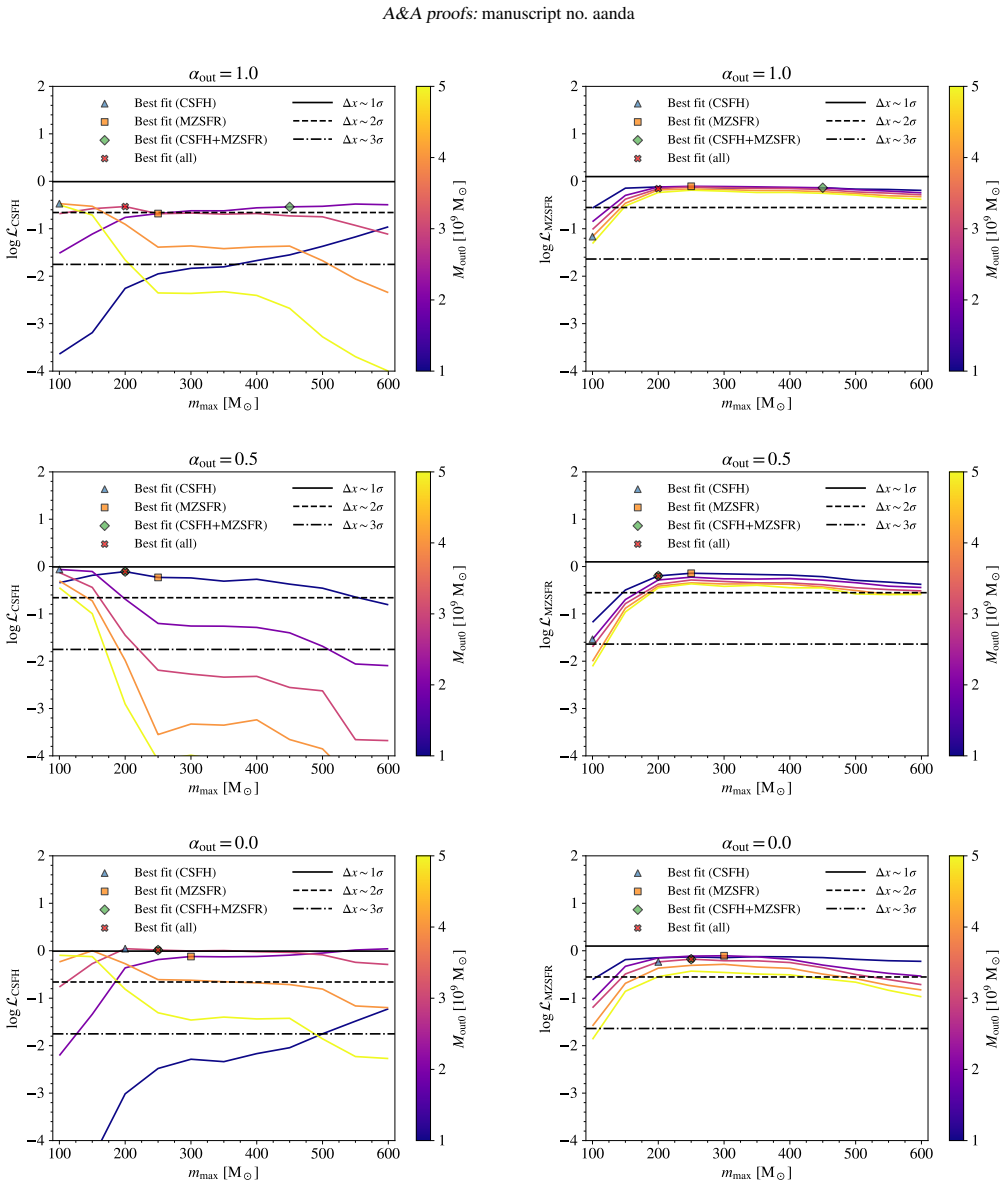
Assuming a Kroupa-like IMF with varying upper mass limit m_max, only models with m_max greater than or equal to 200 solar masses simultaneously reproduce the observed mass-metallicity-star formation rate relation and cosmic star formation history at z greater than or equal to 4, because of the enhanced metal yields contributed by pair-instability supernovae from those very massive stars.
What carries the argument
The a-sloth semi-analytical code run on merger trees from a high-resolution cosmological simulation, using stellar evolution tracks and metal yields for stars from 2 to 600 solar masses across metallicities from 10 to the minus 11 to 0.03, with explicit inclusion of winds, core-collapse, pulsational pair-instability, and Type Ia supernovae.
If this is right
- Pair-instability supernovae from stars above 200 solar masses supply a substantial fraction of the metals observed in high-redshift galaxies.
- The cosmic star formation history at z greater than or equal to 4 is sensitive to the presence of these very massive stars.
- Electromagnetic transients and gravitational-wave events from high-redshift galaxies are expected to include signatures of pair-instability supernovae.
- Lowering the IMF upper mass limit below 200 solar masses breaks the match to both the mass-metallicity-star formation rate relation and the star formation rate density.
Where Pith is reading between the lines
- Future JWST or ELT spectra that resolve individual supernova remnants at z greater than 6 could directly test whether the extra metal production occurs at the predicted rate.
- If very massive stars are common, the rate of pair-instability supernova candidates should be higher than standard IMF models predict, offering a cross-check with transient surveys.
- The same IMF requirement may affect predictions for the number of intermediate-mass black holes formed at high redshift.
Load-bearing premise
The metal yields and evolutionary tracks for stars above 200 solar masses at metallicities as low as 10 to the minus 11 are accurate enough that the extra pair-instability supernova contribution is not an artifact of uncertain input physics.
What would settle it
New observations at z greater than or equal to 4 that show the mass-metallicity-star formation rate relation continuing to hold even when the cosmic star formation rate density is measured independently would falsify the need for an IMF upper limit above 200 solar masses.
Figures




read the original abstract
Recent observations by the James Webb Space Telescope (JWST) have found evidence for an invariant relation between stellar mass, metallicity, and star formation rate up to $z\sim 8$ and its breakdown at higher redshifts. Understanding the underlying physics driving such correlations is thus crucial. Here, we explore the impact of the initial mass function (IMF) on the chemical evolution of high-redshift galaxies. Indeed, star formation and metal enrichment in galaxies are regulated by supernova (SN) explosions and metal yields from massive stars, which are sensitive to the high-mass end of the IMF. Using the semi-analytical galaxy evolution code \textsc{a-sloth}, we follow galactic baryon cycles along merger trees built from a high-resolution cosmological simulation. Stellar feedback is modeled with up-to-date stellar evolution tracks covering the full metallicity range ($Z \sim 10^{-11} - 0.03$) and a broad stellar mass range ($m_\star\sim2 - 600\ \rm M_\odot$), including metal yields from stellar winds, core-collapse SNe, (pulsational) pair-instability SNe, and Type Ia SNe. Assuming a Kroupa-like IMF with a varying upper mass limit $m_{\max}$, we find that only models with $m_{\max} \gtrsim 200\ \rm M_\odot$ can simultaneously reproduce the observed mass-metallicity-star formation rate relation and cosmic star formation history at $z\gtrsim 4$ owing to enhanced metal yields from pair-instability SNe. Our results confirm that very massive ($\gtrsim 200\ \rm M_\odot$) stars and pair-instability SNe play an important role in the star formation and chemical enrichment histories of high-$z$ galaxies. They also have profound implications for electromagnetic transients and gravitational-wave events.
Editorial analysis
A structured set of objections, weighed in public.
Referee Report
Summary. The manuscript uses the semi-analytical code a-sloth to evolve galactic baryon cycles along merger trees extracted from a high-resolution cosmological simulation. Assuming a Kroupa-like IMF with variable upper-mass cutoff m_max and incorporating metal yields from winds, core-collapse SNe, (pulsational) pair-instability SNe, and Type Ia SNe over the full metallicity range Z ~ 10^{-11}–0.03 and stellar masses 2–600 M_⊙, the authors conclude that only models with m_max ≳ 200 M_⊙ simultaneously reproduce the observed mass-metallicity-SFR relation and cosmic SFR density at z ≳ 4, owing to the enhanced metal production from pair-instability supernovae.
Significance. If the result is robust, the work demonstrates that very massive stars and pair-instability supernovae are required to regulate chemical enrichment and star-formation histories in high-redshift galaxies, providing a physical interpretation for JWST trends. The use of up-to-date stellar tracks spanning a broad mass and metallicity range constitutes a clear technical strength.
major comments (2)
- [Methods (stellar yields and feedback implementation)] The central claim that m_max ≳ 200 M_⊙ is required rests entirely on the adopted PISN yields for stars above 200 M_⊙ at Z ~ 10^{-11}. The manuscript should quantify the sensitivity of the MZR-SFR and cosmic SFR fits to plausible variations in those yields arising from uncertain mass-loss rates, rotation, or pulsational instabilities (see the description of supernova and wind yields in the methods).
- [Results (comparison with observations)] It remains unclear whether the reported agreement with observations persists once uncertainties in the input merger trees and yield tables are propagated; the paper should present the range of outcomes under varied assumptions rather than single best-fit curves.
minor comments (2)
- [Abstract] The abstract refers to 'the observed mass-metallicity-star formation rate relation' without citing the specific JWST or other datasets used for the z ≳ 4 comparison.
- [Methods] Notation for the IMF slope and the precise functional form of the Kroupa-like IMF with variable m_max should be stated explicitly in the methods section.
Simulated Author's Rebuttal
We thank the referee for their constructive and detailed comments, which have prompted us to clarify and strengthen several aspects of the manuscript. We address each major comment point by point below, indicating where revisions will be made.
read point-by-point responses
-
Referee: [Methods (stellar yields and feedback implementation)] The central claim that m_max ≳ 200 M_⊙ is required rests entirely on the adopted PISN yields for stars above 200 M_⊙ at Z ~ 10^{-11}. The manuscript should quantify the sensitivity of the MZR-SFR and cosmic SFR fits to plausible variations in those yields arising from uncertain mass-loss rates, rotation, or pulsational instabilities (see the description of supernova and wind yields in the methods).
Authors: We agree that uncertainties in PISN yields at low metallicity, arising from mass-loss rates, rotation, and pulsational instabilities, warrant explicit discussion. Our adopted yields follow the most recent stellar evolution calculations available for the full mass and metallicity range. In the revised manuscript we will add a dedicated paragraph in the methods section summarizing these uncertainties and include a brief sensitivity test in which the PISN metal yields are scaled by ±25 %. These additional runs show that the requirement for m_max ≳ 200 M_⊙ persists, although the precise threshold can shift by ~20 M_⊙. The new material will be presented as an appendix figure and accompanying text. revision: partial
-
Referee: [Results (comparison with observations)] It remains unclear whether the reported agreement with observations persists once uncertainties in the input merger trees and yield tables are propagated; the paper should present the range of outcomes under varied assumptions rather than single best-fit curves.
Authors: We acknowledge that a full propagation of uncertainties from both merger trees and yield tables would be desirable. Because the merger trees are extracted from one high-resolution cosmological simulation, generating an ensemble of trees lies outside the present scope. For the yield tables we likewise adopt published values. In the revised version we will replace the single curves with shaded bands that reflect the spread obtained when m_max is varied across the range 100–300 M_⊙ and will add a short discussion clarifying that the displayed relations correspond to our fiducial yield set. This change will make the robustness of the main conclusion more transparent without requiring new cosmological simulations. revision: partial
Circularity Check
No significant circularity in forward simulation results
full rationale
The paper runs forward semi-analytic simulations in the a-sloth code along external cosmological merger trees, using independently tabulated stellar evolution tracks and metal yields (including PISN) for masses up to 600 M_⊙ across a wide metallicity range. The Kroupa-like IMF with variable m_max is an explicit input parameter; the claim that only m_max ≳ 200 M_⊙ simultaneously matches the observed MZR-SFR relation and cosmic SFR density at z≳4 is obtained by direct comparison of simulation outputs to external observational data. No equation or result is defined in terms of itself, no fitted parameter is relabeled as a prediction, and no load-bearing step reduces to a self-citation or ansatz by construction. The derivation is therefore self-contained against external benchmarks.
Axiom & Free-Parameter Ledger
free parameters (1)
- m_max
axioms (1)
- domain assumption Stellar evolution tracks and metal yields for m_star up to 600 M_⊙ and Z down to 10^-11 are taken as given from prior literature.
Lean theorems connected to this paper
-
IndisputableMonolith/Cost/FunctionalEquation.leanwashburn_uniqueness_aczel unclear?
unclearRelation between the paper passage and the cited Recognition theorem.
Assuming a Kroupa-like IMF with a varying upper mass limit m_max, only models with m_max ≳ 200 M_⊙ can simultaneously reproduce the observed mass-metallicity-star formation rate relation and cosmic star formation history at z≳4 owing to enhanced metal yields from pair-instability SNe.
-
IndisputableMonolith/Foundation/DimensionForcing.leanalexander_duality_circle_linking unclear?
unclearRelation between the paper passage and the cited Recognition theorem.
Stellar feedback is modeled with up-to-date stellar evolution tracks covering the full metallicity range (Z ∼ 10^{-11} - 0.03) and a broad stellar mass range (m⋆∼2 - 600 M⊙)
What do these tags mean?
- matches
- The paper's claim is directly supported by a theorem in the formal canon.
- supports
- The theorem supports part of the paper's argument, but the paper may add assumptions or extra steps.
- extends
- The paper goes beyond the formal theorem; the theorem is a base layer rather than the whole result.
- uses
- The paper appears to rely on the theorem as machinery.
- contradicts
- The paper's claim conflicts with a theorem or certificate in the canon.
- unclear
- Pith found a possible connection, but the passage is too broad, indirect, or ambiguous to say the theorem truly supports the claim.
Reference graph
Works this paper leans on
-
[1]
The Science of the Einstein Telescope
Abac, A., Abramo, R., Albanesi, S., et al. 2025, arXiv e-prints, arXiv:2503.12263 Adams, N. J., Conselice, C. J., Austin, D., et al. 2024, ApJ, 965, 169 Allende Prieto, C., Lambert, D. L., & Asplund, M. 2001, ApJ, 556, L63 Andrews, B. H. & Martini, P. 2013, ApJ, 765, 140 Aravindan, A., Liu, W., Canalizo, G., et al. 2023, ApJ, 950, 33 Arca-Sedda, M. & Capu...
work page internal anchor Pith review Pith/arXiv arXiv 2025
-
[2]
Clearly, the stochasticity of star formation (at the timescale of 10 Myr) is significantly underestimated by the old model of Hartwig et al. (2022). Besides, there are no galaxies from the simulation that is close to the starburst track with SFR /M⋆ ∼ 10−7 yr−1 found by Rinaldi et al. (2022), while many JWST galaxies appear to be in the starburst phase. I...
work page 2022
-
[3]
chosen forαout = 1.0 (top), 0.5 (middle), and 0 (bottom). Similar to the case of the old prescription, the sim- ulated SFMS is generally in agreement with that from Rinaldi et al. (2022) except for the αout = 0 case at z ∼ 4 − 6, where the simulated SFMS has a smaller slope. So, the median SFR of the simulated galaxies is generally lower than that of the ...
work page 2022
-
[4]
3 HST/ALMA JWST 0.10.120.140.170.20.250.30.40.50.71.0 t [Gyr] out = 1.0, Mout0 = 1 × 10⁹ M , mmax = 250 M , R = Rvir/cDM Fig. A.1. SFRD from an exemplar run using the old star formation pre- scription of Hartwig et al. (2022) with R⋆ = Rvir/cDM for αout = 1, Mout0 = 109 M⊙, and mmax = 250 M ⊙. The thick solid curve shows the total SFRD measured on a times...
work page 2022
-
[5]
The long dashed curve shows the total SFRD measured in simulation timesteps
at z ∼ 7.5−15 (dot-dash-dotted). The long dashed curve shows the total SFRD measured in simulation timesteps. The shaded region denotes the regime where at least 3 galaxies in the simulation box are above the JWST detection limit (MUV < −17). increasing SFR dispersion with decreasing R⋆ is found in local observations as well (e.g., He et al. 2025). In con...
work page 2025
-
[6]
including those from Nakajima et al. (2023) and Curti et al. (2024) are shown as the smaller black dots. We fit a linear relation (in log-log space) to the simulated galaxies with log(SFR [M ⊙ yr−1]) > −0.5 outside the hatched region as the long dashed line. The relevant scatter is shown by the green shaded region. Similarly, the thick dashed line and gra...
work page 2023
-
[7]
with the diamonds. Each data point involves three diamonds color-coded by the mean and 1 σ upper and lower limits of metallicity. The relevant spreads in SFR andM⋆ are shown by errorbars. The thick solid, dashed, solid, and dash-dotted lines show the observed SFMS from Clarke et al. (2024), Rinaldi et al. (2022), Salmon et al. (2015), and Heintz et al. (2...
work page 2024
-
[8]
Appendix C: Type Ia supernovae We implement a phenomenological model for Type Ia SNe based on the method of Deng et al. (2024). This model is described by four parameters: the number of Type Ia SNe per unit stellar mass formed NIa, the upper bound tIa,up, lower bound tIa,low, and slope αDTD of the delay time distribution (DTD): pDTD(t) ∝ t−αDTD,R tIa,up t...
work page 2024
-
[9]
Here, we adopt NIa = 1.3 × 10⁻³ M−1 ⊙ , tIa,up = 14 Gyr, tIa,low = 40 Myr (corresponding to the lifetime of a 8 M ⊙ star), and αDTD = 1.12 following Maoz et al. (2012); V ogelsberger et al. (2013). With these choices of parameters, the solar abundance of Fe can be reproduced in MW-like galaxies at z ∼
work page 2012
-
[10]
To reduce computational cost and memory usage, a hybrid approach is adopted to keep track of (1) individual progenitors of Type Ia SNe and (2) progenitor populations. At each star for- mation timestep i, we first estimate the number of SN Ia pro- genitors expected to form as Ni Ia,P,est = NIaδM⋆ given the mass δMi ⋆ of stars formed in this step. If (1) Ni...
work page 2024
-
[11]
3 HST/ALMA JWST 0.10.120.140.170.20.250.30.40.50.71.0 t [Gyr] out = 1.0, Mout0 = 3 × 10⁹ M , mmax = 200 M 5 10 15 20 25 30 z 2 3 4 5 6 7 8log( [M cMpc 3]) M > 108 M M > 107 M M > 106 M M > 105 M Total Donnan+2025 (M > 108 M ) N(M > 108 M ) 3 0.10.120.140.170.20.250.30.40.50.71.0 t [Gyr] out = 1.0, Mout0 = 3 × 10⁹ M , mmax = 200 M 5 10 15 20 25 30 z 10 6 1...
work page 2025
-
[12]
3 HST/ALMA JWST 0.10.120.140.170.20.250.30.40.50.71.0 t [Gyr] out = 0.5, Mout0 = 1 × 10⁹ M , mmax = 200 M 5 10 15 20 25 30 z 2 3 4 5 6 7 8log( [M cMpc 3]) M > 108 M M > 107 M M > 106 M M > 105 M Total Donnan+2025 (M > 108 M ) N(M > 108 M ) 3 0.10.120.140.170.20.250.30.40.50.71.0 t [Gyr] out = 0.5, Mout0 = 1 × 10⁹ M , mmax = 200 M Fig. B.1. Same as Fig. 8 ...
work page 2025
discussion (0)
Sign in with ORCID, Apple, or X to comment. Anyone can read and Pith papers without signing in.