REVIEW 4 major objections 5 minor 7 cited by
Resource Allocation for Pinching-Antenna Systems: State-of-the-Art, Key Techniques and Open Issues
T0 review · 4 major / 5 minor · reviewed 2026-08-07 · deepseek-v4-flash
Pith's one-line read This survey argues that pinching-antenna systems, with jointly optimized antenna positions and radio resources, outperform conventional fixed-antenna systems in single-antenna, single-waveguide, and multi-waveguide deployments.
desk verdict A competent survey of a hot young subfield, but its own case studies are under-specified and the fixed-antenna baseline is never defined, so the headline performance claim is not yet demonstrated. read the letter →
The pith
A machine-rendered reading of the paper's core claim, the machinery that carries it, and where it could break.
The reading
What carries the argument
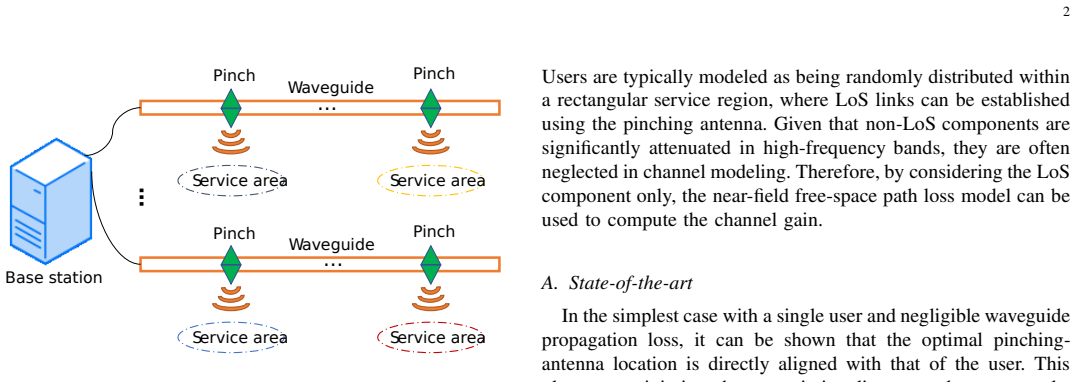
The central object is the pinching-antenna system: a dielectric waveguide fed by a base station, with radiating elements ('pinches') that can be placed at arbitrary positions along it and can be added or removed. The channel is modeled as line-of-sight-only free-space path loss in the near field, optionally including frequency-dependent in-waveguide attenuation. The load-bearing identity is that antenna placement changes the effective channel gain, so the RA problem becomes a joint, non-convex optimization of positions plus power, time, and subcarrier variables; the survey catalogs the techniques used to solve it—one-dimensional search, particle swarm optimization, block coordinate descent, successive convex approximation, alternating optimization, fractional programming, matching theory, penalty methods, and learning-based approaches.
What would settle it
Build or simulate a realistic pinching-antenna prototype with measured frequency-dependent waveguide loss, mutual coupling between pinches, and discrete position constraints, and compare the achievable sum rate against a fixed-antenna array under the same total power; if the pinching system's gain over the fixed baseline disappears or reverses, the central claim of the paper fails.
Extended reading notes
Core claim
The paper's central claim is that the extra optimization degree of freedom provided by pinching antennas—the continuous spatial position of each radiating element along a dielectric waveguide—turns resource allocation from a power/time/subcarrier problem into a joint spatial-and-radio problem, and that solving this joint problem yields consistent gains over fixed-antenna architectures. In the single-antenna case, optimal or near-optimal placement can be found by direct alignment or one-dimensional search, and NOMA or TDMA with a shared position both benefit. With multiple antennas on one waveguide, the array behaves as a reconfigurable linear array whose element positions and phases can be tuned for constructive interference, giving array gain that scales with the number of elements. With multiple waveguides, pinching antennas enable MIMO multiplexing plus analogue beamforming, and the case studies show all pinching schemes—exhaustive search, particle swarm optimization, and iterative one-dimensional search—outperform the fixed-antenna baseline.
Load-bearing premise
The performance gains depend on the physical assumption that a dielectric waveguide can support arbitrary antenna activation positions with controllable radiated power and negligible mutual coupling, in a line-of-sight-only propagation environment.
Editorial extensions
If this is right
- Pinching antennas with dynamically adjusted positions can restore line-of-sight links around blockages, reducing outage in mmWave and THz deployments.
- NOMA-based schemes outperform TDMA with a shared antenna position, but per-user adjusted TDMA placement achieves the highest sum rate in the single-antenna case.
- The array gain of a single-waveguide pinching system scales approximately linearly with the number of activated pinching antennas.
- In multi-waveguide MIMO setups, pinching beamforming plus digital beamforming can satisfy phase-matching and orthogonality conditions that fixed antennas cannot meet simultaneously, enabling interference-free multi-user transmission.
- Energy efficiency can be improved by jointly optimizing power and time allocation alongside antenna positions, and optimized time allocation outperforms equal time sharing.
Reading between the lines
- The survey's line-of-sight-only channel model ignores diffuse scattering and multipath; in real indoor environments, fixed antennas might benefit from reflected paths, narrowing the reported gap.
- A hardware prototype measuring frequency-dependent waveguide loss and mutual coupling between adjacent pinches would directly test whether the modeled performance gains survive in practice.
- The learning-based results suggest a general direction: KKT-guided dual learning could be applied to other joint placement-and-resource problems where iterative solvers are too slow.
- If arbitrary antenna placement is physically limited to discrete positions, the continuous-placement gains in the case studies should be reinterpreted as an upper bound on achievable performance.
Editorial analysis
A structured set of objections, weighed in public.
Referee Report
Summary. This survey article reviews resource allocation (RA) techniques for pinching-antenna systems, organizing the literature into three architectural scenarios: a single pinching antenna, multiple pinching antennas on a single dielectric waveguide, and multiple waveguides with MIMO operation. For each scenario, the paper surveys recent algorithms (e.g., one-dimensional search, PSO, SCA, AO, BCD, matching theory, fractional programming, and learning-based methods) and presents a numerical case study intended to show that pinching-antenna systems outperform conventional fixed-antenna systems. The paper closes by identifying four open research directions: OFDM-based RA, robust RA under user location uncertainty, machine-learning-empowered RA, and RA for pinching-antenna-assisted ISAC.
Significance. The paper provides a useful and well-structured taxonomy of a nascent research area and gives a concise overview of the main optimization tools used in pinching-antenna RA. Its coverage of recent preprints and early-access articles, including the authors' own contributions, makes it a potentially valuable entry point for researchers entering the field. However, the central quantitative claim—that pinching-antenna systems consistently outperform fixed-antenna systems—is currently supported only by numerical case studies whose simulation details and baseline configurations are not reported, so the evidence is not independently checkable. If the case studies can be documented and the baselines fairly specified, the survey would be a solid contribution; as it stands, the evidentiary basis for the headline claim is incomplete.
major comments (4)
- [III.B, Fig. 2] The paper does not specify the simulation setup for the NOMA-Fixed-Antenna baseline, including the number of fixed antennas, their location(s), and whether any optimization (e.g., power or beamforming) was applied. Because the pinching schemes are optimized while the baseline is described only as a 'static antenna placement,' the gains reported in Fig. 2 may reflect an arbitrarily poor baseline rather than a pinching-specific advantage.
- [IV.B and V.B, Figs. 3 and 5] No simulation parameters are provided for the case studies: service-area geometry, user coordinates, waveguide length and attenuation, path-loss exponent, noise power, antenna element lengths, or convergence criteria. This makes the numerical results impossible to reproduce or to compare across the three scenarios, and it directly undermines the 'consistently outperform' claim in Section VII.
- [VII] The central conclusion that pinching-antenna systems 'consistently outperform' their conventional fixed-antenna counterparts is not established by the presented evidence, because in each case study the fixed-antenna baseline is unoptimized and its configuration is not specified. A credible comparison would require either an optimized fixed-antenna baseline (e.g., best possible fixed location with the same number of antennas and RF chains) or a clear statement of the baseline's capabilities; without this, the conclusion is an overreach.
- [III.A, Fig. 2] The paper states that for a single user the optimal pinching-antenna location is direct alignment with that user [3]. In the TDMA-Adjusted scheme of Fig. 2, the antenna is repositioned to each user in turn, so much of the gain over a fixed antenna is simply the well-known geometric gain of moving a radiator close to the user. The paper should explicitly distinguish this expected geometric effect from any additional pinching-specific benefit arising from waveguide constraints, multi-user interference, or joint optimization.
minor comments (5)
- [Fig. 2] The legend contains a typo: 'TDMA-Exhastive' should be 'TDMA-Exhaustive'.
- [Fig. 4] The taxonomy figure contains several typos and formatting errors, including 'loction', 'shared loction', and 'detetor'; these should be corrected to 'location', 'shared location', and 'detector'.
- [Fig. 3] The unit 'EE (bps/J/Hz)' is nonstandard; energy efficiency is usually expressed in bits/Joule, and if bandwidth normalization is intended it should be stated explicitly and used consistently.
- [VI.A] The open-problem discussion of OFDM-based RA mentions frequency-dependent waveguide attenuation but does not elaborate on the modeling challenges or candidate solution approaches; a short elaboration would improve the usefulness of this section.
- [References] Several references list placeholder page numbers such as 'pp. 1–1' or 'p. 1–1' (e.g., [1], [3], [6], [9], [10]); these should be updated to final page numbers before publication.
Circularity Check
No significant circularity: the paper is a survey whose case studies are illustrative, not fitted predictions or derivations that reduce to their inputs.
full rationale
This is a survey/tutorial paper rather than a derivation chain. Its central claim—that pinching-antenna systems consistently outperform fixed-antenna counterparts—is supported by numerical case studies summarized from prior work, including the authors' own papers. However, no new result is derived from a fitted parameter, and no equation is defined in terms of the conclusion it is supposed to support. The case studies in Sections III.B, IV.B, and V.B compare pinching-antenna schemes against fixed-antenna baselines; the paper explicitly attributes the gains to the ability to reposition antennas closer to users under a LoS near-field path-loss model. That explanation is transparent and follows from the model, and any concern about the unspecified static-antenna baseline is a comparison-design or correctness issue, not a circular reduction. Self-citations such as [1], [4], and [13] are used as literature references for algorithms and results, but the survey does not invoke them as unverified, load-bearing theorems that force the conclusion. The paper is self-contained as a categorized overview, and no circular step can be quoted and exhibited.
Assumptions & free parameters
free parameters (1)
- Unreported case-study simulation parameters (service area, user positions, waveguide attenuation, noise)
assumptions (4)
- domain assumption LoS-only channel model: non-LoS components are neglected in mmWave/THz
- domain assumption Near-field free-space path loss model computes channel gain
- domain assumption Pinching antennas can be activated at arbitrary positions along a dielectric waveguide with controllable power distribution
- domain assumption Waveguide propagation loss is frequency-independent (or negligible) in most reviewed works
Cite this review
Pith. "Pith review of Resource Allocation for Pinching-Antenna Systems: State-of-the-Art, Key Techniques and Open Issues." pith.science (2026). https://pith.science/paper/MQXC3E3D
@misc{pith2026250606156,
  author       = {Pith},
  title        = {Pith review of: Resource Allocation for Pinching-Antenna Systems: State-of-the-Art, Key Techniques and Open Issues},
  year         = {2026},
  howpublished = {\url{https://pith.science/paper/MQXC3E3D}},
  note         = {Machine review of arXiv:2506.06156}
}
read the original abstract
Pinching antennas have emerged as a promising technology for reconfiguring wireless propagation environments, particularly in high-frequency communication systems operating in the millimeter-wave and terahertz bands. By enabling dynamic activation at arbitrary positions along a dielectric waveguide, pinching antennas offer unprecedented channel reconfigurability and the ability to provide line-of-sight (LoS) links in scenarios with severe LoS blockages. The performance of pinching-antenna systems is highly dependent on the optimized placement of the pinching antennas, which must be jointly considered with traditional resource allocation (RA) variables -- including transmission power, time slots, and subcarriers. The resulting joint RA problems are typically non-convex with complex variable coupling, necessitating sophisticated optimization techniques. This article provides a comprehensive survey of existing RA algorithms designed for pinching-antenna systems, supported by numerical case studies that demonstrate their potential performance gains. Key challenges and open research problems are also identified to guide future developments in this emerging field.
Figures


Figures from the paper (2 more)


Forward citations
Cited by 7 Pith papers
-
Phase-Aware Localization in Pinching Antenna Systems: CRLB Analysis and ML Estimation
Phase-aware localization in pinching antenna systems achieves sub-meter accuracy in simulation, with a closed-form Cramér-Rao bound showing phase information scales as distance^-4 versus amplitude's distance^-6.
-
Joint Transmit and Pinching Beamforming Optimization in Pinching Antenna-Assisted Symbiotic Radio Systems
Jointly optimizing transmit beamforming and pinching-antenna positions in a backscatter-assisted symbiotic radio system is claimed to raise achievable sum rate by 17-35% over fixed-antenna baselines.
-
Dual-Waveguide Pinching Antennas for PLS: Parallel Placement or Orthogonal Placement?
For dual-waveguide pinching-antenna systems, an FeaPSO/SCA algorithm maximizes secure rate and energy efficiency, and orthogonal waveguide placement offers a modest, scenario-dependent security advantage over parallel...
-
EGS-SLAM: RGB-D Gaussian Splatting SLAM with Events
EGS-SLAM claims to fuse events with RGB-D in Gaussian Splatting SLAM to beat blur, but the supplied full text is an unrelated paper, so the claim is unverifiable.
-
Robust Resource Allocation for Pinching-Antenna Systems under Imperfect CSI
A robust resource allocation with outage constraints for pinching-antenna downlinks under user-location uncertainty, solved by geometric area analysis and PSO.
-
Deep Learning Optimization of Two-State Pinching Antennas Systems
A graph neural network with distributed attention selects near-optimal subsets of active pinching antennas, matching a Gurobi solver's rates within a few percent and generalizing from 50 to 1000 antennas.
-
Hybrid Wireless-Fed Pinching-Antenna Systems with Residual Self-Interference-Aware Optimization
A closed-form solution minimizes total power in a horn-fed, relay-assisted pinching-antenna system by optimizing the pinching position, relay gain, and base-station power.
Reference graph
Works this paper leans on
-
[4]
S um rate maximization for NOMA-assisted uplink pinching-antenna s ystems,
M. Zeng, J. Wang, X. Li, G. Wang, O. A. Dobre, and Z. Ding, “S um rate maximization for NOMA-assisted uplink pinching-antenna s ystems,” 2025. [Online]. Available: https://arxiv.org/abs/2505.00549
arXiv 2025
-
[3]
Performance analysis of pinching- antenna systems,
D. Tyrovolas, S. A. Tegos, P . D. Diamantoulakis, S. Ioann idis, C. K. Liaskos, and G. K. Karagiannidis, “Performance analysis of pinching- antenna systems,” IEEE Trans. Cogn. Commun. Netw. , pp. 1–1, 2025, early access. 8
work page 2025
-
[1]
Flexible-antenna sy stems: A pinching- antenna perspective,
Z. Ding, R. Schober, and H. V . Poor, “Flexible-antenna sy stems: A pinching- antenna perspective,” IEEE Trans. Commun. , pp. 1–1, 2025, early access
work page 2025
-
[2]
Modeling an d beamforming optimization for pinching-antenna systems,
Z. Wang, C. Ouyang, X. Mu, Y . Liu, and Z. Ding, “Modeling an d beamforming optimization for pinching-antenna systems,” 2025. [Online]. Available: https://arxiv.org/abs/2502.05917
arXiv 2025
-
[5]
Energy- efficient resource allocation for NOMA-assisted uplink pin ching-antenna systems,
M. Zeng, X. Li, J. Wang, G. Huang, O. A. Dobre, and Z. Ding, “ Energy- efficient resource allocation for NOMA-assisted uplink pin ching-antenna systems,” 2025. [Online]. Available: https://arxiv.org/ abs/2505.07555
arXiv 2025
-
[6]
Rate maximizati on for downlink pinching-antenna systems,
Y . Xu, Z. Ding, and G. K. Karagiannidis, “Rate maximizati on for downlink pinching-antenna systems,” IEEE Wirel. Commun. Lett. , pp. 1–1, 2025, early access
work page 2025
-
[7]
Pinching-Antenna System (PASS)-enabled Multicast Communications
X. Mu, G. Zhu, and Y . Liu, “Pinching-antenna system (PASS )- enabled multicast communications,” 2025. [Online]. Avail able: https://arxiv.org/abs/2502.16624
work page Pith review arXiv 2025
-
[8]
Graph neural network enabled p inching antennas,
X. Xie, Y . Lu, and Z. Ding, “Graph neural network enabled p inching antennas,” 2025. [Online]. Available: https://arxiv.org /abs/2502.05447
arXiv 2025
Show all 16 references
-
[9]
Minimum data rate maximization for uplink pinching-anten na systems,
S. A. Tegos, P . D. Diamantoulakis, Z. Ding, and G. K. Karag iannidis, “Minimum data rate maximization for uplink pinching-anten na systems,” IEEE Wirel. Commun. Lett. , p. 1–1, 2025, early access
2025
-
[10]
Antenna activation fo r NOMA assisted pinching-antenna systems,
K. Wang, Z. Ding, and R. Schober, “Antenna activation fo r NOMA assisted pinching-antenna systems,” IEEE Wirel. Commun. Lett., pp. 1–1, 2025, early access
2025
-
[11]
Sum-rate maximization for pinching antenna-assisted NOMA systems with multiple d ielectric waveguides,
S. Hu, R. Zhao, Y . Liao, D. W. K. Ng, and J. Y uan, “Sum-rate maximization for pinching antenna-assisted NOMA systems with multiple d ielectric waveguides,” 2025. [Online]. Available: https://arxiv.o rg/abs/2503.10060
2025
-
[12]
Waveguide divi sion multiple access for pinching-antenna systems (PASS),
J. Zhao, X. Mu, K. Cai, Y . Zhu, and Y . Liu, “Waveguide divi sion multiple access for pinching-antenna systems (PASS),” 2025. [Onlin e]. Available: https://arxiv.org/abs/2502.17781
2025 arXiv
-
[13]
MIMO-PASS: Uplink and downlink transmission via MIMO pinching-antenn a systems,
A. Bereyhi, C. Ouyang, S. Asaad, Z. Ding, and H. V . Poor, “ MIMO-PASS: Uplink and downlink transmission via MIMO pinching-antenn a systems,”
-
[14]
Physical layer secu rity for pinching-antenna systems (PASS),
M. Sun, C. Ouyang, S. Wu, and Y . Liu, “Physical layer secu rity for pinching-antenna systems (PASS),” 2025. [Online]. Ava ilable: https://arxiv.org/abs/2503.09075
2025 arXiv
-
[15]
Joint transmit and pinching beamforming for pinching antenna systems (PASS): Optimiza tion-based or learning-based?
X. Xu, X. Mu, Y . Liu, and A. Nallanathan, “Joint transmit and pinching beamforming for pinching antenna systems (PASS): Optimiza tion-based or learning-based?” 2025. [Online]. Available: https://arx iv.org/abs/2502.08637
2025 arXiv
-
[2025]
Available: https://arxiv.org/abs/2503
[Online]. Available: https://arxiv.org/abs/2503. 03117
Reviewed August 7, 2026 · model on record in the stance chip above.
Discussion (0). Sign in to comment.