REVIEW 4 major objections 5 minor 81 references
Diverse mean-field dynamics of clustered, inhibition-stabilized Hawkes networks via combinatorial threshold-linear networks
T0 review · 4 major / 5 minor · reviewed 2026-08-07 · deepseek-v4-flash
Pith's one-line read Clustered spiking networks reduce to a graph-defined rate model in the fast-inhibition limit.
desk verdict A genuine and mostly convincing bridge from clustered Hawkes networks to CTLNs, but the abstract oversells its scope by omitting the exact-cancellation condition that the whole reduction rests on. read the letter →
The pith
A machine-rendered reading of the paper's core claim, the machinery that carries it, and where it could break.
The reading
What carries the argument
The load-bearing mechanism is an exact cancellation condition plus a timescale separation. Eq. 7, $\bar J^{\mathrm{loop}}_{EE} + \frac{\bar J_{EI}\bar J_{IE}}{1-\bar J_{II}}=0$, makes the effective self-interaction of each excitatory cluster vanish once inhibition is eliminated; Eq. 8 then forces the effective between-cluster weights onto the CTLN form, $-1+\epsilon$ along an edge and $-1-\delta$ along a non-edge. The linear-conjugacy result cited as [37] moves the nonlinearity to where the CTLN has it, and the quasi-static elimination of fast inhibition yields the CTLN equations. A forward-invariant region established in the paper's Proposition 1 keeps the inhibitory population above threshold for sufficiently fast inhibition, so the bounds and the paradoxical-effect argument carry over from the CTLN to the EI-TLN. The final piece is the stability analysis of fixed points in the reduced E-I system, which yields the threshold $\tau_I/\tau_E < -(\bar J_{II} - 1)/(\bar J^{\mathrm{eff}}_{EE} - 1)$ for a clique-supported fixed point to remain stable.
What would settle it
Simulate the clustered Hawkes network on a directed 3-cycle with weights satisfying Eqs. 7 and 8, shrink $\tau_I/\tau_E$, and increase the population size; the predicted CTLN limit cycle should appear, with activity following the graph edges. To test whether the exact cancellation is truly load-bearing, shift $\bar J^{\mathrm{loop}}_{EE}$ by a small amount away from Eq. 7 while keeping other parameters fixed: if the same attractors persist for perturbations that do not shrink with $N$, the claimed necessity of cancellation is wrong, and if the dynamics jump to a different regime, the cancellation is the boundary.
Extended reading notes
Core claim
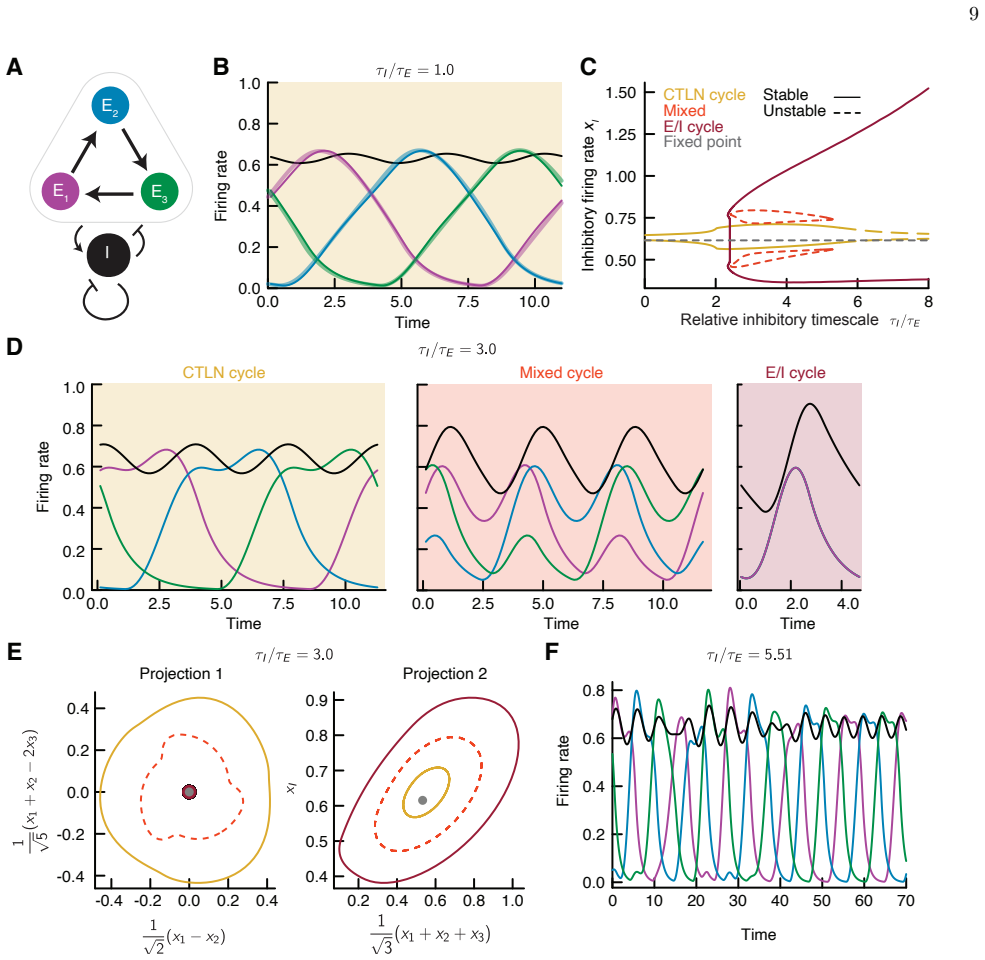
The central claim is a limit statement with a parameter condition: as population sizes grow and $\tau_I/\tau_E \to 0$, the cluster-mean dynamics of the spiking network converge to the EI-TLN equations, and when the weights satisfy Eq. 7 and Eq. 8, the excitatory part of those equations is exactly the CTLN model on the between-cluster graph. The fast-inhibition limit eliminates the inhibitory population quasi-statically, and the exact cancellation condition makes the effective excitatory-to-excitatory weights equal to $-1+\epsilon$ for graph edges and $-1-\delta$ for non-edges. Consequently all established CTLN graph rules transfer: stable fixed points are supported on target-free cliques (bidirectionally connected cluster sets with no common outside target), oriented graphs with no sinks have dynamic attractors, total activity is bounded between $b/(1+\delta)$ and $b/(1-\epsilon)$, and a directed 3-cycle produces a stable limit cycle. The paper further claims that this equivalence degrades gracefully: for finite $\tau_I/\tau_E$, fixed points remain CTLN-predictable when $\tau_I/\tau_E$ falls below a weight-dependent threshold, and in the 3-cycle example the CTLN cycle remains stable up to $\tau_I/\tau_E \approx 6.46$, with slow inhibition producing a separate synchronized E/I oscillation and a region of bistability between the two.
Load-bearing premise
The load-bearing premise is the fine-tuned cancellation condition Eq. 7, $\bar J^{\mathrm{loop}}_{EE} + \frac{\bar J_{EI}\bar J_{IE}}{1-\bar J_{II}}=0$, with the inequalities Eq. 8: the effective self-interaction of each excitatory cluster must vanish precisely after inhibition is eliminated, and the effective between-cluster weights must land on the CTLN form; if that fails, the reduced dynamics are not CTLN and the graph-rule predictions have no standing.
Editorial extensions
If this is right
- From the directed graph of between-cluster connectivity alone, one can predict whether a clustered spiking network has metastable fixed points, and which clusters participate: a set of clusters supports a stable attractor exactly when it forms a target-free clique.
- Oriented graphs with no sinks, such as the directed 3-cycle, have no stable fixed points yet keep total activity bounded, so their clustered spiking networks exhibit periodic or chaotic attractors instead of exploding.
- The paradoxical effect, in which excitatory stimulation of the inhibitory population reduces inhibitory firing rates, holds along all attractors of sufficiently fast-inhibition networks, not only at fixed points.
- CTLN predictions persist at biologically plausible inhibitory timescales: fixed points are stable when $\tau_I/\tau_E$ is below a weight-dependent threshold, and scaling EI-TLN weights can keep CTLN fixed points stable for any timescale ratio.
- When inhibition is slow, the fixed point loses stability through a non-smooth Hopf bifurcation into a synchronized E/I oscillation, and in a directed 3-cycle a bistable region supports both the CTLN-like cycle and the E/I cycle.
Reading between the lines
- Beyond the paper: if the exact cancellation Eq. 7 is only approximate, the reduced dynamics perturb away from CTLN; a natural quantitative test is to measure how far the graph-rule predictions, such as fixed-point supports and bounded total activity, survive under small deviations from cancellation as the population size grows.
- Beyond the paper: reading CTLN nodes as populations rather than neurons suggests that CTLN compositional gluing rules, originally developed for small recurrent circuits, could be used to design module-level attractor landscapes in larger spiking networks, including sequence generation.
- Beyond the paper: the bistable region between the CTLN cycle and the E/I cycle, with an apparent unstable torus, predicts slow switching or quasiperiodic transients in finite-size spiking networks; direct raster simulation near the transition could look for intermittency between the two rhythms.
- Beyond the paper: because finite-size fluctuations turn CTLN attractors into metastable states, transition rates between dynamic attractors in clustered Hawkes networks could be estimated with large-deviation theory and compared with graph-predicted basin boundaries.
Editorial analysis
A structured set of objections, weighed in public.
Referee Report
Summary. The paper studies clustered nonlinear Hawkes networks with one inhibitory population and derives a mean-field limit in which, under an exact cancellation condition (Eq. 7) and parameter inequalities (Eq. 8), the excitatory cluster-rate dynamics reduce to a combinatorial threshold-linear network (CTLN) as the inhibitory timescale tends to zero. It then uses CTLN graph rules to predict metastable fixed points, bounded total activity, and the paradoxical inhibitory-stabilization effect, and it analyzes numerically the loss of CTLN-like dynamics when inhibition is slowed. The central claim is that the CTLN is a mean-field theory for inhibition-stabilized clustered Hawkes networks in the large-population, fast-inhibition limits.
Significance. If the reduction is valid, the paper is a valuable bridge between a mathematically tractable combinatorial model and a spiking-network model with explicit excitation and inhibition, making CTLN graph rules available for predicting attractors of clustered spiking networks. The algebraic mapping from EI-TLN parameters to CTLN parameters is transparent and parameter-free, and the numerical comparisons in Fig. 2, the graph-rule demonstrations in Fig. 1, and the bifurcation analyses in Figs. 5-6 are substantive. The main caveats are that the reduction requires a fine-tuned cancellation condition and that the mean-field and fast-inhibition limits are supported heuristically rather than by a complete theorem; the paper's broad abstract phrasing overstates the scope of the derivation.
major comments (4)
- [Section II B, Eq. (7), and Abstract] The abstract states that the CTLN is a mean-field theory for 'inhibition-stabilized nonlinear Hawkes networks,' but the reduction in Section II B holds only when the exact cancellation condition Eq. (7), J_EE^loop + J_EI J_IE/(1-J_II) = 0, and the inequalities Eq. (8) are satisfied. This cancellation is a codimension-one condition and is not implied by inhibition stabilization (J_EE^loop > 1); for generic ISN parameters the reduced excitatory dynamics retain a residual linear term proportional to J_EE^loop + J_EI J_IE/(1-J_II), which changes the fixed-point equations and invalidates the graph-rule predictions used in Section II C. The abstract and title should be qualified to name this condition explicitly, not merely state the result for generic inhibition-stabilized networks.
- [Appendix A1, Eqs. (A4)-(A6)] The derivation of the mean-field voltage equation (3) is heuristic: it assumes that connectivity and spike emission become independent in the large-N limit and that voltages concentrate around their expectations, and it then swaps the expectation with the threshold nonlinearity. The paper cites mean-field theorems for related nonlinear Hawkes networks, but it does not verify that the block-structured, sparse connectivity with 1/N weight scaling used here satisfies the hypotheses of those theorems. Because Eq. (3) is the starting point of the entire reduction to CTLN, this gap should be addressed either by a precise statement of the mean-field theorem applicable to this model or by an explicit declaration that the mean-field limit is an approximation rather than a proven limit.
- [Section II B and Appendix A4, Proposition 1] The reduction to CTLN relies on the quasi-static elimination x_I = (J_IE sum_beta x_beta + b_I)/(1-J_II), but Proposition 1 only constructs a forward-invariant set on which the inhibitory population stays above threshold and activity bounds hold; it does not prove that EI-TLN trajectories converge to CTLN trajectories as tau_I/tau_E -> 0, nor that all trajectories enter that invariant set. Since the paper claims dynamical equivalence and uses it to transfer CTLN attractor predictions, a singular-perturbation argument, or at least a precise statement of the limiting sense in which the trajectories coincide, is needed.
- [Abstract and Section II C] The abstract promises networks that display 'chaotic attractors,' but no chaotic trajectory or chaotic attractor is shown in any figure or analyzed in the text; the only dynamic attractor explicitly demonstrated in the spiking network and EI-TLN is a periodic orbit (Figs. 1F and 6B-6D). If the claim rests on known CTLN chaotic examples, that should be stated explicitly and ideally supported by a simulation of the corresponding clustered Hawkes network, because the transfer of CTLN dynamic-attractor predictions to the spiking model is a central advertised application.
minor comments (5)
- [Abstract] The word 'metastabilty' is misspelled and should be 'metastability.'
- [Appendix A3] The CTLN weight definition in the appendix gives -1+delta for a non-edge, which is inconsistent with Eq. (4) in the main text and with the surrounding epsilon/delta notation; it should be -1-delta.
- [Appendix A4, Proposition 1] The definition H_max_I = {x | x_I = x_min_I} appears to be a typo for x_I = x_max_I, and the proof sentence 'positive by for large enough tau_I' is an incomplete fragment that should be rewritten.
- [Section II E 1] The equation tau_I dot x_I = -x_I + k J_IE J_II x_I x_E + b_I appears to be a typographical error; the input term should presumably be k J_IE x_E + J_II x_I + b_I.
- [Figure 1 caption] Panel F is described as a raster of the network from panel C, but it appears to show the four-cluster network of panel E; the caption should be corrected.
Circularity Check
No significant circularity: the CTLN mean-field reduction is an explicit parameter mapping, and the graph rules are imported from independent prior work.
full rationale
The central derivation in Section II B is a parametric equivalence, not a fit. Starting from the large-N mean-field voltage dynamics (Eq. 3), the paper applies the external Miller-Fumarola conjugacy [37] to obtain the EI-TLN (Eq. 6), then eliminates the fast inhibitory population quasi-statically. Under the explicitly stated conditions Eqs. 7-8, the reduced excitatory dynamics coincide algebraically with the CTLN equations (4)-(5); the parameters epsilon, delta, and b are computed from the microscopic weights rather than fitted to data. The large-N limit is supported by external rigorous references [30-36], and the graph rules (maximal cliques, target-free cliques, oriented no-sink attractors, total-activity bound Eq. 9) are cited from the CTLN literature [21-23, 25, 26, 40, 41]. The only self-citation, Lienkaemper's thesis [40] for Eq. 9 and Corollary 9.2 used in Proposition 1, is an independent parameter-free result about CTLNs, so under the stated citation rule it does not raise the circularity score. The paper itself flags the fine-tuned nature of the reduction in Appendix A3 ('this defines a three-dimensional manifold of six-dimensional parameter space') and in Appendix A1 ('Inhibition in the model is strong enough to cancel out the within-cluster excitation'), so the scope limitation is explicit; the abstract's omission of Eq. 7 is a correctness or overclaim concern, not a circularity. Proposition 1's proof contains typos and gaps, but those are rigor issues, not circular reasoning. No step in the derivation chain reduces to its inputs by construction beyond the stated, transparent parameter conditions.
Assumptions & free parameters
free parameters (4)
- J_EE^loop (within-cluster excitatory weight) =
1.5 (Fig. 5), 2 (Fig. 4)
- J_EI, J_IE, J_II (inhibitory weights) =
e.g., J_EI=-1.5, J_IE=2, J_II=-1 (Fig. 5); J_EI=-2.25, J_II=-2 (Fig. 6)
- b_E, b_I (external inputs) =
b_E=0.1, b_I=0 (baseline); b_I=0.15 (inhibitory stimulus)
- tau_I/tau_E (inhibitory-to-excitatory timescale ratio) =
0.5 (Fig. 2); varied 0.01 to 8 in bifurcation diagrams
assumptions (7)
- domain assumption Mean-field limit: in the large-N limit, connectivity fluctuations and spike trains decouple, and v_j concentrates around v_alpha, yielding Eq. A6.
- standard math Miller-Fumarola equivalence: any system tau v_dot = -v + J f(v) + b is topologically conjugate to tau x_dot = -x + f(J x + c) when J is invertible, with c a low-pass filter of b.
- standard math The EI-TLN weight matrix J is invertible.
- domain assumption Fast-inhibition reduction: for tau_I -> 0, x_I is at its quasi-static fixed point and remains above threshold, so the [.]_+ on the inhibitory equation can be dropped.
- ad hoc to paper Exact cancellation condition Eq. 7: J_EE^loop + J_EI J_IE/(1-J_II) = 0.
- ad hoc to paper Parameter inequalities Eq. 8 hold, ensuring 0<epsilon<1 and delta>0 in the CTLN mapping.
- standard math CTLN graph rules from prior literature: stable fixed points correspond to target-free cliques; oriented no-sink graphs have no stable fixed points; total activity bounds Eq. 9.
Cite this review
Pith. "Pith review of Diverse mean-field dynamics of clustered, inhibition-stabilized Hawkes networks via combinatorial threshold-linear networks." pith.science (2026). https://pith.science/paper/PCEKRFWL
@misc{pith2026250606234,
  author       = {Pith},
  title        = {Pith review of: Diverse mean-field dynamics of clustered, inhibition-stabilized Hawkes networks via combinatorial threshold-linear networks},
  year         = {2026},
  howpublished = {\url{https://pith.science/paper/PCEKRFWL}},
  note         = {Machine review of arXiv:2506.06234}
}
read the original abstract
Networks of interconnected neurons display diverse patterns of collective activity. Relating this collective activity to the network's connectivity structure is a key goal of computational neuroscience. We approach this question for clustered networks, which can form via biologically realistic learning rules and allow for the re-activation of learned patterns. Previous studies of clustered networks have focused on metastabilty between fixed points, leaving open the question of whether clustered spiking networks can display more rich dynamics--and if so, whether these can be predicted from their connectivity. Here, we show that in the limits of large population size and fast inhibition, the combinatorial threshold linear network (CTLN) model is a mean-field theory for inhibition-stabilized nonlinear Hawkes networks with clustered connectivity. The CTLN has a large body of ``graph rules'' relating network structure to dynamics. By applying these, we can predict the dynamic attractors of our clustered spiking networks from the structure of between-cluster connectivity. This allows us to construct networks displaying a diverse array of nonlinear cluster dynamics, including metastable periodic orbits and chaotic attractors. Relaxing the assumption that inhibition is fast, we see that the CTLN model is still able to predict the activity of clustered spiking networks with reasonable inhibitory timescales. For slow enough inhibition, we observe bifurcations between CTLN-like dynamics and global excitatory/inhibitory oscillations.
Figures


Figures from the paper (4 more)



Reference graph
Works this paper leans on
-
[1]
Figures 1A and C show two examples of clustered spiking networks that exhibit multiple metastable states
Metastable fixed points in clustered spiking networks correspond to maximal cliques in the cluster graph. Figures 1A and C show two examples of clustered spiking networks that exhibit multiple metastable states. The first network, without strong connectivity between clusters, has a metastable state corresponding to each ex- citatory cluster, where neurons...
-
[2]
When between-cluster connectivity is not symmetric, clustered spiking networks have dynamic attractors with bounded total activity. While symmetric connectivity guarantees convergence to a stable fixed point in CTLNs, an alternate condition guarantees the absence of stable fixed points. If a graph 1 A clique is a set of verticesσ⊆[n] such thati↔jfor alli,...
-
[3]
Oscillation emerges from stable fixed points via non-smooth Hopf bifurcation As we observed in Section II C 1, there is a one-to- one correspondence between fixed points in the CTLN and the EI-TLN. We first ask how fast inhibition needs to be for a stable fixed point of the CTLN to remain stable in the EI-TLN. All known fixed points in CTLNs are supported...
-
[4]
Multistability between synchronized oscillation and CTLN-like limit cycle Next, we extend this analysis beyond fixed points by considering the simplest example of a CTLN with a non- trivial dynamic attractor. This is the CTLN whose graph is a directed three-cycle (Fig. 6A), which has a single unstable fixed point and a stable limit cycle for all al- lowed...
-
[5]
G. K. Ocker, Y. Hu, M. A. Buice, B. Doiron, K. Josi´ c, R. Rosenbaum, and E. Shea-Brown, Current Opinion in Neurobiology Computational Neuroscience,46, 109 (2017)
work page 2017
-
[6]
G. La Camera, inComputational Modelling of the Brain: Modelling Approaches to Cells, Circuits and Networks, edited by M. Giugliano, M. Negrello, and D. Linaro (Springer International Publishing, Cham, 2022) pp. 125–157
work page 2022
- [7]
- [8]
Show all 81 references
-
[9]
Perin, T
R. Perin, T. K. Berger, and H. Markram, Proceedings of the National Academy of Sciences108, 5419 (2011), publisher: Proceedings of the National Academy of Sci- ences
2011
-
[10]
Yoshimura, J
Y. Yoshimura, J. L. M. Dantzker, and E. M. Callaway, Nature433, 868 (2005), publisher: Nature Publishing Group
2005
-
[11]
Litwin-Kumar and B
A. Litwin-Kumar and B. Doiron, Nature Communi- cations5, 5319 (2014), publisher: Nature Publishing Group
2014
-
[12]
G. K. Ocker and B. Doiron, Cerebral Cortex29, 937 (2019)
2019
-
[13]
Zenke, E
F. Zenke, E. J. Agnes, and W. Gerstner, Nature Commu- nications6, 6922 (2015), publisher: Nature Publishing Group
2015
-
[14]
Montangie, C
L. Montangie, C. Miehl, and J. Gjorgjieva, PLOS Com- putational Biology16, e1007835 (2020), publisher: Pub- lic Library of Science
2020
-
[15]
B. A. W. Brinkman, H. Yan, A. Maffei, I. M. Park, A. Fontanini, J. Wang, and G. La Camera, Applied Physics Reviews9, 011313 (2022)
2022
-
[16]
Litwin-Kumar and B
A. Litwin-Kumar and B. Doiron, Nature Neuroscience 15, 1498 (2012), publisher: Nature Publishing Group
2012
-
[17]
K. L. Rossi, R. C. Budzinski, E. S. Medeiros, B. R. R. Boaretto, L. Muller, and U. Feudel, Dynamical proper- ties and mechanisms of metastability: a perspective in neuroscience (2024), arXiv:2305.05328 [q-bio]
2024 arXiv
-
[18]
Mazzucato, G
L. Mazzucato, G. La Camera, and A. Fontanini, Nature Neuroscience22, 787 (2019), publisher: Nature Publish- ing Group
2019
-
[19]
Amit, Cerebral Cortex7, 237 (1997)
D. Amit, Cerebral Cortex7, 237 (1997)
1997
-
[20]
Wang, Neuron60, 215 (2008)
X.-J. Wang, Neuron60, 215 (2008)
2008
-
[21]
Moreno-Bote, J
R. Moreno-Bote, J. Rinzel, and N. Rubin, Journal of Neurophysiology98, 1125 (2007), publisher: American Physiological Society
2007
-
[22]
Albantakis and G
L. Albantakis and G. Deco, PLOS Computational Bi- ology7, e1002086 (2011), publisher: Public Library of Science
2011
-
[23]
Marder and D
E. Marder and D. Bucher, Current biology: CB11, R986 (2001)
2001
-
[24]
Curto and K
C. Curto and K. Morrison, Notices of the American Mathematical Society70, 1 (2023)
2023
-
[25]
Curto and K
C. Curto and K. Morrison, Neural Computation28, 2825 (2016)
2016
-
[26]
Curto, J
C. Curto, J. Geneson, and K. Morrison, Neural Compu- tation31, 94 (2019)
2019
-
[27]
Morrison, A
K. Morrison, A. Degeratu, V. Itskov, and C. Curto, SIAM Journal on Applied Dynamical Systems23, 855 (2024). 12
2024
-
[28]
Curto, J
C. Curto, J. Geneson, and K. Morrison, Advances in Ap- plied Mathematics154, 102652 (2024)
2024
-
[29]
Parmelee, J
C. Parmelee, J. L. Alvarez, C. Curto, and K. Morri- son, SIAM Journal on Applied Dynamical Systems21, 1597 (2022), publisher: Society for Industrial and Ap- plied Mathematics
2022
-
[30]
Parmelee, S
C. Parmelee, S. Moore, K. Morrison, and C. Curto, PLOS ONE17, e0264456 (2022), publisher: Public Library of Science
2022
-
[31]
D. E. Santander, S. Ebli, A. Patania, N. Sanderson, F. Burtscher, K. Morrison, and C. Curto, inResearch in Computational Topology 2, edited by E. Gasparovic, V. Robins, and K. Turner (Springer International Pub- lishing, Cham, 2022) pp. 129–165
2022
-
[32]
Fino and R
E. Fino and R. Yuste, Neuron69, 1188 (2011)
2011
-
[33]
M. A. Whittington, R. D. Traub, N. Kopell, B. Ermen- trout, and E. H. Buhl, International Journal of Psy- chophysiology38, 315 (2000)
2000
-
[34]
Stiefel, Mean-field limits for non-linear Hawkes pro- cesses with inhibition on a Erd˝ os-R´ enyi-graph (2023), arXiv:2207.02655 [math]
J. Stiefel, Mean-field limits for non-linear Hawkes pro- cesses with inhibition on a Erd˝ os-R´ enyi-graph (2023), arXiv:2207.02655 [math]
2023 arXiv
-
[35]
Pfaffelhuber, S
P. Pfaffelhuber, S. Rotter, and J. Stiefel, Stochastic Pro- cesses and their Applications153, 57 (2022)
2022
-
[36]
Zhu, The Annals of Applied Probability25, 548 (2015), publisher: Institute of Mathematical Statistics
L. Zhu, The Annals of Applied Probability25, 548 (2015), publisher: Institute of Mathematical Statistics
2015
-
[37]
Chevallier, Stochastic Processes and their Applications 127, 3870 (2017)
J. Chevallier, Stochastic Processes and their Applications 127, 3870 (2017)
2017
-
[38]
Delattre, N
S. Delattre, N. Fournier, and M. Hoffmann, The Annals of Applied Probability26, 216 (2016), publisher: Insti- tute of Mathematical Statistics
2016
-
[39]
Heesen and W
S. Heesen and W. Stannat, Stochastic Processes and their Applications139, 280 (2021)
2021
-
[40]
Ditlevsen and E
S. Ditlevsen and E. L¨ ocherbach, Stochastic Processes and their Applications127, 1840 (2017)
2017
-
[41]
K. D. Miller and F. Fumarola, Neural computation24, 25 (2012)
2012
-
[42]
R. H. R. Hahnloser, R. Sarpeshkar, M. A. Mahowald, R. J. Douglas, and H. S. Seung, Nature405, 947 (2000), publisher: Nature Publishing Group
2000
-
[43]
J. W. Moon and L. Moser, Israel Journal of Mathematics 3, 23 (1965)
1965
-
[44]
Lienkaemper,Combinatorial geometry of neural codes, neural data analysis, and neural networks, Ph.D
C. Lienkaemper,Combinatorial geometry of neural codes, neural data analysis, and neural networks, Ph.D. thesis, Pennsylvania State University (2022)
2022
-
[45]
A. Bel, R. Cobiaga, W. Reartes, and H. G. Rotstein, SIAM Journal on Applied Dynamical Systems20, 1177 (2021)
2021
-
[46]
Sadeh and C
S. Sadeh and C. Clopath, Nature Reviews Neuroscience 22, 21 (2021), publisher: Nature Publishing Group
2021
-
[47]
M. V. Tsodyks, W. E. Skaggs, T. J. Sejnowski, and B. L. McNaughton, The Journal of Neuroscience: The Official Journal of the Society for Neuroscience17, 4382 (1997)
1997
-
[48]
G. B. Ermentrout and D. H. Terman, inMathematical Foundations of Neuroscience, edited by G. B. Ermen- trout and D. H. Terman (Springer, New York, NY, 2010) pp. 331–367
2010
-
[49]
Ermentrout, Neural Computation6, 679 (1994)
B. Ermentrout, Neural Computation6, 679 (1994)
1994
-
[50]
Rinzel and P
J. Rinzel and P. Frankel, Neural Computation4, 534 (1992)
1992
-
[51]
Shriki, D
O. Shriki, D. Hansel, and H. Sompolinsky, Neural Com- putation15, 1809 (2003)
2003
-
[52]
D. J. Pinto and G. B. Ermentrout, SIAM Journal on Applied Mathematics62, 206 (2001), publisher: Society for Industrial and Applied Mathematics
2001
-
[53]
Aviel and W
Y. Aviel and W. Gerstner, Physical Review E73, 051908 (2006), publisher: American Physical Society
2006
-
[54]
Ostojic and S
S. Ostojic and S. Fusi, Trends in Cognitive Sciences28, 677 (2024), publisher: Elsevier
2024
-
[55]
Londono Alvarez,Attractor-based models for sequences and pattern generation in neural circuits, Ph.D
J. Londono Alvarez,Attractor-based models for sequences and pattern generation in neural circuits, Ph.D. the- sis, Pennsylvania State University, University Park, PA (2024)
2024
-
[56]
Mazzucato, A
L. Mazzucato, A. Fontanini, and G. La Camera, Frontiers in Systems Neuroscience10, 10.3389/fnsys.2016.00011 (2016), publisher: Frontiers
2016
-
[57]
Schwalger and A
T. Schwalger and A. V. Chizhov, Current Opinion in Neurobiology Computational Neuroscience,58, 155 (2019)
2019
-
[58]
M. I. Freidlin and A. D. Wentzell, inRandom Perturba- tions of Dynamical Systems, edited by M. I. Freidlin and A. D. Wentzell (Springer, Berlin, Heidelberg, 2012) pp. 258–354
2012
-
[59]
P. C. Bressloff and J. M. Newby, Physical Review E89, 042701 (2014)
2014
-
[60]
Fleurantin, K
E. Fleurantin, K. Slyman, B. Barker, and C. K. R. T. Jones, Physica D: Nonlinear Phenomena454, 133860 (2023)
2023
-
[61]
Barral and A
J. Barral and A. D Reyes, Nature Neuroscience19, 1690 (2016), publisher: Nature Publishing Group
2016
-
[62]
Sompolinsky, A
H. Sompolinsky, A. Crisanti, and H. J. Sommers, Physi- cal Review Letters61, 259 (1988), publisher: American Physical Society
1988
-
[63]
Zeraati, V
R. Zeraati, V. Buend ´ ıa, T. A. Engel, and A. Levina, Physical Review Research6, 023131 (2024)
2024
-
[64]
Mastrogiuseppe and S
F. Mastrogiuseppe and S. Ostojic, Neuron99, 609 (2018), publisher: Elsevier
2018
-
[65]
Dahmen, S
D. Dahmen, S. Recanatesi, X. Jia, G. K. Ocker, L. Cam- pagnola, S. Seeman, T. Jarsky, M. Helias, and E. Shea- Brown, Strong and localized recurrence controls dimen- sionality of neural activity across brain areas (2023), pages: 2020.11.02.365072 Section: New Results
2023
-
[66]
Y. Hu, J. Trousdale, K. Josi´ c, and E. Shea-Brown, Jour- nal of Statistical Mechanics: Theory and Experiment 2013, P03012 (2013), publisher: IOP Publishing and SISSA
2013
-
[67]
Hu and H
Y. Hu and H. Sompolinsky, PLOS Computational Biol- ogy18, e1010327 (2022), publisher: Public Library of Science
2022
-
[68]
Aljadeff, M
J. Aljadeff, M. Stern, and T. Sharpee, Physical Review Letters114, 088101 (2015), publisher: American Physi- cal Society
2015
-
[69]
Stern, H
M. Stern, H. Sompolinsky, and L. F. Abbott, Physical Review E90, 062710 (2014), publisher: American Phys- ical Society
2014
-
[70]
D. G. Clark and M. Beiran, Proceedings of the National Academy of Sciences122, e2404039122 (2025), publisher: Proceedings of the National Academy of Sciences
2025
-
[71]
Wardak and P
A. Wardak and P. Gong, Physical Review Letters129, 048103 (2022), publisher: American Physical Society
2022
-
[72]
Helias and D
M. Helias and D. Dahmen,Statistical Field Theory for Neural Networks, Lecture Notes in Physics, Vol. 970 (Springer International Publishing, Cham, 2020)
2020
-
[73]
G. K. Ocker, Physical Review X13, 041047 (2023), pub- lisher: American Physical Society
2023
-
[74]
R. D. Beer, Neural Computation18, 3009 (2006)
2006
-
[75]
Veltz, BifurcationKit.jl (2020)
R. Veltz, BifurcationKit.jl (2020). 13 Appendix A: Methods
2020
-
[76]
The network has additional structure given by a directed graphGonnnodes which describes the pattern of connectivity between the excitatory clusters
Clustered spiking networks: microscopic model and mean-field limit Our model consists ofnexcitatory clusters withN E neurons each, reciprocally connected to a common inhibitory population ofN I neurons. The network has additional structure given by a directed graphGonnnodes wh...
2000
-
[77]
Here, we focus on invertibleJ(but not necessarily constant b) because this is what occurs generically
Equivalence between two formulations Miller and Fumarola [37] establish the equivalence of two commonly used models, those of the formτ˙v=−v+ J f(v) +bandτ˙x=−x+f(J x+c).In the restricted case whenJis invertible andbis constant, this equivalence via the mapb=c,v=J x+cwas estab...
-
[78]
We now study this system, and relate it to the CTLN model
The EI-TLN model and the CTLN model In the previous section, we showed that in the limit of large population size, the expected firing rates evolve according to deterministic,n+ 1 dimensional dynamics. We now study this system, and relate it to the CTLN model. Lettingx α =⟨x i...
-
[79]
Bounds on total excitatory , inhibitory activity in EI-TLN In the previous section, we informally showed that the EI-TLN model approaches the CTLN model in the limit of fast inhibition. Now, we make this argument more formal and show that whenτ I ≤τ ∗ I for some fixedτ ∗ I >0 ...
-
[80]
Paradoxical response in EI-TLN We prove that in the limit whereτ I /τE →0, the EI-TLN exhibits the paradoxical response: excitatory stimulation of the inhibitory population results in adecreasein inhibitory firing rates. Although interpretation of this statement is straightfor...
-
[81]
Fixed point Now, we explore how fast inhibition must be relative to excitation for stable fixed points supported on target-free cliques to remain stable in the EI-TLN
How fast does inhibition need to be? a. Fixed point Now, we explore how fast inhibition must be relative to excitation for stable fixed points supported on target-free cliques to remain stable in the EI-TLN . At the fixed point, all excitatory firing rates have the same value....
Reviewed August 7, 2026 · model on record in the stance chip above.
Discussion (0). Sign in to comment.