REVIEW 3 major objections 4 minor 36 references
Metasurface-Enabled Astronomical Polarimetry
T0 review · 3 major / 4 minor · reviewed 2026-08-07 · deepseek-v4-flash
Pith's one-line read A single flat metasurface grating can perform snapshot full-Stokes polarimetry of the Sun on sky.
desk verdict A real on-sky first for metasurface polarimetry with a solid qualitative Zeeman detection; the quantitative magnetogram rests on a three-parameter self-calibration that needs supplement scrutiny. read the letter →
The pith
A machine-rendered reading of the paper's core claim, the machinery that carries it, and where it could break.
The reading
What carries the argument
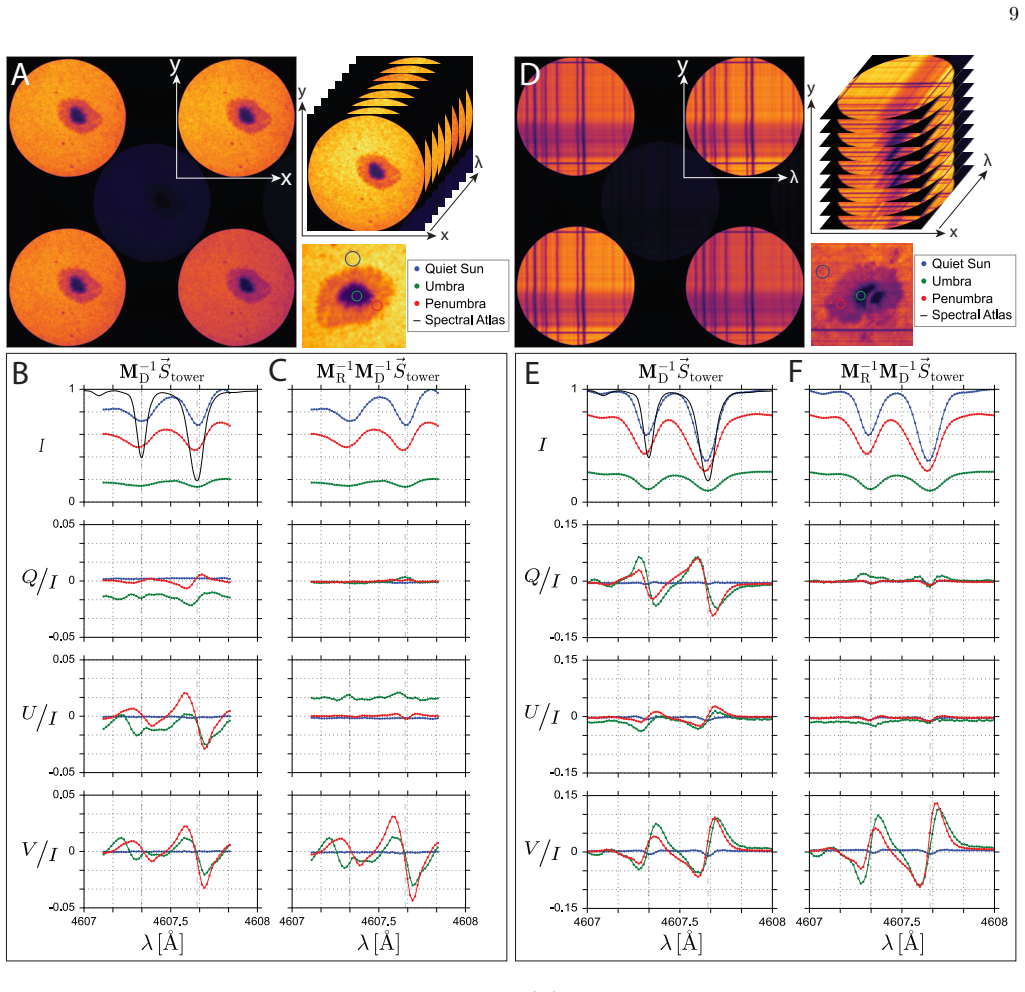
The central object is the metasurface polarization grating (MPG), a passive periodic component whose subwavelength form-birefringent nanostructures make its diffraction orders polarization-dependent; the intensity in order $i$ is $I_i=\vec{S}_i\cdot\vec{S}_{\rm in}$, so four known analyzer vectors $\vec{S}_i$ let one invert the measurement to obtain the input Stokes vector. The MPG converts temporal polarization modulation into spatial modulation: all four polarization-analyzed images are formed simultaneously along a common optical path, eliminating time-varying crosstalk and the need for mechanisms. The demonstration also leans on two supporting mechanisms: a polar-decomposition model of the telescope tower polarization, $M_{\rm Tower}=M_R M_D$, with retarder and diattenuator parts, whose unknown retarder parameters are estimated from the known antisymmetric and symmetric shapes of the Zeeman signatures in the data itself; and the weak-field approximation, which fits the measured $V/I$ profile to the wavelength derivative of the intensity to recover the line-of-sight magnetic field strength.
What would settle it
Place a polarization-calibrating source in front of the telescope tower's entrance window at 460.7 nm, measure the tower's full Mueller matrix directly, and apply that measured inverse to the same raw SIMPol frames; if the corrected Stokes profiles and the resulting magnetogram do not match the $M_R M_D$ correction within the stated uncertainties, the tower model is wrong.
Extended reading notes
Core claim
The central claim is that a metasurface polarization grating (MPG)—a periodic array of subwavelength titanium-dioxide nanostructures whose diffraction orders act as polarization analyzers—is sufficient optical hardware for full-Stokes imaging polarimetry of the Sun. In SIMPol the MPG sits in a pupil plane and sends incident light into four diffraction orders, each analyzing for a different polarization state; registering the four images and applying a pixel-wise calibration matrix recovers the Stokes vector $\vec{S}=(I,Q,U,V)^{T}$ in a single exposure. The fabricated grating sends nearly 70% of the incident energy into the four science orders, leaks less than 1% into the central zero order, and has order diattenuation exceeding 98%. Used at the telescope in both a tunable-Fabry-Perot imaging mode and a slit-spectrograph mode, SIMPol recorded the antisymmetric $V/I$ profile of the longitudinal Zeeman effect and the symmetric $Q/I$, $U/I$ profiles of the transverse Zeeman effect in Fe I and Sr I lines near 460.7 nm. Applying the weak-field approximation to the Fe I line yields a longitudinal magnetogram of a sunspot that matches the morphology and order of magnitude of a simultaneous space-based magnetogram.
Load-bearing premise
The on-sky results depend on the assumption that the telescope tower's polarization is exactly a polarizer followed by a waveplate with no depolarization, and that the unknown waveplate part can be recovered from the Zeeman line shapes in the same data rather than from an independent calibration.
Editorial extensions
If this is right
- A solar polarimeter can be built with no rotating waveplate or other moving polarization optics, removing a known single-point failure for space missions and eliminating polarization crosstalk from time-varying seeing or pointing jitter.
- The same snapshot principle works in at least two instrument architectures—tunable-filter imaging and slit spectrography—so the metasurface can be inserted into existing spectropolarimeters without redesigning the telescope.
- Because the MPG is a passive grating, the technique is wavelength-scalable: changing the target spectral line only requires fabricating a new grating for that wavelength, while the rest of the instrument uses standard achromatic optics.
- A quantitative longitudinal magnetogram can be derived from the measured Stokes $V$ of the Fe I line with the weak-field approximation, and it agrees in morphology and order of magnitude with simultaneous space-based observations.
- The MPG survived environmental qualification appropriate for low-Earth orbit, so the spaceborne path for this technology is not blocked by the survivability of the metasurface itself.
Reading between the lines
- If the tower-calibration trick works as claimed, the same self-calibration strategy—using the known spectral shape of the Zeeman signal to fix an unmeasured retarder—could be applied at any observatory whose telescope Mueller matrix is outdated or unmeasured at the science wavelength.
- The high efficiency and near-total suppression of the zero order suggest the MPG approach could push full-Stokes polarimetry into photon-starved regimes, such as narrowband imaging of the faint corona or off-limb diagnostics, where temporal modulation is impractical; the paper does not demonstrate this.
- A direct measurement of the telescope tower's Mueller matrix at 460.7 nm would provide a clean test of the $M_R M_D$ model and likely explain the systematic difference between SIMPol's and the space-based magnetogram's field maxima.
- Combining snapshot metasurface polarimetry with integral-field or multi-slit spectrographs could remove the remaining tradeoff between spatial and spectral coverage, since the grating's four orders already replicate the field and a scanning slit is the only slow step.
Editorial analysis
A structured set of objections, weighed in public.
Referee Report
Summary. The paper reports the design, fabrication, and on-sky demonstration of the Solar Imaging Metasurface Polarimeter (SIMPol), a snapshot full-Stokes imaging polarimeter built around a single metasurface polarization grating (MPG). The MPG routes incident light into four polarization-analyzing diffraction orders, permitting pixel-wise reconstruction of the Stokes vector without temporal modulation. The authors characterize the grating (∼67% total efficiency in the four orders, dark zero order, diattenuation >98%) and integrate SIMPol with the Dunn Solar Telescope, acquiring data in two modes: a tunable Fabry-Perot imaging mode and a spectrograph mode. They report Zeeman polarization signatures in adjacent Fe I and Sr I lines near 460.7 nm, and a quantitative line-of-sight magnetogram of a sunspot from the Fe I line, compared with HMI data. A tower Mueller-matrix correction is used in the data reduction, with the diattenuating part estimated from quiet-Sun observations and the retarding part estimated from the expected symmetry of the Zeeman signals in the same data.
Significance. If the results hold, this is a genuinely notable demonstration: a passive metasurface component performing a useful astronomical function on-sky at a major observatory, with snapshot full-Stokes capability that avoids rotating mechanisms and temporal cross-talk. The raw four-order images, the independently characterized grating performance, the dark zero order, and the presence of antisymmetric V/I profiles before full tower correction provide strong support for the qualitative snapshot-polarimetry claim. The space-qualification testing is also a useful contribution. The quantitative magnetic-field map, however, rests on a three-parameter tower-retardance self-calibration whose details are deferred to a supplemental document not present in the arXiv version; the quantitative results are therefore conditional on that calibration being valid and independently verifiable.
major comments (3)
- [Facility and Calibration / Metasurface Magnetography] The quantitative magnetogram in Fig. 4 depends on a tower model M_Tower = M_D M_R in which M_R is a three-parameter retarder estimated from the Zeeman line shapes in the very data being corrected. This is a self-calibration, and the paper itself states that residual crosstalk and polarization-aberration effects remain in the umbral U/I trace that the M_Tower ≈ M_R M_D approximation cannot account for. If the true tower response includes depolarization, or if the quiet-Sun region used for M_D is not unpolarized, the fitted M_R can convert linear crosstalk into artificial V/I and directly bias B_LOS. The exact fitting procedure, including the objective function, parameter ranges, and degeneracy checks, is not present in the preprint. Please provide the full calibration algorithm in the supplement or main text, and demonstrate stability of the inferred M_R and resulting B_LOS under perturbations of the assumed model (e.g., including depolarization or an independent tower model).
- [Observations of Solar Magnetism, Fabry-Perot Mode and Spectrograph Mode] The evidence for the transverse Zeeman effect in Figs. 3(C) and 3(F) is not fully independent: the M_R correction is estimated using the known antisymmetric/symmetric shapes of the Zeeman signatures, so the appearance of clean first-derivative V/I and second-derivative Q/I, U/I profiles after correction is in part produced by the constraint used in the fit. The uncorrected data already show antisymmetric V/I in the sunspot regions, which is a solid raw-data indication of longitudinal Zeeman polarization, but the transverse Zeeman claim needs stronger support. Please show the raw (uncorrected) Stokes profiles, quantify the crosstalk before and after correction, and include null tests on quiet-Sun regions or on data with known zero polarization to rule out the possibility that the correction manufactures the reported signatures.
- [Metasurface Magnetography / Fig. 4] The comparison with HMI uses a 35° rotation applied to the HMI data, and the paper reports a systematic discrepancy of about 300 G in the maximum field (-1450 G vs -1750 G), attributed in the text to 'calibration and data reduction challenges' detailed in the supplement. Because the supplement is not included in the arXiv version, the reader cannot assess whether this discrepancy is consistent with the claimed quantitative accuracy, nor whether the rotation or any additional alignment/scaling parameters were free. Please specify all degrees of freedom used in the HMI comparison, and provide an uncertainty budget for the SIMPol B_LOS map that propagates the M_R estimation errors, the quiet-Sun unpolarized assumption, and the spectral resolution of the observations.
minor comments (4)
- [Throughout] There are numerous typographical and formatting issues: 'F abry-Perot Mode' in the section heading, 'T elescope' in the Fig. 2 caption, 'Coud´ e' with an over-wide space, '±5 ◦' spacing, 'withR∼10 5' where the superscript is lost, and inconsistent spacing around equals signs in Mueller-matrix expressions. Please run a careful copyedit pass.
- [Instrument Design] The abstract calls SIMPol a 'telescope', while the main text describes it as an instrument that can be used stand-alone or pupil-matched to a larger telescope; please harmonize this terminology.
- [Conclusions] The statement that metasurface polarization gratings have 'no direct analogues in conventional optics or in past generations of diffractive optical elements' is too strong, given the long history of polarization gratings in liquid-crystal and photo-aligned optics; a more careful comparison would improve accuracy without weakening the novelty claim.
- [Facility and Calibration] The paper repeatedly defers crucial numerical details to a supplement that is not available with the arXiv preprint; at least the tower-correction procedure, the MPG calibration method, and the weak-field fitting formulas should be summarized in the main text or the supplement should be made accessible to reviewers.
Circularity Check
Tower retardance M_R is fitted from the expected Zeeman signature in the same data, then its application is presented as revealing the transverse Zeeman profiles and the magnetogram; raw-order detection and external HMI comparison keep the core claim mostly independent.
-
fitted input called prediction
[Integration with DST: 'Facility and Calibration' (p. 7); 'Fabry-Perot Mode' (Fig. 3(C)); 'Metasurface Magnetography' (Fig. 4)]
"Nonetheless, M_R is defined by just three free parameters for a fixed configuration of the telescope. As we show below, given the known polarization signature of magnetic effects being observed (specifically, the Zeeman effect), an estimate for these three parameters (and thus, for M_R) can be made. ... the retardance correction M^{-1}_R correctly transfers most of this spurious signature in the linear components (Q/I and U/I) to the circular Stokes component (V/I)."
M_R is a three-parameter retarder fitted under the constraint that the corrected data exhibit the expected Zeeman line shapes (antisymmetric V, symmetric Q/U). Applying this same fitted M_R to the data and then exhibiting the now-visible symmetric Q/U profiles as evidence of the transverse Zeeman effect is a self-confirming loop: the output shape is the constraint used to choose the parameters. The same corrected V/I feeds the weak-field magnetogram (Fig. 4), so the quantitative B_LOS is not wholly independent of the assumed Zeeman signature. However, the raw M_D-only data already showed antisymmetric V/I, and the HMI comparison provides an external check, so this is partial circularity rather than complete construction.
full rationale
The paper's central engineering claim—snapshot full-Stokes imaging polarimetry with a pupil-plane MPG at the DST—rests on raw four-order images, order-specific efficiency/diattenuation characterization (Fig. 1G), and the antisymmetric V/I profiles visible even with only M_D correction (Figs. 3B/E). Those parts are self-contained and not circular; the MPG performance is benchmarked by independent laser testbench measurements, and the Zeeman longitudinal signature is present before the tower-retardance fit. The circularity concern is limited to the M_R step: the three free parameters of the retarder are estimated using the expected Zeeman line shapes in the same data being corrected, and the corrected Q/I and U/I traces are then exhibited as evidence of the transverse Zeeman effect. That is a self-calibration that can imprint the assumed signature, so the quantitative magnetogram of Fig. 4 inherits the assumption. The paper discloses the procedure and shows uncorrected data, and the HMI comparison provides an external check, so the circularity is partial rather than total. Self-citations to prior MPG work [8,9,24] support component-design feasibility and are not load-bearing for the on-sky demonstration.
Assumptions & free parameters
free parameters (2)
- Tower retardance parameters (M_R) =
unspecified in main text; three angles
- HMI image rotation =
35 degrees
assumptions (4)
- ad hoc to paper Tower Mueller matrix decomposes as M_Tower = M_R M_D with negligible depolarization
- domain assumption Quiet-Sun regions are unpolarized for calibration
- domain assumption Weak-field Zeeman approximation holds
- ad hoc to paper Zeeman profiles have known symmetry shapes
Cite this review
Pith. "Pith review of Metasurface-Enabled Astronomical Polarimetry." pith.science (2026). https://pith.science/paper/JZYVRBAV
@misc{pith2026250606245,
  author       = {Pith},
  title        = {Pith review of: Metasurface-Enabled Astronomical Polarimetry},
  year         = {2026},
  howpublished = {\url{https://pith.science/paper/JZYVRBAV}},
  note         = {Machine review of arXiv:2506.06245}
}
read the original abstract
In the last decade or so, metasurface optical components have received considerable scientific and industrial interest for a variety of applications. The miniaturization afforded by metasurfaces could benefit astronomy in particular (which is an often-cited potential application area for metasurfaces). However, few developed examples in which metasurface components offer a unique benefit to astronomical instrumentation - substantiated by the production of scientific data - have been shown. Here, we present the Solar Imaging Metasurface Polarimeter (SIMPol), a first-of-its-kind telescope for snapshot imaging polarimetry of the sun around a Sr I line at 460.7 nm enabled by a metasurface polarization-analyzing grating. This high-performance grating exhibits an overall efficiency of nearly 70% and high polarization contrast (diattenuation) across its four observation channels. We demonstrate SIMPol's integration into a major observatory telescope facility with two different imaging modes. In both cases, Zeeman polarization signatures were clearly observed in two adjacent spectral lines of Fe I and Sr I around 460.7 nm. This work demonstrates an early success of metasurface polarization optics in a real application in astronomical instrumentation (here, polarimetric observations of the solar atmosphere), and heralds the application of metasurfaces and emergent nanophotonic technologies in astronomy more broadly.
Figures


Figures from the paper (1 more)

Reference graph
Works this paper leans on
-
[1]
A. H. Dorrah and F. Capasso, Tunable structured light with flat optics, Science376, 10.1126/science.abi6860 (2022)
-
[2]
N. A. Rubin, Z. Shi, and F. Capasso, Polarization in diffractive optics and metasurfaces, Adv. Opt. Photon. 13, 836 (2021). 13
work page 2021
-
[3]
J. P. B. Mueller, N. A. Rubin, R. C. Devlin, B. Groever, and F. Capasso, Metasurface polarization optics: In- dependent phase control of arbitrary orthogonal states of polarization, Physical Review Letters118, 113901 (2017)
work page 2017
- [4]
- [5]
-
[6]
J.-S. Park, S. W. D. Lim, A. Amirzhan, H. Kang, K. Kar- rfalt, D. Kim, J. Leger, A. Urbas, M. Ossiander, Z. Li, and F. Capasso, All-Glass 100 mm Diameter Visible Met- alens for Imaging the Cosmos, ACS Nano18, 4 (2024)
work page 2024
-
[7]
A. Majumder, M. Meem, A. Ingold, P. Ricketts, T. Obray, N. Brimhall, and R. Menon, Color astropho- tography with a 100 mm-diameter f/2 polymer flat lens, Applied Physics Letters126, 5 (2025)
work page 2025
-
[8]
N. A. Rubin, G. D’Aversa, P. Chevalier, Z. Shi, W. T. Chen, and F. Capasso, Matrix Fourier optics enables a compact full-Stokes polarization camera, Science365, eaax1839 (2019)
work page 2019
Show all 36 references
-
[9]
N. A. Rubin, P. Chevalier, M. Juhl, M. Tamagnone, R. Chipman, and F. Capasso, Imaging polarimetry through metasurface polarization gratings, Optics Ex- press30, 6 (2022)
2022
-
[10]
Arbabi, S
E. Arbabi, S. M. Kamali, A. Arbabi, and A. Faraon, Full-Stokes Imaging Polarimetry Using Dielectric Meta- surfaces, ACS Photonics5, 8 (2018)
2018
-
[11]
Trippe, Polarization and Polarimetry: A Review (2014), arXiv:1401.1911 [astro-ph]
S. Trippe, Polarization and Polarimetry: A Review (2014), arXiv:1401.1911 [astro-ph]
2014 arXiv
-
[12]
Kolokolova,Polarimetry of Stars and Planetary Sys- tems(Cambridge University Press, 2015)
L. Kolokolova,Polarimetry of Stars and Planetary Sys- tems(Cambridge University Press, 2015)
2015
-
[13]
Kolokolova, H
L. Kolokolova, H. S. Das, O. Dubovik, T. Lapyonok, and P. Yang, Polarization of cosmic dust simulated with the rough spheroid model, Planetary and Space Science116, 30–38 (2015)
2015
-
[14]
Kolokolova, K
L. Kolokolova, K. Jockers, G. Chernova, and N. Kiselev, Properties of cometary dust from color and polarization, Icarus126, 2 (1997)
1997
-
[15]
Rossi and D
L. Rossi and D. M. Stam, Using polarimetry to retrieve the cloud coverage of Earth-like exoplanets, Astronomy & Astrophysics607, A57 (2017)
2017
-
[16]
W. B. Sparks, M. N. Parenteau, R. E. Blankenship, T. A. Germer, C. H. L. Patty, K. M. Bott, C. M. Telesco, and V. S. Meadows, Spectropolarimetry of Primitive Pho- totrophs as Global Surface Biosignatures, Astrobiology 21, 2 (2021)
2021
-
[17]
Ellery Hale, On the probable existence of a mag- netic field in sun-spots, inA Source Book in Astronomy and Astrophysics, 1900–1975(Harvard University Press,
G. Ellery Hale, On the probable existence of a mag- netic field in sun-spots, inA Source Book in Astronomy and Astrophysics, 1900–1975(Harvard University Press,
1900
-
[18]
F. A. Iglesias and A. Feller, Instrumentation for solar spectropolarimetry: State of the art and prospects, Op- tical Engineering58, 8 (2019)
2019
-
[19]
Kosugi, K
T. Kosugi, K. Matsuzaki, T. Sakao, T. Shimizu, Y. Sone, S. Tachikawa, T. Hashimoto, K. Minesugi, A. Ohnishi, T. Yamada,et al., The HINODE (Solar-B) mission: An overview, Solar Physics243, 3–17 (2008)
2008
-
[20]
Tsuneta, K
S. Tsuneta, K. Ichimoto, Y. Katsukawa, S. Nagata, M. Otsubo, T. Shimizu, Y. Suematsu, M. Nakagiri, M. Noguchi, T. Tarbell,et al., The Solar Optical Tele- scope for the HINODE Mission: An Overview, Solar Physics249, 167–196 (2008)
2008
-
[21]
E. West, J. Cirtain, K. Kobayashi, J. Davis, A. Gary, and M. Adams, Mg II observations using the MSFC so- lar ultraviolet magnetograph, inSolar Physics and Space Weather Instrumentation IV, Vol. 8148 (SPIE, 2011) pp. 176–187
2011
-
[22]
Zeuner, L
F. Zeuner, L. Belluzzi, N. Guerreiro, R. Ramelli, and M. Bianda, Hanle rotation signatures in Sr I 4607 ˚A, Astronomy & Astrophysics662, A46 (2022)
2022
-
[23]
Rubin, and P
N. Rubin, and P. Chevalier, Polarization grating de- sign (2022), https://github.com/noahrbn/Polarization- Grating-Design
2022
-
[24]
L. W. Li, N. A. Rubin, M. Juhl, J.-S. Park, and F. Capasso, Evaluation and characterization of imaging polarimetry through metasurface polarization gratings, Appl. Opt.62, 7 (2023)
2023
-
[25]
Socas-Navarro, D
H. Socas-Navarro, D. Elmore, A. Pietarila, A. Darnell, B. W. Lites, S. Tomczyk, and S. Hegwer, SPINOR: Visi- ble and Infrared Spectro-Polarimetry at the National So- lar Observatory, Solar Physics235, 55–73 (2006)
2006
-
[26]
Skumanich, BW
A. Skumanich, BW. Lites, V. M. Pillet, and P. Seagraves, The Calibration of the Advanced Stokes Polarimeter, The Astrophysical Journal Supplement Series110, 2 (1997)
1997
-
[27]
Socas-Navarro, D
H. Socas-Navarro, D. Elmore, A. A. Ramos, and DM. Harrington, Characterization of telescope polar- ization properties across the visible and near-infrared spectrum-Case study: The Dunn Solar Telescope, As- tronomy & Astrophysics531, A2 (2011)
2011
-
[28]
Lu and R
S.-Y. Lu and R. A. Chipman, Interpretation of Mueller matrices based on polar decomposition, J. Opt. Soc. Am. A13, 5 (1996)
1996
-
[29]
M. L. Degl’Innocenti and M. Landolfi,Polarization in Spectral Lines(Springer Science & Business Media, 2006)
2006
-
[30]
Jovanovic, P
N. Jovanovic, P. Gatkine, N. Anugu, R. Amezcua- Correa, R. B. Thakur, C. Beichman, C. F. Bender, J.- P. Berger, A. Bigioli, J. Bland-Hawthorn,et al., 2023 Astrophotonics Roadmap: Pathways to Realizing Multi- Functional Integrated Astrophotonic Instruments, Jour- nal of Physics...
2023
-
[31]
Cvetojevic, N
N. Cvetojevic, N. Jovanovic, J. Lawrence, M. Withford, and J. Bland-Hawthorn, Developing arrayed waveguide grating spectrographs for multi-object astronomical spec- troscopy, Optics Express20, 3 (2012)
2012
-
[32]
Gatkine, S
P. Gatkine, S. Veilleux, Y. Hu, J. Bland-Hawthorn, and M. Dagenais, Arrayed Waveguide Grating Spectrometers for Astronomical Applications: New Results, Optics ex- press25, 15 (2017)
2017
-
[33]
Bland-Hawthorn and P
J. Bland-Hawthorn and P. Kern, Molding the Flow of Light: Photonics in Astronomy, Physics Today65, 5 (2012)
2012
-
[34]
S. G. Leon-Saval, A. Argyros, and J. Bland-Hawthorn, Photonic Lanterns, Nanophotonics2, 5–6 (2013)
2013
-
[35]
C. D. Moraitis, J. C. Alvarado-Zacarias, R. Amezcua- Correa, S. Jeram, and S. S. Eikenberry, Demonstration of high-efficiency photonic lantern couplers for PolyOculus, Applied Optics60, 19 (2021)
2021
-
[36]
A. G. De Wijn, R. Casini, A. Carlile, AR. Lecinski, S. Sewell, P. Zmarzly, AD. Eigenbrot, C. Beck, F. W¨ oger, and M. Kn¨ olker, The Visible Spectro-Polarimeter of the Daniel K. Inouye Solar Telescope, Solar Physics297, 22 (2022)
2022
Reviewed August 7, 2026 · model on record in the stance chip above.
Discussion (0). Sign in to comment.